And now for something different…

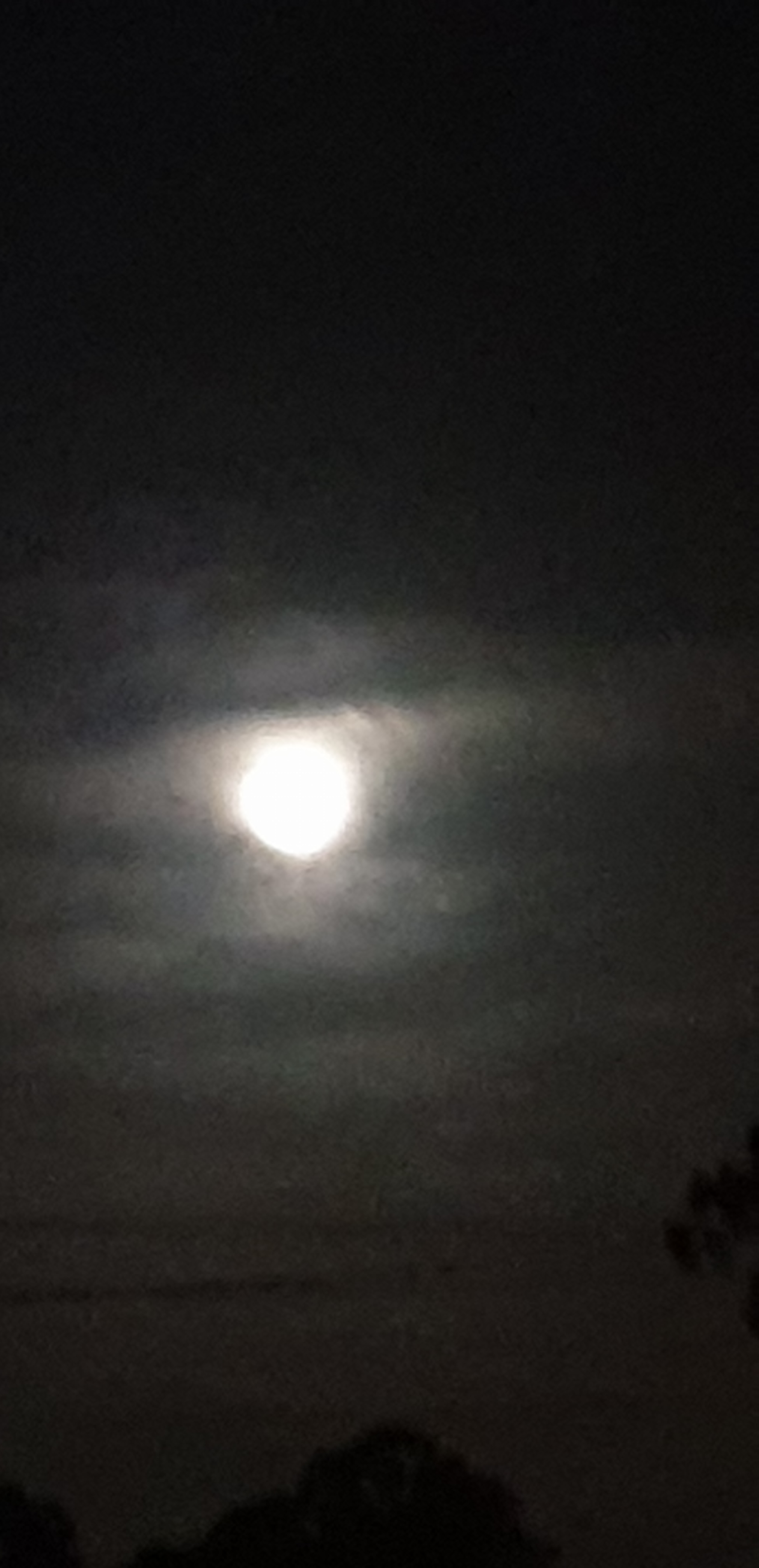
I was on my out to the rubbish bin when I realised there was a fullish moon tonight.  The sky was clear, and I was considering looking for planets, but it was that bright orb in the sky that piqued my interest.

It’s supposed to be a photograph of the moon, but unfortunately, taking night photos on my Samsung Galaxy 10 smartphone wasn’t quite able to be smart enough to make a decent photo of it.

Instead it looks more like a UFO.

Which, of course, got me thinking…

This is the trouble with writers with a few spare minutes.  The germ of an idea pops into your head, and suddenly you have to get the ideas down before they’re gone.

I like the idea of looking up in the sky looking at what you think is the moon, it certainly looks like the moon, but very quickly surprises you when it suddenly moves … sideways.

The moon dies not move sideways, it goes, generally, up and down, or diagonal.  So, mesmerised by this slow moving very bright object, it then does a quick flash and is gone.

Empty clear sky, lots of stars shining, perhaps a planet or two somewhere out there, and, after a minute, a shrug.  Time to go back inside.

Except…

The bright orb returns, much larger this time, and appears to hover not far from the end of the street, though your night vision is playing tricks and it’s probably a million miles away.

Until a beam of light appears from the underside of the orb, slowly going down to the planet surface.

What happens next, you ask?

Perhaps tomorrow night it’ll look different.

An excerpt from “Betrayal” – a work in progress

It could have been anywhere in the world, she thought, but it wasn’t.  It was in a city where if anything were to go wrong…

She sighed and came away from the window and looked around the room.  It was quite large and expensively furnished.  It was one of several she had been visiting in the last three months.

Quite elegant too, as the hotel had its origins dating back to before the revolution in 1917.  At least, currently, there would not be a team of KGB agents somewhere in the basement monitoring everything that happened in the room.

There was no such thing as the KGB anymore, though there was an FSB, but such organisations were of no interest to her.

She was here to meet with Vladimir.

She smiled to herself when she thought of him, such an interesting man whose command of English was as good as her command of Russian, though she had not told him of that ability.

All her knew of her was that she was American, worked in the Embassy as a clerk, nothing important, who life both at work and at home was boring.  Not that she had blurted that out the first tie she met, or even the second.

That first time, at a function in the Embassy, was a chance meeting, a catching of his eye as he looked around the room, looking, as he had told her later, for someone who might not be as boring as the function itself.

It was a celebration, honouring one of the Embassy officials on his service in Moscow, and the fact he was returning home after 10 years.  She had been there one, and still hadn’t met all the staff.

They had talked, Vladimir knew a great deal about England, having been stationed there for a year or two, and had politely asked questions about where she lived, her family, and of course what her role was, all questions she fended off with an air of disinterested interest.

It fascinated him, as she knew it would, a sort of mental sparring as one would do with swords, if this was a fencing match.

They had said they might or might not meet again when the party was over, but she suspected there would be another opportunity.  She knew the signs of a man who was interested in her, and Vladimir was interested.

The second time came in the form of an invitation to an art gallery, and a viewing of the works of a prominent Russian artist, an invitation she politely declined.  After all, invitations issued to Embassy staff held all sorts of connotations, or so she was told by the Security officer when she told him.

Then, it went quiet for a month.  There was a party at the American embassy and along with several other staff members, she was invited.  She had not expected to meet Vladimir, but it was a pleasant surprise when she saw him, on the other side of the room, talking to several military men.

A pleasant afternoon ensued.

And it was no surprise that they kept running into each other at the various events on the diplomatic schedule.

By the fifth meeting, they were like old friends.  She had broached the subject of being involved in a plutonic relationship with him with the head of security at the embassy.  Normally for a member of her rank it would not be allowed, but in this instance it was.

She did not work in any sensitive areas, and, as the security officer had said, she might just happen upon something that might be useful.  In that regard, she was to keep her eyes and ears open, and file a report each time she met him.

After that discussion she got the impression her superiors considered Vladimir more than just a casual visitor on the diplomatic circuit.  She also formed the impression the he might consider her an ‘asset’, a word that had been used at the meeting with security and the ambassador.

It was where the word ‘spy’ popped into her head and sent a tingle down her spine.  She was not a spy, but the thought of it, well, it would be fascinating to see what happened.

A Russian friend.  That’s what she would call him.

And over time, that relationship blossomed, until, after a visit to the ballet, late and snowing, he invited her to his apartment not far from the ballet venue.  It was like treading on thin ice, but after champagne and an introduction to caviar, she felt like a giddy schoolgirl.

Even so, she had made him promise that he remain on his best behaviour.  It could have been very easy to fall under the spell of a perfect evening, but he promised, showed her to a separate bedroom, and after a brief kiss, their first, she did not see him until the next morning.

So, it began.

It was an interesting report she filed after that encounter, one where she had expected to be reprimanded.

She wasn’t.

It wasn’t until six weeks had passed when he asked her if she would like to take a trip to the country.  It would involve staying in a hotel, that they would have separate rooms.  When she reported the invitation, no objection was raised, only a caution; keep her wits about her.

Perhaps, she had thought, they were looking forward to a more extensive report.  After all, her reports on the places, and the people, and the conversations she overheard, were no doubt entertaining reading for some.

But this visit was where the nature of the relationship changed, and it was one that she did not immediately report.  She had realised at some point before the weekend away, that she had feelings for him, and it was not that he was pushing her in that direction or manipulating her in any way.

It was just one of those moments where, after a grand dinner, a lot of champagne, and delightful company, things happen.  Standing at the door to her room, a lingering kiss, not intentional on her part, and it just happened.

And for not one moment did she believe she had been compromised, but for some reason she had not reported that subtle change in the relationship to the powers that be, and so far, no one had any inkling.

She took off her coat and placed it carefully of the back of one of the ornate chairs in the room.  She stopped for a moment to look at a framed photograph on the wall, one representing Red Square.

Then, after a minute or two, she went to the mini bar and took out the bottle of champagne that had been left there for them, a treat arranged by Vladimir for each encounter.

There were two champagne flutes set aside on the bar, next to a bowl of fruit.  She picked up the apple and thought how Eve must have felt in the garden of Eden, and the temptation.

Later perhaps, after…

She smiled at the thought and put the apple back.

A glance at her watch told her it was time for his arrival.  It was if anything, the one trait she didn’t like, and that was his punctuality.  A glance at the clock on the room wall was a minute slow.

The doorbell to the room rang, right on the appointed time.

She put the bottle down and walked over to the door.

A smile on her face, she opened the door.

It was not Vladimir.  It was her worst nightmare.

© Charles Heath 2020

Was it just another surveillance job – Episode 37

I’m back home and this story has been sitting on a back burner for a few months, waiting for some more to be written.

The trouble is, there are also other stories to write, and I’m not very good at prioritizing.

But, here we are, a few minutes opened up and it didn’t take long to get back into the groove.

Chasing leads, maybe

I had a change of mind before I went on an odyssey to Peaslake. I needed help, and I was going to try and convince Jennifer to help me. If she had been injured, that might be more difficult.

I caught a train and a bus to Putney and then walked the remaining fifty yards to her front door. It was a flat over the top of a shop, and, when I read the name of the shop, I thought I knew why she was there. The shop, and quite likely the building belonged to her family, not that it was her surname, but I could be hopeful.

I went up the side stairs and reached the landing. There were two doors, one with 1A on it, and one with 1B on it. Hers was 1A.

I knocked on the door.

A minute later nothing had happened.

I knocked again, this time a little harder.

There was no answer, again, but there was a movement in the flat next door, then the door opened and a scruffy young man, perhaps a university student put his head out.

“She’s not here.”

“Not here, and in no longer living here, or not here as in she is out somewhere and will be back.”

He looked at me blankly, like I’d spoken too fast, or used too many words for him to understand. Possibly he’d just woken up.

He shook his head. “Just out probably getting coffee or something. The shops on the other side of the road, three or four doors up. Can’t miss it, it smells like coffee.”

He gave me a look up and down, gauging whether or not I could be of interest to her, then went back inside his room and closed the door.

It might be a lie, but I was going to take him at his word.

I went back down the stairs and out onto the sidewalk and looked up and down both sides of the street. There was a café, on the other side, not far away.

I waited for a break in the traffic, then crossed the road.

She was inside, reading a paper, oblivious to those around her, and, in particular, those coming from outside. She should be casually keeping an eye out for trouble.

I managed to get inside and take the seat next to her before she raised her head to see who it was.

No surprise.

“You,” she said. “You made it out alive too?”

“You should be more careful.”

“I was told I was no longer employed, that the people who hired me were ex-agents with some sort of agenda.”

I glanced at the open page of the newspaper. The jobs vacant page.

“Then it might come as a bit of a surprise to realize you’re still on their books, just assigned to a different department. Same as me.”

“They told me I was redundant.”

“Who told you?”

“A woman. Monica Sherive she said her name was.”

“I spoke to her earlier this morning. I didn’t ask, but I will the next time I’m in the office. What do you remember about the assignment?”

“We were supposed to maintain surveillance on a man, no name, just a photograph. I heard you had him in sight and was about to pass him off to Adam. I didn’t hear Adam acknowledge. I heard an explosion and all hell broke loose. No point carrying on, so I left.”

And that was what saved her life. Incorrect procedure. Unless she reported in.

“Did you report to the overseer.”

“Over the radio. He told me to go. What happened to Adam and Jack?”

“Dead. Murdered by the target, I think. The target’s dead too. A chap by the name of O’Connell, though the more I find out about him, the more interesting it gets.”

I could see the cogs ticking over behind her eyes as she put one and one together. “So…”

“You should be dead too. What saved your life was just up and leaving.”

“How did you escape?”

“I didn’t. I found the target again after the explosion and followed him to an alley. When I got there he told me I was making a mistake, and then he was shot. Severin and Maury turned up, and that was it.”

“Did they kill him?”

“No. It was a sniper, and I’m still wondering why I didn’t get shot too.”

“The woman told me Severin and Maury didn’t work for the organization. How could that be? They seemed real to me. I think whatever they and we were doing became a mess that needed to be cleaned up by getting rid of everyone associated with it. I liked that job. Now I have to go back to a daily drudge job.”

“Don’t think so. Like I said, I saw your name listed as active in the same department as me, the head of which is a guy called Nobbin. I’ve met him, I’m supposed to be investigating O’Connell, who, by the way, was one of his people, who had allegedly some documents on him when he died. You feel like helping out?”

“I would, but are you sure I’m supposed to be working for these people, God, I don’t know who they are or what I was doing anymore.”

“We can go to the office and ask questions. Get this Monica and get her to tell you. But in the meantime, I had a job I need to do, and it would be better with two. Can you help?”

“If you come with me to the office?”

“Sure.”

She folded the paper and slid off the seat. “Then, let’s go.”

© Charles Heath 2020

Well, that was my August

I have been busy, busy, busy writing this month, but as much as I have done, it still feels like I’m not getting anywhere.

For instance, both ‘The Things we do for Love’ and ‘Strangers We’ve Become’ are still with the editor for the final checking, where I’d expected to be in a position to publish them this month.

It may have something to do with the sending of two new novels, ‘If Only’ and ‘Betrayed’ for first perusal after I completed the third edit, and felt both were ready for someone else to look at.

They will be joined by ‘First Dig Two Graves’, the second Zoe thriller later this month.

Then there’s the episodic stories I’ve been writing, each of which will become a novella eventually. But to begin with, they are episodes as and when I can find the time, and published in their raw form on my writing blog as the ideas come.

They are:

What happens after an action-packed start – now finished with the publication of episode 47.

You can find the end here: https://bit.ly/2Yxnh1k

It’s a story inspired by the Castello di Briolio – I have yet to write more episodes

The latest episode, 36, is here: https://bit.ly/3h1DCCC

So you want to go on a treasure hunt – this has been written up to episode 54, and episodes 55 – 60 have been outlined.

Find the latest episode, 47, here: https://bit.ly/31EHunK

Was it just another surveillance job – has been written up to episode 45

Find the latest episode, 36, here: https://bit.ly/3aeMvX5

I’ve started on the replacement episodic story for ‘Action-Packed’ called ‘Motive, Means and Opportunity’ and have several episodes written. Publishing that story will begin some time in September.

Alas, the ideas never stop, and the notebooks are filling up.

And with the pandemic and having to stay in, this had greatly increased the amount of time I have to write. But it is exhausting, and when the travel restrictions are lifted, I will be going away to some quiet place where I can unwind for a week or two.

Some time, we’re told, around mid 2021.

An excerpt from “If Only” – a work in progress

Investigation of crimes don’t always go according to plan, nor does the perpetrator get either found or punished.

That was particularly true in my case.  The murderer was very careful in not leaving any evidence behind, to the extent that the police could not rules out whether it was a male or a  female.

At one stage the police thought I had murdered my own wife though how I could be on a train at the time of the murder was beyond me.  I had witnesses and a cast-iron alibi.

The officer in charge was Detective Inspector Gabrielle Walters.  She came to me on the day after the murder seeking answers to the usual questions when was the last time you saw your wife, did you argue, the neighbors reckon there were heated discussions the day before.

Routine was the word she used.

Her Sargeant was a surly piece of work whose intention was to get answers or, more likely, a confession by any or all means possible.  I could sense the raging violence within him.  Fortunately, common sense prevailed.

Over the course of the next few weeks, once I’d been cleared of committing the crime, Gabrielle made a point of keeping me informed of the progress.

After three months the updates were more sporadic, and when, for lack of progress, it became a cold case, communication ceased.

But it was not the last I saw of Gabrielle.

The shock of finding Vanessa was more devastating than the fact she was now gone, and those images lived on in the same nightmare that came to visit me every night when I closed my eyes.

For months I was barely functioning, to the extent I had all but lost my job, and quite a few friends, particularly those who were more attached to Vanessa rather than me.

They didn’t understand how it could affect me so much, and since it had not happened to them, my tart replies of ‘you wouldn’t understand’ were met with equally short retorts.  Some questioned my sanity, even, for a time, so did I.

No one, it seemed, could understand what it was like, no one except Gabrielle.

She was by her own admission, damaged goods, having been the victim of a similar incident, a boyfriend who turned out to be a very bad boy.  Her story varied only in she had been made to witness his execution.  Her nightmare, in reliving that moment in time, was how she was still alive and, to this day, had no idea why she’d been spared.

It was a story she told me one night, some months after the investigation had been scaled down.  I was still looking for the bottom of a bottle and an emotional mess.  Perhaps it struck a resonance with her; she’d been there and managed to come out the other side.

What happened become our secret, a once-only night together that meant a great deal to me, and by mutual agreement, it was not spoken of again.  It was as if she knew exactly what was required to set me on the path to recovery.

And it had.

Since then we saw each about once a month in a cafe.   I had been surprised to hear from her again shortly after that eventful night when she called to set it up, ostensibly for her to provide me with any updates on the case, but perhaps we had, after that unspoken night, formed a closer bond than either of us wanted to admit.

We generally talked for hours over wine, then dinner and coffee.  It took a while for me to realize that all she had was her work, personal relationships were nigh on impossible in a job that left little or no spare time for anything else.

She’d always said that if I had any questions or problems about the case, or if there was anything that might come to me that might be relevant, even after all this time, all I had to do was call her.

I wondered if this text message was in that category.  I was certain it would interest the police and I had no doubt they could trace the message’s origin, but there was that tiny degree of doubt, whether or not I could trust her to tell me what the message meant.

I reached for the phone then put it back down again.  I’d think about it and decide tomorrow.

© Charles Heath 2018-2020

I’ve always wanted to go on a Treasure Hunt – Part 47

Here’s the thing…

Every time I close my eyes, I see something different.

I’d like to think the cinema of my dreams is playing a double feature but it’s a bit like a comedy cartoon night on Fox.

But these dreams are nothing to laugh about.

Once again there’s a new installment of an old feature, and we’re back on the treasure hunt.

“A hundred square miles, that must have run up the coast close to Patterson’s Reach?” I asked.

Patterson’s reach was about five miles to the north, a small town, where there was little fishing done and allegedly a lot of ferrying drugs being dropped off by large ships coming along the offshore shipping lanes.  No one could prove it, and every trap set by the coast guard had failed to find any evidence.  That meant that someone was tipping them off.

It was also the domain of the Cossatino’s who discouraged anyone else from living there.  It was said that Cossatino owned all of the lands the town sat on and the people who lived there worked for him.

“Only as far as Patterson’s reach and then inland for about 20 miles, about as far as the Faultline and perhaps the closest point between the foothills and the sea.  Ormiston had bought all the land thinking that the treasure was buried on it.  You see, he had a map too, long before Boggs senior had started forging them for the Cossatino’s.”

And in hearing that it begged the question, who had first found the original map?  If Cossatino found it, then getting Boggs senior to forge a lot of useless maps would hide where it really was.

What if Boggs ‘original’ map was yet another elaborate forgery, given to him by Cossatino to create others?  I put that thought to one side.

I wondered if Boggs had been to see her, to get some background.  If there was going to be an expert on the treasure, if it existed or not, she would know.  In fact, she probably knew old man Ormiston.

“Does that map still exist?”

“Perhaps.  It was not found in his effects after he died.  Spent his last years in an asylum.  It wasn’t not finding the treasure, or losing his fortune that sent him mad, it was Alzheimer’s, poor old man.  Whatever documents that were found when his relatives cleaned the place out were brought to the library to be stored, cataloged at some point, and one day when someone decides to write a history of the area, no doubt they want to see the collection.”

“I couldn’t look at the papers?”

“Are you interested in writing a local history.  I’m sure your hunt for the treasure and the many fruitless other expeditions looking for it would make a very entertaining chapter.”

“Maybe I will.”

If that was what it took to look at the documents.  There might be something interesting to be found.  Especially if he kept a diary.  I thought it best not to ask, and fuel suspicions.

“Elmer said there might be relations of Ormiston still around here?”

“Yes, I did say that which I now regret.  There are, but I don’t know who they are.  I knew his wife’s family name was Maunchen, and that the Maunchens came from California originally, and there’s nothing to say they didn’t go back.  Certainly, the wife would be deceased by now, and they had three daughters, all of whom would have married, and changed names.  You’d have to go digging through wedding records in at least a dozen parishes.  If you were thinking of investigating.”

“Sound like too much hard work.  Besides, the treasure doesn’t; exist.  I’m only helping Boggs to keep him from doing something stupid.”

“Like father, like son, unfortunately.  You do realize the father made some outlandish claim in the hotel one night that he had found the clue to where the treasure was buried.   Trouble was, he was prone to making outlandish claims, and by that time, a drunkard.  He went missing the next day, and has never been seen since.”

“You think he found it?”

“No.  But I’m guessing someone thought he had and killed him trying to find out.  We’ll never know.”

“A lesson to be learned then.  I’ll keep an eye on Boggs junior just in case he’s thinking of making an equally outlandish claim.”

“You do that.”

She opened a drawer and pulled out a form and handed it to me.

“What’s this for?”

“A request to look at the archives.  You have to register, and I have to give you a special card, the key to the history of Arkwon County.”

Where it said signature, I signed it.

“You fill out the rest.  When do you want me to pick up the card?”

“Monday next week.  In the meantime, be careful.”

She said it like she knew I would be walking into trouble.

© Charles Heath 2020

Short Story Writing – Don’t try this at home! – Part 4

This is not a treatise, but a tongue in cheek, discussion on how to write short stories.   Suffice to say this is not the definitive way of doing it, just mine.  It works for me – it might not work for you.

You’ve got the place, now you want the who.

My main characters are quite often me.

Not the real me, because I’m boring.  No, those characters are what I would like to be, that imaginary superhuman that can do everything.

Until, of course, reality sets in, and the bullets start flying.  When that happens, we should be looking to run or at the very least get under cover, not walk into a hail of bullets, with a huge grin, staring down the enemy.

Hang on, that never happens except in superman comics.

What’s really needed here is a little vulnerability, a little humility and a lot of understanding, qualities at times I don’t have.

So, in order to create a more believable character, I start dragging traits from others I’ve met, or know, or really don’t want to know.  

In a writer’s environment, there are a plethora of people out there that you can draw on for inspiration.  I once spent and afternoon at a railway station just observing people.  Even now, I make observations, some of which are true, and others, wildly off course. 

I once tried to convince my other half that I could pick people’s traits, and we sat at a café outside a church in Venice.  I was lucky, I got more than 75% correct.

Other characters in my stories I have met along the way.

Like a piano player in a restaurant.  It was not so much the playing was bad, it was the way he managed to draw people into his orbit and keep them there.  The man has charisma, but sadly no talent for the instrument.

Like an aunt I met only twice in a lifetime, and who left a lasting impression.  Severe, angry looking, speaking a language I didn’t understand, even though it was English.  It was where I learned we came from England, and she was the closest thing I came to as an example of nineteenth-century prim and proper.  And, no, she didn’t have a sense of humour or time for silly little boys.

Like one of my bosses, a man of indeterminate age, but it had to be over 100, or so it seemed to my sixteen-year-old brain, who spoke and dressed impeccably, and yes, he did once say that I would be the death of him.

I can only hope I wasn’t.

Like a Captain of a ship I once met, a man who didn’t seem to have time for the minions, and a man who reeked authority and respect.  I’ve always wanted to be like him, but unfortunately, it was not in the genes.

Those are only a few, there are thousands of others over the years, a built-in library, if you will, of characters waiting to be taken off the shelf and used where necessary or appropriate.  We all have one of these banks.

You just have to know when to use them.

Short story writing – don’t try this at home! – Part 3

Where is this story going to start?

Let’s forget about the what and the who and the when for the moment, and figure out the location.

After all, we couldn’t make a movie unless we have somewhere to shoot it.  Those places are called locations, and before a film begins someone has to go out and find locations.

Sometimes it’s easy, because you know where the story is based.

New York, London, Singapore, Moscow.

It’s more likely it will be somewhere you’ve been, or where you live.

I live in Brisbane, in Australia.  Not a lot of people overseas know of it.  Oddly enough before I moved here over 30 years ago, it was just a name on a map.

But the point is, now that I’m here I could write a story based in Brisbane.  Or as easily, in Melbourne, where I also used to live.

Or I could select a place I’ve travelled to, perhaps not once, but a few times, and each time taking photographs and notes about that place, thinking one day I could used it as a location.

I have, and I do.  It’s one of the reasons why I like to travel.  I’m always on the lookout for someplace new.

Several of my books are based in New York, several in London, and various parts of the story find the characters in places like Paris, Rome, Florence, Tuscany, Hong Kong, Singapore, and Moscow.

Then, sometimes when my knowledge is lacking in some of the finer points of the city, Google maps, and Google itself are there to fill in the gaps.  I have virtually driven down streets in London, especially near Kew Gardens and in Knightsbridge, checking locations.

Suffice to say, I know some parts of London like the back of my hand, and recently, before COVID, visited and did a spot check just to be sure.

With COVID 19 causing havoc with travel plans, virtual travel is all I can do at present.

Then there’s building, like houses, apartments, any sort of building which may require some knowledge.

I guess what I’m saying is that there’s more to locations than just saying something is there, it had to fit the area.  Yes, the story is a work of fiction, but sometimes it’s better to have an idea of what’s there, or readers will be disappointed.

Especially if they live in that city, town, village, house or tent.

I actually use the real estate advertisements in a city of town where I want to have a house, because it gives you a map, exterior views, how to get there, and best of all what it looks like inside.

Still can’t afford that $12,000,000 apartment in New York, but the views, there were to die for.

But I, as always, digress…

Now it’s starting to sound like a lot of hard work.

It is.

Even if you go down the ‘pantser’ road, there’s still lot of research to be done.

More confusion tomorrow.

An excerpt from “If Only” – a work in progress

Investigation of crimes don’t always go according to plan, nor does the perpetrator get either found or punished.

That was particularly true in my case.  The murderer was very careful in not leaving any evidence behind, to the extent that the police could not rules out whether it was a male or a  female.

At one stage the police thought I had murdered my own wife though how I could be on a train at the time of the murder was beyond me.  I had witnesses and a cast-iron alibi.

The officer in charge was Detective Inspector Gabrielle Walters.  She came to me on the day after the murder seeking answers to the usual questions when was the last time you saw your wife, did you argue, the neighbors reckon there were heated discussions the day before.

Routine was the word she used.

Her Sargeant was a surly piece of work whose intention was to get answers or, more likely, a confession by any or all means possible.  I could sense the raging violence within him.  Fortunately, common sense prevailed.

Over the course of the next few weeks, once I’d been cleared of committing the crime, Gabrielle made a point of keeping me informed of the progress.

After three months the updates were more sporadic, and when, for lack of progress, it became a cold case, communication ceased.

But it was not the last I saw of Gabrielle.

The shock of finding Vanessa was more devastating than the fact she was now gone, and those images lived on in the same nightmare that came to visit me every night when I closed my eyes.

For months I was barely functioning, to the extent I had all but lost my job, and quite a few friends, particularly those who were more attached to Vanessa rather than me.

They didn’t understand how it could affect me so much, and since it had not happened to them, my tart replies of ‘you wouldn’t understand’ were met with equally short retorts.  Some questioned my sanity, even, for a time, so did I.

No one, it seemed, could understand what it was like, no one except Gabrielle.

She was by her own admission, damaged goods, having been the victim of a similar incident, a boyfriend who turned out to be a very bad boy.  Her story varied only in she had been made to witness his execution.  Her nightmare, in reliving that moment in time, was how she was still alive and, to this day, had no idea why she’d been spared.

It was a story she told me one night, some months after the investigation had been scaled down.  I was still looking for the bottom of a bottle and an emotional mess.  Perhaps it struck a resonance with her; she’d been there and managed to come out the other side.

What happened become our secret, a once-only night together that meant a great deal to me, and by mutual agreement, it was not spoken of again.  It was as if she knew exactly what was required to set me on the path to recovery.

And it had.

Since then we saw each about once a month in a cafe.   I had been surprised to hear from her again shortly after that eventful night when she called to set it up, ostensibly for her to provide me with any updates on the case, but perhaps we had, after that unspoken night, formed a closer bond than either of us wanted to admit.

We generally talked for hours over wine, then dinner and coffee.  It took a while for me to realize that all she had was her work, personal relationships were nigh on impossible in a job that left little or no spare time for anything else.

She’d always said that if I had any questions or problems about the case, or if there was anything that might come to me that might be relevant, even after all this time, all I had to do was call her.

I wondered if this text message was in that category.  I was certain it would interest the police and I had no doubt they could trace the message’s origin, but there was that tiny degree of doubt, whether or not I could trust her to tell me what the message meant.

I reached for the phone then put it back down again.  I’d think about it and decide tomorrow.

© Charles Heath 2018-2020

Short story writing – don’t try this at home! – Part 2

This is not a treatise, but a tongue in cheek, discussion on how to write short stories. Suffice to say this is not the definitive way of doing it, just mine. It works for me – it might not work for you.

There are two methods of writing, planning, sometimes meticulous planning, or flying by the seat of your pants, or being called a ‘pantser’.

The first has it all planned out before they start writing, from beginning to end, knowing what the end result will be. The second, well, we like to write and see where it takes us.

I like to think I fly by the seat of my pants, you know, like the reader who takes up the story and starts reading, not having a clue where it’s going to go. I prefer that blissful ignorance, of course, until I run out of ideas, roughly the equivalent of hitting a brick wall

Or that common enemy all writers have, the dreaded ‘writers block’.

I’ve tried both methods.

Each work, but in the case of the ‘planner’, you need to know where it’s going to start what’s going to happen in the middle and have the end firmly planted in your mind.

Not much good if a rotten character is making you angry and you want to kill him off, and in the most excruciatingly painful manner.

Flying blind gives you a little more creativeness and be able to go around a corner and see what’s there. It also allows for those complete changes of direction you come up with in the shower, the place that is a fertile ground for new ideas just when you’re running out of them.

But it can sometimes play havoc with word counts and if you’re trying to fit into 2,000 words, 5,000 words, or a lot less, taking the story where it wants to go is not a good idea, and sadly, I tend to let stories run their course.

And sometimes I like the idea of writing three different endings, and then can’t choose which one I like the best.

So, role model I am not. I like writing, and when I’m in the ‘zone’ it’s like I’m in another world.

But then, isn’t that the case for all of us?

More unclarity tomorrow!