A moment to slip back into the past

Televison is a great recorder of the past, and most channels, and especially cable tv have great libraries of films that go back more than a hundred years.

And, whilst it’s possible that modern day films and television series can try to recapture the past, the English as an exception being very good at it, often it is impossible to capture it correctly.

But, if you have a film shot in the moment, then you have a visual record of what life, and what was once part of our world before you in all it’s dated glory. The pity of it is that, then, we never appreciated it.

After all, in those particular times, who had the time to figuratively stop and smell the roses. Back then as life was going on, we were all tied up with just trying to get through each day.

Years later, often on reflection, we try to remember the old days, and, maybe, remember some of what it was like, but the chances are that change came far too rapidly, and often too radical, that it erases what we thought we knew existed before.

My grandmothers house is a case in point. In it’s place is a multi lane super highway, and there’s nothing left to remind us, or anyone of it, just some old sepia photographs.

I was reminded of how volatile history really is when watching an old documentary, in black and white, and how the city I grew up in used to look.

Then, even though it seemed large to me then, it was a smaller city, with suburbs that stretched about ten or so miles in every direction, and the outer suburbs were where people moved to get a larger block, and countrified atmosphere.

Now, those outer suburbs are no longer spacious properties, the acreage subdivided and the old owners now much richer for a decision made with profit not being the motivator, and the current suburban sprawl is now out to forty or fifty miles.

The reason for the distance is no longer the thought of open spaces and cleaner air, the reason for moving now is that land further out is cheaper, and can make buying that first house more affordable.

This is where I tip my hat to the writers of historical fiction. I myself am writing a story based in the 1970s, and its difficult to find what is and isn’t time specific.

If only I had a dollar for every time I went to write the character pulling out his or her mobile phone.

What I’ve found is the necessity to research, and this has amounted to finding old films, documentaries of the day, and a more fascinating source of information, the newspapers of the day.

The latter especially has provoked a lot of memories and a lot of stuff I thought I’d forgotten, some of it by choice, but others that were poignant.

Yes, and don’t get me started on the distractions.

If only I’d started this project earlier…

An excerpt from “Betrayal” – a work in progress

It could have been anywhere in the world, she thought, but it wasn’t.  It was in a city where if anything were to go wrong…

She sighed and came away from the window and looked around the room.  It was quite large and expensively furnished.  It was one of several she had been visiting in the last three months.

Quite elegant too, as the hotel had its origins dating back to before the revolution in 1917.  At least, currently, there would not be a team of KGB agents somewhere in the basement monitoring everything that happened in the room.

There was no such thing as the KGB anymore, though there was an FSB, but such organisations were of no interest to her.

She was here to meet with Vladimir.

She smiled to herself when she thought of him, such an interesting man whose command of English was as good as her command of Russian, though she had not told him of that ability.

All her knew of her was that she was American, worked in the Embassy as a clerk, nothing important, who life both at work and at home was boring.  Not that she had blurted that out the first tie she met, or even the second.

That first time, at a function in the Embassy, was a chance meeting, a catching of his eye as he looked around the room, looking, as he had told her later, for someone who might not be as boring as the function itself.

It was a celebration, honouring one of the Embassy officials on his service in Moscow, and the fact he was returning home after 10 years.  She had been there one, and still hadn’t met all the staff.

They had talked, Vladimir knew a great deal about England, having been stationed there for a year or two, and had politely asked questions about where she lived, her family, and of course what her role was, all questions she fended off with an air of disinterested interest.

It fascinated him, as she knew it would, a sort of mental sparring as one would do with swords, if this was a fencing match.

They had said they might or might not meet again when the party was over, but she suspected there would be another opportunity.  She knew the signs of a man who was interested in her, and Vladimir was interested.

The second time came in the form of an invitation to an art gallery, and a viewing of the works of a prominent Russian artist, an invitation she politely declined.  After all, invitations issued to Embassy staff held all sorts of connotations, or so she was told by the Security officer when she told him.

Then, it went quiet for a month.  There was a party at the American embassy and along with several other staff members, she was invited.  She had not expected to meet Vladimir, but it was a pleasant surprise when she saw him, on the other side of the room, talking to several military men.

A pleasant afternoon ensued.

And it was no surprise that they kept running into each other at the various events on the diplomatic schedule.

By the fifth meeting, they were like old friends.  She had broached the subject of being involved in a plutonic relationship with him with the head of security at the embassy.  Normally for a member of her rank it would not be allowed, but in this instance it was.

She did not work in any sensitive areas, and, as the security officer had said, she might just happen upon something that might be useful.  In that regard, she was to keep her eyes and ears open, and file a report each time she met him.

After that discussion she got the impression her superiors considered Vladimir more than just a casual visitor on the diplomatic circuit.  She also formed the impression the he might consider her an ‘asset’, a word that had been used at the meeting with security and the ambassador.

It was where the word ‘spy’ popped into her head and sent a tingle down her spine.  She was not a spy, but the thought of it, well, it would be fascinating to see what happened.

A Russian friend.  That’s what she would call him.

And over time, that relationship blossomed, until, after a visit to the ballet, late and snowing, he invited her to his apartment not far from the ballet venue.  It was like treading on thin ice, but after champagne and an introduction to caviar, she felt like a giddy schoolgirl.

Even so, she had made him promise that he remain on his best behaviour.  It could have been very easy to fall under the spell of a perfect evening, but he promised, showed her to a separate bedroom, and after a brief kiss, their first, she did not see him until the next morning.

So, it began.

It was an interesting report she filed after that encounter, one where she had expected to be reprimanded.

She wasn’t.

It wasn’t until six weeks had passed when he asked her if she would like to take a trip to the country.  It would involve staying in a hotel, that they would have separate rooms.  When she reported the invitation, no objection was raised, only a caution; keep her wits about her.

Perhaps, she had thought, they were looking forward to a more extensive report.  After all, her reports on the places, and the people, and the conversations she overheard, were no doubt entertaining reading for some.

But this visit was where the nature of the relationship changed, and it was one that she did not immediately report.  She had realised at some point before the weekend away, that she had feelings for him, and it was not that he was pushing her in that direction or manipulating her in any way.

It was just one of those moments where, after a grand dinner, a lot of champagne, and delightful company, things happen.  Standing at the door to her room, a lingering kiss, not intentional on her part, and it just happened.

And for not one moment did she believe she had been compromised, but for some reason she had not reported that subtle change in the relationship to the powers that be, and so far, no one had any inkling.

She took off her coat and placed it carefully of the back of one of the ornate chairs in the room.  She stopped for a moment to look at a framed photograph on the wall, one representing Red Square.

Then, after a minute or two, she went to the mini bar and took out the bottle of champagne that had been left there for them, a treat arranged by Vladimir for each encounter.

There were two champagne flutes set aside on the bar, next to a bowl of fruit.  She picked up the apple and thought how Eve must have felt in the garden of Eden, and the temptation.

Later perhaps, after…

She smiled at the thought and put the apple back.

A glance at her watch told her it was time for his arrival.  It was if anything, the one trait she didn’t like, and that was his punctuality.  A glance at the clock on the room wall was a minute slow.

The doorbell to the room rang, right on the appointed time.

She put the bottle down and walked over to the door.

A smile on her face, she opened the door.

It was not Vladimir.  It was her worst nightmare.

© Charles Heath 2020

An excerpt from “If Only” – a work in progress

Investigation of crimes don’t always go according to plan, nor does the perpetrator get either found or punished.

That was particularly true in my case.  The murderer was very careful in not leaving any evidence behind, to the extent that the police could not rules out whether it was a male or a  female.

At one stage the police thought I had murdered my own wife though how I could be on a train at the time of the murder was beyond me.  I had witnesses and a cast-iron alibi.

The officer in charge was Detective Inspector Gabrielle Walters.  She came to me on the day after the murder seeking answers to the usual questions when was the last time you saw your wife, did you argue, the neighbors reckon there were heated discussions the day before.

Routine was the word she used.

Her Sargeant was a surly piece of work whose intention was to get answers or, more likely, a confession by any or all means possible.  I could sense the raging violence within him.  Fortunately, common sense prevailed.

Over the course of the next few weeks, once I’d been cleared of committing the crime, Gabrielle made a point of keeping me informed of the progress.

After three months the updates were more sporadic, and when, for lack of progress, it became a cold case, communication ceased.

But it was not the last I saw of Gabrielle.

The shock of finding Vanessa was more devastating than the fact she was now gone, and those images lived on in the same nightmare that came to visit me every night when I closed my eyes.

For months I was barely functioning, to the extent I had all but lost my job, and quite a few friends, particularly those who were more attached to Vanessa rather than me.

They didn’t understand how it could affect me so much, and since it had not happened to them, my tart replies of ‘you wouldn’t understand’ were met with equally short retorts.  Some questioned my sanity, even, for a time, so did I.

No one, it seemed, could understand what it was like, no one except Gabrielle.

She was by her own admission, damaged goods, having been the victim of a similar incident, a boyfriend who turned out to be a very bad boy.  Her story varied only in she had been made to witness his execution.  Her nightmare, in reliving that moment in time, was how she was still alive and, to this day, had no idea why she’d been spared.

It was a story she told me one night, some months after the investigation had been scaled down.  I was still looking for the bottom of a bottle and an emotional mess.  Perhaps it struck a resonance with her; she’d been there and managed to come out the other side.

What happened become our secret, a once-only night together that meant a great deal to me, and by mutual agreement, it was not spoken of again.  It was as if she knew exactly what was required to set me on the path to recovery.

And it had.

Since then we saw each about once a month in a cafe.   I had been surprised to hear from her again shortly after that eventful night when she called to set it up, ostensibly for her to provide me with any updates on the case, but perhaps we had, after that unspoken night, formed a closer bond than either of us wanted to admit.

We generally talked for hours over wine, then dinner and coffee.  It took a while for me to realize that all she had was her work, personal relationships were nigh on impossible in a job that left little or no spare time for anything else.

She’d always said that if I had any questions or problems about the case, or if there was anything that might come to me that might be relevant, even after all this time, all I had to do was call her.

I wondered if this text message was in that category.  I was certain it would interest the police and I had no doubt they could trace the message’s origin, but there was that tiny degree of doubt, whether or not I could trust her to tell me what the message meant.

I reached for the phone then put it back down again.  I’d think about it and decide tomorrow.

© Charles Heath 2018-2020

Back on the starship…

Well, we were off to an illustrious start until the dulcet tomes of the Chief Engineer rang through the bridge, uttering those fateful words, “the warp coil has had a catastrophic failure”.

This was et with alternately, the Chief Engineer is prone to hyperbole, to ‘they just don’t make warp coils like they used to’.

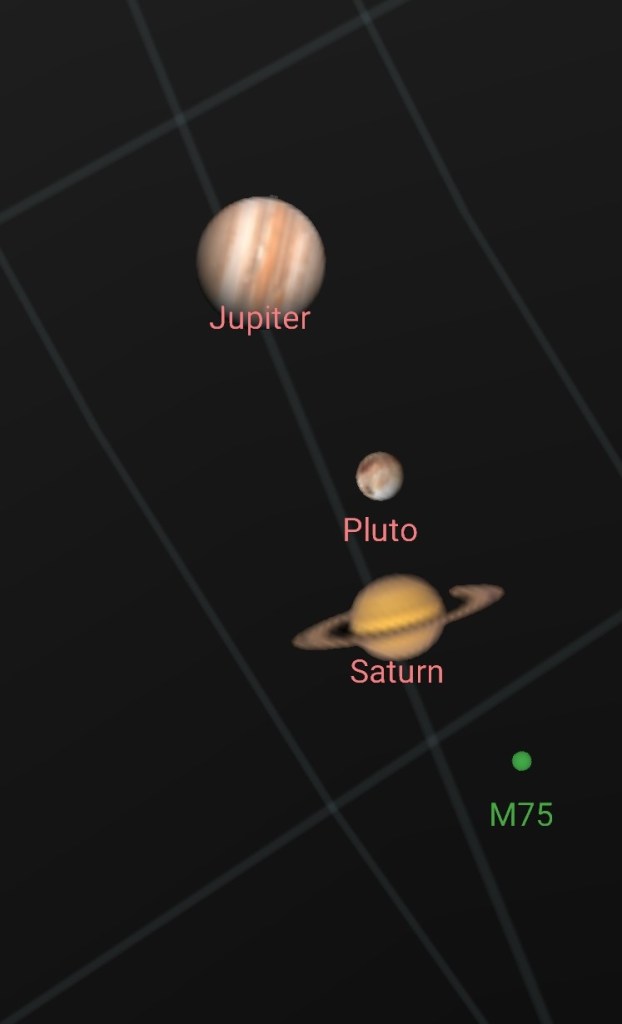
Looking at the screen, we can see the planets taunting us :

I was curious about M75, but the helmsman, a rather taciturn chap who seemed to resent the fact he was assigned to this ship, just shrugged and said, “it’s something, somewhere, but not of much interest,” then went back to his console, probably in the middle of a solitaire game.

If this was Star Trek we’d be ejecting the warp coil by now, but in the space dock, that didn’t seem to me to be a viable option.

“How long before we can get this bucket of bolts moving,” I ask the Chief.

“I’m going as fast as I can.”

Yes, words ripped right out of the script of a Star Trek episode, I thought. A sad case of life imitating art.

A strange whistling sound emanated from the speakers, then the whoosh of the elevator just before the doors opened. OK, new ship, squeaky doors, an item to be put on the ‘look at’ list after the shakedown cruise.

It’s the Captain.

“Why are we still in dock, Number One.” For a moment there, I thought I was talking to John Luc Picard.

“Faulty warp coil. You know how it goes, save a billion by sub contracting to the Chinese.”

The Captain doesn’t appreciate my sardonic humour, or my apparent disparagement of the Chinese manufacturing sector. Maybe that’s because he is of Chinese descent. “I’ll be in my quarters. Let me know when we’re about to leave.”

He doesn’t wait for acknowledgement, and disappears through another squeaky door. More repairs.

The Chief’s voice comes over the speakers. “I can give you impulse speed, warp speed will take a little longer.”

“Doesn’t that refer to miracles over the impossible,” I ask.

“Perhaps. I need a specific spanner, and the replicators are down. So, now we have to fix them, before moving on. Might take a while.”

I look around the crew, seeing their expectant faces drop with disappointment.

Outer space was going to have to wait a little longer.

© Charles Heath 2020

“Chance Encounter”, A short story

The afternoon rush hour jammed the exit roads, particularly those to the beach.  Nearly everyone was heading for relief from the heat wave, now in its tenth consecutive day.  What had started out a novelty was now just tiresome, with no forecast respite.

A light breeze tried to fan away the afternoon heat, but it had little impact.  The temperature was still hovering in the high 30’s when Bill left the office at 6:30 that evening.

On the road it was little better, and hotter in the car than out.  There was no point running the air conditioner in those conditions, as both he and many others had discovered.  The stop-start traffic made it worse, and people who had already suffered enough were close to breaking point.

Once again, the traffic stopped, and tempers frayed to the point of blowing horns and yelling forlorn abuse at some unseen driver or cause.  It was a no-win situation, and to Bill, a waste of time and energy.  His time and energy, he thought, was best directed at analysis.  Yet how different had the afternoon been to what was currently happening?

In charge of the Customer Service centre for the area’s electricity supplier, it had been difficult to say the least.  That afternoon had seen the highest consumption of electricity since the heat wave began, since time immemorial for that matter, and had started to affect the functionality of the grid, with the first failures occurring. 

It had been predicted, but was not expected quite this early, and as parts of the city were beginning to feel the effect of temporary blackouts, his, and his staff’s work had begun to receive the full effect of the community’s contempt and hatred. 

The traffic disaster was not a patch on the abuse both he and members of his staff had received that afternoon, and he instinctively knew it was not going to improve.

Normally he would stay on and help the incoming supervisor.  This time, someone else could handle the problems.  Doing the usual Friday afternoon desk clean up, he’d found the invitation to Wally’s stag party and as best man, he was obligated to go.  One of the other and more compelling reasons was to see which of his colleagues would make a fool of themselves.

It didn’t take long to get home and change into what he considered proper party attire.  He smiled at the thought of being an anachronism from a bygone age, and of what others thought of him.  He was too old to change.

Before leaving, he lingered over several glasses of champagne, and strawberries, trying to get into the mood.  At the same time, he surveyed the ravages of middle management pressures.  Just a year in the job had aged him five, and a tinges of grey beginning to appear at the sides.

A wave of tiredness came over him.  The thought of staying home and immersing himself in classical music and another bottle of champagne crossed his mind, but he said he would go.  Wally was one of the few he could call a true friend.  He would go, but not stay long.

As usual, he was late.

Groups had spilled out onto the front veranda, and onto the front lawn.  He knew most of the partygoers by sight, if not by name.  Acquaintances, not friends.  Not the sort of people he usually mingled with.  He exchanged greetings, accepted drinks, and tried to maintain appearances.

It didn’t take long to realise it was a mistake.  The carnival atmosphere and good cheer all around him made him feel melancholier, as a wave of loneliness closed around him like the night air.

He knew only too well what the problem was but had no idea how to deal with it.  Neither his upbringing, nor experience was of any use.  It would require outside help; the sort Wally had already offered.  Just when would he do something about it, if at all?  If the truth were known, Bill was too frightened of the consequences, of getting hurt.  Perhaps a few more drinks…

Making his way through the crowded rooms towards the back of the house, he felt the deadening effect of the alcohol beginning to fight off the empty feeling within.

He made desultory conversation with a secretary he knew was high on the dating list for most junior executives, deriving some pleasure in the thought she talked to him, then to another young lady who worked his shift, whom he thought both intelligent and charming, and whose behaviour didn’t shatter his assumptions as some others had.

As the night wore on. it became evident few had noticed his arrival, even fewer his sudden disappearance to the back veranda, overlooking the ocean.  He had seen Wally on one occasion when he was trying to drink about 10 gallons of beer in one attempt and thought it wise not to interrupt.

It was, he thought, all part of the game, to drink so much he would forget how it was when he was single, though Bill doubted he could do it in a single night.  Bill could hardly wait till the wedding the next afternoon.

He looked back momentarily at the apparent abandon of the other guests, hearing the muted murmur of endless conversations, and loud music.  Everyone was having a good time, as it should be.

The gentle, soothing, lapping of the tide on the beach beckoned him.  He put his empty glass on a ledge and went quietly down the stairs onto the sand.  A refreshing, cool breeze rolled in with the tide, immediately improving his mood.

At the water’s edge, he paused momentarily to soak in the calming atmosphere, then put his hands in his pockets and headed for the pier.  A leisurely stroll there and back would be sufficient break to enable him to endure the rest of the evening.  Yes, he would stay, if only to see that Wally didn’t overindulge.  After all, some duties did fall on the incumbent best man.

Occasionally he kicked the sand with the toe of his shoe, once for a thoroughly detestable human relations consultant, and another for a particularly annoying assistant.  It scuffed the high polish, but he didn’t care.  This was a time where near impeccable would be good enough.

He was alone, and in more ways than one, he thought, but it was more by design than by accident.  He had recently been involved in a relationship that was doomed before it began.  Work had always pushed that side of his life into second place because he let it.

Now, having thought about it rationally for the first time, he realised it was time to place less importance on work, and more to giving any sort of relationship a chance.

Wally had offered to find him someone, but knowing Wally as he did, Bill had declined.  Of course, to Wally ‘no’ really meant go ahead anyway.  While at the party, he had surveyed those he thought Wally might have invited as potential matches, some voluptuous, some half-naked, some painted, some all three.

There was no doubting their intent, and he had seen the same in the singles bars when on the town with Wally when they had nothing better to do with a Friday night.  Yet, none of those he’d seen, then or now, matched his criteria.  Were his standards set too high?  Wally never said it, but the fact he didn’t said more than if he had said it out loud.

Bill sighed.  Perhaps he was too set in his ways and unable to change.

Adjoining the pier was the old amusement centre, burnt down several years before.  It was the reason for the closing of the beach, and its recent exclusivity to those nearby backing onto the beach.  All that remained was the scorched concrete floor and parts of the walls.  It was these remains he had just gone under.

Beneath them, the sounds of the sea and the night were more pronounced, creating an eerie, sinister feeling.  The smell of the burnt timber still hung in the air, despite the intervening years.

“Hi!”  A feminine voice came out from the shadows, behind one of the pylons nearby.

He started violently, not expecting anyone else.  It took a moment to collect his thoughts, then turn to see who she was. 

“Oh,” was all he could say to the now visible girl’s outline etched against the distant city lights.

Both came out the other side together into the half-light, leaving the gloom behind.  She began, “I hope I didn’t scare you back there?”

“Only half to death.”  He brushed the non-existent wrinkles out of his dinner suit, more a reflex action, then put his hands back in his pockets, composure regained.

“I’m awfully sorry.  I didn’t mean to.”

He was a little angry, and turning to her, said quietly, “Then what was….” He stopped suddenly, surprised at what he saw.  Tall, well proportioned, dressed in expensive eveningwear, much the same as he was.  He instantly realised she could almost pass as an exact replica of Venus except for the untidyish, waist length hair.

“I don’t know.  I guess I wanted to talk to someone, you were handy, so I just said ‘hi’.”  Her tone was apprehensive, with a slight tremor in it. 

She smiled nervously, yet in a way, he noticed it totally changed her appearance, and his heart missed a beat.

“Oh,” he said again, subconsciously feeling she had put him in his place.  He shook his head and looked again, disbelieving what he saw.

“I hope you don’t mind?”

“Don’t mind what?”  He’d lost track of the conversation, and realised he was quickly moving towards looking and sounding like a gibbering idiot.  It was, he realised, just like every other time when faced with a beautiful woman.

“Me talking to you.”

He took a deep breath and tried to remain calm.  He could feel a runnel of sweat slide down the side of his face, “No.  Not really.  It’s just the diversion I need”.  He looked at the sand, the sea, then her.  “I have a feeling I’ve seen you before.” 

He moved on, and so did she, both in unison.

“Staring at you from the pages of magazines?”

“I guess so.  What did you do?  Rob a bank?  Divorce a Prince, or millionaire?”

“As if.  Nothing quite as exotic, or exciting, I’m afraid.  Just draped in clothes or plastered in make-up.  Boring huh?”

“No.  Not really.”

“You’re a bit hard up for new lines?”

He shrugged.  It was difficult talking to this woman, and, lacking in confidence, he was starting to feel a little embarrassed.

She changed the subject.  “Do you live here?”

“No….”

“Don’t say it, not really!” she interrupted.

He sighed, trying to regain composure.  “OK.  I was at a party.”

“Aha.  Now we’re getting somewhere.”  Then she gave him a curious look.  “Was?”  Then, after he didn’t answer, “How come you’re not with the others, having a good time?”

“Perhaps I’m not cut out to ‘have a good time’.  Actually, I thought I’d take a time out from the frenetic pace and get some fresh air.”

“And now the fresh air had lost its appeal?”

“I didn’t say that.”  Did that come out sounding flustered?  It was how he felt inside.  He was going to have to try harder if he was to keep her interest.  “It’s beginning to get interesting.  And I still can’t place where I’ve seen you before.”  He shook his head.  “No matter.  What brings you here?”

“Someone told me about this place a long time ago.  I thought I’d come and check it out.”

He turned and headed back, deciding the diversion had exceeded the time limit he’d set, and it had now become an elongated absence.  She did the same.

“And what do you think?” he asked.

“About what?”

This conversation would sound very strange if anyone else was nearby listening to them.  Luckily, there wasn’t.  “This place.”

“Very peaceful, secluded, interesting, as you said.”

“Interesting in what way?”  Damn, had he asked that already?

“Well …”  She shrugged, then asked, “Do you always walk around with your hands in your pockets?”

Simple answer, yes.  “Can’t think of where else to put them.” 

What did it have to do with her anyway?  And, in that instant, he realised that it he who was the problem here, not her.

“What if you were to hold a girl’s hand?”

“I don’t know of any who would want me to.”

“Would you like to hold mine?”

“Why?  Is it going to run away?”

She smiled.  “More than likely.”

He stopped.  She stopped.  He surveyed her with a critical eye.

“Aha.  The eye that asks, ‘Who is the disreputable and outrageous person who dares to ask such a thing?’

He smiled and took her hand in his.  It was soft and warm, and sent a slight tingle up his spine.

“I talk too much. Don’t I?” she asked suddenly, after they started walking again.

“No.”

She sighed.  “Here we go again.”

On the other side of the pier there was an old car park, no longer used.  Along the beach front was a long, low stone wall, and they headed towards it.  Once there, they sat down to watch darkness finally settle in, the last of the sun’s rays melting in a glorious display of reds, oranges, and yellows.

Without speaking, they were content to listen to the waves, feel the cooling breeze, and watch the sea glisten in the moonlight. 

Nothing happened for an indeterminable length of time, during which he nearly forgot she was there.  He suddenly snapped out of it when he heard a match rasping.

He turned to see her trying to light a cigarette, but her hand was shaking so much, the match went out.  She tried again, but the same thing happened.  She savagely threw the cigarette away and pounded her hand on the cement as though it was something she hated.

He took a pack of cigarettes and a lighter out of his coat pocket and offered her one.

“No.  It’s reason enough to try to give it up,” she said quietly.

He returned the items to his pocket and took her hand in his, looked carefully at it, then kissed it.  “Trying to dent cement is not wise unless you are superman or Supergirl.  I know.  I tried once and broke three fingers.  Fortunately, nothing is broken.”

She moved closer.  “Thanks.”

“For what?”

“Making me feel silly.”

“But … I didn’t mean to … I mean …”

She leaned towards him and kissed his lips.  “Hush.”

He held her hand up and looked at it, rather than her, trying to get a grip on his emotions, and saying, a good dead steadier than he felt, “I need a third hand.  Do you think I could have it?”

“With pleasure.  It’s apparently no good to me anymore.”

“Why?”

“Shakes too much.”

“Perhaps I could use it to massage my face.”  He gently moved her hand down the side of his face and again felt a tingle up his spine.  Again, he kissed it gently where she had hit it, not knowing why, just that it seemed like the right thing to do.

“Perhaps not.  Seems to me you have a case of bad nerves.  These are familiar symptoms.  You need a rest, perhaps a holiday, and complete relaxation.  That will be a five-dollar consultation fee.”

She smiled.  “Will you stop it.”

“Why?  It makes you smile.”

“Your right, of course.  I need a rest.  The last six months have been horrible, working day and night, and a failed relationship on top of it.”  She sighed.  “I feel sleepy.”  She leaned against him, putting her arms around him for balance.

“Hey, no.  You can’t do that.”  He fended her off gently.  “I’ve got a party to get back to, and by now I think I should be missed.  God knows what Wally will think.”

He stood and she rolled sideways.  “Oh, come on.”  He looked up towards the sky.  “Why did you make some women like this for,” he muttered.  Then he put his arms around her and lifted her to her feet.  She leaned back against him and he could feel how warm and soft she was.  It was a battle just to make sure he kept his hands in the right places, and she wasn’t making it easy for him.

He held her up then moved around to the front and caught her just as she began to fall forward.  It was exasperating, and yet amusing.  He let her go and she began to fall down, so he caught her again.

She was smiling.

“Beware the smile on the face of the tiger,” he muttered.  His face was level with hers and just then an idea came to him.  He kissed her forehead, nose, chin, then finally her lips, and she came to life.

It was just what she was hoping would happen.  Instead of surprising her, she surprised him by responding in kind; leaving him with a feeling he’d never experienced before.  And a heart rate that was off the chart.

“Now, if only you’d tried that earlier,” she said.

He looked her straight in the eye.  “Just who are you?”

“Me.”

“Does ‘me’ have a name?”

“Do you want ‘me’ to have name?”

“Yes.”

“Claire.”

“Then you may call me Bill.  Do you often pick up strange lonely men on secluded beaches?”

“No.”

“Infuse life into otherwise dead souls?”

“No.”

“Just happened to be the one thing I needed right now?”

She smiled; a smile that made his heart do double somersaults.

“Perhaps a yes.”

“Can I see you again?  I have to see you again.”

“Have to?”

“Like to, then.”

“Perhaps.”

“When?”

“Soon, perhaps sooner than you think.  Do you have to go back?”

“Yes.  If I don’t, Wally will be mad at me.”  He pulled out a notebook and pencil he always carried with him.  “Where do you live?”

She told him.

“If I come by Sunday may I take you out, a drive, somewhere up the coast.  Fresh sea air, total relaxation.”

“Part of the therapy I’m paying five dollars for?”

He brushed a few strands of hair out of her eyes, feeling her warm soft skin under his hand, then kissed her.  “Until the next time.” 

She smiled again. “Until the next time.”

He turned and headed back to the party, not looking back.

No one noticed his absence; despite the fact over an hour had lapsed.  He resumed his place on the veranda, new drink in hand looking vacantly towards the pier, wondering if he would see her again, if she were just a figment of his imagination.  It was just too good to be true.

“Ah, Bill.  I thought I would find you here.  Thinking about a walk.  No, I see you’ve already been.”  Wally sounded sober and looked it.  Perhaps this was all just a dream.

He looked down.  His shoes still had sand on them.  He looked at Wally and smiled.  “Fresh air.  Contemplating the human condition.  You know what I’m like at parties.”

“Better than you think.  What did you think of her?”

“Her?”

“The so-called blind date.  I didn’t think a formal introduction would work.”

Bill shrugged.  “Very nice, but a little…”

Wally smiled the same unique smile of hers.

“Your sister?”

Wally nodded.  “Take exceptionally good care of her my friend.  She’s very vulnerable at the moment, and I couldn’t think of anyone better to look after her.”  He held up his glass.  “Cheers.”

© Charles Heath 2020

I’ve always wanted to go on a Treasure Hunt – Part 48

Here’s the thing…

Every time I close my eyes, I see something different.

I’d like to think the cinema of my dreams is playing a double feature but it’s a bit like a comedy cartoon night on Fox.

But these dreams are nothing to laugh about.

Once again there’s a new installment of an old feature, and we’re back on the treasure hunt.

Here’s the thing. Should I tell Boggs about the Ormiston’s?

Should I tell him that there was more than one lake?

Should I wait until I’d looked at the information that had been stored away? From the way Gwen was talking, no one had looked at Ormiston’s papers since the day they were deposited in the library, except perhaps Gwen herself.

And it helped that Gwen would not give any meaningful assistance to Alex Benderby or any of his cohorts. It seemed all she had given them was the briefest outline of the Ormiston story. She obviously didn’t mention that Ormiston had left anything behind.

Two tasks that I added to a list were, firstly, to start looking at old newspaper archives in the area for anything on Ormiston’s fruitless searches for the treasure, and find out, if possible, whether he works with a map of any sort. Nadia had mentioned the possibility of the pirate captain keeping a journal. Had he seen it, even owned it one time?

There was also the impression that Boggs’ father was not the only one involved with searching for the treasure. He had a map and it looked quite old. Was it possible it had been handed down from father to son, and just to take it a little further, had Ormiston and Boggs’ grandfather been rivals or cohorts? Indeed, a question for Boggs when I saw him.

Secondly, I would have to go around the various churches in the county and see what I could find about Ormiston’s relations. I would not be the only one, Alex would have people out there now doing just that. Whilst that information would be available at the County’s capital, but I knew from experience when I was looking into my own family’s history, getting information out of them was costly and time-consuming.

That was for my own family. Looking for someone else would, no doubt, be might in impossible, considering privacy regulations. There was more chance of gleaning information from tombstones in church graveyards the getting it from the local government.

It was a thought consuming exercise, considering everything after just a short talk with Gwen, and, about to cross a road to retrieve my bicycle, two things happened. The first, I was nearly run over and had only a blaring horn scaring me half to death as a timely warning, and second, the chance sighting of what looked like a man following me. He thought he’d managed to duck out of the way quick enough, but he hadn’t. It was the red check shirt that gave him away. Perhaps if he had been dressed more conservatively, I might have missed him.

I should have remembered that Alex wanted both me and Boggs followed.

Now he would know I went to the library, and if anyone asked, I hoped Gwen would not give away what we had been talking about.

It brought up another moment, one that sent a shudder through me. Had he seen me come and go to Nadia? I hadn’t seen anyone, and I was careful in both coming and going.

Now I would have to be even more careful.

As I checked before crossing the road towards the bicycle rack, I saw the man again, not exactly trying to hide the fact he was following me. At least I now had an advantage.

I delayed the arrival home until I knew my mother would have left for work. I’d worry about explaining myself to her later.

Boggs was waiting for me, sitting on the front steps to the house, absorbed by a new game on his phone. He looked up as I dropped my bike on the ground. I’d need it soon to go to work, and it was easier just to leave it outside the front door.

He had as combative look on his face, the sort he wore when things weren’t going his way. I was not sure if there was anything more I could have done for him. For a few years now, I had tried to be the best friend I could, and in the circumstances, I tried to be there for him. It was not as if I didn’t share his situation also being without a father, but the way in which we lost him was not the same as Boggs.

Perhaps in the last few days, or weeks, I’d changed a little, getting a job, whereas Boggs had no interest in doing so, and interacting with more and different people. Even just being with Nadia, even though it was a very bad idea, made a difference.

It was time that Boggs grew up and started taking some responsibility. It was just a case of I not wanting to be the one to tell him. So, in the meantime, I would just have to tolerate his attitude.

“What was more important than going to check on the other river.”

He decided to tackle me head-on. The truth is I forgot we were supposed to be going there this morning. It would not have happened if I hadn’t stayed with Nadia, but I wasn’t going to be able to use her as an excuse.

I decided to be nice and deflect his implied criticism. “Hello, and how are you?”

“Yada, yada. Now that you have a job, we have only a few hours every day to get stuff done. I could do this on my own, but I thought you would like to be included. In fact, you said that you needed something to liven up what was a very dull existence.”

I had, but that was before I got the job.

“Maybe you should try and get a job too. I’m sure that the treasure is not likely to be going anywhere.”

“You can’t be sure that Benderby or the Cossatino’s are not hot on the trail right now. Unless you saw something last night to the contrary.”

I was hoping he wouldn’t bring that up. No such luck. “Alex is going around in circles, and I’m not sure what the Cossatino’s think because they originally came up with the idea of selling fake maps which means they have no real idea where it is, a fact you told me.”

“Be that as it may for the Cossatino’s, but Alex is no fool.”

“Alex is a fool, Boggs. He was a fool as school, and just little more than a thug in a suit now. And like the people he hangs out with, and like Vince, if you look closely, they all lack the acumen of their fathers, and they are not necessarily running point for their families, I suspect neither Alex nor Vince had told their respective fathers of what they’re up to.”

That mollified him a little, but he was still looking combative.

“We still should be concentrating our efforts.”

“Well in that respect I have been doing some digging. What do you know about a man called Ormiston?”

It was like the sun just went behind a cloud.

© Charles Heath 2020

The news as dystopian inspiration

I never thought I quite understood the notion of dystopia until now. OK, I seen a few shows and books that sort of cover some aspects of it, but I’m beginning to understand the broader brushstrokes.

For instance the meaning relates to an imaginary state of society where there is great suffering or injustice.

My first thought, after following the news on the upcoming election in the United States.

Well, it’s not imaginary, but it’s hard to imagine that what’s happening as we speak is happening at all. Endless riots protesting over, yes, injustice. The perceived notion by some that American cities are somewhat akin to police states, and that both innocent and guilty live in equal fear of what is being described as militarised police forces.

That only exists in the minds of dystopian writers doesn’t it, so should we consider one or two have transitioned into journalism, and letting their imaginations run wild?

I cannot believe that a reporter would say that the current president needs the riots to continue so he can espouse a law and order platform in order to wind the election. Wouldn’t he end the rioting long before that?

Will the next step in the so-called battle between the state and the people, groups of freedom fighters, anarchists, creating a resistance, that sorts of organisations that exist only in war time to fight, or what? And for what reason? To fight, or achieve, Socialism, Egalitarianism, a dictatorship, Insurrection?

Does the Military take a side. Any dictatorship worth it’s salt has the military on side. but it’s usually a Corporal who promotes himself to General that leads it.

As we all know in a dystopian type story, there’s the good side and the bad side, but both believe they are right and the other is wrong. There’s no middle ground, and because of it, there is no good side, only two bad sides both fighting to gain control.

In this story, elections will have no part to play in the fight, except to polarise the reasons to escalate the ‘war’ because both will claim victory, and refuse to stand down.

Except, for a story to work, it needs a hero.

Somewhere along the road from 1776 an ideal morphed into a dystopian quagmire, the meaning of the Constitution lost in translation, and further muddied by various amendments. The founding fathers would be turning in their graves at what has happened to the country they once saw could be the greatest nation in the world.

And that hero be it man, woman, or organisation, does not have a lot of time to ‘right the ship’ before it capsizes and sinks.

It better be soon. I have one visit left and I’d like to see New York at least one more time before I die.

An excerpt from “Betrayal” – a work in progress

It could have been anywhere in the world, she thought, but it wasn’t.  It was in a city where if anything were to go wrong…

She sighed and came away from the window and looked around the room.  It was quite large and expensively furnished.  It was one of several she had been visiting in the last three months.

Quite elegant too, as the hotel had its origins dating back to before the revolution in 1917.  At least, currently, there would not be a team of KGB agents somewhere in the basement monitoring everything that happened in the room.

There was no such thing as the KGB anymore, though there was an FSB, but such organisations were of no interest to her.

She was here to meet with Vladimir.

She smiled to herself when she thought of him, such an interesting man whose command of English was as good as her command of Russian, though she had not told him of that ability.

All her knew of her was that she was American, worked in the Embassy as a clerk, nothing important, who life both at work and at home was boring.  Not that she had blurted that out the first tie she met, or even the second.

That first time, at a function in the Embassy, was a chance meeting, a catching of his eye as he looked around the room, looking, as he had told her later, for someone who might not be as boring as the function itself.

It was a celebration, honouring one of the Embassy officials on his service in Moscow, and the fact he was returning home after 10 years.  She had been there one, and still hadn’t met all the staff.

They had talked, Vladimir knew a great deal about England, having been stationed there for a year or two, and had politely asked questions about where she lived, her family, and of course what her role was, all questions she fended off with an air of disinterested interest.

It fascinated him, as she knew it would, a sort of mental sparring as one would do with swords, if this was a fencing match.

They had said they might or might not meet again when the party was over, but she suspected there would be another opportunity.  She knew the signs of a man who was interested in her, and Vladimir was interested.

The second time came in the form of an invitation to an art gallery, and a viewing of the works of a prominent Russian artist, an invitation she politely declined.  After all, invitations issued to Embassy staff held all sorts of connotations, or so she was told by the Security officer when she told him.

Then, it went quiet for a month.  There was a party at the American embassy and along with several other staff members, she was invited.  She had not expected to meet Vladimir, but it was a pleasant surprise when she saw him, on the other side of the room, talking to several military men.

A pleasant afternoon ensued.

And it was no surprise that they kept running into each other at the various events on the diplomatic schedule.

By the fifth meeting, they were like old friends.  She had broached the subject of being involved in a plutonic relationship with him with the head of security at the embassy.  Normally for a member of her rank it would not be allowed, but in this instance it was.

She did not work in any sensitive areas, and, as the security officer had said, she might just happen upon something that might be useful.  In that regard, she was to keep her eyes and ears open, and file a report each time she met him.

After that discussion she got the impression her superiors considered Vladimir more than just a casual visitor on the diplomatic circuit.  She also formed the impression the he might consider her an ‘asset’, a word that had been used at the meeting with security and the ambassador.

It was where the word ‘spy’ popped into her head and sent a tingle down her spine.  She was not a spy, but the thought of it, well, it would be fascinating to see what happened.

A Russian friend.  That’s what she would call him.

And over time, that relationship blossomed, until, after a visit to the ballet, late and snowing, he invited her to his apartment not far from the ballet venue.  It was like treading on thin ice, but after champagne and an introduction to caviar, she felt like a giddy schoolgirl.

Even so, she had made him promise that he remain on his best behaviour.  It could have been very easy to fall under the spell of a perfect evening, but he promised, showed her to a separate bedroom, and after a brief kiss, their first, she did not see him until the next morning.

So, it began.

It was an interesting report she filed after that encounter, one where she had expected to be reprimanded.

She wasn’t.

It wasn’t until six weeks had passed when he asked her if she would like to take a trip to the country.  It would involve staying in a hotel, that they would have separate rooms.  When she reported the invitation, no objection was raised, only a caution; keep her wits about her.

Perhaps, she had thought, they were looking forward to a more extensive report.  After all, her reports on the places, and the people, and the conversations she overheard, were no doubt entertaining reading for some.

But this visit was where the nature of the relationship changed, and it was one that she did not immediately report.  She had realised at some point before the weekend away, that she had feelings for him, and it was not that he was pushing her in that direction or manipulating her in any way.

It was just one of those moments where, after a grand dinner, a lot of champagne, and delightful company, things happen.  Standing at the door to her room, a lingering kiss, not intentional on her part, and it just happened.

And for not one moment did she believe she had been compromised, but for some reason she had not reported that subtle change in the relationship to the powers that be, and so far, no one had any inkling.

She took off her coat and placed it carefully of the back of one of the ornate chairs in the room.  She stopped for a moment to look at a framed photograph on the wall, one representing Red Square.

Then, after a minute or two, she went to the mini bar and took out the bottle of champagne that had been left there for them, a treat arranged by Vladimir for each encounter.

There were two champagne flutes set aside on the bar, next to a bowl of fruit.  She picked up the apple and thought how Eve must have felt in the garden of Eden, and the temptation.

Later perhaps, after…

She smiled at the thought and put the apple back.

A glance at her watch told her it was time for his arrival.  It was if anything, the one trait she didn’t like, and that was his punctuality.  A glance at the clock on the room wall was a minute slow.

The doorbell to the room rang, right on the appointed time.

She put the bottle down and walked over to the door.

A smile on her face, she opened the door.

It was not Vladimir.  It was her worst nightmare.

© Charles Heath 2020

A story inspired by Castello di Brolio – Episode 37

For a story that was conceived during those long boring hours flying in a steel cocoon, striving to keep away the thoughts that the plane and everyone in it could just simply disappear as planes have in the past, it has come a long way.

Whilst I have always had a fascination with what happened during the second world war, not the battles or fighting, but in the more obscure events that took place, I decided to pen my own little sidebar to what was a long and bitter war.

And, so, it continues…

Johannsen hadn’t signed up for this. He’d been in the room when Leonardo reported to Wallace, to tell him that the villagers had been neutralized, and he brought the ring leaders of the so-called resistance to the castle.

By his reckoning, Leonardo and his men had killed probably 20 or so people who had nothing to do with the war, other than try to live around the war going on in their backyard.

In fact, when he had arrived at the castle, the intention was to work with the locals and the resistance to facilitate the onward movement of prized defectors. Until Jackerby arrived, and the dynamic changed.

Johannsen hadn’t realized that Wallace was a double agent, not until it was too late.

The thing of it was, Wallace thought he was a double agent too, a belief Johannsen had taken extreme care not to dispel. And, where it was possible, he had tried to help those caught up in Wallace’s trap.

Wallace was already in situ at the castle when Johannsen arrived with another four men to join those already there, on order from London to vet the incoming defectors. Those four he had met at the plane, and he hadn’t realized they were not who they were supposed to be. By the time the four had replaced were found, it was too late to stop the mission.

That brought the complement to 10 including Wallace and himself. Then he received a message, one he assumed was from Thompson, advising the arrival of a further 5, Jackerby, and four soldiers.

He soon discovered that those orders were false.

When Jackerby reported to Wallace, and the fact Wallace sent him out of the room, he stayed behind, hidden, to listen to the conversation. There he discovered he was in the midst of an enemy operation that had been recruited from the German Army.

He then tried to warn Thompson in a coded message, but that had been substituted by Wallace with another, causing another lamb to be sent to the slaughter, Atherton. When Jackerby first arrived, he advised Wallace, not Johannsson, that Atherton was not one of them, so he was captured and sent to the cells.

By the time the paratroopers arrived, there was no effort to hide who they were or what they were doing. The castle was, for all intents and purposes, a Nazi stronghold, there to collect and execute defectors. All he had to do was play his part, and try not to arouse the suspicions of Jackerby, whom, it seemed, trusted no one.

Wallace wasn’t all that interested in being as suspicious as Jackerby, who had to be Gestapo, or worse, one of the SS.

But luck was on Johansson’s side when he took a plan to Wallace that would essentially free Atherton, and then have Atherton lead them to the other resistance. It was also a masterstroke to select Burke, a simple man who liked to think everything was his idea.

That Atherton had got away was no fault of his, but those charged with following him. Jackerby had tried to mess with him, but Wallace intervened, telling Jackerby that he had had missing people too and should be out there looking for them.

With any luck, Johansson thought, they would be dead, a likely result since none of them had come back yet.

Now, all he could do was sit and wait for Atherton, and whoever was left from the resistance to come and stop Wallace.

Johansson knew that Atherton had a good working knowledge of the castle’s architecture because on one occasion they had been discussing archaeology. Johansson was not an archaeologist but had worked with one and an assistant, before the war, of several digs.

He was hoping Atherton had an idea where there might be a secret entrance to the castle. It was old, and in his spare time, he had been pacing out room measurements, looking for nooks and crannies, and anything else that would be useful.

He had found a room full of swords, not exactly in fighting condition, but might be useful in a situation that called for a weapon. After all, he had taken a few sword fighting lessons at the university.

He had traversed a number of stone passageways, found the way from the upstairs down to the radio room, two different ways, and beyond that, there was an exit or entrance, what in modern terminology would be called the tradesman’s entrance. A back door.

He had also gone around the whole perimeter of the outer castle wall, looking for holes. When he thought about it, leaving holes in the wall was asking for trouble because the idea was to keep people out, not to leave quickly and quietly in the middle of a siege.

And this castle had seen a few sieges in its time. More than once if he could travel back in time, he would have like to see what it was like 200 years ago, or more.

But, there were only three entrances or exits. There were no grates on the ground, or anywhere within 20 yards of the exterior wall, hidden in the forests.

He was also sure there were hidden passageways inside the castle that must go somewhere, a result of checking internal measurements of rooms, and a few came up oddly short a few yards.

Still down in the dungeon, the new arrivals guard had just appeared.

“The woman is awake.”

“Thanks.”

Now, if he could just get some sense out of her.

© Charles Heath 2020

An excerpt from “If Only” – a work in progress

Investigation of crimes don’t always go according to plan, nor does the perpetrator get either found or punished.

That was particularly true in my case.  The murderer was very careful in not leaving any evidence behind, to the extent that the police could not rules out whether it was a male or a  female.

At one stage the police thought I had murdered my own wife though how I could be on a train at the time of the murder was beyond me.  I had witnesses and a cast-iron alibi.

The officer in charge was Detective Inspector Gabrielle Walters.  She came to me on the day after the murder seeking answers to the usual questions when was the last time you saw your wife, did you argue, the neighbors reckon there were heated discussions the day before.

Routine was the word she used.

Her Sargeant was a surly piece of work whose intention was to get answers or, more likely, a confession by any or all means possible.  I could sense the raging violence within him.  Fortunately, common sense prevailed.

Over the course of the next few weeks, once I’d been cleared of committing the crime, Gabrielle made a point of keeping me informed of the progress.

After three months the updates were more sporadic, and when, for lack of progress, it became a cold case, communication ceased.

But it was not the last I saw of Gabrielle.

The shock of finding Vanessa was more devastating than the fact she was now gone, and those images lived on in the same nightmare that came to visit me every night when I closed my eyes.

For months I was barely functioning, to the extent I had all but lost my job, and quite a few friends, particularly those who were more attached to Vanessa rather than me.

They didn’t understand how it could affect me so much, and since it had not happened to them, my tart replies of ‘you wouldn’t understand’ were met with equally short retorts.  Some questioned my sanity, even, for a time, so did I.

No one, it seemed, could understand what it was like, no one except Gabrielle.

She was by her own admission, damaged goods, having been the victim of a similar incident, a boyfriend who turned out to be a very bad boy.  Her story varied only in she had been made to witness his execution.  Her nightmare, in reliving that moment in time, was how she was still alive and, to this day, had no idea why she’d been spared.

It was a story she told me one night, some months after the investigation had been scaled down.  I was still looking for the bottom of a bottle and an emotional mess.  Perhaps it struck a resonance with her; she’d been there and managed to come out the other side.

What happened become our secret, a once-only night together that meant a great deal to me, and by mutual agreement, it was not spoken of again.  It was as if she knew exactly what was required to set me on the path to recovery.

And it had.

Since then we saw each about once a month in a cafe.   I had been surprised to hear from her again shortly after that eventful night when she called to set it up, ostensibly for her to provide me with any updates on the case, but perhaps we had, after that unspoken night, formed a closer bond than either of us wanted to admit.

We generally talked for hours over wine, then dinner and coffee.  It took a while for me to realize that all she had was her work, personal relationships were nigh on impossible in a job that left little or no spare time for anything else.

She’d always said that if I had any questions or problems about the case, or if there was anything that might come to me that might be relevant, even after all this time, all I had to do was call her.

I wondered if this text message was in that category.  I was certain it would interest the police and I had no doubt they could trace the message’s origin, but there was that tiny degree of doubt, whether or not I could trust her to tell me what the message meant.

I reached for the phone then put it back down again.  I’d think about it and decide tomorrow.

© Charles Heath 2018-2020