Once a bustling railway
When you pick up a document that describes tourist attractions in Coffs Harbour, there’s one about the Orara Valley, and what caught my eye was firstly the Lowanna Railway Station.

To get there, you pass through Coramba, where the current railway line runs through it, but any attempt to find the railway station will be met with disappointment.
But …
That’s not the railway story we’re trying to visualise, that is the Glenreagh to Dorrigo line, first mooted in 1906, but not getting started until 1910, then halted because of the First World War and not completed until December 1924, and ran until October 1972.
However, back to Coramba momentarily…
The North Coast railway (the primary rail route in the Mid North Coast and Northern Rivers regions of New South Wales) passes through Coramba, which had a now-closed railway station from 1922. An attempt to find the station took us to a private residence, which obviously was once the station. It was not what we were looking for.
And then to the right historic station, in Lowanna, not far from Coramba…
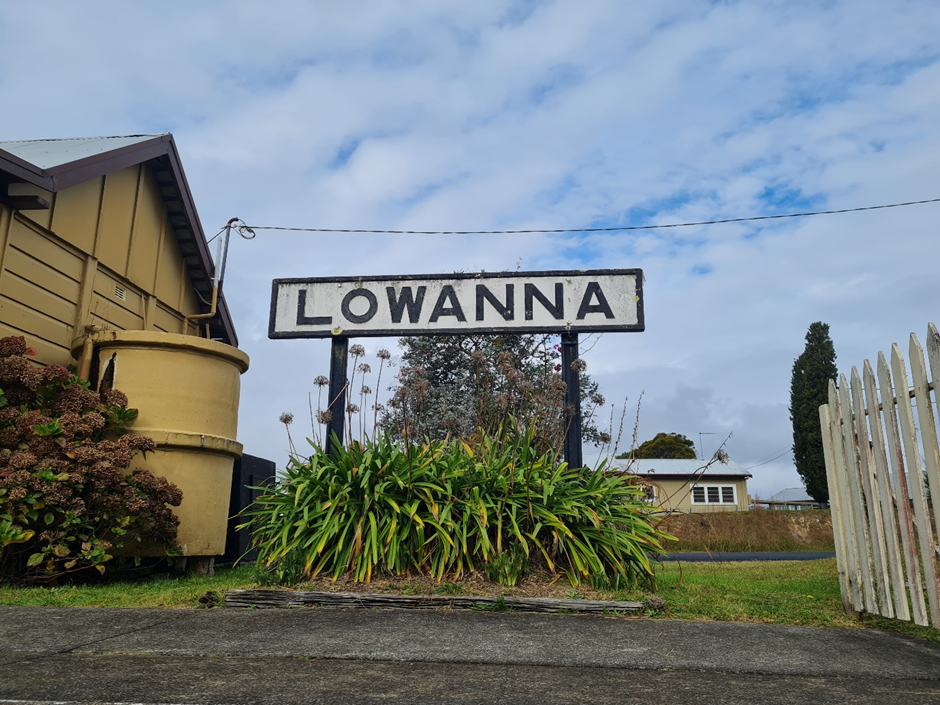
Lowanna was the largest of the intermediate stations. It was an attended station, with a crossing loop and siding. Most of the timber was loaded at this location.
Opened 23-Dec-1924 and Closed 20-Sep-1975
What we were really looking for was the Lowanna Railway Station, which, when we put it in the GPS, almost got us lost. We eventually found the refurbished station, a rather run-down platform, and rail tracks.


Lowanna was on the Dorrigo branch and lies on the north coast of NSW. It branches off the North Coast Line at Glenreagh and climbs up to the Dorrigo Plateau.
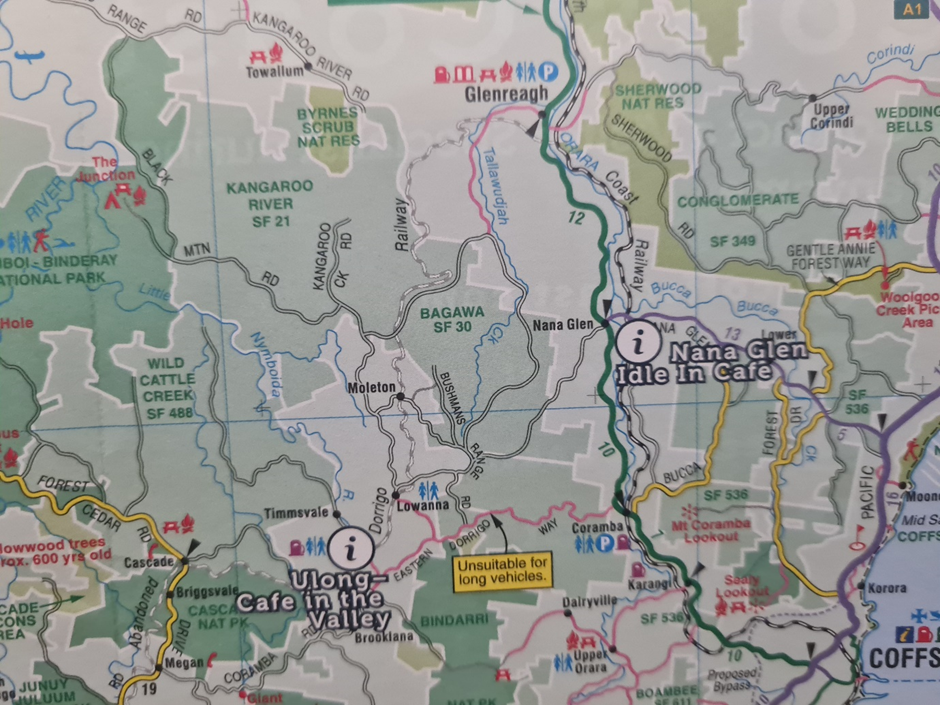
The Dorrigo area was settled in the early 1900s by pastoralists and tree fellers. Due to the steep terrain, it was decided to build a railway to allow products to be brought to nearby port towns. Several routes were surveyed, with the route from Glenreagh eventually chosen. The line climbs 664m over a length of 69km.
Apart from the endpoints of Dorrigo and Glenreagh, the stations on this line were very small, often consisting of a short platform with a small shelter. The major traffic on this line was timber.
More on the other stations, not that much still exists, on the line from Dorrigo to Glenreagh. At Dorrigo, there is a very big surprise…
 Thrills, Spills, and just a dash of Romance