Writing about writing a book – Day 13 supplemental

I was going to say ‘Captain’s log supplemental’ and add a stardate, but the analogy might get lost because not everyone is a Star Trekker.

Needless to say, there’s always more to say about an event, especially when the mind is casting about for ideas to add or enhance a story.

It comes down to, does art imitate life, or does life imitate art?  It’s an interesting question because, in this instance, art will be imitating, to a certain extent, life.

Perhaps what is lost in the telling is the inability of newly divorced people in working out where the boundaries are, whether or not they are entitled to know about the other person’s private life, and how that will make them feel.

I’m guessing when a marriage breaks down, there’s always a cause, and while the word amicable gets bandied around a lot, it’s said, but quite often not meant.

Does mummy have a boyfriend?

Does daddy have a girlfriend?

What generally happens is the children are the only ones who know what’s really happening to each of the parents, because they get transported between the two, as neither parent would want to be seen stopping the other from seeing them/

Of course, where the children are grown up and leading their own lives, the situation should be a lot easier.

But, where does this fit in with the story I hear you asking.


Marriages fall apart for many reasons.  In the story, Bill acknowledges that it is largely his fault, and one suspects it’s probably an undiagnosed case of PTSD that back in the sixties and seventies was not really understood.

It led to both he and Ellen leading individual but separate lives whilst keeping up appearances for the sake of their children.  There’s no doubting who brought them up, Ellen, and who had the greater influence over them, although, for the sake of this story, both couldn’t wait to leave home and live somewhere else.

They do, and together.  They are not married and do not have children.  They were not the cause of the breakup, and fortunately, neither of the girls blame one or the other parent.

But that doesn’t mean, over the years, that either parent hasn’t tried to use them to glean information about the other.  It is how Bill discovered, some time ago, that Ellen had ‘a special friend’.

Yet, neither of the daughters have seen him, and not surprisingly, he had made sure that Bill has never seen him.  It’s for a particular reason, one that will become obvious later in the story.  It is, I think, a rather clever twist.

Also, Ellen is not a bad person and certainly wasn’t bad to Bill, perhaps more long-suffering.  She did stay with him for a long time, mainly for the children, but also because she genuinely cared for Bill.

And Bill had not had another woman friend, not until he discovers his feelings towards Jennifer and even then, he keeps that to himself, even when he really doesn’t have to.

Sigh.

Time to return to my fictional world.

That helicopter story that kept me awake – Episode 27

Our hero knows he’s in serious trouble.

The problem is, there are familiar faces and a question of who is a friend and who is foe made all the more difficult because of the enemy, if it was the enemy, simply because it didn’t look or sound or act like the enemy.

Now, it appears, his problems stem from another operation he participated in.


It took almost an hour to recover.  Monroe didn’t come looking for me, so I think they knew it would take some time for me to get my legs back.

And it felt good to stand under the hot shower for twenty-odd minutes, letting the warmth of the water sink into my bones and clear my head.

And think.

How long had Bamfield have an eye on me?  It was a question that sprung to mind the moment I saw him in the desert camp.  I’d heard if you were transferred to one of his commands, at some point, it was not because it was another posting, it was because he wanted you there.

I’d been specially selected by Bamfield personally, out of the preliminary training camp, to further my military career under his oversight.  I’d made it very clear from the outset that I was not interested in a commission, that I preferred the lower ranks.  Officers were a different breed, and I’d not been cut from that cloth.  Bamfield had admitted as much when I was first interviewed by him, and several other’s on what I soon discovered was his selection panel.

They were charged by him to find the best of the best.

And at that first interview, I’d disagreed with his assessment.  I’d been in trouble before, and the military was the only place I could go if I didn’t want to serve a stretch in jail.  Perhaps it was that innate ability of mine to seek out and become embroiled in trouble that caught his attention.

Certainly over time he and his instructors had honed those skills to a more refined set that, in civilian life, would set me up for a long stay in prison.  It begged the question of what I was going to do with myself after the military had finished with me, a question I hadn’t really thought about until I’d been shunted to my last post in a training school of sorts.

I realised now that it had been Bamfield sidelining me until an operation crying out for my particular talents came along.

That disastrous operation with Treen.

Was it his?  Or was it someone else who pulled it together, and he just provided the manpower.  It had been the first major active offshore operation I’d been on.  There’d been a few skirmishes along the way, but that was the first, and in a zone where I don’t think we were meant to be operating.

That had, I thought, been the sole purview of the CIA, and if I looked back on what had happened, there was no doubt the two agents we were supposed to pull out were CIA operatives, it had got too hot for them to stay, and they had clandestinely called for help.

It begged another question, was Bamfield CIA or working with the CIA, with or without the military hierarchy knowing?

The thing is, if it had been pulled off, as expected, no one would be any the wiser in that country, but once they found out, by whatever means it happened, the proverbial had hit the fan.  It goes hand in hand with trusting people on the ground who were purportedly working against their country’s regime, for better or worse.

That country had a ‘friendly’ government, that had been ‘supported’ and then been deposed in the usual coup by the military, and, afterwards, the new hardliners got the benefit of those times when the country was a friendly and had military hardware and knowledge to wage war clandestinely or otherwise with its neighbours, given willingly.

Lessons hadn’t been learned after a particular middle east debacle.  Maybe lessons would never be learned.  Just look at the number of times had relations turned sour after a coup and agents had to hastily withdraw.  It seems that my visit had been at the end of another of those ‘diplomatic’ missions that had gone wrong.

If this was such a case, I was about to find out.

© Charles Heath 2019

“Anyone can have a bad day” – a short story

It had been one of those days, you know, the sort where you hoped, when you woke up again, it would be a distant memory if not gone altogether. Everything had gone wrong, the handover from my shift to the next, longer than usual, I got home late to find the building’s security system malfunctioning, and after everything that could go wrong had, I was late getting to bed, which meant I was going to be tired and cranky even before my shift started.

But what topped it all off was that the alarm didn’t go off. It was not as if I hadn’t set it, I remembered doing it. There was something else in play.

I rolled over and instantly noticed how dark it was. It was never this dark. It was why I chose an apartment as high up as I could, there would always be light coming from the advertising sign on the roof of the building over the road at night, or direct sunlight not blotted out by surrounding buildings.

I also left the curtains open, deliberately. I liked the notion of being able to see out, sometimes looking at the stars, other times watching the rain, but mostly to see that I was not in a dark place.

Not like now.

I got out of bed and went over to the window. Yes, there were lights, but they were all the way down on the street level. Everywhere else, nothing. It had to be a power blackout. Our first in a long time. I should have noticed the air conditioning was not on, and it was almost silent inside the room.

The apartment had windows that opened, not very far, but enough to allow some airflow, and the room feeling stuffy, I opened one in the bedroom. Instantly, sounds drifted up from street level, and looking down I could see the flashing lights of police cars and fire trucks, as well as the sounds of sirens.

The cold air was refreshing.

It took a few minutes before I realized the elevators would not be working, and I remembered the only pitfall of having a high-up apartment, it was a long way down by the stairs, and even longer going back up.

In the distance, I could see other buildings, about ten blocks away, with their lights on. It had to be a localized blackout, or perhaps a brownout. We had been having problems across the city with power supply caused by an unexplained explosion at several power stations on the grid.

Some were saying it was a terrorist attack, others were saying the antiquated infrastructure had finally given out.

My attention was diverted from the activity below by the vibration of my cell phone on the bedside table. I looked over at the clock and saw it was 3:10 in the morning, not a time I usually got a phone call.

I crossed the room and looked at the screen, just as the vibrating stopped. Louis Bernard. Who was Louis Bernard? It was not a name I was familiar with, so I ignored it. It wasn’t the first wrong number to call me, though I was beginning to think I had been given a recycled phone number when I bought the phone. Perhaps the fact it was a burner may have had something to do with it.

About the go back to the window, the phone started ringing again. The same caller, Louis Bernard.

Curiosity got the better of me.

“Yes?” I wasn’t going to answer with my name.

“Get out of that room now.”

“Who….” It was as far as I got before the phone went dead.

The phone displayed the logo as it powered off, a sign the battery was depleted. I noticed then though I’d plugged the phone in to recharge, I’d forgotten to turn the power on.

Damn.

Get out of that room now? Who could possibly know firstly who I was, and where I was living, to the point they could know I was in any sort of danger?

It took another minute of internal debate before I threw on some clothes and headed for the door.

Just in case.

As I went to open the door, someone started pounding on it, and my heart almost stopped.

“Who is it?” I yelled out. First thought; don’t open it.

“Floor warden, you need to evacuate. There’s a small fire on one of the floors below.”

“OK. Give me a minute or so and I’ll be right out.”

“Don’t take too long. Take the rear stairs on the left.”

A few seconds later I heard him pounding on the door next to mine. I waited until he’d moved on, and went out into the passage.

It was almost dark, the security lighting just above floor level giving off a strange and eerie orange glow. I thought there was a hint of smoke in the air, but that might have been the power of suggestion taking over my mind.

There were two sets of stairs down, both at the rear, one on the left and one on the right, designed to aid quick evacuation in the event of a calamity like a fire. He had told me to take the left. I deliberately ignored that and went to the right side, passing several other tenants who were going towards where they’d been told. I didn’t recognize them, but, then, I didn’t try to find out who my fellow tenants were.

A quick look back up the passage, noting everyone heading to the left side stairs, I ducked into the right stairwell and stopped for a moment. Was that smoke I could smell. From above I could hear a door slam shut, and voices. Above me, people had entered the stairwell and were coming down.

I started heading down myself.

I was on the 39th floor, and it was going to be a long way down. In a recent fire drill, the building had been evacuated from the top floor down, and it proceeded in an orderly manner. The idea was that starting at the top, there would not be a logjam if the lower floors were spilling into the stairwell and creating a bottleneck. Were those above stragglers?

I descended ten floors and still hadn’t run into anyone, but the smell of smoke was stronger. I stopped for a moment and listened for those who had been above me. Nothing. Not a sound. Surely there had to be someone above me, coming down.

A door slammed, but I couldn’t tell if it was above or below.

Once again, I descended, one floor, two, three, five, all the way down to ten. The smoke was thicker here, and I could see a cloud on the other side of the door leading out of the stairwell into the passage. The door was slightly ajar, odd, I thought, for what was supposed to be a fire door. I could see smoke being sucked into the fire escape through the door opening.

Then I saw several firemen running past, axes in hand. Was the fire on the tenth floor?

Another door slammed shut, and then above me, I could hear voices. Or were they below? I couldn’t tell. My eyes were starting to tear up from the smoke, and it was getting thicker.

I headed down.

I reached the ground floor and tried to open the door leading out of the fire escape. It wouldn’t open. A dozen other people came down the stairs and stopped when they saw me.

One asked, “Can we get out here?”

I tried the door again with the same result. “No. It seems to be jammed.”

Several of the people rushed past me, going down further, yelling out, “there should be a fire door leading out into the underground garage.”

Then, after another door slamming shut, silence. Another person said, “they must have found a way out,” and started running down the stairs, the others following. For some odd reason I couldn’t explain, I didn’t follow, a mental note popping up in my head telling me that there was only an exit into the carport from the other stairs, on this side, the exit led out onto an alley at the back of the building.

If the door would open. It should push outwards, and there should also be a bar on it, so when pushed, it allowed the door to open.

The smoke was worse now, and I could barely see, or breathe, overcome with a coughing fit. I banged on the door, yelling out that I was stuck in the stairwell, but there was no reply, nor could I hear movement on the other side of the door.

Just as I started to lose consciousness, I thought I could hear a banging sound on the door, then a minute later what seemed like wood splintering. A few seconds after that I saw a large black object hovering over me, then nothing.

It was the culmination of a bad night, a bad day, and another bad night. Was it karma trying to tell me something?

When I woke, I was in a hospital, a room to myself which seemed strange since my insurance didn’t really cover such luxuries. I looked around the room and stopped when I reached the window and the person who was standing in front of it, looking out.

“Who are you?” I asked, and realized the moment the words came out, they made me sound angry.

“No one of particular importance. I came to see if you were alright. You were very lucky by the way. Had you not stayed by that door you would have died like all the rest.”

Good to know, but not so good for the others. Did he know that the fire door was jammed? I told him what happened.

“Someone suspected that might be the case which is why you were told to take the other stairs. Why did you not do as you were told?”

“Why did the others also ignore the advice.” It was not a question I would deign to answer.

They didn’t know any better, but you did, and it begs the question, why did you take those stairs.”

Persistent, and beginning to bother me. He sounded like someone else I once knew in another lifetime, one who never asked a question unless he knew the answer.

The man still hadn’t turned around to show me his face, and it was not likely I’d be getting out of bed very soon.

“You tell me?”

He turned slightly and I could see his reflection in the window. I thought, for a moment, that was a familiar face. But I couldn’t remember it from where.

“The simple truth, you suspected the fire was lit to flush you out of the building and you thought taking those stairs would keep you away from trouble. We both know you’ve been hiding here.”

Then he did turn. Hiding, yes. A spot of trouble a year or so before had made leaving Florida a necessity, and I’d only just begun to believe I was finally safe.

I was not.

They had found me.

And it only took a few seconds, to pull the silenced gun out of his coat pocket, point it directly at me, and pull the trigger.

Two stabbing pains in the chest, and for a moment it was as if nothing happened, and then, all of a sudden, I couldn’t breathe.

The last thing I saw and heard, several rounds from at least two guns, voices yelling out on the passage, and people running.

As I lay dying, my last thought was, it had been a good run, but no one can run forever.


© Charles Heath 2021
“Trouble in Store” – Short Stories my way: Editing becomes re-writing (7)

 It’s time to look at what’s been written for the unfortunate Annalisa, who had been caught up in a situation that is rapidly getting out of her control, not that she had it under control in the first place.  Perhaps it’s time to start reassessing her bad boy phase and think about a new lifestyle. 

Drugs, for her, were fun to begin with, but she can now see the effect they have on long term users, and the question will be, can she learn from this and move on?


Annalisa looked at the two men facing her.

Simmo, the boy on the floor, had told her that the shopkeeper would be a pushover, he was an old man who’d just hand over the drugs, rather than cause trouble for himself.

Where Simmo had discovered what the shopkeeper’s true vocation, dispensing drugs to the neighborhood addicts, she didn’t know, but it was not the first place like this they had visited.

She had always known Simmo had a problem, but he had assured her he had it under control.  Until a month ago, when he had tried something new.

It had changed him.

The breaking point came earlier that day when, seeing how sick he was, she threatened to leave.  It brought out the monster within him, and he threatened to kill her.  Not long after he had changed into a whimpering child pleading with her to stay, that he hadn’t meant anything he’d said before.

All he needed was one more ‘score’ to get his ‘shit’ together, and he would do as she asked, and find help.

She believed him.

He said he knew a place not far from the apartment, a small shop where what he needed was available, and said he had the money.

That should have been the first sign he was not telling the truth because she had been funding his habit until her parents cut off the money supply.  She suspected her father had put a private detective on to find her, had, and reported back, and rather than make a scene, just cut her off so she would have to come home or starve.  Her father was no better than Simmo.

And, as soon as they stepped into the shop, Simmo pulled out the gun,

Instead of the shopkeeper cowered like Simmo said he would, he had laughed at them and told them to get out.  Simmo started ranting and waving the gun around, then all of a sudden collapsed. 

There was a race for the gun which spilled out of Simmo’s hand, and she won. 

That was just before the customer burst into the shop.

It had been shortly before closing time.  Simmo had said there would be no one else around.

Wrong again.

Now she had another problem to deal with, a man who was clearly as scared shitless as she was.

This was worse than any bad hair day, or getting out of the wrong side of bed day, this was, she was convinced, the last day of her life.

She heard a strange sound come from beside her and looked down.  There was a trickle of blood coming out of his mouth and Simmo was making strange sounds like he was choking.

Any other time she might have been concerned, but the hard reality of it was, Simmo was never going to change.  She was only surprised at the fact it took so long for her to realize it.

As for the man standing in front of her, she was safe from the shopkeeper with him around, so he would have to stay.

“No.  Stay.”

Another glance at the shopkeeper told her she had made the right decision, his expression said it all.  Gun or no gun, the moment she was alone with him, he would kill her.


© Charles Heath 2018-2020

Writing about writing a book – Day 13 extra

There’s nothing worse than an interrogation by children, particularly when they are brutally honest.  To make matters worse, I had two inquisitors, and it was clear they had spent some time before getting in the car to organize a coordinated plan of attack.

But, first, a little history.

Back in happier times, in other words before the eventual separation and divorce, we were known as nanna and poppy. I was, most of the time, referred to as grumpy poppy, and the two, girls adored their nanna.

She always had a way with children, and, it was also the case, with our own two sons.  They preferred her to me, for obvious reasons, I had to be bad cop all the time.

When we separated, and this was an eventuality that we both agreed on, and it was, I thought, quite amicable.  There was no underlying reason, like one or other of us cheating, but that we had, over time, simply drifted apart because we had separate ideas about life.

Since I was the nonpreferred grandparent, I decided to see less of the children and allow them more time to be with their nanna.  Sometimes we appeared together, like at birthdays and Christmas, but normally I kept my distance.

No one seemed to complain about my absences, least of all my own children, which spoke volumes, to me, about what they thought of me.

Now, out of the blue, I get this call to pick up my granddaughters from school. It was not as if their nanna was as so overloaded with things to so, so it seemed to me it was some sinister plot, but to what end, I could hardly imagine.

I’d find out soon enough.

The girls were waiting in the drop zone and got in the car.  It didn’t phase them that it was me, and I had thought they may have a problem since I was in a different car. But they seemed to know what to look for.

There was silence until we exited the school grounds, they went to a church primary school and perhaps they didn’t want to risk God’s judgment on me.

The older child fired the first salvo, “Nanna says you have a girlfriend.”

Ok, not the first question I was expecting.

Then the younger girl followed up with the second salvo, “is she going to become our new nanna?”

To them, these were serious questions.  But had they been inspired by their current nanna, and they were to get answers.  She’d know I wouldn’t lie to them.

I stopped at the traffic lights.

“If your nanna saw me with a friend having lunch the other day, then it’s quite possible it may have looked like that, but, no, I don’t have a girlfriend, and for what it’s worth, I’m not ready to embark on that journey again for a while.  As for the other question, there will never be a new or any other sort of nanna other than the one you have already.”

Speech timed to perfection.  The lights changed to green.

I let that sink in and then after a minute asked a question of my own.  “How come your nanna is not picking you up today?”

I notice the two give each other a look and wonder how young does a child have to be to understand what a lie is or be able to keep a secret.

“We were told that you would be collecting us today, that’s all.”

A question then for whoever is at home when I drop them off.

I notice a rather prolonged look from the younger girl, perhaps searching for a truth of her own in my expression, or that she was trying to read my thoughts.  Whatever she saw, she asked, “Do you still go to work?”

“In a manner of speaking.  I work for myself these days.”

“With computers?”

“Not anymore.  I thought I might try writing a novel.  Before, there never seemed to be enough time in a day to do anything, but now things are a little easier.”

Then the older girl chimed in, “Nanna says that it’s a bit late for you to become a writer.”

Yes, I can see it now, the rest of the family sitting around the dinner table saying that I’d finally lost my marbles doing what I always wanted to rather than what I had to.

And my ex had always said I would be wasting my time from the very first time I’d mentioned it to her.  So much for confiding your hopes and dreams in your so-called lifelong partner who is supposed to support you.  I know I had supported her through various career changes, no matter what the consequences.

“What do you think I should do?”

It would be interesting to get their perspective.

“If you don’t have a real job, how do you pay the bills?”

A practical question.  Just the sort my ex would have posed if she was here.

“You’d be surprised what you can do when you put your mind to it.  I manage.”

There was no doubt a dozen other questions to be asked, but the capacity for a child to remember was about three or four.  And then they had to remember my answers so they could relay them.

Hopefully, the interrogation was over.

Searching for locations: From X’ian to Zhengzhou dong by bullet train, China

Lunch and then off on another high-speed train

We walked another umpteen miles from the exhibition to a Chinese restaurant that is going to serve us Chinese food again with a beer and a rather potent pomegranate wine that has a real kick.  It was definitely value for money at 60 yuan per person.

But perhaps the biggest thrill, if it could be called that, was discovering downstairs, the man who discovered the original pieces of a terracotta soldier when digging a well.  He was signing books bought in the souvenir store, but not those that had been bought elsewhere.

Some of is even got photographed with him.  Fifteen minutes of fame moment?  Maybe.

After lunch, it was off to the station for another high-speed train ride, this time for about two and a half hours, from X’ian to Zhangzhou dong.

It’s the standard high-speed train ride and the usual seat switching because of weird allocation issues, so a little confusion reigns until the train departs at 5:59.

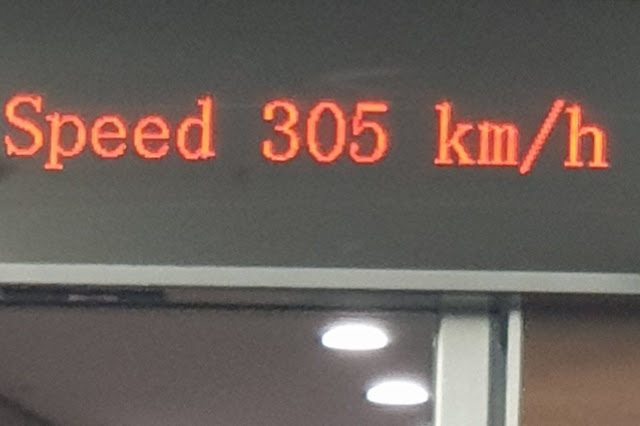
Once we were underway it didn’t take long before we hit the maximum speed

Twenty minutes before arrival, and knowing we only have three minutes to get off everyone is heading for the exit clogging up the passageway.  It wasn’t panic but with the three-minute limit, perhaps organized panic would be a better description.

As it turned out, with all the cases near the door, the moment to door opened one of our group got off, and the other just started putting cases on the platform, and in doing so we were all off in 42 seconds with time to spare.

And this was despite the fact there were about twenty passengers just about up against the door trying to get in.  I don’t think they expected to have cases flying off the train in their direction.

We find our way to the exit and our tour guide Dannie.  It was another long walk to the bus, somewhat shabbier from the previous day, no leg room, no pocket, no USB charging point like the day before.  Disappointing.

On the way from the station to the hotel, the tour guide usually gives us a short spiel on the next day’s activities, but instead, I think we got her life history and a song, delivered in high pitched and rapid Chinglish that was hard to understand.

Not at this hour of the night to an almost exhausted busload of people who’d had enough from the train.  Oh, did I forgot the singing, no, it was an interesting rendition of ‘you are my sunshine’.

The drive was interesting in that it mostly in the dark.  There was no street lighting and in comparison to X’ian which was very bright and cheerful, this was dark and gloomy.

Then close to the hotel our guide said that if we had any problems with the room, she would be in the lobby for half an hour.

That spoke volumes about the hotel they put us in.

That helicopter story that kept me awake – Episode 26

Our hero knows he’s in serious trouble.

The problem is, there are familiar faces and a question of who is a friend and who is foe made all the more difficult because of the enemy, if it was the enemy, simply because it didn’t look or sound or act like the enemy.

Now, it appears, his problems stem from another operation he participated in.


I could truthfully say I was blinded by the light.  Whoever my next visitor was, came in and turned on the lights just about blinding me after the ethereal darkness I’d been in for several hours.

Of course, it had to be Lallo.

“I trust you had an uneventful journey and got plenty of rest.”  He seemed to be in what might be called a jovial mood.

Perhaps they were going to let him use his instruments of torture on me now we had arrived.  I was sure that the Geneva Convention, if we were still a signatory to it, was left outside the door to this building.

“Well enough.  Whose idea was it to put me in casts and make me think I had been severely injured?”

“I doubt that would be of interest to you now.  Just be thankful it wasn’t purposely done to you.  I had been an option, but Colonel Bamfield apparently has you in mind for a job he needs doing, so we opted for subterfuge.  You can thank us later.”

Or not at all.  I was right.  Bamfield, or they, whoever they were, needed me alive.  And in one piece.  I was not sure I liked the sound of that.

“More questions?”

“No, not at the moment.  I’m going to have a chat to the source, you remember me telling you we were bringing him over with us.  He was not so lucky as you, as you’ll soon discover.  I want you to sit in on the session, I want you to listen and assess what you think about what he tells us.”

“In what capacity?”

“Just listen.  I’m told that you have conducted a few interrogations, and have a sense about the target, whether they’re lying or telling the truth.  We won’t be using force initially, so let’s hope he opts to tell the truth.”

So did I.  The last thing I wanted to see was a messy interrogation. Those I’d been on were relatively simple.  A man at the end of a gun usually told the truth or felt a great deal of pain and suffering if he didn’t.

It had never been my favourite job, which is why I’d not done very many, and I had hoped I’d never see Lallo at his worst.  Perhaps, then, that was the point of this exercise.  They were not finished with me, so he’d make an example out of someone else, letting me know the extent to which he would go, thus making me more co-operative.

A bit pointless, really, because I didn’t know very much.  Maybe the Colonel forgot to tell him that.

“There are clothes in the cupboard over there,” he nodded towards the corner of the room where there were two doors.  One I figured was the bathroom.  “Clean yourself up, get dressed, and let Monroe know when you’re ready.  Oh, and take it easy for the first few minutes, the serum we gave you tends to make your legs turn to jelly when you first try to stand up.  It’ll pass.  Just be careful.”


© Charles Heath 2019

Searching for locations: Terracotta Warriors and Horses Museum, X’ian, China

Terracotta Warriors and Horses Museum

A little history, and anecdotal advice first:

In 1974 a 26-year-old farmer, Yang Jide, was drilling a well and found fragments of the terracotta soldiers and bronze weapons.

What was discovered later was one of the biggest attended burial pits of China’s first feudal Emperor, Qin Shi Huang.  In the following years remains had been found in 3 pits, yielding at least 8,000 soldiers and horses, and over 100 chariots.  The soldiers were infantry, cavalry, and others.

Emperor Qin was born in 259 BC and died in 210 BC.  He began building a mausoleum for himself at the foot of Mount Li when he was 13.  Construction took 38 years, from 247 BC to 208 BC.  It was divided into 3 stages and involved 720,000 conscripts.

The pits of pottery figures are 1.5 km east of Emperor Qin’s mausoleum.  Pit 1 has about 6,000 terracotta armored warriors and horses and 40 wooden chariots.  Pit 2 is estimated to have over 900 terracotta warriors and 350 terracotta horses with about 90 wooden chariots.  Pit 3 had so far yielded only 66 pottery figures and one chariot drawn by four horses.

Official records say it was discovered later that it was likely Xiang Yu, a rebel, intentionally damaged the Mausoleum and the soldiers in the pits, by setting fire to the wooden roof rafters, and these fell on and broke the warriors into pieces.

However, we were told that after the terracotta warriors were completed, the Emperor ordered the builders to be killed so that they would not tell anyone about the warriors, and then of those that remained alive deliberately smashed all of the artifacts.

The thing is, all of the terracotta figures that have been found are in pieces, and they need computers to piece them back together again.

The visit:
The first impression is the size of the car park and the number of buses parked in the lot, and a hell of a lot more outside up the road an off on side streets.  Obviously, it costs money to park in the parking lot.

The other first impressions; the numbers waiting to get in were not as many as yesterday outside the forbidden city, in fact, a lot less.

Be warned there’s a long walk from the entrance gate where your bags are scanned and a body scan as well, before admittance.  This walk is through a landscaped area which it is expect might sometime in the future reveal more soldiers, or other artifacts.

At the end of the walk that takes about ten minutes, you can get a one-way ride to the second checkpoint, but we opted not to as no one else in our group did.

That walk is the warm-up exercise to an organized viewing of the exhibits after going through a second ticket checkpoint.  On the other side, we had to hand our tickets back to the tour guide which was disappointing not to end up with a memento of actually having been there.

So, on the other side in the courtyard, the guide told us the most important parts of the exhibition, that we should spend most of the time looking at pit 1, and then spent a little time in 2 which is only there in the first stages of excavation.  Then move onto the museum if only to see the replica chariots.

We do.

The chariots were small but interesting

The horses were better and intricately detailed

These are soldiers, perhaps complete examples of those types found in the end pit.

This is one of the archers.  You can tell by the way he wears his hair.

Pit 2

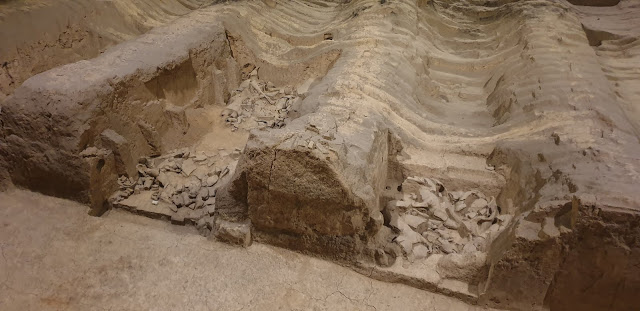
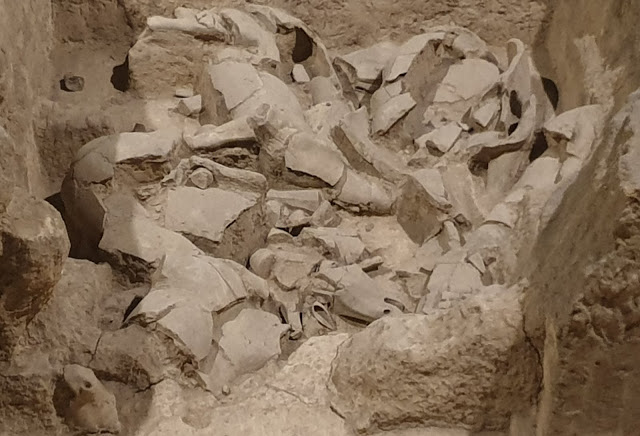
The excavation of this pit has only just begun, so it is possible to see where they have carefully removed the top cover, and you can see the broken parts of the warriors lying in a heap.

Some parts of the warriors are more discernible closer up

These parts are carefully extracted and taken to the ‘hospital’ where they are digitised and the computer will match each part with the warrior it belongs to.

Pit 1

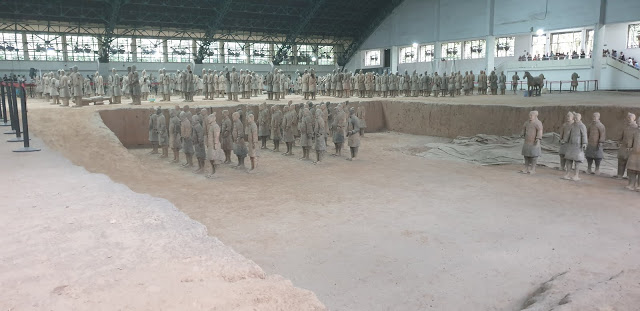
This has quite a number of standing soldiers that have been glued back together, but not necessarily complete and I notice a number if the statues were incomplete. And if they cannot find the missing pieces, then they are not added to or filled in.

The scale of the pit is enormous, and they have hardly scratched the surface in the restoration process.

What is there is a number of horses as well.

That’s at the front of the pit, a long line of statues, and what is clear is the location of the well where the first fragments were found by a farmer.

There are about eight lines of soldiers, and some lining the sides.

Midway down there is a large area currently under excavation

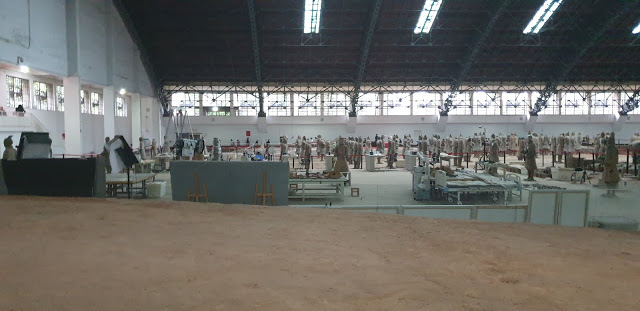
At the back is the hospital where the soldiers are reassembled.  There’s nearly a hundred in the various stages of rebuilding.  These days the soldiers are rebuilt using computer imaging.

The hospital area is where they are put back together

And these are some of the statues in various stages of reconstruction

Another two views of the size and scale of the reconstruction project

The coffee shop is also a sales centre, but there are too many people waiting for coffee and too few places to sit down.

NaNoWriMo 2021 – Day 20

This image has an empty alt attribute; its file name is NaNoWriMo-WriterBadge-851-2x.png

A score to settle

Today, it’s viva la revolution.

I’m writing the first part of what is about to unfold as a civilian takeover. Of course, planning aside, and not reckoning on opposition from what should be allies, it fails.

So, it’s not that the rebels had the wrong plan, they just didn’t think it through, or fully understand the circumstances of the person they chose to kidnap and try to use as leverage.

Perhaps this was the moment I was waiting for, and having all of the preliminary backgrounds, and setting all of the plot elements needed to lead to this point, this part is almost writing itself.

I’ve just got to make the really bad guy, badder, if that’s possible.

I want to show a human side to a character that cannot afford to have one, and that in stepping outside their comfort zone things can go horribly wrong very quickly.

And the main character that has returned too soon after a life-changing incident, can and will have moments where the loss of focus could have devastating results.

What’s that expression? Everything could go to hell in a handbasket.

Or not.

Stay tuned.

Today’s word count: 3,257 words, for the running total of 50,130.

That helicopter story that kept me awake – Episode 25

Our hero knows he’s in serious trouble.

The problem is, there are familiar faces and a question of who is a friend and who is foe made all the more difficult because of the enemy, if it was the enemy, simply because it didn’t look or sound or act like the enemy.

Now, it appears, his problems stem from another operation he participated in.


When I woke up, it was in a whole new world, but not necessarily of pain.

It was a different room, not quite dark, not hot or cold, looked much like a hospital room layout with a hospital bed, and bright lights outside the doors.

I had no idea if it was daylight or night.  Classic disorientation procedure before a different sort of interrogation.

What I also realised, though I was not sure why was that the casts and bandages I had back at the previous base hospital were gone, and everything looked, well, different.

That there was nothing wrong with me.

It’s a terrible thing to realise your own people had basically told you a web of lies about your condition, and how the mind adjusted to those lies.  And yet, I would have sworn on a stack of bibles my pain was real.

Drugs.  Not only could they do good, but they could also do some very bad things, to the mind and the body.  At a guess, I would say it was for Breeman’s benefit.  If I’d come back in one piece there would be a truckload of questions.

So, I’d been moved, and kept under the whole time.  And if there was nothing wrong with me, why was I still in what looked like a hospital?  Maybe it wasn’t.  There was only one bed in the room.  Perhaps it was a cell for recovering transportees.

My worst fears then, a black site.

My waking must have triggered an alarm because I heard the door open and someone come into the room.  The exact position of the door was hidden by a curtain, but I could see the light from outside intensify when it opened and slowly drop ass it closed.

The curtain moved on its rings to show a man in a white coat, perhaps a doctor, but more likely the interrogator or his assistant coming to check the viability of their target.

I had to ask, “Where am I?”

“In a camp, at a location, I’m not at liberty to disclose.”

“When did I get here?”

“Yesterday, late last night.  It was busy.  We had three new arrivals.  You must be on the right side because you didn’t arrive in chains, the other two did.”

He took my temperature, blood pressure and some other tests, and wrote the numbers on a page in a file.

“You haven’t reacted to the serum we gave you.  That’s good.”  He saw my look of concern.  “Oh, it’s only used for transporting injured people from one base to another.  It helps to minimise the external forces causing them unnecessary pain.”

“Apparently I’m not injured.”

“No.  Not quite sure what happened there, but, whatever happened, it’s above my pay grade.  By the way, don’t try to leave this room.  There’s a guard outside who had been told to shoot first and ask questions later.  I’ve seen the results of her work.”

It had to be Monroe.

That means Lallo would be around soon enough.


© Charles Heath 2019