Writing about writing a book – Day 14 starts

Colonel Davenport, the evil mastermind as I like to think of him, but in reality, he was a tortured soul on a number of fronts.

I’d like to say what happened to him was not his fault, but to a certain extent, people can go one way or the other, choose between right and wrong, choose the easy path or the hard path, and most of all, never take advantage of a situation for personal gain.

Most people.

But try having a reputation to live up to, and the expectations of everyone put on your shoulders, and you knew you would never be able to carry the load?

That was Archibald Davenport, first son of General Horace Davenport, the great, great, great, so many times grandson of the fearless and famous Walter Davenport, who was with General Grant, serving with honor and valor in the Civil War.

No such weight was ever passed on to his younger brother, Leslie, so, free to live his own life, and in doing so, far surpassing his older brother in respect and accomplishment.

Archibald Davenport managed to miss the Second World War, much to the disappointment of his father, kept to the fringes of the Korean War, but unluckily was in the wrong place at the wrong time when serving officers were sought to go over as advisors to the Vietnamese in the years before the conflict escalated.

Or, speaking plainly, his commander wanted to move the problem on by obtaining a promotion to Major and recommending him for service in Vietnam.  It was either that or dishonorable discharge and a few years in the stockade.

Knowing how it would affect his father, he took the commission.

But for an operator like Davenport, a man who could seek out and at the same time have trouble finding him, saw the conflict as a means to an end, and has latched onto an operative that he assumed was working covertly with the CIA, realized the potential for a man of his talents.

It didn’t take long before he was unofficially attached to the CIA, his army commander willingly signing the orders to ‘get rid of what will become a major (pardon the pun) problem’.  So began the empire, arms, drugs, information, whatever was needed by whoever had the wherewithal, he was the man to see.

How did Bill find himself under Davenport’s command?

You’ll have to wait and see.

Searching for locations: The Henan Museum, Zhengzhou, Henan Province, China

The Henan Museum is one of the oldest museums in China.  In June 1927, General Feng Yuxiang proposed that a museum be built, and it was completed the next year.  n 1961, along with the move of the provincial capital, Henan Museum moved from Kaifeng to Zhengzhou.

It currently holds about 130,000 individual pieces, more of which are mostly cultural relics, bronze vessels of the Shang and Zhou Dynasties, and pottery and porcelain wares of the various dynasties.

Eventually, we arrive at the museum and get off the bus adjacent to a scooter track and despite the efforts of the guide, there’s no stopping them from nearly running us over.

We arrive to find the museum has been moved to a different and somewhat smaller building nearby as the existing, and rather distinctively designed, building is being renovated.

While we are waiting for the tickets to enter, we are given another view of industrial life in that there is nothing that resembles proper health and safety on worksites in this country, and the workers are basically standing on what looks to be a flimsy bamboo ladder with nothing to stop them from falling off.

The museum itself has exhibits dating back a few thousand years and consist of bronze and ceramic items.  One of the highlights was a tortoiseshell with reportedly the oldest know writing ever found.

Other than that it was a series of cooking utensils, a table, and ceramic pots, some in very good condition considering their age.


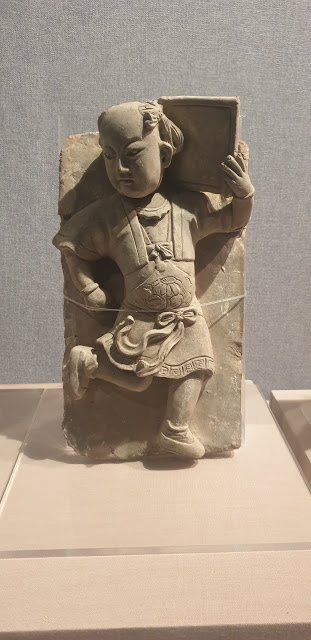
There were also small sculptures

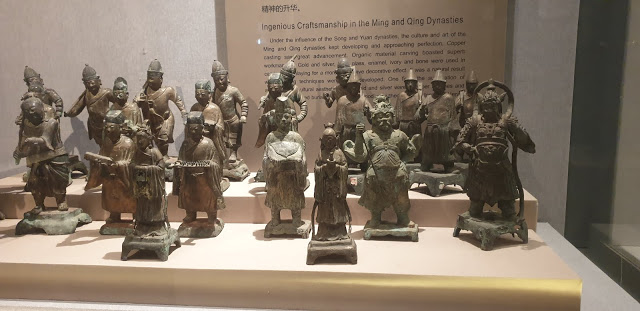
an array of small figures

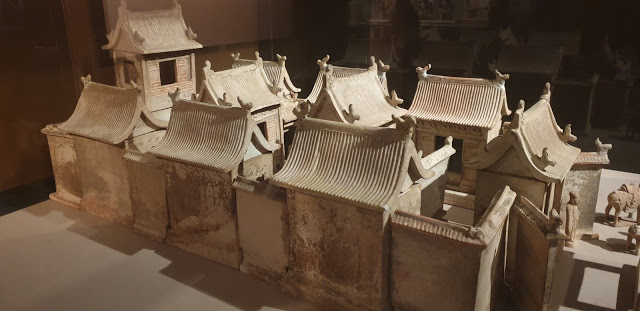
and a model of a settlement

20 minutes was long enough.

NaNoWriMo 2021 – Day 23

This image has an empty alt attribute; its file name is NaNoWriMo-WriterBadge-851-2x.png

A score to settle

Between researching the locations, and creating personas for the characters, I’m exhausted. Yesterday was the longest day this month because I had underestimated the amount of work needed to bring these characters, pertinent to this story at least, to life.

Plan or no plan, there’s always something lurking in the details that are going to trip you up sooner rather than later.

Of course, not every story is pulled together and written entirely in the space of thirty days, so these sorts of logistical problems rarely cause the angst they are at the moment. You hit a roadblock, and it’s well just ho-hum, let’s do something about it, tomorrow!

This thirty-day deadline, well, it’s like the proverbial rocket you know where.

So, there was a lot of scribbling actual words on a real piece of paper, lots of crossing out, very little erasing because you can’t erase biro ink, not the cheap stuff anyway, and lots of going back and forth, turning pages.

A real page-turner of a different sort!

I can see the humor in it now, but at 2am, there was very little humor and had the shredder not been broken, a few good ideas might have gone through it.

Today is a new day.

The revolution beckons.

Today’s word count: 3,579 words, for the running total of 61,750.

That helicopter story that kept me awake – Episode 28

Our hero knows he’s in serious trouble.

The problem is, there are familiar faces and a question of who is a friend and who is foe made all the more difficult because of the enemy, if it was the enemy, simply because it didn’t look or sound or act like the enemy.

Now, it appears, his problems stem from another operation he participated in.

I was escorted to a small room that adjoined the interview room, and I was separated from the main event by a one-way mirror.

It was a cliché, but not surprising.

The interrogation room was much the same as an office, with a table, two chairs, and on the side, a cabinet, closed up, and an interesting addition to what might be called a boring room.

It was currently empty, and I was the only one in this small room, sitting at a counter, looking in.  In front of me was a stack of writing pads, pens and pencils.  I wondered if I was the only party that was about to observe Lallo and the new arrival.

Five minutes passed before the door to the room next door opened and a hooded man was led in.  His hands were cuffed, and his legs had chains, standard prisoner gear.  

From the man’s manner and body language, it appeared to me as though he was surprised he was being treated so badly, and was not forcefully resistant, but wasn’t making it easy for his captors.

He was asked to sit, and when he didn’t he was forced to sit, with some force, and then his hands were locked onto the metal bar at the table.  His legs were locked to a lower bar.  A precaution in case he decided to attack his interrogator.

One thing I knew for sure, this man would not give up information willingly.

Once he was secured, one guard took up station inside the door, the other left.  That’s when Lallo made his appearance.  He came in, put a file on the desk, nodded to the guard who remove3d the hood, and then he sat.

I’d expected to see Lallo in full uniform.  He was not.  He was, if anything, dressed casually.  The man on the other side was in a cream suit, very crumpled and slightly stained as if he had not changed during the entire journey from capture to this room.

No doubt part of his conditioning.

“Mr Jacobi, that is your name isn’t it?”

The man stared at him sullenly.  I got the impression he was usually the one asking the questions, not the other way around.

The man lifted his head and stared straight at Lallo.  It was not a look I’d want to be on the end of, but Lallo, I suspect, had been on the end of a lot worse.  And a closer inspection of his face, and features, I noticed that someone had already started the harsher form of interrogation.

“You know this already.  I am an employee of the United States Government, your Government, and you will regret treating me like this.”

“That may be so, but you have failed to define what part of the Government it is you work for.  Is it the CIA?”

Another withering stare, followed by, “You people are so incompetent, the left-hand does not know what the right hand is doing.  I require a telephone so that I can contact my liaison, and this farce will stop, and you will be reprimanded very severely.”

“I seriously doubt anyone knows you are missing yet.  Maybe after a week or so, but we know you keep to yourself, and very few people know your business, a situation, I assure you, the benefits us more than it benefits you.  So I will assume you are Jacobi.”

There was a knock on the door, and Monroe came in with a small box, handed it to Lallo, and then left again.

Lallo looked in the box, then pulled out a plastic evidence bag with a mobile phone in it, and put it on the table.  “This is the phone you use to call General Bahti, your contact inside the current government.  It seems it is not registered with a telephone network in your country, but another, shall we say neutral, country.

He reached into the box and pulled out another plastic evidence bag also with mobile phone in it.  “This phone,” he held it up, “is the one you use to talk to the, shall we call them the local resistance.  It’s so much nicer than calling them rebels.”

The man’s eyes followed each bag from the box to the table.  He was almost expressionless.

Then Lallo pulled out another bag, with another phone, “This is the phone which you make and receive calls from your American contact.  It is what we call a burner phone, and was given to you, we think, on a recent visit to this country, by that contact.  I am assuming this is the person you wish to call and who will stop this farce.”

If Lallo was expecting the man to break down there and then, he was sadly mistaken.  There was little if any movement in his expression, perhaps just enough for Lallo to assume he’d got the men behind the phones correct.  That he was basically unmoved at Lallo’s revelations told me this man had a resolve Lallo was going to find hard to shake.

Lallo took the third phone out of the evidence bag and pushed it across the table towards the man.  “You can call your contact now, and you can tell him I would like to speak to him.”

© Charles Heath 2019-2021

Writing about writing a book – Day 14 starts

Colonel Davenport, the evil mastermind as I like to think of him, but in reality, he was a tortured soul on a number of fronts.

I’d like to say what happened to him was not his fault, but to a certain extent, people can go one way or the other, choose between right and wrong, choose the easy path or the hard path, and most of all, never take advantage of a situation for personal gain.

Most people.

But try having a reputation to live up to, and the expectations of everyone put on your shoulders, and you knew you would never be able to carry the load?

That was Archibald Davenport, first son of General Horace Davenport, the great, great, great, so many times grandson of the fearless and famous Walter Davenport, who was with General Grant, serving with honor and valor in the Civil War.

No such weight was ever passed on to his younger brother, Leslie, so, free to live his own life, and in doing so, far surpassing his older brother in respect and accomplishment.

Archibald Davenport managed to miss the Second World War, much to the disappointment of his father, kept to the fringes of the Korean War, but unluckily was in the wrong place at the wrong time when serving officers were sought to go over as advisors to the Vietnamese in the years before the conflict escalated.

Or, speaking plainly, his commander wanted to move the problem on by obtaining a promotion to Major and recommending him for service in Vietnam.  It was either that or dishonorable discharge and a few years in the stockade.

Knowing how it would affect his father, he took the commission.

But for an operator like Davenport, a man who could seek out and at the same time have trouble finding him, saw the conflict as a means to an end, and has latched onto an operative that he assumed was working covertly with the CIA, realized the potential for a man of his talents.

It didn’t take long before he was unofficially attached to the CIA, his army commander willingly signing the orders to ‘get rid of what will become a major (pardon the pun) problem’.  So began the empire, arms, drugs, information, whatever was needed by whoever had the wherewithal, he was the man to see.

How did Bill find himself under Davenport’s command?

You’ll have to wait and see.

Searching for locations: The Henan Museum, Zhengzhou, Henan Province, China

The Henan Museum is one of the oldest museums in China.  In June 1927, General Feng Yuxiang proposed that a museum be built, and it was completed the next year.  n 1961, along with the move of the provincial capital, Henan Museum moved from Kaifeng to Zhengzhou.

It currently holds about 130,000 individual pieces, more of which are mostly cultural relics, bronze vessels of the Shang and Zhou Dynasties, and pottery and porcelain wares of the various dynasties.

Eventually, we arrive at the museum and get off the bus adjacent to a scooter track and despite the efforts of the guide, there’s no stopping them from nearly running us over.

We arrive to find the museum has been moved to a different and somewhat smaller building nearby as the existing, and rather distinctively designed, building is being renovated.

While we are waiting for the tickets to enter, we are given another view of industrial life in that there is nothing that resembles proper health and safety on worksites in this country, and the workers are basically standing on what looks to be a flimsy bamboo ladder with nothing to stop them from falling off.

The museum itself has exhibits dating back a few thousand years and consist of bronze and ceramic items.  One of the highlights was a tortoiseshell with reportedly the oldest know writing ever found.

Other than that it was a series of cooking utensils, a table, and ceramic pots, some in very good condition considering their age.


There were also small sculptures

an array of small figures

and a model of a settlement

20 minutes was long enough.

NaNoWriMo 2021 – Day 23

This image has an empty alt attribute; its file name is NaNoWriMo-WriterBadge-851-2x.png

A score to settle

Between researching the locations, and creating personas for the characters, I’m exhausted. Yesterday was the longest day this month because I had underestimated the amount of work needed to bring these characters, pertinent to this story at least, to life.

Plan or no plan, there’s always something lurking in the details that are going to trip you up sooner rather than later.

Of course, not every story is pulled together and written entirely in the space of thirty days, so these sorts of logistical problems rarely cause the angst they are at the moment. You hit a roadblock, and it’s well just ho-hum, let’s do something about it, tomorrow!

This thirty-day deadline, well, it’s like the proverbial rocket you know where.

So, there was a lot of scribbling actual words on a real piece of paper, lots of crossing out, very little erasing because you can’t erase biro ink, not the cheap stuff anyway, and lots of going back and forth, turning pages.

A real page-turner of a different sort!

I can see the humor in it now, but at 2am, there was very little humor and had the shredder not been broken, a few good ideas might have gone through it.

Today is a new day.

The revolution beckons.

Today’s word count: 3,579 words, for the running total of 61,750.

That helicopter story that kept me awake – Episode 28

Our hero knows he’s in serious trouble.

The problem is, there are familiar faces and a question of who is a friend and who is foe made all the more difficult because of the enemy, if it was the enemy, simply because it didn’t look or sound or act like the enemy.

Now, it appears, his problems stem from another operation he participated in.

I was escorted to a small room that adjoined the interview room, and I was separated from the main event by a one-way mirror.

It was a cliché, but not surprising.

The interrogation room was much the same as an office, with a table, two chairs, and on the side, a cabinet, closed up, and an interesting addition to what might be called a boring room.

It was currently empty, and I was the only one in this small room, sitting at a counter, looking in.  In front of me was a stack of writing pads, pens and pencils.  I wondered if I was the only party that was about to observe Lallo and the new arrival.

Five minutes passed before the door to the room next door opened and a hooded man was led in.  His hands were cuffed, and his legs had chains, standard prisoner gear.  

From the man’s manner and body language, it appeared to me as though he was surprised he was being treated so badly, and was not forcefully resistant, but wasn’t making it easy for his captors.

He was asked to sit, and when he didn’t he was forced to sit, with some force, and then his hands were locked onto the metal bar at the table.  His legs were locked to a lower bar.  A precaution in case he decided to attack his interrogator.

One thing I knew for sure, this man would not give up information willingly.

Once he was secured, one guard took up station inside the door, the other left.  That’s when Lallo made his appearance.  He came in, put a file on the desk, nodded to the guard who remove3d the hood, and then he sat.

I’d expected to see Lallo in full uniform.  He was not.  He was, if anything, dressed casually.  The man on the other side was in a cream suit, very crumpled and slightly stained as if he had not changed during the entire journey from capture to this room.

No doubt part of his conditioning.

“Mr Jacobi, that is your name isn’t it?”

The man stared at him sullenly.  I got the impression he was usually the one asking the questions, not the other way around.

The man lifted his head and stared straight at Lallo.  It was not a look I’d want to be on the end of, but Lallo, I suspect, had been on the end of a lot worse.  And a closer inspection of his face, and features, I noticed that someone had already started the harsher form of interrogation.

“You know this already.  I am an employee of the United States Government, your Government, and you will regret treating me like this.”

“That may be so, but you have failed to define what part of the Government it is you work for.  Is it the CIA?”

Another withering stare, followed by, “You people are so incompetent, the left-hand does not know what the right hand is doing.  I require a telephone so that I can contact my liaison, and this farce will stop, and you will be reprimanded very severely.”

“I seriously doubt anyone knows you are missing yet.  Maybe after a week or so, but we know you keep to yourself, and very few people know your business, a situation, I assure you, the benefits us more than it benefits you.  So I will assume you are Jacobi.”

There was a knock on the door, and Monroe came in with a small box, handed it to Lallo, and then left again.

Lallo looked in the box, then pulled out a plastic evidence bag with a mobile phone in it, and put it on the table.  “This is the phone you use to call General Bahti, your contact inside the current government.  It seems it is not registered with a telephone network in your country, but another, shall we say neutral, country.

He reached into the box and pulled out another plastic evidence bag also with mobile phone in it.  “This phone,” he held it up, “is the one you use to talk to the, shall we call them the local resistance.  It’s so much nicer than calling them rebels.”

The man’s eyes followed each bag from the box to the table.  He was almost expressionless.

Then Lallo pulled out another bag, with another phone, “This is the phone which you make and receive calls from your American contact.  It is what we call a burner phone, and was given to you, we think, on a recent visit to this country, by that contact.  I am assuming this is the person you wish to call and who will stop this farce.”

If Lallo was expecting the man to break down there and then, he was sadly mistaken.  There was little if any movement in his expression, perhaps just enough for Lallo to assume he’d got the men behind the phones correct.  That he was basically unmoved at Lallo’s revelations told me this man had a resolve Lallo was going to find hard to shake.

Lallo took the third phone out of the evidence bag and pushed it across the table towards the man.  “You can call your contact now, and you can tell him I would like to speak to him.”

© Charles Heath 2019-2021

“Because it’s not me” – a short story

If the was one fault I had, it was prevarication.

For a long time, I had always been afraid of making a mistake, after I had done exactly that.  They said our mistakes didn’t define us, but that one had.  I had lost the trust of everyone, from my parents to friends.

It was only a small lie, or so I told myself, but it had far-reaching ramifications, and almost cost someone their life.  But whilst I believed it was not all that bad, and the police had agreed that anyone who had been put in the same position would have done the same, there were those who didn’t agree.

It was a moment in time I often relived in my mind, over and over, and eventually led to several outcomes.

The first, I left home, the town where up till then I’d lived all of my life, walking away from family and those who used to be friends, knowing that what they said and what they felt were two entirely different things.  For all concerned, it was better that I left, cutting all ties, and make a fresh start, away from those whom I knew would never forget, even though they forgave me.

The second, and most dire, I changed my name, and my history, even how I looked.  Today, I was a very different person to that of thirty years ago.

The third, I moved to another country and vowed never to return, always looking constantly over my shoulder, expecting someone from the past to find me.  I instinctively knew that I would never escape, that one day a stark reminder would come back and destroy everything.

I picked the one occupation that would keep me both occupied and invisible.

Journalist.

I had started at the bottom, literally writing death notices, and worked my way up to what is ubiquitously known as ‘foreign correspondent’, going to places where no one else would go, those hotbeds of unrest, and war zones, reporting from both sides.

Perhaps it could say I had a death wish, a statement my editor had once said when he came to see me in hospital back in London after I’d been caught up in a rocket attack and repatriated.  He had come to offer me a job back home, to tell me my tour was over.

I declined the opportunity, and he left, shaking his head.

But that was not the only visitor that came to the hospital that day.  The other visitor was an elderly man, immaculately dressed in a pinstripe suit and bowler hat.  It screamed public servant, and the moment I saw him wandering up the passage, a chill ran down my spine.

Although he looked like he was looking for someone else, I knew he would eventually finish up in my doorway.

Five minutes after I first saw him.

When he appeared at the door, I thought about ignoring him, but realized that wasn’t going to change anything.  Besides that, I guess I wanted to know why he would want to see me.

“James Wilson?”

“Would it make any difference if I said no?”  Well, it didn’t mean I couldn’t spar with him, just a little.  “Who are you.”

“Do you mind if I come in?”

I got the impression he would do it anyway, irrespective of what I said.  I said no, and as I suspected he came in anyway, closing the door behind him, then took a minute or two to make himself comfortable in the visitor’s chair, which was an impossible task.

Then, settled, he said, “I understand you have just been repatriated from Syria.”

“I was in the wrong place at the wrong time.”

It wasn’t common knowledge where I’d come from, so this person knew something about me, which was immediate cause for concern.

“The bane of a reporter trying to cover a dangerous situation,” he said, with just the right amount of levity in his tone.  “I get it, by the way.  I once had that devil may care attitude you need to get the story.  I was chasing a Pulitzer, believe it or not, and used a few of those nine lives in the process.  Which one are you up to?”

I was going to say that awards didn’t matter but among those who made up the press pack in those God-forsaken places, there was an unwritten desire to be rewarded other than by pay.  For me, though, it was not a defining factor.

“Lost count.  But why would that interest you, or whoever it is you represent?  By the way, just who do you represent?”

Second attempt at finding out who this man was.  If he was dodging and weaving, it would suggest a clandestine organization.

“People who would like to use your unique talent in getting into trouble spots around the world.  We’re not asking you to come work for us exclusively, rather piggyback on the job that you already do so well.”

An unnamed man from an unnamed organization.  What he was offering wasn’t unheard of, and I had been warned, more than once, that jobs, like he was suggesting, were more often than not offered to people like me.  With that came one line of advice, turn around and run like hell.

But, with nothing to amuse me in hospital, I was curious.  “Doing what exactly?”

The fact his expression changed indicated my response had taken him by surprise.  Perhaps he was used to being told where to go.  Not yet.  I had this fanciful notion in the back of my mind that what he might offer might get me closer to the story.

“Keeping your eyes and ears open.  We’ll tell you what to look for, all you’ll be doing is looking for evidence.  There will be no need to go looking for trouble, if there’s evidence we ask you to report it, if not, no harm done.”

Not so hard.  If that was all it was.  The trouble was, if something sounds simple, which that did, but inevitably, it was going to be anything but.  I’d heard stories and the consequences.

“You’re presuming that my editor will send me back.  He just offered me a job at home.”

“I think both of us know you’re not interested in domesticity.  If he isn’t willing to adhere to your wishes, I’m sure we could find someone else who would be willing to take you on.  You have had several offers recently, have you not?”

So, without a doubt, he knew a lot about me, especially if he asked around.  I had had several offers, but I was happy where I was.  I liked the no questions about your past that my current employer had promised.

Yes, looking at the determination on this man’s face, I had no doubt they or he could do what he said.  No one comes to a meeting like this without holding all the cards.  Also, not that I wanted it to be so, It told me that my agreement was not necessarily going to be optional.

But I was happy to dither and find out.  “Since I’m not sure when the hospital is going to discharge me, and the fact I’m not exactly very mobile at the moment, can I consider the proposal.  Right now, as you can imagine, getting back to work is not exactly a priority.”

“Of course.”  He took a card out of his coat pocket and put it on the bedside table.  “By all means.  Call me on that number when you’ve decided.”

He stood.  “It will be a great opportunity.  Thank you for your time.”

Of course, the two impressions I was left with were, one, he had me mixed up with someone else, and two, that I would never see him again.

It was an impossible task, for me at least, because I did not have a poker face, and could barely carry a lie.  I would be the last person they’d want for the job.

And thinking that, I rolled over, put it out of my mind, and went back to sleep.


© Charles Heath 2021

NaNoWriMo 2021 – Day 22

This image has an empty alt attribute; its file name is NaNoWriMo-WriterBadge-851-2x.png

A score to settle

It’s hard to know just how someone would react in real life to a situation that is not normally expected to happen.

Like, for instance, a gunman walks into a supermarket and suddenly starts shooting randomly.

But, in the USA, that seems to be a situation that could happen anywhere, anytime and does with tragic results.

What would I do in such a situation?

It’s probably impossible to tell unless it really happened.

Why do I ask this question?

There’s a lot of effort required to plan out what each character is going to do in any given situation. What he or she might do has a lot to do with how they have been previously portrayed.

If they were nervous or frightened at the little things, it’s hardly likely that they would run into a hail of bullets unless there was a very good reason like saving a child, and even then it might be stretch to believe they would.

So, I’m writing about a dangerous situation, and it’s taking a lot longer than I expected because my characters have to fit their previous profiles, and I have to remember them, or, what I should have done in the first place, create profiles from which to draw on when necessary.

Another lesson learned the hard way, that planning is necessary, even if it appears tedious.

Today’s word count: 4,179 words, for the running total of 58,171.