The story behind the story: A Case of Working With the Jones Brothers

The write a private detective serial has always been one of the items at the top of my to-do list, though trying to write novels and a serial, as well as a blog, and maintain a social media presence, well, you get the idea.

But I made it happen, from a bunch of episodes I wrote a long, long time ago, used these to start it, and then continue on, then as now, never having much of an idea where it was going to end up, or how long it would take to tell the story.

That, I think is the joy of ad hoc writing, even you, as the author, have as much idea of where it’s going as the reader does.

It’s basically been in the mill since 1990, and although I finished it last year, it looks like the beginning to end will have taken exactly 30 years.  Had you asked me 30 years ago if I’d ever get it finished, the answer would be maybe?


My private detective, Harry Walthenson

I’d like to say he’s from that great literary mold of Sam Spade, or Mickey Spillane, or Phillip Marlow, but he’s not.

But, I’ve watched Humphrey Bogart play Sam Spade with much interest, and modeled Harry and his office on it.  Similarly, I’ve watched Robert Micham play Phillip Marlow with great panache, if not detachment, and added a bit of him to the mix.

Other characters come into play, and all of them, no matter what period they’re from, always seem larger than life.  I’m not above stealing a little of Mary Astor, Peter Lorre or Sidney Greenstreet, to breathe life into beguiling women and dangerous men alike.


Then there’s the title, like

The Case of the Unintentional Mummy – this has so many meanings in so many contexts, though I image back in Hollywood in the ’30s and ’40s, this would be excellent fodder for Abbott and Costello

The Case of the Three-Legged Dog – Yes, I suspect there may be a few real-life dogs with three legs, but this plot would involve something more sinister.  And if made out of plaster, yes, they’re always something else inside.

But for mine, to begin with, it was “The Case of the …”, because I had no idea what the case was going to be about, well, I did, but not specifically.

Then I liked the idea of calling it “The Case of the Brother’s Revenge” because I began to have a notion there was a brother no one knew about, but that’s stuff for other stories, not mine, so then went the way of the others.


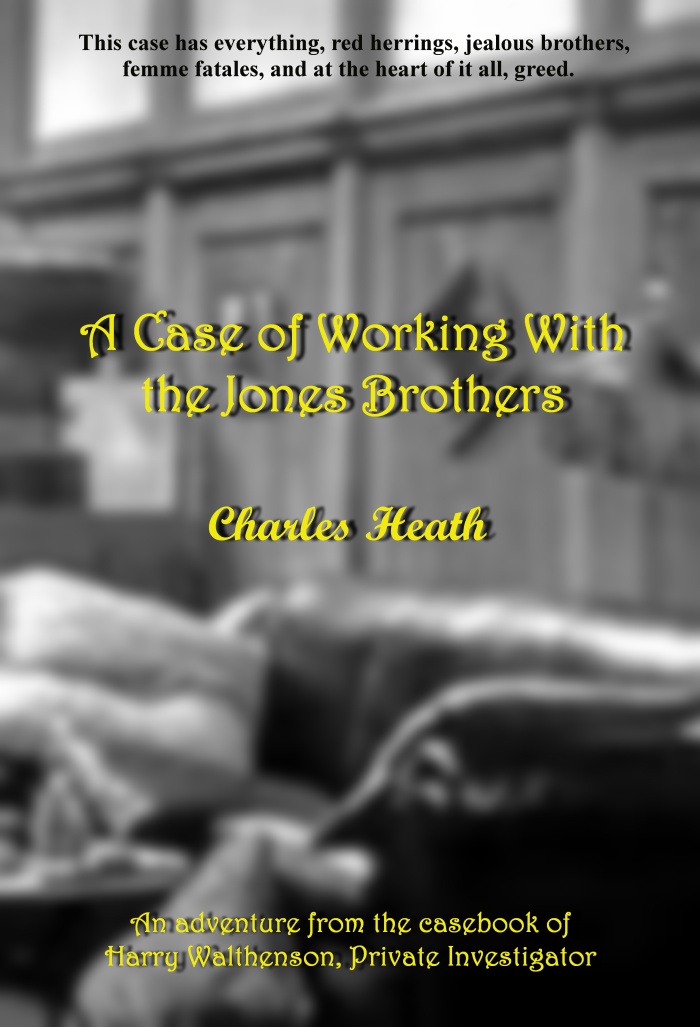
Now it’s called ‘A Case of Working With the Jones Brothers’, finished the first three drafts, and at the editor for the last.

I have high hopes of publishing it in May 2020.  It even has a cover.


PIWalthJones1

A to Z Challenge – J is for: Jump now…

J2020

It was 2 am, the ideal time to assemble a team that would be clandestinely boarding a vessel.

Dark and moonless, it was fortuitous rather than planned, and, dressed in black from head to toe, it was hard to see the others in the inky darkness.  At least something was on our side.

Up until this point, we’d had nothing but bad luck, though I was more of the opinion we had a traitor in our midst because some of the events could not have any other explanation.

It had caused me to be far more selective in who I gave details of the mission to.

Each of the four team members had arrived and let themselves into the shed.  It was not far from the ocean, and a small pier where there was a landing craft waiting.  From there, it would be a half-hour trip out to the ship in question, where, if we got close enough, we would either have to go over the side and swim, or pull alongside, but either way we’d have to go up a rope.

A lot depended on the crew member we had recruited getting a rope overboard, and given the luck we had so far, if there was a flaw in the plan, that was it.

Aside from the four people sitting in front of me, there were only three others privy to what was about to happen.  Now, with recent events, it was hard to imagine that one of them could betray us. That’s why I hadn’t completely told them what they were about to do, just that they needed to be prepared to get wet.

“I’m sure, now we’re here, you can tell us what’s going on.”  Robert was the most trusted of my team and my best friend.

“And why all the hush-hush,”  Linda added.  She had been amused at the secrecy and my explanation.

I was never very good at spinning a story.  She knew that but had not questioned why.

“It’s been touch and go for the last week.  It’s why we’ve all been on standby, with this last-minute call out.  We’ve been waiting for a particular ship to leave port, and now it has.  So, without further ado, let’s get to it.  A boat ride, just enough time to gather the courage to the sticking point, and then with any luck we won’t have to go into the water and swim, but a short shimmy up a rope.  I hope you’ve all been working out.”

The boat ride was in silence.  I’d worked with this group before and they were not big on talking.  Aside from the fact that noise traveled over water, and since we had a specially silenced motor on the boat, there was not going to be any unnecessary conversation.

We could see the ship once we reached the headland, and aside from it’s running lights, there were lights where I presumed the bridge was, and several in the crew quarters.  Closer again, I got the impression it was not moving, or if it was, it was very slow.  It was hard to tell in the darkness.  That same darkness aided our approach.

When we were within several hundred yards I could see that the ship was not moving, and, in fact, had the anchor out.

That was not expected.  Were they waiting for us?  Had they discovered the cream member who was working with us?  We’d know soon enough if there was no rope in the designated point, not far forward of the stern, a spot where we could maneuver the boat under the hull curvature.

The driver piloted the boat slowly to the designated point and the rope was there.  He would stay with the boat and wait.  The four of us would go up and collect what we came for.

I watched the three go up the rope before me, waiting for the last to stop at the top and then go over the side onto the deck.  It took nearly a minute before I got the signal it was clear to follow.

It had been too easy.

I went up the rope slowly, slower than the others, something else other than the object of the exercise on my mind.  Not three days before I had a conversation with my boss, telling him that I’d been doing the job too long and that it was time to retire.  Approaching forty wasn’t exactly retirement age, but in this job, lasting that long was almost a miracle.  The places I’d been, the sights I’d seen, and the people I’d met.  And how many lives I’d used up.

It was a dangerous thing, thinking about anything other than the job when you’re on the job.

I reached the top and pulled myself over the railing and onto the deck.  A little off balance it took a moment to stand.  By then it was too late.

Two of the three other members of the team were sitting by the superstructure, heads on their heads, two members of the crew were watching them, guns at the ready, and Linda had one pointing at me.

“I can’t imagine how MacIntyre thought he was going to convince Petra to defect.  Or how this charade of a rescue attempt was ever going to work.”

I put my hands up.  Not entirely unexpected.  “It was not the mission objective.”

“What…”

I was surprised that she had made her move so early.  If it was my operation, I would wait until we were well into the superstructure, heading to the cabin where Petra would be waiting, and then make the move.

Three seconds, three shots, two guards taken out, and Linda incapacitated.  She would not be moving or fighting back any time soon.  The Petra came out of the shadows, and I collected Linda’s gun and stood near her, just in case Petra missed the target.

Petra cut the two other’s bindings, and said, “get to the side and jump now.”

Linda looked up at me.  “What now?”

I shrugged.  “Time for us to leave.”  I gave Petra a nod, and she went over to the side, took one look back at Linda, shook her head, then jumped.

“You’re just going to leave me here?”

“If it were up to me, I’d shoot you, but MacIntire is getting a little soft in his old age.  But yes, I’m leaving you here.  Now, I really must go.”

I took a last look at Linda, who realized that if she moved it would only worsen her injury, and jumped, not exactly my preferred way of leaving the ship.

The boat came up alongside me and two hands dragged me on board, at the same time we could hear the sound of the anchor chain being pulled up, and the propellers creating a wash as the ship started moving.

Job done, and not one that pleased me.  “Let’s go home,” I told the driver, “it’s past my bedtime.”


© Charles Heath 2020

In a word: Bore, or is that boar

I’ve had the ubiquitous pleasure of being called one, and that is, a bore.

Probably because I spend so much time telling people about the joys and woes of being a writer.

You can be a tedious bore, cooking could be a bore, and then you could bore someone to death, and then you will bore the responsibility of, yes, doing just that.

Would it be murder or manslaughter?

But, of course, there are other meanings of the word, such as, on my farm I have a bore.

No, we’re not talking about the farmhand, but where artesian water is brought to the surface, in what would otherwise be very arid land.

Or, could be the size of a drill hole, and in a specific instance the measurement of the circular space that piston goes up and down.  And if you increase the size of the bore, the more powerful the engine.

Or it could refer to the size of a gun barrel, for all of you who are crime fiction writers.

But, let’s not after all of that, confuse it with another interpretation of the word, boar, which is basically a male pig.

It could also just as easily describe certain men.

Then there is another interpretation, boor, which is an extremely rude person, or a peasant, a country bumpkin or a yokel.

I’ve only seen the latter in old American movies.

There is one more, rather obscure interpretation, and that is boer, which is a Dutch South African, who at the turn of the last century found themselves embroiled in a war with the British.

In a word: Saw or Sore or Soar

In the first or is the second instance of the word Sore, we all know this malady can sometimes fester into something a lot worse.

Or that a person could be a sore loser

Or after spending an hour on the obstacle course, they come off very sore and sorry.  I never quite understood why they should be sorry because no one ever apologises to inanimate object.  Or do they?

Or perhaps he was sore at his friend for not telling him the truth.

Then, there’s another meaning, saw, which can mean the past tense of seeing, that is, I saw them down by the pool.

I could also use a saw, you know, that thing that custs through wood, steel, plastic, almost anything.  And yes, it’s possible someone might actually saw through a loaf of bread.

There are hand saws, electric saws, band saws, coping saws, even a bread knife, all of these have one thing in common, a serrated edge with teeth of different sizes, designed to cut, smoothly or roughly depending on the size.

Add it to bones, and you have Captain Kirk’s description of his medical officer on the Enterprise.  I’m not sure any doctor would like to be addressed as saw-bones.

But then, confusingly in the way only English can do, there’s another word that sounds exactly the same, soar

This, of course, means hovering up there in the heavens, with or without propulsion or oxygen.

Yes, it’s difficult to soar with eagles when you work with turkeys.  I’ve always liked this expression though most of the time people don’t quite understand what it means.


A to Z Challenge – H is for: How could that possibly happen…

H2020

I had hoped by the time I was promoted to assistant manager it might mean something other than long hours and an increase in pay.

It didn’t.

But unlike others who had taken the job, and eventually become jaded and left, I stayed. Something I realized that others seemed to either ignore or just didn’t understand, this was a company that rewarded loyalty.

It was why there were quite a few who had served 30 years or more. They might not reach the top job, but they certainly well looked after.

I had a long way to go, having been there only 8 years, and according to some, on a fast track. I was not sure how I would describe this so-called ‘fast track’ other than being in the right place at the right time and making a judicial selection.

When it was my turn to be promoted, I had a choice of a plum department, or one most of my contemporaries had passed over. At the time, the words of my previous manager sprang to mind, that being a manager for the most sought after department or the least sought after, came with exactly the same privileges.

And, he was right. I took the least sought after, much to their disdain and disapproval. One year on, that disapproval had turned almost to envy; that was when the Assistant Managers were granted a new privilege, tea, and lunch in the executive dining room.

“So, what’s it like?” John asked, when our group met on a Friday night, this the first after the privilege was granted.

He had been one of the three, including me, who had the opportunity to take the role. Both he and Alistair had both declined, prepared to wait for a more prestigious department. It hadn’t happened to them yet.

“The same as the staff dining room, only smaller. Except, I guess, the waitstaff and butler. They come and serve you when you have to go to them in the staff room. They’re the same staff, by the way, except for the butler.”

I could see the awe, or was it envy, in their eyes. “but it’s not that great. The Assistant Managers all sit at one end of the table, and we’re not part of the main group, so no sharing of information I’m afraid. And the meals are the same, just served on fancier crockery.”

“Then nothing to write home about?” Will was one of those who they also thought to be on a ‘fast track’. I was still trying to see how my ‘fast track’ was actually that fast.

“Put it this way, the extra pay doesn’t offset the long hours because you get overtime, I don’t, so on a good week, you’d all be earning more than me. Without responsibility, if anything goes wrong. I think that’s why Assistant Managers were created, to take the blame when anything goes wrong.”

That had been the hardest pill to swallow. Until I got the role, I hadn’t realized what it really involved. Nor had the others, and it was not something we could whinge about. My first-day introductory speech from Tomkins, my Manager, was all about taking responsibility, and how I was there to make his life easier. It was a speech he made a few times because he’d been Manager for the last 16 years, much the same as the others, and promotion if ever, would come when they died.

And Manager’s rarely died, because of their Assistant Managers.

“How old is Tomkins now?” Bert, a relative newcomer to our group, asked. He was still in the ‘in awe’ phase.

“About the same as Father Time,” I said. “But the reality is, no one knows, except perhaps for the personnel manager.” O looked over at Wally, the Personnel Department’s Assistant Manager. “Any chance of you telling us?”

“No. You know I can’t.”

“But you know?” I asked.

“Of course, but you know the rules. That’s confidential information. Not like what you are the custodian of, information everyone needs.”

Which, of course, was true. Communication and Secretarial Services had no secrets, except for twice a year when the company Bord of Directors met, and we were responsible for all the documents used at their meetings. Then, and only then, was I privy to all the secrets, including promotions. And be asked ‘What’s happening?’.

“Just be content to know that he’s as old as the hills, as most of them. It seems to me that one of the pre-requisites for managership is that you have been employed here for 30 years.”

Not all, though, I’d noticed, but there wasn’t one under the age of fifty.

And so it would go, the Friday night lament, those ‘in’ the executive, and those who were not quite there yet.
It seemed prophetic, in a sense, that we had been talking about Mangers and their ages. By a quirk of fate, some weeks before, that I learned of Tomkins’s currents state of health via a call on his office phone. At the time he was out, where, he had not told me, but by his the I believed it was something serious, so serious he didn’t want me, or anyone else, to know about it.

That phone call was from his wife, Eleanor, whom I’d met on a number of occasions when she came to take him home from work. I liked her, and couldn’t help but notice she was his exact opposite, Tomkins, silent and at times morose, and Eleanor, the life of the party. I could imagine her being a handful in her younger days, and it was a stark reminder of that old saying ‘opposites attract’.

She was concerned and asked me if he had returned from the specialist. I simply said he had but was elsewhere, and promised to get him to call her when he returned. Then I made a quick call around to see where he was and found that he was in Personnel. I left an innocuous message on his desk, and then let my imagination run wild.

At least for a day or so, the time it took for me to realize that it was probably nothing, the lethargy he’d been showing, gone.

I’d put it out of my mind until my cell phone rang, and it was from the Personnel Manager. On a Sunday, no less. In the few seconds before I answered it, I’d made the assumption that Tomkins’s secretive visits to the specialist meant he needed time off for a routine operation.

Greetings over, O’Reilly, the Personnel Manager, cut straight to the chase, “For your personal information, and not to be repeated, Tomkins will be out of action for about two months, and as that is longer than the standard period, you will become Acting Manager. We’ll talk more about this Tuesday morning.” Monday was a holiday.

All Assistant Managers knew the rules. Any absence of a manager for longer than a month, promotion to Acting Manager. Anything less, you sat in the office, but no change in title. There was one more rule, that in the event of the death of a manager, the assistant manager was immediately promoted to Manager. This had only happened once before. 70 years ago. If a manager retired, then the position of Manager was thrown open to anyone in the organization.

It was an intriguing moment in time.

Tuesday came, and as usual, I went into the office, with only one thought in mind, let the staff in the department know what was happening, of course, the moment I was given the approval to do so by Personnel.

Not a minute after I sat down, the phone rang. I picked it up, gave my name and greeting. It was met with a rather excitable voice of the Assistant Manager, Personnel, “I just got word from on high, you’ve been promoted to manager. How could that possibly happen…”

Then a moment later, as realization set in, “Unless…”


© Charles Heath 2020

In a word: Dog

Yes, it’s that little or big furry thing that’s also known as man’s best friend, a dog.

But the word has a number of other meanings, like a lot of three-letter words.

It can also mean to follow someone closely.

If you are going to the greyhound racing, you could say you’re going to the dogs, or it could mean something entirely different, like deteriorating in manner and ethics.

Then there are those employers who make their workers work very hard, and therefore could be described as making them work like a dog.

Some might even say that it is a dog of a thing, i.e. of poor quality.

There’s a dogleg, which could aptly name some of those monstrous golf course holes that sometimes present the challenge of going through the wood rather than around it.

Tried that and failed many times!

A dog man used to ride the crane load from the ground to the top, an occupation that would not stand the test of occupational health and safety anymore.

And of course, in a battle to the death, it’s really dog eat dog, isn’t it?

A to Z Challenge – G is for: Going once, going twice…

G2020

It was the small town that we had visited once, some years ago, that had enticed me back.

Those had been happier times, times when the stench of money hadn’t overtaken sensibility, and who we really were.

Not that I had changed all that much, except for the upper west side apartment, and posh car to go with it, but what had disappointed me was the change in Liz, the woman I thought once as the love of my life.

Without the trappings of wealth, she was the kindest, most thoughtful and generous person I knew, but that had changed when I became the recipient of an inheritance that beggared belief.  We both made a promise from the outset that it would not change us, but unfortunately, it did.

And that was probably the main reason why I was standing outside an old fixer-upper house on several acres overlooking the ocean.

I’d asked Liz to come, but she was having a weekend away in Las Vegas with her new friends, or as one of the ladies rather salaciously said, a what happens in Vegas stays in Vegas kind of weekend.

Charmaine had told me about the house, one that she had admired for a long time, but didn’t have the means to buy it.

Charmaine was a painter, a rather good one, and both Liz and I had met her on a weekend away upstate, and I’d bought one of her landscapes to hang in our new apartment.  Liz hated it, but I think that had more to do with the painter than the painting, and that was because Charmaine had flirted with me, and that, I had observed over time, was how she was with everyone.

She called it her sales technique.  After all, it had worked on me.

I listened to the auctioneer go through the rules of the action and then move on to a physical description of the property.  I’d been to several viewings and got a good idea of what was needed if I was to buy it.  It had good foundations and had suffered from a lack of TLC.  It was how the auctioneer summed up.

When he called for the first bid, I felt a hand slip into mine, and a glance sideways showed it to be Charmaine.  I had asked her along for support but she had something else to do, but it appeared now, she hadn’t.

“So,” she whispered next to my ear, “you were serious about this place?”

I had been dithering, not being able to make my mind up, but Liz, in the end, made the decision for me.  I’d overheard a snippet of conversation with one of her new friends, and, to be honest, I’d been surprised.

“Perhaps it was time to find a hideaway.”

“Things that bad?”

I shrugged.  “Maybe I’m writing too much into it.  At any rate, I needed an excuse to get out of town, and being here was as good as any.”

The first bid came in at 450,000.   I knew the reserved was about 700,000, and I was prepared to 850,000.  But I was hoping to spend less than that because the renovations would be about 250,000.

“We could go and have a picnic.  It’ll certainly cost less than buying this place.”

“I’m here now.”

Holding hands was just one of Charmaine’s ‘things’, and I had never written anything into what might have been called a relationship of sorts.  We were not lovers, and the conversation had never been steered in that direction, but I did find myself gravitated towards her when Liz was off doing her thing with her friends.  To be honest, I just liked the idea of a picnic and watching Charmaine paint her landscapes.

I raised the bid to 500,000.  Another from the previous bidder, 550,000.  Another at 600,000.  It seems there were three bidders for the property.  The other sixteen people attending were observers, probably locals interested in how this would help their property value.

I went 625,000 when the auctioneer changed the increment after a lack of bidding.  It was countered, moving to 650,000.  Another at 657,000, and then the first bidder went to 700,000, the reserve.

“You do realize the other bidders are friends of the owner and are there to push the price up?” Charmaine whispered in my ear.

I’d heard of it happening, but I’d not suspected it until she mentioned it.

“Going once, going twice at 700,000.”  The auctioneer looked at me.  “I’ll accept 10,000 increments.”

I nodded.  710,000.  It quickly moved to 800,000, after I bid 790,000.

The auctioneer looked at me expectantly.  “810,000, sir?”

That was more than I wanted to spend though an elbow in the ribs was the clincher, and when I declined, there was an air of disappointment.

“Going once, going twice, all done at 800,000?”  A look around the crowd confirmed we were all done, and the gavel came down.

“Looks like we’re going on a picnic,” she said.  “I’d expect a call in an hour or so.”

Two things happened that weekend, both of which surprised me.  The first, Charmaine was right, I did get a call, and finished up with a hideaway in the country, overlooking the ocean.  The second, Liz didn’t come back from Las Vegas.  She had apparently found someone new, someone more exciting, or so she said.

I guess I was disappointed but not overly concerned.  She had changed and I had not and if the truth be told, we were drifting apart.  We parted amicably, sold the apartment, and moved on, each in a different direction.

I had a new residence, and renovations to take my mind off the break-up, and when I told Charmaine, she was just said she didn’t believe we were that perfect match.  And in the light of my new status, I could now ask her to come and stay in the spare bedroom, a lot better, I said, than the one person tent she had been using, an offer she readily accepted.

Until, a year later, it became something more than that.


© Charles Heath 2020

A to Z Challenge – F is for: Follow that cab…

F2020

Nothing ever good comes from eavesdropping.

Or, so my mother said, once, with such feeling that I suspect she had some experience of having done so. It might explain the enmity between her and her older sister, the aunt we never saw.

Except all that changed when I received an odd email from a woman who claimed to be that very aunt.

We had all been warned about scams that came from dubious sources online, and this initially struck me as one. I would need more information before I answered.

That meant poking the bear, that is, asking my mother about her sister.

And coming right out with the words she hoped she’d never heard.

“Aunt Guenivere sent me an email, asking if we could meet. It seems she wants to meet the nephew she hasn’t seen since I was born. What happened to you two?”

It brought a look of total hatred in return.

“You would be wise not to respond. That woman is just plain evil.”

“You do realize that a statement like that makes it even more imperative that I should meet her. If you’re not going to tell me what happened, I’m sure she will.”

“Then if you must, you must.”

It wasn’t resignation but suppressed rage. Whatever had happened, it was something she believed no one would believe her, or understand, least of all me.

With that, she stood, and walked out of the room, leaving me with the ominous feeling that it would be the last time I saw her.
After verifying that my so-called aunt was Aunt Guenivere, I arranged a meeting in a public place, a tea room in the next town to where I lived. And it wasn’t going to be hard to recognize her, she would just an older version of my mother.

I knew this because I had found a photograph of my mother and her two sisters, all of who looked very much alike. I’d know about the younger sister, she had died in an accidental car crash many years before, and what my mother regarded as a wasted life.

I saw her about the same time she saw me.

And she just made it to the table when her cell phone rang. She smiled, put a hand up and asked for a moment, and then went back outside. I watched her walk up and down, slowly at first, but I could see the conversation was getting heated.

After a few minutes, I went outside to see if I could be of any assistance.

Apparently not. One look was enough, and I knew what it meant. At least her sister and my mother shared the same facial expressions when angry.

Then the conversation ended. I thought, for a moment, she was going to throw the phone on the ground, and only just managed to stop herself.

Instead, she came over and said. “I’m sorry but something has come up and I have to go. I’ll call you.”

With that, she waved down a taxi, one stopped, and she jumped in.

Another pulled in behind her taxi and on the spur of the moment, and said with a flourish, “Follow that cab.”

The driver turned to look at me, and then said, “You’re kidding.”

I held up a hundred dollar note and said, seriously, “This is yours if you don’t lose them.”

Incentive enough.

It was a lot easier to follow that taxi than I thought. We caught up and the first set of lights and then proceeded to miss every second intersection as if the universe knew I needed to keep her in sight.

All the way to the upper west side and a very expensive apartment block. I paid the cabbie and jumped out, just in time to see a very familiar figure join my aunt.

My father.

And they didn’t look like people who didn’t know each other, or who were at war.

They remained outside the apartment block, and I could see my father had arrived by cab, and it was waiting for him.

I got as close as I could, hidden effectively behind the bushes that lined the building entrance. They were speaking loudly, which surprised me

“What the hell were you thinking,” he said, not angrily, but I could tell he was agitated.

“I was thinking it was time someone told him the truth.”

What truth?

“You know what Evelyn thinks of that, and I do too. You made an agreement.”

“I’ve changed my mind. After all, he is my son, not hers.”


© Charles Heath 2020

Conversations with my cat – 93

20160917_075223

This is Chester.  We’re getting by during the ‘stay at home’ order.

I’m doing just that, though it sometimes feels like I’m in jail, on the inside looking out.

“Now you know how I feel”, Chester tells me, after jumping up on the window ledge to look out the window, trying to see what had caught my interest.

I don’t tell him I’m basically staring into space.

Except, a car passes, not fast, not slow, but much like the rest of the traffic that passes by.  Or used to.  With the order to stay at home, and the fact schools are not open, there have been fewer and fewer cars passing by.

“Didn’t that car…” Chester mutters.

He’s right.  The same car just went back the other way.  Slow, but not too slow.

“Perhaps’s he’s looking for a house, a particular address.”

We watch and wait.

Five minutes later the car has returned and stops outside my window.  A man gets out the passenger side, says something to the driver, then closes the door.  He starts walking back up the street from where the car had just come.

The car drives off, then a minute later is back, and parks on the other side of the road.  We can see the driver.  Not the sort of person you’d want to need on a dark night.  Tattoos on his arm, and smoking a cigarette, negligently stopping ask on the road below his window.

“He’s watching,” Chester says.

“He’s a lookout?”

We’re both thinking the same.  A crime is being committed.  They’ve scoped the street for an unattended house, a rarity for obvious reasons, though these days robbers rob the house while you’re still in it.

We wait.  Three minutes later the other man comes running very quickly to the car, jumps in and they drive off very quickly before the man had closed the door.

Seconds later another man appears with a baseball bat in his hand.

“Close call,” Chester says, interest now waning.  He jumps down.  “Pity they didn’t catch the robber.”

Perhaps.  But one thing is for sure, those robbers will not be back.

Diversion over, back to boredom.  Chester has gone back to one of his hiding spots.  I’m going to do another crossword.

Six months is going to be a long, long, long, long time.

The story behind the story: A Case of Working With the Jones Brothers

The write a private detective serial has always been one of the items at the top of my to-do list, though trying to write novels and a serial, as well as a blog, and maintain a social media presence, well, you get the idea.

But I made it happen, from a bunch of episodes I wrote a long, long time ago, used these to start it, and then continue on, then as now, never having much of an idea where it was going to end up, or how long it would take to tell the story.

That, I think is the joy of ad hoc writing, even you, as the author, have as much idea of where it’s going as the reader does.

It’s basically been in the mill since 1990, and although I finished it last year, it looks like the beginning to end will have taken exactly 30 years.  Had you asked me 30 years ago if I’d ever get it finished, the answer would be maybe?


My private detective, Harry Walthenson

I’d like to say he’s from that great literary mold of Sam Spade, or Mickey Spillane, or Phillip Marlow, but he’s not.

But, I’ve watched Humphrey Bogart play Sam Spade with much interest, and modeled Harry and his office on it.  Similarly, I’ve watched Robert Micham play Phillip Marlow with great panache, if not detachment, and added a bit of him to the mix.

Other characters come into play, and all of them, no matter what period they’re from, always seem larger than life.  I’m not above stealing a little of Mary Astor, Peter Lorre or Sidney Greenstreet, to breathe life into beguiling women and dangerous men alike.


Then there’s the title, like

The Case of the Unintentional Mummy – this has so many meanings in so many contexts, though I image back in Hollywood in the ’30s and ’40s, this would be excellent fodder for Abbott and Costello

The Case of the Three-Legged Dog – Yes, I suspect there may be a few real-life dogs with three legs, but this plot would involve something more sinister.  And if made out of plaster, yes, they’re always something else inside.

But for mine, to begin with, it was “The Case of the …”, because I had no idea what the case was going to be about, well, I did, but not specifically.

Then I liked the idea of calling it “The Case of the Brother’s Revenge” because I began to have a notion there was a brother no one knew about, but that’s stuff for other stories, not mine, so then went the way of the others.


Now it’s called ‘A Case of Working With the Jones Brothers’, finished the first three drafts, and at the editor for the last.

I have high hopes of publishing it in May 2020.  It even has a cover.


PIWalthJones1