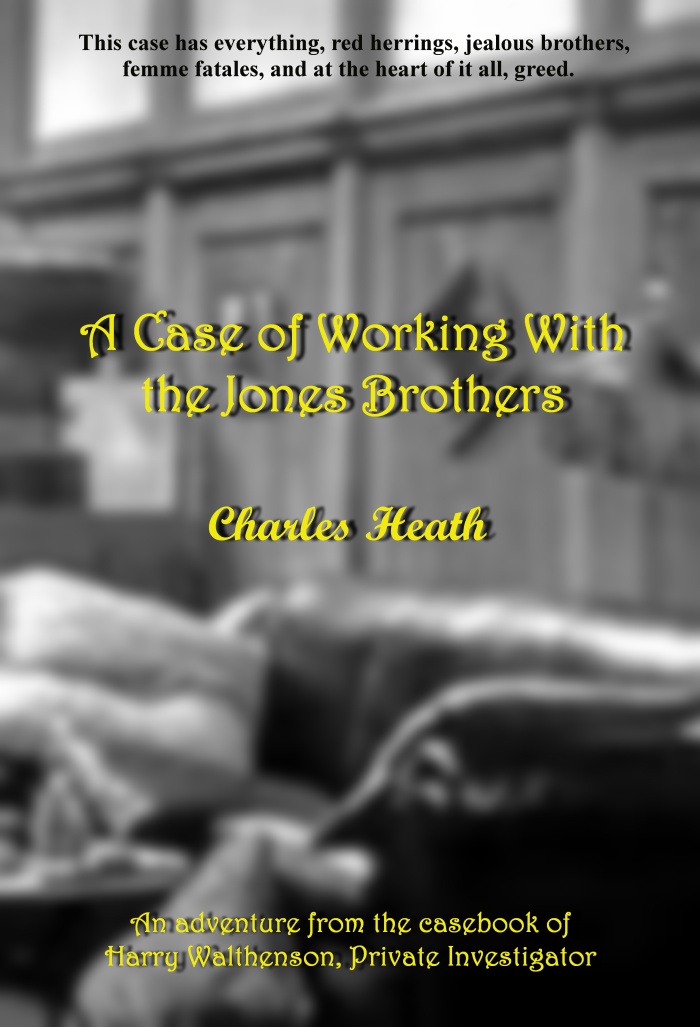
The story behind the story: A Case of Working With the Jones Brothers

The write a private detective serial has always been one of the items at the top of my to-do list, though trying to write novels and a serial, as well as a blog, and maintain a social media presence, well, you get the idea.

But I made it happen, from a bunch of episodes I wrote a long, long time ago, used these to start it, and then continue on, then as now, never having much of an idea where it was going to end up, or how long it would take to tell the story.

That, I think is the joy of ad hoc writing, even you, as the author, have as much idea of where it’s going as the reader does.

It’s basically been in the mill since 1990, and although I finished it last year, it looks like the beginning to end will have taken exactly 30 years.  Had you asked me 30 years ago if I’d ever get it finished, the answer would be maybe?


My private detective, Harry Walthenson

I’d like to say he’s from that great literary mold of Sam Spade, or Mickey Spillane, or Phillip Marlow, but he’s not.

But, I’ve watched Humphrey Bogart play Sam Spade with much interest, and modeled Harry and his office on it.  Similarly, I’ve watched Robert Micham play Phillip Marlow with great panache, if not detachment, and added a bit of him to the mix.

Other characters come into play, and all of them, no matter what period they’re from, always seem larger than life.  I’m not above stealing a little of Mary Astor, Peter Lorre or Sidney Greenstreet, to breathe life into beguiling women and dangerous men alike.


Then there’s the title, like

The Case of the Unintentional Mummy – this has so many meanings in so many contexts, though I image back in Hollywood in the ’30s and ’40s, this would be excellent fodder for Abbott and Costello

The Case of the Three-Legged Dog – Yes, I suspect there may be a few real-life dogs with three legs, but this plot would involve something more sinister.  And if made out of plaster, yes, they’re always something else inside.

But for mine, to begin with, it was “The Case of the …”, because I had no idea what the case was going to be about, well, I did, but not specifically.

Then I liked the idea of calling it “The Case of the Brother’s Revenge” because I began to have a notion there was a brother no one knew about, but that’s stuff for other stories, not mine, so then went the way of the others.


Now it’s called ‘A Case of Working With the Jones Brothers’, finished the first three drafts, and at the editor for the last.

I have high hopes of publishing it in May 2020.  It even has a cover.


PIWalthJones1

A to Z Challenge – N is for: No stone unturned…

N2020

Mondays were usually a slow day to start the week, a brief few hours after the storm the was every Friday. Some chose to come in late, others gathered on arrival to have a team debriefing.

Our department chose to have a debriefing, and it was my job to analyze all the data and turn it into a graphical representation that basically said the business was heading in the right direction – up.

But, this Monday morning, the circumstances were slightly different.

The head of the company had personally sent both an email and a memo to every employee, an event that had never happened before.

In fact, for most of us, it was an eye-opening discovery, one where had the company not become engulfed in a scandal of international proportions, his identity might have remained a secret.

Not that it mattered to the 15,000 odd people who worked for the company, because the bottom line was that it would not affect us, or our employment.  Well, that was the message the email and the memo was primarily about.

Was it too little too late?

The problem was that the morning’s paper’s headlines screamed scandal in large letters and then went on to describe how the company was basically a front for laundering money associated with various criminal activities. It stopped short of accusing the company’s upper management of being criminals, but it was clear, reading between the lines, they had to know something was wrong.

I walked into the meeting room where all of the Department’s staff were seated, talking among themselves, that dying down the moment I closed the door behind me. On the desk in front of each was one of the three morning papers, all with basically the same story.

I didn’t bring a paper in with me, nor a copy of the email, or the memo. I was hoping the meeting was not going to be about the scandal.

I was wrong.

It was one of those companies where everyone knew everyone. I knew everyone in the room, and regarded most as friends as well as workmates. The company promoted from within and on merit, and with this, I had the respect of everyone who worked under me.

I could see by the mood, and looks of expectation, that trust was going to be tested.

“I suspect that everyone has seen the news, and hopefully read both missives from management regarding the situation the company finds itself.”

That was met with a murmur of agreement.

“It was also, for some, a surprise.”

For others, it was not. Our department was basically in place to ensure that all transactions were conducted properly and that clients’ accounts were managed within the guidelines set by the company, and the various government institutions responsible for financial affairs.

Several of the senior officers had come to me with what they regarded as anomalies, and I have given them the authority to investigate. It was also within my remit to advise the relevant government authority. Most of the anomalies had simply been oversights by the account manager, except for one, which as far as I was aware, had been cleared.

Or not.

“Can we safely assume that Wally Anderson’s somewhat abrupt was not as described?”

Wally Anderson’s abrupt departure had been described to me in a one-line email, ‘taking some personal time to work through some family issues’. In the week leading up to his departure he had become increasingly agitated, and one call one of the others had taken in his absence was from a reporter.

It was one of his accounts that remained doubtful, until shortly after he left when an external investigator was brought in.

But I had a difficult line to walk, trying to placate both sides of the spectrum and management, and as a leader. Respect could be won or lost in a matter of words.

“That might or might not be the case, but the odds are, given what we’re reading, that there may be room for doubt. However, despite what we may conclude, or deduce, it is better for all of us to keep an open mind. I suspect, at some point, again based on what I read, we might be approached by the police or representatives of a number of regulatory organizations for information.”

It was as far as I got.

The side door swung open, and my superior, the Chief Accountant, strode in, along with the mystery man who was, the papers said, the Owner, followed by the harried personal assistant.

“Mr. Nelson…”

The Chief Accountant stood front and center to the group. I thought it wise to stand off to one side, the opposite, in fact, the Owner, now standing just inside the door, next to his PA who was quietly talking into her cell phone.

“I’ll take over from here, Max.”

He switched his attention back to the group and took a few seconds to run his eye over all over them, almost as if he was looking for someone or something.

“I have spent the last 48 hours in rather tedious discussions with the regulators who insist that they received information about the Ridley investigation. Unfortunately, without consulting the company, he took part of the results of the investigation to them. Was anyone here aware of his actions?”

Another eye cast over the group, and, in the end, a glance at me.

I felt responsible to answer for the group.

“Investigations are conducted by individuals, and as far as I was concerned, the Ridley investigation was his. As equally that after he departed, that investigation was completed and cleared. Are you intimating that it wasn’t?”

I knew as much about it as the others.

“It was, until someone else reopened it, and reported it. We believe it was someone in this room.”

“That’s not possible,” I said. “I have oversight of all the officers in this room, and the ability to monitor everything they do and everything they look at. You know the security protocols in place in the software itself.”

“An investigation into the software has been implemented, and it shows that certain log files were altered so that the user log wouldn’t show who looked at the records. Someone with database experience.”

“We’re basically auditors not database managers.”

“Well, someone apparently is. Everyone is on notice. We will find out who it was, and believe me when I say we will leave no stone unturned in the process.”

An almost imperceptible not from the Owner, the harried PA was still on the cell phone, the Chief Accountant gave the group another steely look, then glared at me, said, “My office, one hour,” then left pulling the other two along in his wake.

I cast an eye over the group, picking out those whom I suspected were capable of performing such a search and destroy operation. Three.

“My door is open for anyone who might have any information, with the promise of anonymity.”

I left them with that and also left.

What should have been a quiet morning’s discussion just became a witch hunt where someone would be burnt at the stake. Whether they were guilty or not.


© Charles Heath 2020

In a word: Second

It would be very interesting if duelling was still allowed.  There are a few people I’d like to stand toe to toe with, take ten paces, then test my ability to shoot with an old style flint duelling pistol.

What’s this got to do with anything?

It’s where our word of the day comes in.  If I lose my nerve, or I know my opposite number is a better shot, my second would have to stand in my place.

It’s,  if anything, an older use of the word.

Of course, it mainly means, on one hand, coming second in a race or a competition, not exactly the place you really want to be, simply because no one really remembers who came second.

It plays host to a plethora of statements using second as part of the saying, such as,

Second rate, second hand, even if it had more than one owner, second best.

But then there’s a few more that mean something else like a second look, mainly because you didn’t trust your eyes, second nature, it’s been drilled into you (a rather painful idiom if it truly was) and second sight, though this might not necessarily be a verifiable attribute.

And, of lesser note, I’m not necessarily sure I’m second to none.

On the other hand, and pardon the pun using this definition, it also describes a length of time, very short in fact, and it takes 60 of them to make a minute.

Hang on, it’ll only take a second.  Yes, we often use the word in vain.  I doubt there is any one of us who could do anything useful in a second.

A to Z Challenge – M is for: More or less…

M2020

It was meant to be time to reacquaint as brothers.

Louis and I had not seen each other for decades, and when he returned, about a week before, I got the impression there was more than just ‘missing his brother’ going on.

But that was Louis. He was never one to say what or how he felt about anything, preferring to be the strong silent type, and it had not fared well for him transitioning from teenager to adult.

As for me, when our parents split up, Louis went with our father, and I stayed with our mother, and, given the amount of acrimony there was attached to the split, it was no surprise to anyone that Louis and I had effectively become estranged.

In fact, when I had tried to find them, about two years after the split and our mother had died suddenly, all I found were loose ends. They had effectively vanished.

With that part of my life effectively over, I had married, had children and watched 30 years disappear before Louis suddenly popped up. He simply knocked on the front door one afternoon, Helen answered it, and within minutes they were the best of friends. I’d had that rapport, once, many years before, but life and circumstances had all but ruined that.

Or perhaps that was just me, worn down by that same life and circumstances we were all supposed to take on the chin.

His arrival was a welcome distraction, and when, after a week, he suggested that he and I go on a hike, the sort our father used to take us on when we were a family, I agreed. Helen was happy to be rid of me, and I guess a week without our arguing would suit everyone.

It was probably fortuitous timing. Helen and I had finally got to the point where divorce lawyers were about to be called in. The children had all moved on and had children and problems of their own, and we, as parents just didn’t gel anymore.

Besides, I said, just before I joined Louis in the truck, ready to embark for the wilderness, it would be time to clear my head.

And by day two, my head was clear, and Louis, taking the lead, led us along the ridgeline, a trek he said, that would take us about seven hours. We’d stopped the previous night in a base camp and then headed out the next morning. We were the only two, it being early in the season with snow still on the ground.

Above was the clear cloudless blue sky and in front of us, trees and mountains. There was snow on the ground but it was not solid and showed no signs of human footsteps, only animals. The air was fresh, and it was good to be away from the city and its pressures.

Approaching noon, I’d asked him if we were about halfway. I knew he was holding back, being the fitter of us.

“More or less.”

“More or less what, more closer or less close than we should be.”

I watched him do a 360-degree turn, scoping out our position. It was a maneuver I was familiar with from my time with the National Guard. I’d used my backcountry experience that I’d learned from my father, as a skill I thought they might be able to, and eventually did, use. I got the feeling Louis was looking for something.

“You get the impression we’re not alone?” I asked. I had that nagging feeling something was not right, not from about two miles back in the forest. It was like my sixth sense being switched on.

“Doesn’t seem so, though there have been a few animals lurking behind us, probably surprised anyone’s about this time of the year. It’s been a while, so I’m just getting a feel for the trail. This is, for now, our mountain.”

There was a time, from a time when we were kids, that I could tell when he was lying. He was better at covering it, but it was still there.

Where we’d stopped was a small clearing, a staging point that would be used by other trekkers, still overgrown because of lack of trekkers. Ahead there were the signs of a trail, and after six months, it would become clear again. In places, as we had made our way from the base camp, sections of the distinctive trail had all but disappeared, but Louis seemed to know where he was going, and it was not long before we had picked up the trail again. This spot was a lookout, giving a spectacular view of the valley below, and a fast running river through it.

I walked to the edge and looked up and down the valley, and at the trail that ran along the cliff for a short distance. I looked down, not the wisest of things to do, but it was long enough to catch sight of several charred pieces of wood. On top of the snow. The thing is, someone had been along this trail before us, and recently, something I thought wise to keep to myself.

Back at the log, I sat for a moment and drank some water, while Louis stood patiently, but impatiently, for me to join him.

“You look like you’ve got somewhere to be.” Probably not the wisest thing to say but it was out before I could stop it.

A flicker of annoyance crossed his face, then it was gone. “If we stop too long, joints will freeze up, especially when it gets colder.”

“Sorry.” I put the container back in the pack and joined him. “Let’s go. The cold and I don’t get along very well, and it’s been a long time since the last time I ventured into the great unknown.”

“Helen said you gave up trekking when you married her.”

“She wasn’t a trekker, Robbie. We all have to give up something, sooner or later.”

Another hour, feeling rather weary, we’d come to another small clearing and a place where I could sit down.

“You always were the weak link, Robbie. Admittedly you were younger, but you never seemed to grasp the concept of exercise and fitness.”

I looked up at him and could see my father, the exact stance, the exact words, the exact same sneer in his voice. It all came rushing back as if it was yesterday, the reasons why I chose to go with our mother, that another day with his bullying would be one too many. And he was a bully. And, in an instant, I could see the apple hadn’t fallen far from the tree.

“Out of shape after languishing in an office, perhaps,” I said, “but I was never the disappointment our father always considered me.”

“You didn’t join the army, follow in his footsteps, as he wanted us to do. I did. Proudly served, too.”

I could see it. Like father, like son. No surprise Robbie had followed in his father’s footsteps. And it was a clue as to what Robbie had been doing since I saw him last.

“So, tell me about it.”

“You wouldn’t understand.”

“No, I probably wouldn’t. Let’s push on.”

I’d also thought, along the way, he might ask questions, delve further into the problems that Helen and I were having, but I knew she had told him all he needed to know. I’d been held up at the office, and had rung to ask her to take him to dinner, get to know him, she might get to learn something of my life before I met her, details of which I hadn’t told her other than that my mother was dead, my father had left and taken Robbie with him. My past, I’d told her from the outset, was not something I would talk about.

I didn’t ask what they talked about, but I could see a change in both of them. Perhaps she had succumbed to Robbie’s charm, back in school all the girls did, but they all soon learned he was not a nice person, not once you got to know him. I didn’t warn her, and perhaps that was regrettable on my part, but it reflected the state in which our relationship had reached.

I’d also tried, once or twice, to find out if our father was still alive, but he deflected it, changing the subject. That meant he was still alive, somewhere, perhaps annoyed at Robbie for coming to see me. If I was a betting man, I’d bet our father would have denied permission for
Robbie to do so, even if he was a grown man and capable of making his own decisions.

Odd, but not surprising. Even now I could remember my father had secrets, and those secrets had fed into the breakup of our parents.

“So, you’ve been dodging it for days now, but you still haven’t told me if dad is alive or dead. He’d be about seventy-odd now.”

He stopped and turned to face me. “Would it matter if he was alive? I doubt you’d want to see him after what mother must have said about him.”

Interesting that he would think so. “She never had a bad word for him, and wouldn’t hear of one spoken, by me or anyone. And I have wondered what became of him, and you. At least now I know you spent time in the Army. If I was to guess what happened, that would be high on my list.”

“No surprise then you became an office wanker.”

Blunt, but, to him, it was a fact. I’d used that expression when telling Helen one time after a very bad day.

“We can’t all be heroes, Robbie.”

I put my hand up. Alarm bells were going off in my head. “You can come out now,” I yelled.

Robbie looked puzzled.

“I know you’re there. You’ve been behind us for about a half-mile now.”

A few seconds passed before the cracking of a twig, and then a person in a camouflage kit came towards us.

He’d aged, hair and beard grey in places but almost white now, but the face was familiar.

“What brings you to this part of the woods, Dad. Or is it just an unlucky coincidence?”


© Charles Heath 2020

What happens after the action packed start – Part 40

Our hero knows he’s in serious trouble.

The problem is, there are familiar faces and a question of who is a friend and who is foe made all the more difficult because of the enemy, if it was the enemy, simply because it didn’t look or sound or act like the enemy.

Now, it appears, his problems stem from another operation he participated in, and because of it, he has now been roped into what might be called a suicide mission.


I left the others out the front of the hut in Barnes charge, except for Williamson who stayed inside, feigning illness.  If everything went according to plan, a sketchy plan at best, Monroe would slip the diamonds to Williamson, and then melt back into the bush, heading back towards the fork in the road heading to the airstrip.  She would then report on what troops were between us and our objective.

I signaled for Davies to join me.

The commander and the man who’d reported to him earlier strode across the compound to a smaller building that might pass as a jail.  There was a guard out the front who jumped up and snapped to attention when the commander came up the steps.

“Open the door.”

The guard fumbled with a ring of keys, found the one for the door, and unlocked it.

The commander looked at me.  “You may speak to them for five minutes.”

“Alone.  You have my word we’ll not try anything.”

He nodded at the guard.  “Bottom of the steps.  Don’t let them out of your sight.”  To me, he pointed to another building about 50 yards away, “I’ll be there, don’t keep me waiting.”

We waited for him to come down the steps and start striding to his office, then went up the stairs, and I knocked on the door.  “My name is James, and I’m here with Davies to take you home.  We’re coming in.”

I opened the door slowly pulling it towards me, and the odor that came out of the room was that of people who had not been allowed to wash for several days, if not longer.  Once the door was fully open and the interior lit, I could see two stretchers and two men sitting up, struggling with the light in their eyes.

At least they were able to sit up.

Our information was they had been captive now for about seven months, and, looking at them, they didn’t seem to appear to badly off.  They showed signs of weight loss, and pallid skin, but not to the point of being maltreated or starved.

“Who did you say you were?”  The man on the left was about 50ish, grey thinning hair, and I suspect once a lot bulkier than he was now.  There was an air of brashness about him, but that would have been beaten out of him long ago.  Now he was just a shell of his former self.

“Sgt James, and Lieutenant Davies.  Part of the rescue team sent to bring you home.  A Colonel Bamfield sent us.”

“You took your time.”

Th either man spoke.  Younger, a military type, perhaps the other man’s bodyguard.  He had a few scars, so I expect he had offered some resistance and paid for it with the butt of a gun or two.

“We tried once, but it failed.  There were not the people who had been holding you at the time though, were they?”

“No.  If that was an attempt, they were the people who came to ‘rescue’ us, only it was a means for them to use us for ransom.  It’s taken them a while to find the right people.  Bamfield you say?  Who is he?”

“Runs the military’s operations that the military doesn’t want to acknowledge.  We’re here, but we’re not here if you know what I mean.”

The older man shook his head.  “It doesn’t matter.  What happens now?”

“I go and have another chat with the commander.  We exchange gifts, and we leave.”

“You do realize that’s not going to happen,” the military type said with a degree of despondency.

“How so?”

“There are about 50 men here, possibly more, all armed, and all waiting for you to arrive.  I expect they’ll take the ransom and then kill all of us.”

“Yes, I had thought that might be the case.  But, don’t worry.  We have a few tricks up our sleeve.  So, gather your belongings, if you have any, and wait for us to come back and get you.”

“Are you going to drive out of here?”  The military man spoke again.

“A short distance, yes.  There’s an airstrip not far from here, so all we have to do is get there, and we’re halfway home.”

“There’ll be government troops there.  It’s used for people coming in to visit the national park and they provide local security.  Boroko knows the Captain in charge there, and they have an arrangement.  He’ll know what your options are, and you’ll just be walking into a trap.”

That had always been a possibility, but Bamfield wouldn’t send us there unless there was a chance we could use it for our escape.  But, what the man was saying was just another wrinkle in a plan that had lots of wrinkles.

“Provided you get a mile from this place before being attacked.”

“All very interesting points,” I said.  “But, like I said, pack your stuff and let me worry about the details.  Feel free to take in some fresh air while we’re gone.  It won’t be long.”

“I’ll stay,” Davies said.

“OK.”

I took a last look at the two, both now struggling to their feet.  They might not be in as good a condition as the commander had said.  As long as they could cover about half a mile at best, everything would be fine.

I walked slowly back to the hut where Williamson had just emerged, and I went over to him.

He handed me a package that hardly made a dent in my pocket.  It was probably the reason why diamonds were used, small, and easily transportable.  Gold bars would have been a different, and far more difficult, proposition.

From there, I walked more briskly to the commander’s hut and as I approached he came out.

“Everything in order?”

“It is.”

I pulled the package out of my pocket and handed it to him.  “You can check the contents while I wait here.”

A smile, like a cat who swallowed the canary.  A nod to a soldier standing behind me, I could hear the weapon being trained on me.

“I guess this is where…”

A second later the soldier crumpled to the ground, a bloody mess where his head had just been.  A second raised his gun and suffered the same result.

“Call off your dogs’ commander.  I’m sure we both don’t want to see people die needlessly.”

Two hands for a signal to lower weapons.

“Your missing people.”

“Out there, strategically placed.  Excellent marksmen too.  At the moment they’re showing restraint.  It’s up to you how long that lasts.”

He motioned to the guard at the prisoner’s hut to take them to the cars, “Join them, Sargeant James, I’ll be along when I’ve checked the diamonds.”

By the time the two men had joined the rest of the team at the cars, the commander had come out of his office and was walking towards us.

“Three cars, we’ll keep the other.  I assume you’re heading towards the airstrip.”

“It’s one of our options.  I hear the government had a platoon of soldiers there under the command of a Captain.  You might want to warn him we’re coming.  You might also want to warn whoever you have in the field between here and there we’re coming.”

“I can’t guarantee your safety once you leave the compound.  If there is anyone out there, it will not be my men.  We have an agreement remember.”

“Good.”  

While we were talking the others had got themselves into the cars and started the engines.  Time was of the essence.

We walked down to the barrier, and once again he ordered his guards to remove it.

Once they had the cars drove past and then the last car stopped just the other side, waiting for me.

“I wish you good luck, Sargeant James.”

“Let’s hope the atmospherics don’t interfere with my call to my people.  I’d hate to see this place destroyed because of a misunderstanding.”

I hadn’t seen Jacobi since just after we arrived, and he had headed straight to the commander’s hut.  No doubt they had a lot to talk about.

I got in the car, and we drove off.

I was half expecting a hail of bullets, but all I could see was the two guards replacing the barrier and the commander standing behind it, arms crossed, still looking like the cat who swallowed the canary.


© Charles Heath 2020

In a word: Incline

When you first think of this word, it is with a slippery slope in mind.

I’ve been on a few of those in my time.

And while we’re on the subject, those inclines measured in degrees are very important if you want a train to get up and down the side of a mountain.

For the train, that’s an incline plane, the point where traction alone won’t get the iron horse up the hill.

Did I say ‘Iron Horse’?  Sorry, regressed there, back to the mid-1800s in the American West for a moment.

It’s not that important when it comes to trucks and cars, and less so if you like four-wheel driving; getting up near-vertical mountainsides often present a welcome challenge to the true enthusiast

But for the rest of us, not so much if you find yourself sliding in reverse uncontrollably into the bay.  I’m sure it’s happened more than once.

Then…

Are you inclined to go?

A very different sort of incline, ie to be disposed towards an attitude or desire.

An inclination, maybe, not to go four-wheel driving?

There is another, probably more obscure use of the word incline, and that relates to an elevated geological formation.  Not the sort of reference that crops up in everyday conversation at the coffee shop.

But, you never know.  Try it next time you have coffee and see what happens.

In a word: Straight

Yes, that man is straight as an arrow.

Well, in my experience based on the fact many years ago I used to play Cowboys and Indians, and I was always an Indian, I used to make a bow, and arrows, from the limbs of a tree in our back yard, those arrows were never straight.

How they got them so back in the middle ages without a lathe is anybody’s guess.

We all know what straight means, level, even, true, not deviating.  It could be a board, a road, the edge of a piece of paper.

But, of course, there are other meanings like,

He was straight, meaning heterosexual, a question not 50 odd years ago anyone would ask you, and 100 years ago, you wouldn’t dare admit anything but.

In poker, a card game, it is a sequence of five cards, and the sort of straight I’d like to get is ace high.  Chances of that happening, zero per cent.

It can mean being honest, that is, you should be straight with her, though I’m not sure telling your wide you’re having an affair would be conducive to continuing good health.

It could mean immediately, as in, I’ve got a headache and going straight to bed, probably after hearing news of that affair that was best left unspoken.

Perhaps that would be the time to have a whiskey straight, that is without mixers or ice.  I’ve tried, but still, at the very least I need ice.

This is not to be confused with the word strait, which is a narrow waterway between to areas of land.

But, here’s where it gets murky because a company can be in dire straits after being in desperate straits, and a person can be strait-laced, and just to be certain, most lunatics finish up in a straitjacket.


A to Z Challenge – K is for: Knowledge can be dangerous…

K2020

It was, perhaps, the saddest week of my life.

It started with a phone call, then a visit by two police officers.  It was about my parents, but the news could not be imparted over the phone, only in person.  That statement alone told me it was very bad news, so I assumed the worst.

The two police officers, standing at the front door, grim expressions on their faces, completed the picture.  The news, my parents were dead, killed in a freak car accident.

At first, it didn’t sink in.  They were on their way back from another of their extensive holidays, one of many since my father had retired.  I’d seen them probably six months out of the last five years, and the only reason they were returning this time was that my mother needed an operation.

They hadn’t told me why, not that they ever told me very much any time since the day I’d been born, but that was who they were.  I thought them eccentric, being older when I’d come along, and others thought them, well, eccentric.

And being an only child, they packed me off to boarding school, then university, and then found me a job in London, and set me up so that I would only see them weekends if they were home.

I had once wondered if they ever cared about me, keeping me at arm’s length, but my mother some time ago had taken me aside and explained why.  It was my father’s family tradition.  The only part I’d missed was a nanny.

It most likely explained why I didn’t feel their passing as much as I should.

A week later, after a strange funeral where a great many people I’d never met before, and oddly who knew about me, I found myself sitting in the sunroom, a glass of scotch in one hand, and an envelope with my name on it, in the other.

The solicitor, a man I’d never met before, had given it to me at the funeral.   We had, as far as I knew an elderly fellow, one of my father’s old school friends, as the family solicitor, but he hadn’t shown at the funeral and wasn’t at home when I called in on my way home.

It was all very odd.

I refilled the glass and took another look at the envelope.  It was not new, in fact, it had the yellow tinge of age, with discoloration where the flap was.  The writing was almost a scrawl, but identifiable as my father’s handwriting, perhaps an early version as it was now definitely an illegible scrawl.

I’d compared it with the note he’d left me before they had embarked on their last adventure, everything I had to do while caretaking their house.  The last paragraph was the most interesting, instructing me to be present when the cleaning lady came, he’d all but accused her of stealing the candlesticks.

To be honest, I hadn’t realized there were candlesticks to steal, but there they were, on the mantlepiece over the fire in the dining room.  The whole house was almost like being in an adventure park, stairs going up to an array of rooms, mostly no longer used, and staircase to the attic, and then another going down to the cellar.  The attic was locked and had been for as long as I could remember, and the cellar was dank and draughty.

Much like the whole house, but not surprising, it was over 200 years old.

And perhaps it was now mine.  The solicitor, a man by the name of Sir Percival Algernon Bridgewater, had intimated that it might be the last will and testament and had asked me to tell him if it was.  I was surprised that Sir Percival didn’t have the document in question.

And equally. so that the man I knew as his solicitor, Lawerence Wellingham, didn’t have a copy of my father’s last will and testament either.

I finished the drink, picked up the envelope, and opened it.

It contained two sheets of paper, the will, and a letter.  A very short letter.

“If you are reading this I have died before my time.  You will need to find Albert Stritching, and ask him to help you find the murderer.”

Even the tenor of that letter didn’t faze me as it should have, because at this point nothing would surprise me.  In fact, as I  unfolded the document that proclaimed it was the will, I was ready for it to say that whole of his estate and belongings were to be left to some charity, and I would get an annual stipend of a thousand pounds.

In fact, it didn’t.  The whole of his estate was left to my mother should she outlive him, or in the event of her prior decease, to me.

I had to put all of those surprises on hold to answer a knock on the door.

Lawerence Wellingham.

I stood too e side, let him pass, closed the door, and followed him into the front room, the one my mother called the ‘drawing room’ though I never knew why.

He sat in one of the large, comfortable lounge chairs.  I sat in the other.

I showed him the will.  I kept the other back, not knowing what to make of it.

“No surprise there,” Wellingham said.

“Did you have any idea what my father used to do, beyond being, as he put it, a freelance diplomat?”

I thought it a rather odd description but it was better than one he once proffered, ‘I do odd jobs for the government’.

“I didn’t ask.  Knowledge can be dangerous, particularly when associated with your father.  Most of us preferred not to know, but one thing I can tell you.  If anyone tries to tell you what happened to your parents was not an accident, ignore them.  Go live your life, and keep those memories you have of them in the past, and don’t look back.  They were good people, Ken, remember them as such.”

We reminisced for the next hour, making a dent in the scotch, one of my father’s favorite, and he left.

Alone again, the thoughts went back to the second note from my father.  That’s when the house phone rang.

Before I could answer it, a voice said, “My name is Stritching.  Your father might have mentioned me?  We need to talk.”


© Charles Heath 2020

In a word: Stick

Everyone knows what a stick is, it’s a lump of wood that you throw out in front of you, and if your dog is inclined to, he will run out and fetch it back.

Of course, there’s the obstinate ones who just lie down on the ground and look at you like you’re foolishly throwing away something useful.

For instance, that stick, and a few others that would be very useful to light a campfire, or just a woodfire in the house, during winter.

Or it can be a stick of wood needed for something else, like a building project, of of those highly secret affairs that go on in the locked shed at the bottom of the garden.

I’m sure the dog who refuses to fetch sticks knows exactly what is going on there, but is disinclined to say.

But..

If you are looking at the gooey sense of the word, there is an old saying, if you throw enough mud, some of it sticks’.

Yes, you can stick stuff to stuff, such as words cut out of various newspapers to make up a ransom, or warning, note.

Too many mystery movies, I know.

Paint will stick to timber, or any surface really.

Mud sticks to the bottom of shoes or boots and then becomes analysable evidence.

I can stick to you like glue, which means, really, where you go I go, quite handy if you are trying to stop an opposition player from scoring in a game.

I can use a walking stick, beat someone with a stick, use a stick to fly a plane, or a gear stick to move a car.

I’m sure, if you think about it, you can come up with a dozen more ways to use it.


In a word: Dry

We all know what this means, without moisture, in other words not wet.

It could also mean dull factually, as in reading some non-fiction books, and quite often those prescribed as mandatory reading at school.

You could also have a dry sense of humour, where you have to be on your game to understand, or get, the humour.

It could also describe boredom by saying that it’s like watching paint dry.

For those who like a bit of a tipple, the last place you want to go is a dry bar, where no alcohol is served.

Perhaps this should be mandatory for weddings and funerals, places where feelings often run very high and do not need the stimulus of half a dozen double Scotches.

And speaking of alcohol and cider in particular, you can have it sweet, dry, or draft. Many people prefer dry, sometimes the drier the better, especially wine, and oddly martinis.

Aside from whether they are shaken or stirred.

But the most fascinating version of dry is dry cleaning. Just how can you ‘dry’ clean clothes?

Would that be what they call an oxymoron?