Past conversations with my cat – 17

Am I seriously reading my work to a cat, as an aid to correcting errors and grammar

20160907_135509

This is Chester, he helps with the proofreading.

It’s not his favorite job, and truth be told he’d rather be outside being chased by a dog.  But that’s why he’s not allowed outside.

He mistakenly wanders into my writing room ready to take up a spot on the seat near the window.

I watch him, and he’s pretending not to care if I’m watching him.  A wide yawn, and a dour look in my direction.  Yes, I can hear him now, “do your worst.”

For a moment while I read, trying to add the right amount of inflection and accent into the voices of the various characters, I realize that some of the conversational pieces seem a little awkward.

I think, judging from the expression on Chester’s face he agrees

Stilted, forced, or ‘mate, you’ve got a bloody awful accent, that sounded nothing like an Italian using English as a second language’.

OK, so I can’t write accents very well.  Note to self, find an Italian and spend some time talking to them.

So, the conversation needs a little rework, let’s move on.

The next part is a little descriptive, just to set the scene.

‘Flowery’ is the word Chester uses.  Flowery?  It isn’t describing a garden.  Oh, overly descriptive with too many comparisons.

What’s wrong with the sky is as blue as the ocean?

Have you seen the ocean?

Yes.

I doubt it.  The ocean is green.

How do you know, you’ve never seen an ocean?  This cat is starting to annoy me.

A gentle shrug, he gets up off the floor and heads towards the door.  A condescending look over his shoulder and he’s gone.

What’s the definition of madness?  Doing the same thing over and over and expecting a different result.

It’s official.  I’m mad!

I’ve always wanted to go on a Treasure Hunt – Part 29

Here’s the thing…

Every time I close my eyes, I see something different.

I’d like to think the cinema of my dreams is playing a double feature but it’s a bit like a comedy cartoon night on Fox.

But these dreams are nothing to laugh about.

Once again there’s a new instalment of an old feature, and we’re back on the treasure hunt.


“Where is he?” I asked, hardly disguising the annoyance in my tone.

“In the toilet.”

A minor relief, but what the hell was she doing in his room?

“You do know Vince is responsible for Boggs being attacked, and me too, by the way.  There was no mistaking that thug even if he was hiding behind a balaclava.

“You’re not telling me anything I didn’t know already.  And it might be my fault.  I told him, no, he all but beat it out of me, about the map and Boggs, and you, and Alex.”

“So, I can expect to see Alex in here sometime soon?”

“No.  The Benderby’s have their own private hospital.  No one will get to hear about it, except maybe when there is the retaliation.  This who map and treasure thing is about to get a whole lot more problematical.”

Boggs chose to return from the bathroom and stopped dead in his tracks when he saw me.  “How did you manage to get past the head of Gestapo, Nurse Jamieson?”

“I had an angel show me the way.  How are you?”

“This is a hospital; how do you think I feel.”

The nurse was right, he looked worse than he was.  The bruising was going to be very colourful in the coming days, before everything settled down.

“Vince?”

“Like I could tell who it was.  Only Vince can sound like Vince even where he’s trying not to sound like Vince.”

“Did he get the map.”

“One of them, but not necessarily the right one, just a better one.”

Boggs got back onto the bed and lay back.  I got the impression he was putting on a brave face for Nadia.  But it didn’t explain why she was there.

“What are you doing here,” I asked, with just a shade less annoyance.

“I heard what Vince did and I cam to apologise.  You were next,.” She said to me, “But, seriously guys, you were the masters of your own destinies with this map thing.  You don’t even know if it’s real or just another of a host of hoaxes.  Old man Cossatino reckons that Boggs’s dad created a lot of different variations, in the hope of selling them as the real thing.  He was, after all, just a common con man, and not very good at it.”

The patriarch of the Cossatino’s the one she referred to as Old Man Cossatino, was Nadia’s grandfather, and although Nadia’s father was nominally in charge of the clan, everyone knew who the real leader was.  And Old Man Cossatino was someone you didn’t cross, and that went for the Benderby’s too.

Boggs’s dad had worked for the Cossatino’s at one time, and it would not surprise me if it was Cossatino’s idea to create all the bogus maps, just to make money.  I couldn’t see Boggs’s dad having the brains to mount a scheme such as Nadia described.

It surprised me that I had forgotten about that.  Way back, when my father was still picking a side, he had said there’d been a rumour going around that a new map for the treasure had been found, and that both the Cossatino’s and the Benderby’s were in a bidding war for it, along with some other unsavoury characters.

And the rumour died as fast as it had risen, and not long after Boggs’s dad disappeared, later to turn up dead.  One rumour, he had gone looking for the treasure, though no one proffered an answer as to how he might have come across the original map which he had, at one time, claimed, and another, Cossatino had him make it up, then killed him so he would never reveal the truth.

That original map had never seen the light of day, nor mentioned since.

It didn’t explain why Vince was on the warpath.

“What’s Vince up to?  I thought you guys had the original map?”

She looked surprised.  “First I’m hearing about it.”

I realised then she would have been as young as I was, and Boggs, which was about five or six.  Precognitive memories.  She might have been too young to remember.  I only remembered it because my father had continually bagged Boggs’s father as a fool who should have got a real job and support his family, rather than let others do it for him, a veiled reference about the times Boggs stayed over and ate with us.

But it was not lost on Boggs.

“There’s any number of maps, yes.  I found a lot of them in Dad’s stuff in the shed.  I suspect those were the ones created for the Cossatino’s to sell privately, and I also think he double-crossed them and kept one particular map, the one he called ‘the map’ for himself, which may have been the original.”

That I was guessing, was the map Boggs had now.  “And you’re telling me that’s the one you said you found, and…”

“I still have it.  Vince has one of the half dozen that all seem to be slightly different, different enough from the original to keep him happy for a while.”

“What was the point of sending him to me?”

“I needed more time to figure out which variation to give him.  I’m hoping now, if he thinks it’s the original, he’ll start looking for it.  Save us a lot of time and effort if he does the groundwork.  And I’m sorry about what happened to you.  If it’s any consolation, I knew he wouldn’t hurt you.”

It seemed to me, judging from the expression on Nadia’s face, that discussing the fact Vince didn’t have the right may prompt her to tell him.  She was a Cossatino first, after all, and had for years toed the family line.

Maybe she’d changed, but I wish Boggs was not so trusting.

“That’s nonsense Boggs,” Nadia said.  “My brother doesn’t go easy on anyone.”

“How did you get in here?”

No mistaking that voice of authority.  The head of the hospital Gestapo had arrived.  She glared at me.  “You’d better leave before I call both the hospital security staff and the police.”  Then she looked at Nadia, who was getting out of the seat.  “You should know better.”  Much kinder voice for Nadia, suggesting they were acquainted.

She probably helped old man Cossatino with his interrogations.

“Had you told me how Boggs was, I would not be here.”  I’m not sure why I decided to take a stand with her.\

“Don’t be impertinent.  You can see how he is, now leave while I’m in a good mood.”

I’d hate to see her when she was in a bad mood.

“Tomorrow,” Boggs said.  “I’m sure they’ll let me have visitors by then.”

I waved and left.  Nadia stayed back for a moment, then joined me in the passage.

“What were you really doing here,” I asked her.  “It’s bot as if you had any reason to visit Boggs, other than to cause trouble.”

“I came to apologise.  My brother can be a moron sometimes.”

“Does he know you’re here?”

“No.  And I want to keep it that way.”

“It’s Vince we’re talking about, or has he gone soft.  From what I witness during our encounter, it seems he’s got worse.”

“Which is why I don’t want to see him.  You want to come back to the room and have a few drinks.  Maybe we could talk about old times, you know, trash Alex?”

“Sounds good to me.”

A nightcap with Nadia.  I would never have thought that possible, even in my wildest dreams.  Had she changed, or was she up to something?

Time would tell.


© Charles Heath 2019

Short Story writing: don’t try this at home!

This is not a treatise on how to write short stories.  Everyone has one in them, possibly more, and me, well, it’s how I keep the wolves from the door.

Yes, I read my stories to them and they fall asleep.

Or maybe not, I’m never quite sure what effect anything I write has on anyone.  And, reading a lot of the posts on how to handle bad reviews and rejection, such a recurrent theme, I don’t think I want to.

Ignorance is bliss, is it not?

Well, one day I’m sure something will happen.  It’s probably in the seven stages of writing:


Euphoria

Planning

Research

Writing

Failure

Search for the guilty

Distinction for the uninvolved


I guess you don’t fail if you don’t put it out there.  Searching for the guilty, well, there’s only one person to blame, the editor, and distinction for the uninvolved, didn’t your friend, relation, confidente, significant other, say it wasn’t going to work?

But, despite everything, I like writing short stories and try to produce one in a single sitting.  I try to keep the word count down, but the stories, somehow they just evolve in my head and don’t want to end the main character’s story.

In reality, there is no end to the story unless they die, and then, of course, the story branches off, just like a family tree,

Some stories are so intricate, they need another story to fill in the gaps, and then another because the plot is running through your head at a thousand miles an hour and your fingers won’t stop typing, because if you do, it will all dissipate into thin air like smoke.

Stories can, you know, dissipate like smoke, one minute your mining a rich vein the next, you’ve hit a ton of worthless quartz.

Then all the constraints come into play, nagging at the back of your mind, and you find yourself waking up in a bath of sweat crying out, I didn’t do it, the crime that is, not lose the best 2,000 words you’ve ever written.

But that’s all of those words you write, isn’t it?

But I digress, and I’ll write some more on the subject, what was it again?


Sending a final draft to the editor, isn’t quite the end, is it?

Can you actually say you know the exact moment a story is done, finished, and that’s it?

For me, the end never quite seems to be the end, that point where you finally draw a line in the sand and say, that’s it, I’m done, step away from the typewriter.

But are we ever satisfied the story is done, can we not make one more change, it’s just a little tweak, it won’t take long.

Please!

My editor tolerated three ‘minor’ changes.

Firstly, a change of name for a character

Secondly, consistency of word use, such as times and contractions

Thirdly, I wasn’t happy with the overall story, and it needed some more action.  More writing, more editing, more prevaricating.

It took three weeks to sort out all of those issues, and last night I send the final draft to the Editor.

It’s like watching your child go to school on their first day.  Not knowing what will happen but expecting everything will be fine.

But, knowing me, I’ll probably react to a suggestion, and it will create more words rather than less, or some slight dissatisfaction.

I’m not a perfectionist, far from it, but it is hard to finally let go.

Now the draft is gone, it’s time to work on the second book in the series, which had been over half done.  I need to sit down, read, fix, read more, add or subtract as the case may be, and then continue writing.

I think I’m getting the hang of it.

Until I go to bed trying to sleep and thinking of everything that might need fixing.

Damn.

A matter of life and … what’s worse than death – Episode 20

For a story that was conceived during those long boring hours flying in a steel cocoon, striving to keep away the thoughts that the plane and everyone in it could just simply disappear as planes have in the past, it has come a long way.

Whilst I have always had a fascination in what happened during the second world war, not the battles or fighting, but in the more obscure events that took place, I decided to pen my own little sidebar to what was a long and bitter war.

And, so, it continues…


Wallace was furious, and despite his attempts to stay clear of his commanding officer, Thompson discovered he couldn’t hide forever.

“Where is Atherton?”  Wallace asked the moment Johannsson walked into the room.

It was a question he couldn’t answer and had been equally as furious as Wallace when he learned of what had happened.  It was not supposed to go the way it did.  Atherton was to lead them to the remnants of the Resistance, and then Burke and Richardson had orders to kill them all.

The first part of the plan had worked as Burke had said it would.  It was his idea to ‘break’ Atherton out and then he would lead them to the resistance.  London would know where they were, and Atherton would also know, nay not exactly where they were, but how to contact them.  There were only about six left, according to Leonardo.

But he had been wrong before.  He’d labelled the remnants of the resistance as useless but to his chagrin discovered they were anything but.  He had three dead men to prove it.  And given the restraints on his current mission, he couldn’t go into the village and execute a like number of villagers for those men.

That would give away the fact they were not British, but Germans in disguise.  Best, he had been told, to let the matter be until their current mission was completed.  Then, Wallace told him, he could do what he liked with the villagers.

But like all plans, this one had gone awry.  Burke had lost Atherton approaching the village, and a thorough search of every building hadn’t found him.  Atherton, according to Burke, had completely disappeared.

Now Wallace was on the warpath because he didn’t like loose ends and not one as dangerous as Atherton.

“My men lost him by the time they reached the village.  They did a thorough search but he wasn’t there.”

“And you believe that?”

“I trust my men.  Atherton is a fully trained soldier with a few extra tricks up his sleeve, otherwise, London would not have sent him out.  There is a positive in this if he’s out of the way he can’t stir up any trouble.”

“But those so

Called remnants of the resistance can, and I assure you, will.  And more so now they know that we’re not exactly the British liberators they were hoping for.”

“You can’t believe that he found them.  We’ve seen none of them since Leonardo defected.  He told us he killed them all.”

“Well, he’s a liar.  Here’s an idea, get him and tell him to take his men down the hill and find them.  Promise him anything, as long he brings back Atherton and the rest of them dead or alive, preferably dead.  Unless you think you can do a better job.”

“Sir…”

A soldier came running in, then stood to attention until Wallace addressed him.  “What is it?”

“Carmichael hasn’t returned.”

“What do you mean, hasn’t returned.  I thought everyone was confined to the castle?’  He turned around to look at Johannsson.  “What the devil is going on?”

“Some men don’t exactly respond well to curfews.  Carmichael was one of them.”

“Carmichael?  Isn’t he the one who knows the Reich Marshall by sight?”

“Yes, sir.”

“And now he’s missing.  You still don’t think there is resistance out there, and making us look like monkeys?  This has Atherton written all over it.  How much did he find out?  I thought you had that situation covered.”

“I couldn’t exactly put him under house arrest, could I, not unless you wanted to hand out a sign that said German outpost.”

“Don’t get snippy with me Johannsson. Just get a team of five or six and find the bastard.  And while you’re at it, find this Carmichael.  Take those two fools that lost him, and if you accidentally shoot them, we’ll call them casualties of war.”

“Yes, sir.”  And how long before I share their fate, he thought.  Blame was transferable, so he’d kick it down the line.  “Jackerby,” he yelled out.  I’ve got a job for you.”

© Charles Heath 2019

“The Things We Do For Love” – Coming soon

Is love the metaphorical equivalent to ‘walking the plank’; a dive into uncharted waters?

For Henry the only romance he was interested in was a life at sea, and when away from it, he strived to find sanctuary from his family and perhaps life itself.  It takes him to a small village by the sea, s place he never expected to find another just like him, Michelle, whom he soon discovers is as mysterious as she is beautiful.

Henry had long since given up the notion of finding romance, and Michelle couldn’t get involved for reasons she could never explain, but in the end both acknowledge that something happened the moment they first met.  

Plans were made, plans were revised, and hopes were shattered.

A chance encounter causes Michelle’s past to catch up with her, and whatever hope she had of having a normal life with Henry, or anyone else, is gone.  To keep him alive she has to destroy her blossoming relationship, an act that breaks her heart and shatters his.

But can love conquer all?

It takes a few words of encouragement from an unlikely source to send Henry and his friend Radly on an odyssey into the darkest corners of the red light district in a race against time to find and rescue the woman he finally realizes is the love of his life.

The cover, at the moment, looks like this:

lovecoverfinal1

In a word: Mark

A teacher will mark a test in order to give the student a mark out of 100.  Yes, to mark a test means to ascertain right and wrong answers and score it accordingly, and getting a mark out of 100 could determine a great many different outcomes at school.

Whereas a mark on your clothes could mean you’ve been playing with fire, rolled in the mud or if much older having a salacious affair with an unexplainable lipstick mark on your collar.

A mark is someone that a con man believes will be easily deceived.

A mark is a catch in certain types of football.

You can have an identifying mark on some item of property.

it’s literally the x marks the spot for someone who cannot write, i.e. make your mark

There can be a mark on a rope that indicates the depth of water.

And many, many more…

But not to be confused with marque, which could be the make or model of a particular type of car

Or marc with is the refuse of grapes after being pressed


Was it just another surveillance job – Episode 19

I’m back home and this story has been sitting on a back burner for a few months, waiting for some more to be written.

The trouble is, there are also other stories to write, and I’m not very good at prioritising.

But, here we are, a few minutes opened up and it didn’t take long to get back into the groove.

Nothing good ever comes of snooping


I jumped down from the first level of the fire escape, halfway down an alley which was empty.  Keeping close to the wall so I couldn’t be seen, I headed back towards the main street, and then to a café not far from the front of the building.

Would Fred call in the police?  Surely at the very least, he would have to call an ambulance, finding an unconscious woman on the floor of a trashed flat.  He would also have to report the break-in, so I waited.

And waited.

No ambulance came.  If she had been unconscious and he’d reported it, there would be an almost instant response.  Unconscious bodies were given high priority.

After an hour passed, and no sign of a police car, or any police on foot, I thought there might be a crime wave going on, and it was taking time for the police to get there.

The fact no ambulance had turned up told me she must have regained consciousness, obviating the need for medical help.

Two hours, still nothing.

Three hours, I was left with the assumption, Jan didn’t want Fred to call the police.  It would be interesting to know what those reasons were.

My plan was to wait until she came out and follow her.  Beyond that, I would be making it up as I went.  After three hours, I had to switch cafes because of the looks the girl who made the coffee was giving me.

Apparently, people didn’t spend three hours drinking four cups of coffee unless they were working on their computer or reading a book, or paper, none of which I had.

It forced a move to another café further away and with an indistinct view of the front door, so I had to be extra vigilant.

As dusk was falling, a man nearer the doorway accidentally dropped his cup, and, when I looked up to see what the commotion was about, I saw what looked like Jan leaving, and, lucky for me, heading my way on the opposite side of the street.

Time to go back into surveillance mode.

She had changed into different clothes, and something else, though I wasn’t quite sure what it was that made her look different.  It almost made me think I’d got it wrong, and it was someone else.

Then, when she walked past me, not 20 feet away, I knew it was her.

What was different, she had suddenly become a brunette with long hair than the original shoulder-length blonde hair.  A change in persona.  Not the sort of thing a normal person did.  Unless, of course, she had a night job, one which she didn’t want anyone to recognise her.

I followed from the other side of the street.

Around a corner, past an underground station entrance, which was a huge bonus because she wasn’t going anywhere by train, not that it would matter to me.  It would if she caught a taxi.

Once or twice she looked behind her, on the same side of the street.  She looked over the other side too, in a careless sort of manner, but I was well hidden in plain sight because she wouldn’t recognise me as her assailant.

Around the corner, down another street, then stopped at a bus stop.  Still not a problem because there was no bus in sight.  On the way, I’d bought a copy of the evening paper and strolled up to the stop and sat down.  She gave me a once over and then ignored me.

The bus came and we got on.  She went upstairs I stayed downstairs, easier to get off at the same stop without raising her suspicions.

It was heading into the city, via Putney.  I had time to read the news, nothing of which was interesting, and keep one eye out for her.  She got off the bus without glancing in my direction at Putney and walked to the railway station.

After she headed for the platform, I checked where she might be going, and the service ended at Waterloo station if she went that far.  I waited a few minutes, then went down to the platform just as a train arrived.

She got on about halfway along, and I remained at the end.  I resisted the urge to move closer to her carriage where I could maintain visual contact, but since there was only one in this surveillance team, I had to be careful she didn’t see me.

The train terminated at Waterloo, and everyone had to get off.  For a few minutes, I thought I’d lost her among the other passengers.  Then I just managed to catch a glimpse of her going through the platform exit gate out into the station.

By the time I had got there, she was gone.

When you lost sight of the target, don’t panic.  And don’t act like someone who just lost a target because that will bring attention to yourself.  Take a long careful look in every direction, then move in the last direction you saw the target heading.

I did everything in accordance with my training.

The problem with Waterloo station?  There are several exits, and an entrance to the underground in the direction she had been heading.

Anyone could lead me in the wrong direction.

I went upstairs to a café, and looked down on the station floor, taking advantage of the height.

Until I felt something prodding me in the back, and a voice behind me saying, “Who are you, and why are you following me?”

Jan.


© Charles Heath 2019

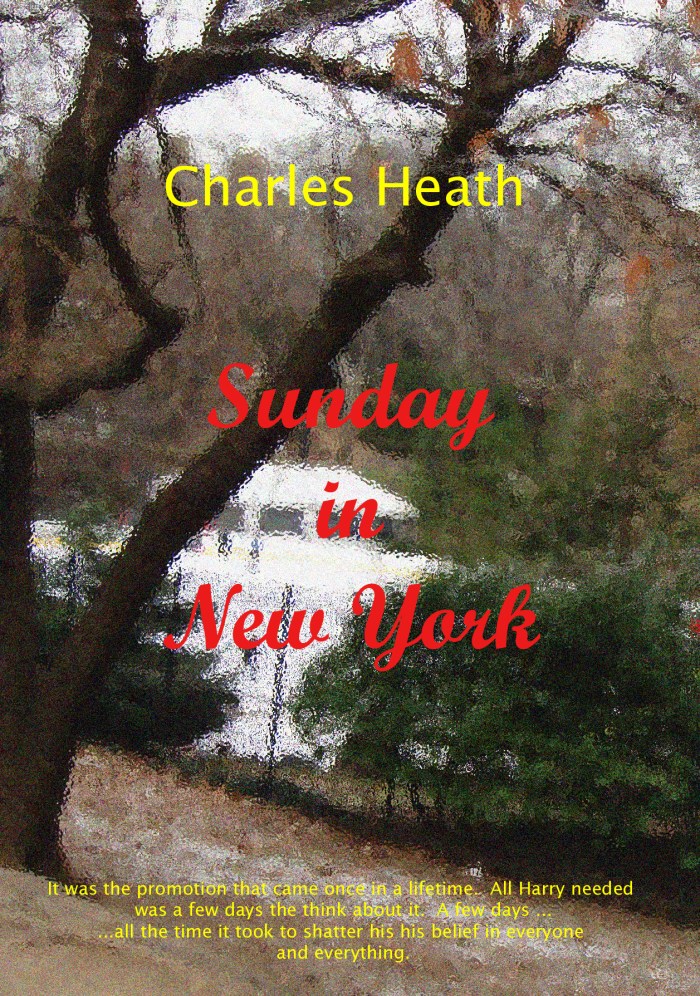
“Sunday in New York”, it’s a bumpy road to love

“Sunday in New York” is ultimately a story about trust, and what happens when a marriage is stretched to its limits.

When Harry Steele attends a lunch with his manager, Barclay, to discuss a promotion that any junior executive would accept in a heartbeat, it is the fact his wife, Alison, who previously professed her reservations about Barclay, also agreed to attend, that casts a small element of doubt in his mind.

From that moment, his life, in the company, in deciding what to do, his marriage, his very life, spirals out of control.

There is no one big factor that can prove Harry’s worst fears, that his marriage is over, just a number of small, interconnecting events, when piled on top of each other, points to a cataclysmic end to everything he had believed in.

Trust is lost firstly in his best friend and mentor, Andy, who only hints of impending disaster, Sasha, a woman whom he saved, and who appears to have motives of her own, and then in his wife, Alison, as he discovered piece by piece damning evidence she is about to leave him for another man.

Can we trust what we see with our eyes or trust what we hear?

Haven’t we all jumped to conclusions at least once in our lives?

Can Alison, a woman whose self-belief and confidence is about to be put to the ultimate test, find a way of proving their relationship is as strong as it has ever been?

As they say in the classics, read on!

Purchase:

http://tinyurl.com/Amazon-SundayInNewYork

Sunday In New York

A ‘killer’ biography! What is that?

Since Twitter moved from 140 characters to 280 characters, it’s like having a new lease on life.

Not.

Still agonizing over what constitutes a ‘killer’ bio.

So much so that I have been trawling through thousands of other bio’s trying to understand what makes a good one.

Quite a lot preface theirs with Dad to or Mom to x wonderful children.  I think that goes without saying, so moving on.

Quite a lot advertise services using hashtags which is a great idea, perhaps in the hope people are looking for said services and DM them for more information.  I don’t think many people would take much notice of that, and move on.

But …

That brings up the relevance of using hashtags in the bio.  That gives me a bit more scope to make it to the point.

A quick search of relevant hashtags reveals:

writer, author, thriller, mystery, adventure, writing etc.

All are useful but it doesn’t really carry any pulling power.  We need something that grabs the reader’s attention and do it in the shortest, most succinct manner.

I am a writer, a wordsmith, who, I was once told, swallowed a dictionary.  But, in the light of the current task, you’d think it would be just a ‘walk in the park’ instead of the proverbial ‘pain in the neck’.

Perhaps I could compose a riddle that comes back to the answer of who I am, but who has the time to sit and work it out.

I think that might be a little pretentious.

So, how about, ‘published author’, technically correct as my books are published on Amazon.  I could use ‘aspiring to become the best selling author’.  But that one worries me, because a lot of authors use that, and er all can’t be ‘vest’ selling authors.

Or can we?

Perhaps I might say, ‘an author aspiring to become a successful author, who published five novels on Amazon and adding more soon’.

Better, but not great.

Maybe I’ll keep working on it.