Two novels are on special for $0.99 for the next two weeks.
They are
for “Echoes from the Past” go to

for “The Devil You Don’t” go to
Two novels are on special for $0.99 for the next two weeks.
They are
for “Echoes from the Past” go to
for “The Devil You Don’t” go to
The April version of the November write-a-thon is upon us, well, me actually. I’m not sure hope many others are trying to resurrect an old piece of writing.
The truth is, I’ve been at this story off and on over the past three years, and every time I get a head of steam, something else comes along.
Now I’ve decided to use the April version of NANOWRIMO to get this thing finished, or at least in a first draft state.
Part 4 is now finished and it is onto the laborious work of getting part 5 in some sort of shape. It’s mostly done, but so many other things got in the way, it is still not complete.
What I have to do now is not drop the ball, and stick at it until the first draft is completed. This will probably take a few more days.
Today’s I continued with making some revisions, where words were struck off and words added, the net result amounted to adding another 1,328 words for a final total of 77,145.
If only it is one bright moment among heaps of darker ones.
We do not have a COVID 19 case in our house. Of course, we had to wait an agonizing 24 hours before we got the good news by phone.
She has something else, perhaps just the common cold.
It shows that our testing labs are getting through the tests, of which I heard in the news there were about 4,000, with only 10 or so new cases countrywide.
Queensland had none overnight, so if our case had been positive, we would have been in the news for all the wrong reasons.
But, you know, 15 minutes of fame and all that.
I’m looking at my continuously updating COVID 19 count, and it’s up to 3,223,596 cases worldwide and 228,195 deaths.
I feel a deep sadness for the families of those people who have died.
But, on the other hand, I feel somewhat angry that world leaders, instead of focussing on the job of saving more lives, are more interested in finding someone to blame. Perhaps when this is all over everyone should band together to see what happened, what they did wrong, what they did right, and be prepared next time.
And there will be a next time.
One thing that should happen is, no blaming the opposition party but actually work with them, without politicizing the pandemic, make sure the right people are put in positions where they can do the best, and most of all honour and respect the health workers whose only mission is to save as many lives as they can.
It can relate to an object such as an engine in a car when sitting at traffic lights. Then the engine is not in gear or under any load, therefore it is idle.
That he is idle might mean he is currently not working or refuses to work. Then it could be said he is bone idle which is to say he is any or all of lazy, or shiftless, even indolent
It could refer to the time when nothing is happening.
It could also refer to money in accounts not earning any interest
How many of us indulge in idle chatter, which is meaningless?
And how many of us have made an idle threat, especially to a child who refuses to go to bed, or sleep.
This is not to be confused with idol
An idol is generally thought of as a representation of a god, one used as an object of worship.
An idol can also be a person who is greatly admired, like a celebrity or superstar or a hero.
It could also be a figment of the imagination.
Then there is idyll which could be an extremely happy place, or a picturesque period or situation, one that is unsustainable
It could also be a short verse about rustic life.
I wandered back to my villa.
It was in darkness. I was sure I had left several lights on, especially over the door so I could see to unlock it.
I looked up and saw the globe was broken.
Instant alert.
I went to the first hiding spot for the gun, and it wasn’t there. I went to the backup and it wasn’t there either. Someone had found my carefully hidden stash of weapons and removed them.
Who?
There were four hiding spots and all were empty. Someone had removed the weapons. That could only mean one possibility.
I had a visitor, not necessarily here for a social call.
But, of course, being the well-trained agent I’d once been and not one to be caught unawares, I crossed over to my neighbor and relieved him of a weapon that, if found, would require a lot of explaining.
Suitably armed, it was time to return the surprise.
There were three entrances to the villa, the front door, the back door, and a rather strange escape hatch. One of the more interesting attractions of the villa I’d rented was its heritage. It was built in the late 1700s, by a man who was, by all accounts, a thief. It had a hidden underground room which had been in the past a vault but was now a wine cellar, and it had an escape hatch by which the man could come and go undetected, particularly if there was a mob outside the door baying for his blood.
It now gave me the means to enter the villa without my visitors being alerted, unless, of course, they were near the vicinity of the doorway inside the villa, but that possibility was unlikely. It was not where anyone could anticipate or expect a doorway to be.
The secret entrance was at the rear of the villa behind a large copse, two camouflaged wooden doors built into the ground. I move aside some of the branches that covered them and lifted one side. After I’d discovered the doors and rusty hinges, I’d oiled and cleaned them, and cleared the passageway of cobwebs and fallen rocks. It had a mildew smell, but nothing would get rid of that. I’d left torches at either end so I could see.
I closed the door after me, and went quietly down the steps, enveloped in darkness till I switched on the torch. I traversed the short passage which turned ninety degrees about halfway to the door at the other end. I carried the key to this door on the keyring, found it and opened the door. It too had been oiled and swung open soundlessly.
I stepped in the darkness and closed the door.
I was on the lower level under the kitchen, now the wine cellar, the ‘door’ doubling as a set of shelves which had very little on them, less to fall and alert anyone in the villa.
Silence, an eerie silence.
I took the steps up to the kitchen, stopping when my head was level with the floor, checking to see if anyone was waiting. There wasn’t. It seemed to me to be an unlikely spot for an ambush.
I’d already considered the possibility of someone coming after me, especially because it had been Bespalov I’d killed, and I was sure he had friends, all equally as mad as he was. Equally, I’d also considered it nigh on impossible for anyone to find out it was me who killed him because the only people who knew that were Prendergast, Alisha, a few others in the Department, and Susan.
That raised the question of who told them where I was.
If I was the man I used to be, my first suspect would be Susan. The departure this morning, and now this was too coincidental. But I was not that man.
Or was I?
I reached the start of the passageway that led from the kitchen to the front door and peered into the semi-darkness. My eyes had got used to the dark, and it was no longer an inky void. Fragments of light leaked in around the door from outside and through the edge of the window curtains where they didn’t fit properly. A bone of contention upstairs in the morning, when first light shone and invariably woke me up hours before I wanted to.
Still nothing.
I took a moment to consider how I would approach the visitor’s job. I would get a plan of the villa in my head, all entrances, where a target could be led to or attacked where there would be no escape.
Coming in the front door. If I was not expecting anything, I’d just open the door and walk-in. One shot would be all that was required.
Contract complete.
I sidled quietly up the passage staying close to the wall, edging closer to the front door. There was an alcove where the shooter could be waiting. It was an ideal spot to wait.
Crunch.
I stepped on some nutshells.
Not my nutshells.
I felt it before I heard it. The bullet with my name on it.
And how the shooter missed, from point-blank range, and hit me in the arm, I had no idea. I fired off two shots before a second shot from the shooter went wide and hit the door with a loud thwack.
I saw a red dot wavering as it honed in on me and I fell to the floor, stretching out, looking up where the origin of the light was coming and pulled the trigger three times, evenly spaced, and a second later I heard the sound of a body falling down the stairs and stopping at the bottom, not very far from me.
Two assassins.
I’d not expected that.
The assassin by the door was dead, a lucky shot on my part. The second was still breathing.
I checked the body for any weapons and found a second gun and two knives. Armed to the teeth!
I pulled off the balaclava; a man, early thirties, definitely Italian. I was expecting a Russian.
I slapped his face, waking him up. Blood was leaking from several slashes on his face when his head had hit the stairs on the way down. The awkward angle of his arms and legs told me there were broken bones, probably a lot worse internally. He was not long for this earth.
“Who employed you?”
He looked at me with dead eyes, a pursed mouth, perhaps a smile. “Not today my friend. You have made a very bad enemy.” He coughed and blood poured out of his mouth. “There will be more …”
Friends of Bespalov, no doubt.
I would have to leave. Two unexplainable bodies, I’d have a hard time explaining my way out of this mess. I dragged the two bodies into the lounge, clearing the passageway just in case someone had heard anything.
Just in case anyone was outside at the time, I sat in the dark, at the foot of the stairs, and tried to breathe normally. I was trying not to connect dots that led back to Susan, but the coincidence was worrying me.
A half-hour passed and I hadn’t moved. Deep in thought, I’d forgotten about being shot, unaware that blood was running down my arm and dripping onto the floor.
Until I heard a knock on my front door.
Two thoughts, it was either the police, alerted by the neighbors, or it was the second wave, though why would they be knocking on the door?
I stood, and immediately felt a stabbing pain in my arm. I took out a handkerchief and turned it into a makeshift tourniquet, then wrapped a kitchen towel around the wound.
If it was the police, this was going to be a difficult situation. Holding the gun behind my back, I opened the door a fraction and looked out.
No police, just Maria. I hoped she was not part of the next ‘wave’.
“You left your phone behind on the table. I thought you might be looking for it.” She held it out in front of her.
When I didn’t open the door any further, she looked at me quizzically, and then asked, “Is anything wrong?”
I was going to thank her for returning the phone, but I heard her breathe in sharply, and add, breathlessly, “You’re bleeding.”
I looked at my arm and realized it was visible through the door, and not only that, the towel was soaked in blood.
“You need to go away now.”
Should I tell her the truth? It was probably too late, and if she was any sort of law-abiding citizen she would go straight to the police.
She showed no signs of leaving, just an unnerving curiosity. “What happened?”
I ran through several explanations, but none seemed plausible. I went with the truth. “My past caught up with me.”
“You need someone to fix that before you pass out from blood loss. It doesn’t look good.”
“I can fix it. You need to leave. It is not safe to be here with me.”
The pain in my arm was not getting any better, and the blood was starting to run down my arm again as the tourniquet loosened. She was right, I needed it fixed sooner rather than later.
I opened the door and let her in. It was a mistake, a huge mistake, and I would have to deal with the consequences. Once inside, she turned on the light and saw the pool of blood just inside the door and the trail leading to the lounge. She followed the trail and turned into the lounge, turned on the light, and no doubt saw the two dead men.
I expected her to scream. She didn’t.
She gave me a good hard look, perhaps trying to see if I was dangerous. Killing people wasn’t something you looked the other way about. She would have to go to the police.
“What happened here?”
“I came home from the cafe and two men were waiting for me. I used to work for the Government, but no longer. I suspect these men were here to repay a debt. I was lucky.”
“Not so much, looking at your arm.”
She came closer and inspected it.
“Sit down.”
She found another towel and wrapped it around the wound, retightening the tourniquet to stem the bleeding.
“Do you have medical supplies?”
I nodded. “Upstairs.” I had a medical kit, and on the road, I usually made my own running repairs. Another old habit I hadn’t quite shaken off yet.
She went upstairs, rummaged, and then came back. I wondered briefly what she would think of the unmade bed though I was not sure why it might interest her.
She helped me remove my shirt, and then cleaned the wound. Fortunately, she didn’t have to remove a bullet. It was a clean wound but it would require stitches.
When she’d finished she said, “Your friend said one day this might happen.”
No prizes for guessing who that friend was, and it didn’t please me that she had involved Maria.
“Alisha?”
“She didn’t tell me her name, but I think she cares a lot about you. She said trouble has a way of finding you, gave me a phone and said to call her if something like this happened.”
“That was wrong of her to do that.”
“Perhaps, perhaps not. Will you call her?”
“Yes. I can’t stay here now. You should go now. Hopefully, by the time I leave in the morning, no one will ever know what happened here, especially you.”
She smiled. “As you say, I was never here.”
© Charles Heath 2018-2020
This is not meant to be a treatise on short story writing. Far be it for me to advise anyone on the subject. I prefer to say how it is that I do it so you can learn all of the pitfalls in one go.
I like to think I fly by the seat of my pants, you know, like the reader who takes up the story and starts reading, not having a clue where it’s going to go.
I prefer that blissful ignorance, of course, until I have to start editing it into something that resembles a logical story,
It was a revelation when I discovered there are two types (possibly more) or writer, pantsers and planners.
I’ve tried both. Both work. But in the case of the latter, you need to know where it’s going to start what’s going to happen in the middle and have the end firmly planted in your mind. Not much good if a rotten character is pissing you off and you want to kill him, excruciatingly.
Flying blind gives you a little more creativeness, and be able to go around a corner and see what’s there. it also allows for those complete changes of direction you come up with in the shower, that place that is a fertile ground for new ideas just when you’re running out of them.
But, it can sometimes play havoc with word counts and if you’re trying to fit into 2,000 words, 5,000 words, or a lot less, taking the story where it wants to go is not a good idea, and sadly, I tend to let stories run their course.
And sometimes I like the idea of writing three different endings, and then can’t choose which one I like the best.
So, role model I am not. I like writing, and when I’m in the ‘zone’ it’s like I’m in another world.
But, then, isn’t that the case for all of us?
More unclarity tomorrow!
The April version of the November write-a-thon is upon us, well, me actually. I’m not sure hope many others are trying to resurrect an old piece of writing.
The truth is, I’ve been at this story off and on over the past three years, and every time I get a head of steam, something else comes along.
Now I’ve decided to use the April version of NANOWRIMO to get this thing finished, or at least in a first draft state.
Part 3 is now finished and it is onto the laborious work of getting part 4 right. There will be about ten chapters in this section, and then a short Part 5 which is yet to be written.
Today’s assignment was to go back and make some revisions, where words were struck off and words added, the net result not amounting to much and certainly does not justify the amount of work put in.
Today’s word count adds another 632 words for a total of 75,817 so far.
We are going to exceed my original estimate of 75,000 words by at least another 5,000.
The write a private detective serial has always been one of the items at the top of my to-do list, though trying to write novels and a serial, as well as a blog, and maintain a social media presence, well, you get the idea.
But I made it happen, from a bunch of episodes I wrote a long, long time ago, used these to start it, and then continue on, then as now, never having much of an idea where it was going to end up, or how long it would take to tell the story.
That, I think is the joy of ad hoc writing, even you, as the author, have as much idea of where it’s going as the reader does.
It’s basically been in the mill since 1990, and although I finished it last year, it looks like the beginning to end will have taken exactly 30 years. Had you asked me 30 years ago if I’d ever get it finished, the answer would be maybe?
My private detective, Harry Walthenson
I’d like to say he’s from that great literary mold of Sam Spade, or Mickey Spillane, or Phillip Marlow, but he’s not.
But, I’ve watched Humphrey Bogart play Sam Spade with much interest, and modeled Harry and his office on it. Similarly, I’ve watched Robert Micham play Phillip Marlow with great panache, if not detachment, and added a bit of him to the mix.
Other characters come into play, and all of them, no matter what period they’re from, always seem larger than life. I’m not above stealing a little of Mary Astor, Peter Lorre or Sidney Greenstreet, to breathe life into beguiling women and dangerous men alike.
Then there’s the title, like
The Case of the Unintentional Mummy – this has so many meanings in so many contexts, though I image back in Hollywood in the ’30s and ’40s, this would be excellent fodder for Abbott and Costello
The Case of the Three-Legged Dog – Yes, I suspect there may be a few real-life dogs with three legs, but this plot would involve something more sinister. And if made out of plaster, yes, they’re always something else inside.
But for mine, to begin with, it was “The Case of the …”, because I had no idea what the case was going to be about, well, I did, but not specifically.
Then I liked the idea of calling it “The Case of the Brother’s Revenge” because I began to have a notion there was a brother no one knew about, but that’s stuff for other stories, not mine, so then went the way of the others.
Now it’s called ‘A Case of Working With the Jones Brothers’, finished the first three drafts, and at the editor for the last.
I have high hopes of publishing it in May 2020. It even has a cover.
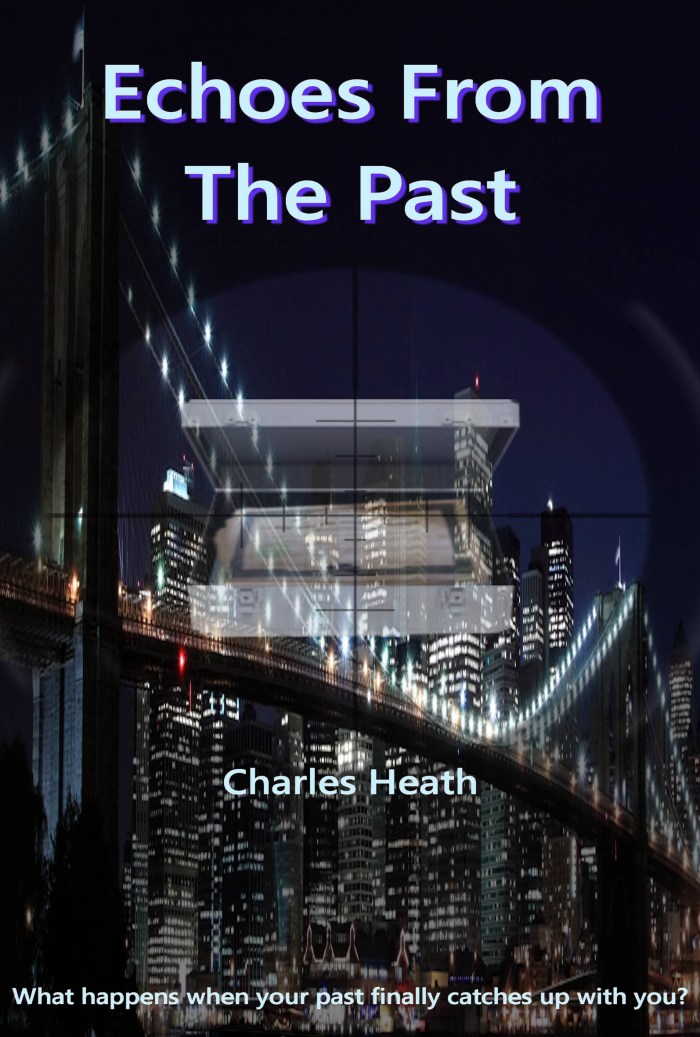
The novel ‘Echoes from the past’ started out as a short story I wrote about 30 years ago, titled ‘The birthday’.
My idea was to take a normal person out of their comfort zone and led on a short but very frightening journey to a place where a surprise birthday party had been arranged.
Thus the very large man with a scar and a red tie was created.
So was the friend with the limousine who worked as a pilot.
So were the two women, Wendy and Angelina, who were Flight Attendants that the pilot friend asked to join the conspiracy.
I was going to rework the short story, then about ten pages long, into something a little more.
And like all re-writes, especially those I have anything to do with, it turned into a novel.
There was motivation. I had told some colleagues at the place where I worked at the time that I liked writing, and they wanted a sample. I was going to give them the re-worked short story. Instead, I gave them ‘Echoes from the past’
Originally it was not set anywhere in particular.
But when considering a location, I had, at the time, recently been to New York in December, and visited Brooklyn and Queens, as well as a lot of New York itself. We were there for New Years, and it was an experience I’ll never forget.
One evening we were out late, and finished up in Brooklyn Heights, near the waterfront, and there was rain and snow, it was cold and wet, and there were apartment buildings shimmering in the street light, and I thought, this is the place where my main character will live.
It had a very spooky atmosphere, the sort where ghosts would not be unexpected. I felt more than one shiver go up and down my spine in the few minutes I was there.
I had taken notes, as I always do, of everywhere we went so I had a ready supply of locations I could use, changing the names in some cases.
Fifth Avenue near the Rockefeller center is amazing at first light, and late at night with the Seasonal decorations and lights.
The original main character was a shy and man of few friends, hence not expecting the surprise party. I enhanced that shyness into purposely lonely because of an issue from his past that leaves him always looking over his shoulder and ready to move on at the slightest hint of trouble. No friends, no relationships, just a very low profile.
Then I thought, what if he breaks the cardinal rule, and begins a relationship?
But it is also as much an exploration of a damaged soul, as it is the search for a normal life, without having any idea what normal was, and how the understanding of one person can sometimes make all the difference in what we may think or feel.
And, of course, I wanted a happy ending.
Except for the bad guys.
Get it here: https://amzn.to/2CYKxu4

How often do we make a judgment call simply on what we see?
I knew what I saw, and it looked exactly like a situation that, if you asked any ten others who witnessed it, they would agree with me.
And then there would always be one that wouldn’t.
The prosecution had made a very good case, the defense counsel had woven a brilliant tale from start to finish, and he delivered in an almost persuading tone, with the subliminal message, the defendant was not guilty.
I felt sorry for the prosecution because his delivery had been halting, filled with ums and ers and in the end, everyone, from the judge down, wanted it to end.
As for the jury, it was an odd assortment of characters, a lawyer, a builder, a plumber, a housewife, two sales staff, two clerks, a janitor, two retirees, and a motor mechanic. I thought it would be the lawyer who would be the problem.
The trial had lasted 22 days, and over that time I noticed that groups would form, and discuss aspects of the case, each of the groups forming a different opinion. Sometimes, the dynamics of the groups changed as more evidence and testimony was revealed.
But, I think on those first few days, opinions were made, and judgment was passed.
In my opinion, based on looking at the defendant, it could be said that she didn’t look like a murderer, nor did she seem capable of committing such a heinous act. Having said that, as a throwaway first assumption, the lawyer nixed it in a second. Knowing something of how these trials worked, he said there would have been a lot of careful grooming, dress down, but not to drab, look demure, not aggressive, and speak in a modulated tone, like everyday conversation.
In other words, he was basically telling us she was giving an academy award performance.
I certainly looked at her in a different light after that, but the fact remained, for some of us, that initial assessment said not guilty.
A few days before we had to deliberate, a very damning piece of video was tendered and we all watched as the defendant was shown talking to her alleged accomplice, the victim’s current girlfriend, and passing an enveloped which the defense claimed was the payoff for helping her dispose of her husband.
It seemed odd to me that someone had known she would be in that bar, perfectly placed under the CCTV camera, both women so easily recognizable. Of course, the woman in question could not be found, and the inference was that she might also be one of the defendant’s victims.
Several people were called by the defense to assert a line of defense that the husband was a cruel man, who had treated his wife very badly indeed, to the extent her best friend remarked that she had turned up for work on several occasions with the results of what looked like a beating, and another, an ER nurse, had confirmed the defendant had visited the hospital on several occasions with lacerations consistent with what was considered spousal abuse.
Those photographs were quite confronting, but a question had to be asked, why had she not gone to the police with that evidence and let them deal with the husband.
The fact she hadn’t was one weakness in her defense. The thing there was why the defense introduced such testimony because, to me, it confused the issue by pushing the jury into thinking she had killed him, but in mitigating circumstances. Was she looking for a verdict of justifiable homicide?
From day two, after the lawyer had told us about how lawyers schooled their clients, I watched her carefully, when sitting beside her lawyer, or when on the stand. There were interesting actions she made when certain events occurred, like brushing a stray lock of hair back behind her ear, like teasing it out with a slight shake of the head, in a subtle but obvious show of displeasure. Like smoothing out the invisible wrinkles in her clothes, perfectly fitting and obviously made for her, but understated in a sense that she would stand out in a crown but not ostentatiously so. It was almost a ritual when she came in at the start, and when she took the stand, preparing herself.
Perfectionist, maybe. Or trying to convey a certain picture. Certainly, in the early days before the trial began, the media had a field day with the case, whipped into an even bigger frenzy when the police finally arrested the wife for the murder of her husband. Almost all of them said he had it coming, with page after page of revelations about a man who could not have done half the things he was accused of.
The trial by newspaper done, I suspect it was hard to find 12 unbiased men and women who could be trusted to make the right decision. I knew 100 would be jurors had been called up.
Now, in the jury room for the third day, trying to reach a verdict, it was the lawyer trying to wrap it up. He had a job to go back to. So did everyone else, for that matter.
“So, in essence, we are all agreed, that she is not guilty.”
It had been an interesting change in his position on the morning of day three of our deliberation. Before that, he wanted to hang her from the nearest yardarm. Interestingly enough, that morning, after he had given us his reasons for changing his mind, it would have been unanimous, and over.
The thing is, I didn’t like the way he changed sides so easily or for the reasons he spoke of.
So, in that vote, I changed my decision to guilty, and watch a group of people who had been friendly suddenly become enemies.
But at that moment, that other ten didn’t interest me, it was the expression on the lawyer’s face. He hadn’t expected the vote to go that way. It was like he had been goading everyone into voting not guilty and weathering the storm because of his stance. Had it been staged, had we been led down this path, and then all of a sudden, the verdict he wanted being reached?
I had to find out.
I watched the eleven raise their hands to vote not guilty. I did not. And immediately felt the looks of every one of those eleven on me.
“Why?” he asked.
By this time he had taken the lead, and the others had let him. Now I suspect they would let him do the talking.
“You’ve got it all wrong. The reasons are the same. There are two sides to that tale you came up with this morning. The problem I have is from being adamant she was guilty, and as you said, without a shadow of a doubt, now all of a sudden you’re having doubts.”
“So, you don’t think she’s guilty, you’re just voting that way because you suspect my motives?”
“What I think is irrelevant right now. You need to convince me that you truly think she’s not guilty. What is it you saw, or heard, or know that changed your mind. It certainly had nothing to do with that so-called video in the bar being staged. It has nothing to do with the fact they can’t find that woman so they can either verify or dispel the accusations being made she was an accomplice. It had nothing to do with the fact you think she might have been goaded into it and was left with no other option. In that case, it might well be a case of manslaughter rather than murder. Is that what you’re trying to suggest?”
“I think given the evidence, or lack of concrete evidence against her, she is not guilty.”
“But given everything you have said, it seems to me you think she had some crime to answer for.”
“Hasn’t she suffered enough?”
“That might well be the case, but it doesn’t give you an excuse to murder., and there’s certainly no forensic evidence that she was defending herself against an attack at the time. She should have taken her case to the police and have it investigated. She chose not to, for reasons that were never fully explained.”
“And didn’t we hear that the husband had links to various police that might have made such an investigation a waste of time. This was a woman trapped in a bad situation with no way out.”
It was a long way from where we, as jurors, were at the beginning of our deliberations. The first vote at the end of the first day was four voted not guilty and eight voted guilty. In the following days, a lot of arguments changed the decisions of those seven to vote not guilty, when they believed, in their own minds the defendant was guilty.
In my mind, the first instinct was usually correct. Over time that decision was only changed because of expediency, not necessarily for the right reasons. My first instinct was that she was, in fact, not guilty for all the reasons the lawyer cited.
“Look,” he said. “We’ve been here for three days. It’s an open and shut case. Let’s vote.”
We did with the same result. Eleven for not guilty and one against.
A hung jury. I wasn’t going to be moved on my position, and so it went back to the court. It was declared a mistrial and the defendant was returned to custody and a new trial was to be scheduled.
I was reading the paper’s version of events, and speculation on the result. Several of the jurors had featured in the discussion, but none were willing to talk about the result or who was responsible for the hung jury, only that one juror had not agreed with the majority. In some states, it was argued, it only required a majority, but in this and other states, quite rightly, it needed a unanimous decision to confer the death sentence.
Justice, it seemed to the writer of the piece, had prevailed.
They also believed that the plight of women trapped in marriages to violent men was a matter that should be looked at and that such women should be treated better in the eyes of the law. It was not a position that I disagreed with. What I disagreed with was the notion of jury tampering.
It was, apparently, the fifth time that a case such as this had a similar track record, that the deliberations of the jury had swung from an initial guilty verdict to not guilty at the hands of a single juror. In each of the five cases, the circumstances were similar, the wife had endured violence by her husband, and then, in odd circumstances, the husband had finished up dead.
Someone had discerned a pattern, and this had been a test case. In each of the other four cases, a not guilty verdict had been handed down by a jury that had also started with a majority guilty verdict, only to be worn down by a single juror with an agenda. To get the defendant a not guilty verdict.
My job was to find out which juror it was that was there to change minds. Then it was a case of finding links between him and four other jurors who were equally instrumental in obtaining a not guilty verdict. In each of the five cases, there was irrefutable evidence that the defendant was, in fact, guilty of the charge, and the expectation was the legal system would prosecute them.
And then, in each of the cases, a weak prosecutor was selected, and a particular juror was selected by that prosecutor. From there, the trail led back to a particular assistant District Attorney who had overseen each of the five cases. The fact was, justice was not served, and four out of the five defendants had escaped justice.
Until now.
© Charles heath 2020

