It’s a long standing joke that the light at the end of the tunnel is the headlight of an express train coming right at you.
Metaphorically speaking this is quite often true, if you are a pessimist, but since l’ve converted to being an optimist, a bit like changing religions, l think I’ve seen the ‘light’.
It’s a lot like coming up from the bottom of a deep pool, breaking the surface and taking that first long gulp of air.
Along with that elated feeling that you’re not going to drown.
What’s this got to do with anything, you ask.
Perhaps nothing.
As an allegory it represents to me as a time when l finally get over a period of self doubt, where a series of events started to make me question why l want to be a writer.
I mean why put yourself through rejections, sometimes scathing criticism, and the have the people whom you thought were your friends suddenly start questioning your choices after initially wholeheartedly supporting them.
Are we only a success or supportable if we are earning a sufficient wage?
Is this why so many people do not give up their day job, and then find themselves plying the other trade into the dark hours of the night, only to find themselves being criticised for plying a trade with little chance of success?
It seems like a no win situation but these are the times when you mettle is tested severely.
But in the end it is worth it when the book is finished and it is published even if it is only on Amazon.
I made the comment the other day, that I’d rather it was snowing than raining. It was an idiotic comment because we live in the tropics, and it never gets cold enough.
That’s why we go away to the other side of the world where it is snowing every Christmas. There is nothing like a white Christmas, right down to the Bing Crosby song.
Not this year.
It’s Christmas in the 40 degree centigrade heat. Well, it was before we got air-conditioning.
The thing is, for some reason this year I hate everything about Christmas. It’s not COVID because in this country, we’ve all but got rid of it, it’s not because we can’t go away overseas, or that Christmas lunch is at our place and I have to do all the cooking. Well, maybe that’s part of it.
Being locked down for about 10 weeks taught me a few things. One, why can’t the traffic stay off the road, half the useless shops close down, and malls stay empty so that you can get an easy parking space.
Two, I quite like being on my own without having to go out, or have people over. I guess I’m not really a people person. Three, I’ve discovered I don’t need very much, but if I do, there’s an online shop that will sell it to me, and then deliver it so I don’t have to go out, talk to the delivery guy, or worry about having the cash to pay.
I’m perfectly content in a cashless society.
I’m perfectly happy if I don’t have to go out and mingle with the Christmas shoppers, any shoppers for that matter, and especially mall shoppers. They are an extremely weird bunch of people, who never seem to walk in a straight line, and have to walk six abreast as slowly as possible. And the children, don’t you just love the squealing competition. And the people who have to have a reunion in the doorway or exit of a shop, or worse, the check out person is a long lost relative, and they have to catch there and then. Ugh! Ugh! Ugh!!!!!!!
And the tantrums when children don’t get what they want. Wow! The sugar industry, confectionary makers, and soft drink (read soda) companies all should be held to account for the damage their customers cause.
Alright … rant over. You can tell I just spent an hour looking for a car park, three hours trying to get some presents when it should have taken 30 minutes, and the crowds … ugh!
I guess I shouldn’t complain. Life is all but back to normal, and I survived the pandemic. Now there’s a vaccine, it can only get worse, normal life that it.
For those who have forgotten what normal is like, now there’s a vaccine, normal I understand is when 75% of the population has been vaccinated or had it and survived. For those going stir crazy, trust me when I say there’s light at the end of the tunnel. We went through a long tunnel and got to the end.
May it be for you that the news will no longer have saturation coverage of the pandemic, and have something more pleasant to talk about. Other than Brexit or the presidential elections.
We have a battle with China. Seems they hate us, and don’t want anything from us. Lobster eaters here love it, because finally we can get some at affordable prices. Wine, too, might actually be affordable now.
And yes, we finally put up the tree, decorated with tinsel, baubles, and lights.
Not as good as the one at Rockefeller Centre, but once we get a bigger house …….
Deal or no deal. That was a game show on TV once, involving briefcases.
Then, if you win…
It’s a big deal!
Or, of course, it is if you get in on the ground floor, which is to say, you’re one of the original investors, it becomes a great deal; it’s meaning, taking part in a financial transaction.
The word ‘deal’ along with big, great, tremendous, and once in a lifetime, feature prominently, but if you are like me by the time you invest the pyramid is about to collapse!
Then you’re in a great deal of trouble, meaning a lot of trouble — at the time, it feels catastrophic.
Or you’re working impossibly long hours to enrich the others above you, it a good deal of effort on your part for no reward.
Or deal with a problem, which is to say cope with or control, though if it’s a problem child, good luck with that.
But enough of the depressing descriptions,
When you play a card game, the first thing to happen is to deal the cards.
The second is to ask yourself if the dealer is dealing from the bottom of the deck, even if it looks like the top.
My father called these dealers ‘card sharps’.
Then there is a piece of wood commonly called deal, usually thin and square though not always so; it can also be a plank of pine or fir.
Well, I’m still writing, though since the start of the grand children’s school holidays has arrived and I’m now the official child minder.
It’s just a constant job jeeping them fed, and amused (I’d like a dollar for every time they’ve said they’re bored) and it is making it difficult to write.
So, it is left to the wee small hours of the morning to get it done, and it is proceeding slowly.
Yesterday I hit a wall (not literally) and couldn’t progress any part of the story because my brain had ceased to work. That’s usually writer’s block or something like that, but it was a mental thing. I had three chapters on the go, and in writing a later one, I’d hoped it would fill in the gaps for the two prior chapters.
It did, eventually, and now it’s flowing again.
Until I get to that great white plain of nothingness, heading for the lookout.
For the bean counters, latest word count is 3,322 for a running total of 87,629.
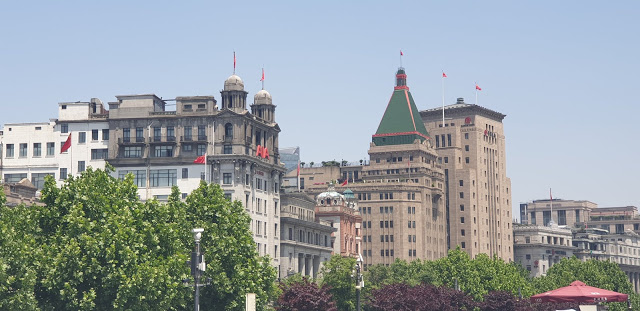
The Bund The architecture along the Bund or Waitan is a living museum of the colonial history of the 1800s. The area centers on a section of Zhongshan Road within the former Shanghai International Settlement. The word bund means an embankment or an embanked quay. It was initially a British settlement; later the British and American settlements were combined in the International Settlement. The Bund is a mile-long stretch of waterfront promenade along the Huangpu River. There are 52 buildings of various architectural styles, including Gothic, baroque, and neoclassical styles. The area is often referred to as “the museum of buildings”. Building styles include Romanesque Revival, Gothic Revival, Renaissance Revival, Baroque Revival, Neo-Classical or Beaux-Arts, as well as a number in Art Deco style. Having seen these buildings initially the night before, mostly lit up, our viewing this morning was from the land side, and particularly interesting in that the colonial architecture was really fascinating considering their location, but not surprising given Shanghai’s history. A lot of these buildings would be more at home in London, that out in the far east.
The Bund waterfront is about two kilometers long and impossible to cover in the time allowed for this part of the tour.
There was just enough time to get photos of the waterfront and the old buildings.
Some of these buildings had odd shapes, like one on the far right that looks like a bottle opener.
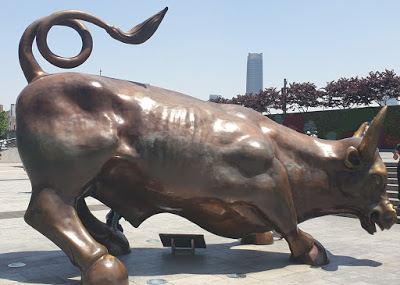
And, for some odd reason, a bull.
On the other side of the water, the sights that had been quite colorful the night before, were equally impressive though somewhat diminished by the haze.
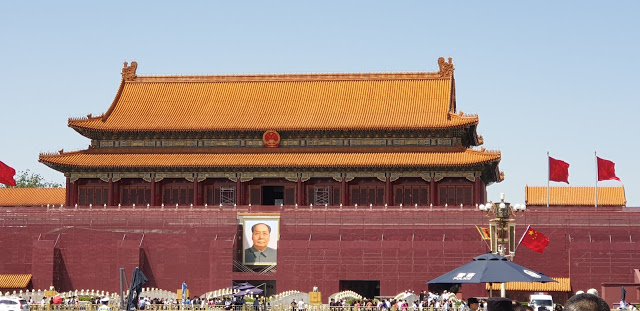
Tiananmen Square Some interesting facts before we get out of the bus… Tiananmen Square or Tian’anmen Square is in the centre of Beijing name after the Gate of Heavenly Peace, a gate that one separated the square from the Forbidden City.
The Square contains,
the Monument to the People’s Heroes the Great Hall of the People the National Museum of China the Mausoleum of Mao Zedong.
The square is about 109 acres and was designed and built in 1651, and since then been enlarged four times since, the most recent upgrade in the 1950s.
The Monument to the People’s Heroes
This is a ten-story obelisk built to commemorate the matters of the revolutions. It was built between August 1952 and May 1958. On the pedestal are reliefs depicting the eight major revolutionary episodes.
The Great Hall of the People
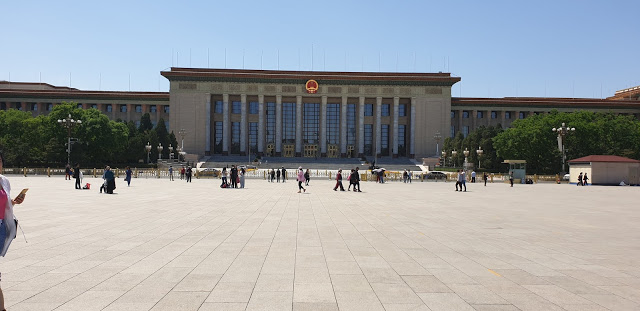
This was opened in September 1959, and covers 171809 square meters. The Great Hall is the largest auditorium in China and can seat up to 10,000 people. The State Banquet Hall can seat up to 5,000 diners.
The National Museum of China
This is one of the largest museums in the world and the second most visited museum in the world after the Louvre in Paris. It was completed in 1959, and sits on 65 hectares, and rises four floors. It has a permanent collection of over 1,000,000 items.
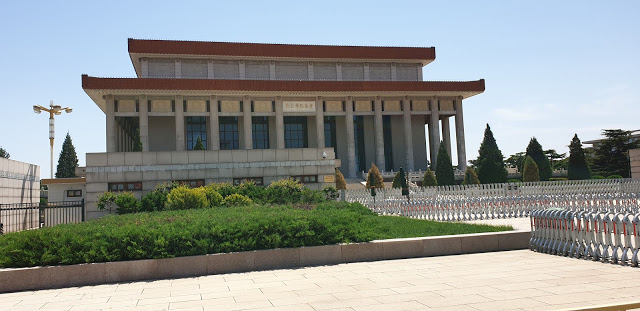
The Mauseloum of Mao Zedong
This was built shortly after his death, and completed on May 24th, 1977. The embalmed body of the Chairman is preserved and on display in the center hall.
My own observations This is huge; one of the largest public squares in the world, and if you’re going to walk it, like we did, make sure you’ve been exercising before you go. It covers 44 hectares, borders on the Forbidden City, and has a memorial to Chairman Mao in the center of it. But you cannot go near it, it’s fenced off, and it is guarded.
That’s both the statue and the square as there are random guards marching in random directions all the while watching us to see that we don’t misbehave.No one wants to find out what would happen if you jumped the fence around the statue, but I’m guessing you’ll have a few years to contemplate the stupidity of your actions with some very unhappy government officials.
Around the edges of the square are huge buildings, on one side is the museum
and on the other is the Chinese equivalent of parliament.
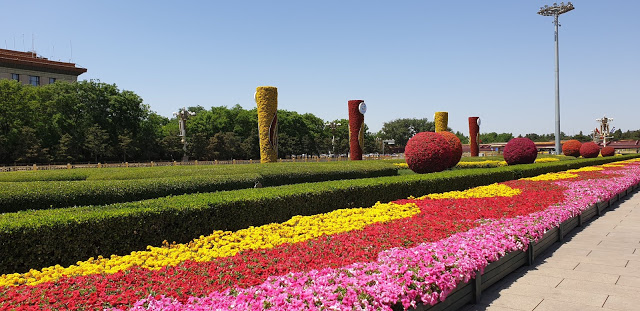
Around the sides are also large gardens
At one end, where the Forbidden City borders on the square, there’s a huge flag pole flying the Chinese flag, and this too like the monument is fenced off, and guarded by members of all of their armed services. No tanks rolled out during our visit much to our disappointment. There is no entrance to the Forbidden City from the square
At the other end is the Mausoleum of Mao Zedong, which was closed the day we were there, as was the museum.
There are four sculptural groups installed outside the mausoleum.
Other than that, it’s just another square, albeit probably one of the largest in the world. It can, we were told, hold about a million people.
I have spent the last few days catching up with everything that didn’t get done during November, and find that only about half of what I wanted to do.
The in tray is about seven inches high, and daunting.
But I haven’t given up and I’m pressing forward and got another two chapters written, and a good start on another.
A direction I thought the story might go a week or so back now seems not to be the right way, and I’m outlining this and plot it’s impact on later storylines.
It’s like hitting a fork in the road, and you’re not sure which direction to take.
For the statisticians, a total of 3,141 words for the two days, making a total of 84,107.
In 1974 a 26-year-old farmer, Yang Jide, was drilling a well and found fragments of the terracotta soldiers and bronze weapons.
What was discovered later was one of the biggest attended burial pits of China’s first feudal Emperor, Qin Shi Huang. In the following years remains had been found in 3 pits, yielding at least 8,000 soldiers and horses, and over 100 chariots. The soldiers were infantry, cavalry, and others.
Emperor Qin was born in 259 BC and died in 210 BC. He began building a mausoleum for himself at the foot of Mount Li when he was 13. Construction took 38 years, from 247 BC to 208 BC. It was divided into 3 stages and involved 720,000 conscripts.
The pits of pottery figures are 1.5 km east of Emperor Qin’s mausoleum. Pit 1 has about 6,000 terracotta armored warriors and horses and 40 wooden chariots. Pit 2 is estimated to have over 900 terracotta warriors and 350 terracotta horses with about 90 wooden chariots. Pit 3 had so far yielded only 66 pottery figures and one chariot drawn by four horses.
Official records say it was discovered later that it was likely Xiang Yu, a rebel, intentionally damaged the Mausoleum and the soldiers in the pits, by setting fire to the wooden roof rafters, and these fell on and broke the warriors into pieces.
However, we were told that after the terracotta warriors were completed, the Emperor ordered the builders to be killed so that they would not tell anyone about the warriors, and then of those that remained alive deliberately smashed all of the artifacts.
The thing is, all of the terracotta figures that have been found are in pieces, and they need computers to piece them back together again.
The visit: The first impression is the size of the car park and the number of buses parked in the lot, and a hell of a lot more outside up the road an off on side streets. Obviously, it costs money to park in the parking lot.
The other first impressions; the numbers waiting to get in were not as many as yesterday outside the forbidden city, in fact, a lot less.
Be warned there’s a long walk from the entrance gate where your bags are scanned and a body scan as well, before admittance. This walk is through a landscaped area which it is expect might sometime in the future reveal more soldiers, or other artifacts.
At the end of the walk that takes about ten minutes, you can get a one-way ride to the second checkpoint, but we opted not to as no one else in our group did.
That walk is the warm-up exercise to an organized viewing of the exhibits after going through a second ticket checkpoint. On the other side, we had to hand our tickets back to the tour guide which was disappointing not to end up with a memento of actually having been there.
So, on the other side in the courtyard, the guide told us the most important parts of the exhibition, that we should spend most of the time looking at pit 1, and then spent a little time in 2 which is only there in the first stages of excavation. Then move onto the museum if only to see the replica chariots.
We do.
The chariots were small but interesting
The horses were better and intricately detailed
These are soldiers, perhaps complete examples of those types found in the end pit.
This is one of the archers. You can tell by the way he wears his hair.
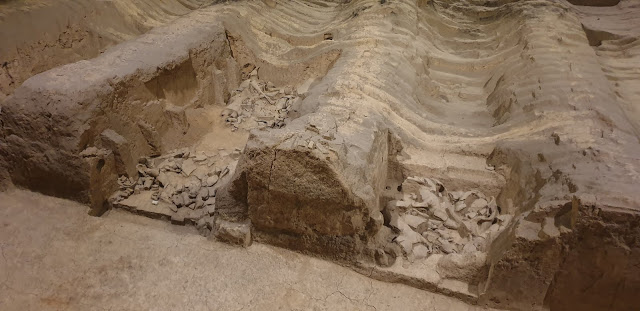
Pit 2
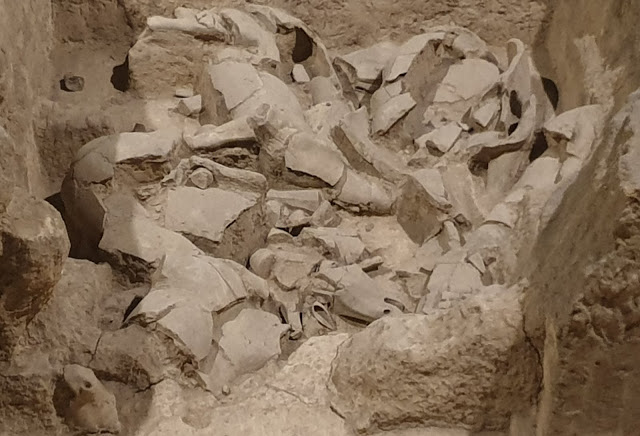
The excavation of this pit has only just begun, so it is possible to see where they have carefully removed the top cover, and you can see the broken parts of the warriors lying in a heap.
Some parts of the warriors are more discernible closer up
These parts are carefully extracted and taken to the ‘hospital’ where they are digitised and the computer will match each part with the warrior it belongs to.
Pit 1
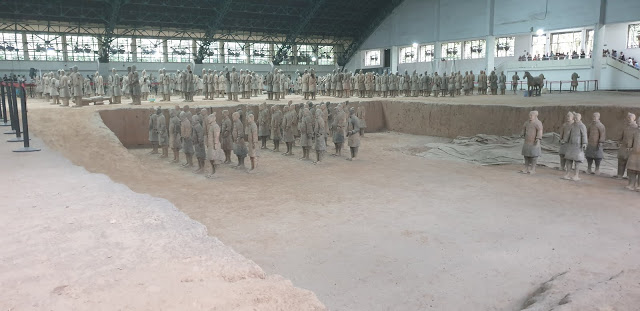
This has quite a number of standing soldiers that have been glued back together, but not necessarily complete and I notice a number if the statues were incomplete. And if they cannot find the missing pieces, then they are not added to or filled in.
The scale of the pit is enormous, and they have hardly scratched the surface in the restoration process.
What is there is a number of horses as well.
That’s at the front of the pit, a long line of statues, and what is clear is the location of the well where the first fragments were found by a farmer.
There are about eight lines of soldiers, and some lining the sides.
Midway down there is a large area currently under excavation
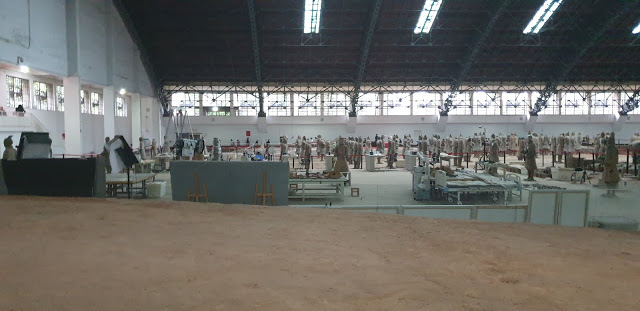
At the back is the hospital where the soldiers are reassembled. There’s nearly a hundred in the various stages of rebuilding. These days the soldiers are rebuilt using computer imaging.
The hospital area is where they are put back together
And these are some of the statues in various stages of reconstruction
Another two views of the size and scale of the reconstruction project
The coffee shop is also a sales centre, but there are too many people waiting for coffee and too few places to sit down.
Our destination is about 10 kilometers (6 miles) from downtown Hangzhou.
Meijiawu Tea Village is located in the west of the world-known West Lake and hailed as “ten miles Meiwu” for its vast area along the Meiling Road, is an ancient village with a history of 600 years. It is the main production base and a protected area of the fragrant West Lake Dragon Well Tea.
The tea leaves from Meijiawu are beautiful in green color, graceful in shape, strong in fragrance and rich in flavor.
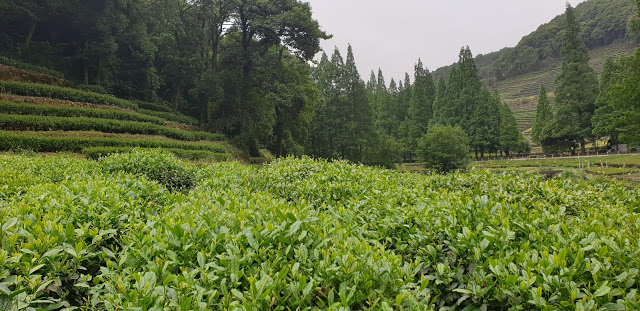
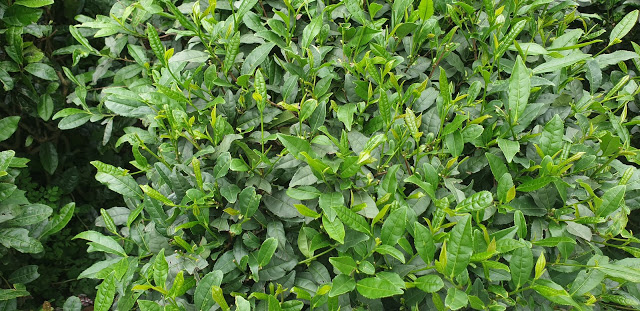
So, first, we get to look at the tea bushes, which are much larger than the bushes we’ve seen on the side of the road. I’m not up for becoming a tea picker any time soon, so I’ll leave it to the professionals.
All tea leaves are picked by women. It takes about 8 hours to pick two kilos of leaves.
Tea leaves are still picked by hand three times a year, the first spring, by young girls about 15 or 16, the second, summer tea, picked by girls about 20 years old, and the autumn tea, called grandma tea, picked by older women.
Next, we go to the drying demonstration, three tubs with tea leaves, that have to be stirred by hand for a number of hours.
We then get the sales pitch, which extols the benefits of the green tea, which apparently good for everything. So, now we have tea and supplement pills.
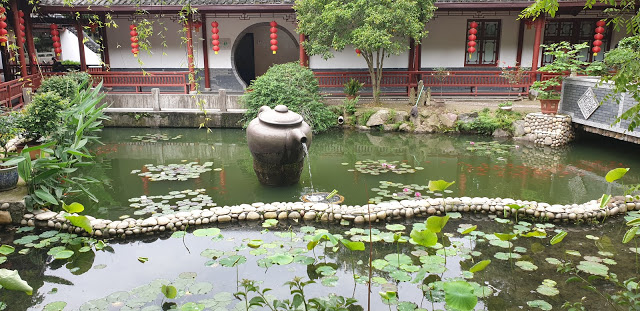
The teapot fountain in the gardens is a nice touch.
Still, we had a cup or two of tea discovered the right way to make it and had a stroll about the grounds. And for that hour in the morning, it was very pleasant.
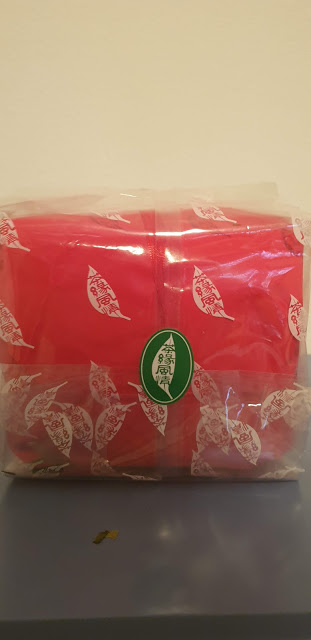
This is a about 1kg package of tea leaves. Don’t ask me how many cups of tea that will make!