I was told a long time ago I wasn’t perfect, and it didn’t bother me. Then.
But it’s true. I don’t always get it right, sometimes I get annoyed and say things in the heat of the moment that perhaps shouldn’t be said, and sometimes I can be ‘difficult’.
I’ll be the first in line to say my blog isn’t perfect, in fact sometimes it bothers me some of the bits and pieces that go up because I doubt if they’re interesting, at the time, to anyone but me.
Perhaps it’s because I chose to be a writer.
It’s a hard slog at the best of times. Getting ideas, carving out time to write, having to live a normal life as distinct from that of living in a garret, on your own, writing that next great Nobel prize for literature, or is it a Pulitzer?
I don’t get that, I don’t have that, and I don’t want that.
For those of us living on that ‘edge’ of finding time to write, maintain a blog, keep up with social media, do the daily chores and watch some television, something has to give.
So, I’m not getting any writing done if I’m working on the blog, or I’m on social media. If I’m doing the blog, something else has to be sacrificed.
Mostly it’s my blog. My blog is about writing stuff, visiting places that have been or will be used in stories, and once, a recalcitrant cat who sadly has passed on. It also has running episodic stories, usually four different at a time.
It also had about 2,000 past posts. When I don’t get the time to do my blog, which has been mostly for the last three months off and on, I sometimes repackage or repeat past posts, just to keep it ticking over, much like a scoreboard.
It is also a tool for advertising my books and stories, and what’s coming (if only I stopped using social media) and these are repeated every four or five days. It’d the equivalent of advertising because I can’t afford other advertising. If this is an annoyance, I’m sorry.
And just so everyone knows, I will always keep writing, not because I want to become the next James Patterson, though it would be nice, I write because I want to, and it pleases me when someone reads something I write, and they like it. It is the greatest compliment of all, and I believe in encouragement. It’s why I spend a lot of that social media time highlighting other writers so they can build a following.
After all, we are all in the same boat, it would just be nice if we were all rowing in the same direction.
After arriving in Hong Kong early in the morning, we were taken to the Hong Kong Conrad Hotel where we were staying for several days. We had a short sleep, then I took the grandchildren for a walk and we found Hong Kong Park, with a Fountain Plaza, waterways, a waterfall, and turtles.
Part of the fountain area.
Turtles resting on a rock
A turtle about to go in the water
The waterfall.
It was a pleasant surprise to find this park in such a highly built-up area.
Nearby was a multi-story underground shopping center that was huge, and very conveniently accessible from our hotel.
In 1974 a 26-year-old farmer, Yang Jide, was drilling a well and found fragments of the terracotta soldiers and bronze weapons.
What was discovered later was one of the biggest attended burial pits of China’s first feudal Emperor, Qin Shi Huang. In the following years remains had been found in 3 pits, yielding at least 8,000 soldiers and horses, and over 100 chariots. The soldiers were infantry, cavalry, and others.
Emperor Qin was born in 259 BC and died in 210 BC. He began building a mausoleum for himself at the foot of Mount Li when he was 13. Construction took 38 years, from 247 BC to 208 BC. It was divided into 3 stages and involved 720,000 conscripts.
The pits of pottery figures are 1.5 km east of Emperor Qin’s mausoleum. Pit 1 has about 6,000 terracotta armored warriors and horses and 40 wooden chariots. Pit 2 is estimated to have over 900 terracotta warriors and 350 terracotta horses with about 90 wooden chariots. Pit 3 had so far yielded only 66 pottery figures and one chariot drawn by four horses.
Official records say it was discovered later that it was likely Xiang Yu, a rebel, intentionally damaged the Mausoleum and the soldiers in the pits, by setting fire to the wooden roof rafters, and these fell on and broke the warriors into pieces.
However, we were told that after the terracotta warriors were completed, the Emperor ordered the builders to be killed so that they would not tell anyone about the warriors, and then of those that remained alive deliberately smashed all of the artifacts.
The thing is, all of the terracotta figures that have been found are in pieces, and they need computers to piece them back together again.
The visit: The first impression is the size of the car park and the number of buses parked in the lot, and a hell of a lot more outside up the road an off on side streets. Obviously, it costs money to park in the parking lot.
The other first impressions; the numbers waiting to get in were not as many as yesterday outside the forbidden city, in fact, a lot less.
Be warned there’s a long walk from the entrance gate where your bags are scanned and a body scan as well, before admittance. This walk is through a landscaped area which it is expect might sometime in the future reveal more soldiers, or other artifacts.
At the end of the walk that takes about ten minutes, you can get a one-way ride to the second checkpoint, but we opted not to as no one else in our group did.
That walk is the warm-up exercise to an organized viewing of the exhibits after going through a second ticket checkpoint. On the other side, we had to hand our tickets back to the tour guide which was disappointing not to end up with a memento of actually having been there.
So, on the other side in the courtyard, the guide told us the most important parts of the exhibition, that we should spend most of the time looking at pit 1, and then spent a little time in 2 which is only there in the first stages of excavation. Then move onto the museum if only to see the replica chariots.
We do.
The chariots were small but interesting
The horses were better and intricately detailed
These are soldiers, perhaps complete examples of those types found in the end pit.
This is one of the archers. You can tell by the way he wears his hair.
Pit 2
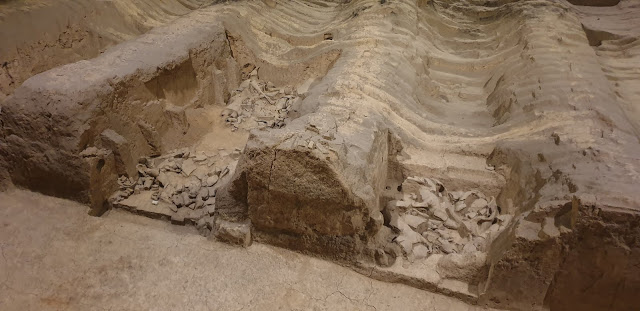
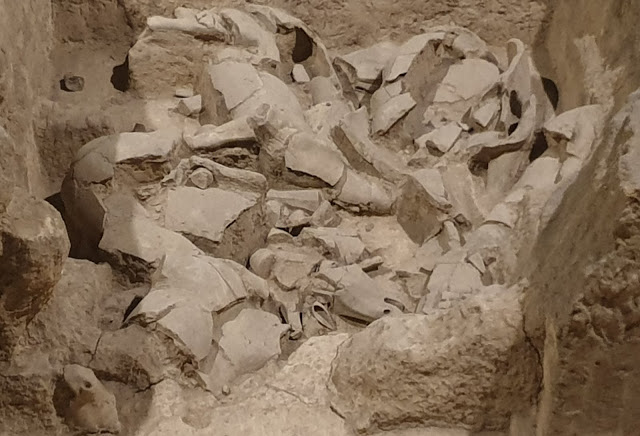
The excavation of this pit has only just begun, so it is possible to see where they have carefully removed the top cover, and you can see the broken parts of the warriors lying in a heap.
Some parts of the warriors are more discernible closer up
These parts are carefully extracted and taken to the ‘hospital’ where they are digitised and the computer will match each part with the warrior it belongs to.
Pit 1
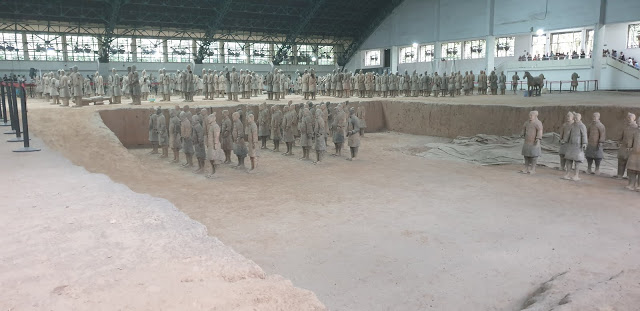
This has quite a number of standing soldiers that have been glued back together, but not necessarily complete and I notice a number if the statues were incomplete. And if they cannot find the missing pieces, then they are not added to or filled in.
The scale of the pit is enormous, and they have hardly scratched the surface in the restoration process.
What is there is a number of horses as well.
That’s at the front of the pit, a long line of statues, and what is clear is the location of the well where the first fragments were found by a farmer.
There are about eight lines of soldiers, and some lining the sides.
Midway down there is a large area currently under excavation
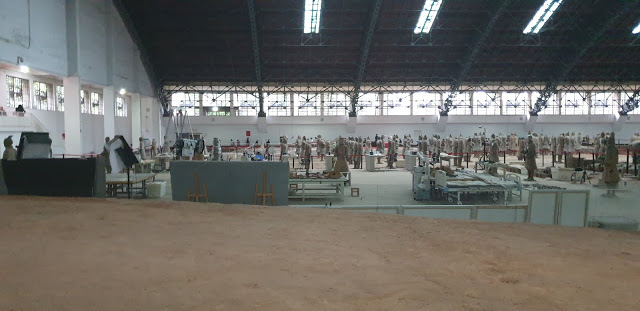
At the back is the hospital where the soldiers are reassembled. There’s nearly a hundred in the various stages of rebuilding. These days the soldiers are rebuilt using computer imaging.
The hospital area is where they are put back together
And these are some of the statues in various stages of reconstruction
Another two views of the size and scale of the reconstruction project
The coffee shop is also a sales centre, but there are too many people waiting for coffee and too few places to sit down.
In 1974 a 26-year-old farmer, Yang Jide, was drilling a well and found fragments of the terracotta soldiers and bronze weapons.
What was discovered later was one of the biggest attended burial pits of China’s first feudal Emperor, Qin Shi Huang. In the following years remains had been found in 3 pits, yielding at least 8,000 soldiers and horses, and over 100 chariots. The soldiers were infantry, cavalry, and others.
Emperor Qin was born in 259 BC and died in 210 BC. He began building a mausoleum for himself at the foot of Mount Li when he was 13. Construction took 38 years, from 247 BC to 208 BC. It was divided into 3 stages and involved 720,000 conscripts.
The pits of pottery figures are 1.5 km east of Emperor Qin’s mausoleum. Pit 1 has about 6,000 terracotta armored warriors and horses and 40 wooden chariots. Pit 2 is estimated to have over 900 terracotta warriors and 350 terracotta horses with about 90 wooden chariots. Pit 3 had so far yielded only 66 pottery figures and one chariot drawn by four horses.
Official records say it was discovered later that it was likely Xiang Yu, a rebel, intentionally damaged the Mausoleum and the soldiers in the pits, by setting fire to the wooden roof rafters, and these fell on and broke the warriors into pieces.
However, we were told that after the terracotta warriors were completed, the Emperor ordered the builders to be killed so that they would not tell anyone about the warriors, and then of those that remained alive deliberately smashed all of the artifacts.
The thing is, all of the terracotta figures that have been found are in pieces, and they need computers to piece them back together again.
The visit: The first impression is the size of the car park and the number of buses parked in the lot, and a hell of a lot more outside up the road an off on side streets. Obviously, it costs money to park in the parking lot.
The other first impressions; the numbers waiting to get in were not as many as yesterday outside the forbidden city, in fact, a lot less.
Be warned there’s a long walk from the entrance gate where your bags are scanned and a body scan as well, before admittance. This walk is through a landscaped area which it is expect might sometime in the future reveal more soldiers, or other artifacts.
At the end of the walk that takes about ten minutes, you can get a one-way ride to the second checkpoint, but we opted not to as no one else in our group did.
That walk is the warm-up exercise to an organized viewing of the exhibits after going through a second ticket checkpoint. On the other side, we had to hand our tickets back to the tour guide which was disappointing not to end up with a memento of actually having been there.
So, on the other side in the courtyard, the guide told us the most important parts of the exhibition, that we should spend most of the time looking at pit 1, and then spent a little time in 2 which is only there in the first stages of excavation. Then move onto the museum if only to see the replica chariots.
We do.
The chariots were small but interesting
The horses were better and intricately detailed
These are soldiers, perhaps complete examples of those types found in the end pit.
This is one of the archers. You can tell by the way he wears his hair.
Pit 2
The excavation of this pit has only just begun, so it is possible to see where they have carefully removed the top cover, and you can see the broken parts of the warriors lying in a heap.
Some parts of the warriors are more discernible closer up
These parts are carefully extracted and taken to the ‘hospital’ where they are digitised and the computer will match each part with the warrior it belongs to.
Pit 1
This has quite a number of standing soldiers that have been glued back together, but not necessarily complete and I notice a number if the statues were incomplete. And if they cannot find the missing pieces, then they are not added to or filled in.
The scale of the pit is enormous, and they have hardly scratched the surface in the restoration process.
What is there is a number of horses as well.
That’s at the front of the pit, a long line of statues, and what is clear is the location of the well where the first fragments were found by a farmer.
There are about eight lines of soldiers, and some lining the sides.
Midway down there is a large area currently under excavation
At the back is the hospital where the soldiers are reassembled. There’s nearly a hundred in the various stages of rebuilding. These days the soldiers are rebuilt using computer imaging.
The hospital area is where they are put back together
And these are some of the statues in various stages of reconstruction
Another two views of the size and scale of the reconstruction project
The coffee shop is also a sales centre, but there are too many people waiting for coffee and too few places to sit down.
A convoluted explanation on the reasons for this memorial came down to it being about the deaths of those involved in the 1923 Erqi strike, though we’re not really sure what the strike was about.
So, after a little research, this is what I found:
The current Erqi Tower was built in 1971 and was, historically, the tallest building in the city. It is a memorial to the Erqi strike and in memory of Lin Xiangqian and other railway workers who went on strike for their rights, which happened on February 7, 1923.
It has 14 floors and is 63 meters high. One of the features of this building is the view from the top, accessed by a spiral staircase, or an elevator, when it’s working (it was not at the time of our visit).
There seems to be an affinity with the number 27 with this building, in that
It’s the 27th memorial to be built
to commemorate the 27th workers’ strike
located in the 27th plaza of Zhengzhou City.
We drive to the middle of the city where we once again find traveling in kamikaze traffic more entertaining than the tourist points
When we get to the drop-off spot, it’s a 10-minute walk to the center square where the tower is located on one side. Getting there we had to pass a choke point of blaring music and people hawking goods, each echoing off the opposite wall to the point where it was deafening. Too much of it would be torture.
But, back to the tower…
It has 14 levels, but no one seemed interested in climbing the 14 or 16 levels to get to the top. The elevator was broken, and after the great wall episode, most of us are heartily sick of stairs.
The center square was quite large but paved in places with white tiles that oddly reflected the heat rather than absorb it. In the sun it was very warm.
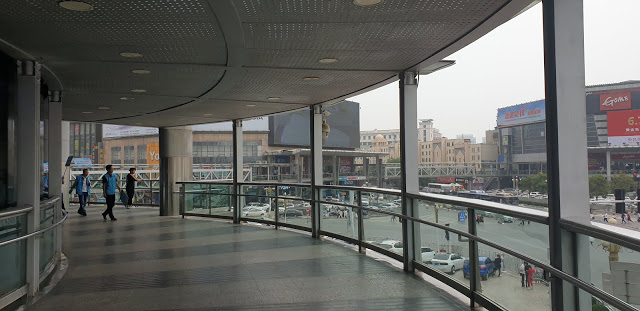
Around the outside of two-thirds of the square, and crossing the roads, was an elevated walkway, which if you go from the first shops and around to the other end, you finish up, on the ground level, at Starbucks.
This is the Chinese version and once you get past the language barrier, the mixology range of cold fruity drinks are to die for, especially after all that walking. Mine was a predominantly peach flavor, with some jelly and apricot at the bottom. I was expecting sliced peaches but I prefer and liked the apricot half.
A drink and fruit together was a surprise.
Then it was the walk back to the meeting point and then into the hotel to use the happy house before rejoining the kamikaze traffic.
We are taken then to the train station for the 2:29 to our next destination, Suzhou, the Venice of the East.
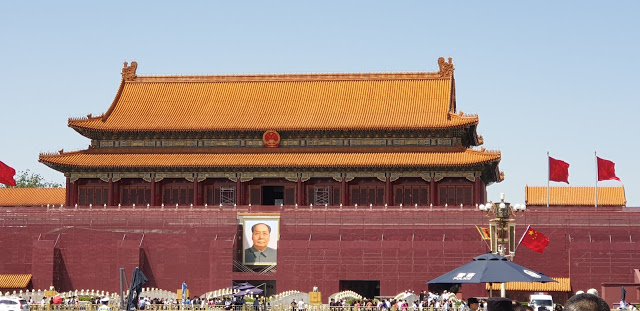
Tiananmen Square Some interesting facts before we get out of the bus… Tiananmen Square or Tian’anmen Square is in the centre of Beijing name after the Gate of Heavenly Peace, a gate that one separated the square from the Forbidden City.
The Square contains,
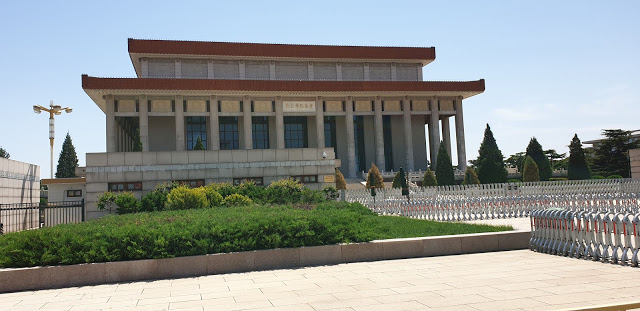
the Monument to the People’s Heroes the Great Hall of the People the National Museum of China the Mausoleum of Mao Zedong.
The square is about 109 acres and was designed and built in 1651, and since then been enlarged four times since, the most recent upgrade in the 1950s.
The Monument to the People’s Heroes
This is a ten-story obelisk built to commemorate the matters of the revolutions. It was built between August 1952 and May 1958. On the pedestal are reliefs depicting the eight major revolutionary episodes.
The Great Hall of the People
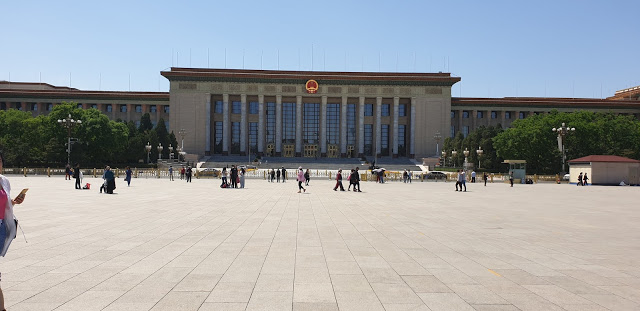
This was opened in September 1959, and covers 171809 square meters. The Great Hall is the largest auditorium in China and can seat up to 10,000 people. The State Banquet Hall can seat up to 5,000 diners.
The National Museum of China
This is one of the largest museums in the world and the second most visited museum in the world after the Louvre in Paris. It was completed in 1959, and sits on 65 hectares, and rises four floors. It has a permanent collection of over 1,000,000 items.
The Mauseloum of Mao Zedong
This was built shortly after his death, and completed on May 24th, 1977. The embalmed body of the Chairman is preserved and on display in the center hall.
My own observations This is huge; one of the largest public squares in the world, and if you’re going to walk it, like we did, make sure you’ve been exercising before you go. It covers 44 hectares, borders on the Forbidden City, and has a memorial to Chairman Mao in the center of it. But you cannot go near it, it’s fenced off, and it is guarded.
That’s both the statue and the square as there are random guards marching in random directions all the while watching us to see that we don’t misbehave.No one wants to find out what would happen if you jumped the fence around the statue, but I’m guessing you’ll have a few years to contemplate the stupidity of your actions with some very unhappy government officials.
Around the edges of the square are huge buildings, on one side is the museum
and on the other is the Chinese equivalent of parliament.
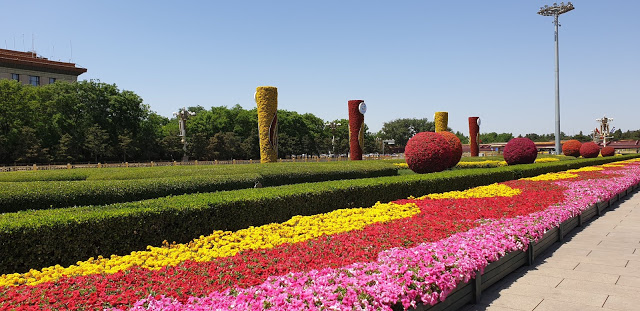
Around the sides are also large gardens
At one end, where the Forbidden City borders on the square, there’s a huge flag pole flying the Chinese flag, and this too like the monument is fenced off, and guarded by members of all of their armed services. No tanks rolled out during our visit much to our disappointment. There is no entrance to the Forbidden City from the square
At the other end is the Mausoleum of Mao Zedong, which was closed the day we were there, as was the museum.
There are four sculptural groups installed outside the mausoleum.
Other than that, it’s just another square, albeit probably one of the largest in the world. It can, we were told, hold about a million people.
Tiananmen Square Some interesting facts before we get out of the bus… Tiananmen Square or Tian’anmen Square is in the centre of Beijing name after the Gate of Heavenly Peace, a gate that one separated the square from the Forbidden City.
The Square contains,
the Monument to the People’s Heroes the Great Hall of the People the National Museum of China the Mausoleum of Mao Zedong.
The square is about 109 acres and was designed and built in 1651, and since then been enlarged four times since, the most recent upgrade in the 1950s.
The Monument to the People’s Heroes
This is a ten-story obelisk built to commemorate the matters of the revolutions. It was built between August 1952 and May 1958. On the pedestal are reliefs depicting the eight major revolutionary episodes.
The Great Hall of the People
This was opened in September 1959, and covers 171809 square meters. The Great Hall is the largest auditorium in China and can seat up to 10,000 people. The State Banquet Hall can seat up to 5,000 diners.
The National Museum of China
This is one of the largest museums in the world and the second most visited museum in the world after the Louvre in Paris. It was completed in 1959, and sits on 65 hectares, and rises four floors. It has a permanent collection of over 1,000,000 items.
The Mauseloum of Mao Zedong
This was built shortly after his death, and completed on May 24th, 1977. The embalmed body of the Chairman is preserved and on display in the center hall.
My own observations This is huge; one of the largest public squares in the world, and if you’re going to walk it, like we did, make sure you’ve been exercising before you go. It covers 44 hectares, borders on the Forbidden City, and has a memorial to Chairman Mao in the center of it. But you cannot go near it, it’s fenced off, and it is guarded.
That’s both the statue and the square as there are random guards marching in random directions all the while watching us to see that we don’t misbehave.No one wants to find out what would happen if you jumped the fence around the statue, but I’m guessing you’ll have a few years to contemplate the stupidity of your actions with some very unhappy government officials.
Around the edges of the square are huge buildings, on one side is the museum
and on the other is the Chinese equivalent of parliament.
Around the sides are also large gardens
At one end, where the Forbidden City borders on the square, there’s a huge flag pole flying the Chinese flag, and this too like the monument is fenced off, and guarded by members of all of their armed services. No tanks rolled out during our visit much to our disappointment. There is no entrance to the Forbidden City from the square
At the other end is the Mausoleum of Mao Zedong, which was closed the day we were there, as was the museum.
There are four sculptural groups installed outside the mausoleum.
Other than that, it’s just another square, albeit probably one of the largest in the world. It can, we were told, hold about a million people.
A fine day, on this trip a rarity, we decided to take the train to Windsor and see the castle.
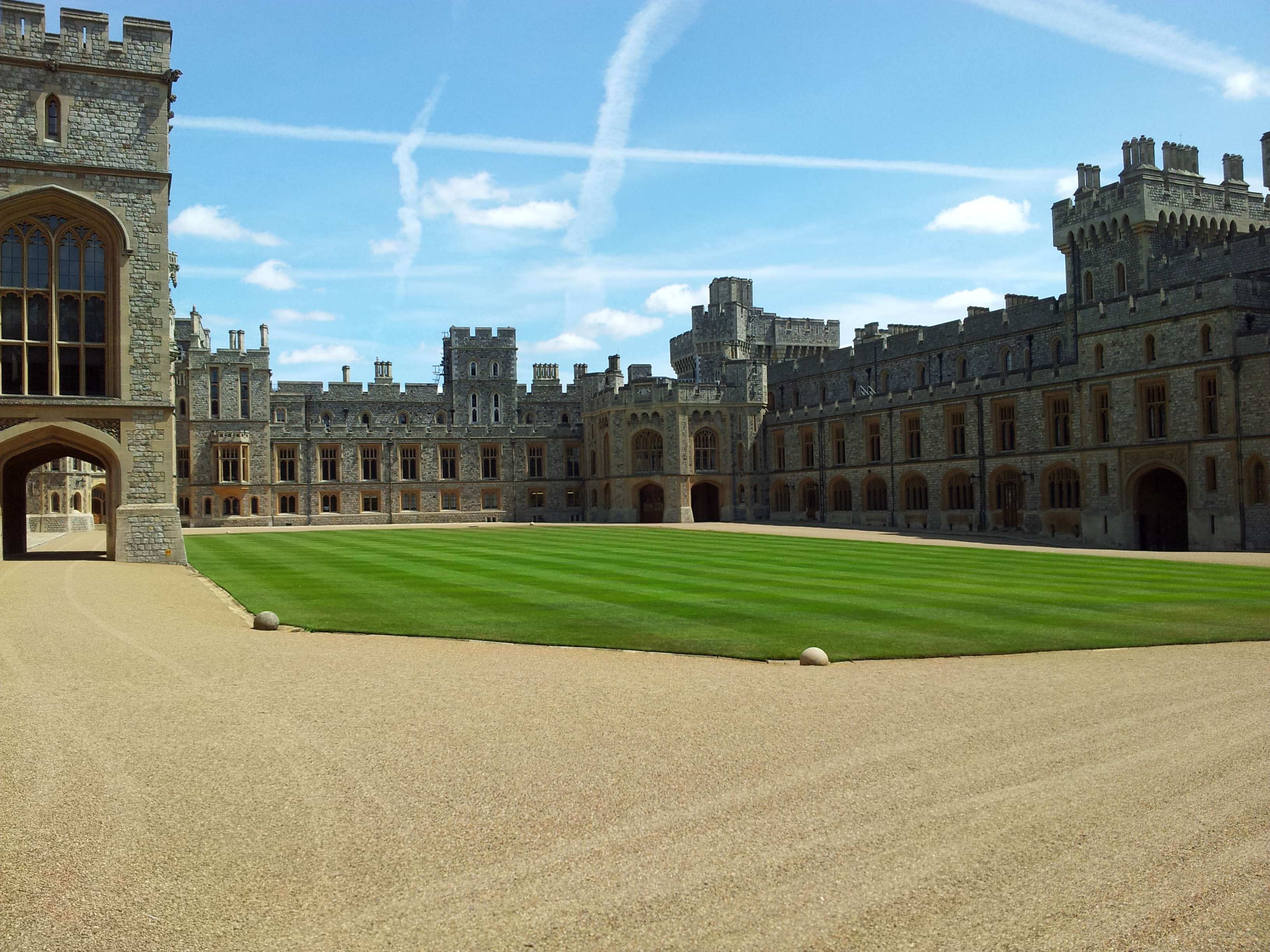
This is a real castle, and still in one piece, unlike a lot of castles.
Were we hoping to see the Queen, no, it was highly unlikely.
But there were a lot of planes flying overhead into Heathrow. The wind must have been blowing the wrong day, and I’m sure, with one passing over every few minutes, it must annoy the Queen if she was looking for peace and quiet.
Good thing then, when it was built, it was an ideal spot, and not under the landing path. I guess it was hard to predict what would happen 500 years in the future!
I’m not sure if this was the front gate or back gate, but I was wary of any stray arrows coming out of those slits either side of the entrance.
You just never know!
An excellent lawn for croquet. This, I think, is the doorway, on the left, where dignitaries arrive by car. The private apartments are across the back.
The visitor’s apartments. Not sure who that is on the horse.
St George’s Chapel. It’s a magnificent church for a private castle. It’s been very busy the last few months with Royal weddings.
The Round Tower, or the Keep. It is the castle’s centerpiece. Below it is the gardens.
Those stairs are not for the faint-hearted, nor the Queen I suspect. But I think quite a few royal children and their friends have been up and down them a few times.