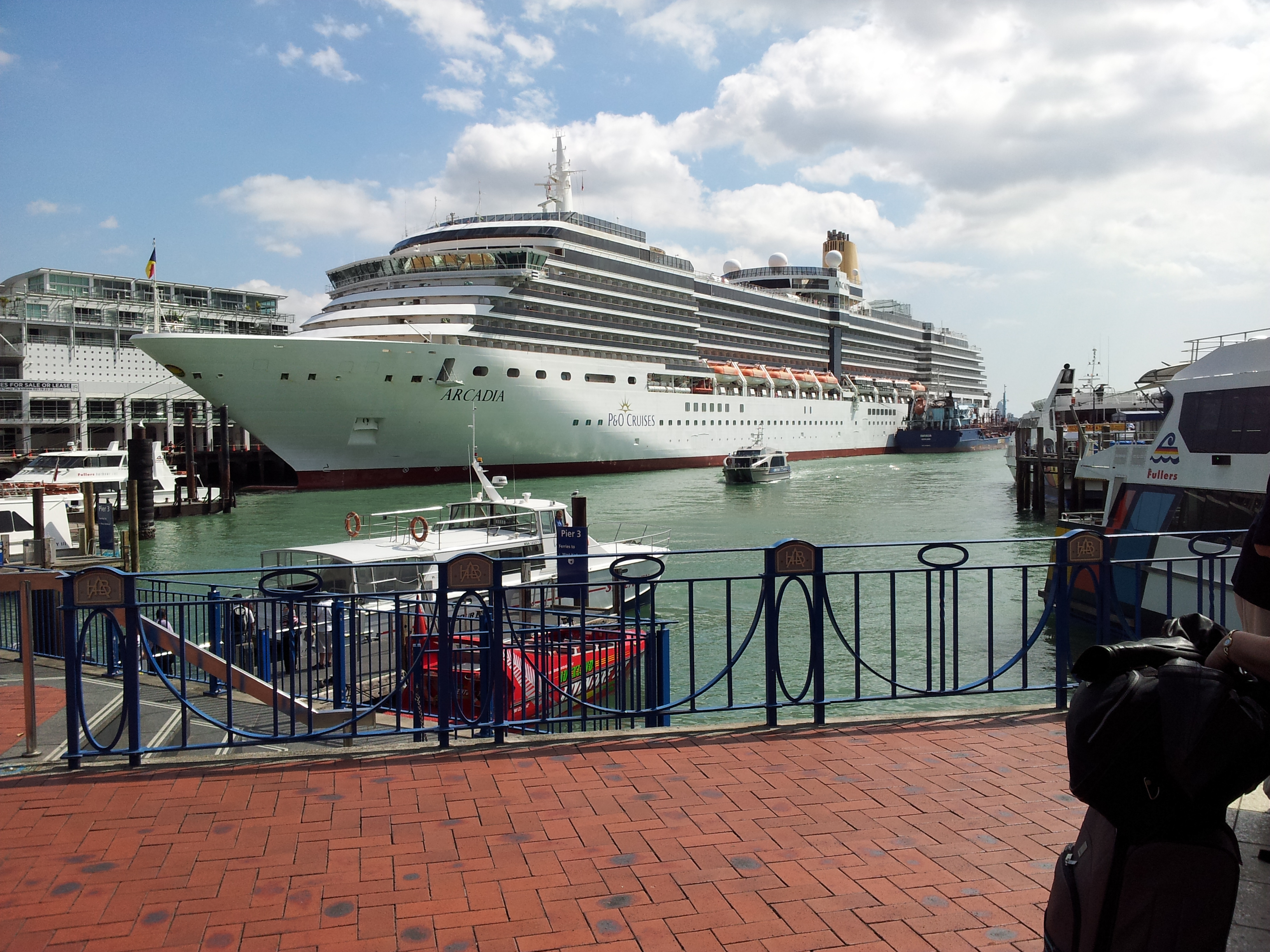
We were staying at the Hilton and advised there would be a large cruise liner berthing next to the hotel. There was the Arcadia.
This is the view from the other side of the hotel. Where our room was, we could almost walk onto the aft end of the ship.
We were also told this was a rather extraordinary day because there were two cruise ships in the port. particularly because it was near the end of the cruising season.
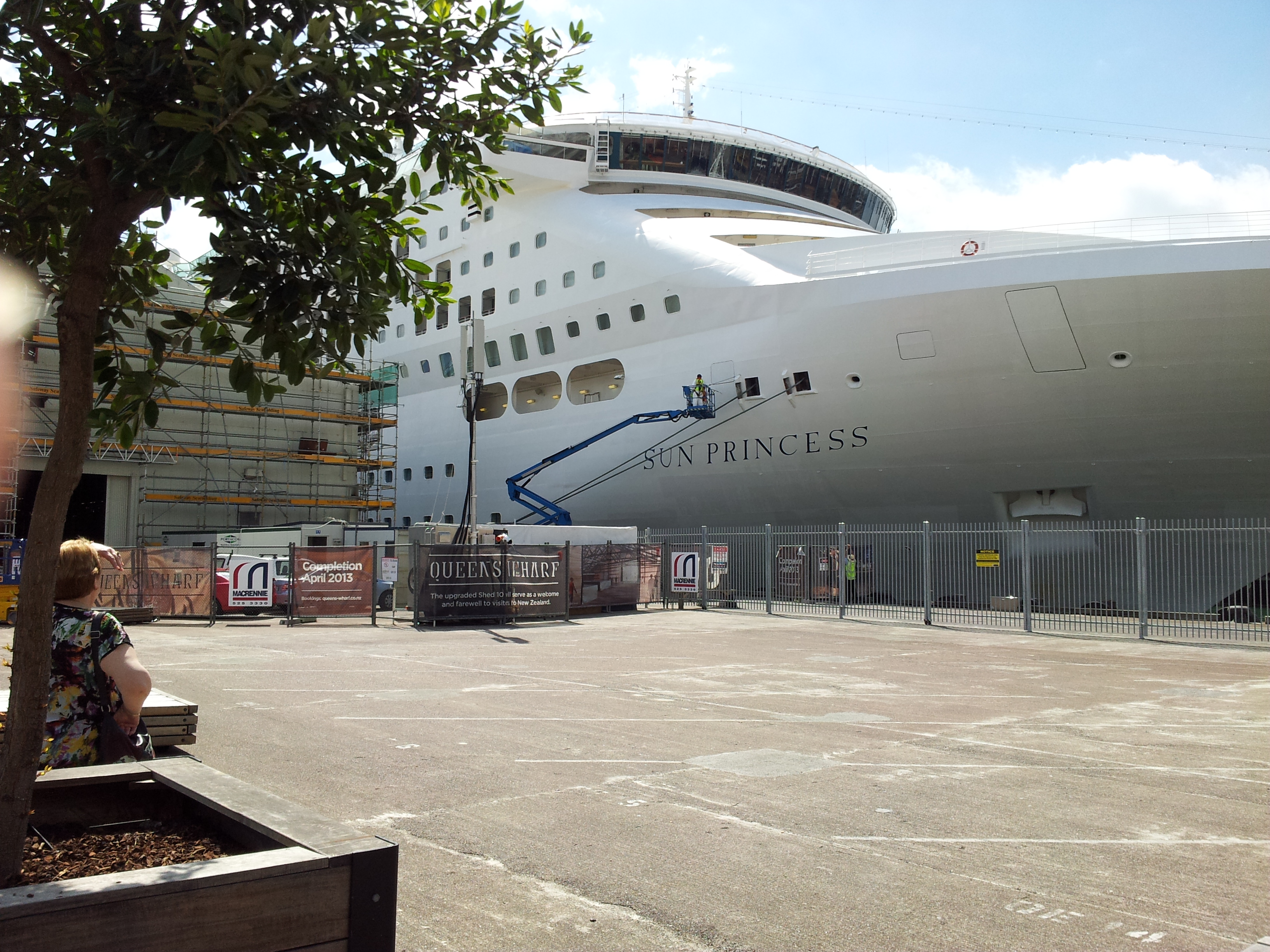
The other ship was two berths along, the Sun Princess.
Not as big as the Arcadia, up close it was still very impressive.
I have a passion for visiting transport museums, to see old trains, planes, buses, cars, even ships if it’s possible.
This has led to taking a number of voyages on the TSS Earnslaw in Queenstown, New Zealand.
Many, many, many years ago on Puffing Billy, a steam train in the Dandenongs, Victoria, Australia.
The steam train in Kingston, New Zealand, before it was closed down, but hopefully it will reopen sometime in the future.
The London Transport Museum in London England, which had a lot of buses.
The Workshops Railway Museum in Ipswich, Queensland, where once the many steam engines were built and maintained, and now had only a handful of engines remaining.
However, in the quest for finding and experiencing old transportation methods, we came across the Mary Valley Rattler, which runs out of Gympie, Queensland, Australia.
The ride begins in Gympie at the old Gympie Railway station, and as can be seen below, is one of the relics of the past, and, nothing like the new more modern stations. Thankfully.
If you’re going to have a vintage train, then you have to have a vintage station.
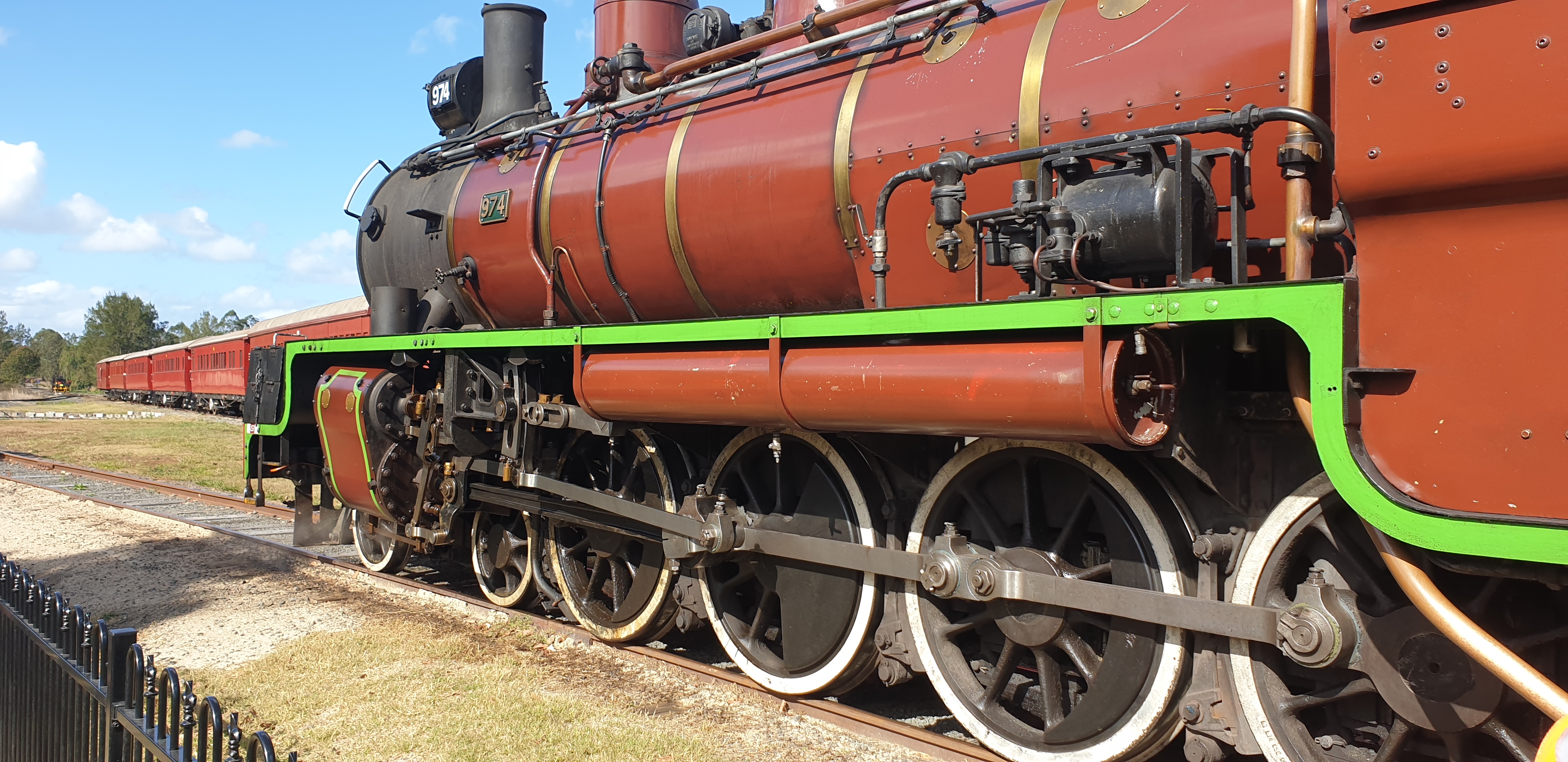
The Class of engine, seen below, is the C17, a superheated upgrade to the C16 it was based on, and first run in 1903. This particular engine was built in 1951, although the first of its type was seen in 1920 and the last of 227 made in 1953. It was the most popular of the steam engines used by Queensland Railways.
The C designation meant it had four driving axels and 17 was the diameter of the cylinder, 17 inches. It is also known as a 4-8-0 steam locomotive and nicknamed one of the “Brown Bombers” because of its livery, brown with green and red trimming.
Also, this engine was built in Maryborough, not far from Gympie by Walkers Limited, one of 138.
This photo was taken as the train returned from Amamoor, a trip that takes up to an hour.
The locomotive is detached from the carriages, then driven to the huge turntable to turn around for the return journey to Amamoor.
This is the locomotive heading down to the water station, and then taking on water. After that, it will switch lines, and reverse back to reconnect the carriages for the trip to Amamoor.
The carriages are completely restored and are extremely comfortable. It brings back, for me, many memories of riding in older trains in Melbourne when I was a child.
The trains, then, were called Red Rattlers.
This is the locomotive climbing one of the hilly parts of the line before crossing over the Mary River on a trestle bridge.
This is the engine at Amamoor near the picnic area where young children and excited parents and grandparents can get on the locomotive itself and look inside where the driver sits.
And, no, I didn’t volunteer to shovel coal.
This particular locomotive spent most of its working life between Townsville and Mount Isa and was based in Cloncurry, Charters Towers, and Townsville, before being sent, at the end of its useful days in the late 1960s, to the Ipswich Railway Workshops.
If there is one thing I cannot resist is walking into a book store wherever it might be.
It usually elicits a groan from everyone I’m with because for them, watching grass grow is a more fascinating exercise.
But…
The best bookshops are the pop-up ones that appear in various shopping centres where there are empty spaces, and these have a wide variety of books for just $7 each.
And there are lots of bargains…
As you can see, I have been on a few bargain hunts lately and like any writer’s room, tucked away with the boxes of drinks, gardening equipment and everything else that just doesn’t fit in the house, are the piles of books awaiting being put into the shelves
As you can see, the shelves are almost full so it’s going to be an uphill battle to find spaces for them.
By the way, there are eight such book cases on the surrounding walls, as well as a new one, recently discarded from the lounge room, to house the reference books
Along with a few stuffed bears.
The job of putting books on shelves falls to the grandchildren, whom I am trying to convince that when they get older, they should too embrace the idea of having a reading room, which my writing room will also be when I eventually get to throw out the accumulation of years of discarded homewares.
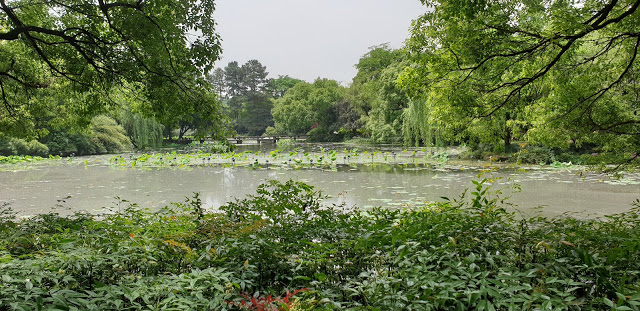
West Lake is a freshwater lake in Hangzhou, China. It is divided into five sections by three causeways. There are numerous temples, pagodas, gardens, and artificial islands within the lake.
Measuring 3.2 kilometers (2 miles) in length, 2.8 kilometers (1.7 miles) in width, and 2.3 meters (7.5 feet) in average depth, the lake spreads itself in an area totaling 6.5 square kilometers (2.5 square miles).
The earliest recorded name for West Lake was the “Wu Forest River”, but over time it changed to two distinct names. One is “Qiantang Lake”, due to the fact that Hangzhou was called “Qiantang” in ancient times. The other, “West Lake”, due to the lake being west of the city
It’s about to get busy, with a number of activities planned, and the warmth of the day is starting to make an impact.
The tour starts in the car park about a kilometer away, but the moment we left the car park we were getting a taste of the park walking along a tree-lined avenue.
When we cross the road, once again dicing with death with the silent assassins on motor scooters.
We are in the park proper, and it is magnificent, with flowers, mostly at the start hydrangeas and then any number of other trees and shrubs, some carved into other flower shapes like a lotus.
Then there was the lake and the backdrop of bridges and walkways.
.
And if you can tune out the background white noise the place would be great for serenity and relaxation.
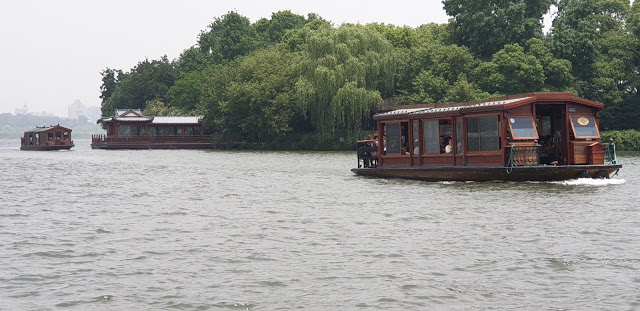
That, in fact, was how the boat ride panned out, about half an hour or more gliding across the lake in an almost silent boat, by an open window, with the air and the majestic scenery.
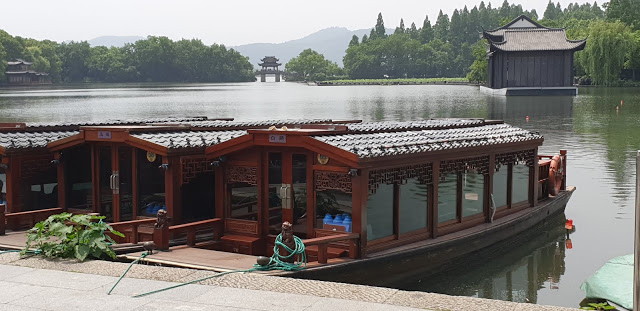
No, not that boat, which would be great to have lunch on while cruising, but the boat below:
Not quite in the same class, but all the same, very easy to tune out and soak it in.
It was peaceful, amazingly quiet, on a summery day
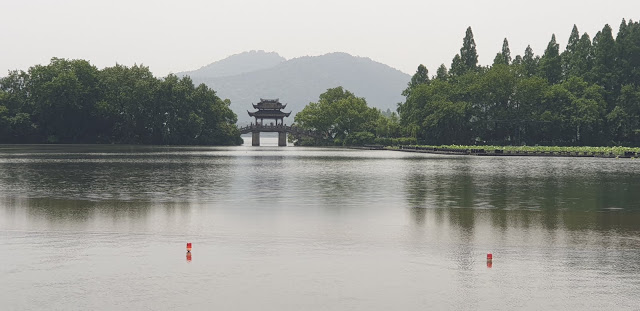
A pagoda in the hazy distance, an island we were about to circumnavigate.
Of all the legends, the most touching one is the love story between Bai Suzhen and Xu Xi’an. Bai Suzhen was a white snake spirit and Xu Xi’an was a mortal man.
They fell in love when they first met on a boat on the West Lake, and got married very soon after.
However, the evil monk Fa Hai attempted to separate the couple by imprisoning Xu Xi’an. Bai Suzhen fought against Fa Hai and tried her best to rescue her husband, but she failed and was imprisoned under the Leifeng Pagoda by the lake.
Years later the couple was rescued by Xiao Qing, the sister of Baisuzhen, and from then on, Bai Suzhen and Xu Xi’an lived together happily.
The retelling of the story varied between tour guides, and on the cruise boat, we had two. Our guide kept to the legend, the other tour guide had a different ending.
Suffice to say it had relevance to the two pagodas on the far side of the lake.
There was a cafe or restaurant on the island, but that was not our lunch destination.
Nor were the buildings further along from where we disembarked.
All in all the whole cruise took about 45 minutes and was an interesting break from the hectic nature of the tour.
Oh yes, and the boat captain had postcards for sale. We didn’t buy any.
Lunch
At the disembarkation point there was a mall that sold souvenirs and had a few ‘fast food’ shops, and a KFC, not exactly what we came to China for, but it seemed like the only place in town a food cautious Australian could eat at.
And when tried to get in the door, that’s where at least 3 busloads were, if they were not in the local Starbucks. Apparently, these were the places of first choice wherever we went.
The chicken supply by the time we got to the head of the line amounted to pieces at 22.5 RMB a piece and nuggets. Everything else had run out, and for me, there were only 5 pieces left. Good thing there were chips.
And Starbucks with coffee and cheesecake.
At least the setting for what could have been a picnic lunch was idyllic.
West Lake is a freshwater lake in Hangzhou, China. It is divided into five sections by three causeways. There are numerous temples, pagodas, gardens, and artificial islands within the lake.
Measuring 3.2 kilometers (2 miles) in length, 2.8 kilometers (1.7 miles) in width, and 2.3 meters (7.5 feet) in average depth, the lake spreads itself in an area totaling 6.5 square kilometers (2.5 square miles).
The earliest recorded name for West Lake was the “Wu Forest River”, but over time it changed to two distinct names. One is “Qiantang Lake”, due to the fact that Hangzhou was called “Qiantang” in ancient times. The other, “West Lake”, due to the lake being west of the city
It’s about to get busy, with a number of activities planned, and the warmth of the day is starting to make an impact.
The tour starts in the car park about a kilometer away, but the moment we left the car park we were getting a taste of the park walking along a tree-lined avenue.
When we cross the road, once again dicing with death with the silent assassins on motor scooters.
We are in the park proper, and it is magnificent, with flowers, mostly at the start hydrangeas and then any number of other trees and shrubs, some carved into other flower shapes like a lotus.
Then there was the lake and the backdrop of bridges and walkways.
.
And if you can tune out the background white noise the place would be great for serenity and relaxation.
That, in fact, was how the boat ride panned out, about half an hour or more gliding across the lake in an almost silent boat, by an open window, with the air and the majestic scenery.
No, not that boat, which would be great to have lunch on while cruising, but the boat below:
Not quite in the same class, but all the same, very easy to tune out and soak it in.
It was peaceful, amazingly quiet, on a summery day
A pagoda in the hazy distance, an island we were about to circumnavigate.
Of all the legends, the most touching one is the love story between Bai Suzhen and Xu Xi’an. Bai Suzhen was a white snake spirit and Xu Xi’an was a mortal man.
They fell in love when they first met on a boat on the West Lake, and got married very soon after.
However, the evil monk Fa Hai attempted to separate the couple by imprisoning Xu Xi’an. Bai Suzhen fought against Fa Hai and tried her best to rescue her husband, but she failed and was imprisoned under the Leifeng Pagoda by the lake.
Years later the couple was rescued by Xiao Qing, the sister of Baisuzhen, and from then on, Bai Suzhen and Xu Xi’an lived together happily.
The retelling of the story varied between tour guides, and on the cruise boat, we had two. Our guide kept to the legend, the other tour guide had a different ending.
Suffice to say it had relevance to the two pagodas on the far side of the lake.
There was a cafe or restaurant on the island, but that was not our lunch destination.
Nor were the buildings further along from where we disembarked.
All in all the whole cruise took about 45 minutes and was an interesting break from the hectic nature of the tour.
Oh yes, and the boat captain had postcards for sale. We didn’t buy any.
Lunch
At the disembarkation point there was a mall that sold souvenirs and had a few ‘fast food’ shops, and a KFC, not exactly what we came to China for, but it seemed like the only place in town a food cautious Australian could eat at.
And when tried to get in the door, that’s where at least 3 busloads were, if they were not in the local Starbucks. Apparently, these were the places of first choice wherever we went.
The chicken supply by the time we got to the head of the line amounted to pieces at 22.5 RMB a piece and nuggets. Everything else had run out, and for me, there were only 5 pieces left. Good thing there were chips.
And Starbucks with coffee and cheesecake.
At least the setting for what could have been a picnic lunch was idyllic.
Poetry is like art, its beauty is in the eye of the beholder.
But, while art can be very subjective, poetry often has a special meaning, to both the writer and then the reader. In turn, for each of us readers, a poem will have a different meaning, some will see what it represents, and others may not.
And, whilst I have not read a lot of poetry over the years, that changed recently when I subscribed to several blogs and discovered this whole new class of literature.
This view was strengthened when I came across a volume of poems by Jenny Andrews, titled Life at the End of the Rainbow.
For me, each poem is an insight into an extraordinary life, where the author sometimes lays bare those raw emotions, which, at times, we will find ourselves drawing parallels.
In a sense, I think we have all been to this mythical place called, The End of the Rainbow, and sometimes need a gentle reminder that it took a lot of ups and downs to get there.
This is, to my mind, a remarkable piece of work.
I, for one, can’t wait to see what the next stage of the journey will be.
When we arrive at the embarkation site we find at least 100 buses all lined up and parked, and literally thousands of Chinese and other Asians streaming through the turnstiles to get on another boat leaving earlier than ours.
Buses were just literally arriving one after the other stopping near where we were standing with a dozen or so other groups waiting patiently, and with people were everywhere it could only be described as organized chaos.
Someone obviously knew where everyone was supposed to go, and when it was our turn, we joined the queue. There were a lot of people in front of us, and a lot more behind, so I had to wonder just how big the boat was.
We soon found out.
And it was amusing to watch people running, yes, they were actually running, to get to the third level, or found available seating. Being around the first to board, we had no trouble finding a seat on the second level.
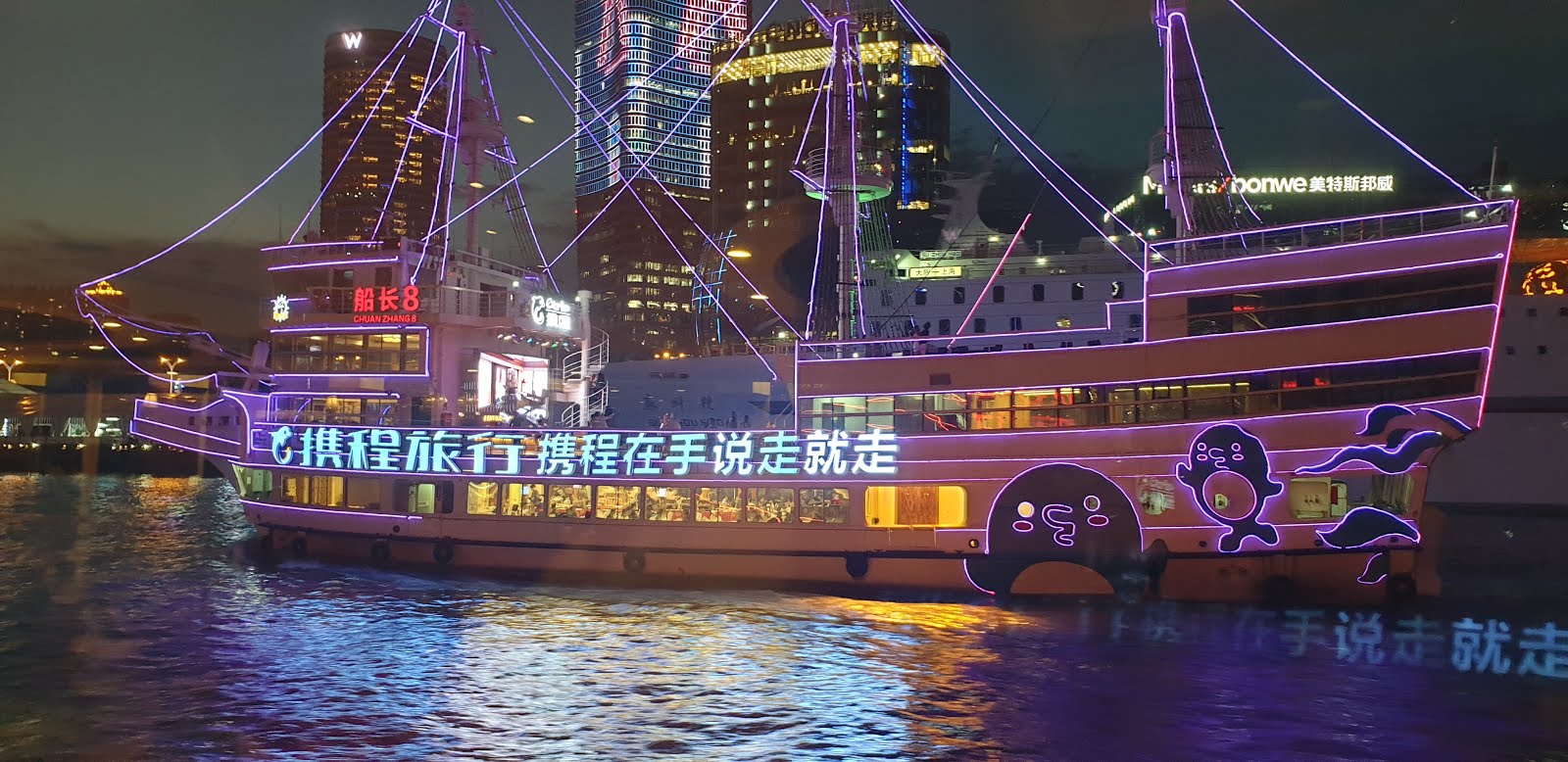
I was not quite sure what the name of the boat was, but it had 3 decks and VIP rooms and it was huge, with marble staircases, the sort you could make a grand entrance on. The last such ornate marble staircase we had seen was in a hotel in Hong Kong, and that was some staircase.
But who has marble staircases in a boat?
We’re going out across the water as far as the Bund and then turn around and come back about 30 to 40 minutes. By the time everyone was on board, there was no room left on the third level, no seats on the second level nor standing room at the end of the second level where the stairs up to the third level were.
No one wanted to pay the extra to go into the VIP lounge.
We were sitting by very large windows where it was warm enough watching the steady procession of the colored lights of other vessels, and outside the buildings.
It was quite spectacular, as were some of the other boats going out on the harbor.
All the buildings of the Bund were lit up
And along that part of the Bund was a number of old English style buildings made from sandstone, and very impressive to say the least.
On the other side of the harbour were the more modern buildings, including the communications tower, a rather impressive structure.
I had to go to the rear of the vessel to get a photo, a very difficult proposition given here was no space on the railing, not even on the stairs going up or down. It was just luck I managed to get some photos between passengers heads.
And, another view of that communications tower:
There was no doubt this was one of the most colourful night-time boat tours I’ve ever been on. Certainly, when we saw the same buildings the following day, they were not half as spectacular in daylight.
I never did get up to the third level to see what the view was like.
When we arrive at the embarkation site we find at least 100 buses all lined up and parked, and literally thousands of Chinese and other Asians streaming through the turnstiles to get on another boat leaving earlier than ours.
Buses were just literally arriving one after the other stopping near where we were standing with a dozen or so other groups waiting patiently, and with people were everywhere it could only be described as organized chaos.
Someone obviously knew where everyone was supposed to go, and when it was our turn, we joined the queue. There were a lot of people in front of us, and a lot more behind, so I had to wonder just how big the boat was.
We soon found out.
And it was amusing to watch people running, yes, they were actually running, to get to the third level, or found available seating. Being around the first to board, we had no trouble finding a seat on the second level.
I was not quite sure what the name of the boat was, but it had 3 decks and VIP rooms and it was huge, with marble staircases, the sort you could make a grand entrance on. The last such ornate marble staircase we had seen was in a hotel in Hong Kong, and that was some staircase.
But who has marble staircases in a boat?
We’re going out across the water as far as the Bund and then turn around and come back about 30 to 40 minutes. By the time everyone was on board, there was no room left on the third level, no seats on the second level nor standing room at the end of the second level where the stairs up to the third level were.
No one wanted to pay the extra to go into the VIP lounge.
We were sitting by very large windows where it was warm enough watching the steady procession of the colored lights of other vessels, and outside the buildings.
It was quite spectacular, as were some of the other boats going out on the harbor.
All the buildings of the Bund were lit up
And along that part of the Bund was a number of old English style buildings made from sandstone, and very impressive to say the least.
On the other side of the harbour were the more modern buildings, including the communications tower, a rather impressive structure.
I had to go to the rear of the vessel to get a photo, a very difficult proposition given here was no space on the railing, not even on the stairs going up or down. It was just luck I managed to get some photos between passengers heads.
And, another view of that communications tower:
There was no doubt this was one of the most colourful night-time boat tours I’ve ever been on. Certainly, when we saw the same buildings the following day, they were not half as spectacular in daylight.
I never did get up to the third level to see what the view was like.
After arriving in Hong Kong early in the morning, we were taken to the Hong Kong Conrad Hotel where we were staying for several days. We had a short sleep, then I took the grandchildren for a walk and we found Hong Kong Park, with a Fountain Plaza, waterways, a waterfall, and turtles.
Part of the fountain area.
Turtles resting on a rock
A turtle about to go in the water
The waterfall.
It was a pleasant surprise to find this park in such a highly built-up area.
Nearby was a multi-story underground shopping center that was huge, and very conveniently accessible from our hotel.