Searching for locations: The Jade Factory, Beijing, China

The first stop is at a Jade Museum to learn the history of jade. In Chinese, jade is pronounced as “Yu” and it has a history in China of at least four thousand years.  On the way there, we are given a story about one of the guide’s relatives who had a jade bracelet, and how it has saved her from countless catastrophes.It is, quite literally ‘the’ good luck charm.  Chinese gamblers are known to have small pieces of jade in their hands when visiting the casinos, for good luck.  I’m not sure anything could provide a gambler with any sort of luck given how the odds are always slanted towards the house.

At any rate, this is neither the time of the place to debunk a ‘well-known fact’.

 On arrival, our guide hands us over to a local guide, a real staff member, and she begins with a discussion on jade while we watch a single worker working on an intricate piece, what looks to be a globe within a globe, sorry, there are two workers, and the second is working on a dragon.

At the end of the passage that passes by the workers, and before you enter the main showroom, you are dazzled by the ship and is nothing short of magnificent.

Then it’s into a small room just off the main showroom where we are taken through the colors, and the carving process in the various stages, without really being told how the magic happens.

Then it’s out into the main showroom where the sales are made, and before dispersing to look at the jade collection, she briefly tells us how to tell real and fake jade, and she does the usual trick of getting one of the tour group to model a piece.

Looks good, let’s move on.  To bigger and better examples.

What interested me, other than the small zodiac signs and other smallish pieces on the ‘promotion’ table, was the jade bangle our tour guide told us about on the bus.  If anyone needs one, it is my other half, with all the medical issues and her sometimes clumsiness, two particular maladies this object is supposed to prevent.
Jade to the Chinese is Diamonds to westerners, and the jade bangle is often handed down to the females of the family from generation to generation, often as an engagement present, to be worn on the left hand, the one closest to the heart.

There are literally thousands of them, but, they have to be specially fitted to your wrist because if it’s too large, you might lose it if it slips off and I didn’t think it could be too small.  
Nor is it cheap, and needing a larger size, it is reasonably expensive.  But it is jadeite, the more expensive of the types of jade, and it can only appreciate in value, not that we are interested in the monetary value, it’s more the good luck aspect.

We could use some of that.

But, just to touch on something that can be the bugbear of traveling overseas, is the subject of happy houses, a better name for toilets, and has become a recurrent theme on this tour.  It’s better than blurting out the word toilet and it seems there can be some not so happy houses given that the toilets in China are usually squat rather than sit, even for women.
And apparently, everyone has an unhappy house story, particularly the women, and generally in having to squat over a pit.  Why is this a discussion point, it seems the jade factory had what we have come to call happy, happy houses which have more proper toilets, and a stop here before going on the great wall was recommended, as the ‘happy house’ at the wall is deemed to be not such a happy house.

Not even this dragon was within my price range.  Thank heaven they had smaller more affordable models.  The object of having a dragon, large or small, is that it should be placed inside the main door to the house so that money can come in.

It also seems that stuffing the dragon’s mouth with money is also good luck.  We passed on doing that.

After spending a small fortune, there was a bonus, free Chinese tea.  Apparently, we will be coming back, after the Great Wall visit, to have lunch upstairs.


Searching for locations: The remnants of the wall that surrounded Beijing, China

The fortification walls, both an inner wall and an outer wall, surrounding Beijing city were built from the early 1400s to 1553.

The dimensions of the Inner city wall are:
          Length: 24 kilometers or 15 miles
          Height: 25 meters or 49 feet high
          Thickness, at ground level: 20 meters or 66 feet
                            at the top: 12 meters or 29 feet

It had nine gates.  The fortifications included gate towers, archways, watchtowers, barbicans, barbican towers, sluice gates, sluice gate towers, enemy sighting towers, corner guard towers, and a moat system.

The outer city wall had a length of 28 kilometers or 17 miles.

From 1911, after the collapse of the Qing Dynasty, the dismantling of the fortifications began.

In 1965, major deconstruction of the fortifications was commenced to allow for the construction of the 2nd wrong road, and Line 2 or the Beijing underground railway.

 In 1979, the government called off the demolition of the remaining city walls and named them cultural heritage sites. By this time, the only intact sections were the gate tower and watchtower at Zhengyangmen, the watchtower at Deshengmen, the guard tower at the southeast corner, the northern moats of the Inner city, the section of the Inner city wall south of the Beijing railway station, and a small section of Inner-city wall near Xibianmen.

For more reading, go to: https://en.wikipedia.org/wiki/Beijing_city_fortifications

As for our guide’s explanation of the fortifications: Leaving the Square to go to the Golden Mask Dynasty Show, we pass remnants of the wall that used to surround Beijing.

This wall was built in the early 15th century and was about 24 km long, up to 15 meters high and about 20 meters thick, and had nine gates, one of which still exists today.  In 1965 most of it was removed so that the second ring road and an underground railway line could be built.

Searching for locations: On the road to Tiananmen Square, Beijing, China

One the first things you notice when driving around Beijing, other than the roads are congested with traffic, is the number of trees and flowers that have been planted, in the median strip as well as along the edges of the road.

What you also notice is the large number of multi-story apartment blocks, which are needed to house the millions of Beijing residents.  What we have, so far, rarely seen, is single-story houses.
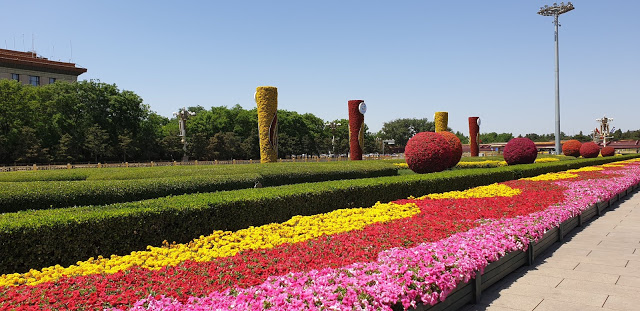
These continuous areas of trees and rose bushes are, every now and then, broken up by very colorful garden beds:

Nearer to the square we are able to get up close to the flowers.  These, we are told, are a variation on the rose, one that flowers for nine months of the year.

They come in a variety of colors.

And they are literally everywhere you go, on the side of the roadway, often blotting out the concrete jungle behind them.

Searching for locations: Tiananmen Square, Beijing, China

Tiananmen Square

Some interesting facts before we get out of the bus…

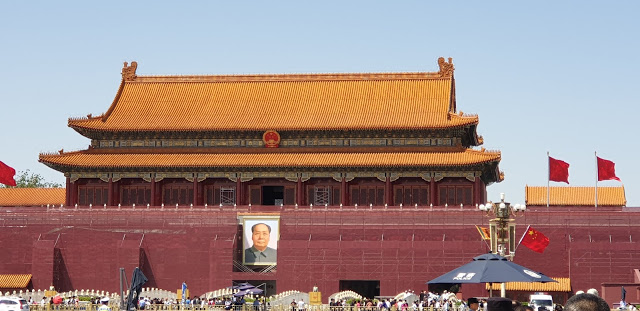
Tiananmen Square or Tian’anmen Square is in the centre of Beijing name after the Gate of Heavenly Peace, a gate that one separated the square from the Forbidden City.

The Square contains,

   the Monument to the People’s Heroes
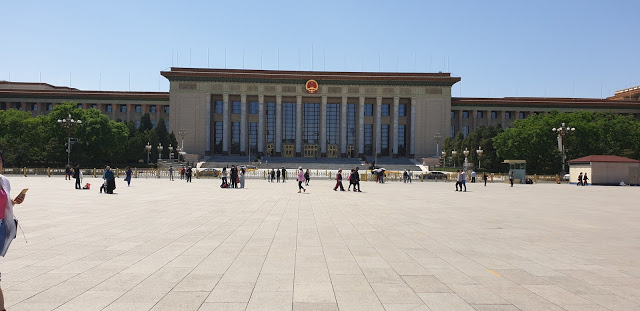
   the Great Hall of the People
   the National Museum of China
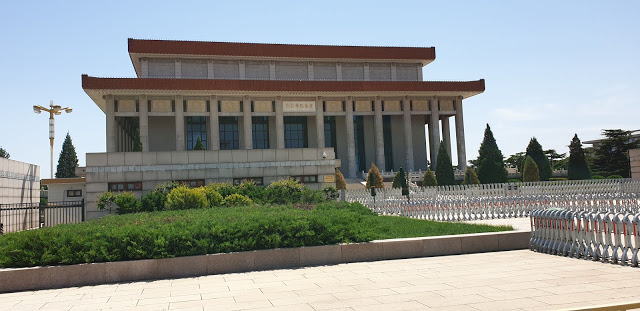
   the Mausoleum of Mao Zedong.

The square is about 109 acres and was designed and built in 1651, and since then been enlarged four times since, the most recent upgrade in the 1950s.

The Monument to the People’s Heroes

This is a ten-story obelisk built to commemorate the matters of the revolutions.  It was built between August 1952 and May 1958.  On the pedestal are reliefs depicting the eight major revolutionary episodes.

The Great Hall of the People

This was opened in September 1959, and covers 171809 square meters.  The Great Hall is the largest auditorium in China and can seat up to 10,000 people.  The State Banquet Hall can seat up to 5,000 diners.

The National Museum of China

This is one of the largest museums in the world and the second most visited museum in the world after the Louvre in Paris.   It was completed in 1959, and sits on 65 hectares, and rises four floors.  It has a permanent collection of over 1,000,000 items.

The Mauseloum of Mao Zedong

This was built shortly after his death, and completed on May 24th, 1977.  The embalmed body of the Chairman is preserved and on display in the center hall.

My own observations
This is huge; one of the largest public squares in the world, and if you’re going to walk it, like we did, make sure you’ve been exercising before you go.  It covers 44 hectares, borders on the Forbidden City, and has a memorial to Chairman Mao in the center of it.  But you cannot go near it, it’s fenced off, and it is guarded.

That’s both the statue and the square as there are random guards marching in random directions all the while watching us to see that we don’t misbehave.No one wants to find out what would happen if you jumped the fence around the statue, but I’m guessing you’ll have a few years to contemplate the stupidity of your actions with some very unhappy government officials.

 Around the edges of the square are huge buildings, on one side is the museum 

 and on the other is the Chinese equivalent of parliament.

Around the sides are also large gardens

At one end, where the Forbidden City borders on the square, there’s a huge flag pole flying the Chinese flag, and this too like the monument is fenced off, and guarded by members of all of their armed services.  No tanks rolled out during our visit much to our disappointment.  There is no entrance to the Forbidden City from the square

 At the other end is the Mausoleum of Mao Zedong, which was closed the day we were there, as was the museum. 

 There are four sculptural groups installed outside the mausoleum.

Other than that, it’s just another square, albeit probably one of the largest in the world.  It can, we were told, hold about a million people.

Trying to get off, or is that on, the merry-go-round

Self-published authors are fully aware that perhaps the easiest part of the writing journey is the actual writing.  Well, compared to the marketing aspect I believe it is.

I have read a lot of articles, suggestions and tips and tricks to market the book to the reading public.  It is, to say the least, a lot harder to market eBooks than perhaps their hard or paper-covered relatives.

This is despite the millions of eReaders out there.

Then there is that other fickle part of the publishing cycle, the need for reviews.

Proper reviews of course.

As we are learning, reviews can be bought, and in more ways than one.  What happened to finding writers of the same genre and offering to buy one copy and write a review in return for a buy one copy and write a review.

I’ve noticed that all the current best selling novelists do the same for their fellow novelists though I guess when you get to be a best-seller, you might not have to buy a copy, so I can only dream of attaining such lofty heights in the publishing world.

But until I reach such rarefied air, I guess I have to figure out how to appeal to my fellow writers, and, of course, hope that my work is good enough.

It might be a start in getting through that difficult cycle, more reviews means more sales, etc.  And getting those first sales and reviews  …

Therein lies the conundrum.  It is a question of paying for advertising or working it out for ourselves.  I guess if I were to get more sales, I could afford the advertising … yes, back on the merry-go-round!

And yet, the harder the road, the more I enjoy what I do.  It is exhilarating while writing, it is a joy to finish the first draft, it is an accomplishment when it is published, but when you sell that first book, well, there is no other feeling like it.

I am inspired.

Now as for that advertisement and where to post it…

Searching for locations: The Forbidden City, Beijing, China

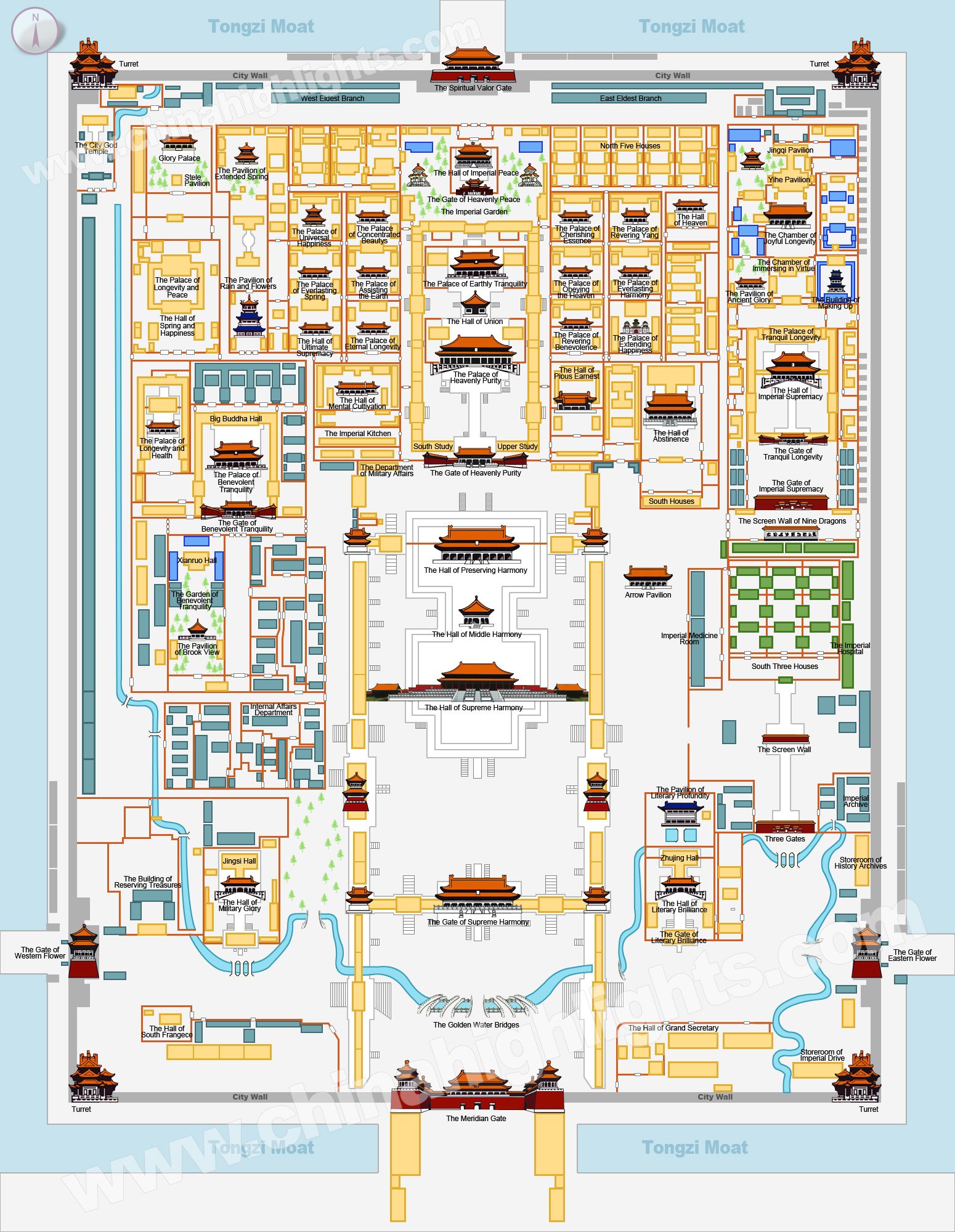
Now we’re walking to the Forbidden City, and it seems like we’re walking for miles and we’re practically exhausted before we get started on the main tour.  I’m not sure if we received a map of the city, but one is certainly needed so that you can navigate the many features, buildings, and walkways.

There are tour groups everywhere in the large courtyard outside the gate, most likely getting a lecture on the last of the Chinese emperors about that time Sun Yat-Sen proclaimed the new China around 1912.  We were no exception, and it was an interesting way to spend the time waiting to get in.  It was a tale of intrigue, interwoven with a 3-year-old emperor, and a scheming concubine who becomes the Emperor’s favorite, enough to bear him a son and successor.

Bribery and corruption at its best.

But its history runs something like this:

The Forbidden City is was once the imperial and state residence of the Emperor of China, as well as the center of government, from the Ming Dynasty to the Qing Dynasty, or 1420 to 1924.

It was built from 1406 to 1420 when the Yongle Emperor moved the capital from Nanking to Beijing and consists of about 980 buildings, and 8,886 bays of rooms (not the 9,999 as prescribed in myth) and covers 180 acres.  Over the 14 years, a million workers used whole logs of wood from the jungles of southwestern China, marble from quarries near Beijing, specially made golden bricks from Suzhou

Since 1925 it has been a museum and is the largest number of preserved wooden structures in the world.

The city is surrounded by a wall 7.9 meters high, and a moat that is 6 meters deep and 52 meters wide.  A tower sits at each of the four corners.  Each side has a gate, the north is called the Gate of Divine Might, the south is called the Meridian gate.  East and west are called East Glorious Gate and West Glorious Gate respectively.

But, back in the courtyard, we are ready to go in and follow the tour guide who has switched from her amplified microphone to a whisper device we all wear in our ears.  She talks and we listen.

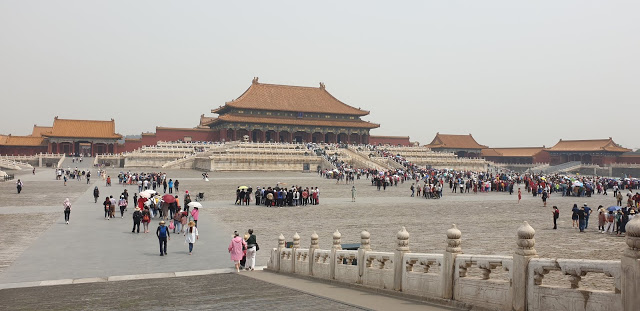
We all make it through and regroup on the other side. This is where the fun begins because we are about to meet a large percentage of the 80,000, they let for the day.

It seems to me they have all arrived at the same time, although by the time we get to the entrance gate, it is very well organized, bags are scanned, people are scanned, and you’re in.

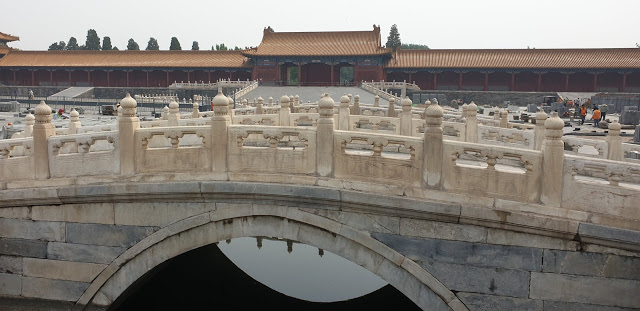
After crossing one of the seven Golden Water bridges, you begin to get some idea of the size and scope of the City, and in the distance, the first of the buildings, The Gate of Supreme Harmony.  On a hot day, that could be a long and thirsty walk.

From there it is one pagoda after another with buildings that surround the edge of the whole Forbidden City, as does the moat.

By the time we get to the second courtyard, it was time to have ice cream as a refresher.  Others head up to another exhibit, and it’s just too many stairs for us.

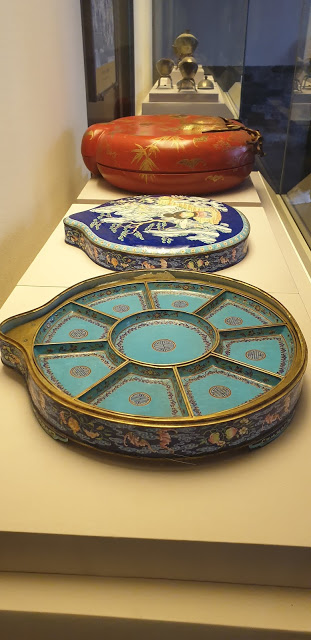
After this, it’s a walkthrough another courtyard, heading up and down some more stairs, we go and see the museum, with priceless relics from past emperors.

There are areas like the outer courtyard, the inner courtyard, yet another courtyard, and the gardens where the concubines walked and spent their leisure time.  It is not far from the emperor’s wives living quarters, though there’s precious little left of the furniture, other than a settee and two rather priceless so-called Ming dynasty vases.

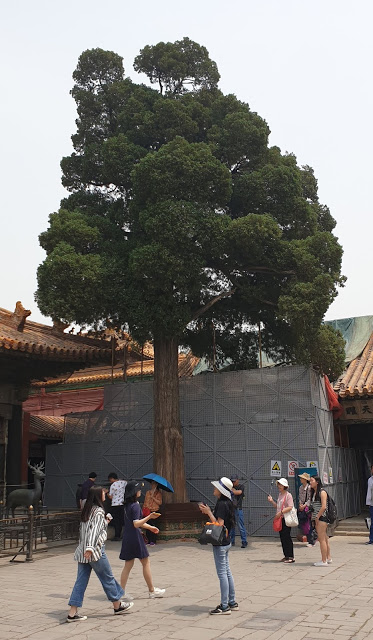
We get into the bad habit of calling all of the vases Ming dynasties.  Above is one of the inner courtyards there were living quarters, and that tree is over 300 years old.

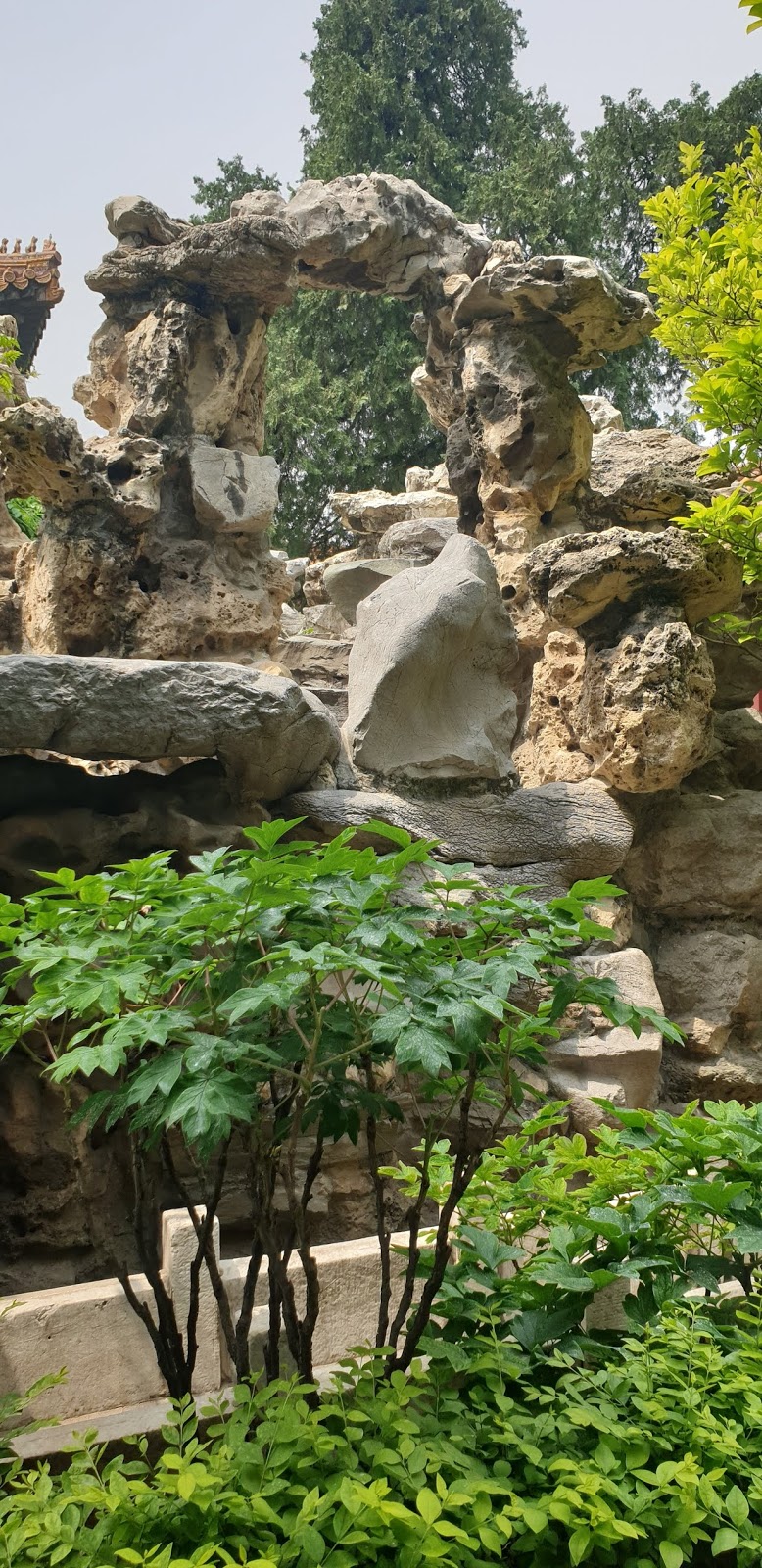
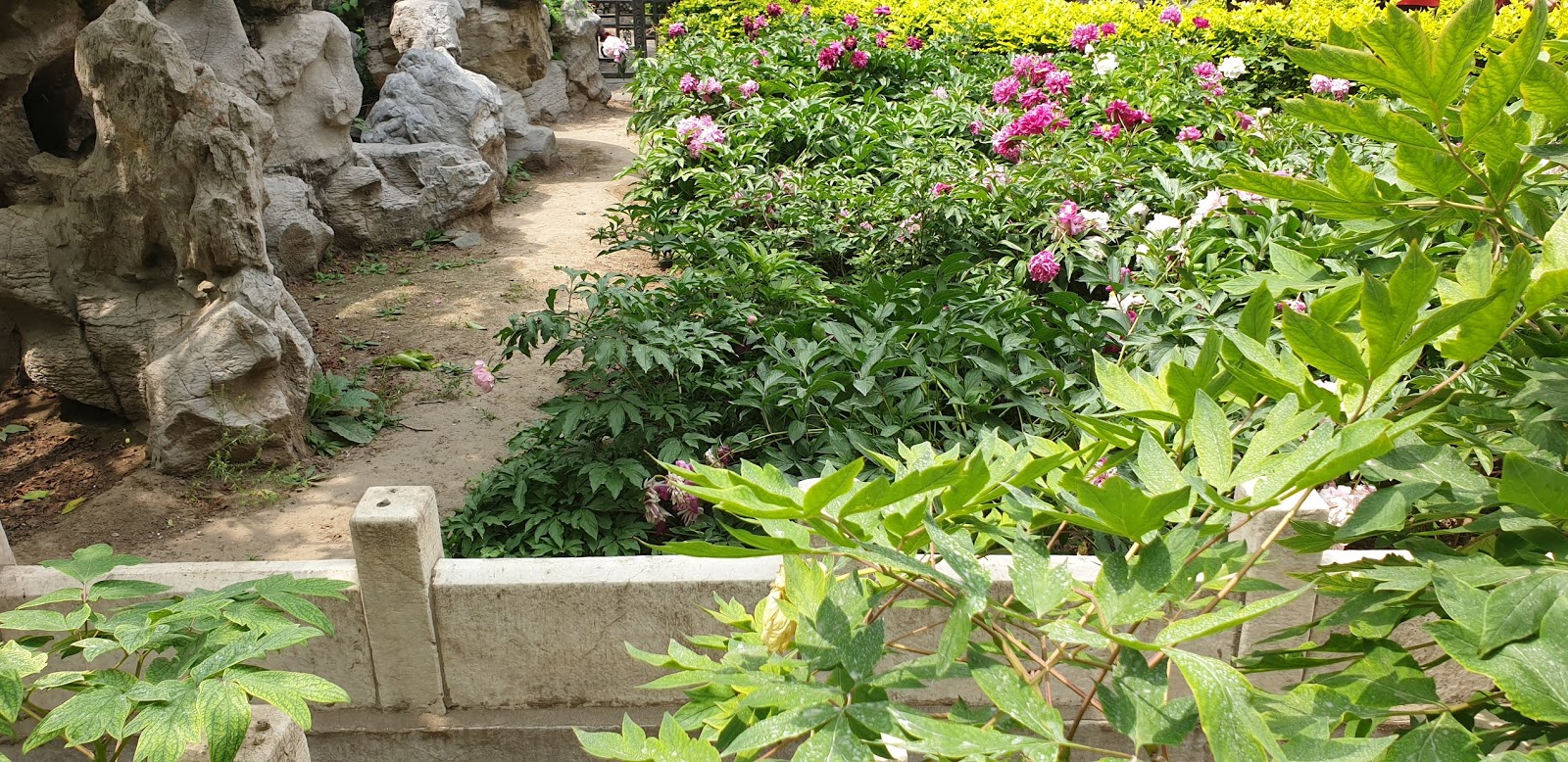
Out through some more alleyways and through an entrance that led to the area where the concubines lived, very spacious, bright, and filled with trees, plants, and walkways through rocky outcrops.

The whole area was made up of living quarters and waterways, rocks and paths, all very neatly set out, and it looked to be a very good place to live.

This is an example of the living quarters, overlooking the gardens

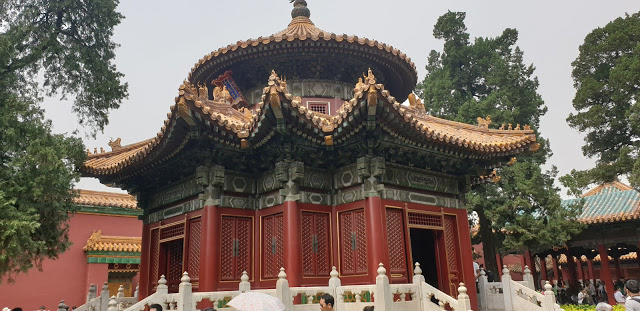
And there were several pagodas

From there its a quick exit out the northern entrance, and another longish walk to our bus, which arrives at the meeting point shortly after we do.

That done, the Beijing tour guide has completed her section of our China experience, and we’re ready to move onto the next.