Searching for locations: A trip to New Jersey

That meant we had to make the journey from New York to New Jersey, by train.  It involved the underground, or as New Yorkers call it, the subway, from Columbus Circle which by any other name was really, 80th street, to 34th street which apparently was the New Jersey jump-off point for us to get overground, well a lot of it was overground. So, were we going uptown or downtown?

Apparently, it was downtown, and to 34th Street on the A train.

You would not think this to be a difficult task, but for people not used to the subway, and where they were going other than some internet derived instructions, but without the help of a man at the station, just getting tickets may have stopped us dead in our tracks.  With his help, we determined the return fare for three of us and then get through the turnstile onto the platform.

We get on the A train, but soon discover it was not stopping at all stations.  There was for a few minutes, a little apprehension we might just simply bypass our station.  Luckily we did not.

Now, finding your way to the New Jersey transit part of Penn station might appear to be easy, on paper, but once there, on the ground, and mingling with the other passengers which all seemed to be purpose going somewhere, it took a few moments to realize we had to follow the New Jersey transit signs.

This led to a booking hall where luckily we realized we needed to buy more tickets, then find the appropriate platform, and then get on the right train, all of which, in the end, was not difficult at all.

Maybe on the return trip, it might be.

At Newark Penn station it was momentarily confusing because the exit was not readily in sight, so it was a case of following the majority of other passengers who’d got off the train.

This led us to exit onto the street under the train tracks.  Luckily, having been before to Prudential Stadium to buy the tickets, we knew what the stadium looked like and roughly where it was, so it was a simple task to walk towards it.

We were early, so it was a case of finding a restaurant to get dinner before the game. So was a great many others, and we passed about 6 different restaurants that looked full to overflowing before we stopped at one called Novelty Burger and Bar.

It looked inviting, and it was not crowded.

It was yet another excuse to have a hamburger and beer, both of which seemed to be a specialty in American.  I could not fault either.

And soon after we arrived, this restaurant too was full to overflowing.  Thankfully there were other Maple Leaf fans there because being in a room full of opposition teams supports can be quite harrowing.

That was yet to come when we finally got to the stadium.  I was not expecting a lot of Maple Leaf fans.
We went to this game with high hopes.  New Jersey Devils were not exactly at the top of the leader board, and coming off the loss in Toronto, this was make or break for whether we would ever go to another game.

It’s remarkable in that all the Ice Hockey stadiums are the same.  Everyone has an excellent view of the game, the sound systems are loud, and the fans passionate. Here it seems to be a thing to ride on the Zambonis.
At the front door they were handing out figurines of a Devil’s past player, and it seems a thing that you get a handout of some sort at each game.  At Toronto we got towels. And, finally, we were in luck.

The Maple Leafs won.

And it was an odd feeling to know that even though their team lost, there did not seem to be any rancor amount the fans and that any expectation of being assaulted by losing fans was totally unfounded, unlike some sporting events I’ve been to.

Perhaps soccer should take a leaf out of the ice hockey playbook.

That also went for taking public transport late at night.  I did not have any fears about doing so, which is more than I can say about traveling at night on our own transport system back home.

Oh, and by the way, there are train conductors who still come to every passenger to collect or stamp their tickets.  No trusting the passenger has paid for his trip here.  And, if you don’t have a ticket, I have it on good authority they throw you off the train and into the swamp.  Good thing then, we had tickets.

It was, all in all, a really great day.

Searching for locations: A trip to New Jersey

That meant we had to make the journey from New York to New Jersey, by train.  It involved the underground, or as New Yorkers call it, the subway, from Columbus Circle which by any other name was really, 80th street, to 34th street which apparently was the New Jersey jump-off point for us to get overground, well a lot of it was overground. So, were we going uptown or downtown?

Apparently, it was downtown, and to 34th Street on the A train.

You would not think this to be a difficult task, but for people not used to the subway, and where they were going other than some internet derived instructions, but without the help of a man at the station, just getting tickets may have stopped us dead in our tracks.  With his help, we determined the return fare for three of us and then get through the turnstile onto the platform.

We get on the A train, but soon discover it was not stopping at all stations.  There was for a few minutes, a little apprehension we might just simply bypass our station.  Luckily we did not.

Now, finding your way to the New Jersey transit part of Penn station might appear to be easy, on paper, but once there, on the ground, and mingling with the other passengers which all seemed to be purpose going somewhere, it took a few moments to realize we had to follow the New Jersey transit signs.

This led to a booking hall where luckily we realized we needed to buy more tickets, then find the appropriate platform, and then get on the right train, all of which, in the end, was not difficult at all.

Maybe on the return trip, it might be.

At Newark Penn station it was momentarily confusing because the exit was not readily in sight, so it was a case of following the majority of other passengers who’d got off the train.

This led us to exit onto the street under the train tracks.  Luckily, having been before to Prudential Stadium to buy the tickets, we knew what the stadium looked like and roughly where it was, so it was a simple task to walk towards it.

We were early, so it was a case of finding a restaurant to get dinner before the game. So was a great many others, and we passed about 6 different restaurants that looked full to overflowing before we stopped at one called Novelty Burger and Bar.

It looked inviting, and it was not crowded.

It was yet another excuse to have a hamburger and beer, both of which seemed to be a specialty in American.  I could not fault either.

And soon after we arrived, this restaurant too was full to overflowing.  Thankfully there were other Maple Leaf fans there because being in a room full of opposition teams supports can be quite harrowing.

That was yet to come when we finally got to the stadium.  I was not expecting a lot of Maple Leaf fans.
We went to this game with high hopes.  New Jersey Devils were not exactly at the top of the leader board, and coming off the loss in Toronto, this was make or break for whether we would ever go to another game.

It’s remarkable in that all the Ice Hockey stadiums are the same.  Everyone has an excellent view of the game, the sound systems are loud, and the fans passionate. Here it seems to be a thing to ride on the Zambonis.
At the front door they were handing out figurines of a Devil’s past player, and it seems a thing that you get a handout of some sort at each game.  At Toronto we got towels. And, finally, we were in luck.

The Maple Leafs won.

And it was an odd feeling to know that even though their team lost, there did not seem to be any rancor amount the fans and that any expectation of being assaulted by losing fans was totally unfounded, unlike some sporting events I’ve been to.

Perhaps soccer should take a leaf out of the ice hockey playbook.

That also went for taking public transport late at night.  I did not have any fears about doing so, which is more than I can say about traveling at night on our own transport system back home.

Oh, and by the way, there are train conductors who still come to every passenger to collect or stamp their tickets.  No trusting the passenger has paid for his trip here.  And, if you don’t have a ticket, I have it on good authority they throw you off the train and into the swamp.  Good thing then, we had tickets.

It was, all in all, a really great day.

Searching for locations: The Golden Mask Dynasty Show, Beijing, China

The Golden Mask Dynasty Show was located at the OCT Theatre in Beijing’s Happy Valley. 

The theatre was quite full and the seats we had were directly behind the VIP area; as our guide told us, we had the best seats in the house. 

The play has 20 different dance scenes that depict war, royal banquets, and romance.  There are eight chapters and over 200 actors, and throughout the performance we were entertained by dancers, acrobats, costumes, lighting, and acoustics.

The story:

It is of romantic legend and historical memories, the Golden Mask Queen leads her army in defeating the invading Blue Mask King’s army, and afterwards the lands return to a leisurely pastoral life until the Queen forges a ‘mysterious tree’.  When the tree has grown, the Queen has a grand celebration, and releases the captured Blue soldiers, much to the admiration of the Blue Mask King.
This is followed by monstrous floods, and to save her people, and on the advice from the ‘mysterious tree’, the Queen sacrifices herself to save her people.  The Queen then turns into a golden sunbird flying in the sky blessing the people and that of the dynasty.

Billed as the best live show in China, described as a large scale dramatic musical, “The Golden Mask Dynasty” it lived up to its reputation and was thoroughly enjoyed by all.

It was not just singing dancing and acrobatics, it had a story and it was told so that language and cultural issues aside, it worked.  There was a narration of the story running beside the stage, but it was hard to divide attention between what was happening, and what was being related.

Then came the peacock dance, with live peacocks

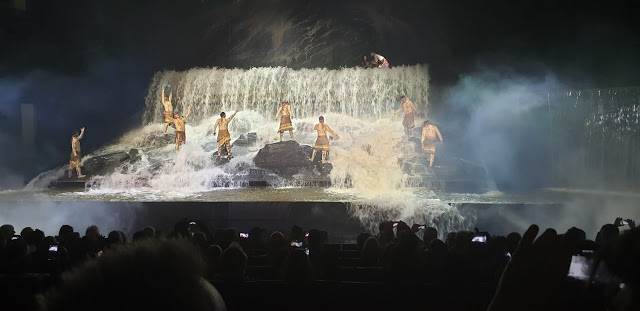
And this was followed by a waterfall, well, I don’t think anyone in that audience could believe what they were seeing.

I know I was both astonished and in awe of the performance.

What a way to finish off our first day in Beijing.

Oh, sorry, that high was dented slightly when we had to go back to our room.

Searching for locations: The Jade Factory, Beijing, China

The first stop is at a Jade Museum to learn the history of jade. In Chinese, jade is pronounced as “Yu” and it has a history in China of at least four thousand years.  On the way there, we are given a story about one of the guide’s relatives who had a jade bracelet, and how it has saved her from countless catastrophes.It is, quite literally ‘the’ good luck charm.  Chinese gamblers are known to have small pieces of jade in their hands when visiting the casinos, for good luck.  I’m not sure anything could provide a gambler with any sort of luck given how the odds are always slanted towards the house.

At any rate, this is neither the time of the place to debunk a ‘well-known fact’.

 On arrival, our guide hands us over to a local guide, a real staff member, and she begins with a discussion on jade while we watch a single worker working on an intricate piece, what looks to be a globe within a globe, sorry, there are two workers, and the second is working on a dragon.

At the end of the passage that passes by the workers, and before you enter the main showroom, you are dazzled by the ship and is nothing short of magnificent.

Then it’s into a small room just off the main showroom where we are taken through the colors, and the carving process in the various stages, without really being told how the magic happens.

Then it’s out into the main showroom where the sales are made, and before dispersing to look at the jade collection, she briefly tells us how to tell real and fake jade, and she does the usual trick of getting one of the tour group to model a piece.

Looks good, let’s move on.  To bigger and better examples.

What interested me, other than the small zodiac signs and other smallish pieces on the ‘promotion’ table, was the jade bangle our tour guide told us about on the bus.  If anyone needs one, it is my other half, with all the medical issues and her sometimes clumsiness, two particular maladies this object is supposed to prevent.
Jade to the Chinese is Diamonds to westerners, and the jade bangle is often handed down to the females of the family from generation to generation, often as an engagement present, to be worn on the left hand, the one closest to the heart.

There are literally thousands of them, but, they have to be specially fitted to your wrist because if it’s too large, you might lose it if it slips off and I didn’t think it could be too small.  
Nor is it cheap, and needing a larger size, it is reasonably expensive.  But it is jadeite, the more expensive of the types of jade, and it can only appreciate in value, not that we are interested in the monetary value, it’s more the good luck aspect.

We could use some of that.

But, just to touch on something that can be the bugbear of traveling overseas, is the subject of happy houses, a better name for toilets, and has become a recurrent theme on this tour.  It’s better than blurting out the word toilet and it seems there can be some not so happy houses given that the toilets in China are usually squat rather than sit, even for women.
And apparently, everyone has an unhappy house story, particularly the women, and generally in having to squat over a pit.  Why is this a discussion point, it seems the jade factory had what we have come to call happy, happy houses which have more proper toilets, and a stop here before going on the great wall was recommended, as the ‘happy house’ at the wall is deemed to be not such a happy house.

Not even this dragon was within my price range.  Thank heaven they had smaller more affordable models.  The object of having a dragon, large or small, is that it should be placed inside the main door to the house so that money can come in.

It also seems that stuffing the dragon’s mouth with money is also good luck.  We passed on doing that.

After spending a small fortune, there was a bonus, free Chinese tea.  Apparently, we will be coming back, after the Great Wall visit, to have lunch upstairs.


Searching for locations: The Golden Mask Dynasty Show, Beijing, China

The Golden Mask Dynasty Show was located at the OCT Theatre in Beijing’s Happy Valley. 

The theatre was quite full and the seats we had were directly behind the VIP area; as our guide told us, we had the best seats in the house. 

The play has 20 different dance scenes that depict war, royal banquets, and romance.  There are eight chapters and over 200 actors, and throughout the performance we were entertained by dancers, acrobats, costumes, lighting, and acoustics.

The story:

It is of romantic legend and historical memories, the Golden Mask Queen leads her army in defeating the invading Blue Mask King’s army, and afterwards the lands return to a leisurely pastoral life until the Queen forges a ‘mysterious tree’.  When the tree has grown, the Queen has a grand celebration, and releases the captured Blue soldiers, much to the admiration of the Blue Mask King.
This is followed by monstrous floods, and to save her people, and on the advice from the ‘mysterious tree’, the Queen sacrifices herself to save her people.  The Queen then turns into a golden sunbird flying in the sky blessing the people and that of the dynasty.

Billed as the best live show in China, described as a large scale dramatic musical, “The Golden Mask Dynasty” it lived up to its reputation and was thoroughly enjoyed by all.

It was not just singing dancing and acrobatics, it had a story and it was told so that language and cultural issues aside, it worked.  There was a narration of the story running beside the stage, but it was hard to divide attention between what was happening, and what was being related.

Then came the peacock dance, with live peacocks

And this was followed by a waterfall, well, I don’t think anyone in that audience could believe what they were seeing.

I know I was both astonished and in awe of the performance.

What a way to finish off our first day in Beijing.

Oh, sorry, that high was dented slightly when we had to go back to our room.

Searching for locations: The Jade Factory, Beijing, China

The first stop is at a Jade Museum to learn the history of jade. In Chinese, jade is pronounced as “Yu” and it has a history in China of at least four thousand years.  On the way there, we are given a story about one of the guide’s relatives who had a jade bracelet, and how it has saved her from countless catastrophes.It is, quite literally ‘the’ good luck charm.  Chinese gamblers are known to have small pieces of jade in their hands when visiting the casinos, for good luck.  I’m not sure anything could provide a gambler with any sort of luck given how the odds are always slanted towards the house.

At any rate, this is neither the time of the place to debunk a ‘well-known fact’.

 On arrival, our guide hands us over to a local guide, a real staff member, and she begins with a discussion on jade while we watch a single worker working on an intricate piece, what looks to be a globe within a globe, sorry, there are two workers, and the second is working on a dragon.

At the end of the passage that passes by the workers, and before you enter the main showroom, you are dazzled by the ship and is nothing short of magnificent.

Then it’s into a small room just off the main showroom where we are taken through the colors, and the carving process in the various stages, without really being told how the magic happens.

Then it’s out into the main showroom where the sales are made, and before dispersing to look at the jade collection, she briefly tells us how to tell real and fake jade, and she does the usual trick of getting one of the tour group to model a piece.

Looks good, let’s move on.  To bigger and better examples.

What interested me, other than the small zodiac signs and other smallish pieces on the ‘promotion’ table, was the jade bangle our tour guide told us about on the bus.  If anyone needs one, it is my other half, with all the medical issues and her sometimes clumsiness, two particular maladies this object is supposed to prevent.
Jade to the Chinese is Diamonds to westerners, and the jade bangle is often handed down to the females of the family from generation to generation, often as an engagement present, to be worn on the left hand, the one closest to the heart.

There are literally thousands of them, but, they have to be specially fitted to your wrist because if it’s too large, you might lose it if it slips off and I didn’t think it could be too small.  
Nor is it cheap, and needing a larger size, it is reasonably expensive.  But it is jadeite, the more expensive of the types of jade, and it can only appreciate in value, not that we are interested in the monetary value, it’s more the good luck aspect.

We could use some of that.

But, just to touch on something that can be the bugbear of traveling overseas, is the subject of happy houses, a better name for toilets, and has become a recurrent theme on this tour.  It’s better than blurting out the word toilet and it seems there can be some not so happy houses given that the toilets in China are usually squat rather than sit, even for women.
And apparently, everyone has an unhappy house story, particularly the women, and generally in having to squat over a pit.  Why is this a discussion point, it seems the jade factory had what we have come to call happy, happy houses which have more proper toilets, and a stop here before going on the great wall was recommended, as the ‘happy house’ at the wall is deemed to be not such a happy house.

Not even this dragon was within my price range.  Thank heaven they had smaller more affordable models.  The object of having a dragon, large or small, is that it should be placed inside the main door to the house so that money can come in.

It also seems that stuffing the dragon’s mouth with money is also good luck.  We passed on doing that.

After spending a small fortune, there was a bonus, free Chinese tea.  Apparently, we will be coming back, after the Great Wall visit, to have lunch upstairs.


Searching for locations: The remnants of the wall that surrounded Beijing, China

The fortification walls, both an inner wall and an outer wall, surrounding Beijing city were built from the early 1400s to 1553.

The dimensions of the Inner city wall are:
          Length: 24 kilometers or 15 miles
          Height: 25 meters or 49 feet high
          Thickness, at ground level: 20 meters or 66 feet
                            at the top: 12 meters or 29 feet

It had nine gates.  The fortifications included gate towers, archways, watchtowers, barbicans, barbican towers, sluice gates, sluice gate towers, enemy sighting towers, corner guard towers, and a moat system.

The outer city wall had a length of 28 kilometers or 17 miles.

From 1911, after the collapse of the Qing Dynasty, the dismantling of the fortifications began.

In 1965, major deconstruction of the fortifications was commenced to allow for the construction of the 2nd wrong road, and Line 2 or the Beijing underground railway.

 In 1979, the government called off the demolition of the remaining city walls and named them cultural heritage sites. By this time, the only intact sections were the gate tower and watchtower at Zhengyangmen, the watchtower at Deshengmen, the guard tower at the southeast corner, the northern moats of the Inner city, the section of the Inner city wall south of the Beijing railway station, and a small section of Inner-city wall near Xibianmen.

For more reading, go to: https://en.wikipedia.org/wiki/Beijing_city_fortifications

As for our guide’s explanation of the fortifications: Leaving the Square to go to the Golden Mask Dynasty Show, we pass remnants of the wall that used to surround Beijing.

This wall was built in the early 15th century and was about 24 km long, up to 15 meters high and about 20 meters thick, and had nine gates, one of which still exists today.  In 1965 most of it was removed so that the second ring road and an underground railway line could be built.

Searching for locations: The remnants of the wall that surrounded Beijing, China

The fortification walls, both an inner wall and an outer wall, surrounding Beijing city were built from the early 1400s to 1553.

The dimensions of the Inner city wall are:
          Length: 24 kilometers or 15 miles
          Height: 25 meters or 49 feet high
          Thickness, at ground level: 20 meters or 66 feet
                            at the top: 12 meters or 29 feet

It had nine gates.  The fortifications included gate towers, archways, watchtowers, barbicans, barbican towers, sluice gates, sluice gate towers, enemy sighting towers, corner guard towers, and a moat system.

The outer city wall had a length of 28 kilometers or 17 miles.

From 1911, after the collapse of the Qing Dynasty, the dismantling of the fortifications began.

In 1965, major deconstruction of the fortifications was commenced to allow for the construction of the 2nd wrong road, and Line 2 or the Beijing underground railway.

 In 1979, the government called off the demolition of the remaining city walls and named them cultural heritage sites. By this time, the only intact sections were the gate tower and watchtower at Zhengyangmen, the watchtower at Deshengmen, the guard tower at the southeast corner, the northern moats of the Inner city, the section of the Inner city wall south of the Beijing railway station, and a small section of Inner-city wall near Xibianmen.

For more reading, go to: https://en.wikipedia.org/wiki/Beijing_city_fortifications

As for our guide’s explanation of the fortifications: Leaving the Square to go to the Golden Mask Dynasty Show, we pass remnants of the wall that used to surround Beijing.

This wall was built in the early 15th century and was about 24 km long, up to 15 meters high and about 20 meters thick, and had nine gates, one of which still exists today.  In 1965 most of it was removed so that the second ring road and an underground railway line could be built.

Searching for locations: On the road to Tiananmen Square, Beijing, China

One the first things you notice when driving around Beijing, other than the roads are congested with traffic, is the number of trees and flowers that have been planted, in the median strip as well as along the edges of the road.

What you also notice is the large number of multi-story apartment blocks, which are needed to house the millions of Beijing residents.  What we have, so far, rarely seen, is single-story houses.
These continuous areas of trees and rose bushes are, every now and then, broken up by very colorful garden beds:

Nearer to the square we are able to get up close to the flowers.  These, we are told, are a variation on the rose, one that flowers for nine months of the year.

They come in a variety of colors.

And they are literally everywhere you go, on the side of the roadway, often blotting out the concrete jungle behind them.

Searching for locations: On the road to Tiananmen Square, Beijing, China

One the first things you notice when driving around Beijing, other than the roads are congested with traffic, is the number of trees and flowers that have been planted, in the median strip as well as along the edges of the road.

What you also notice is the large number of multi-story apartment blocks, which are needed to house the millions of Beijing residents.  What we have, so far, rarely seen, is single-story houses.
These continuous areas of trees and rose bushes are, every now and then, broken up by very colorful garden beds:

Nearer to the square we are able to get up close to the flowers.  These, we are told, are a variation on the rose, one that flowers for nine months of the year.

They come in a variety of colors.

And they are literally everywhere you go, on the side of the roadway, often blotting out the concrete jungle behind them.