Searching for locations: From Beijing to X’ian by bullet train

Beijing West train station.

Beijing west railway station is about eight kilometers from the Forbidden City, located at East Lianhuachi Road, Fengtai District.  Most trains traveling between south central, southwest, northwest, and south China are boarded here.

This place is huge and there are so many people here, perhaps the other half of Beijing’s population that wasn’t in the forbidden city.
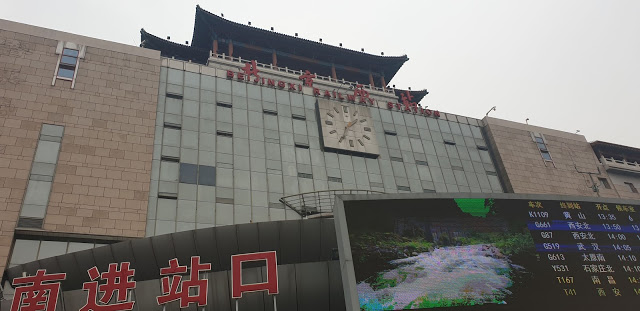
Getting into the station looked like it was going to be fraught with danger but the tour guide got us into the right queue and then arranged for a separate scanner for the group to help keep us all together
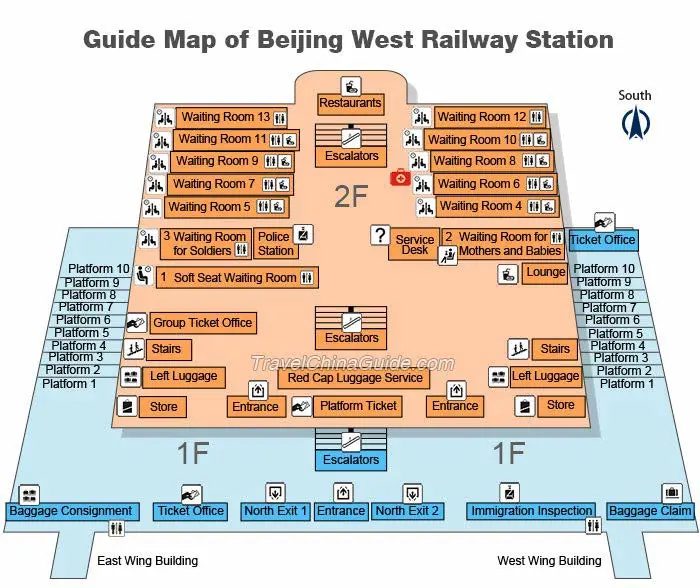
Then we decided to take the VIP service and got to waiting room no 13, the VIP service waiting room which was full to overflowing.  Everyone today was a VIP.  We got the red hat guy to lead us to a special area away from the crowd.

Actually, it was on the other side of the gate, away from the hoards sitting or standing patiently in the waiting room.  It gave us a chance to get something to eat before the long train ride.

The departure is at 4 pm, the train number was G655, and we were told the trains leave on time.  As it is a high-speed train, stops are far and few between, but we’re lucky, this time, in that we don’t have to count stations to know where to get off.

We’re going to the end of the line.

However, it was interesting to note the stops which, in each case, were brief, and you had to be ready to get off in a hurry.

These stops were Shijiazhuang, Zhengzhou East, Luoyang Longmen, Huashan North, and Weinan North.  At night, you could see the lights of these cities from a distance and were like oases in the middle of a desert.  During the day, the most prominent features were high rise apartment blocks and power stations.

A train ride with a difference
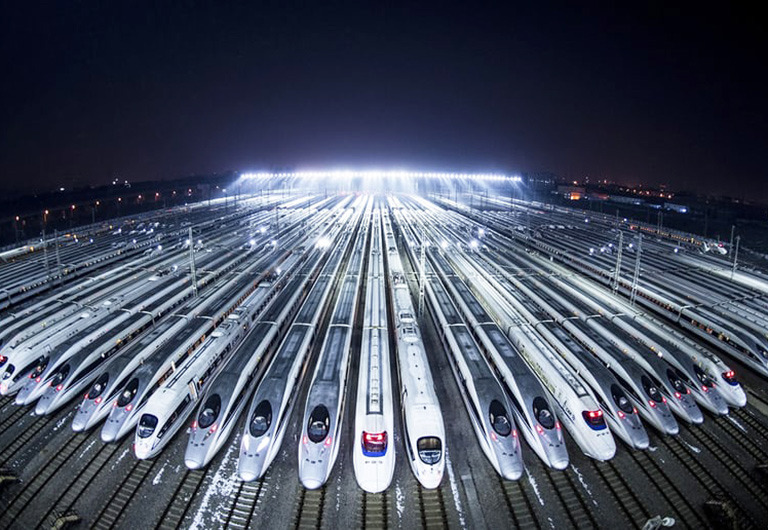
G Trains at Wuhan Railway Station

China’s high-speed trains, also known as bullet or fast trains, can reach a top speed of 350 km/h (217 mph).

Over 2,800 pairs of bullet trains numbered by G, D or C run daily connecting over 550 cities in China and covering 33 of the country’s 34 provinces. Beijing-Shanghai high-speed train link the two megacities 1,318 km (819 mi) away in just 4.5 hours.

By 2019, China keeps the world’s largest high-speed rail (HSR) network with a length totaling over 35,000 km (21,750 mi).

To make the five and a half hours go quicker we keep an eye on the speed which hovers between 290 and 305 kph, and sitting there with our camera waiting for the speed to hit 305 which is a rare occurrence, and then, for 306 and then for 307, which happened when we all took a stroll up to the restaurant car to find there had nothing to eat.

I got a strange flavored drink for 20 yuan.

There was a lady manning a trolley that had some food, and fresh, maybe, fruit on it, and she had a sense of humor if not much English.

We didn’t but anything but the barrel of caramel popcorn looked good.

The good thing was, after hovering around 298, and 299 kph, it finally hit 300.

We get to the end of the line, and there is an announcement in Chinese that we don’t understand and attempts to find out if it is the last station fall on deaf ears, probably more to do with the language barrier than anything else.

Then, suddenly the train conductor, the lady with the red hat, comes and tells us it is, and we have fifteen minutes, so we’re now hurrying to get off.

As the group was are scattered up and down the platform, we all come together and we go down the escalator, and, at the bottom, we see the trip-a-deal flags.

X’ian,and the Xi’an North Railway Station

Xi’an North Railway Station is one of the most important transportation hubs of the Chinese high-speed rail network. It is about 8.7 miles (14 km) from Bell Tower (city center) and is located at the intersection of the Weiyang Road and Wenjing Road in Weiyang District.

This time we have a male guide, Sam, who meets us at the end of the platform after we have disembarked.  We have a few hiccups before we head to the bus.  Some of our travelers are not on his list, but with the other group.  Apparently a trip-a-deal mix-up or miscommunication perhaps.

Then it’s another long walk with bags to the bus.  Good thing its a nicely air-conditioned newish bus, and there’s water, and beer for 10 yuan.  How could you pass up a tsing tao for that price?

Xi’an is a very brightly lit up city at night with wide roads.  It is very welcoming, and a surprise for a city of 10 million out in the middle of China.

As with all hotels, it’s about a 50-minute drive from the railway station and we are all tired by the time we get there.

Tomorrow’s program will be up at 6, on the bus 8.40 and off to the soldiers, 2.00 late lunch, then train station to catch the 4.00 train, that will arrive 2 hours later at the next stop.  A not so late night this time.

The Grand Noble Hotel
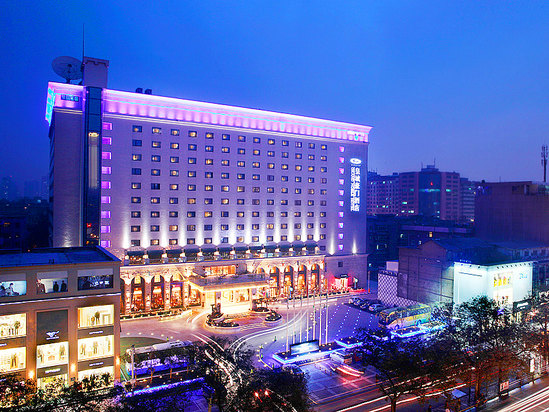
Outdoor scene

Grand Noble Hotel Xi’an is located in the most prosperous business district within the ancient city wall in the center of Xi’an.

The Grand Noble Hotel, like the Friendship Hotel, had a very flash foyer with tons of polished marble.  It sent out warning signals, but when we got to our room, we found it to be absolutely stunning.  More room, a large bathroom, air conditioning the works.

Only one small problem, as in Beijing the lighting is inadequate.  Other than that it’s what I would call a five-star hotel.  This one is definitely better than the Friendship Hotel.

In the center of the city, very close to the bell tower, one of the few ancient buildings left in Xi’an.  It is also in the middle of a larger roundabout and had a guard with a machine gun.

Sadly there was no time for city center sightseeing.

Searching for locations: From Beijing to X’ian by bullet train

Beijing West train station.

Beijing west railway station is about eight kilometers from the Forbidden City, located at East Lianhuachi Road, Fengtai District.  Most trains traveling between south central, southwest, northwest, and south China are boarded here.

This place is huge and there are so many people here, perhaps the other half of Beijing’s population that wasn’t in the forbidden city.

Getting into the station looked like it was going to be fraught with danger but the tour guide got us into the right queue and then arranged for a separate scanner for the group to help keep us all together

Then we decided to take the VIP service and got to waiting room no 13, the VIP service waiting room which was full to overflowing.  Everyone today was a VIP.  We got the red hat guy to lead us to a special area away from the crowd.

Actually, it was on the other side of the gate, away from the hoards sitting or standing patiently in the waiting room.  It gave us a chance to get something to eat before the long train ride.

The departure is at 4 pm, the train number was G655, and we were told the trains leave on time.  As it is a high-speed train, stops are far and few between, but we’re lucky, this time, in that we don’t have to count stations to know where to get off.

We’re going to the end of the line.

However, it was interesting to note the stops which, in each case, were brief, and you had to be ready to get off in a hurry.

These stops were Shijiazhuang, Zhengzhou East, Luoyang Longmen, Huashan North, and Weinan North.  At night, you could see the lights of these cities from a distance and were like oases in the middle of a desert.  During the day, the most prominent features were high rise apartment blocks and power stations.

A train ride with a difference

G Trains at Wuhan Railway Station

China’s high-speed trains, also known as bullet or fast trains, can reach a top speed of 350 km/h (217 mph).

Over 2,800 pairs of bullet trains numbered by G, D or C run daily connecting over 550 cities in China and covering 33 of the country’s 34 provinces. Beijing-Shanghai high-speed train link the two megacities 1,318 km (819 mi) away in just 4.5 hours.

By 2019, China keeps the world’s largest high-speed rail (HSR) network with a length totaling over 35,000 km (21,750 mi).

To make the five and a half hours go quicker we keep an eye on the speed which hovers between 290 and 305 kph, and sitting there with our camera waiting for the speed to hit 305 which is a rare occurrence, and then, for 306 and then for 307, which happened when we all took a stroll up to the restaurant car to find there had nothing to eat.

I got a strange flavored drink for 20 yuan.

There was a lady manning a trolley that had some food, and fresh, maybe, fruit on it, and she had a sense of humor if not much English.

We didn’t but anything but the barrel of caramel popcorn looked good.

The good thing was, after hovering around 298, and 299 kph, it finally hit 300.

We get to the end of the line, and there is an announcement in Chinese that we don’t understand and attempts to find out if it is the last station fall on deaf ears, probably more to do with the language barrier than anything else.

Then, suddenly the train conductor, the lady with the red hat, comes and tells us it is, and we have fifteen minutes, so we’re now hurrying to get off.

As the group was are scattered up and down the platform, we all come together and we go down the escalator, and, at the bottom, we see the trip-a-deal flags.

X’ian,and the Xi’an North Railway Station

Xi’an North Railway Station is one of the most important transportation hubs of the Chinese high-speed rail network. It is about 8.7 miles (14 km) from Bell Tower (city center) and is located at the intersection of the Weiyang Road and Wenjing Road in Weiyang District.

This time we have a male guide, Sam, who meets us at the end of the platform after we have disembarked.  We have a few hiccups before we head to the bus.  Some of our travelers are not on his list, but with the other group.  Apparently a trip-a-deal mix-up or miscommunication perhaps.

Then it’s another long walk with bags to the bus.  Good thing its a nicely air-conditioned newish bus, and there’s water, and beer for 10 yuan.  How could you pass up a tsing tao for that price?

Xi’an is a very brightly lit up city at night with wide roads.  It is very welcoming, and a surprise for a city of 10 million out in the middle of China.

As with all hotels, it’s about a 50-minute drive from the railway station and we are all tired by the time we get there.

Tomorrow’s program will be up at 6, on the bus 8.40 and off to the soldiers, 2.00 late lunch, then train station to catch the 4.00 train, that will arrive 2 hours later at the next stop.  A not so late night this time.

The Grand Noble Hotel

Outdoor scene

Grand Noble Hotel Xi’an is located in the most prosperous business district within the ancient city wall in the center of Xi’an.

The Grand Noble Hotel, like the Friendship Hotel, had a very flash foyer with tons of polished marble.  It sent out warning signals, but when we got to our room, we found it to be absolutely stunning.  More room, a large bathroom, air conditioning the works.

Only one small problem, as in Beijing the lighting is inadequate.  Other than that it’s what I would call a five-star hotel.  This one is definitely better than the Friendship Hotel.

In the center of the city, very close to the bell tower, one of the few ancient buildings left in Xi’an.  It is also in the middle of a larger roundabout and had a guard with a machine gun.

Sadly there was no time for city center sightseeing.
Searching for locations: The Longjing Pearl Factory, Beijing, China

The Longjing Pearl Factory is located at:
No.2 Zuoan Gate Inner Street, ChongWen District, Beijing 100061 China.

This Pearl Center specializes in both freshwater and seawater pearls, with a reputation backed by the government of China, with a big selection and of the highest quality.  There were all kinds of jewelry made of pearls in different colors, shapes, and sizes.

They also had, as an interesting sideline, famous Chinese traditional cosmetics such as pearl cream and pearl powder, reputed to make your skin smoother, tendered and most importantly, younger.

We were advised of all of this well before we arrived at the factory, and of course, one suspected the glowing review, with emphasis on the fact it was a government operation and therefore trustworthy, suggested we should buy, meant the tour guide would receive a commission on each sale.

This is nothing new, it’s the same the world over, so it’s up to the visitor to buy or not to buy.

As soon as you get in the door you are taken to the group’s guide for the tour (and afterward, available for help on making purchases). who gives you a rundown on the different types and colors of pearls.  This briefly is,

Pearls come in two main categories: freshwater cultured pearls and saltwater cultured pearls. Various types of pearls are the result of the environment in which they live, and different cultivation techniques used by the pearl farmers. 

Freshwater cultured pearls are grown in lakes and rivers, whereas saltwater cultured pearls are grown in bodies of saltwater such as bays.  The most commonly used pearls are Freshwater pearls. 

Freshwater Pearls come in various pastel shades of white, pink, peach, lavender, plum, purple, and tangerine.  
South Sea cultured pearls come in shades of lustrous white, often with silver or rose overtones. 

Black pearls are known as Tahitian pearls and come most often in shades of black and gray. While a Tahitian pearl has a black body color, it will vary in its overtones, which most often will be green or pink.

Then there’s a demonstration, where one of the tour group is selected to pick an oyster out of the tank, and then there’s the guessing game as to how many pearls are in the shell, with the winner getting a pearl.

Guesses ranged from 1 to 23 and the answer was 26.  Nearest wins, and one for the person who picked the oyster out of the tank.  After this demonstration, we move on to the ways we can tell the difference between real and fake pearls.

It seems strange that they would, but we were guaranteed by both the tour guide and the lady delivering the lecture that the pearls we were about to buy were real, so how could we suspect there was anything dodgy about them?  Besides, now we could tell real from fake!

We then move onto the showroom floor where there are casements of pearl products, in the form of necklaces, earrings, and any number of variations and uses.  And, just to let you know, the prices are very, very expensive, even if they say they have a special.

Perhaps the best products, and those that found favor with many of the women on the tour, was the pearl cremes and powders.  These were not expensive, and, as we discovered later, actually worked as described.

Searching for locations: From Beijing to X’ian by bullet train

Beijing West train station.

Beijing west railway station is about eight kilometers from the Forbidden City, located at East Lianhuachi Road, Fengtai District.  Most trains traveling between south central, southwest, northwest, and south China are boarded here.

This place is huge and there are so many people here, perhaps the other half of Beijing’s population that wasn’t in the forbidden city.

Getting into the station looked like it was going to be fraught with danger but the tour guide got us into the right queue and then arranged for a separate scanner for the group to help keep us all together

Then we decided to take the VIP service and got to waiting room no 13, the VIP service waiting room which was full to overflowing.  Everyone today was a VIP.  We got the red hat guy to lead us to a special area away from the crowd.

Actually, it was on the other side of the gate, away from the hoards sitting or standing patiently in the waiting room.  It gave us a chance to get something to eat before the long train ride.

The departure is at 4 pm, the train number was G655, and we were told the trains leave on time.  As it is a high-speed train, stops are far and few between, but we’re lucky, this time, in that we don’t have to count stations to know where to get off.

We’re going to the end of the line.

However, it was interesting to note the stops which, in each case, were brief, and you had to be ready to get off in a hurry.

These stops were Shijiazhuang, Zhengzhou East, Luoyang Longmen, Huashan North, and Weinan North.  At night, you could see the lights of these cities from a distance and were like oases in the middle of a desert.  During the day, the most prominent features were high rise apartment blocks and power stations.

A train ride with a difference

G Trains at Wuhan Railway Station

China’s high-speed trains, also known as bullet or fast trains, can reach a top speed of 350 km/h (217 mph).

Over 2,800 pairs of bullet trains numbered by G, D or C run daily connecting over 550 cities in China and covering 33 of the country’s 34 provinces. Beijing-Shanghai high-speed train link the two megacities 1,318 km (819 mi) away in just 4.5 hours.

By 2019, China keeps the world’s largest high-speed rail (HSR) network with a length totaling over 35,000 km (21,750 mi).

To make the five and a half hours go quicker we keep an eye on the speed which hovers between 290 and 305 kph, and sitting there with our camera waiting for the speed to hit 305 which is a rare occurrence, and then, for 306 and then for 307, which happened when we all took a stroll up to the restaurant car to find there had nothing to eat.

I got a strange flavored drink for 20 yuan.

There was a lady manning a trolley that had some food, and fresh, maybe, fruit on it, and she had a sense of humor if not much English.

We didn’t but anything but the barrel of caramel popcorn looked good.

The good thing was, after hovering around 298, and 299 kph, it finally hit 300.

We get to the end of the line, and there is an announcement in Chinese that we don’t understand and attempts to find out if it is the last station fall on deaf ears, probably more to do with the language barrier than anything else.

Then, suddenly the train conductor, the lady with the red hat, comes and tells us it is, and we have fifteen minutes, so we’re now hurrying to get off.

As the group was are scattered up and down the platform, we all come together and we go down the escalator, and, at the bottom, we see the trip-a-deal flags.

X’ian,and the Xi’an North Railway Station

Xi’an North Railway Station is one of the most important transportation hubs of the Chinese high-speed rail network. It is about 8.7 miles (14 km) from Bell Tower (city center) and is located at the intersection of the Weiyang Road and Wenjing Road in Weiyang District.

This time we have a male guide, Sam, who meets us at the end of the platform after we have disembarked.  We have a few hiccups before we head to the bus.  Some of our travelers are not on his list, but with the other group.  Apparently a trip-a-deal mix-up or miscommunication perhaps.

Then it’s another long walk with bags to the bus.  Good thing its a nicely air-conditioned newish bus, and there’s water, and beer for 10 yuan.  How could you pass up a tsing tao for that price?

Xi’an is a very brightly lit up city at night with wide roads.  It is very welcoming, and a surprise for a city of 10 million out in the middle of China.

As with all hotels, it’s about a 50-minute drive from the railway station and we are all tired by the time we get there.

Tomorrow’s program will be up at 6, on the bus 8.40 and off to the soldiers, 2.00 late lunch, then train station to catch the 4.00 train, that will arrive 2 hours later at the next stop.  A not so late night this time.

The Grand Noble Hotel

Outdoor scene

Grand Noble Hotel Xi’an is located in the most prosperous business district within the ancient city wall in the center of Xi’an.

The Grand Noble Hotel, like the Friendship Hotel, had a very flash foyer with tons of polished marble.  It sent out warning signals, but when we got to our room, we found it to be absolutely stunning.  More room, a large bathroom, air conditioning the works.

Only one small problem, as in Beijing the lighting is inadequate.  Other than that it’s what I would call a five-star hotel.  This one is definitely better than the Friendship Hotel.

In the center of the city, very close to the bell tower, one of the few ancient buildings left in Xi’an.  It is also in the middle of a larger roundabout and had a guard with a machine gun.

Sadly there was no time for city center sightseeing.
Searching for locations: Hutongs, Beijing, China

What are Hutongs?

In Beijing Hutongs are formed by lines of traditional courtyard residences, called siheyuan.  Neighborhoods were formed by joining many hutongs together. These siheyuan are the traditional residences, usually occupied by a single or extended family, signifying wealth, and prosperity. 

Over 500 of these still exist.Many of these hutongs have been demolished, but recently they have become protected places as a means of preserving some Chinese cultural history.  They were first established in the Yuan Dynasty (1279-1368)Many of these Hutongs had their main buildings and gates built facing south, and lanes connecting them to other hutongs also ran north to south.

Many hutongs, some several hundred years old, in the vicinity of the Bell Tower and Drum Tower and Shichahai Lake are preserved and abound with tourists, many of which tour the quarter in pedicabs.

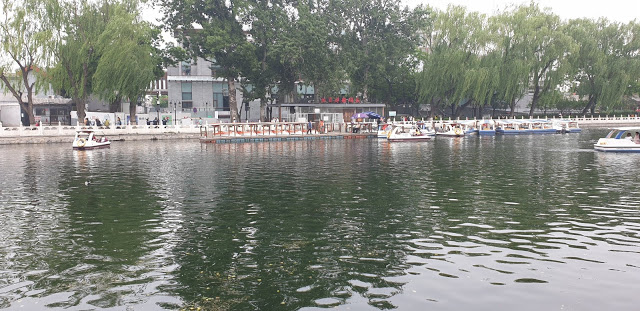
The optional tour also includes a visit to Shichahai, a historic scenic area consisting of three lakes (Qianhai, meaning Front Sea; Houhai, meaning Back Sea and Xihai, meaning West Sea), surrounding places of historic interest and scenic beauty and remnants of old-style local residences, Hutong and Courtyard.  

First, we had a short walk through the more modern part of the Hutong area and given some free time for shopping, but we prefer just to meander by the canal.  

There is a lake, and if we had the time, there were boats you could take.

With some time to spare, we take a quick walk down one of the alleyways where on the ground level are small shops, and above, living quarters.

Then we go to the bell and drum towers before walking through some more alleys was to where the rickshaws were waiting.
The Bell tower

And the Drum tower. Both still working today.

The rickshaw ride took us through some more back streets where it was clear renovations were being made so that the area could apply for world heritage listing.  Seeing inside some of the houses shows that they may look dumpy outside but that’s not the case inside.

The rickshaw ride ends outside the house where dinner will be served, and is a not so typical hose but does have all the elements of how the Chinese live, the boy’s room, the girl’s room, the parent’s room, the living area, and the North-south feng shui.

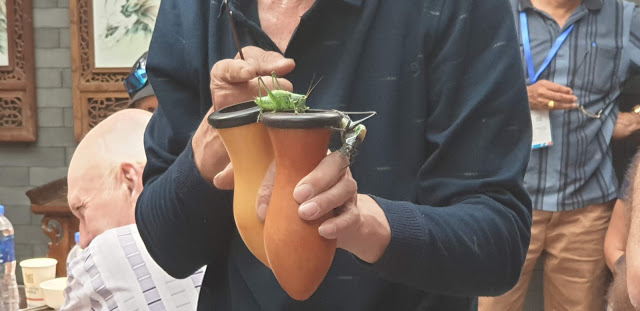
Shortly after we arrive, the cricket man, apparently someone quite famous in Beijing arrives and tells us all about crickets and then grasshoppers, then about cricket racing.  He is animated and clearly enjoys entertaining us westerners.

I’m sorry but the cricket stuff just didn’t interest me.  Or the grasshoppers.

As for dinner, it was finally a treat to eat what the typical Chinese family eats, and everything was delicious, and the endless beer was a nice touch.

And the last surprise, the food was cooked by a man.

Searching for locations: Hutongs, Beijing, China

What are Hutongs?

In Beijing Hutongs are formed by lines of traditional courtyard residences, called siheyuan.  Neighborhoods were formed by joining many hutongs together. These siheyuan are the traditional residences, usually occupied by a single or extended family, signifying wealth, and prosperity. 

Over 500 of these still exist.Many of these hutongs have been demolished, but recently they have become protected places as a means of preserving some Chinese cultural history.  They were first established in the Yuan Dynasty (1279-1368)Many of these Hutongs had their main buildings and gates built facing south, and lanes connecting them to other hutongs also ran north to south.

Many hutongs, some several hundred years old, in the vicinity of the Bell Tower and Drum Tower and Shichahai Lake are preserved and abound with tourists, many of which tour the quarter in pedicabs.

The optional tour also includes a visit to Shichahai, a historic scenic area consisting of three lakes (Qianhai, meaning Front Sea; Houhai, meaning Back Sea and Xihai, meaning West Sea), surrounding places of historic interest and scenic beauty and remnants of old-style local residences, Hutong and Courtyard.  

First, we had a short walk through the more modern part of the Hutong area and given some free time for shopping, but we prefer just to meander by the canal.  

There is a lake, and if we had the time, there were boats you could take.

With some time to spare, we take a quick walk down one of the alleyways where on the ground level are small shops, and above, living quarters.

Then we go to the bell and drum towers before walking through some more alleys was to where the rickshaws were waiting.
The Bell tower

And the Drum tower. Both still working today.

The rickshaw ride took us through some more back streets where it was clear renovations were being made so that the area could apply for world heritage listing.  Seeing inside some of the houses shows that they may look dumpy outside but that’s not the case inside.

The rickshaw ride ends outside the house where dinner will be served, and is a not so typical hose but does have all the elements of how the Chinese live, the boy’s room, the girl’s room, the parent’s room, the living area, and the North-south feng shui.

Shortly after we arrive, the cricket man, apparently someone quite famous in Beijing arrives and tells us all about crickets and then grasshoppers, then about cricket racing.  He is animated and clearly enjoys entertaining us westerners.

I’m sorry but the cricket stuff just didn’t interest me.  Or the grasshoppers.

As for dinner, it was finally a treat to eat what the typical Chinese family eats, and everything was delicious, and the endless beer was a nice touch.

And the last surprise, the food was cooked by a man.

Searching for locations: Hutongs, Beijing, China

What are Hutongs?

In Beijing Hutongs are formed by lines of traditional courtyard residences, called siheyuan.  Neighborhoods were formed by joining many hutongs together. These siheyuan are the traditional residences, usually occupied by a single or extended family, signifying wealth, and prosperity. 

Over 500 of these still exist.Many of these hutongs have been demolished, but recently they have become protected places as a means of preserving some Chinese cultural history.  They were first established in the Yuan Dynasty (1279-1368)Many of these Hutongs had their main buildings and gates built facing south, and lanes connecting them to other hutongs also ran north to south.

Many hutongs, some several hundred years old, in the vicinity of the Bell Tower and Drum Tower and Shichahai Lake are preserved and abound with tourists, many of which tour the quarter in pedicabs.

The optional tour also includes a visit to Shichahai, a historic scenic area consisting of three lakes (Qianhai, meaning Front Sea; Houhai, meaning Back Sea and Xihai, meaning West Sea), surrounding places of historic interest and scenic beauty and remnants of old-style local residences, Hutong and Courtyard.  

First, we had a short walk through the more modern part of the Hutong area and given some free time for shopping, but we prefer just to meander by the canal.  

There is a lake, and if we had the time, there were boats you could take.

With some time to spare, we take a quick walk down one of the alleyways where on the ground level are small shops, and above, living quarters.

Then we go to the bell and drum towers before walking through some more alleys was to where the rickshaws were waiting.
The Bell tower

And the Drum tower. Both still working today.

The rickshaw ride took us through some more back streets where it was clear renovations were being made so that the area could apply for world heritage listing.  Seeing inside some of the houses shows that they may look dumpy outside but that’s not the case inside.

The rickshaw ride ends outside the house where dinner will be served, and is a not so typical hose but does have all the elements of how the Chinese live, the boy’s room, the girl’s room, the parent’s room, the living area, and the North-south feng shui.

Shortly after we arrive, the cricket man, apparently someone quite famous in Beijing arrives and tells us all about crickets and then grasshoppers, then about cricket racing.  He is animated and clearly enjoys entertaining us westerners.

I’m sorry but the cricket stuff just didn’t interest me.  Or the grasshoppers.

As for dinner, it was finally a treat to eat what the typical Chinese family eats, and everything was delicious, and the endless beer was a nice touch.

And the last surprise, the food was cooked by a man.

Searching for locations: The Longjing Pearl Factory, Beijing, China

The Longjing Pearl Factory is located at:
No.2 Zuoan Gate Inner Street, ChongWen District, Beijing 100061 China.

This Pearl Center specializes in both freshwater and seawater pearls, with a reputation backed by the government of China, with a big selection and of the highest quality.  There were all kinds of jewelry made of pearls in different colors, shapes, and sizes.

They also had, as an interesting sideline, famous Chinese traditional cosmetics such as pearl cream and pearl powder, reputed to make your skin smoother, tendered and most importantly, younger.

We were advised of all of this well before we arrived at the factory, and of course, one suspected the glowing review, with emphasis on the fact it was a government operation and therefore trustworthy, suggested we should buy, meant the tour guide would receive a commission on each sale.

This is nothing new, it’s the same the world over, so it’s up to the visitor to buy or not to buy.

As soon as you get in the door you are taken to the group’s guide for the tour (and afterward, available for help on making purchases). who gives you a rundown on the different types and colors of pearls.  This briefly is,

Pearls come in two main categories: freshwater cultured pearls and saltwater cultured pearls. Various types of pearls are the result of the environment in which they live, and different cultivation techniques used by the pearl farmers. 

Freshwater cultured pearls are grown in lakes and rivers, whereas saltwater cultured pearls are grown in bodies of saltwater such as bays.  The most commonly used pearls are Freshwater pearls. 

Freshwater Pearls come in various pastel shades of white, pink, peach, lavender, plum, purple, and tangerine.  
South Sea cultured pearls come in shades of lustrous white, often with silver or rose overtones. 

Black pearls are known as Tahitian pearls and come most often in shades of black and gray. While a Tahitian pearl has a black body color, it will vary in its overtones, which most often will be green or pink.

Then there’s a demonstration, where one of the tour group is selected to pick an oyster out of the tank, and then there’s the guessing game as to how many pearls are in the shell, with the winner getting a pearl.

Guesses ranged from 1 to 23 and the answer was 26.  Nearest wins, and one for the person who picked the oyster out of the tank.  After this demonstration, we move on to the ways we can tell the difference between real and fake pearls.

It seems strange that they would, but we were guaranteed by both the tour guide and the lady delivering the lecture that the pearls we were about to buy were real, so how could we suspect there was anything dodgy about them?  Besides, now we could tell real from fake!

We then move onto the showroom floor where there are casements of pearl products, in the form of necklaces, earrings, and any number of variations and uses.  And, just to let you know, the prices are very, very expensive, even if they say they have a special.

Perhaps the best products, and those that found favor with many of the women on the tour, was the pearl cremes and powders.  These were not expensive, and, as we discovered later, actually worked as described.

Searching for locations: The Longjing Pearl Factory, Beijing, China

The Longjing Pearl Factory is located at:
No.2 Zuoan Gate Inner Street, ChongWen District, Beijing 100061 China.

This Pearl Center specializes in both freshwater and seawater pearls, with a reputation backed by the government of China, with a big selection and of the highest quality.  There were all kinds of jewelry made of pearls in different colors, shapes, and sizes.

They also had, as an interesting sideline, famous Chinese traditional cosmetics such as pearl cream and pearl powder, reputed to make your skin smoother, tendered and most importantly, younger.

We were advised of all of this well before we arrived at the factory, and of course, one suspected the glowing review, with emphasis on the fact it was a government operation and therefore trustworthy, suggested we should buy, meant the tour guide would receive a commission on each sale.

This is nothing new, it’s the same the world over, so it’s up to the visitor to buy or not to buy.

As soon as you get in the door you are taken to the group’s guide for the tour (and afterward, available for help on making purchases). who gives you a rundown on the different types and colors of pearls.  This briefly is,

Pearls come in two main categories: freshwater cultured pearls and saltwater cultured pearls. Various types of pearls are the result of the environment in which they live, and different cultivation techniques used by the pearl farmers. 

Freshwater cultured pearls are grown in lakes and rivers, whereas saltwater cultured pearls are grown in bodies of saltwater such as bays.  The most commonly used pearls are Freshwater pearls. 

Freshwater Pearls come in various pastel shades of white, pink, peach, lavender, plum, purple, and tangerine.  
South Sea cultured pearls come in shades of lustrous white, often with silver or rose overtones. 

Black pearls are known as Tahitian pearls and come most often in shades of black and gray. While a Tahitian pearl has a black body color, it will vary in its overtones, which most often will be green or pink.

Then there’s a demonstration, where one of the tour group is selected to pick an oyster out of the tank, and then there’s the guessing game as to how many pearls are in the shell, with the winner getting a pearl.

Guesses ranged from 1 to 23 and the answer was 26.  Nearest wins, and one for the person who picked the oyster out of the tank.  After this demonstration, we move on to the ways we can tell the difference between real and fake pearls.

It seems strange that they would, but we were guaranteed by both the tour guide and the lady delivering the lecture that the pearls we were about to buy were real, so how could we suspect there was anything dodgy about them?  Besides, now we could tell real from fake!

We then move onto the showroom floor where there are casements of pearl products, in the form of necklaces, earrings, and any number of variations and uses.  And, just to let you know, the prices are very, very expensive, even if they say they have a special.

Perhaps the best products, and those that found favor with many of the women on the tour, was the pearl cremes and powders.  These were not expensive, and, as we discovered later, actually worked as described.

Searching for locations: The Golden Mask Dynasty Show, Beijing, China

The Golden Mask Dynasty Show was located at the OCT Theatre in Beijing’s Happy Valley. 

The theatre was quite full and the seats we had were directly behind the VIP area; as our guide told us, we had the best seats in the house. 

The play has 20 different dance scenes that depict war, royal banquets, and romance.  There are eight chapters and over 200 actors, and throughout the performance we were entertained by dancers, acrobats, costumes, lighting, and acoustics.

The story:

It is of romantic legend and historical memories, the Golden Mask Queen leads her army in defeating the invading Blue Mask King’s army, and afterwards the lands return to a leisurely pastoral life until the Queen forges a ‘mysterious tree’.  When the tree has grown, the Queen has a grand celebration, and releases the captured Blue soldiers, much to the admiration of the Blue Mask King.
This is followed by monstrous floods, and to save her people, and on the advice from the ‘mysterious tree’, the Queen sacrifices herself to save her people.  The Queen then turns into a golden sunbird flying in the sky blessing the people and that of the dynasty.

Billed as the best live show in China, described as a large scale dramatic musical, “The Golden Mask Dynasty” it lived up to its reputation and was thoroughly enjoyed by all.

It was not just singing dancing and acrobatics, it had a story and it was told so that language and cultural issues aside, it worked.  There was a narration of the story running beside the stage, but it was hard to divide attention between what was happening, and what was being related.

Then came the peacock dance, with live peacocks

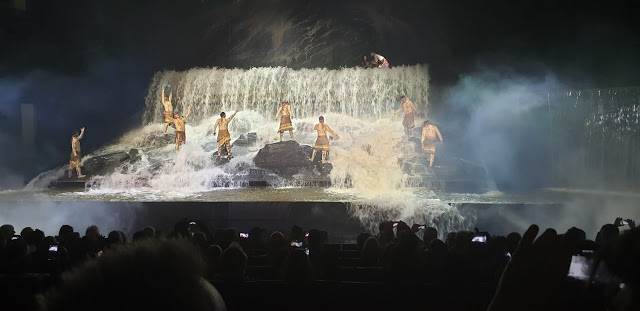
And this was followed by a waterfall, well, I don’t think anyone in that audience could believe what they were seeing.

I know I was both astonished and in awe of the performance.

What a way to finish off our first day in Beijing.

Oh, sorry, that high was dented slightly when we had to go back to our room.