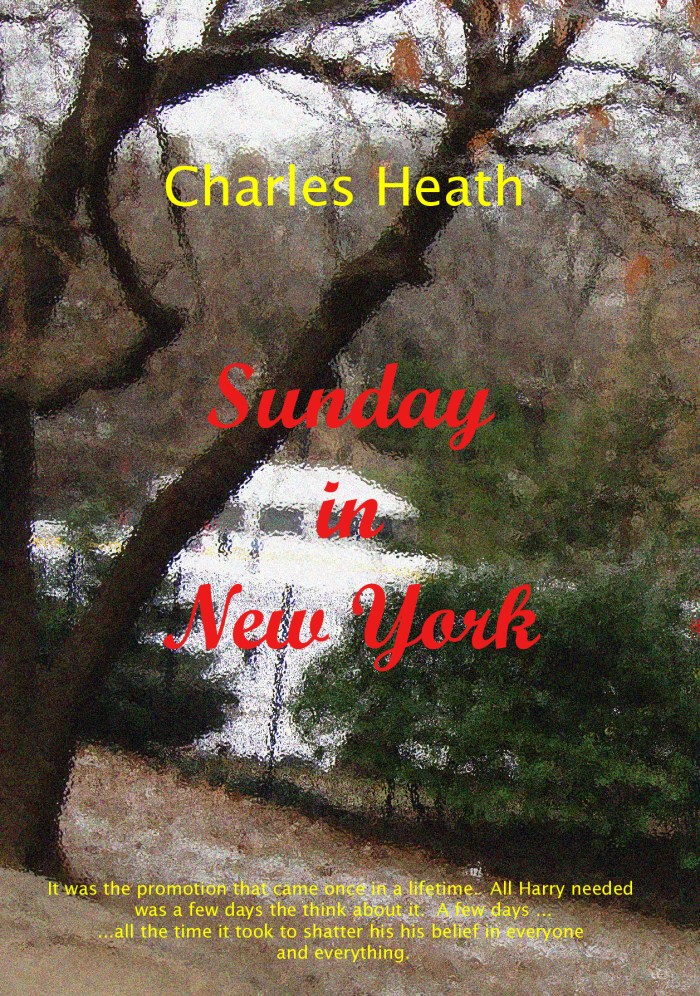
“Sunday in New York” is ultimately a story about trust, and what happens when a marriage is stretched to its limits.
When Harry Steele attends a lunch with his manager, Barclay, to discuss a promotion that any junior executive would accept in a heartbeat, it is the fact his wife, Alison, who previously professed her reservations about Barclay, also agreed to attend, that casts a small element of doubt in his mind.
From that moment, his life, in the company, in deciding what to do, his marriage, his very life, spirals out of control.
There is no one big factor that can prove Harry’s worst fears, that his marriage is over, just a number of small, interconnecting events, when piled on top of each other, points to a cataclysmic end to everything he had believed in.
Trust is lost firstly in his best friend and mentor, Andy, who only hints of impending disaster, Sasha, a woman whom he saved, and who appears to have motives of her own, and then in his wife, Alison, as he discovered piece by piece damning evidence she is about to leave him for another man.
Can we trust what we see with our eyes or trust what we hear?
Haven’t we all jumped to conclusions at least once in our lives?
Can Alison, a woman whose self-belief and confidence is about to be put to the ultimate test, find a way of proving their relationship is as strong as it has ever been?
This story is now on the list to be finished so over the new few weeks, expect a new episode every few days.
The reason why new episodes have been sporadic, there are also other stories to write, and I’m not very good at prioritizing.
But, here we are, a few minutes opened up and it didn’t take long to get back into the groove.
Things are about to get complicated…
With Jan safely in custody, probably for about 15 minutes when Dobbin discovered she was in police hands, Jennifer and I were free to chase up O’Connell and maybe we would also find Anna.
It was a long shot at best.
But we had to find out more about Anna Jacovich. For that, we would have to go back to the office and talk to Joanne. I told Jennifer what I intended to do and dropped her at the safe house for some much-needed rest before we went after O’Connell.
Then, back in the car, I called the number I had for Joanne.
“Sam.”
“Memorised my number?”
“I like to know who’s calling before I answer.”
“Then this isn’t a restricted line?”
“Restricted enough.”
“I found your little toy?”
Did I hear a sigh?
“You know the world we live in Sam, trust no one not even your mother. Hard for me to trust or not trust her, she passed away when I was seven. Monica said you were good. What can I do for you?”
“A full workup on Anna Jacovich. I’m coming into the office now, and will be there in about half an hour.”
“No pressure then?”
“Not at all.”
“Try not to irritate security this time.”
I’m sure I saw a grim expression on the face of the soldier that had been there the last time I tried to run the gauntlet, and then disappointment when my card worked. I signed in and put the name of the department I was visiting down as Research.
When he asked for a name, I gave him Joanne’s. No doubt he would call her long before I got to her.
She met me at the second level of defence and then took me to a room where two folders sat at opposite ends of a table, two desk lamps shining light down on them. The rest of the room was in darkness.
When she shut the door, I said, “Please tell me there in;t a firing squad in black camouflage just waiting to shoot me.”
She smiled. “If it was more sensitive information, I’d let you read it, then have you shot. Not today.
That was a relief. Oddly, I believed that she would if the circumstances warranted it. Joanne was scary, nor scary than Jan. It’s the quiet ones you had to worry about.”
We sat.
“Read. Then I’ll answer questions.”
For the ten minutes, it took me to discover that Anna was a biochemist herself, and had worked in a not-so-secret government laboratory that had been unmasked with disastrous results, adding another dimension to the problem. I was beginning to think she might be the one who created the monster and had set her husband up to take the blame.
If that was the case, she was never going to pass it on to O’Connell or sell it to him, other than to take the money and run. If that was the case, Severin knew it was her all along, and how dangerous she was.
But and there was a big but in all of this. She needed an accomplice to get to England, which was O’Connell. Now he was no longer needed…
Yes, she would also need both Severin and Maury off her tail, and that had been taken care of.
Jan? Unless I completely misread her, it was not possible she could be the accomplice; she was doing what Dobbin requested. Or had she? Dobbin did say she was able to make executive decisions on the fly.
“The threat isn’t O’Connell. He’s just a pawn.”
“Not just a pretty face then?”
“I never regard my face as pretty.”
She shook her head. “It’s Anna. She played Severin and Maury, she played Dobbin, and she played Dobbin’s little toy soldier, O’Connell. Or Quigley I believe his real name is. I hesitate to say O’Connell played you.”
“Call a dog a dog, Joanne. If I had more experience and more information I might have seen that. You can’t keep people in the dark, and then expect miracles.”
“I’m the messenger, Sam.”
“I’ve been known to shoot messengers, just because I can.”
“Save your bullets for the bad guys.”
“How do I know you and Monica are not the bad guys?”
Another shake of the head. “OK. You’ve passed the scepticism test, Sam. Now put it away. We have to work together on this. It’s a condition for continuing to work on the case.”
“And if I don’t?”
“I don’t need to answer that. But, I get it. You’re a self-starter and will keep at it, with or without us. I can see why people like you. To me, your just another dangerous amateur.”
There were words I could say, but judging by the reek of self-aggrandisement, it would not penetrate the thick hide.
I smiled. “Not noted for your charm then.”
“No. Where is Jan?”
“Who?”
“Don’t play games, Sam. They don’t become you. You went to see Severin, but he ended up dead, and she shot him. Why?”
“You read this file?” I picked it up and dropped it on the table.
She was the sort that read the first page, the preamble, and the last page, the result or desired result.
“I did.”
“Then you know why, as for Jan, if you know I was there when Severin was shot, you’d know where Jan is.”
“She disappeared into the trees. And no doubt in the wind. You should know she’s a trained MI5 assassin on loan to Dobbin.”
Who was now in jail somewhere pending the Detective Inspectors leisure, unless she filed a report. If she did, she would be out now, and looking for O’Connell and Anna.
“Then how should I know?”
She shrugged. “I thought I’d ask. I’m not sure I like having to peel away the layers of this story one by one.”
“Be more forthcoming.” I stood. I had what I needed. “If that’s all, I’ll go on with the job.”
“O’Connell?”
“He’s probably dead by now, but I have to find him, one way or another.”
How the messier emotions in our lives can spark our most powerful ideas
“The best art comes from a place of discomfort.” – Anonymous
We’re taught to chase calm, to “think clearly” before we write, paint, design, or launch a new project. Yet some of the most unforgettable works—whether a novel that reshaped a generation, a song that still makes us shiver, or a startup that turned an industry upside‑down—were born from moments of angry frustration or gut‑wrenching confusion.
If you’ve ever felt a surge of irritation while stuck in traffic, or a bewildering swirl of thoughts after a heated argument, you already have a well‑spring of raw material waiting to be transformed. The trick isn’t to suppress those feelings, but to channel them.
Below, we’ll explore why anger and confusion are surprisingly fertile creative soil, look at real‑world examples, and walk through practical steps you can use right now to turn those messy emotions into compelling content, products, or art.
1. Why the “Negative” Emotions Matter
Emotion
What It Does to Your Brain
How It Helps Creativity
Anger
Triggers the amygdala, spikes adrenaline, and heightens focus on perceived threats.
Sharpens problem‑solving, fuels urgency, and pushes you to “break the rules” to resolve the tension.
Confusion
Activates the prefrontal cortex as you search for meaning and coherence.
Forces you to ask why and how, encouraging divergent thinking and novel connections.
Energy Surge – Both anger and confusion release physiological energy (adrenaline, cortisol). When redirected, that energy can become the stamina needed for long writing sessions or intense brainstorming.
Narrative Drive – Stories thrive on conflict. Anger supplies a clear antagonist (the source of frustration), while confusion supplies the mystery that keeps the audience hooked.
Authenticity – Audiences can sense when a piece is born from genuine feeling. Raw, unfiltered emotion builds trust and resonance.
2. Legends Who Turned Rage & Uncertainty Into Masterpieces
Creator
Emotion
Resulting Work
Why It Worked
Vincent Van Gogh
Deep melancholy & inner turmoil (bordering on confusion)
Starry Night
The turbulent sky mirrors his mental state, turning personal chaos into universal beauty.
Kanye West
Public outrage & indignation after award show snubs
“Yeezus” (2013)
Aggressive beats and confrontational lyrics harnessed his anger, producing one of his most daring albums.
Malala Yousafzai
Fear and outrage at oppression
I Am Malala (memoir)
The anger at injustice fueled a powerful narrative that inspired global activism.
James Dyson
Frustration with underperforming vacuum cleaners
Dyson Cyclone technology
Anger at the status quo drove relentless prototyping, resulting in a market‑disrupting product.
These stories underscore a simple truth: the more personal the friction, the more universal the impact—when you translate your private storm into public art, you give others permission to feel seen.
3. From Internal Turmoil to Tangible Output – A Step‑by‑Step Workflow
TL;DR: Capture, Clarify, Convert, Polish.
Step 1 – Capture the Spark
Immediate journal: Keep a small notebook or note‑app on hand. As soon as you feel a flash of anger or a wave of confusion, jot down:
What triggered it? (e.g., “Stuck in endless Zoom meetings.”)
Dissonant chords, irregular time signatures, spoken‑word interludes that ask “what’s next?”
Product Development
Identify the pain point that fuels the anger; prototype a solution that eliminates that pain.
Map out the confusion journey (user flow gaps) and redesign for clarity, turning uncertainty into elegance.
Marketing
Campaigns that call out a common frustration (“Stop waiting for support”) often go viral.
Story‑driven ads that pose a mystery (“What happens when…?”) encourage engagement and shares.
5. Avoiding the Pitfalls
Risk
Warning Sign
Mitigation
Burnout
You keep feeding on anger without rest.
Schedule “emotion detox” days (no work, just leisure).
Over‑Negativity
The final piece sounds purely bitter, alienating the audience.
Balance with hope or solution; end on a constructive note.
Unclear Messaging
Confusion remains unresolved for the reader.
Ensure the conclusion clearly answers the core question you posed.
Echo Chamber
You only share with people who agree with your rage.
Seek diverse feedback; a calm third‑party can spot blind spots.
6. A Mini‑Exercise to Try Right Now
Pick a recent moment of anger or confusion (e.g., the last time a software glitch ruined your workflow).
Write a 150‑word micro‑story that starts with a vivid line of that feeling.
Angry example: “The screen froze, and my deadline sprint turned into a marathon of curses.”
Confused example: “Why does the ‘Save’ button disappear right when I need it most?”
Identify the underlying demand or question.
Add a single, unexpected twist that resolves the tension in a fresh way.
Read it aloud—does the emotion still feel punchy? If not, sharpen the language.
Do this daily for a week and watch how quickly raw moments become polished ideas.
7. Closing Thoughts: Embrace the Storm
Creativity isn’t a serene garden; it’s a storm‑tossed sea where the fiercest winds generate the biggest waves. Anger and confusion are not obstacles to be sidestepped; they are compasses pointing toward the stories, solutions, and art that matter most.
When you feel that heat rising or your thoughts spiralling, ask yourself:
What is this feeling demanding of me?
What truth lies hidden beneath the confusion?
Then, grab your notebook, your sketchpad, or your laptop, and turn that turbulence into triumph.
Ready to test the theory? Share a snippet of your angry‑or‑confused‑inspired work in the comments below. Let’s turn the collective noise into a chorus of brilliant ideas.
Perhaps not in the beginning, but as time passed, yes.
In my younger years, as an awkward child who didn’t fare well in school, with the sort of boys who treated the weaker kids with aggression, and at home, where we were victims of domestic violence, it became necessary to immerse myself in another world than the one that I lived in.
That’s when I began to invent different lives, mostly generated from reading books morning, noon and night and spending any spare time in the school library, anywhere other than in the schoolyard.
Those books fuelled my imagination. I could be anyone else other than who I was, go anywhere, and do anything. The Secret Seven, The Famous Five, Biggles, Billy Bunter, all those characters that today would never get a fair chance.
Soon, those imaginings became scribbles, and the first story I wrote was one of a spy landing on a distant beach in another country and executing a mission which, when I look back, was rather strange, but it kept me busy.
Then a thousand or so books later, fuelled by Alistair MacLean, Hammond Innes, James Patterson, Clive Cussler, Steve Berry, David Baldacci, and countless others, I improved my writing skills, the story became more focused and less childish, and I decided thrillers were the go.
And when romance didn’t seem to work out all that well, I decided to write myself into one, imagining how it would be. For that, I devoured a few Mills and Boons, but when it came time to write a similar story, it got halfway, then veered into thriller territory.
I think, in that first effort, I was not the hero, but the forever-tired, always battling to stay alive and discovering the love of his life, found ways they could not be together. A bit like real life at times.
In my latest effort, I used to read stories for my grandchildren, and then foolishly one night told her I would write a better fair tale. After 11 years, much toiling and excuses for not having it done, I have finished it. 3 volumes, 1,000 plus pages, it is an epic.
Did I always want to be a writer?
Maybe I did and just didn’t realise it back when I was too young to know.
What happens when your past finally catches up with you?
…
Christmas is just around the corner, a time to be with family. For Will Mason, an orphan since he was fourteen, it is a time for reflection on what his life could have been, and what it could be.
Until a chance encounter brings back to life the reasons for his twenty years of self-imposed exile from a life only normal people could have. From that moment, Will’s life slowly starts to unravel, and it’s obvious to him that it’s time to move on.
This time, however, there is more at stake.
Will has broken his number one rule: don’t get involved.
With his nemesis, Eddie Jamieson, suddenly within reach, and a blossoming relationship with an office colleague, Maria, about to change everything, Will has to make a choice. Quietly leave, or finally, make a stand.
But as Will soon discovers, when other people are involved there is going to be terrible consequences no matter what choice he makes.
There’s something to be said for a story that starts like a James Bond movie, throwing you straight in the deep end, a perfect way of getting to know the main character, David, or is that Alistair?
A retired spy, well not so much a spy as a retired errand boy, David’s rather wry description of his talents, and a woman that most men would give their left arm for, not exactly the ideal couple, but there is a spark in a meeting that may or may not have been a setup.
But as the story progressed, the question I kept asking myself was why he’d bother.
And, page after unrelenting page, you find out.
Susan is exactly the sort of woman to pique his interest. Then, inexplicably, she disappears. That might have been the end to it, but Prendergast, that shadowy enigma, David’s ex-boss who loves playing games with real people, gives him an ultimatum, find her or come back to work.
Nothing like an offer that’s a double-edged sword!
A dragon for a mother, a sister he didn’t know about, Susan’s BFF who is not what she seems or a friend indeed, and Susan’s father who, up till David meets her, couldn’t be less interested, his nemesis proves to be the impossible dream, and he’s always just that one step behind.
When the rollercoaster finally came to a halt, and I could start breathing again, it was an ending that was completely unexpected.
How the messier emotions in our lives can spark our most powerful ideas
“The best art comes from a place of discomfort.” – Anonymous
We’re taught to chase calm, to “think clearly” before we write, paint, design, or launch a new project. Yet some of the most unforgettable works—whether a novel that reshaped a generation, a song that still makes us shiver, or a startup that turned an industry upside‑down—were born from moments of angry frustration or gut‑wrenching confusion.
If you’ve ever felt a surge of irritation while stuck in traffic, or a bewildering swirl of thoughts after a heated argument, you already have a well‑spring of raw material waiting to be transformed. The trick isn’t to suppress those feelings, but to channel them.
Below, we’ll explore why anger and confusion are surprisingly fertile creative soil, look at real‑world examples, and walk through practical steps you can use right now to turn those messy emotions into compelling content, products, or art.
1. Why the “Negative” Emotions Matter
Emotion
What It Does to Your Brain
How It Helps Creativity
Anger
Triggers the amygdala, spikes adrenaline, and heightens focus on perceived threats.
Sharpens problem‑solving, fuels urgency, and pushes you to “break the rules” to resolve the tension.
Confusion
Activates the prefrontal cortex as you search for meaning and coherence.
Forces you to ask why and how, encouraging divergent thinking and novel connections.
Energy Surge – Both anger and confusion release physiological energy (adrenaline, cortisol). When redirected, that energy can become the stamina needed for long writing sessions or intense brainstorming.
Narrative Drive – Stories thrive on conflict. Anger supplies a clear antagonist (the source of frustration), while confusion supplies the mystery that keeps the audience hooked.
Authenticity – Audiences can sense when a piece is born from genuine feeling. Raw, unfiltered emotion builds trust and resonance.
2. Legends Who Turned Rage & Uncertainty Into Masterpieces
Creator
Emotion
Resulting Work
Why It Worked
Vincent Van Gogh
Deep melancholy & inner turmoil (bordering on confusion)
Starry Night
The turbulent sky mirrors his mental state, turning personal chaos into universal beauty.
Kanye West
Public outrage & indignation after award show snubs
“Yeezus” (2013)
Aggressive beats and confrontational lyrics harnessed his anger, producing one of his most daring albums.
Malala Yousafzai
Fear and outrage at oppression
I Am Malala (memoir)
The anger at injustice fueled a powerful narrative that inspired global activism.
James Dyson
Frustration with underperforming vacuum cleaners
Dyson Cyclone technology
Anger at the status quo drove relentless prototyping, resulting in a market‑disrupting product.
These stories underscore a simple truth: the more personal the friction, the more universal the impact—when you translate your private storm into public art, you give others permission to feel seen.
3. From Internal Turmoil to Tangible Output – A Step‑by‑Step Workflow
TL;DR: Capture, Clarify, Convert, Polish.
Step 1 – Capture the Spark
Immediate journal: Keep a small notebook or note‑app on hand. As soon as you feel a flash of anger or a wave of confusion, jot down:
What triggered it? (e.g., “Stuck in endless Zoom meetings.”)
Dissonant chords, irregular time signatures, spoken‑word interludes that ask “what’s next?”
Product Development
Identify the pain point that fuels the anger; prototype a solution that eliminates that pain.
Map out the confusion journey (user flow gaps) and redesign for clarity, turning uncertainty into elegance.
Marketing
Campaigns that call out a common frustration (“Stop waiting for support”) often go viral.
Story‑driven ads that pose a mystery (“What happens when…?”) encourage engagement and shares.
5. Avoiding the Pitfalls
Risk
Warning Sign
Mitigation
Burnout
You keep feeding on anger without rest.
Schedule “emotion detox” days (no work, just leisure).
Over‑Negativity
The final piece sounds purely bitter, alienating the audience.
Balance with hope or solution; end on a constructive note.
Unclear Messaging
Confusion remains unresolved for the reader.
Ensure the conclusion clearly answers the core question you posed.
Echo Chamber
You only share with people who agree with your rage.
Seek diverse feedback; a calm third‑party can spot blind spots.
6. A Mini‑Exercise to Try Right Now
Pick a recent moment of anger or confusion (e.g., the last time a software glitch ruined your workflow).
Write a 150‑word micro‑story that starts with a vivid line of that feeling.
Angry example: “The screen froze, and my deadline sprint turned into a marathon of curses.”
Confused example: “Why does the ‘Save’ button disappear right when I need it most?”
Identify the underlying demand or question.
Add a single, unexpected twist that resolves the tension in a fresh way.
Read it aloud—does the emotion still feel punchy? If not, sharpen the language.
Do this daily for a week and watch how quickly raw moments become polished ideas.
7. Closing Thoughts: Embrace the Storm
Creativity isn’t a serene garden; it’s a storm‑tossed sea where the fiercest winds generate the biggest waves. Anger and confusion are not obstacles to be sidestepped; they are compasses pointing toward the stories, solutions, and art that matter most.
When you feel that heat rising or your thoughts spiralling, ask yourself:
What is this feeling demanding of me?
What truth lies hidden beneath the confusion?
Then, grab your notebook, your sketchpad, or your laptop, and turn that turbulence into triumph.
Ready to test the theory? Share a snippet of your angry‑or‑confused‑inspired work in the comments below. Let’s turn the collective noise into a chorus of brilliant ideas.
50 photographs, 50 stories, of which there is one of the 50 below.
They all start with –
A picture paints … well, as many words as you like. For instance:
And, the story:
Have you ever watched your hopes and dreams simply just fly away?
Everything I thought I wanted and needed had just left in an aeroplane, and although I said I was not going to, i came to the airport to see the plane leave. Not the person on it, that would have been far too difficult and emotional, but perhaps it was symbolic, the end of one life and the start of another.
But no matter what I thought or felt, we had both come to the right decision. She needed the opportunity to spread her wings. It was probably not the best idea for her to apply for the job without telling me, but I understood her reasons.
She was in a rut. Though her job was a very good one, it was not as demanding as she had expected, particularly after the last promotion, but with it came resentment from others on her level, that she, the youngest of the group would get the position.
It was something that had been weighing down of her for the last three months, and if noticed it, the late nights, the moodiness, sometimes a flash of temper. I knew she had one, no one could have such red hair and not, but she had always kept it in check.
And, then there was us, together, and after seven years, it felt like we were going nowhere. Perhaps that was down to my lack of ambition, and though she never said it, lack of sophistication. It hadn’t been an issue, well, not until her last promotion, and the fact she had to entertain more, and frankly I felt like an embarrassment to her.
So, there it was, three days ago, the beginning of the weekend, and we had planned to go away for a few days and take stock. We both acknowledged we needed to talk, but it never seemed the right time.
It was then she said she had quit her job and found a new one. Starting the following Monday.
Ok, that took me by surprise, not so much that it something I sort of guessed might happen, but that she would just blurt it out.
I think that right then, at that moment, I could feel her frustration with everything around her.
What surprised her was my reaction. None.
I simply asked where who, and when.
A world-class newspaper, in New York, and she had to be there in a week.
A week.
It was all the time I had left with her.
I remember I just shrugged and asked if the planned weekend away was off.
She stood on the other side of the kitchen counter, hands around a cup of coffee she had just poured, and that one thing I remembered was the lone tear that ran down her cheek.
Is that all you want to know?
I did, yes, but we had lost that intimacy we used to have when she would have told me what was happening, and we would have brainstormed solutions. I might be a cabinet maker but I still had a brain, was what I overheard her tell a friend once.
There’s not much to ask, I said. You’ve been desperately unhappy and haven’t been able to hide it all that well, you have been under a lot of pressure trying to deal with a group of troglodytes, and you’ve been leaning on Bentley’s shoulder instead of mine, and I get it, he’s got more experience in that place, and the politics that go with it, and is still an ally.
Her immediate superior and instrumental in her getting the position, but unlike some men in his position he had not taken advantage of a situation like some men would. And even if she had made a move, which I doubted, that was not the sort of woman she was, he would have politely declined.
One of the very few happily married men in that organisation, so I heard.
So, she said, you’re not just a pretty face.
Par for the course for a cabinet maker whose university degree is in psychology. It doesn’t take rocket science to see what was happening to you. I just didn’t think it was my place to jump in unless you asked me, and when you didn’t, well, that told me everything I needed to know.
Yes, our relationship had a use by date, and it was in the next few days.
I was thinking, she said, that you might come with me, you can make cabinets anywhere.
I could, but I think the real problem wasn’t just the job. It was everything around her and going with her, that would just be a constant reminder of what had been holding her back. I didn’t want that for her and said so.
Then the only question left was, what do we do now?
Go shopping for suitcases. Bags to pack, and places to go.
Getting on the roller coaster is easy. On the beginning, it’s a slow easy ride, followed by the slow climb to the top. It’s much like some relationships, they start out easy, they require a little work to get to the next level, follows by the adrenaline rush when it all comes together.
What most people forget is that what comes down must go back up, and life is pretty much a roller coaster with highs and lows.
Our roller coaster had just come or of the final turn and we were braking so that it stops at the station.
There was no question of going with her to New York. Yes, I promised I’d come over and visit her, but that was a promise with crossed fingers behind my back. After a few months in t the new job the last thing shed want was a reminder of what she left behind. New friends new life.
We packed her bags, three out everything she didn’t want, a free trips to the op shop with stiff she knew others would like to have, and basically, by the time she was ready to go, there was nothing left of her in the apartment, or anywhere.
Her friends would be seeing her off at the airport, and that’s when I told her I was not coming, that moment the taxi arrived to take her away forever. I remember standing there, watching the taxi go. It was going to be, and was, as hard as it was to watch the plane leave.
So, there I was, finally staring at the blank sky, around me a dozen other plane spotters, a rather motley crew of plane enthusiasts.
Already that morning there’s been 6 different types of plane depart, and I could hear another winding up its engines for take-off.
People coming, people going.
Maybe I would go to New York in a couple of months, not to see her, but just see what the attraction was. Or maybe I would drop in, just to see how she was.
As one of my friends told me when I gave him the news, the future is never written in stone, and it’s about time you broadened your horizons.
I turned, and saw what appeared to be a relatively unkempt man standing behind me.
Jerome Kennedy. Astro physicist. A man who was mocked rather than revered for his theories on space, and in particular, space travel.
And those theories were, to put it mildly, interesting.
It was probably why the Admiral conscripted him for this voyage into the unknown.
“I though that was only in the imagination of television script writers.”
“Possibly, but we just witnessed something that none of us can rationally explain. One minute they were there, the next, poof.”
“That’s why you are along for the ride, to find explanations for the unexplainable. I look forward to your report.” Then, turning back to the navigator, “are we still in touch with the original alien vessel?”
“Just, and still heading towards Uranus.”
“Then let’s get after it, maximum speed when possible.”
I left the newly promoted number one in charge and went into the captains day room. I was still getting used to the idea of actually bring captain, because the aura of previous inhabitant of this room was still there. And it felt like he was in the room watching everything I did.
I shook my head, as if that would cast off the jitters I felt, and sat down behind the imposing desk, one thathad been made over a hundred years before, and from a vessel with the same name.
I still didn’t have a lot to put in any report to the Admiral, but had a lot to think about.
I brought up the navigation screen and looked at the suggested path from where we were to Uranus, and the time it would take.
There was a buzzing sound, and a face appeared on my screen. It was the Captain’s personal assistant for want of a better name, Louise Chalmers, an ex Lieutenant Colonel from the military, but not by much. She had retired into this position, and, I suspect, another was for the military to keep up to date on the Captain’s decisions.
“Come in.”
The door opened, she came in, and it closed behind her. There was no open door policy on this ship.
“Sir.”
“What can I do for you?”
“I’m not sure if you are aware, but I am here to serve whomever the current Captain is, and since Captain V is not here, that would be you in his stead.”
I had read that she was his choice for P A, and that it was a personal matter, as usually Captains didn’t have such staff members.
“I thought you were on board to serve only the previous captain “
“Not so. If you read standing order 207615, you will realise my position was ratified as general crew member, serving the ship rather than an individual. My job is to make your job easier.”
While she was speaking, I fetched the standing orders, and the one she referred, and a quick scan proved such to be the case.
“In what way?”
“Paperwork, the vane of any officers existence I’m told, and to organise all activities of a non urgent nature, like bring the daily reports to you.”
I knew that captain had to be appraised of everything that happened on board, just not every day.
“I take it you have the reports?”
“I have, and unfortunately, as per regulations, I have to make sure you have received them. Your predecessor wanted me to summarise. I can do the same for you.”
This is what we saw driving along the Coquihalla Highway in Canada, a rather infamous stretch of road featured on the Discovery Channel, and yes, we saw a number of cars and trucks off the side of the road, and not in a good way
The road was iced over in place, and driving was difficult, but on the plus side the scenery was spectacular, and it was hard not to be distracted when driving.
But, inspiration for a story? It might go something like this:
…
Arty was adamant that he knew the best where man in the business.
That might gave been true if he was in the middle of the city where there were endless tests and turns that could be used to lost chasing police vehicles.
But that didn’t apply to the open road, and one that was think with ice and snow, even if it had recently been cleared.
But that wasn’t as bad as the fact that we had got free of the city, lost the pursuing cars, changed vehicles, and got away free.
All he had to fo was follow the road.
Except Arty had a temper, and getting stuck behind an old van going ever so slowly on the road, caused him to first blast them with horn, then start doing dangerous accelations up behind them, and then attempt to overtake on a bend in the road.
That might not have been so bad if there had not been an oncoming car, but there was.
Even that might not have been so bad if the car had not been a police vehicle.
But the real kicker: Arty lost control of the car and we went sailing off the edge of the road into a ravine, landing on soft ice which after a minute started cracking and then gave way.
The last place I wanted to be was to be sinking into a freezing cold river, but there we were, all frantically trying to get out.
Fortunately, I did, but not before I was soaking wet, and almost frozen. The rest didn’t make it.



 Thrills, Spills, and just a dash of Romance