As part of a day tour by Very Tuscany Tours, we came to this quiet corner of Tuscany to have a look at an Italian winery, especially the Sangiovese grapes, and the Chianti produced here.
And what better way to sample the wine than to have a long leisurely lunch with matched wines. A very, very long lunch.
But first, a wander through the gardens to hone the appetite:
And a photo I recognize from many taken of the same building:
Then a tour of the wine cellar:
Then on to the most incredible and exquisite lunch and wine we have had. It was the highlight of our stay in Tuscany. Of course, we had our own private dining room:
And time to study the paintings and prints on the walls while we finished with coffee and a dessert wine.
And of course, more wine, just so we could remember the occasion.
We could travel on real airplanes instead of having models hanging in our writing rooms to reminds us of those days
Turn a dream about travelling to a distant oasis, or city that never sleeps
And in planes that had seatback screens where you could watch the planes progress?
It feels like we are never going to be able to travel anywhere ever again, even in a country where the COVID 19 virus has basically been controlled.
Except…
It hasn’t. We were doing so well when everything went haywire in the southern state of Victoria, and it proves that with a moment’s complacency, it will come back.
I suspect we will never get to travel again until a vaccine is found.
Certainly, we are being told overseas travel may not return until July 2021.
Nearly every city has a high building, a tower, or a large Ferris wheel.
London had the London eye Paris has the Eiffel tower The Galata in Istanbul The CN Tower in Toronto The towers of San Gimignano Pisa has a leaning tower
We’ve managed to see all of the above bar the Galata in Istanbul. One day we might get there.
But, on this side of the world, there are two, the Sydney Tower, and the Sky Tower in Auckland, which we just visited recently.
It’s not a tall tower, but it definitely gives great vies of Auckland, particularly to the north
The mountain in the background at the top of the photo is of a volcano on Rangitoto Island. When we were visiting, there were reports that it might become active again.
To give a height perspective, it didn’t seem all that far down to the apartment building and gardens nearby.
The novel ‘Echoes from the past’ started out as a short story I wrote about 30 years ago, titled ‘The birthday’.
My idea was to take a normal person out of their comfort zone and led on a short but very frightening journey to a place where a surprise birthday party had been arranged.
Thus the very large man with a scar and a red tie was created.
So was the friend with the limousine who worked as a pilot.
So were the two women, Wendy and Angelina, who were Flight Attendants that the pilot friend asked to join the conspiracy.
I was going to rework the short story, then about ten pages long, into something a little more.
And like all re-writes, especially those I have anything to do with, it turned into a novel.
There was motivation. I had told some colleagues at the place where I worked at the time that I liked writing, and they wanted a sample. I was going to give them the re-worked short story. Instead, I gave them ‘Echoes from the past’
Originally it was not set anywhere in particular.
But when considering a location, I had, at the time, recently been to New York in December, and visited Brooklyn and Queens, as well as a lot of New York itself. We were there for New Years, and it was an experience I’ll never forget.
One evening we were out late, and finished up in Brooklyn Heights, near the waterfront, and there was rain and snow, it was cold and wet, and there were apartment buildings shimmering in the street light, and I thought, this is the place where my main character will live.
It had a very spooky atmosphere, the sort where ghosts would not be unexpected. I felt more than one shiver go up and down my spine in the few minutes I was there.
I had taken notes, as I always do, of everywhere we went so I had a ready supply of locations I could use, changing the names in some cases.
Fifth Avenue near the Rockefeller center is amazing at first light, and late at night with the Seasonal decorations and lights.
The original main character was a shy and man of few friends, hence not expecting the surprise party. I enhanced that shyness into purposely lonely because of an issue from his past that leaves him always looking over his shoulder and ready to move on at the slightest hint of trouble. No friends, no relationships, just a very low profile.
Then I thought, what if he breaks the cardinal rule, and begins a relationship?
But it is also as much an exploration of a damaged soul, as it is the search for a normal life, without having any idea what normal was, and how the understanding of one person can sometimes make all the difference in what we may think or feel.
We were staying at the Hilton and advised there would be a large cruise liner berthing next to the hotel. There was the Arcadia.
This is the view from the other side of the hotel. Where our room was, we could almost walk onto the aft end of the ship.
We were also told this was a rather extraordinary day because there were two cruise ships in the port. particularly because it was near the end of the cruising season.
The other ship was two berths along, the Sun Princess.
Not as big as the Arcadia, up close it was still very impressive.
The Harbour Grand Hotel, Kowloon, Hong Kong, is a modern, but luxurious hotel, one that our travel agent found for us.
I was initially worried that it might be too far away from central Hong Kong, but a free shuttle bus that runs at convenient times took us to and from the hotel to the Star Ferry terminal.
The luxuriousness of the hotel starts the moment you walk in the front entrance with a magnificent staircase that I assumed led up to the convention center (or perhaps where weddings are catered for) and a staircase where one could make a grand entrance or exit. Oh, and there’s a chandelier too.
We booked into a Harbourview suite, and it was not only spacious but had that air of luxury about it that made it an experience every time you walked into it.
But the view of Hong Kong Harbour, that was the ‘piece de resistance’
I spent a lot of time staring out that window, and it was more interesting than watching the television, which we didn’t do much of. Most of the time, when we travel, TV is limited to International English speaking news channels.
This time we had several movies included with the room, but I still preferred to watch the endless water traffic on the harbor.
The lounge area had several comfortable chairs, an area for the bar fridge and tea or coffee making facilities and on the opposite side the usual table and chairs for those who came to conduct business
The bedroom was separate to the entrance and lounge. Notable was the fact the room had two bathrooms, one in the bedroom, and one out in the lounge, perhaps for the guests who were having friends in.
We dined in one of the restaurants, Hoi Yat Heen, where we experienced Guandong cuisine. I tried the roasted goose for the first time, and it was interesting to say the least.
There’s no doubt where we will be staying the next time we go to Hong Kong.
Of course, it could easily be Collingwood depending on who you barrack for in the local football competition, as it is Fitzroy, but the map and my GPS tells me the street is, for all intents and purposes, in Fitzroy.
Not that there is a football team for Fitzroy any more, that moved north to Queensland a long, long time ago.
But…
Going for a wander up and down the street shows two or three very different sides to inner suburban living, and the effect that comes from a diverse range of cultures, the city has acquired over the past few decades.
Once viewed as almost the slums of Melbourne, these inner suburban areas have moved upscale to become havens for the more wealthy middle classes and a home for many diverse outlets, not the least of which are eateries.
And. In just this small section of Smith Street, there are a lot of eating establishments, from the Old Kingdom Peking duck restaurant to a small place selling Falafel, and then everything in between. It says a lot about how Australian eating habits have changed in a single generation, where back in those infamous old days you would be lucky to have a fish and chips/ hamburger shop and one or two Chinese restaurants.
Now, intermingled with gourmet bakeries and cozy coffee shops, there are a plethora of other eating establishments that cater to any cuisine you can imagine. In fact, it’s possible to dine out on a different cuisine every night for a fortnight and only traverse about half a kilometre up and down the street. It could be ideal if you lived in one of the small fronted houses just off the main carriageway in a leafy narrow side street or laneway.
And, as you would expect in an inner-city suburb, the streets are narrow and made more hazardous for traffic because of the trams, a familiar sight in many of the streets in this area, and a much-used form of transport for workers making the short trip into the city. It’s almost possible to take the extra half hour, and walk.
The street is lined with old buildings, some dating back to about 1868, there’s around the turn of the century, but most are not inhabited except for the street level where there is an eclectic mixture of furniture, haberdashery, and clothing stores catering to a particular group of people, what some call yuppies or upwardly mobile men and women who are between 25-35, with high paying jobs, and preferably no children.
Then there a subgroup walking there streets, homosexual men, some wheeling adopted children in pushers, others walking hand in hand out for a Saturday afternoon stroll where they can feel safe among many others. It’s very different from other places I’ve been, but one can imagine there are places like this in every city all over the world.
But as a backdrop to the appearance of wealth, the shopfronts that cater to those upwardly mobile upper middle classes, there’s that exact opposite in full view, the homeless, and beggars, sitting on the ground outside the more run down shops soliciting alms, asking for a spare dollar, and even one asking for a cigarette.
Everyone walks past them, imagining no doubt there are not there, or that if they ignore them, they will go away. I think not. And, I suspect, more will come out of their daytime hiding places and take up residence in Smith Street itself.
The only surprise is that the local council has not asked the police to move them on. It’s an interesting juxtaposition of inhabitants in an area that no doubt can only attract the upper middle classes, as anything and everything is relatively expensive, particularly real estate, and permit driven parking spaces.
Would I live here? No.
Would I come here to wine and dine?
Maybe, if I could get parking, which there appear to be very few spots or any other form of parking such as under the local supermarket which can be very expensive. And if you are lucky enough to find a spot, who has the time or the memory if continually feeding a parking meter every two hours, particularly if you’re having a good time.
Equally, it’s a place I would not feel comfortable, even if it was once a safe haven, which up to a few years ago, I’d probably think it not. In fact, at times I was not sure what to make of some of the people on the street, but I guess if I lived here, it would no doubt be the norm.
Would I recommend people to come here?
Of course. One of the more interesting places in Melbourne to experience grassroots cuisine that is incredibly diverse in it range and price, and even from a place with tables and chairs that may have seen better days, but you haven’t come to see the furniture.
And to my mind, the dining is definitely better, here than perhaps Carlton, which in itself is Mecca to a plethora of university types, both teachers and students alike, and the coffee culture that pervade that area of Melbourne.
I have no doubt you will come and leave with a very good opinion of the place.
As for me, I came here for an engagement party held at the Hotelito de Jesus, a Mexican restaurant, serving a variety of Mexican dishes. As I’m no expert of that particular cuisine, everything was going to be new.
It was. It’s spicy but not too spicy, the pork belly excellent, the canapés delicious, and both the mushroom-based and shredded beef based mini tacos were equally scrumptious.
All of this was washed down with two particular Mexican beers, two of several available in bottles, cans, or by the glass.
Oh, and you can get sangria by the jug too if you like. I would have, but my passion for trying different beers won out.
We have visited this town on a hill, famous for its fourteen towers, twice. The first time we stayed in a hotel overlooking the main piazza, and the second time, for a day visit, and return to a little restaurant tucked away off the main piazza for its home cooking.
No cars are allowed inside the town and parking is provided outside the town walls. You can drive up to the hotel to deliver your baggage, but the car must return to the carpark overnight.
This is one of the fourteen towers
I didn’t attempt to climb to the tower, which you can do in some of them, just getting up the church steps was enough for me. Inside the building was, if I remember correctly, a museum.
Looking up the piazza towards some battlements, and when you reach the top and turn left, there is a small restaurant on the right-hand side of the laneway that had the best wild boar pasta.
Another of the fourteen towers, and through the arch, down a lane to the gated fence that surrounds the town. The fortifications are quite formidable and there are several places along the fence where you can stand and look down the hill at the oncoming enemy (if there was one).
Part of the main piazza which is quite large, and on the right, the wishing well where my wish for a cooler day was not granted.
Officially, the Piazza della Cisterna is the most beautiful square of the town, San Gimignano. The well was built in 1273 and enlarged in 1346 by Podestà Guccio dei Malavolti.
And not to be outdone by any other the other old towns, there is an old church, one of several. It is the Collegiate Church or the Duomo di San Gimignano, a monument of Romanesque architecture built around 1000 and enlarged over time.
Next door is the Museum of Sacred Art.
And I guess it’s rather odd to see television aerials on top of houses that are quite literally about a thousand years old. I wonder what they did back then for entertainment?
I don’t think anyone in the whole world could miss what happened in Washington on the 6th January.
I watched in horror.
But, why would it matter to anyone who is not American?
12 years ago, in January before Obama’s inauguration, we were visiting a very different Washington. It was a cold but sunny winter’s day, and at the time there were very few people about.
We had come down from Baltimore by train to visit the sights, and monuments, which included the Capitol.
I remember going into the building, and through the rooms that we saw being invaded, and was struck by a sense of awe in that these were the hallowed halls of democracy.
We have all been taught that democracy and the United States go hand in hand, and that it is enshrined in these buildings and in their constitution. I saw and read a copy of this constitution, even bought a copy of it to read in more detail later. Even I could understand what it meant, not only for America, but for the rest of the world.
I wonder if any of those people who invaded the Capitol had taken the time to understand just what their constitution stood for or how sacred their monuments to democracy are.
I have a passion for visiting transport museums, to see old trains, planes, buses, cars, even ships if it’s possible.
This has led to taking a number of voyages on the TSS Earnslaw in Queenstown, New Zealand.
Many, many, many years ago on Puffing Billy, a steam train in the Dandenongs, Victoria, Australia.
The steam train in Kingston, New Zealand, before it was closed down, but hopefully it will reopen sometime in the future.
The London Transport Museum in London England, which had a lot of buses.
The Workshops Railway Museum in Ipswich, Queensland, where once the many steam engines were built and maintained, and now had only a handful of engines remaining.
However, in the quest for finding and experiencing old transportation methods, we came across the Mary Valley Rattler, which runs out of Gympie, Queensland, Australia.
The ride begins in Gympie at the old Gympie Railway station, and as can be seen below, is one of the relics of the past, and, nothing like the new more modern stations. Thankfully.
If you’re going to have a vintage train, then you have to have a vintage station.
The Class of engine, seen below, is the C17, a superheated upgrade to the C16 it was based on, and first run in 1903. This particular engine was built in 1951, although the first of its type was seen in 1920 and the last of 227 made in 1953. It was the most popular of the steam engines used by Queensland Railways.
The C designation meant it had four driving axels and 17 was the diameter of the cylinder, 17 inches. It is also known as a 4-8-0 steam locomotive and nicknamed one of the “Brown Bombers” because of its livery, brown with green and red trimming.
Also, this engine was built in Maryborough, not far from Gympie by Walkers Limited, one of 138.
This photo was taken as the train returned from Amamoor, a trip that takes up to an hour.
The locomotive is detached from the carriages, then driven to the huge turntable to turn around for the return journey to Amamoor.
This is the locomotive heading down to the water station, and then taking on water. After that, it will switch lines, and reverse back to reconnect the carriages for the trip to Amamoor.
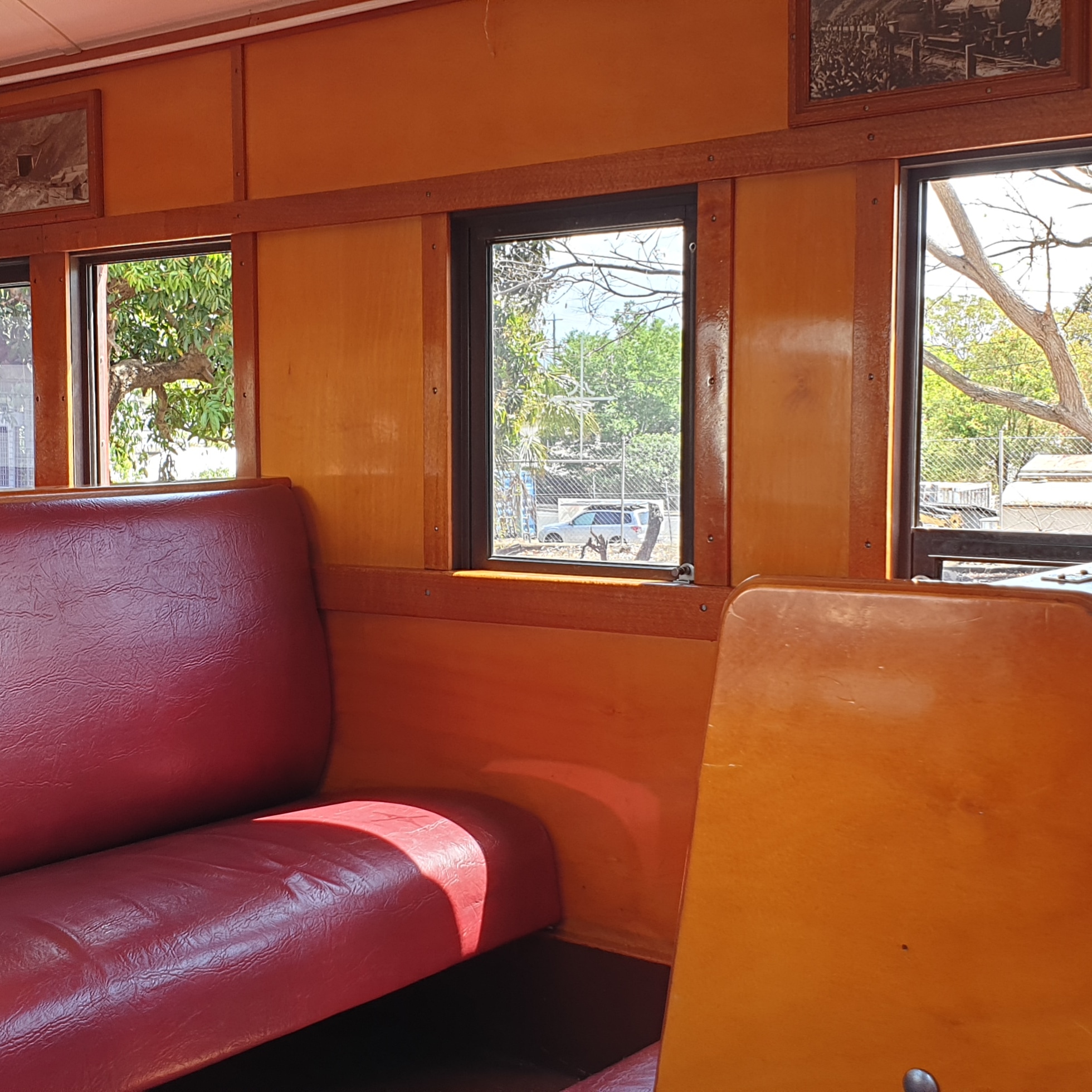
The carriages are completely restored and are extremely comfortable. It brings back, for me, many memories of riding in older trains in Melbourne when I was a child.
The trains, then, were called Red Rattlers.
This is the locomotive climbing one of the hilly parts of the line before crossing over the Mary River on a trestle bridge.
This is the engine at Amamoor near the picnic area where young children and excited parents and grandparents can get on the locomotive itself and look inside where the driver sits.
And, no, I didn’t volunteer to shovel coal.
This particular locomotive spent most of its working life between Townsville and Mount Isa and was based in Cloncurry, Charters Towers, and Townsville, before being sent, at the end of its useful days in the late 1960s, to the Ipswich Railway Workshops.