There is always something to be found that can be very interesting, and sometimes, when following more obscure links in web pages, you can either finish up having your computer trashed, or you find a gem.
As you can imagine, when I saw the CIA, I thought, OK, this fits my penchant for conspiracies and subterfuge, and when I stumbled across this thing called the Phoenix Program. Whether it existed or not, one can never sure when reading about CIA activities, its premise gives me an avenue to attach a few shady characters and let them run with it.
Then, of course, there was a film which I noticed was on cable TV, so I watched it. Air America, and whether that was true or not, it gave me another idea, and so the characterization of Colonel Davenport will fit into both these scenarios.
I suspect there may have been one or two more enterprising officers who saw an opportunity to not only appear to fulfill the parameters of their mission, but also make a little money on the side, setting up an operation within an operation, whether it’s to move into a black market arms supply, or moving and selling drugs from what was called the golden triangle that may or may not have included Cambodia.
That also lends itself to Davenport, when Bill finally catches on to what he is up to, arranging for his capture and removal to a prisoner of war campo over the border in Cambodia. It could also probably have been in Laos, at the CIA may or may not have been running an operation there as well.
There is so much now to consider.
I now have to find out about airbases and personnel, come up with a suitable band of misfits, find out what sort of aircraft and land transport could be involved in moving the contraband, and a little more about Saigon back in the mid-sixties.
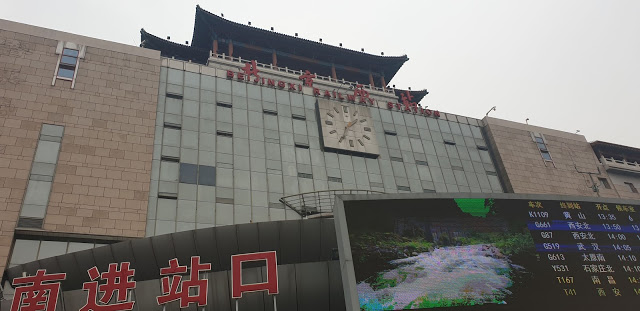
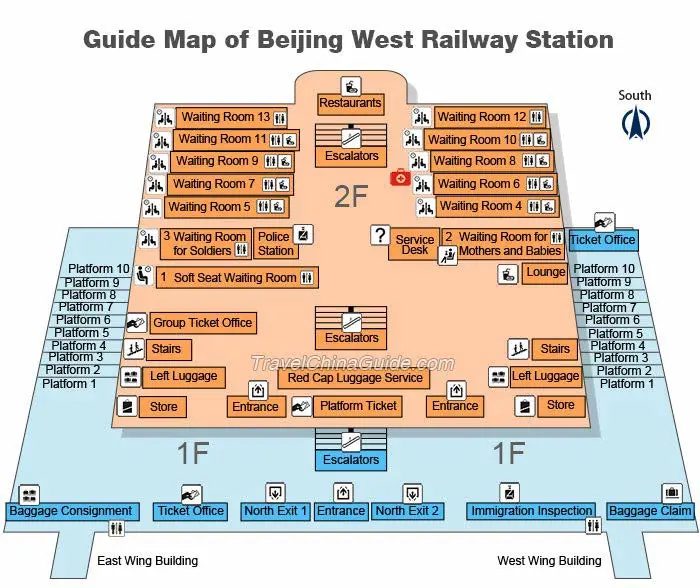
Beijing west railway station is about eight kilometers from the Forbidden City, located at East Lianhuachi Road, Fengtai District. Most trains traveling between south central, southwest, northwest, and south China are boarded here.
This place is huge and there are so many people here, perhaps the other half of Beijing’s population that wasn’t in the forbidden city.
Getting into the station looked like it was going to be fraught with danger but the tour guide got us into the right queue and then arranged for a separate scanner for the group to help keep us all together
Then we decided to take the VIP service and got to waiting room no 13, the VIP service waiting room which was full to overflowing. Everyone today was a VIP. We got the red hat guy to lead us to a special area away from the crowd.
Actually, it was on the other side of the gate, away from the hoards sitting or standing patiently in the waiting room. It gave us a chance to get something to eat before the long train ride.
The departure is at 4 pm, the train number was G655, and we were told the trains leave on time. As it is a high-speed train, stops are far and few between, but we’re lucky, this time, in that we don’t have to count stations to know where to get off.
We’re going to the end of the line.
However, it was interesting to note the stops which, in each case, were brief, and you had to be ready to get off in a hurry.
These stops were Shijiazhuang, Zhengzhou East, Luoyang Longmen, Huashan North, and Weinan North. At night, you could see the lights of these cities from a distance and were like oases in the middle of a desert. During the day, the most prominent features were high rise apartment blocks and power stations.
A train ride with a difference
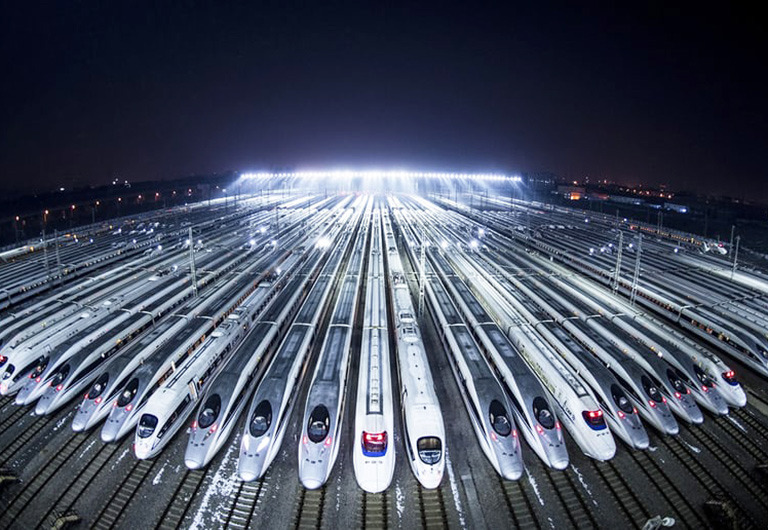
China’s high-speed trains, also known as bullet or fast trains, can reach a top speed of 350 km/h (217 mph).
Over 2,800 pairs of bullet trains numbered by G, D or C run daily connecting over 550 cities in China and covering 33 of the country’s 34 provinces. Beijing-Shanghai high-speed train link the two megacities 1,318 km (819 mi) away in just 4.5 hours.
By 2019, China keeps the world’s largest high-speed rail (HSR) network with a length totaling over 35,000 km (21,750 mi).
To make the five and a half hours go quicker we keep an eye on the speed which hovers between 290 and 305 kph, and sitting there with our camera waiting for the speed to hit 305 which is a rare occurrence, and then, for 306 and then for 307, which happened when we all took a stroll up to the restaurant car to find there had nothing to eat.
I got a strange flavored drink for 20 yuan.
There was a lady manning a trolley that had some food, and fresh, maybe, fruit on it, and she had a sense of humor if not much English.
We didn’t but anything but the barrel of caramel popcorn looked good.
The good thing was, after hovering around 298, and 299 kph, it finally hit 300.
We get to the end of the line, and there is an announcement in Chinese that we don’t understand and attempts to find out if it is the last station fall on deaf ears, probably more to do with the language barrier than anything else.
Then, suddenly the train conductor, the lady with the red hat, comes and tells us it is, and we have fifteen minutes, so we’re now hurrying to get off.
As the group was are scattered up and down the platform, we all come together and we go down the escalator, and, at the bottom, we see the trip-a-deal flags.
X’ian,and the Xi’an North Railway Station
Xi’an North Railway Station is one of the most important transportation hubs of the Chinese high-speed rail network. It is about 8.7 miles (14 km) from Bell Tower (city center) and is located at the intersection of the Weiyang Road and Wenjing Road in Weiyang District.
This time we have a male guide, Sam, who meets us at the end of the platform after we have disembarked. We have a few hiccups before we head to the bus. Some of our travelers are not on his list, but with the other group. Apparently a trip-a-deal mix-up or miscommunication perhaps.
Then it’s another long walk with bags to the bus. Good thing its a nicely air-conditioned newish bus, and there’s water, and beer for 10 yuan. How could you pass up a tsing tao for that price?
Xi’an is a very brightly lit up city at night with wide roads. It is very welcoming, and a surprise for a city of 10 million out in the middle of China.
As with all hotels, it’s about a 50-minute drive from the railway station and we are all tired by the time we get there.
Tomorrow’s program will be up at 6, on the bus 8.40 and off to the soldiers, 2.00 late lunch, then train station to catch the 4.00 train, that will arrive 2 hours later at the next stop. A not so late night this time.
The Grand Noble Hotel
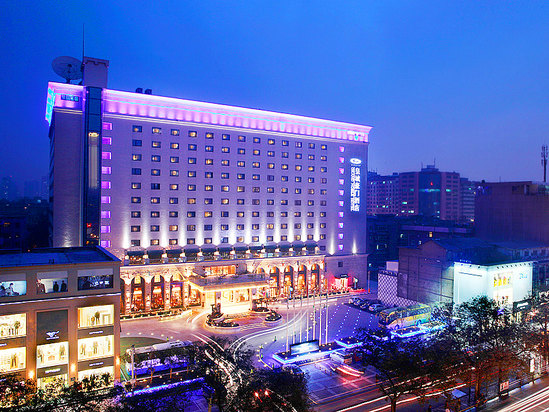
Grand Noble Hotel Xi’an is located in the most prosperous business district within the ancient city wall in the center of Xi’an.
The Grand Noble Hotel, like the Friendship Hotel, had a very flash foyer with tons of polished marble. It sent out warning signals, but when we got to our room, we found it to be absolutely stunning. More room, a large bathroom, air conditioning the works.
Only one small problem, as in Beijing the lighting is inadequate. Other than that it’s what I would call a five-star hotel. This one is definitely better than the Friendship Hotel.
In the center of the city, very close to the bell tower, one of the few ancient buildings left in Xi’an. It is also in the middle of a larger roundabout and had a guard with a machine gun.
Sadly there was no time for city center sightseeing.
Nothing I start seems to work out, a bit like painting yourself into a corner.
Words are beginning to annoy me, so much so, every file I’ve started today, so far, I’ve deleted.
It’s not a matter of getting words on paper, no matter how bad they are. If I added up all the words I’ve written so far, and discarded, it would have to be close to 10,000.
Time to step away from the laptop. My head is hurting, and I’m tired, more so than usual. I think the combination of late nights and not being able to work out where this story is going, is giving me a great deal of grief.
Is this where real writers head for the drinks cabinet and make a severe dent in the single malt?
Maybe I need to go out to a restaurant and have a fancy meal.
Or go to the pizza shop and get a meat lover’s special, and a cheap bottle of merlot.
It’s the second-worst number of words for a day in the past month.
Maybe after a rest, it’ll be different.
…
Today’s word count: 1,439 words, for the running total of 46,873.
The problem is, there are familiar faces and a question of who is a friend and who is foe made all the more difficult because of the enemy, if it was the enemy, simply because it didn’t look or sound or act like the enemy.
Now, it appears, his problems stem from another operation he participated in.
“So,” Lallo said, “you’re telling me you landed separately, Treen and his group advanced towards their position without waiting for your team, that shortly after landing you heard gunfire exchanged, that the members of your team broke ranks and went to help their comrades and that all of them, as far as you were aware at the time, had been killed or captured.”
“Yes.”
“And the two operatives you’d come to rescue?”
“At the time, I had no idea what their status was, but I did make a preliminary assumption that if our mission was blown, then they would hardly be left alive unless the enemy thought they had some strategic value.”
“Or intelligence?”
“It hadn’t occurred to me at the time because my job was to simply to aid the extraction team. To be honest, I had no idea who they were or what their value was.”
That was not exactly the truth because I could hardly say I hadn’t overheard a conversation between Treen, the briefing officers, and an unseen, unnamed officer discussing the two operatives, and the fact it was imperative we get them out at any cost. It wasn’t said why, but I could guess.
It didn’t take long to realize that if our arrival had been known, so would the location and worth of the two we were to rescue. I didn’t think they were killed out of hand, not until they’d told the enemy’s interrogators everything they knew.
And I got the impression they knew enough to cause our whole operation in that country ended up with a great deal of irreparable damage.
No wonder they wanted to sweep it under the carpet.
I watched Lallo scribble a long not over several pages. Was his conclusion the same as mine, but based on truth rather than hearsay?
Then, “Were you met by the person who has been referred to as the so-called source?”
“No.”
“Do you know if Treen’s group were met?”
“No. I was given to understand that source had gone quiet, I suppose another word for either captured or defected to the other side.”
“Apparently there was a report that the agent in situ was going to be at the landing site.”
“Well, there’s your explanation as to why the mission was blown from the start. Whoever it was, was either captured, or a double agent, and told the enemy of our plans.”
“A reasonable assumption in the circumstances, but not necessarily correct.”
“And you know this because…”
I was curious. The agent’s defection would explain everything.
“That agent resurfaced three days ago, again asking for repatriation, and is in the air to a secure site as we speak.”
He stood and took a moment to stow the pencil in the binding of the notebook before giving me his attention.
“We will also be in their air tomorrow, headed for the same secure location. I’m, sure you will be available for that interrogation, because I, too, have serious doubts about this agent’s shall we say, loyalties.”
That still didn’t mean I wasn’t going to finish up at a black site, or worse.
Today, I’ve decided on doing a little research, and this means giving the internet and Google a good workout.
I need some information about the Vietnam War.
So, as a start, I type in the words ‘Vietnam War’ into Google.
This returns: About 699,000,000 results (0.83 seconds)
Wikipedia says “The Vietnam War, also known as the Second Indochina War, and in Vietnam as the Resistance War Against America or simply the American War, was a conflict that occurred in Vietnam, Laos, and Cambodia from 1 November 1955 to the fall of Saigon on 30 April 1975”
OK, so this gives me the broadest outline. What I need is details, so it’s a matter of where to start. This means to start with, when did troops get sent from both Australia and the United States for service. It seems the US sent troops from 1964 to 1969, and Australia between August 1965 and March 1966. This gives me a starting point, because our main character is Australian, and somehow gets seconded to the Americans.
January 1972, the war ends.
Now we need to know
where the bases were
where the battle zones were
methods of transportation
what happened to prisoners of war
rest and recreation points
CIA involvement (which will no doubt be impossible to find evidence)
what happened to soldiers injured in battle
It’s a list that will get longer and may require a reading list, and first-hand accounts.
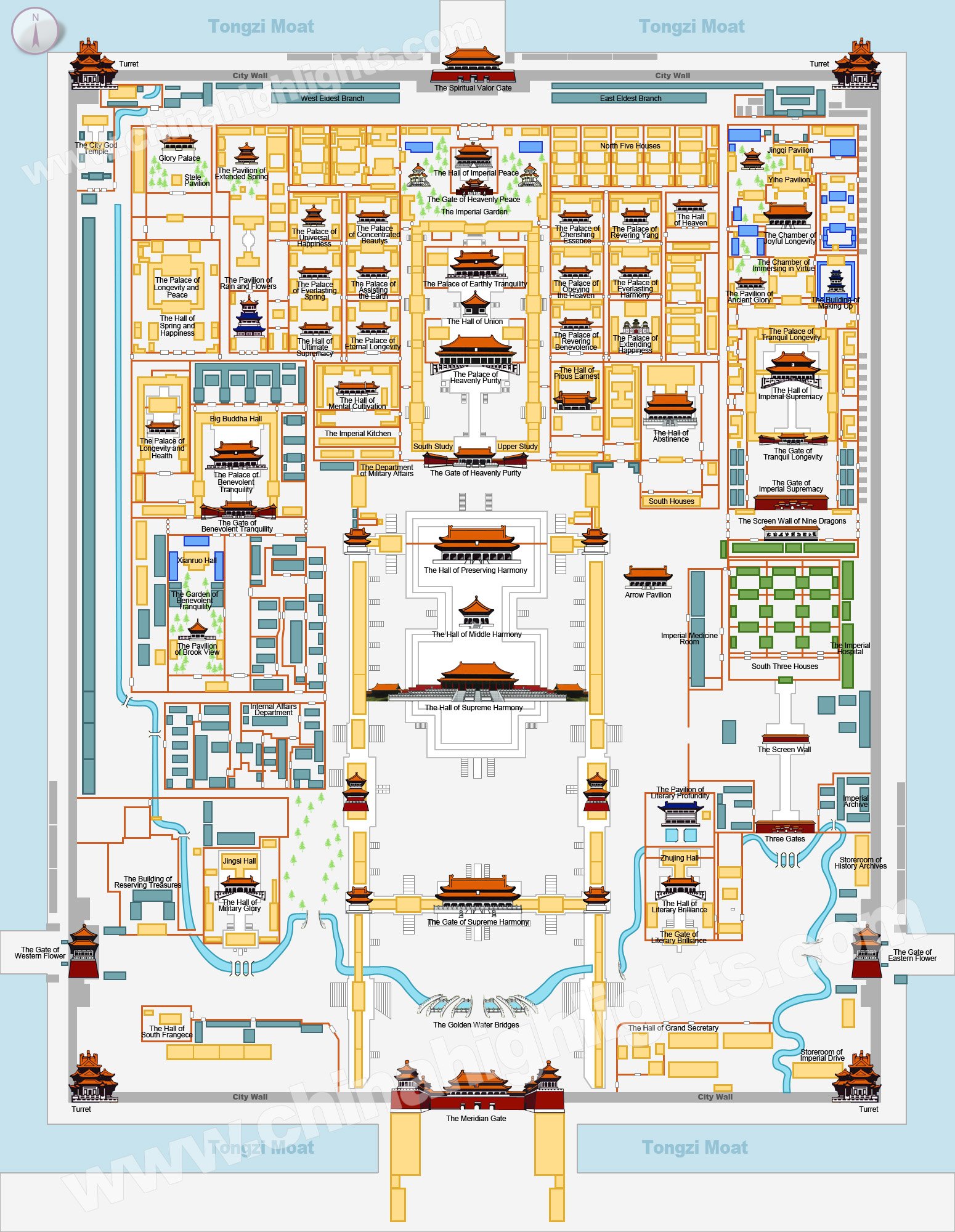
Now we’re walking to the Forbidden City, and it seems like we’re walking for miles and we’re practically exhausted before we get started on the main tour. I’m not sure if we received a map of the city, but one is certainly needed so that you can navigate the many features, buildings, and walkways.
There are tour groups everywhere in the large courtyard outside the gate, most likely getting a lecture on the last of the Chinese emperors about that time Sun Yat-Sen proclaimed the new China around 1912. We were no exception, and it was an interesting way to spend the time waiting to get in. It was a tale of intrigue, interwoven with a 3-year-old emperor, and a scheming concubine who becomes the Emperor’s favorite, enough to bear him a son and successor.
Bribery and corruption at its best.
But its history runs something like this:
The Forbidden City is was once the imperial and state residence of the Emperor of China, as well as the center of government, from the Ming Dynasty to the Qing Dynasty, or 1420 to 1924.
It was built from 1406 to 1420 when the Yongle Emperor moved the capital from Nanking to Beijing and consists of about 980 buildings, and 8,886 bays of rooms (not the 9,999 as prescribed in myth) and covers 180 acres. Over the 14 years, a million workers used whole logs of wood from the jungles of southwestern China, marble from quarries near Beijing, specially made golden bricks from Suzhou
Since 1925 it has been a museum and is the largest number of preserved wooden structures in the world.
The city is surrounded by a wall 7.9 meters high, and a moat that is 6 meters deep and 52 meters wide. A tower sits at each of the four corners. Each side has a gate, the north is called the Gate of Divine Might, the south is called the Meridian gate. East and west are called East Glorious Gate and West Glorious Gate respectively.
But, back in the courtyard, we are ready to go in and follow the tour guide who has switched from her amplified microphone to a whisper device we all wear in our ears. She talks and we listen.
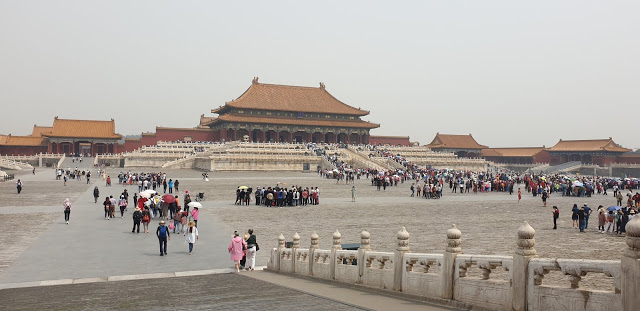
We all make it through and regroup on the other side. This is where the fun begins because we are about to meet a large percentage of the 80,000, they let for the day.
It seems to me they have all arrived at the same time, although by the time we get to the entrance gate, it is very well organized, bags are scanned, people are scanned, and you’re in.
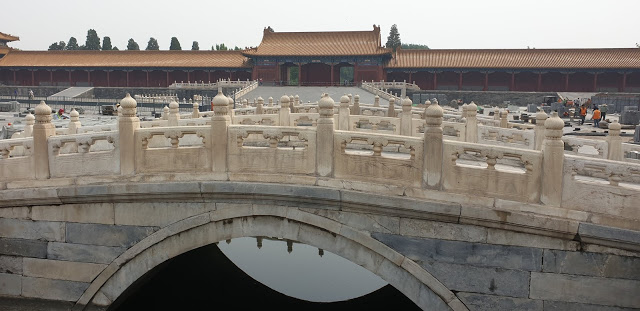
After crossing one of the seven Golden Water bridges, you begin to get some idea of the size and scope of the City, and in the distance, the first of the buildings, The Gate of Supreme Harmony. On a hot day, that could be a long and thirsty walk.
From there it is one pagoda after another with buildings that surround the edge of the whole Forbidden City, as does the moat.
By the time we get to the second courtyard, it was time to have ice cream as a refresher. Others head up to another exhibit, and it’s just too many stairs for us.
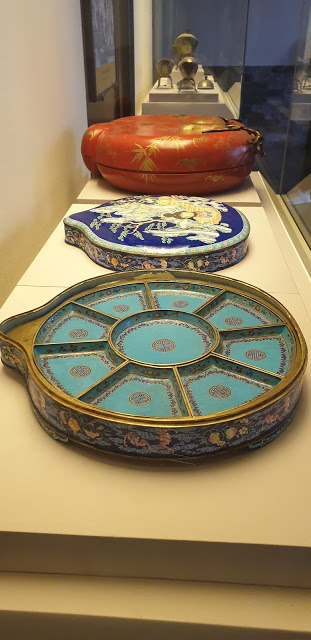
After this, it’s a walkthrough another courtyard, heading up and down some more stairs, we go and see the museum, with priceless relics from past emperors.
There are areas like the outer courtyard, the inner courtyard, yet another courtyard, and the gardens where the concubines walked and spent their leisure time. It is not far from the emperor’s wives living quarters, though there’s precious little left of the furniture, other than a settee and two rather priceless so-called Ming dynasty vases.
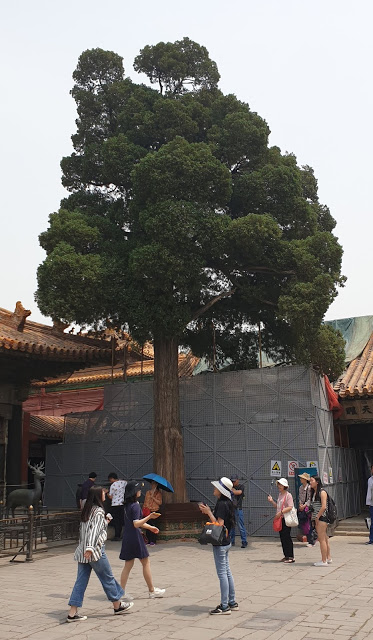
We get into the bad habit of calling all of the vases Ming dynasties. Above is one of the inner courtyards there were living quarters, and that tree is over 300 years old.
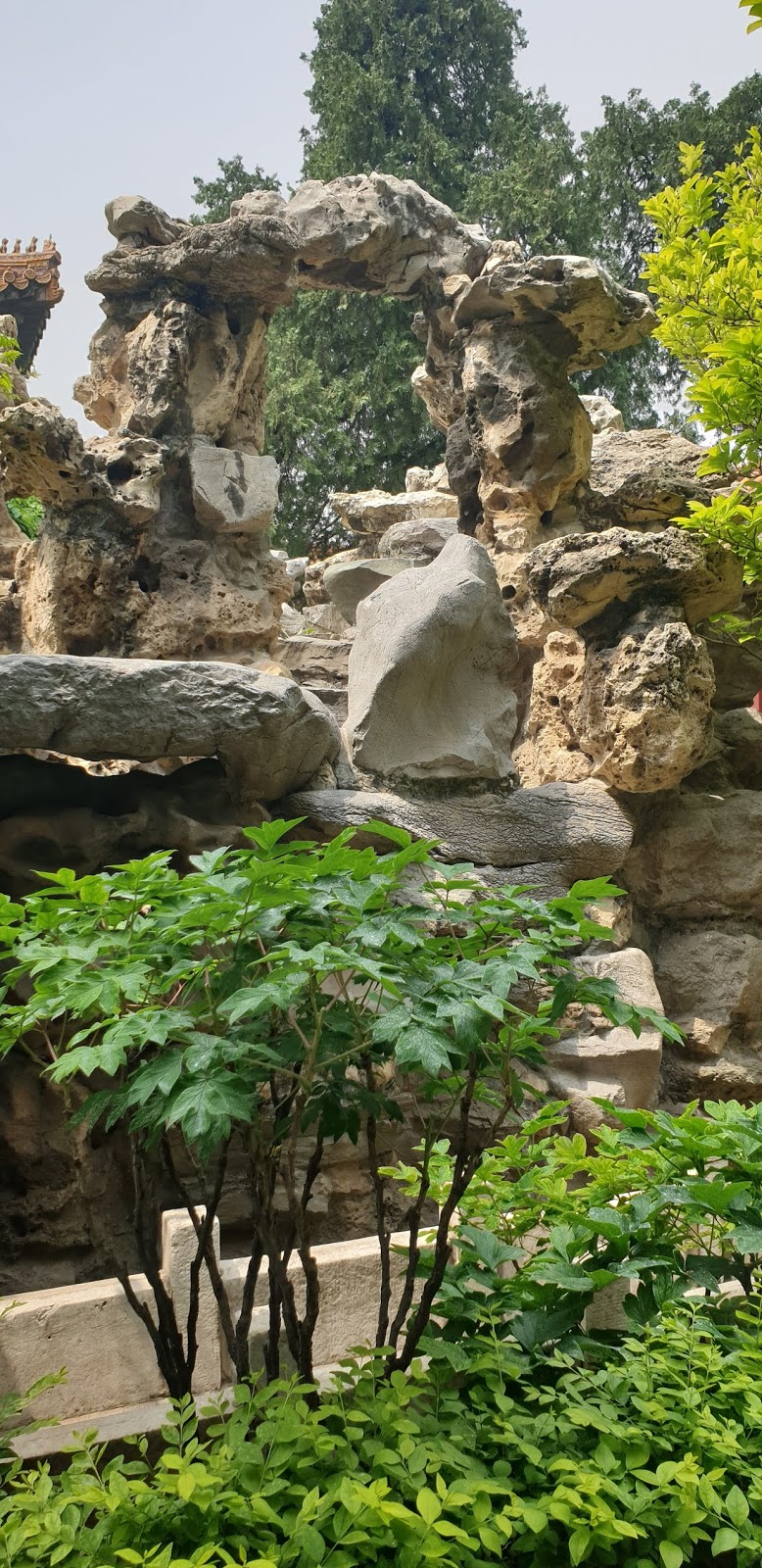
Out through some more alleyways and through an entrance that led to the area where the concubines lived, very spacious, bright, and filled with trees, plants, and walkways through rocky outcrops.
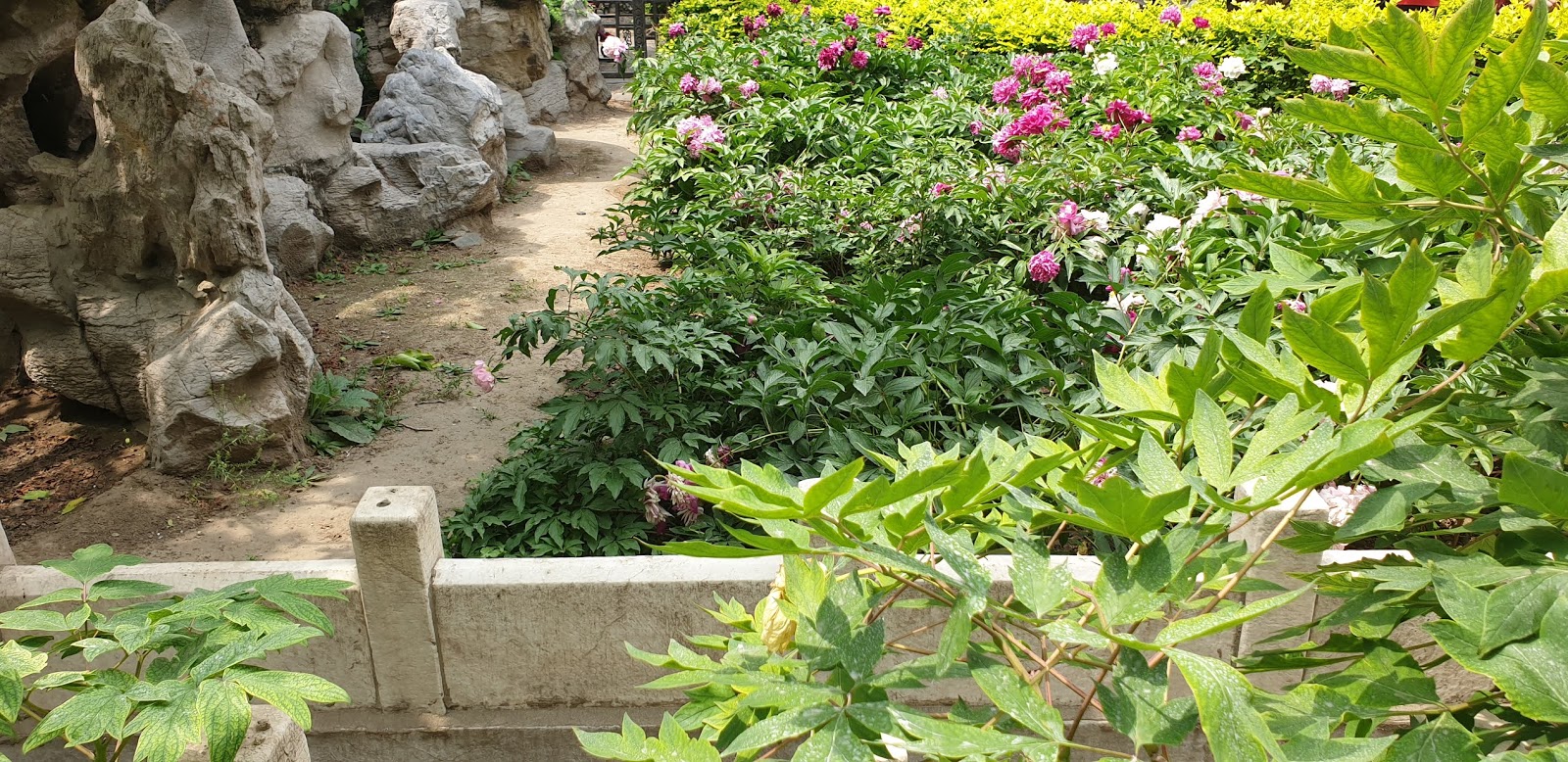
The whole area was made up of living quarters and waterways, rocks and paths, all very neatly set out, and it looked to be a very good place to live.
This is an example of the living quarters, overlooking the gardens
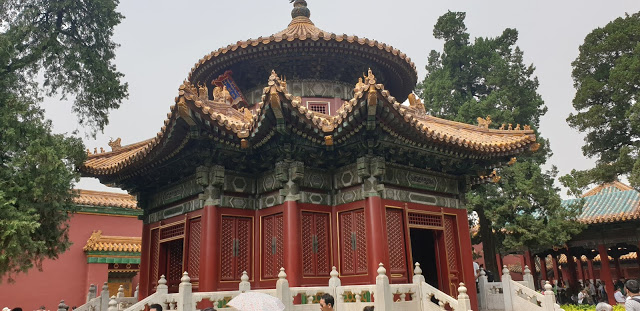
And there were several pagodas
From there its a quick exit out the northern entrance, and another longish walk to our bus, which arrives at the meeting point shortly after we do.
That done, the Beijing tour guide has completed her section of our China experience, and we’re ready to move onto the next.
There’s only so long you can keep the real world out.
That notion that you can write for as long as you want is a myth. Aside from the fact you have to stop for coffee breaks, meals, and sleep, all entirely optional, there are other factors that come into play.
Family.
Just to name one, there is still my usual job of picking up my granddaughter from school as and when required.
And this impinging on the world that you have created for yourself, in that writing bubble that is November, it doesn’t take much to crack it, even just a little.
So, here I am, sitting in the queue waiting with the hundreds of others who have decided public transport is way too unsafe, health-wise in this world of COVID scares, that we should pick them up and deliver them safely to their homes.
My phone then becomes the principal instrument in my office, the equivalent of a computer with writing software and a cloud directory where I can work on any part of the manuscript, in the office or anywhere in the world, but today, from my car.
Toll back 40 years, and this wasn’t possible, except if you had a writing pad and a pen or pencil. Such a messy and time-consuming way of writing, but it was all we had back then, other than a typewriter that could not be used in a car.
How times have changed, and for the better.
…
Today’s word count: 2,238 words, for the running total of 45,434.
The problem is, there are familiar faces and a question of who is a friend and who is foe made all the more difficult because of the enemy, if it was the enemy, simply because it didn’t look or sound or act like the enemy.
Now, it appears, his problems stem from another operation he participated in.
“As I understand it, you were to fly to the drop off point about two miles from the abandoned farm where the operatives were hiding, and not far from the farm, where a group of enemy soldiers had set up camp. The plan was one team was to create a diversion, while the other rescued the operatives.”
It sounded quite simple and equally workable when said out loud, now.
But, at the time and on the ground, nothing could be further from the truth. It had sounded equally simple when we discussed the final plan before we moved out. My team would provide the diversion; Treen’s would affect the rescue.
“In your post operational debriefing, you said you encountered the enemy not far from the drop zone.” He looked down at his notebook, and then up again, after checking what the question was, “but you didn’t exactly say how that affected moving forward, or whether you thought they had been informed prior to your arrival.”
“It was basically unexpected and both Treen and I had to adjust the plan on the fly so to speak. It was a setback, but it wasn’t what might be called a show stopper. Not initially, anyway.”
Except Treen had lost it because I soon discovered he didn’t like changes. The plan was the plan, come what may.
“And, now, after you’ve had time to think about it?”
“I did say, at the briefing, that if the source of the ground had gone silent, it might mean he’d been caught, and if so, may have told the enemy of our intentions.”
“And this suggestion was given no credence?”
“It was left to Treen to factor that into his decision as the officer in charge. I’m sure that decision was based on more than just my input. but, on the other hand, no one else asked seemed to consider that a possibility. So, if it was you, would it not seem strange the enemy would let the choppers land, drop us off, and take off again, then give us time to set up before attacking. If I’d been told anyone was coming, I’d use rockets to take out the choppers in the air, kill the raid before it started.”
Lallo had his best poker face on, so I had no idea what he thought, but he did make a note.
“Where was Treen after you landed?”
“With his group. We’d re-worked the plan while in the air, and to minimise the choppers exposure, we were to hit the ground running. We had different destinations, so I didn’t see him or his team. It was dark, and not possible to see where anyone other than your immediate team members were.”
But as it turned out, their chopper had landed closer to the pickup zone, and we had enemy soldiers between us and them. We were as soon as we landed effectively cut off from Tree, and he would not get any support from us.
“The choppers didn’t land together?”
“No. We were a hundred yards, maybe more, apart.”
“But you knew they were close. You said you heard shots fired not long after your chopper took off. Was the gunfire theirs or ours?”
“All guns sound the same at night. It was impossible to say. It was the first indication that there was a group of enemy soldiers near the drop zone, coincidentally or otherwise, and Treen’s team had been seen. I sent Sycamore to find out what had happened, and the rest of the team waited. No point walking into a firefight. I trusted Treen to get the job done whatever the circumstances.”
“Your man didn’t come back?”
“No.”
“What happened then?”
My team members disobeyed orders to stay on mission, and not wanting to remain alone in the field, I followed them on what I thought was suicide. If the other members of their team had been killed, or, worse, captured, and it was certainly looking like it, then the odds were they were going to join them.
It’s a perfect situation where being the odd man out works in your favour.
I saw Andrews and Ledgeman go over the hill and disappear, and seconds later the sound of automatic fire. It was exactly as I thought it would be. I broke for cover and made it just in time to see a dozen enemy soldiers come over the hill, heading towards our drop zone. I assumed they’d done a head count and found one was missing.
Today, I’ve decided on doing a little research, and this means giving the internet and Google a good workout.
I need some information about the Vietnam War.
So, as a start, I type in the words ‘Vietnam War’ into Google.
This returns: About 699,000,000 results (0.83 seconds)
Wikipedia says “The Vietnam War, also known as the Second Indochina War, and in Vietnam as the Resistance War Against America or simply the American War, was a conflict that occurred in Vietnam, Laos, and Cambodia from 1 November 1955 to the fall of Saigon on 30 April 1975”
OK, so this gives me the broadest outline. What I need is details, so it’s a matter of where to start. This means to start with, when did troops get sent from both Australia and the United States for service. It seems the US sent troops from 1964 to 1969, and Australia between August 1965 and March 1966. This gives me a starting point, because our main character is Australian, and somehow gets seconded to the Americans.
January 1972, the war ends.
Now we need to know
where the bases were
where the battle zones were
methods of transportation
what happened to prisoners of war
rest and recreation points
CIA involvement (which will no doubt be impossible to find evidence)
what happened to soldiers injured in battle
It’s a list that will get longer and may require a reading list, and first-hand accounts.
Now we’re walking to the Forbidden City, and it seems like we’re walking for miles and we’re practically exhausted before we get started on the main tour. I’m not sure if we received a map of the city, but one is certainly needed so that you can navigate the many features, buildings, and walkways.
There are tour groups everywhere in the large courtyard outside the gate, most likely getting a lecture on the last of the Chinese emperors about that time Sun Yat-Sen proclaimed the new China around 1912. We were no exception, and it was an interesting way to spend the time waiting to get in. It was a tale of intrigue, interwoven with a 3-year-old emperor, and a scheming concubine who becomes the Emperor’s favorite, enough to bear him a son and successor.
Bribery and corruption at its best.
But its history runs something like this:
The Forbidden City is was once the imperial and state residence of the Emperor of China, as well as the center of government, from the Ming Dynasty to the Qing Dynasty, or 1420 to 1924.
It was built from 1406 to 1420 when the Yongle Emperor moved the capital from Nanking to Beijing and consists of about 980 buildings, and 8,886 bays of rooms (not the 9,999 as prescribed in myth) and covers 180 acres. Over the 14 years, a million workers used whole logs of wood from the jungles of southwestern China, marble from quarries near Beijing, specially made golden bricks from Suzhou
Since 1925 it has been a museum and is the largest number of preserved wooden structures in the world.
The city is surrounded by a wall 7.9 meters high, and a moat that is 6 meters deep and 52 meters wide. A tower sits at each of the four corners. Each side has a gate, the north is called the Gate of Divine Might, the south is called the Meridian gate. East and west are called East Glorious Gate and West Glorious Gate respectively.
But, back in the courtyard, we are ready to go in and follow the tour guide who has switched from her amplified microphone to a whisper device we all wear in our ears. She talks and we listen.
We all make it through and regroup on the other side. This is where the fun begins because we are about to meet a large percentage of the 80,000, they let for the day.
It seems to me they have all arrived at the same time, although by the time we get to the entrance gate, it is very well organized, bags are scanned, people are scanned, and you’re in.
After crossing one of the seven Golden Water bridges, you begin to get some idea of the size and scope of the City, and in the distance, the first of the buildings, The Gate of Supreme Harmony. On a hot day, that could be a long and thirsty walk.
From there it is one pagoda after another with buildings that surround the edge of the whole Forbidden City, as does the moat.
By the time we get to the second courtyard, it was time to have ice cream as a refresher. Others head up to another exhibit, and it’s just too many stairs for us.
After this, it’s a walkthrough another courtyard, heading up and down some more stairs, we go and see the museum, with priceless relics from past emperors.
There are areas like the outer courtyard, the inner courtyard, yet another courtyard, and the gardens where the concubines walked and spent their leisure time. It is not far from the emperor’s wives living quarters, though there’s precious little left of the furniture, other than a settee and two rather priceless so-called Ming dynasty vases.
We get into the bad habit of calling all of the vases Ming dynasties. Above is one of the inner courtyards there were living quarters, and that tree is over 300 years old.
Out through some more alleyways and through an entrance that led to the area where the concubines lived, very spacious, bright, and filled with trees, plants, and walkways through rocky outcrops.
The whole area was made up of living quarters and waterways, rocks and paths, all very neatly set out, and it looked to be a very good place to live.
This is an example of the living quarters, overlooking the gardens
And there were several pagodas
From there its a quick exit out the northern entrance, and another longish walk to our bus, which arrives at the meeting point shortly after we do.
That done, the Beijing tour guide has completed her section of our China experience, and we’re ready to move onto the next.






 Thrills, Spills, and just a dash of Romance