Searching for Locations: Waitomo caves house, North Island, New Zealand

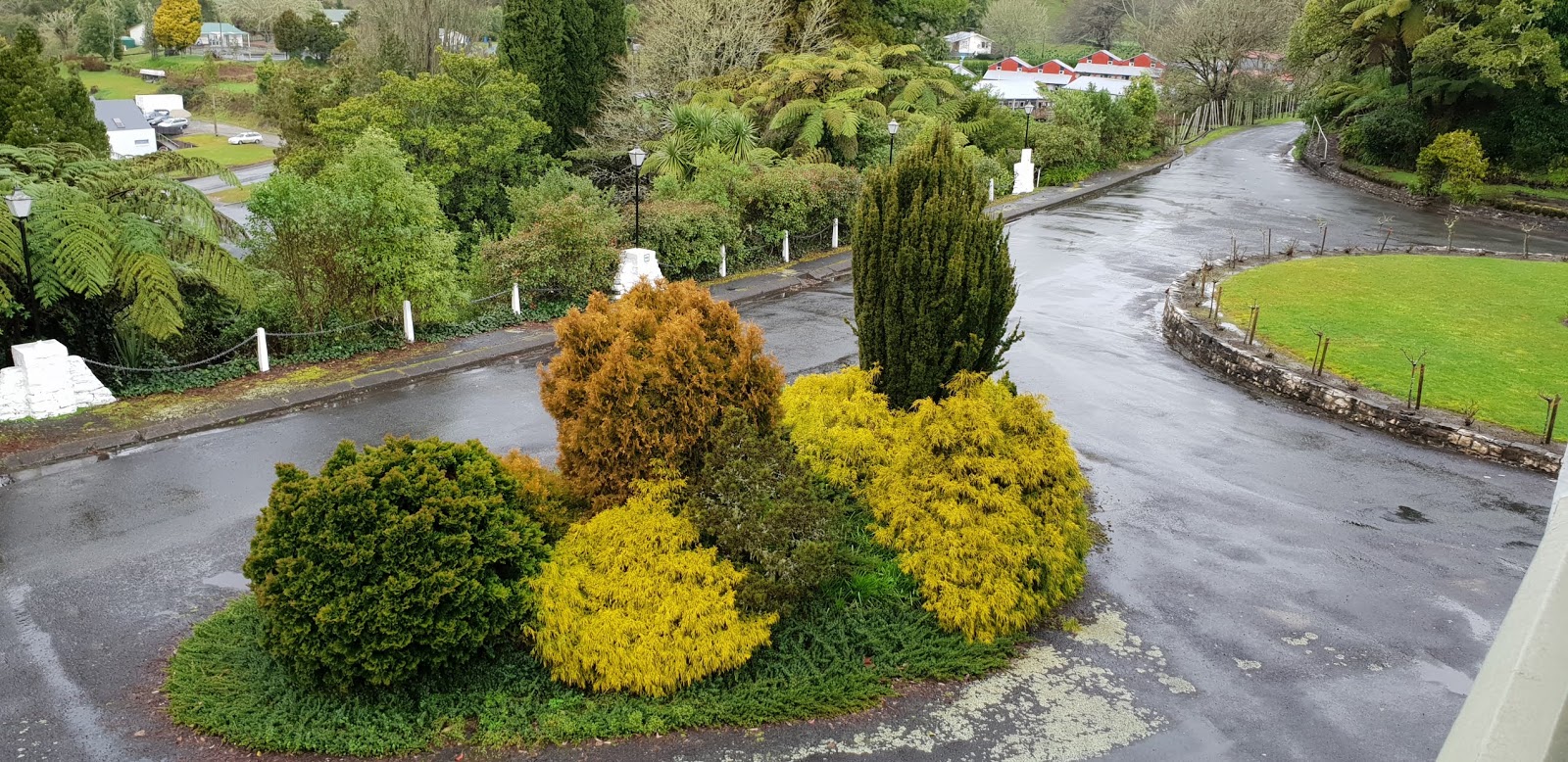
A relatively unassuming lane leads to what could be described as a grand hotel, called Waitomo Caves Hotel.

The original hotel was built in 1908, and it was later extended in 1928.  Part of it is ‘Victorian’, based on an eastern Europe mountain chalet, and part of it is ‘Art Deco’, the concrete wing, and a feature, if it could be called that, is none of the four corners are the same.

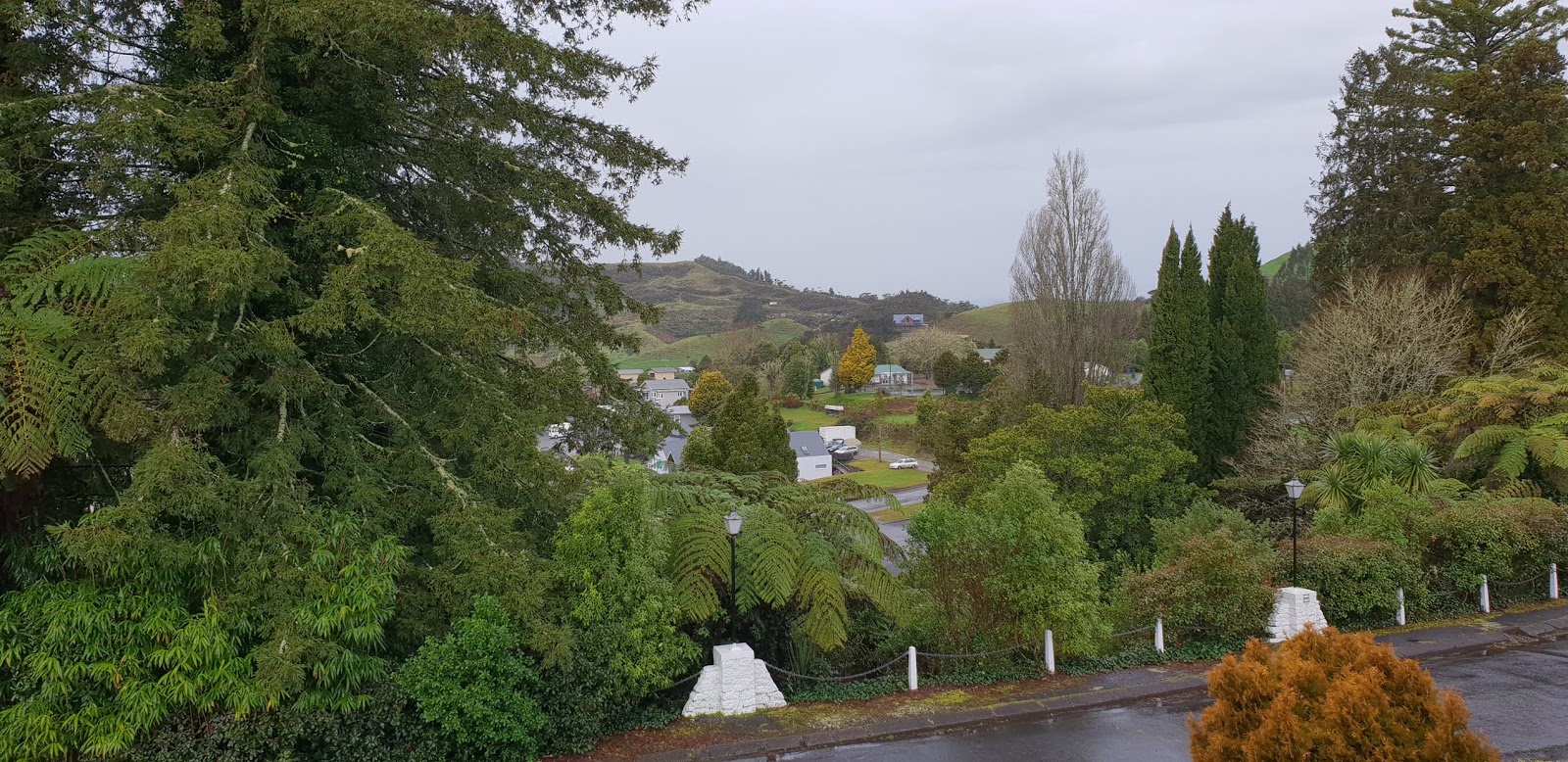
Views from the balcony show part of the surrounding gardens
 

and the town of Waitomo in the distance.
 

In gloomy weather, it does look rather spooky, and I suspect there may be a ghost or two lurking somewhere in the buildings.


But…
 

This a a very interesting, and the words of one of my younger grand daughters, a very creepy place. It would make an excellent base for paranormal activity, and there could very well be ghosts walking the corridors of this hotel.

It has the long darkish passageways that lead in all directions and to almost hidden rooms, a creepy nighttime aspect, and the creaky woodwork.

I know when we were exploring, it was easy to lose your bearings, if not get lost, trying to find certain places, and once found, hard to find your way back.

All in all, it was one of the best stays in a very old place going through the throes of modernisation.

And looking at it from the outside at night, I’ll leave you with that thought…

“Trouble in Store” – Short stories my way: Adding more to the second part

The story fleshed out for the second section, discussed in Point of View


Annalisa looked at the two men facing her, a shopkeeper who, despite his protestations, was a dealer, and the other man, a customer scared shitless.

The poor bastard was not the only one scared. 

It was meant to be simple, arrive at the shop just before closing, force the shopkeeper to hand over the shit, and leave.

What had happened?

The shopkeeper laughed at them and  told them to get out.  Simmo started ranting and waving the gun around, then all of a sudden collapsed. 

There was a race for the gun which spilled out of Simmo’s hand, and she won.  No more arguments, the shopkeeper was getting the stuff when the customer burst into the shop.

This was worse than any bad hair day, or getting out of the wrong side of bed day, this was, she was convinced, the last day of her life.

Her mother said she would never amount to anything, and here she was with a drug addict coming apart because she had been cut off from her money and could no longer pay for his supply, which had led them to this inevitable ending.

She heard a strange sound come from beside her and looked down.  Simmo was getting worse, like he had a fever, and was moaning.


If Alphonse had thought his day was going to get any better after the delivery disaster earlier that day, he was wrong.

If he thought he could maintain his real business and his under the counter business with no one finding out, in that he was wrong too.  He’s know, inevitably, some useless punk would come and do exactly what Simmo was doing.

It might have been salvageable before the customer came in the door, but now it was not.  The customer had heard the words, and given him ‘the look’.  A drug addict telling the cops he was a dealer, it was his word against an  unreliable addict, but this local chap, he had that air of respectability the cops would listen too.

Damn.

But he had to try and salvage the situation, there was a lot of money involved, and other people depending on him.  He looked at the boy, on the floor, then  the girl.

“Listen to me, young lady, I have no idea what you are talking about.  Please, put the gun down before someone gets hurt.  Your friend needs medical help and I can call an ambulance.”

The girl switched her attention back to him.  “Shut up, let me think.  Shit.”

The storekeeper glanced over at the customer.  He’s been in once or twice, probably lived in the neighborhood, but looked the sort who’d  prefer to be anywhere but in his shop.  More so now.  If only he hadn’t burst in when he did.  He would have the gun, called the police, and brazened his way out of trouble.  Now, that remedy was off the table.

Now he had to deal with the fallout, especially if the girl started talking.


© Charles Heath 2016-2020

The cinema of my dreams – I always wanted to write a war story – Episode 2

This is a story inspired by a visit to an old castle in Italy.  It was, of course, written while traveling on a plane, though I’m not sure if it was from Calgary to Toronto, or New York to Vancouver.

But, there’s more to come.  Those were long flights…

And sadly when I read what I’d written, off the plane and in the cold hard light of dawn, there were problems, which now in the second draft, should provide the proper start.

I calculated the odds.  Thirty to one.  I wasn’t going to add Jack to the team, because he could never understand what was going on.  I was finding it hard myself.  

The man who sent me on this mission, the man whom I had given a detailed report on what I thought was happening at the castle, gleaned from soldiers passing through and the local resistance, had taken me aside in London, told me the mission he was sending me on was top secret and I could tell no one.

Only now did I realize the import of those words.  Someone I had trusted with my life, for a very long time, was not the person I thought they were.

That was in the second the message I’d received, read, and immediately destroyed.  I hadn’t believed it.  Not at first.  But it had one other piece of information as proof, one when I thought about, made sense of everything that had been happening.  The word coincidence had become overused in the last week.

But I didn’t have time to think about it now, I had to try and get away if only as far as the resistance, to get help and report on what had just happened.

But I couldn’t understand what the enemy would gain from retaking the castle.  Behind enemy lines, it would only be a matter of time before they were caught, or killed.

Enough.  I could hear the footsteps approaching.

Jack had found the passage when he and I had been doing some reconnaissance of the old castle.  I thought it odd that no one knew of any secret passages when all of these old places usually had at least a few.  The lord of the manor would want to be able to move about secretly, visiting mistresses, escaping from enemies, or just sneaking about checking up on staff and family

We’d found one that ran from the guard tower to the grand hall.  A lot of cobwebs, a musty odor, and signs it hadn’t been used for a long time, it was perfect for my soon to be unannounced arrival.

The passage ended at a large wooden cabinet which had a compartment that opened out into the hall.  From within, it was possible to hear conversations and see a veiled view of any activity.

Johansson and that man I’d been warned about, that man I had trusted, Lieutenant General Wallace.  I could only assume he had arrived with the stormtroopers, so for a moment, I was confused as to whether they were ours or the enemy.

I could see Wallace was angry. “I thought I told you I wanted Atherton neutralized before I got here.  Where is he?”

Just then Jackerby came in and looked flustered.  “He’s gone.”

“What the hell do you mean, he’s gone.  Gone where, for God’s sake.  There’s nowhere to go.”

I wondered what neutralized meant.  It didn’t sound very pleasant.  Jack was nudging my leg.  What was he trying to tell me?

“He was in the south tower with that mangy dog of his, where he usually hangs out.”

“Then he can’t be far.  Find him and bring him, to me.  Pity that bomb didn’t kill him or we wouldn’t be in this situation.”

Why did it have to be Wallace?  I actually liked the man.  Until now.  I kneeled down, “Well, Jack,” I whispered.  “It looks like we are both in serious trouble.  What’s say we get out of here?”

A lick on the side of my face told me all I needed to know.

© Charles Heath 2019-2022

Books, books, and more books

If there is one thing I cannot resist is walking into a book store wherever it might be.

It usually elicits a groan from everyone I’m with because for them, watching grass grow is a more fascinating exercise.

But…

The best bookshops are the pop-up ones that appear in various shopping centres where there are empty spaces, and these have a wide variety of books for just $7 each.

And there are lots of bargains…

As you can see, I have been on a few bargain hunts lately and like any writer’s room, tucked away with the boxes of drinks, gardening equipment and everything else that just doesn’t fit in the house, are the piles of books awaiting being put into the shelves

As you can see, the shelves are almost full so it’s going to be an uphill battle to find spaces for them.

By the way, there are eight such book cases on the surrounding walls, as well as a new one, recently discarded from the lounge room, to house the reference books

Along with a few stuffed bears.

The job of putting books on shelves falls to the grandchildren, whom I am trying to convince that when they get older, they should too embrace the idea of having a reading room, which my writing room will also be when I eventually get to throw out the accumulation of years of discarded homewares.

Perhaps one day next year…

Writing about writing a book – Day 30

I’m having fun with chapter one.

Can you reach a point where you are never satisfied with what you’ve written?

What more can I say?

Looking at the mess constituting my room and my life, slob may have been an appropriate description.  I considered myself old, overweight though not necessarily fat, hair graying at the edges, and few wrinkles around the eyes, there were no real pluses in my description.

Some said I had a kindly face, but perhaps I had the look of a paternalistic grandfather.  There were several men in the office who were the same age and had grandchildren.  And some who had children at a time when they should be planning for retirement, not parenthood.

World-weary and perpetually tired, I’d passed the mid-life crisis, wondering what it was that affected other men my age.  Twenty-odd years later, I was still wondering.

I used to think I’d missed a lot in half a lifetime.

Now, I didn’t know what to think.

Did I deserve pity?  No.

Did I deserve sympathy?  No!

The only person who could get me out of the rut was myself.  For years I’d traded on Ellen’s good nature.  She deserved better, left me, and was now happier in the arms of a man who I wanted to believe treated her far better than I.  She had told me so herself, and judging by her manner, it had to be true.  Only recently had she got her smile back, the one that lit her face up, one that infectiously spread happiness to anyone near her.

There were reasons why I became the person I was now.  Some might say they were valid.  In the cold, hard light of dawn, I could see it was time I stopped using my past as a crutch and got on with the business of living.

Perhaps today would be the first day of the rest of my life.

I took the bus rather than drove.  At that hour of the morning, the traffic would be bad, and there would be no parking spaces left.  And I was using public transport more and more, have become accustomed to the convenience.  Time to read the paper, or a good book, or just dream about a different life.

This morning I thought about Ellen.  I hadn’t for a while, but that might have been fueled by the arrival of the divorce papers she wanted me to sign.  I’d had my time to be angry, and disappointed, she’d said, and she was right.  It was time to move on.

And she had stuck by me through thick and thin, coming back from overseas service a basket case after nine months in a POW camp, after a war that was more horrible than anyone could imagine.  Two mental breakdowns, periods of indolence and lassitude, leaving her to bring up the girls on her own.  I had not been a great father, and much less a husband.

I remembered that argument word for word.

I could see the looks of pain in the girl’s faces.

I remembered the hug, the kiss on the cheek, the tears.  It had not been out of hate, but a necessity.  For her and the children.  Until I found some lasting peace, they were better off at arm’s length.  Away from the arguing, the silences, the absences.

And disappointment.

After she left I tried to get my life in order.  Drugs, professional help, alcohol, meditation, then work.

Over ten years ago, it took a year, perhaps a little more before sanity returned.

She did not.

By then I knew she had found someone else, a mystery man, whom neither she would tell me who, and the girls honestly didn’t know.  She’d promised that much, any new man in her life would not get to meet the girls.  And she would tell me, and then when she was ready.

Then, suddenly, the children were no longer children but young adults and out in the world on their own, and I had become more a banker than a father, an observer rather than a participant, and it was as if we were more like ships passing in the night.  And overnight, the ships had sailed to the other side of the world.

My own fault, of course, and a bit late now to change history.  I could see Ellen’s influence over them, her prejudices and dislikes, and their contempt, like their mother, for me, simmering beneath the surface, but in fairness to them, I really hadn’t been much of a help as a parent should be.

And now I was getting my life back in order, perhaps I could try and make it up to them, and that first meeting, with them and Ellen, nearly a month ago, had been a step in the right direction.  They’d agreed to see me again, without her, during the holidays, which had now arrived.  All I had to do was make the call, and get on a plane.

This mess I was heading into, it would not take long.  I pulled out my phone and after searching for a travel agent near where I worked, I made an appointment to see about going overseas.

She had spoken to me about the divorce papers several days ago, alternately pleading with, and then abusing, me.  There had been some very strong language in the conversation, words I’d thought her incapable of using, but I confess, finally, I didn’t really know her all that well anymore.

Since then I had been calling her to arrange a meeting.  She had not yet replied.  With some distance to go before I reached the office, I tried calling her again.  I was almost glad when she didn’t answer.

I never realized just how hard it was to revise and re-write, and how much time it takes.

Perhaps that’s why first novels take so long to write!

© Charles Heath 2016-2021

Searching for locations: Auckland, New Zealand – Another city that has a tower

Nearly every city has a high building, a tower, or a large Ferris wheel.

London had the London eye
Paris has the Eiffel tower
The Galata in Istanbul
The CN Tower in Toronto
The towers of San Gimignano
Pisa has a leaning tower

We’ve managed to see all of the above bar the Galata in Istanbul.  One day we might get there.

But, on this side of the world, there are two, the Sydney Tower, and the Sky Tower in Auckland, which we just visited recently.

20140522_153338

It’s not a tall tower, but it definitely gives great vies of Auckland, particularly to the north

20140522_150952

The mountain in the background at the top of the photo is of a volcano on Rangitoto Island.  When we were visiting, there were reports that it might become active again.

20140522_151039

To give a height perspective, it didn’t seem all that far down to the apartment building and gardens nearby.

The cinema of my dreams – I always wanted to write a war story – Episode 1

It’s the story that was inspired by the Castello di Briolio, which had small aspirations when first conceived, but now it’s reached a point where we need to fill in a few blanks at the start.

Thus, a revised Episode One

“You have got the guards set up on the back wall,” I asked Jackerby, the officer in charge of the rearguards.

“Can you see them?” he said in a tone that dripped sarcasm.

I didn’t like Jackerby, he seemed far too sure of himself and his men, and so far, we hadn’t had to rely on them.

But I expected that time was coming, and sooner than both of us wanted to believe.

“No.”

“Then no one else will either.  Trust me; no one will be coming over the back wall.”

That was a matter of opinion, and, in my assessment of the fortifications, and the security precautions, about the only way the enemy could attack us, was from the sky.

And that was, given the current situation the enemy were in, practically impossible.  But, as my old commander used to say, ‘This is war, anything is possible, and when you least expect it.’

I’d survived four years of it, and didn’t want to be one of those who didn’t make it to the end.  For that reason, I trusted no one, and particularly people who said ‘trust me’.

I glanced along the back wall again, just to make sure, but it didn’t make me feel any safer.

“I’ll be in the command post if you need me, and it has a clear view of anything coming.”

“Excellent,” I said, trying to sound more confident that I felt.

We were in an old castle, though not strictly speaking a real castle, built only a few hundred years ago.  It was an enemy stronghold up until a month ago when, acting on advice from the local resistance that the enemy strength had dropped as they had begun to retreat, a strike force came and liberated it.

And, given its strategic position between the front line and the sea it became a gateway for anyone who wanted to escape the Germans and what was left of the Italians.

That also included departing boffins from the Reich, looking to bargain their way to a new home in England or the US.

To oversee that operation was a Colonel called Johansson, along with a dozen or so specialist soldiers, and the operation had been running smoothly.

Then came an attempted incursion, where a group of enemy soldiers who were fighting to the end, made a brave attempt to take the castle back.,  They failed, because of a twelfth-hour arrival of a Major called Jackerby, and a small motley crew of men.

When I read the report after the battle, it seemed odd.

As a result of his help, Jackerby was recruited by Johansson, in circumstances that seemed a little too coincidental for my liking.  Johansson was too easy going for me, and although he had not made a mistake, yet, I felt sure one was going to happen on my watch.

I came later, sent by Command to ‘lend assistance where possible’ to the operation, assistance the good Colonel took no pains to tell command he didn’t need.  But they didn’t give him a choice.

Except…

On my way there, my driver and I had almost reached the castle when we were caught in a roadside bomb.  The driver was killed, and I’d been saved by a dog, one we had found on the side of the road, badly in need of water, and food.

I had brought him with me.  The thought of doing so, at the time, had been on the end of a single idea, a dog could not betray me, men and women could.  And the fact its name was Jack seemed to me to be rather poetic, if not somewhat ironic in the circumstances.

There was a communication in my pocket, one I’d received earlier in the afternoon, sent in a onetime code no one but I could decode.

A warning of a second attempt on the castle by the enemy, but for reasons unknown.

Tonight.

Jack and I were in the guard tower at the south-western corner of the castle.  It overlooked the valley and gave a clear view of anyone or anything coming from that quadrant.  If I was going to retake the castle, that’s where I’d launch an attack from.

Of course, if it came by air, you’d expect to hear it.

I didn’t, but Jack did.  He suddenly stood and made a small moaning noise, as if he knew quiet communication was needed.  The stiffness in his body told me it was danger.

Then I saw it, just as I came out of the guardhouse onto the gravel path, the moonlight shining of very large wings, and for a moment it didn’t make sense until I realized it was a glider.

Silent.  It passed, and behind I could see parachutes, then the sound of boots on the gravel walkways just down from the tower.  A precision flight and precision landing of a dozen stormtroopers.

And Jackerby’s guards were nowhere to be seen.

© Charles Heath 2018-2022

“Because it’s not me” – a short story

If the was one fault I had, it was prevarication.

For a long time, I had always been afraid of making a mistake, after I had done exactly that.  They said our mistakes didn’t define us, but that one had.  I had lost the trust of everyone, from my parents to friends.

It was only a small lie, or so I told myself, but it had far-reaching ramifications, and almost cost someone their life.  But whilst I believed it was not all that bad, and the police had agreed that anyone who had been put in the same position would have done the same, there were those who didn’t agree.

It was a moment in time I often relived in my mind, over and over, and eventually led to several outcomes.

The first, I left home, the town where up till then I’d lived all of my life, walking away from family and those who used to be friends, knowing that what they said and what they felt were two entirely different things.  For all concerned, it was better that I left, cutting all ties, and make a fresh start, away from those whom I knew would never forget, even though they forgave me.

The second, and most dire, I changed my name, and my history, even how I looked.  Today, I was a very different person to that of thirty years ago.

The third, I moved to another country and vowed never to return, always looking constantly over my shoulder, expecting someone from the past to find me.  I instinctively knew that I would never escape, that one day a stark reminder would come back and destroy everything.

I picked the one occupation that would keep me both occupied and invisible.

Journalist.

I had started at the bottom, literally writing death notices, and worked my way up to what is ubiquitously known as ‘foreign correspondent’, going to places where no one else would go, those hotbeds of unrest, and war zones, reporting from both sides.

Perhaps it could say I had a death wish, a statement my editor had once said when he came to see me in hospital back in London after I’d been caught up in a rocket attack and repatriated.  He had come to offer me a job back home, to tell me my tour was over.

I declined the opportunity, and he left, shaking his head.

But that was not the only visitor that came to the hospital that day.  The other visitor was an elderly man, immaculately dressed in a pinstripe suit and bowler hat.  It screamed public servant, and the moment I saw him wandering up the passage, a chill ran down my spine.

Although he looked like he was looking for someone else, I knew he would eventually finish up in my doorway.

Five minutes after I first saw him.

When he appeared at the door, I thought about ignoring him, but realized that wasn’t going to change anything.  Besides that, I guess I wanted to know why he would want to see me.

“James Wilson?”

“Would it make any difference if I said no?”  Well, it didn’t mean I couldn’t spar with him, just a little.  “Who are you.”

“Do you mind if I come in?”

I got the impression he would do it anyway, irrespective of what I said.  I said no, and as I suspected he came in anyway, closing the door behind him, then took a minute or two to make himself comfortable in the visitor’s chair, which was an impossible task.

Then, settled, he said, “I understand you have just been repatriated from Syria.”

“I was in the wrong place at the wrong time.”

It wasn’t common knowledge where I’d come from, so this person knew something about me, which was immediate cause for concern.

“The bane of a reporter trying to cover a dangerous situation,” he said, with just the right amount of levity in his tone.  “I get it, by the way.  I once had that devil may care attitude you need to get the story.  I was chasing a Pulitzer, believe it or not, and used a few of those nine lives in the process.  Which one are you up to?”

I was going to say that awards didn’t matter but among those who made up the press pack in those God-forsaken places, there was an unwritten desire to be rewarded other than by pay.  For me, though, it was not a defining factor.

“Lost count.  But why would that interest you, or whoever it is you represent?  By the way, just who do you represent?”

Second attempt at finding out who this man was.  If he was dodging and weaving, it would suggest a clandestine organization.

“People who would like to use your unique talent in getting into trouble spots around the world.  We’re not asking you to come work for us exclusively, rather piggyback on the job that you already do so well.”

An unnamed man from an unnamed organization.  What he was offering wasn’t unheard of, and I had been warned, more than once, that jobs, like he was suggesting, were more often than not offered to people like me.  With that came one line of advice, turn around and run like hell.

But, with nothing to amuse me in hospital, I was curious.  “Doing what exactly?”

The fact his expression changed indicated my response had taken him by surprise.  Perhaps he was used to being told where to go.  Not yet.  I had this fanciful notion in the back of my mind that what he might offer might get me closer to the story.

“Keeping your eyes and ears open.  We’ll tell you what to look for, all you’ll be doing is looking for evidence.  There will be no need to go looking for trouble, if there’s evidence we ask you to report it, if not, no harm done.”

Not so hard.  If that was all it was.  The trouble was, if something sounds simple, which that did, but inevitably, it was going to be anything but.  I’d heard stories and the consequences.

“You’re presuming that my editor will send me back.  He just offered me a job at home.”

“I think both of us know you’re not interested in domesticity.  If he isn’t willing to adhere to your wishes, I’m sure we could find someone else who would be willing to take you on.  You have had several offers recently, have you not?”

So, without a doubt, he knew a lot about me, especially if he asked around.  I had had several offers, but I was happy where I was.  I liked the no questions about your past that my current employer had promised.

Yes, looking at the determination on this man’s face, I had no doubt they or he could do what he said.  No one comes to a meeting like this without holding all the cards.  Also, not that I wanted it to be so, It told me that my agreement was not necessarily going to be optional.

But I was happy to dither and find out.  “Since I’m not sure when the hospital is going to discharge me, and the fact I’m not exactly very mobile at the moment, can I consider the proposal.  Right now, as you can imagine, getting back to work is not exactly a priority.”

“Of course.”  He took a card out of his coat pocket and put it on the bedside table.  “By all means.  Call me on that number when you’ve decided.”

He stood.  “It will be a great opportunity.  Thank you for your time.”

Of course, the two impressions I was left with were, one, he had me mixed up with someone else, and two, that I would never see him again.

It was an impossible task, for me at least, because I did not have a poker face, and could barely carry a lie.  I would be the last person they’d want for the job.

And thinking that, I rolled over, put it out of my mind, and went back to sleep.


© Charles Heath 2021

“Trouble in Store” – Short stories my way: Actions have consequences

It’s time for the policewoman to arrive.

There is such a thing as pure dumb luck.

If she did not walk through the door when she did then Jack would have walked away.

From the policewoman’s perspective:


She crossed the street from the corner instead of remaining on the same side of the street as she did every other night.  When she reached the other sidewalk, she was about 20 yards from the nearest window of the store.

As she crossed, she got a better view of the three people in the store and noticed the woman, or girl, was acting oddly as if she had something in her hand, and, from time to time looked down beside her.

A yard or two from the window she stopped, took a deep breath, and then moved slowly, getting a better view of the scene with each step.

Then she saw the gun in the girl’s hand, and the two men, the shopkeeper and a customer facing her, hands up.

It was a convenience store robbery in progress.

She reached for her radio, but it wasn’t there.  She was off duty.  Instead, she withdrew, and called the station on her mobile phone, and reported the robbery.  The officer at the end of the phone said a car would be there in five minutes.

In five minutes there could be dead bodies.

She had to do something, and reached into her bag and pulled out a gun.  Not her service weapon, but one she carried in case of personal danger.


Guns are dangerous weapons in the hands of professional and amateur alike.  You would expect a professional who has trained to use a gun to not have a problem but consider what might happen in exceptional circumstances.

People freeze under pressure.  Alternately, some shoot first and ask questions later.

We have an edgy and frightened girl with a loaded gun, one bullet or thirteen in a magazine, it doesn’t matter.  It only takes one bullet to kill someone.

Then there’s the trigger pressure, light or heavy, the recoil after the shot and whether it causes the bullet to go into or above the intended target, especially if the person has never used a gun.

The policewoman, with training, will need two hands to take the shot, but in getting into the shop she will need one to open the door, and then be briefly distracted before using that hand to steady the other.

It will take a lifetime, even if it is only a few seconds.

Actions have consequences:


The policewoman crouched below the window shelf line so the girl wouldn’t see her, and made it to the door before straightening.  She was in dark clothes so the chances were the girl would not see her against the dark street backdrop.

Her hand was on the door handle about to push it inwards when she could feel in being yanked hard from the other side, and the momentum and surprise of it caused her to lose balance and crash into the man who was trying to get out.

What the hell…

A second or two later both were on the floor in a tangled mess, her gun hand caught underneath her, and a glance in the direction of the girl with the gun told her the situation had gone from bad to worse.

The girl had swung the gun around and aimed it at her and squeezed the trigger twice.

The two bangs in the small room were almost deafening and definitely disorientating.

Behind her, the glass door disintegrated when the bullet hit it.

Neither she nor the man beside her had been hit.

Yet.

She felt a kick in the back and the tickling of glass then broke free as the man she’d run into rolled out of the way.

Quickly on her feet, she saw the girl had gone, and wasted precious seconds getting up off the floor, then out the door to find she had disappeared.

She could hear a siren in the distance.  They’d find her.


If the policewoman had not picked that precise moment to enter the shop, maybe the man would have got away.

Maybe.

If he’d been aware of the fact he was allowed to leave.

He was lucky not to be shot.

Yet there were two shots, and we know at least one of them broke the door’s glass panel.


Next – the epilog

© Charles Heath 2016-2020

Writing about writing a book – Day 28

So after that rather undramatic ‘off with the fairies’ moment, it’s time to come back to earth.  Holiday or not, there’s always something that can go wrong.

Even when you’ve been told to take some vacation days, and reluctantly stayed home.  The notion that vacation meant going away somewhere doesn’t enter Bill’s mind.

Perhaps he’s like a lot of workaholics, using their job as an excuse to forget about life outside work.

Maybe he was hoping something would go wrong.  Maybe he had considered manufacturing a problem so that he would have to go back.

Maybe not, but that was the sort of employee he was, not one that could willingly take a day away, just in case.

Like now.


I’d almost managed to doze off again when the phone rang.

I jumped to its equally shrill sound cutting through the silence.  It had to be a wrong number because no one at work would call me, and I didn’t have many friends, so I let it ring out.  As far as I could remember, it was only the third time it had rung since I’d moved in, four years ago.

Blissful silence.  I looked at the bedside clock.  7 am.  Who called anyone at that hour?

It rang again.

Ignore it, I thought.  If it was anyone, it would be someone from the office.  I’d told them all not to call me, not unless the building was burning down and they were all trapped in it.

And even then, I’d have to think about it.

Burying my head under the pillow didn’t shut out the insistent ringing, compelling me to answer.  Almost reluctantly I rolled back, pulled the telephone out from under the bed, and lifted the receiver to my ear.

“Bill?”

It was Carl Benton, my immediate superior; an insipid, loathsome, irritating little man, the last person I would want to speak to.  He’d insisted I take this leave, that the office could survive without me, adding in his most condescending manner that I needed the break.

I slammed the receiver down in anger.  It was a forlorn gesture.  Seconds later, it rang again.

“I seem to remember you were the one to tell me to go on holiday, that I needed a holiday.  I’m off the roster.  It can’t be that important.  Call someone else.”  I wasn’t going to give him the opportunity to speak.  Not this morning.  I was not in the mood to listen to that squeaky, falsetto voice of his, one that always turned into a whine when he didn’t get his way.

And hung up again.

Not that it would do any good.  I knew that even if I was in Tibet, he would still call.  Then I realized it was too early for him to be in the office, and if he was, he would have been dragged out of bed and put in a position where if he didn’t produce results, they might realize just how incompetent he was.

At last, my holiday had some meaning and smiled to myself.  I’d make the bastard sweat.

He left it a few minutes before he rang again.  And I let it ring out.  I could see the expression on his face, bewilderment, changing slowly into suffused anger.  How dare I ignore him!

Another five minutes, then the phone began its shrill insistence again.  Before it rang again, I’d moved it from the floor to the bed.  I counted the rings, to ten, and then picked up the receiver.

“Bill?  Don’t hang up.”  Almost pleading.

“Why?  You said I should go, away from work, away from the phones, away to recharge my batteries, I believe you said.”

“That was Friday.  This is Monday. You’re needed.  Richardson has been found shot dead by his desk.  All hell has broken loose!”  Benton rarely used adjectives, so I assumed when he said all hell had broken loose, it meant something had happened he couldn’t fix.  His flowery language and telegram style had momentarily distracted my attention from Richardson’s fate.

Harold Richardson was an accountant, rather stuffy, but good at his job.  I’d spoken to him probably twice in as many years, and he didn’t strike me as the sort who would kill himself.  So why did I think that?  Benton had only said he was shot.

Benton’s voice went up an octave, a sure sign he was going into meltdown.  “It’s a circus down here.  Jennifer is missing, Giles is not in yet, the network is down, and that bunch of nincompoops you call support staff are running around the office like headless chooks.”

It all came out in a nonstop sentence, followed by a gasp for air.  It gave me time to sift the facts.  Jennifer, my sometime assistant, and responsible for data entry and accounts maintenance, was not there, which in itself was unusual, because she kept longer hours than me, Peter Giles, my youthful assistant, just out of university and still being beaten into shape was not in, and that was usual, so it could only mean one thing.

The network was down.


© Charles Heath 2016-2020