Searching for locations: Windsor Castle, London, England

A fine day, on this trip a rarity, we decided to take the train to Windsor and see the castle.

This is a real castle, and still in one piece, unlike a lot of castles.

Were we hoping to see the Queen, no, it was highly unlikely.

But there were a lot of planes flying overhead into Heathrow.  The wind must have been blowing the wrong day, and I’m sure, with one passing over every few minutes, it must annoy the Queen if she was looking for peace and quiet.

Good thing then, when it was built, it was an ideal spot, and not under the landing path.  I guess it was hard to predict what would happen 500 years in the future!

2013-06-30 12.09.56

I’m not sure if this was the front gate or back gate, but I was wary of any stray arrows coming out of those slits either side of the entrance.

You just never know!

2013-06-30 13.58.11

An excellent lawn for croquet.  This, I think, is the doorway, on the left, where dignitaries arrive by car.  The private apartments are across the back.

2013-06-30 13.58.00

The visitor’s apartments.  Not sure who that is on the horse.

2013-06-30 14.07.25

St George’s Chapel.  It’s a magnificent church for a private castle.  It’s been very busy the last few months with Royal weddings.

2013-06-30 12.12.29

The Round Tower, or the Keep.  It is the castle’s centerpiece.  Below it is the gardens.

2013-06-30 13.59.57

Those stairs are not for the faint-hearted, nor the Queen I suspect.  But I think quite a few royal children and their friends have been up and down them a few times.

2013-06-30 12.13.04

And well worth the effort to reach the bottom.

2013-06-30 14.00.40

Any faces peering out through the windows?

In a word: Flight

There is a saying, if God wanted us to fly then he would have given us wings.

Unfortunately, he didn’t, so we do not get to know what it’s like to be in flight,

Unless…

We take an aeroplane, which usually has a flight number such as QF607, or in conversation, ‘I’ll be taking the 6 o’clock flight’.

If someone runs away, then we say they have taken flight.

If we roll back a few years, say about 80, to World War 2, flight tales on a whole new meaning.

It refers to a group of planes, in one case a number of spitfires, or,

The man in charge, a flight lieutenant, also colloquially known as ‘flight’.

This is not be confused with the word flite which has several very obscure meanings,

First, it means to quarrel or argue, or engage in a debate, and

Second, to make a complaint.

But one that sticks in my my mind is Flyte, from Brideshead Revisited.  they were a very interesting family.

A matter of life and … what’s worse than death? – Episode 26

For a story that was conceived during those long boring hours flying in a steel cocoon, striving to keep away the thoughts that the plane and everyone in it could just simply disappear as planes have in the past, it has come a long way.

Whilst I have always had a fascination with what happened during the second world war, not the battles or fighting, but in the more obscure events that took place, I decided to pen my own little sidebar to what was a long and bitter war.

And, so, it continues…


Mayer realized something was terribly wrong when they reached the outskirts of Weimar and passed through the checkpoint on the outskirts of the city.

It was the sixth such checkpoint and each time the Standartenfuhrer told the sentries that they were escorting a valuable prisoner, and being mere German Army soldiers, most of the Obergefreiter rank, and not willing to argue with an SS Colonel.

Then he remembered there was a large Government building in the city and assumed that was where they were talking to him.

Except they were either lost or taking the long way to get there because they were taking back streets.  When he asked why, he was told to be quiet, or they would silence him.

When they reached the outskirts of the city on the other side, still heading south, he knew something else was going on.  It was then he started to think that these men might not necessarily be Nazi’s.  After all, there had to be other people who were sickened by the atrocities that were going on, particularly to the labor from the camps.

He understood the need for labor, just not the way his superiors went about getting it.

They passed through the next checkpoint without any questions and soon caught up to a convoy of trucks with what looked like prisoners in the back.

It was the first time he had seen either of the two officers look worried.

Then a soldier on a motorcycle turned around and came back to check on the vehicle and its occupants.  He flagged them to the side of the road, got off his bike and there was no mistaking the itchy trigger finger on the gun he was loosely holding.

In front of their car, the last truck in the convoy turned a corner and disappeared.

“Where are you going?” the motorcyclist asked.

Mayer noticed he was not army but SS of a lower rank Scharfuhrer, and though of a lower rank, there was still the superiority of just being SS.

The Standartenfuhrer looked the soldier up and down and then opened the door to the car and got out.  He took two steps towards the cyclist.

“Do you know who you are addressing Scharfuhrer, what is your name?  I will take this insubordination to your superior officer.”

Mayer had seen similar men in his unit back at Nordhausen, including one, when in a hotel having lunch heard one of a group of army soldiers being rowdy.  He singled the loudest of them, told him to be less noisy and the soldier laughed at him.

The next thing he remembered was the other solders carrying their dead leader out of the hotel.  The Standartenfuhrer had shot him, on the same charge, insubordination.  Would this Standartenfuhrer do the same?

He had learned that day the SS, especially the higher-ranked officers, didn’t tolerate anything, and as one, he was expected to do the same.

“Sir.  It is my job to ask questions, as you are fully aware.  I was given orders, and I obey those orders.”  Suddenly the man was less confident.

“I understand that.  It is of no concern to you where we are going, only that it is on urgent and classified Reich business.  It is of no concern to anyone but the Oberfuhrer I report to, and I will have to report to him on why I was delayed.  You name Scharfuhrer?”

“I have no wish to delay you, sir.”  He saluted, got back on his motorcycle and left, speeding up to catch up to the rest of the convoy.

The Standartenfuhrer got back in the car.

“That was close,” the driver said.  In English.

Mayer was proficient in English as his father had told him that it would stand him in good stead one day.  He just omitted to tell anyone he worked with, or when he was recruited.  They had asked, and he thought it wisest to say no.

Now, these two men were speaking English.  It was not unknown for SS officers to speak English, as well as several other languages like Dutch, French and Italian. He had a little French, and less Italian.

“Who are you?” Mayer asked again but sticking to German.

The Standartenfuhrer glared at his driver.

“This is the point where it depends on how you answer the next question whether we execute you here, or we continue.  Bear in mind that if you tell us a lie, you will be shot.”  The Standartenfuhrer also spoke in German.

The English Mayer decided was to correct to be from an Englishman, only a German who had learned it as a second language, and definitely as an SS officer.  Perhaps these two were charged with interrogating English prisoners, though that didn’t explain why they had taken him.

All of a sudden, he had a very bad feeling about this kidnapping.  It was a kidnapping, and these men were taking him to a different location, perhaps to torture him.  He had heard rumors, but since it came from a fellow SS officer, he considered it to be true.

“The question?” he stammered, nerves getting the better of him.

“Do you want to get out of Germany?”

What?  IT wasn’t [possible that anyone could know that.  He’d only admitted that sentiment to one person, and he knew he could trust them not to tell anyone.  OR could he?

And, was this a trick question.  If he answered no, it meant they could charge him with crimes against the Reich for having the blueprints of the V2 rocket?  And if he said yes, would they execute him here on the side of the road?

There was no answer that wouldn’t see him shot.

So better to say he was fed up with the conditions he’d been working under, get shot, and never return.

“Yes.”  Of course, there was a pertinent question to add to that reply, “How did you know?”

“You had the plans and specifications outside the bunker.  An executable offense.  I believe you do not like the idea of the German High Command using these rockets as weapons.”

“Most of us on the project do not, but we have to do as we are told.  For obvious reasons.”

“So far so good,” the Standartenfuhrer switched back to English.  “We know you speak English, in fact we know quite a lot about you.  As you’ve obviously guessed, we are not going to and interrogation site, but further south to Italy where there is an escape route set up by the resistance.”

“Who do you work for?”

“OSS.  We are probably worse off than you in that if we get caught, we will be shot as spies.  But, so far we’ve had good luck, except for that nosy motorcyclist.  I expect he will not keep his mouth shut and report us.”

“You won’t get that far.  With petrol rationing, this car is going to run out long before we get to the border.”

“Don’t you worry about the details.  That’s our job.  You just sit back, do as we ask, and everything should be alright.  Very few people question an SS officer of my rank.” 

He looked at his driver. 

“Now, let’s get the hell out of here before that nosy fool comes back with reinforcements.”


© Charles Heath 2020

Writing about writing a book – Day 23

I’ve been thinking a lot about Bill’s service, and the characters he meets along the way, some of whom shape the man he became, others he remained friends with after he was discharged, and those that were killed.

Several have a direct bearing in the main story, for instance, Brainless, a rather ubiquitous nickname, given to him because of his actions, that is to say, he acts without thinking, sometimes when in great peril, a man who never quite recovered, but is, for all intents and purposes Bill’s friend and someone he feels responsible to look after, perhaps because of how many times he saved Bill from death, or worse.

There is also Manilow, but we’ll save him for later.

So, this is where ‘Brainless’ get’s his introduction:


It was the first time I’d been hit by a bullet, and it hurt.  It was a steep learning curve, realizing you have been hit, and then the brain going into overdrive to tell you first it going to hurt like hell, and then begin to assess the damage, running every scenario from ‘it’s a flesh wound’ to ‘Oh God, I’m going to die’.

At least, that was what had happened to me for my first time.

Seconds, or minutes, or hours later, a man who doubled as a Medic came scrabbling over to me and looked at the wound.  A silly thought, how did he know I’d been shot?  Had I screamed?  He made a quick assessment, told me I’d live, and dressed it as good and as quickly as he could.

There were other casualties.

I lasted until I was brought into a clearing some miles further on, after the enemy had been killed, or had retreated, and loaded onto a helicopter.  There I was told everything would be OK and then the lights went out.


My first visit to a mobile army hospital, after being hit, was a novelty.  It was nothing like a real hospital.  Nor was the staff.  It took a different sort of medical personnel to man a front-line hospital where you were just as likely to become a casualty yourself.

The doctor was quite jovial about the whole matter saying I would be back out again in no time, not exactly a prospect I was looking forward to.  It was almost a mend job without anesthetic and the memory of it remained with me for some time.  Facilities were not primitive, but they just appeared that way.

I was one of the less needy casualties that day.  After being stitched up, a nurse took me to a bed in a ward with a mixture of serious and not so seriously wounded.

The nurse, whose name was Wendy, had the same sense of humor I had.  She insisted we be on first name terms from the start.  How she kept her humor was a mystery, for most noticeable was her tired look as if she had been doing the same thing for too long.

The bed was comfortable, the temperature bearable, and the food edible.  Being, and remaining, injured had its good points.

I slept well the first night.  I presumed the injection she’d given me was to ensure I had a restful sleep.  It was long overdue and much needed.

The next morning the numbers had thinned.  Two men had died, several others returned to duty.  To my left was a sad and distant private, who, from time to time, would start moaning.  He’d been in the middle of a mortar attack and was both deaf and had serious psychological problems.

To my right, there was a large man who barely fit in the bed.  He was a perpetually unhappy person, with only minor injuries, a bullet wound to his upper leg.  Nothing serious, he said, and just wanted to leave as soon as possible.  Brainless, the nurse called him.  Always wanted to get back to the war and kill some more of the enemy.  An obsession, she said.

He was staring morosely at the ceiling when I woke.  It took a few minutes to regain full consciousness, a sign I’d been in a drugged sleep.

“What are you in for?” he asked.

“Leg wound.  Nothing serious.”  You?”

“Leg.  Bastards snuck up on me.  And the useless rearguard didn’t do his job properly.”

“Landmine?”

“Sniper.”

I’d seen both.  Tread in the wrong place, and you didn’t do it again.  Sniper’s fire came from almost anywhere, taking out soldiers and civilians indiscriminately.  You could never hear the bullet, just feel it.

“Mongrel,” I said with feeling.

“Yours?”

“Probably the same.  I didn’t see it coming.  I hate it when you can’t see the bastards.  There ought to be some law they send you a message first.  Give you a chance….”

“Chap other side killed himself.  Had enough.  It was written all over his face.  What kind of sooks are we bringing over here?”

“National service,” I said quietly.

“You?” he asked.

I could feel his contempt for ‘Nashos’ and to be glad I was not one.  “I believe I volunteered.”

He didn’t ask what I meant, and even if he had, I probably would have made up a lie.  I hardly thought if I said my father in law hated me that much he would send me here, would make any sense, particularly to this man beside me.

He snorted.  “More the fool you, then.”


We were both released on the same day.  His unit had suffered major casualties, and the story he gave me in the hospital was not quite true.  He’d gone down trying to save what men he could in an ambush.  Heroics came to mind, but his selfless actions were much more than that.  Without a unit, he joined ours.

Wendy remained in my mind for some time after that visit.  When I returned the next time, my injuries being more serious, I enquired as to her whereabouts, only to discover she was dead too, a victim of her own hand, simply because she could not cope with the death, mutilation, and waste.

There was no doubt it affected all of us in different ways.  Some didn’t like the idea of going back out into the jungle and found their own peace.  Others, like Wendy, needed something more, but all too often, no-one recognized what the solution was until it was too late.


Now that I have paved the way, I must get back to the main story and write the part where Brainless enters the picture.


© Charles Heath 2016-2020

I’ve always wanted to go on a Treasure Hunt – Part 34

Here’s the thing…

Every time I close my eyes, I see something different.

I’d like to think the cinema of my dreams is playing a double feature but it’s a bit like a comedy cartoon night on Fox.

But these dreams are nothing to laugh about.

Once again there’s a new installment of an old feature, and we’re back on the treasure hunt.


When I woke the next morning, it was to the sound of voices in the front of the house.  One of the voices was my mothers.  The other I had trouble placing, and I initially thought it was Benderby, calling in on the way to work.

When I threw on some clothes and came out, still a little bleary-eyed, I found it was the Sherriff.  It seemed, all of a sudden, my mother had become the most popular girl in town.

The thing is, I knew little of the history of what went on in my mother’s time in a city where she had been born, raised, and remained.  Married and divorced her high school sweetheart, there was talk of her being one of the popular girls at school, coincidentally the same school I went to, and there was evidence everywhere of her there.

I had not lived up to the family name.

Not that she expected me too, nor did she acknowledge those wild and hazy days where she had not been weighed down by a useless drunken husband, and struggle to pay the bills, hold onto the house, and both work and be a mother.  Life had not gone the way she had expected.

But curiously those times were also those of Sherriff Johnson, in the same grade, along with Benderby, a few years ahead, and both Boggs’ mother and father who were contemporaries along with others including Nadia and Vince’s mother.  They had been friends once until she married Cossatino and she ‘changed’.

Now they were an ocean apart on the social or any scale.

“Ah, Sam.  How are you now?”

“Better.  I’ll be more careful next time.  Got any leads on who it was?”

“Ghosts.  We have a few.  Some of them are Cossatino’s, the others Benderby.  Pity no one is willing to name names.”

“I didn’t see them, Sherriff.  They wore masks.”

“Of course.”

“Is there anything more about the Frobisher case?”

“You seem very interested in police matters Sam.”

“He was an antique dealer, according to the papers, and there’s a lot of talk going around about the infamous treasure maps and you can’t help but put two and two together.  Especially when Rico is related to Boggs whose father was the one responsible for creating those treasure maps.  You think Rico was trying to get some answers out of him?”

“Hardly the sort of thing that any sane man would kill for, don’t you think?”

I doubted he would tell me if he knew anything, but he had taken more interest in what I was saying.  It was stuff he’d know, or at least should know, since he had been the one to investigate Boggs’ father’s disappearance.

“Who said Rico was sane.  He was a terrifying sort of guy when he lost his temper which I’ve seen him do in front of Boggs.  But you have to agree, Rico had to know about Boggs’ father’s role in creating the maps for the Cossatino’s.”

The sheriff shook his head.

“Those are not the sort of rumors you want to be spreading around town, not unless you want an army of Cossatino’s layers on your doorstep.  They are just that, rumors.  Nothing was ever proven, and there was no evidence that the Cossatino’s had anything to do with Boggs’ father’s disappearance.”

“And Rico?”

“Rico is a harmless fool who talks big and that’s all.  He did his time for running a map scam that he claims was run by Boggs senior.  No one could prove it so he copped it sweet.  Now, he should know better.  But I will say this, Frobisher was not here to see Rico, but Benderby.  Benderby apparently had some old coins he’s scooped up off the ocean floor on a dive and thought they might be worth something.  Frobisher took them to be assessed and valued but got no further than Rico’s boat.  And the coins are now missing.”

“Sounds to me like there’s going to be another treasure hunt.”

There’d been another some years before fuelled by news an authentic treasure map had been found, showing the location of Captain Markaby’s plunder stashed away for another day somewhere on our shores.

It all ended with Boggs senior’s disappearance.

“It might, but we can only hope what happened to the father in the last one, doesn’t happen to the son in this one.  It’s why I called in.  Your mother tells me you have some influence on young Boggs.  Please tell him to stop stirring the pot with this notion he has the real map.  He doesn’t.  No one does.  The plain truth is, there isn’t one.  Someone needs to get through to him before something really bad happens to him.  He’s already had one close shave.  I’ll deal with the Cossatino’s and the Benderby’s.  I expect you to deal with Boggs.  Am I clear?”

Put to me in that authoritarian voice, it was very clear.  But to Boggs, it was going to be like a red rag to a bull.

I nodded and went back to my room.

How did I manage to get in the middle of this mess?

© Charles Heath 2019-2020

Past conversations with my cat – 44

20160902_123157

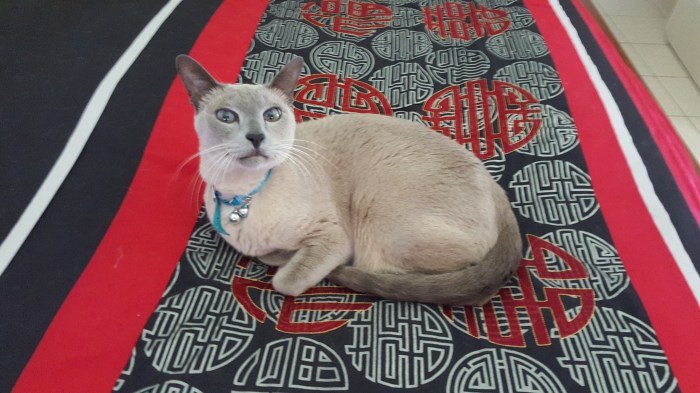
This is Chester.  I’ve just dropped the bombshell we’re thinking of getting a dog.

So, the first response from him:  Well, the last dog didn’t turn out so well, did it?

We didn’t tell him what happened to the dog, but maybe he’s psychic.

Or is that psycho?

Anyway, the last dog we had moved to my son’s place when he moved, and shortly after, broke his hip and had to be put down.

So I say, that dog moved when my son left.  I don’t have any more sons living in, so that won’t be a problem.

It’s going to be a mistake.

Oh, how?

You know they all start out like soft furry balls, like cat’s I’ll admit, but then they grow up, and up, and up, and up.  And eat you out of house and home.  Not like us lovable cats, we stay small furry balls, and don’t eat all that much.

No, you’re just fussy, and it’s like hell on earth getting you to eat.

Then stop buying the cheap stuff.

Cheap?  Cheap?  That last lot of food cost an arm and a leg.  At least with a dog, it will eat anything, including scraps from the table.

He gives me that condescending look reserved for people who think they own or know cats.

As you wish, my Lord.

Then he walks off, head in the air and tail swishing in annoyance.

Writing about writing a book – Day 22

More of Bill’s backstory, and, if it’s possible, I’m beginning to like this guy.

I suspect, for him as well as many others, it wasn’t easy, but in war zones, it’s either hot or cold, but never any pleasant in any weather conditions, and perhaps if there was a possibility of a fine, balmy, day, there would be no time to enjoy it.


Sleep was difficult. 

Sleep was always difficult, if not impossible. 

Whilst I had lived in barracks, in the tropics as part of my training and acclimatization, it was nothing like this.  Nothing could have prepared me for the endless, oppressive heat.

It started from the day the plane had landed on the tarmac at Saigon airport, the crew opened the door to the cabin, and we walked down the stairs.  The heat came from above, and from the tarmac below.  We were soaked in sweat by the time we reached the buildings.

And it was difficult not to be exhausted, even if you were lucky enough to get a few hours sleep.  That constant feeling of exhaustion was the biggest enemy, and what caused many of the unnecessary deaths.  In the end, for many, it was just too much.  For me, it was training that kept me alive, because of that little voice in my head that kept me vigilant.

That and a keen sense of self-preservation.

Our platoon was still recovering from the shock of seeing the death of two of our mates the previous day.  Although in the camp only a week, already it felt like a year.  We’d been sent out on a patrol, trying to find a group of the enemy who was responsible for cutting one of the supply lines, and it hadn’t taken long for us to realize we didn’t really know if it was the Viet Cong or the people we were supposed to be protecting.  They all looked the same to me, and we had to rely on our South Vietnamese Army liaison to ensure we didn’t shoot the wrong people.

After an eventless day, if you discounted the rain, the heat, and the scares, the Lieutenant ordered us to make camp, just before darkness set in.  We had not seen the enemy, and, as I was finally getting to understand, we probably wouldn’t until they were prepared to show themselves.

At that moment of maximum unpreparedness, when our attention was diverted, and after a long and debilitating day, they chose to attack.

I had no doubt they had been tracking us, and for quite some distance.  I had that effect of hair standing up on the back of my neck.  It actually saved me from getting shot.

The attack killed three of our men and shattered our confidence.

No one slept that night, either from fear the attackers would return, or because we were just plain terrified.  I volunteered for guard duty.  It was easier to be up and about instead of on a camp stretcher staring at the roof of the tent waiting for the inevitable.

Seeing our mates killed so horrifically, before our eyes, had the desired effect.  In the beginning, we expected it to be a walk in the park, with some hoping that we would just stumble around in the jungle for a week or so, then go back to the camp for a well-earned rest.  None had counted on the reality of war, or the fact some of us might die.  Some were even hoping they would not have to shoot their gun.

All of those illusions had now gone after three months had passed, and as reality set in.

Some had sobbed openly, such was their preparedness.  I had to say, I was a little more prepared, but had hoped for a little more time before the battle.  And it surprised me how calm I was when all around me it was chaos.


“Bastards,” Killer muttered.

We called him ‘Killer’ because it was the nickname the Army had given him.  We were sharing the guard duty and had spoken briefly over the watch, but up till then, the silence had stretched over an hour or so.  It didn’t take long for anyone to realize he was a man of few words.

He’d been in the regular army for years and asked for the posting.  He’d made Sergeant several times, only to lose those same stripes for fighting, usually after R&R and a bout of heavy drinking.  Now assigned to our platoon to lend his experience, the conscripts were expecting him to ‘look after’ them.  Other than myself and the Lieutenant, he was the only other regular soldier.  Unfortunately for them, he hated both conscripts and the Viet Cong in varying degrees, and depending on his mood there was little tolerance left for the rest of us.

“The people who sent us here or the people trying to kill us?” I asked before I realized I’d spoken.

I didn’t hear the reply, the skies opening up with another torrential downpour that lasted for about five minutes, and going as fast as it came.  When the sun finally came up, it would make the atmosphere steamy, hot, and unbearable.  It was quite warm now, and I was feeling both uncomfortable, and fatigued.

Killer looked just as stoic as he had before the rain.  He looked at me.  “Damn weather.  Worse than home.”

“Scotland?”

“Scapa Flow, Kirkwall.  I should have been an engineer on ships like my father, but I was too stupid.  Joined the Army, finished up here.  What’s your excuse?”

“Square peg in a round hole.  The army seems to handle us in its stride.”  It was more or less the truth.  I joined the Army to get away from my parents.

“That it does.  That it does.”

The rain came and went, during which the rest of the camp roused and went about its business.  It had been a long night for some, still getting over the shock of the attack, and the ever-pervading thought the enemy was still out there, biding their time.  It would be, for them, a waiting game, waiting for the conditions to wear us down, and lose concentration as inevitably we would.

Certainly, by the time we were relieved from sentry duty, I felt I was in no condition to match wits with a donkey, let alone the enemy on his own home ground.  When I stumbled over to the mess area and looked at the tired and haggard looks on the faces of the platoon, I realized that went for all of us.

Killer and I managed to get about an hour’s rest before the call came to move out, rain or no rain, and after a breakfast to make anyone ill, we left.  For hours it rained.  No one spoke as we strained to listen over the rain spattering on the undergrowth, all the time expecting the unexpected.  That was the benefit of the surprise attack; we no longer took for granted we would be safe.

Water gathered in pools along the trail, hiding any chance of seeing landmines.  Rainwater and sweat ran into our eyes, making it difficult to see.  Water leaked everywhere, making it very uncomfortable.  This was not a war; this was utter stupidity.

I was about to remark on the futility of it all to the Lieutenant, who had taken the lead, when one second he was talking to me and the next he crashed to the ground, a sniper’s bullet killing him instantly.   Someone yelled “Contact” and we hit the ground, bullets flying all around us. 

Too late, I thought, as I felt the hit of what seemed to be a large rock, then the searing pain in my leg, just as I hit the ground…


© Charles Heath 2016-2020

In a word: Hair

You comb it every day, or brush it, it can be tangled, fine, smooth and silky or shiny.

It can fall out, you can have none, it can be red, brown, black, blonde, white, and a million shades in between.

Yes, it’s hair.

It can be pesky stuff, especially from animals who tend to moult and leave it everywhere.  We have a cat and well know the foibles of hair loss.

You can get it cut, get it coloured, trimmed, permed by a hairdresser in a salon, where lots of subjects are discussed, and even movies have been made around salons.

I haven’t been within a hairsbreadth of either living or dying, but I’m sure someone has.  That hairsbreadth is not very wide, and I’d rather have bullets, arrows or fists missing by that margin.

You can be in another’s hair, that is, being a pest.

There’s the hair of the dog, supposedly a hangover cure.

And, going to scary places will make your hair stand on end.


This is not to be confused with the word heir which means something completely different, namely it described the legatee or inheritor of the family fortune.

Or not.  Ages ago, only sons were seen as heirs, and that was even more prevalent among royal families.  It also applied to heirs when it came to titles, and the family wealth and property, which went to the eldest son.

It makes a good plotline for many a murder mystery.

Also, let’s be clear, there is also an heiress and an heirloom.


Then there is another, hare, which is a cousin of the rabbit and considered a pest.

I’m not quite sure how someone came up with the descriptor harebrained, which has nothing to do with the hare.

It could mean to run quickly and usually in a careless manner.

What happens after the action packed start – Part 36

Our hero knows he’s in serious trouble.

The problem is, there are familiar faces and a question of who is a friend and who is foe made all the more difficult because of the enemy, if it was the enemy, simply because it didn’t look or sound or act like the enemy.

Now, it appears, his problems stem from another operation he participated in, and because of it, he has now been roped into what might be called a suicide mission.


The next stretch of road was from Aba to Nagero, the gateway to the Garamba National Park.  This was a road where we would have to be more careful because it was possible, now we were off the main road, even though it was designated a highway, or perhaps that was a little too optimistic since it had a number N26, which ran into the R240 at a place nominally named Faradje, but did have a place to stay called the Residence Robert Ball.

I guess I missed that.

Beyond Faradje the road was a little more intense, but something else that worried me, there was more scope for us to be ambushed.  To be honest, I had expected trouble for the last 100 kilometers, but trucks and people were plentiful enough to keep any surprises away.  Now, that element of safety had gone and for quite some distance now we’d been moving slowly, and everyone was on alert.

My fears were not misplaced.

We’d hit a rather rough patch and had to slow down, and coming into a creek crossing the road narrowed, and the trees came down to the side of the road, providing any would-be attacker plenty of cover.  I had been considering how I would arrange an ambush when, suddenly the car in front stopped suddenly, and we, caught unawares, slid almost into the back of them.

My other radio crackled, Monroe was reporting in.  “Houston, we’ve got a problem.”

A flooded creek that was impassable, or a rockfall.  There had been one of each so far, but both had been relatively easy to negotiate.

Then she added, “A gentleman in army gear with a gun.  He’s brought a few friends to the party.”

“Real army, or…”

“The or, I think.  Some of his ‘men’ are, well, not men.”

A local militia.  Ahead I could see several more of the ‘soldiers’ filtering down to cover each of the vehicles until a real soldier stopped near ours, gun aimed and ready to fire.

“Send in our guide and get him to sort the matter out.”

No one was asking us to leave the vehicles yet, so this might but just a ‘request’ for a passing fee.  Jacobi had said this might happen once we left the mainstream roads.  I had hoped, the Garamba National Park is internationally known, all roads in and out would be ‘protected’.  Perhaps that was only for convoys protected by Government troops, a service we had to forego due to the nature of our business.

Five minutes passed, then the next update.

“Jacobi is going now.  We’ve finally got past any possible misunderstandings.  Good thing he knows the language.”

Mindful of where the soldier covering us was standing and his line of sight into the car, I said into the other radio, “Mobley?”

“Sir?”

“Where are you?”

“About a k behind you.”

“Stop.  Park, and approach on foot.  We have a small problem, about 10 militiamen have stopped us at a choke point.”

“Done.  I will be there shortly.  Take them out?”

“Get a position and standby.”

Forward of us little was happening.  I could now see Jacobi and the group commander standing to one side of the lead vehicle, talking.  Jacobi was gesturing, and the soldier was looking defensive.

Seconds dragged by like they were minutes.

Davies came back to life.  “Why have we stopped?”

“Checkpoint.”

“There isn’t meant to be a checkpoint here, is there?”

“No.”

Before we started out Davies had hidden a sidearm under her seat, in a place where I had hoped would not be checked by the border officials.  They had made a cursory scan in the front of the car but hadn’t seen it.  Now she had reached down and had it in her hand, at the same time making sure she had eye contact with the militiaman on her side of our car.

Our personal detail had doubled in the last minute or so.  I had just watched Jacobi return to the lead vehicle, get in, but leave the door open.

The radio crackled again.  “They want five thousand US dollars, and we can proceed.”

“We got five thousand.”

“Jacobi says two should do it.”

“Give it a go.”

I watched and waited as it took a few more minutes before Jacobi, with a bulky envelope, got out of the car and walked towards the soldier.

Showing we had money and were willing to hand it over might lead to further demands, particularly if the soldier though he was being disrespected.  It all depended on Jacobi’s negotiating skills.

Mobley reported in.  He had a position where he could see the men at the head of the convoy.

I spoke into the radio to the others, “Has everyone got a clear shot on their covering guards, just in case this goes sideways.”

“They’re not exactly soldiers,” I heard Barnes say.

“But they’ll shoot to kill you all the same.  Unfortunately, we’re on a mission-critical timeline here, and whilst I don’t like it, it’s going to be one of those at all costs decisions.”

A series of ‘ready’ came over the radio.

Several more minutes passed, and more animated conversation between Jacobi and the commander, then Jacobi returned to the car, minus the envelope.

Was it successful?

Monroe.  “Seems he wants ten thousand now.  Orders?”

“Negotiations are over.”

Several shots rang our, taking down the three men at the front of the convoy in quick succession, the signal for the others to take out their guards almost simultaneously.  It was a miracle none of the guards got a shot off, but, then, they were standing a little too close for their own good.


Five minutes later we were back on the road, the militiamen having their arms removed, and removed from sight, just in case anyone came looking for them.  It might be a forward group from the kidnappers, looking for some extra cash, or, if the negotiations had dragged on, looking to take the ransom and then demand another when we turned up empty-handed.

Whatever had happened, it was over.

Ten minutes later Mobley had re-joined the convoy behind me.


© Charles Heath 2019-2020

In a word: Steal

You know how it goes, somebody breaks into your house and they steal the family jewels, which means, they’ve taken something that’s not theirs.

Baseballers will be well familiar with the term steal a base because that sneaky second base runner is trying to get to third, before the pitcher fires in a curveball.

But then there’s that same thief trying to rob you is stealing his way downstairs.

You come across a bargain, that is the seller doesn’t quite know what they’ve got and assumed it’s junk, that’s a steal.

On stage, one actor can steal the limelight from another.  if a film, an actor with a lesser part, can, if their good enough, steal the scene.

And if you’re lucky enough, you might steal a kiss, or just get slapped.

Then there’s the government, using a certain event to change the laws, and it might just steal your liberty.

This is not to be confused with the word steel, which means something else entirely, like a very malleable metal that’s low in carbon.

Or like most of our heroes, they have nerves of steel, or if they are like us, they need to steel themselves with a suitable fortification, rum is my choice.

But for me, I like the phrase, he had a steely look on his face and it was hard to tell if that was good or bad.