Writing about writing a book – Day 17

There is more, and it has been forming in my mind overnight after I read, and re-read yesterday’s work.


This operation was led by two ex American army lieutenants who had served in the Vietnam war and afterward searching for lost comrades.  The Colonel told me they had spent a few years looking for lost POW’s held in camps just over the border in Cambodia or Laos and had a good track record in the jungle.  He trusted them and said I could too.

I thought it odd he felt the need to reassure me.

He said they’d had marginal success, but my own impression was that they were ex CIA, gone rogue, and were part of the burgeoning drug trade that had sprung up during and after the war had ended.   For all that, I had also begun to suspect the Colonel had sold out and we were more about protecting the criminals rather than trying to catch them, and for me, that unquestioning obedience he demanded was beginning to slip.

They also had the look of men who had spent their time sampling the product, and as such were treading a fine line between sanity and insanity.  Still, at first, they didn’t seem all that different to us.

Thoroughly soaked, we made the camp on schedule, planned the attack, and carried it out.  Only there was no one there, it was empty, and had been for some time.  I turned to question the two ‘experts’.

Pity then I hadn’t noticed his partner coming up from behind.  If I had, my situation may have been very, very, different.


When I woke up, it was not in a nice warm or comfortable bed.  It was a dirt floor.  I looked up and realized I was in a hut.  Daytime, very hot, with sharp, bright shards of light leaking through the cracks in the wall and around the doorway.

My head was hurting, as was just about every other part of me, but a cursory examination showed nothing was broken.  Yet.

It took only a moment for clarity to return, and the realization we were prisoners.  Survivors from the group, the only survivors.

The other occupant, a soldier whom I only knew by his first name, Barry, stirred, and then rolled over.

“Where are we?” he asked.

‘In a hut.”

“Where?”

“Your guess is as good as mine.”

He groaned, and then tried to sit up, only to slowly sink back down again.  Perhaps he had tried harder to escape and paid a heavier price.

“This is not looking good,” he said.

“No.”  An understatement, I thought, but to my knowledge, this was the first time I’d heard they took prisoners.  Usually, everyone was summarily executed, and the bodies set up as an example to others.

I heard the sound of boots on gravel coming towards the hut, then, in an instant, the harsh light coming in, temporarily blinding me as the door was yanked open.

When my eyes adjusted I saw two bulky men holding machine guns standing behind another, a short Chinese, with a very familiar face.

Where?  When?

Then I remembered.  A week ago, in Hong Kong, at a hastily arranged meeting between Davenport and the police who were supposed to be helping us with information on a smuggling group known to be operating in the Vietnam/Cambodia/Laos area.  He was the Chinese liaison, connected with the Government.

Apparently not.

This was bad.  Very, very bad.

“Mr. Chandler.  So nice of you to join us.  Colonel Davenport and I are so disappointed in you.”


© Charles Heath 2015-2020

In a word: Loose

We’ve all heard of the expression, he’s playing it fast and loose, or more interestingly, he’s fast and loose with the truth.

I’ve never really got a proper definition of that expression, but it sounds good, and people have to use their imaginations and put their own interpretation to it.

And if this was the 1930s, and Clarke Gable was playing opposite Jean Harlow, it’s exactly how the posters would describe the blonde bombshell.

Loose, however, in a more literal sense means not tight, so a loose nut on a bolt might be the cause of a catastrophe.

And speaking of catastrophes, there’s a fox loose in the hen house.  Sadly it would be very difficult to catch and tie up.

Of course, in hot weather, you’d rather be wearing something loose, to keep cool.

Women, in particular, can wear their hair loose, as distinct from ‘up’, or in a ponytail or braids.

Some people make a loose interpretation, which inevitably creates grey areas, and loose lips, well, they’ve been known to sink ships.

This word can sometimes be confused with lose, which means something else entirely.

Like, lose a watch, lose your head, in more ways than one, lose your life, as if it was one of nine when it isn’t, and lose everything, perhaps, in the 1930’s stock market crash.

Quite literally, it means to be deprived of, or cease to gain or have.

You can lose weight, have a clock that loses time, or you can lose your temper.

Sometimes I lose the plot.

In a word: Light

Yes, I see the lighthouse, what’s it doing all the way out there?  The thing is, these places are sometimes so remote, I start thinking I should rent one for 6 months and then, without any distractions, I’ll get the blasted book finished.

Until there’s a shipwreck, of course!

Light is of course light, duh.  Turn on the switch and let there be light.

Hang on, didn’t someone else say that, millennia ago?  Someone famous?  It’s on the tip of my tongue.

No! It’s not cyanide…

So, whilst we need it to see everything, it has another meaning…

My, that’s a light load your carrying today, which means not very heavy.

Or, that’s a light-coloured jumper, which means pale.

Oh, and did you light the fire?

And, after you light the fire, do you light out to a safe haven in light traffic because really it was arson, and you got a light sentence the last time enabling you to do it again.

If you are trying to rob someone, then it was a kilo light.

And after a long hard struggle, did you light upon the correct answer?

This is not to be confused with another similar word, lite.

It seems this is only used for describing low-calorie drinks and food, such as lite beer, which seems to me to be a lazy way of not using light

Still, there’s not much other use of the word except as a suffix -lite, but then you’d have to mention -lyte as well.

The message here – just use the damn word light and be done with it.


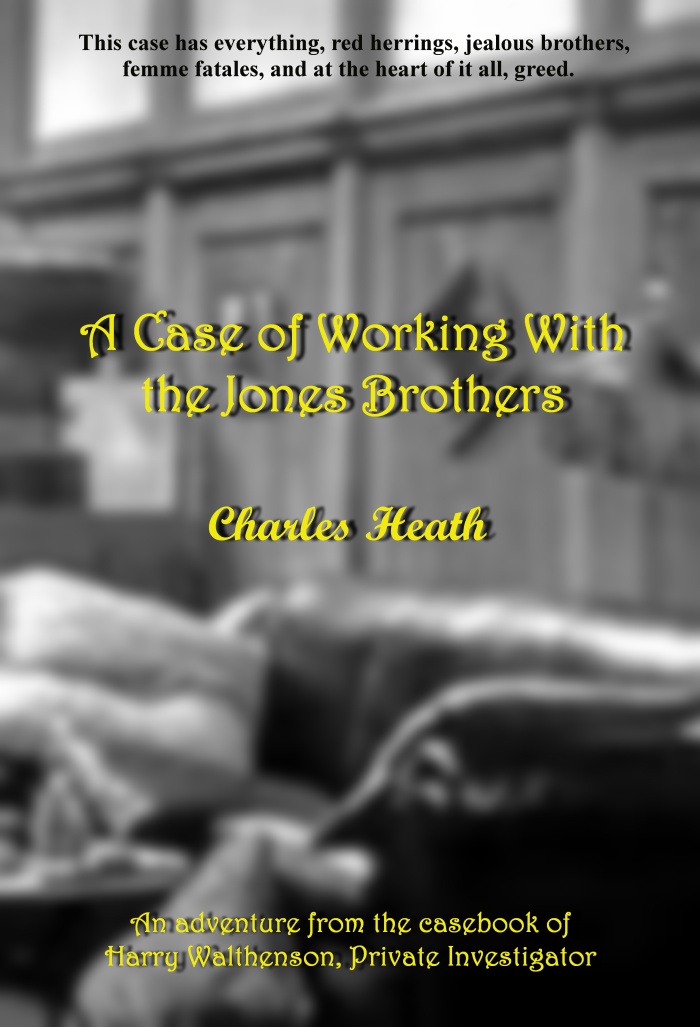
The story behind the story: A Case of Working With the Jones Brothers

To write a private detective serial has always been one of the items at the top of my to-do list, though trying to write novels and a serial, as well as a blog, and maintain a social media presence, well, you get the idea.

But I made it happen, from a bunch of episodes I wrote a long, long time ago, used these to start it, and then continue on, then as now, never having much of an idea where it was going to end up, or how long it would take to tell the story.

That, I think is the joy of ad hoc writing, even you, as the author, have as much idea of where it’s going as the reader does.

It’s basically been in the mill since 1990, and although I finished it last year, it looks like the beginning to end will have taken exactly 30 years.  Had you asked me 30 years ago if I’d ever get it finished, the answer would be maybe?


My private detective, Harry Walthenson

I’d like to say he’s from that great literary mold of Sam Spade, or Mickey Spillane, or Phillip Marlow, but he’s not.

But, I’ve watched Humphrey Bogart play Sam Spade with much interest, and modeled Harry and his office on it.  Similarly, I’ve watched Robert Micham play Phillip Marlow with great panache, if not detachment, and added a bit of him to the mix.

Other characters come into play, and all of them, no matter what period they’re from, always seem larger than life.  I’m not above stealing a little of Mary Astor, Peter Lorre or Sidney Greenstreet, to breathe life into beguiling women and dangerous men alike.


Then there’s the title, like

The Case of the Unintentional Mummy – this has so many meanings in so many contexts, though I image back in Hollywood in the ’30s and ’40s, this would be excellent fodder for Abbott and Costello

The Case of the Three-Legged Dog – Yes, I suspect there may be a few real-life dogs with three legs, but this plot would involve something more sinister.  And if made out of plaster, yes, they’re always something else inside.

But for mine, to begin with, it was “The Case of the …”, because I had no idea what the case was going to be about, well, I did, but not specifically.

Then I liked the idea of calling it “The Case of the Brother’s Revenge” because I began to have a notion there was a brother no one knew about, but that’s stuff for other stories, not mine, so then went the way of the others.


Now it’s called ‘A Case of Working With the Jones Brothers’, finished the first three drafts, and at the editor for the last.

I have high hopes of publishing it in May 2020.  It even has a cover.


PIWalthJones1

Writing about writing a book – Day 16

As we now know Bill realizes that he had been captured and interrogated by someone, ostensibly Chinese, but not exactly from the Viet Kong

I’ve been pondering how Bill ends up in the hands of the Chinese, well, I know how he does, and this needs to be put down.

Some pieces of the puzzle are coming together.


Davenport arrived at the airstrip where I was waiting in a makeshift building, with windows, easy chairs, a self-serve bar, and best of all air conditioning.  Waiting for the chopper that was bringing in my replacement from Singapore airport.

He didn’t normally come to see us off so I thought it either odd or just a change of heart.  He had brought the shiny Cadillac, an ostentatious piece of Americana that never failed to capture the local’s imagination.

Davenport was, I soon discovered, a man who liked to impress upon the world how great America was.  I hadn’t the heart to tell him it failed on me.

He had crisp fatigues on and looked as though he had just stepped out of the shower, very clean, very cool, and very refreshed.  The car’s air-conditioning would have helped.  We all got that first ride from the strip to the camp in that car, and it was memorable, to say the least.

The driver stayed in the car, engine running, as he stepped into the lounge.  “Chandler.”

“Sir.”  No snapping to attention, neither of us was in uniform.

“There’s been a change of plans.”

“Sir.”  This didn’t sound very good.

“Your replacement is not coming.  Some trouble on the plane over.  Can’t spare a man so you will have to fill in.  I’m sorry.”

I went to say that I’d done my rotation, but the look on his face told me it would fall on deaf ears, so instead, I shrugged, let the driver, who had appeared out of the car as if on cue, collect my case, and followed Davenport out to the car.

It was definitely cooler in the car.  Davenport slid in the other side, the driver closing his door, then got in himself.  I had to close my own.  We headed back towards the camp slowly.

“We need 6 men for this op, Bill.  I’ll find some way of making this up to you.”

I shrugged.  “If you say so.”

I’d been looking forward to getting out of the jungle and getting back to civilization, as well as Ellen, who had been waiting patiently for the last six months.  She would not be very happy when I finally got to tell her.

“Oh, but the way, I took the liberty of calling your wife and apologizing on your behalf and said you’d probably be another week at the most.  She didn’t seem to mind.  She sounds like a nice lady.”

“She is.  She has to put up with me.”

“Yes.  We all have that problem.”

I listened to the hum of the air conditioning, the only other sound inside the car.  Usually, Davenport had a symphony playing over the radio, but not today.  He seemed different, more aloof, but, then, after the altercation, I had with him recently, we hadn’t spoken much after that.  Not unless we had to.

“The job isn’t difficult,” he said when we were nearing the compound.  “Another prison camp, and this time the intel is solid.  Buggers were careless and we’ve got some pictures.  The only problem is getting there.  It’s going to be a bit of a hike.”

Another of his understatements.  I could remember the last ‘bit of a hike’.  “When do we leave?”

“First light tomorrow.  Chopper to the drop zone then a day’s march to the camp.  RV at the drop zone from day 4 till you get there.”

“Who’s in charge?”  I’d run the last operation so I was hoping it would carry forward.

“If you’d been staying instead of being a last-minute replacement, it would have been you.  Instead, we had to bring in a couple of specialists who have been on the ground here quite some time.  They know the terrain and the people.”

New guys.  I hated new guys.  Especially those who purport to have experience on the ground.  Invariably they didn’t and I’d had words with Davenport more than once about it, especially when we had such a high attrition rate.  I believed it was only a miracle that I had lasted this long, and I was now tempting providence this time around.

“I hope they are better than the last two.”

“They are.  I picked them myself.  At least you will be there to keep them on the straight and narrow.

Which was exactly what I didn’t want.

Damn.


Back at the compound, I dragged myself back to my old quarters, hoping they hadn’t given away my billet just yet.  It was a hut if you could call it that, which had seen better days, but it kept the rain out.

I shared it with another soldier, or ex, I didn’t really know, and he was not the sort of man you asked, and even less talkative than most.  I knew his name was Barry McDougall, that he was Scottish, he didn’t wear a kilt and had killed men with his bare hands, one in a barroom fight.

Allegedly.

I was not surprised.  He was six feet six inches tall, all muscle, and always surly, and unlike many of the English that had come and gone, didn’t complain about the heat.

I dumped my bag on the locker at the end of the bed and sat in one of the two well worn easy chairs.  Barry was in the other, reading.

He lowered the paper and looked at me.  “Back, huh?”

“Yes.”

“Miss the chopper?”

“No.”

“Beer’s cold.”

“Thanks.”

I got up and went to the fridge.  One of the perks of the job.  An endless supply of cold beer.

“Get me one too.”

I did and passed it to him, the sat down again.  He took the beer and went back to his paper.

“Seen the new guys,” I asked.

A voice from behind the paper, “Yes.”

“Any good?”

“No.”

“Another fun run in the jungle then?”

“Looks like it.”

We drank in silence.  What more could be said?


There is more but I have to let the words jumble around in my head while I sleep.  More on this tomorrow!


© Charles Heath 2018-2020

Writing about writing a book – Day 15

Our main character Bill probably needs to give an account of the situation he found himself in.  I have, for a while, considered that he is just another soldier who found himself in the wrong place at the wrong time, but now, I want to add a dimension.

He finishes up where he is, in the end, because he chose to be there, and it was something of a rocky ride to get there.

That I’m still planning in my head.

In the meantime, this is the initial piece I wrote for his situation description:


I used to joke about telling people my middle name was ‘danger’.  It seemed I was not the only one, and for a time, worked with a group of soldiers and ex-soldiers in a capacity similar to that of being a mercenary.

Each one of us had a specialty.  Mine was being the sniper.  Johnny had knife skills and not the sort that was used in a kitchen.  Freddie, explosives, Bill, well, you just left Bill alone because he had a grudge against the world and everyone in it.

The Colonel used to say we were all handpicked, but that wasn’t necessarily the case.  I knew for a fact some of the team came straight out of the stockade before their time was up.

Because some of us were expendable.

The thing was; none of us cared.  For those who were ‘rescued’, it was better out in the jungle, dodging bullets, than being inside, your fate left in the hands of the Gods. 

I knew how it was.  I’d been there once or twice myself.

This morning had started the same as many others.  Rise and shine, a breakfast of sorts, into the chopper, and after an hour or so, dropping into a grassy patch, with nothing but jungle in every direction.  Our mission was to find and liberate a number of our people who had gone missing, read captured, on the border between Cambodia and Vietnam.  It was a familiar country because I had, over the last year or so, gone hunting missing POW’s in the area.  Old prisons had been converted into drug laboratories, and we’d broken up a few of those too.

The noise of the chopper put paid to any sort of stealthy approach and, by the time it dropped us off, if there was anyone nearby, our advantage, if we ever had one, was gone.  The trouble was, to cover the same distance by foot would take a week, and, by the time we arrived, if we arrived, more than half the team would be dead.  We may have been good, but we were not that good.  It was not our home turf.

It was hot, sticky, and nothing like home.  There wasn’t a day that passed when I thought to myself it was getting harder and harder to remember when I wasn’t constantly hot and sweaty, nor as frightened.  It happened that way, towards the end of a tour.

Once on the ground, every man was on full alert.  We changed the lead and tail end constantly, to make sure we didn’t lose anyone.  And it was hard going, the constant heat, sweat, punctuated with slight relief when it rained.

Then as quickly as it came, it went, leaving you wet then sticky.

And if that wasn’t enough to contend with, there was the enemy.   You couldn’t see them, nor hear them yet you had the feeling he was watching you the whole time, and it made your skin crawl.

Sometimes the enemy attacked when we had to camp, invisibly swooping, shooting from the trees, and firing a mortar or two, then disappearing back into the luminous greenery without a trace.  These were the remnants of the Viet Cong, Cambodian armed forces, disaffected Laotians, or the Chinese, or so we believed, but they were well-trained mercenaries and just the sort of people the drug cartels would use.

And surviving the operation, any operation, was like playing Russian roulette.  Was it your turn this time, or someone else’s?  You could be walking along, straining your eyes and ears, and next minute, find the man who was covering your back, dead.  Booby traps were silent and swift.  Landmines are loud and very messy.  Both hangovers from the war, and never cleaned up.  People you’d meet, you never knew whose side they were on, so it was best to avoid all contact.


© Charles Heath 2015-2020

In a word: Hail

Yes, you know what it is, and it can be very unpleasant when it hits – hail.

Hailstones as big as golf balls, hailstones that make small or large dents in your car, smash windows, wreck trees, and, sometimes, give the appearance that snow has just fallen.

And hail with snow equals sleet, and it’s not very pleasant to be caught in it.

Of course, there’s a different sort of hail, one that you might also not want to be subject to, that from someone across the street trying to get your attention.

Or a hail that you do want someone or something to stop; a taxi, or cab

Or a ship across the water… though I’m not sure why you, personally would want to hail a ship

Perhaps you could be praised in some way, like, he hailed from London – no, not yelled so loudly he could be heard in New York

And no, we do not go around saying, Hail Minister, or Hail Friend!  Not unless we’ve used a time machine and gone back to ancient Roman days

This is not to be confused with the word hale

Yes, it can be something you eat, and I hear it’s very good for you

Or that man is hale and hearty, which means in good health – and I have to say I’m envious because I’m anything but hale


Writing about writing a book – Day 14 Continues

Whilst Davenport’s backstory is now coming together, I’m back with the main character, and working on a bit of his backstory too, mainly what he is about to remember of his past, locked away for many years, most likely caused by the trauma he suffered at the hands of the enemy, though the definition of ‘enemy’ here will have a number of different meanings.

These first dreams are disjointed but point to one certainty, Bill was, for a time, a prisoner, whether it was as a prisoner of war, or something else, he is yet to discover.

Another certainty he will learn in time is that he holds a secret, a secret several people would like to find out about, and who will go to extreme lengths to get it from him.

This memory fragment confirms he was a prisoner, despite the assurances to the contrary:


I woke suddenly, tense, eyes open, and alert.  I could feel the fear coursing through my veins, every nerve end tingling.

I had only one thought in mind.

Escape.

Now.

Before it started again.

I moved my hand and found it strapped down as was my other hand and my legs.  I was barely able to move.

A sudden jolt of pain went through me, starting at my shoulder where the knife had been dug in and twisted, the memory of which was very clear in my mind.  It increased as I struggled against the restraints, the fear of it happening again stirring me to try harder.

I’d been here before and the result was bad.

Very bad.

I struggled harder.

I looked around and saw no one or anything else.  The room seemed different from the one I last remembered, more closed in, claustrophobic.  The light came on, bright neon lights, blinding me.  The flash I got before I closed my eyes, it was a hospital room.  I was captive, and it was after the torture session, where the doctors put me back together just enough to last the next session.

Torture, recovery, torture, recovery, over and over, night, day, light, dark, warm, cold.  I had no idea where I was, what day, week, month, or year it was, when I’d last eaten, or eaten at all.

And I didn’t know why.

Why they didn’t kill me and get it over with.  I didn’t know anything.

The door opened and I opened my eyes, now a little more adjusted to the bright light.  He came over and looked down at me.

Chinese.

The enemy.

One of the insidious men keeping me alive.

I kept my eyes on him as he looked at the folder beside the bed, and checked my vital signs.

“How are we this morning?”

English, with only a trace of a Chinese accent.  They all spoke nearly perfect English, confusing me, making me think I was safe.  That I would talk to them.  Confide in them.

I didn’t feel safe and I had nothing to say.

“You had a very bad night.”

Tell me something I didn’t know.  I struggled against the restraints.

“They’re for your own protection.  You tried to get out of bed and reopened your wound.  I’m sorry, but we have had to restrain you.”

“Let me go,” I hissed, “or kill me.”

“I assure you no one wants to kill you.”

I didn’t believe him.  He was trying to trick me.  Trying to allay my fears.  I knew all of their tricks now.

I had to escape.  I had to get away or die trying.  I could not take another session.  Not in that dark, dank, evil room.

I tried harder to escape, felt the restraining hands of his friends, holding me down as he administered another injection, silence, and darkness closing in once again.


Still not sure where this is going, but it’s defining the past of our main character, and will become a lot clearer as the story progresses.

I am intending for these dreams, if extracted and put in order, will be the basis of the missing past the main character has not been able to remember, and given how horrific some of them are, it’s no surprise they’ve been buried very deep in his subconscious.


© Charles Heath 2015-2020

In a word: Sheet

Well, we all know what a sheet is, it’s one of those things you put on a bed.  A bottom sheet, a fitted sheet, a top sheet, flannelette sheet.

It could also be a piece of paper, e.g. pass me a sheet of paper please, only to get in reply, what size?

There can be a sheet of flames, best if you see one get away as fast as you can.

Of course, that fire can be put out by rain sheeting down.

You can have a sheet map, that is one that opens out.  Funny how you can never get them folded back the same way.  And a problem when you’re in a car and open it out – hang on, I can’t see out the window!

That lake is a lovely sheet of water, very still just as the sun comes up, and then, what a reflection.  Great if you are a landscape painter.

Then there’s sheet metal, did that in school and wasn’t very good at it.

If you’re a philatelist, then there’s always a sheet of stamps, might be worth something in a hundred years’ time.

Then, if it is worth millions, you might turn white as a sheet with shock.

But the best of all, if you drink too much it is said you are ‘two sheets to the wind’.

When you’re given another chance, it is like being given a clean sheet.

And another form might be to do with sailing when you sheet a sail, which is to say you are making it either tauter or less taut.

English can be confusing sometimes, can’t it?

Sayings: Flogging a dead horse

This wouldn’t be so apt if it didn’t bring back a raft of bad memories, those days I used to go to the races, and back all of the wrong horses.

I had a knack, you see, of picking horses that fell over, or came dead last.

Perhaps that’s another of those sayings, dead last, with a very obvious meaning.  Dead!  Last!

But…

In the modern vernacular, flogging a dead horse is like spending further time on something in which the outcome is already classed as a complete waste of time.

However…

Back in the old days, the dead horse referred to the first month’s wages when working aboard a ship, usually paid for before you stepped on board the ship.  At the end of the first month, the theoretical dead horse was tossed overboard symbolically, and thereafter you were paid.

It still didn’t make sense to me that someone would tell me I was flogging a dead horse, until I realized, one day, the lesson to be learned was never to get paid in advance.