In a word: Freeze

Yes, if the temperature was 20 degrees below zero and the forecast for the net week was the same, then that would be the big freeze.

In a more understandable way of putting it, to freeze something is to preserve it at a temperature below zero.

Some things don’t freeze, like petrol.

And you want to hope that you put antifreeze in your radiator otherwise you are going to have big problems with your car in winter.

It also means to stand still.

You can also isolate someone by freezing them out.

And freeze in fear, unable to move, like a deer in headlights.

But the worst example of a freeze is when your computer stops, and you forgot to save that 200-page novel, thereby being lost forever.

No.  That would never happen, you had autosave on, didn’t you?

Didn’t you??????????

Freeze is not to be confused with a frieze which is a broad horizontal band of sculpted or painted decoration, especially on a wall near the ceiling.

Or frees, which in some countries type of football described multiple free kicks, in one sense, and, in another, what you do when you let them go, e.g. he frees the dog.

In a word: Flight

There is a saying, if God wanted us to fly then he would have given us wings.

Unfortunately, he didn’t, so we do not get to know what it’s like to be in flight,

Unless…

We take an aeroplane, which usually has a flight number such as QF607, or in conversation, ‘I’ll be taking the 6 o’clock flight’.

If someone runs away, then we say they have taken flight.

If we roll back a few years, say about 80, to World War 2, flight tales on a whole new meaning.

It refers to a group of planes, in one case a number of spitfires, or,

The man in charge, a flight lieutenant, also colloquially known as ‘flight’.

This is not be confused with the word flite which has several very obscure meanings,

First, it means to quarrel or argue, or engage in a debate, and

Second, to make a complaint.

But one that sticks in my my mind is Flyte, from Brideshead Revisited.  they were a very interesting family.

I’ve always wanted to go on a Treasure Hunt – Part 47

Here’s the thing…

Every time I close my eyes, I see something different.

I’d like to think the cinema of my dreams is playing a double feature but it’s a bit like a comedy cartoon night on Fox.

But these dreams are nothing to laugh about.

Once again there’s a new installment of an old feature, and we’re back on the treasure hunt.

“A hundred square miles, that must have run up the coast close to Patterson’s Reach?” I asked.

Patterson’s reach was about five miles to the north, a small town, where there was little fishing done and allegedly a lot of ferrying drugs being dropped off by large ships coming along the offshore shipping lanes.  No one could prove it, and every trap set by the coast guard had failed to find any evidence.  That meant that someone was tipping them off.

It was also the domain of the Cossatino’s who discouraged anyone else from living there.  It was said that Cossatino owned all of the lands the town sat on and the people who lived there worked for him.

“Only as far as Patterson’s reach and then inland for about 20 miles, about as far as the Faultline and perhaps the closest point between the foothills and the sea.  Ormiston had bought all the land thinking that the treasure was buried on it.  You see, he had a map too, long before Boggs senior had started forging them for the Cossatino’s.”

And in hearing that it begged the question, who had first found the original map?  If Cossatino found it, then getting Boggs senior to forge a lot of useless maps would hide where it really was.

What if Boggs ‘original’ map was yet another elaborate forgery, given to him by Cossatino to create others?  I put that thought to one side.

I wondered if Boggs had been to see her, to get some background.  If there was going to be an expert on the treasure, if it existed or not, she would know.  In fact, she probably knew old man Ormiston.

“Does that map still exist?”

“Perhaps.  It was not found in his effects after he died.  Spent his last years in an asylum.  It wasn’t not finding the treasure, or losing his fortune that sent him mad, it was Alzheimer’s, poor old man.  Whatever documents that were found when his relatives cleaned the place out were brought to the library to be stored, cataloged at some point, and one day when someone decides to write a history of the area, no doubt they want to see the collection.”

“I couldn’t look at the papers?”

“Are you interested in writing a local history.  I’m sure your hunt for the treasure and the many fruitless other expeditions looking for it would make a very entertaining chapter.”

“Maybe I will.”

If that was what it took to look at the documents.  There might be something interesting to be found.  Especially if he kept a diary.  I thought it best not to ask, and fuel suspicions.

“Elmer said there might be relations of Ormiston still around here?”

“Yes, I did say that which I now regret.  There are, but I don’t know who they are.  I knew his wife’s family name was Maunchen, and that the Maunchens came from California originally, and there’s nothing to say they didn’t go back.  Certainly, the wife would be deceased by now, and they had three daughters, all of whom would have married, and changed names.  You’d have to go digging through wedding records in at least a dozen parishes.  If you were thinking of investigating.”

“Sound like too much hard work.  Besides, the treasure doesn’t; exist.  I’m only helping Boggs to keep him from doing something stupid.”

“Like father, like son, unfortunately.  You do realize the father made some outlandish claim in the hotel one night that he had found the clue to where the treasure was buried.   Trouble was, he was prone to making outlandish claims, and by that time, a drunkard.  He went missing the next day, and has never been seen since.”

“You think he found it?”

“No.  But I’m guessing someone thought he had and killed him trying to find out.  We’ll never know.”

“A lesson to be learned then.  I’ll keep an eye on Boggs junior just in case he’s thinking of making an equally outlandish claim.”

“You do that.”

She opened a drawer and pulled out a form and handed it to me.

“What’s this for?”

“A request to look at the archives.  You have to register, and I have to give you a special card, the key to the history of Arkwon County.”

Where it said signature, I signed it.

“You fill out the rest.  When do you want me to pick up the card?”

“Monday next week.  In the meantime, be careful.”

She said it like she knew I would be walking into trouble.

© Charles Heath 2020

Short Story Writing – Don’t try this at home! – Part 4

This is not a treatise, but a tongue in cheek, discussion on how to write short stories.   Suffice to say this is not the definitive way of doing it, just mine.  It works for me – it might not work for you.

You’ve got the place, now you want the who.

My main characters are quite often me.

Not the real me, because I’m boring.  No, those characters are what I would like to be, that imaginary superhuman that can do everything.

Until, of course, reality sets in, and the bullets start flying.  When that happens, we should be looking to run or at the very least get under cover, not walk into a hail of bullets, with a huge grin, staring down the enemy.

Hang on, that never happens except in superman comics.

What’s really needed here is a little vulnerability, a little humility and a lot of understanding, qualities at times I don’t have.

So, in order to create a more believable character, I start dragging traits from others I’ve met, or know, or really don’t want to know.  

In a writer’s environment, there are a plethora of people out there that you can draw on for inspiration.  I once spent and afternoon at a railway station just observing people.  Even now, I make observations, some of which are true, and others, wildly off course. 

I once tried to convince my other half that I could pick people’s traits, and we sat at a café outside a church in Venice.  I was lucky, I got more than 75% correct.

Other characters in my stories I have met along the way.

Like a piano player in a restaurant.  It was not so much the playing was bad, it was the way he managed to draw people into his orbit and keep them there.  The man has charisma, but sadly no talent for the instrument.

Like an aunt I met only twice in a lifetime, and who left a lasting impression.  Severe, angry looking, speaking a language I didn’t understand, even though it was English.  It was where I learned we came from England, and she was the closest thing I came to as an example of nineteenth-century prim and proper.  And, no, she didn’t have a sense of humour or time for silly little boys.

Like one of my bosses, a man of indeterminate age, but it had to be over 100, or so it seemed to my sixteen-year-old brain, who spoke and dressed impeccably, and yes, he did once say that I would be the death of him.

I can only hope I wasn’t.

Like a Captain of a ship I once met, a man who didn’t seem to have time for the minions, and a man who reeked authority and respect.  I’ve always wanted to be like him, but unfortunately, it was not in the genes.

Those are only a few, there are thousands of others over the years, a built-in library, if you will, of characters waiting to be taken off the shelf and used where necessary or appropriate.  We all have one of these banks.

You just have to know when to use them.

Short story writing – don’t try this at home! – Part 3

Where is this story going to start?

Let’s forget about the what and the who and the when for the moment, and figure out the location.

After all, we couldn’t make a movie unless we have somewhere to shoot it.  Those places are called locations, and before a film begins someone has to go out and find locations.

Sometimes it’s easy, because you know where the story is based.

New York, London, Singapore, Moscow.

It’s more likely it will be somewhere you’ve been, or where you live.

I live in Brisbane, in Australia.  Not a lot of people overseas know of it.  Oddly enough before I moved here over 30 years ago, it was just a name on a map.

But the point is, now that I’m here I could write a story based in Brisbane.  Or as easily, in Melbourne, where I also used to live.

Or I could select a place I’ve travelled to, perhaps not once, but a few times, and each time taking photographs and notes about that place, thinking one day I could used it as a location.

I have, and I do.  It’s one of the reasons why I like to travel.  I’m always on the lookout for someplace new.

Several of my books are based in New York, several in London, and various parts of the story find the characters in places like Paris, Rome, Florence, Tuscany, Hong Kong, Singapore, and Moscow.

Then, sometimes when my knowledge is lacking in some of the finer points of the city, Google maps, and Google itself are there to fill in the gaps.  I have virtually driven down streets in London, especially near Kew Gardens and in Knightsbridge, checking locations.

Suffice to say, I know some parts of London like the back of my hand, and recently, before COVID, visited and did a spot check just to be sure.

With COVID 19 causing havoc with travel plans, virtual travel is all I can do at present.

Then there’s building, like houses, apartments, any sort of building which may require some knowledge.

I guess what I’m saying is that there’s more to locations than just saying something is there, it had to fit the area.  Yes, the story is a work of fiction, but sometimes it’s better to have an idea of what’s there, or readers will be disappointed.

Especially if they live in that city, town, village, house or tent.

I actually use the real estate advertisements in a city of town where I want to have a house, because it gives you a map, exterior views, how to get there, and best of all what it looks like inside.

Still can’t afford that $12,000,000 apartment in New York, but the views, there were to die for.

But I, as always, digress…

Now it’s starting to sound like a lot of hard work.

It is.

Even if you go down the ‘pantser’ road, there’s still lot of research to be done.

More confusion tomorrow.

The story behind the story: A Case of Working With the Jones Brothers

To write a private detective serial has always been one of the items at the top of my to-do list, though trying to write novels and a serial, as well as a blog, and maintain a social media presence, well, you get the idea.

But I made it happen, from a bunch of episodes I wrote a long, long time ago, used these to start it, and then continue on, then as now, never having much of an idea where it was going to end up, or how long it would take to tell the story.

That, I think is the joy of ad hoc writing, even you, as the author, have as much idea of where it’s going as the reader does.

It’s basically been in the mill since 1990, and although I finished it last year, it looks like the beginning to end will have taken exactly 30 years.  Had you asked me 30 years ago if I’d ever get it finished, the answer would be maybe?

My private detective, Harry Walthenson

I’d like to say he’s from that great literary mold of Sam Spade, or Mickey Spillane, or Phillip Marlow, but he’s not.

But, I’ve watched Humphrey Bogart play Sam Spade with much interest, and modeled Harry and his office on it.  Similarly, I’ve watched Robert Micham play Phillip Marlow with great panache, if not detachment, and added a bit of him to the mix.

Other characters come into play, and all of them, no matter what period they’re from, always seem larger than life.  I’m not above stealing a little of Mary Astor, Peter Lorre or Sidney Greenstreet, to breathe life into beguiling women and dangerous men alike.

Then there’s the title, like

The Case of the Unintentional Mummy – this has so many meanings in so many contexts, though I image back in Hollywood in the ’30s and ’40s, this would be excellent fodder for Abbott and Costello

The Case of the Three-Legged Dog – Yes, I suspect there may be a few real-life dogs with three legs, but this plot would involve something more sinister.  And if made out of plaster, yes, they’re always something else inside.

But for mine, to begin with, it was “The Case of the …”, because I had no idea what the case was going to be about, well, I did, but not specifically.

Then I liked the idea of calling it “The Case of the Brother’s Revenge” because I began to have a notion there was a brother no one knew about, but that’s stuff for other stories, not mine, so then went the way of the others.

Now it’s called ‘A Case of Working With the Jones Brothers’, finished the first three drafts, and at the editor for the last.

I have high hopes of publishing it in early 2021.  It even has a cover.
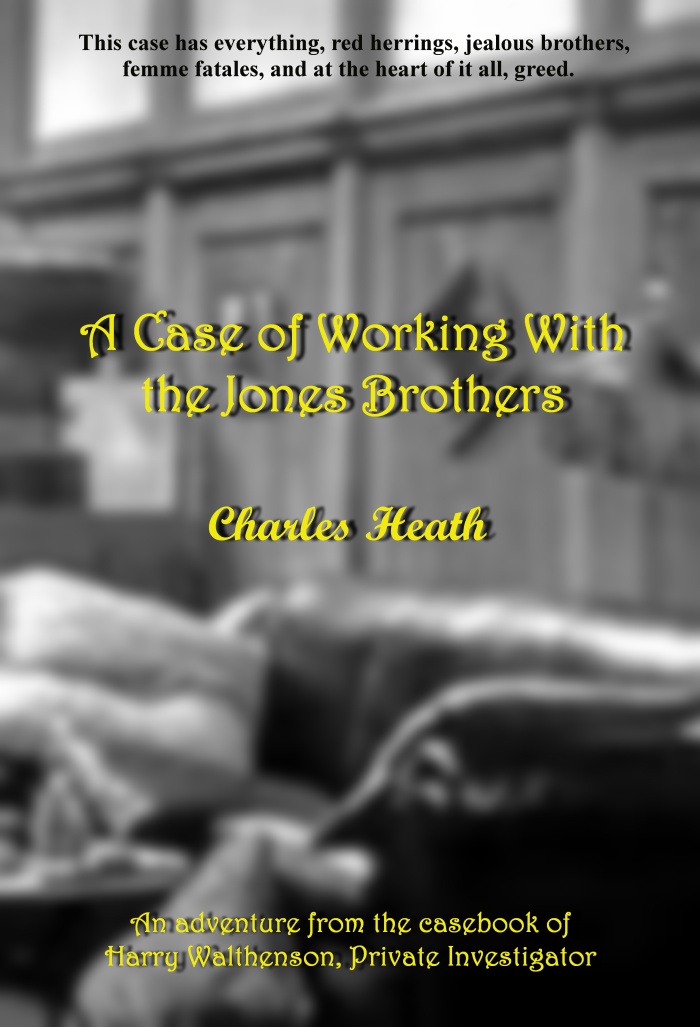
PIWalthJones1

In a word: Rain

Well, isn’t it just like you to rain on my parade?

Yes, and don’t we need a lot of rain because of the bushfires that are burning out of control?

Rain is that stuff that falls from the sky, sometimes at the awkwardest of times, like when you leave your umbrella in the car.

And rain can be a problem in sub-zero temperatures and high winds when it almost takes on the form of multiple miniature knives.  Rain and snow together, sleep, but that’s something else.

Of course, it could always rain cats and dogs, a rather interesting occurrence if it ever happened.

This should not be confused with the word rein.

As any horseperson would know this is what helps control a horse

But, it doesn’t have to be a horse, it might be that you are told to rein in your attack dog

Or rein in your excesses

Or alternatively, give a person free rein to go about their business.

Then there is reign, that period of time when a monarch rules, and it seems in England women hold the record for the longest reign, Queen Victoria, and Queen Elizabeth II

That’s distinct from the office oligarchs who seem to think they reign over the plebs

Short story writing – don’t try this at home! – Part 2

This is not a treatise, but a tongue in cheek, discussion on how to write short stories. Suffice to say this is not the definitive way of doing it, just mine. It works for me – it might not work for you.

There are two methods of writing, planning, sometimes meticulous planning, or flying by the seat of your pants, or being called a ‘pantser’.

The first has it all planned out before they start writing, from beginning to end, knowing what the end result will be. The second, well, we like to write and see where it takes us.

I like to think I fly by the seat of my pants, you know, like the reader who takes up the story and starts reading, not having a clue where it’s going to go. I prefer that blissful ignorance, of course, until I run out of ideas, roughly the equivalent of hitting a brick wall

Or that common enemy all writers have, the dreaded ‘writers block’.

I’ve tried both methods.

Each work, but in the case of the ‘planner’, you need to know where it’s going to start what’s going to happen in the middle and have the end firmly planted in your mind.

Not much good if a rotten character is making you angry and you want to kill him off, and in the most excruciatingly painful manner.

Flying blind gives you a little more creativeness and be able to go around a corner and see what’s there. It also allows for those complete changes of direction you come up with in the shower, the place that is a fertile ground for new ideas just when you’re running out of them.

But it can sometimes play havoc with word counts and if you’re trying to fit into 2,000 words, 5,000 words, or a lot less, taking the story where it wants to go is not a good idea, and sadly, I tend to let stories run their course.

And sometimes I like the idea of writing three different endings, and then can’t choose which one I like the best.

So, role model I am not. I like writing, and when I’m in the ‘zone’ it’s like I’m in another world.

But then, isn’t that the case for all of us?

More unclarity tomorrow!

In a word: Might

We might have to use some might to beat the mite.  Confused?

Might is force, so expending might is much the same as what Thor does with his hammer.

We might expend some force, we this might is a maybe.  You’re never quite sure when someone uses the word might, whether or not they will actually do it.

I might do a lot of things, but somehow I never seem to get around to actually doing them,

Of and just for the record, it’s the past tense of the word may.  You know, you may do something, or you might not.

You might also use the word might when being polite, which seems to be a rarity these days because everyone is terse, tense, and it a hurry.

So might I go to the movie will aways get a resounding no if it means you get home late at night.   And you’re only 10 years old.

I might be interested, but I don’t think so.  Let me think about it.  Which also means no.

Of course, if you’re slack in doing homework, you might want to try a little harder next time.

What might have been if only you tried harder?

Then there’s that little pest called a mite, though it goes by a lot of other names, one of which is everywhere, a termite.

Or a dust mite.

It also could be used slangily for a child in distress, that is, look at that poor little mite, he looks so tired.

Or another word for slightly, for example, the girl seemed a mite embarrassed.


What happens after the action packed start – Part 47

Our hero knows he’s in serious trouble.

The problem is, there are familiar faces and a question of who is a friend and who is foe made all the more difficult because of the enemy, if it was the enemy, simply because it didn’t look or sound or act like the enemy.

Now, it appears, his problems stem from another operation he participated in, and because of it, he has now been roped into what might be called a suicide mission.

At least the helicopter pilot hadn’t hit the fuel tanks or any of the control wires.

Because of the holes in the fuselage, we couldn’t fly any higher than between two and five thousand feet or go as fast as Davies would like, but the plane settled into a routine and got us where we wanted to go.

Just a few miles from the base, fuel almost exhausted, we got a fighter escort.

At first, I thought the base commander thought we were an unidentified flying object, mainly because something else had been hit, our communications. We couldn’t tell the base we were coming, and they only had the Colonel’s transmission of an approximate arrival time, much earlier than the actual time we were supposed to arrive.

On the ground, we were met with fire trucks, and a military escort, with weapons that could take out a mouse at one thousand yards. Just in case we were terrorists, I suppose.

We were parked in a bay away from the main terminal area and had to wait for a half-hour before we were met by Lallo. Monroe’s comment, that he was probably finishing his lunch which would be more important than meeting us, had kept us waiting.

The two abductees were the first to leave the aircraft, then Shurl’s body was removed after the doctor certified he was dead.

Then the rest of us were allowed to leave the aircraft. A bus was waiting, and everyone bar Monroe and I had boarded and been taken away. Under guard. Perhaps their service had not mitigated their prison sentences. I didn’t ask Lallo why; I’d probably not get the truth anyway.

“Good job,” he said, after watching the bus depart. “Pity, it wasn’t done right the first time.”

A compliment followed by disparagement.

“Next time you can do the job yourself,” Monroe said. “And until you’ve been in the field and actually got shot at, you’d do well to keep that trap of yours shut.”

“May I …”

“…remind me you’re my superior officer? No. I’m sure that status won’t last much longer. I’m applying for a transfer.”

He looked at me. “What about you?”

“Nothing to say, except I don’t blame her. Now, since all you’ve done is prove to me you’re an idiot, I’ll take my leave.”

In the distance I could see a large American car, the sort that proliferated in the 1950s and 1960s before petrol prices were a problem, cutting across the runway at speed. Was it the owner of the DC3 coming to see the damage?

No. When it got closer I could see Bamfield, cigar in mouth, beaming. I suppose no one felt they had the authority to tell him not to.

The car stopped behind Lallo’s jeep and Bamfield got out, then leaned against the driver’s side door and looked at us over the roof.

“James, Monroe. Still alive I see. Pity about the plane; I know the chap who owns it. He’s going to be pissed when he sees the cannon holes. What happened?”

“Bad guys,” Monroe said.

“Of course. Get in, I’ll give you a ride back to the terminal. We can talk on the way.”

Neither of us moved. If Monroe wasn’t going to suffer fools gladly, neither was I.

“Well…”

“I’d rather walk,” I said.

“We’d rather walk, sir.” With a heavy emphasis on the ‘sir’.

“Look, you did a great job, minimal losses, and we got two assets back. Everyone is happy. But, we have a small problem down in South America…”

© Charles Heath 2020