That helicopter story that kept me awake – Episode 24

Our hero knows he’s in serious trouble.

The problem is, there are familiar faces and a question of who is a friend and who is foe made all the more difficult because of the enemy, if it was the enemy, simply because it didn’t look or sound or act like the enemy.

Now, it appears, his problems stem from another operation he participated in.

“So,” Lallo said, “you’re telling me you landed separately, Treen and his group advanced towards their position without waiting for your team, that shortly after landing you heard gunfire exchanged, that the members of your team broke ranks and went to help their comrades and that all of them, as far as you were aware at the time, had been killed or captured.”

“Yes.”

“And the two operatives you’d come to rescue?”

“At the time, I had no idea what their status was, but I did make a preliminary assumption that if our mission was blown, then they would hardly be left alive unless the enemy thought they had some strategic value.”

“Or intelligence?”

“It hadn’t occurred to me at the time because my job was to simply to aid the extraction team.  To be honest, I had no idea who they were or what their value was.”

That was not exactly the truth because I could hardly say I hadn’t overheard a conversation between Treen, the briefing officers, and an unseen, unnamed officer discussing the two operatives, and the fact it was imperative we get them out at any cost.  It wasn’t said why, but I could guess.

It didn’t take long to realize that if our arrival had been known, so would the location and worth of the two we were to rescue.  I didn’t think they were killed out of hand, not until they’d told the enemy’s interrogators everything they knew.

And I got the impression they knew enough to cause our whole operation in that country ended up with a great deal of irreparable damage.

No wonder they wanted to sweep it under the carpet.

I watched Lallo scribble a long not over several pages.  Was his conclusion the same as mine, but based on truth rather than hearsay?

Then, “Were you met by the person who has been referred to as the so-called source?”

“No.”

“Do you know if Treen’s group were met?”

“No.  I was given to understand that source had gone quiet, I suppose another word for either captured or defected to the other side.”

“Apparently there was a report that the agent in situ was going to be at the landing site.”

“Well, there’s your explanation as to why the mission was blown from the start.  Whoever it was, was either captured, or a double agent, and told the enemy of our plans.”

“A reasonable assumption in the circumstances, but not necessarily correct.”

“And you know this because…”

I was curious.  The agent’s defection would explain everything.

“That agent resurfaced three days ago, again asking for repatriation, and is in the air to a secure site as we speak.”

He stood and took a moment to stow the pencil in the binding of the notebook before giving me his attention.

“We will also be in their air tomorrow, headed for the same secure location.  I’m, sure you will be available for that interrogation, because I, too, have serious doubts about this agent’s shall we say, loyalties.”

That still didn’t mean I wasn’t going to finish up at a black site, or worse.

© Charles Heath 2019-2021

Writing about writing a book – Day 12

Today, I’ve decided on doing a little research, and this means giving the internet and Google a good workout.

I need some information about the Vietnam War.

So, as a start, I type in the words ‘Vietnam War’ into Google.

This returns: About 699,000,000 results (0.83 seconds)

Wikipedia says “The Vietnam War, also known as the Second Indochina War, and in Vietnam as the Resistance War Against America or simply the American War, was a conflict that occurred in Vietnam, Laos, and Cambodia from 1 November 1955 to the fall of Saigon on 30 April 1975”

OK, so this gives me the broadest outline.  What I need is details, so it’s a matter of where to start.  This means to start with, when did troops get sent from both Australia and the United States for service.  It seems the US sent troops from 1964 to 1969, and Australia between August 1965 and March 1966.  This gives me a starting point, because our main character is Australian, and somehow gets seconded to the Americans.

January 1972, the war ends.

Now we need to know

  •  where the bases were
  • where the battle zones were
  • methods of transportation
  • what happened to prisoners of war
  • rest and recreation points
  • CIA involvement (which will no doubt be impossible to find evidence)
  • what happened to soldiers injured in battle

It’s a list that will get longer and may require a reading list, and first-hand accounts.

It looks like it’s going to be a long day.

Searching for locations: The Forbidden City, Beijing, China

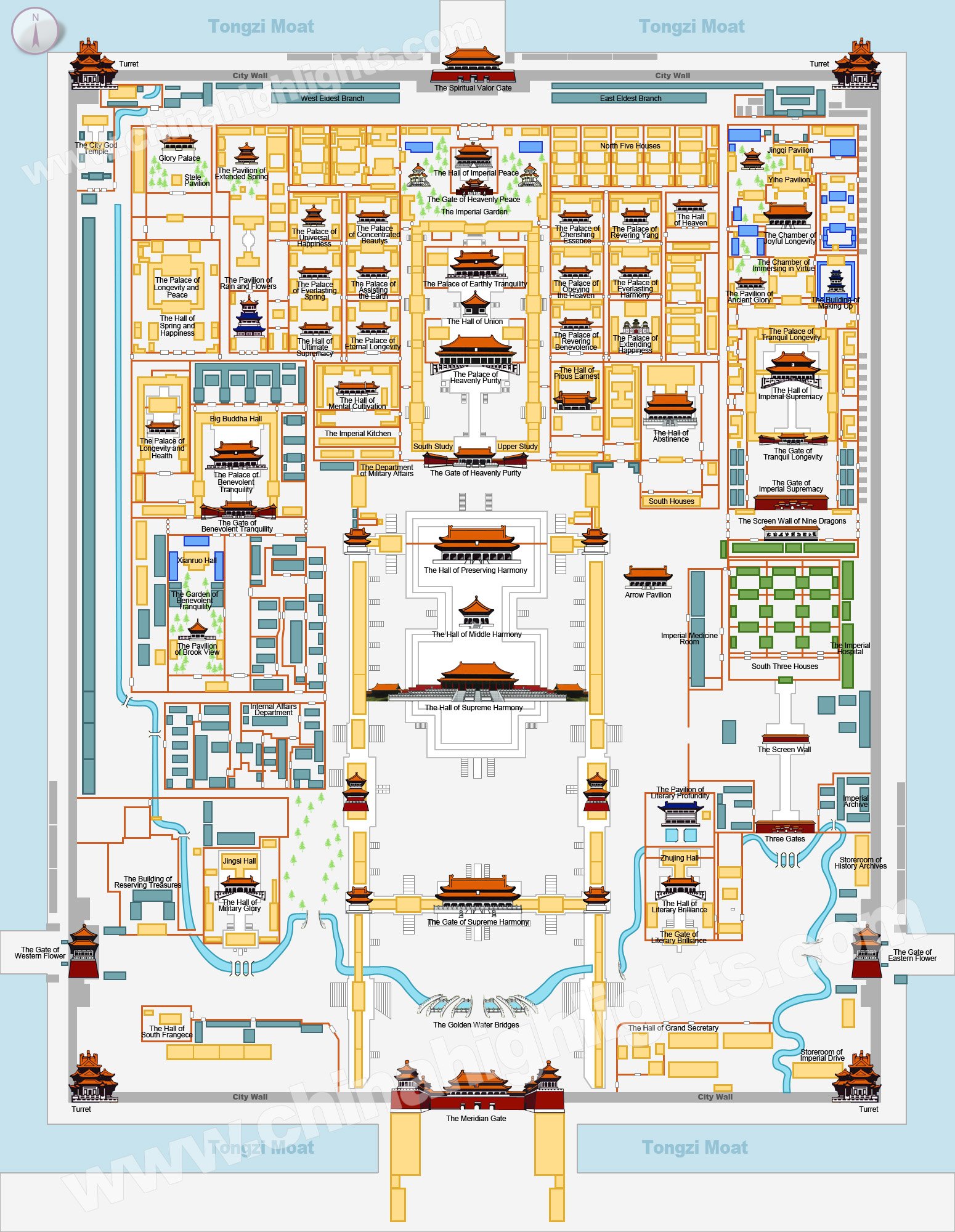
Now we’re walking to the Forbidden City, and it seems like we’re walking for miles and we’re practically exhausted before we get started on the main tour.  I’m not sure if we received a map of the city, but one is certainly needed so that you can navigate the many features, buildings, and walkways.
There are tour groups everywhere in the large courtyard outside the gate, most likely getting a lecture on the last of the Chinese emperors about that time Sun Yat-Sen proclaimed the new China around 1912.  We were no exception, and it was an interesting way to spend the time waiting to get in.  It was a tale of intrigue, interwoven with a 3-year-old emperor, and a scheming concubine who becomes the Emperor’s favorite, enough to bear him a son and successor.

Bribery and corruption at its best.

But its history runs something like this:

The Forbidden City is was once the imperial and state residence of the Emperor of China, as well as the center of government, from the Ming Dynasty to the Qing Dynasty, or 1420 to 1924.

It was built from 1406 to 1420 when the Yongle Emperor moved the capital from Nanking to Beijing and consists of about 980 buildings, and 8,886 bays of rooms (not the 9,999 as prescribed in myth) and covers 180 acres.  Over the 14 years, a million workers used whole logs of wood from the jungles of southwestern China, marble from quarries near Beijing, specially made golden bricks from Suzhou

Since 1925 it has been a museum and is the largest number of preserved wooden structures in the world.

The city is surrounded by a wall 7.9 meters high, and a moat that is 6 meters deep and 52 meters wide.  A tower sits at each of the four corners.  Each side has a gate, the north is called the Gate of Divine Might, the south is called the Meridian gate.  East and west are called East Glorious Gate and West Glorious Gate respectively.

But, back in the courtyard, we are ready to go in and follow the tour guide who has switched from her amplified microphone to a whisper device we all wear in our ears.  She talks and we listen.

We all make it through and regroup on the other side. This is where the fun begins because we are about to meet a large percentage of the 80,000, they let for the day.
It seems to me they have all arrived at the same time, although by the time we get to the entrance gate, it is very well organized, bags are scanned, people are scanned, and you’re in.

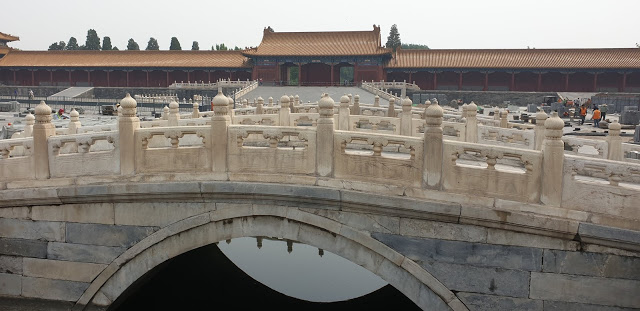
After crossing one of the seven Golden Water bridges, you begin to get some idea of the size and scope of the City, and in the distance, the first of the buildings, The Gate of Supreme Harmony.  On a hot day, that could be a long and thirsty walk.
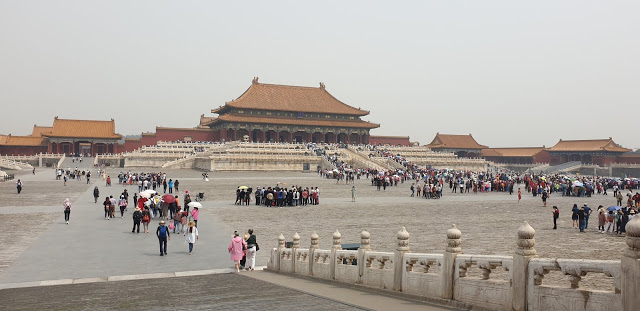
From there it is one pagoda after another with buildings that surround the edge of the whole Forbidden City, as does the moat.

By the time we get to the second courtyard, it was time to have ice cream as a refresher.  Others head up to another exhibit, and it’s just too many stairs for us.

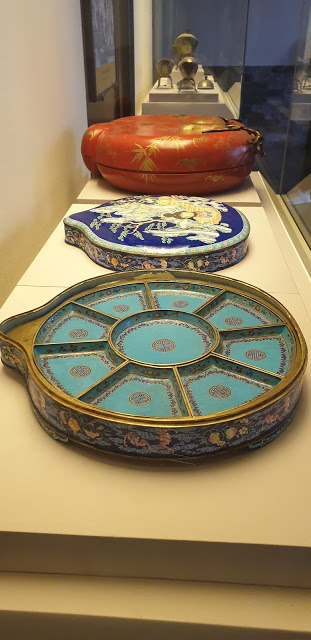
After this, it’s a walkthrough another courtyard, heading up and down some more stairs, we go and see the museum, with priceless relics from past emperors.
There are areas like the outer courtyard, the inner courtyard, yet another courtyard, and the gardens where the concubines walked and spent their leisure time.  It is not far from the emperor’s wives living quarters, though there’s precious little left of the furniture, other than a settee and two rather priceless so-called Ming dynasty vases.

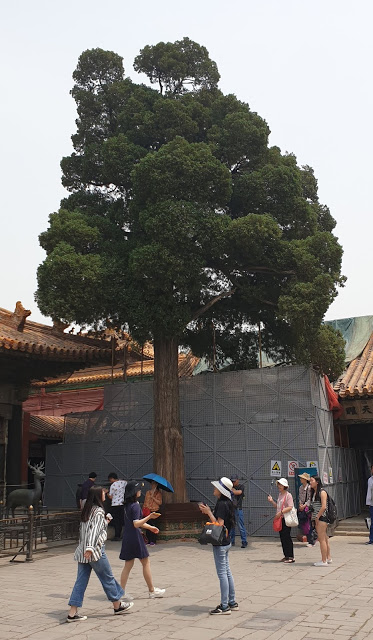
We get into the bad habit of calling all of the vases Ming dynasties.  Above is one of the inner courtyards there were living quarters, and that tree is over 300 years old.
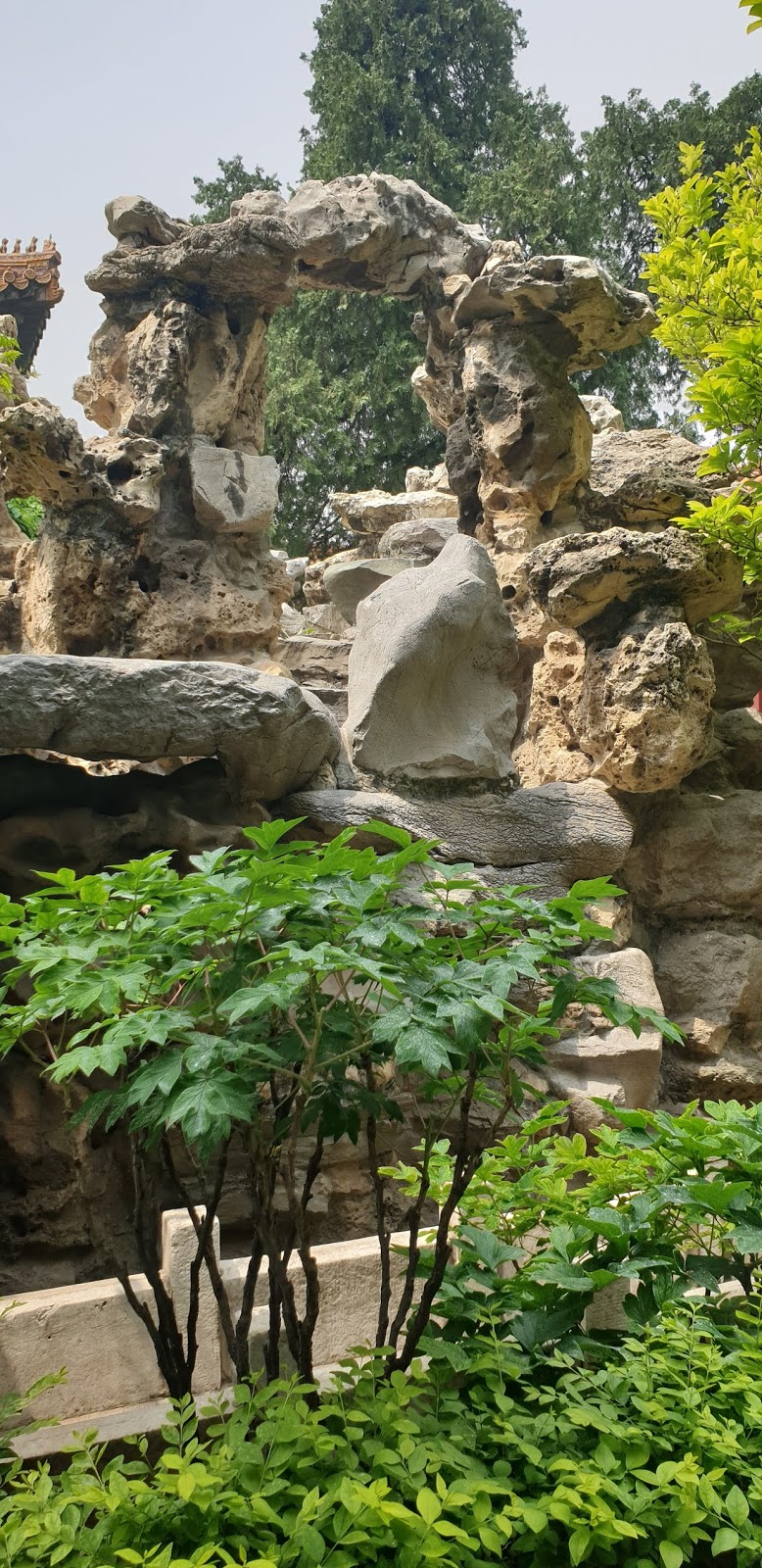
Out through some more alleyways and through an entrance that led to the area where the concubines lived, very spacious, bright, and filled with trees, plants, and walkways through rocky outcrops.

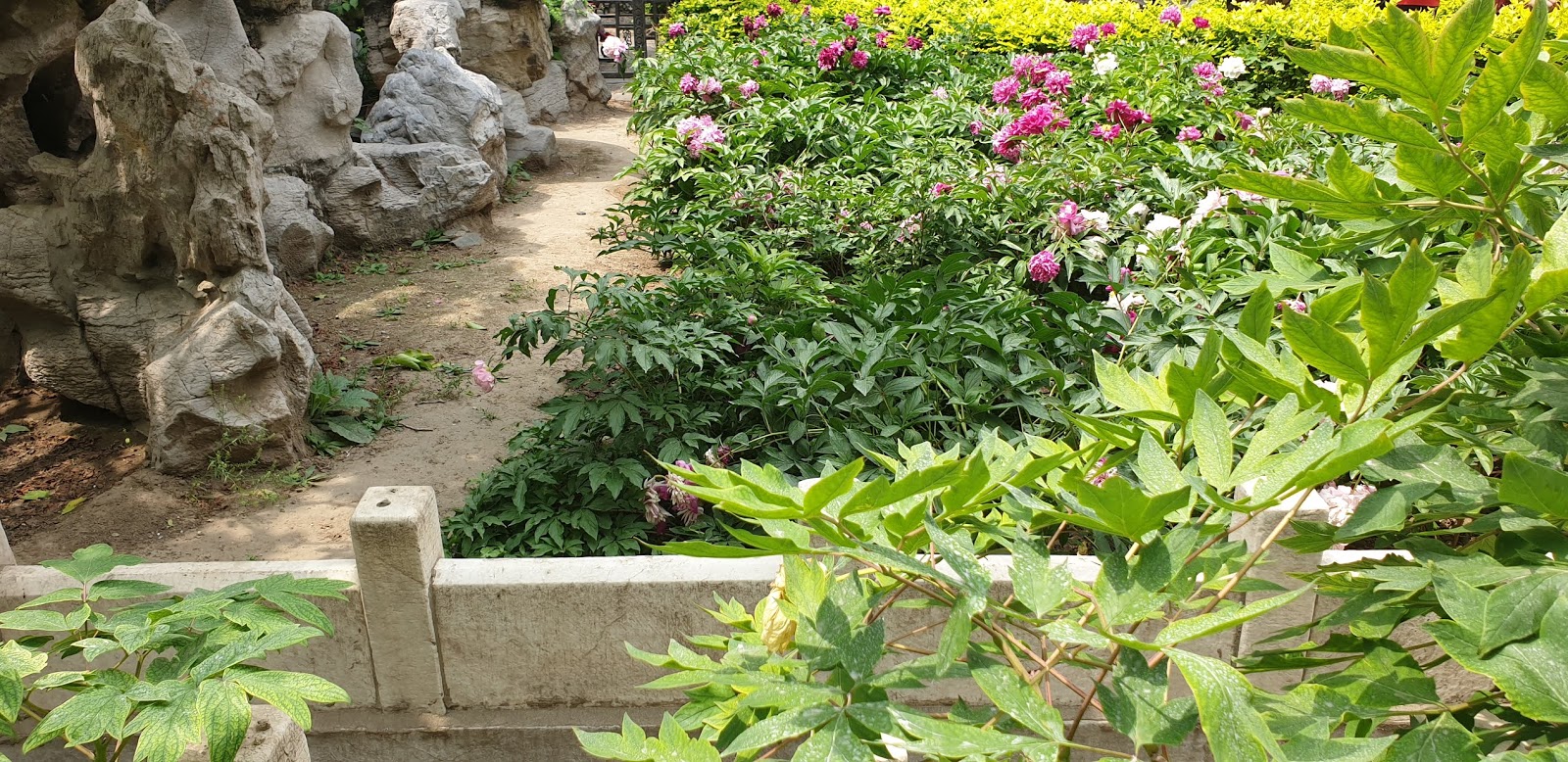
The whole area was made up of living quarters and waterways, rocks and paths, all very neatly set out, and it looked to be a very good place to live.

This is an example of the living quarters, overlooking the gardens

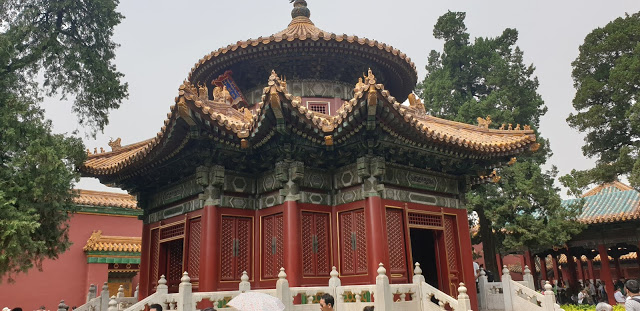
And there were several pagodas
From there its a quick exit out the northern entrance, and another longish walk to our bus, which arrives at the meeting point shortly after we do.

That done, the Beijing tour guide has completed her section of our China experience, and we’re ready to move onto the next.

NaNoWriMo 2021 – Day 18

This image has an empty alt attribute; its file name is NaNoWriMo-WriterBadge-851-2x.png

A score to settle

There’s only so long you can keep the real world out.

That notion that you can write for as long as you want is a myth. Aside from the fact you have to stop for coffee breaks, meals, and sleep, all entirely optional, there are other factors that come into play.

Family.

Just to name one, there is still my usual job of picking up my granddaughter from school as and when required.

And this impinging on the world that you have created for yourself, in that writing bubble that is November, it doesn’t take much to crack it, even just a little.

So, here I am, sitting in the queue waiting with the hundreds of others who have decided public transport is way too unsafe, health-wise in this world of COVID scares, that we should pick them up and deliver them safely to their homes.

My phone then becomes the principal instrument in my office, the equivalent of a computer with writing software and a cloud directory where I can work on any part of the manuscript, in the office or anywhere in the world, but today, from my car.

Toll back 40 years, and this wasn’t possible, except if you had a writing pad and a pen or pencil. Such a messy and time-consuming way of writing, but it was all we had back then, other than a typewriter that could not be used in a car.

How times have changed, and for the better.

Today’s word count: 2,238 words, for the running total of 45,434.

Writing about writing a book – Day 12

Today, I’ve decided on doing a little research, and this means giving the internet and Google a good workout.

I need some information about the Vietnam War.

So, as a start, I type in the words ‘Vietnam War’ into Google.

This returns: About 699,000,000 results (0.83 seconds)

Wikipedia says “The Vietnam War, also known as the Second Indochina War, and in Vietnam as the Resistance War Against America or simply the American War, was a conflict that occurred in Vietnam, Laos, and Cambodia from 1 November 1955 to the fall of Saigon on 30 April 1975”

OK, so this gives me the broadest outline.  What I need is details, so it’s a matter of where to start.  This means to start with, when did troops get sent from both Australia and the United States for service.  It seems the US sent troops from 1964 to 1969, and Australia between August 1965 and March 1966.  This gives me a starting point, because our main character is Australian, and somehow gets seconded to the Americans.

January 1972, the war ends.

Now we need to know

  •  where the bases were
  • where the battle zones were
  • methods of transportation
  • what happened to prisoners of war
  • rest and recreation points
  • CIA involvement (which will no doubt be impossible to find evidence)
  • what happened to soldiers injured in battle

It’s a list that will get longer and may require a reading list, and first-hand accounts.

It looks like it’s going to be a long day.

Searching for locations: The Forbidden City, Beijing, China

Now we’re walking to the Forbidden City, and it seems like we’re walking for miles and we’re practically exhausted before we get started on the main tour.  I’m not sure if we received a map of the city, but one is certainly needed so that you can navigate the many features, buildings, and walkways.

There are tour groups everywhere in the large courtyard outside the gate, most likely getting a lecture on the last of the Chinese emperors about that time Sun Yat-Sen proclaimed the new China around 1912.  We were no exception, and it was an interesting way to spend the time waiting to get in.  It was a tale of intrigue, interwoven with a 3-year-old emperor, and a scheming concubine who becomes the Emperor’s favorite, enough to bear him a son and successor.

Bribery and corruption at its best.

But its history runs something like this:

The Forbidden City is was once the imperial and state residence of the Emperor of China, as well as the center of government, from the Ming Dynasty to the Qing Dynasty, or 1420 to 1924.

It was built from 1406 to 1420 when the Yongle Emperor moved the capital from Nanking to Beijing and consists of about 980 buildings, and 8,886 bays of rooms (not the 9,999 as prescribed in myth) and covers 180 acres.  Over the 14 years, a million workers used whole logs of wood from the jungles of southwestern China, marble from quarries near Beijing, specially made golden bricks from Suzhou

Since 1925 it has been a museum and is the largest number of preserved wooden structures in the world.

The city is surrounded by a wall 7.9 meters high, and a moat that is 6 meters deep and 52 meters wide.  A tower sits at each of the four corners.  Each side has a gate, the north is called the Gate of Divine Might, the south is called the Meridian gate.  East and west are called East Glorious Gate and West Glorious Gate respectively.

But, back in the courtyard, we are ready to go in and follow the tour guide who has switched from her amplified microphone to a whisper device we all wear in our ears.  She talks and we listen.

We all make it through and regroup on the other side. This is where the fun begins because we are about to meet a large percentage of the 80,000, they let for the day.

It seems to me they have all arrived at the same time, although by the time we get to the entrance gate, it is very well organized, bags are scanned, people are scanned, and you’re in.

After crossing one of the seven Golden Water bridges, you begin to get some idea of the size and scope of the City, and in the distance, the first of the buildings, The Gate of Supreme Harmony.  On a hot day, that could be a long and thirsty walk.

From there it is one pagoda after another with buildings that surround the edge of the whole Forbidden City, as does the moat.

By the time we get to the second courtyard, it was time to have ice cream as a refresher.  Others head up to another exhibit, and it’s just too many stairs for us.

After this, it’s a walkthrough another courtyard, heading up and down some more stairs, we go and see the museum, with priceless relics from past emperors.

There are areas like the outer courtyard, the inner courtyard, yet another courtyard, and the gardens where the concubines walked and spent their leisure time.  It is not far from the emperor’s wives living quarters, though there’s precious little left of the furniture, other than a settee and two rather priceless so-called Ming dynasty vases.

We get into the bad habit of calling all of the vases Ming dynasties.  Above is one of the inner courtyards there were living quarters, and that tree is over 300 years old.

Out through some more alleyways and through an entrance that led to the area where the concubines lived, very spacious, bright, and filled with trees, plants, and walkways through rocky outcrops.

The whole area was made up of living quarters and waterways, rocks and paths, all very neatly set out, and it looked to be a very good place to live.

This is an example of the living quarters, overlooking the gardens

And there were several pagodas

From there its a quick exit out the northern entrance, and another longish walk to our bus, which arrives at the meeting point shortly after we do.

That done, the Beijing tour guide has completed her section of our China experience, and we’re ready to move onto the next.
NaNoWriMo 2021 – Day 18

This image has an empty alt attribute; its file name is NaNoWriMo-WriterBadge-851-2x.png

A score to settle

There’s only so long you can keep the real world out.

That notion that you can write for as long as you want is a myth. Aside from the fact you have to stop for coffee breaks, meals, and sleep, all entirely optional, there are other factors that come into play.

Family.

Just to name one, there is still my usual job of picking up my granddaughter from school as and when required.

And this impinging on the world that you have created for yourself, in that writing bubble that is November, it doesn’t take much to crack it, even just a little.

So, here I am, sitting in the queue waiting with the hundreds of others who have decided public transport is way too unsafe, health-wise in this world of COVID scares, that we should pick them up and deliver them safely to their homes.

My phone then becomes the principal instrument in my office, the equivalent of a computer with writing software and a cloud directory where I can work on any part of the manuscript, in the office or anywhere in the world, but today, from my car.

Toll back 40 years, and this wasn’t possible, except if you had a writing pad and a pen or pencil. Such a messy and time-consuming way of writing, but it was all we had back then, other than a typewriter that could not be used in a car.

How times have changed, and for the better.

Today’s word count: 2,238 words, for the running total of 45,434.

“Trouble in Store” – Short stories my way:  Editing becomes re-writing (3)

I have reworked the first part of the story with a few new elements about the characters and changed a few of the details of how the characters finish up in the shop before the policewoman makes her entrance.

This is part of the new first section is the one that involves the shopkeeper`:


This wasn’t the shopkeeper’s first hold up.  In fact, over the years there had been a dozen.  But only one got reported to the police, and that was only because the robber was shot and killed.

He’d taken a bullet that night, too, which, from the police point of view, made him a concerned citizen simply defending himself.

The rest had been scared off by the double-barrel shotgun he kept under the counter for just such emergencies.

The young punk who came into the shop with his girlfriend had pulled out the pistol and told him if he reached for the shotgun he’d shoot him.  The kid looked unstable and he’d backed away.

When the kid collapsed, he should have gone for the shotgun, but instead, he thought he could get to the gun before the girl realized what was happened.  She wasn’t an addict and clearly looked like she was only along for the ride.  Her expression, when the kid pulled out the gun told him she’d known nothing about her partner’s true intentions.

But, he wasn’t fast enough, and she had the gun pointing at him before he’d got past the counter.

From one pair of unpredictable hands to another.

Like the girl, he was just as surprised when the customer burst in the door, just before closing time.

The situation might have been salvageable before the customer came in the door, getting the girl to go along with the robbery being about money, but there was no denying what the kid on the floor’s problem was.

Damn.

He had to try and salvage the situation simply because there was a lot of money involved, and other people depending on him.  He looked at the boy, on the floor, then the girl.

“Listen to me, young lady, you would be well advised to let this man go as he suggests.  And, please put the gun down before someone gets hurt.  Your friend needs medical help and I can call an ambulance.”

The girl switched her attention back to him.  “No one’s going anywhere, so just shut the hell up and let me think.”

The storekeeper glanced over at the customer. 

He’d seen him come into the shop once or twice, probably lived in the neighborhood, the sort who’d make a reliable witness, either a lawyer or an accountant.  Not like most of the residents just beyond the fringe of respectability.

If only he hadn’t burst into the shop when he did.


© Charles Heath 2016-2020

Writing about writing a book – Day 11

Once again, instead of writing, I have been obsessing over the planning and creation of a website for the book.

And, that being the case, now I have to give the book a name so I can name the site/blog after it.

The word Starburst has featured in the story so tentatively I’m going to name it “The Starburst Conspiracy”

The site will be on WordPress.  There will be progress blog posts, there will draft writing and possible chapters for beta reading and comment.  There will be separate pages for each of the characters.

I’m not sure how I’m going to build an email list so perhaps I’ll build a following first.

So, having mapped out a plan for the site, I’ve made the first post and written the ‘About’ page which basically gives a bit of history about the book.

Bear in mind the original book of about 400 pages scribbled over a long period of time, and not really a book in the sense of the word (more a collection of ideas set in some form of chronology) and set in the early eighties and will probably stay there but will be the basis for the new novel.

Another interesting aspect of this exercise is to see how far I have come writing-wise in the last 30 years and how easy it is to spot the issues with the original manuscript.

I’ve also created a master page for the cast of characters and only a page for the main character so far.  Others will follow.

There will be another page with an ongoing, updated synopsis.

Shortcuts to these pages, as the information flows will be in subsequent posts.


For now, it’s back to writing, after a long gap, and the ideas have been churning in my head.


© Charles Heath 2016-2020

NaNoWriMo 2021 – Day 17

This image has an empty alt attribute; its file name is NaNoWriMo-WriterBadge-851-2x.png

A score to settle

We’re now coming up to the start of the revolution and although the first parries by the rebels, so-called by the ruling junta because it sounds better than revolutionaries, or dissidents, will fail, it’s not because of bad management, but events they could not have foreseen.

That lethargy and periods of self-doubt have lifted like a fog, and the story is now taking shape.

Perhaps I had to get to the interesting part. Sometimes the setting of the scene and providing an introduction to the characters can be energy-draining because as the reader, it can take almost too long to get going.

Perhaps I should make a mental note of that so that in the second draft, I can remove the boring bits and get to the real story sooner.

I cannot wait for tomorrow and almost had to resist the temptation of not stopping for sleep, just in case the words stopped flowing. There are times, I have discovered, that in taking that break, the idea and word flow stops, and conjures up something like writer’s block.

Let’s hope tomorrow is the same as today.

Today’s word count: 2,742 words, for the running total of 43,196.