In a word: Holiday

Some call time off from work whether it is for a day, a few days, and couple of weeks, or maybe longer, a holiday.

Or leave, leave of absence, annual leave, or long service leave.

Others may call it vacation.

It depends on what part of the world you live in.

But the end result is the same, you do not go to work, so you stay home and do all those things that have mounted up, you drive up, and for some reason it is always up, to the cabin, for a little hunting shooting a fishing, or you get on a planr or a ship and try to get as far away from home and work as possible.

That’s called going overseas. It seems if there is an ocean between w there you go and where you live, no one will be able to disturb you.

Sorry, I bet you didn’t leave that mobile phone or iPad home did you?

But, of course there are a few other obscure references to the word holiday.

For instance,

It can be a day set aside to commemorate an event or a person, a day when you are not expected to work, e.g. Memorial Day, Christmas Day, Good Friday. In Britain they used to be called Bank Holidays.

It can be a specified period that you may be excused from completing a task, or doing something such as getting a one year tax exemption, which maifh also be called a one year tax holiday.

Yes, now that is an obscure reference, particularly when no tax department would ever grant anyone an exemption of any sort.

Searching for locations: Shanghai, China, by night.

When we arrive at the embarkation site we find at least 100 buses all lined up and parked, and literally thousands of Chinese and other Asians streaming through the turnstiles to get on another boat leaving earlier than ours.

Buses were just literally arriving one after the other stopping near where we were standing with a dozen or so other groups waiting patiently, and with people were everywhere it could only be described as organized chaos.

Someone obviously knew where everyone was supposed to go, and when it was our turn, we joined the queue.  There were a lot of people in front of us, and a lot more behind, so I had to wonder just how big the boat was.

We soon found out.

And it was amusing to watch people running, yes, they were actually running, to get to the third level, or found available seating.  Being around the first to board, we had no trouble finding a seat on the second level.

I was not quite sure what the name of the boat was, but it had 3 decks and VIP rooms and it was huge, with marble staircases, the sort you could make a grand entrance on.  The last such ornate marble staircase we had seen was in a hotel in Hong Kong, and that was some staircase.

But who has marble staircases in a boat?

We’re going out across the water as far as the Bund and then turn around and come back about 30 to 40 minutes.   By the time everyone was on board, there was no room left on the third level, no seats on the second level nor standing room at the end of the second level where the stairs up to the third level were.

No one wanted to pay the extra to go into the VIP lounge.

We were sitting by very large windows where it was warm enough watching the steady procession of the colored lights of other vessels, and outside the buildings.

It was quite spectacular, as were some of the other boats going out on the harbor.

All the buildings of the Bund were lit up

And along that part of the Bund was a number of old English style buildings made from sandstone, and very impressive to say the least.

On the other side of the harbour were the more modern buildings, including the communications tower, a rather impressive structure.

I had to go to the rear of the vessel to get a photo, a very difficult proposition given here was no space on the railing, not even on the stairs going up or down.  It was just luck I managed to get some photos between passengers heads.

And, another view of that communications tower:

There was no doubt this was one of the most colourful night-time boat tours I’ve ever been on.  Certainly, when we saw the same buildings the following day, they were not half as spectacular in daylight.

I never did get up to the third level to see what the view was like.

The fourth attempt, let’s look at the main character

So there are words on paper, and three times I’ve tried to fix it, or, perhaps just make it sound better because reading it in my head, there’s too little background and too many questions.

The flow of the story isn’t working for me, so I guess it’s time to sit down and work out what it is I’m trying to say.

The notion that our main character, Graham, is a loser seems to shine through, and that’s not what I’m trying to portray him as.  No, far from it, it’s been a lifetime of bad choices that have put him where he is, and he knows it.

So, in part, this is about owning your mistakes, and it’s my job to make him come across as a hero in waiting.  There’s good in him, perhaps too much, but there is also that attitude that led to all those bad choices, the one that can get him into trouble, and a sort of intransigence inherited from his father, that has more or less got him ostracised from the family. 

I want this character to be a chop off the old block, both of whom are the type not to back down, not to say sorry, and, to quote a rather apt allegory, would cut their nose off to spite their face.

Graham’s intransigence led to his refusal to follow his father into business, refusal to go to University despite having the necessary qualifications, and just to round out the defiance, his choice of women whom he knew would meet with family disapproval.

And these factors, over a period of time, saw him bounce from a low-paying job to jobs with no prospects, and a string of failed relationships, until this moment in time, where he was basically on his own, working the graveyard shift as a security guard.  The sort of job where qualifications weren’t looked for and workmates looked like and probably were ex-cons.

There are a few more details like the older brother, Jackson, politician and schemer, the same as his father before him (the seat was passed down through the family), like the younger sister who is a highly successful surgeon, married into immense wealth.  His brother had been less successful in the marital stakes but what he lacked in a wife was more than made up with a string of highly eligible and beautiful women.

And, no, he doesn’t resent the fact they’re rich, or that his parents were, too, just that they treated him with contempt.

It was almost five years since the last time he had seen any of them, that last time he attended the family Christmas in Martha’s Vineyard, the ‘Stockdale Residence’ an ostentatious sprawling fifty-room mansion that, in a drunken rage, he’s tried to burn down.

Once again, he had not received an invitation to the next, due in a few days, and it was not entirely unexpected.

Graham has his faults, but that even, five years ago, had pulled him off the road to self-destruction, helped along by a year stint in jail where he learned a great many lessons about life itself, and survival.

The four years since?

A lot of regrets, and a lot of repentance.  Life after jail was a lot worse than life trying to defy the family and the system.  There were two roads he could have gone down, and thankfully for him, it was not the wrong one.

So, he’s back on the path, a whole lot wiser, a whole lot tougher.

That might not have been exactly what I was thinking for him over the first three attempts.  I don’t think any character really begins to shine until halfway through, as you find him meeting various challenges in ways even you, as the writer, find quite unexpected.

Is that the end result of being a pantser over being a planner?

I don’t think, even as a planner, you can create a character that’s not going to change, or even surprise you, as the story evolves.

And somehow I don’t think I’m about to change from one to the other.

Well, not completely.

But there’s more, and no, it’s not steak knives!

© Charles Heath 2020-2021

The fourth attempt, let’s look at the main character

So there are words on paper, and three times I’ve tried to fix it, or, perhaps just make it sound better because reading it in my head, there’s too little background and too many questions.

The flow of the story isn’t working for me, so I guess it’s time to sit down and work out what it is I’m trying to say.

The notion that our main character, Graham, is a loser seems to shine through, and that’s not what I’m trying to portray him as.  No, far from it, it’s been a lifetime of bad choices that have put him where he is, and he knows it.

So, in part, this is about owning your mistakes, and it’s my job to make him come across as a hero in waiting.  There’s good in him, perhaps too much, but there is also that attitude that led to all those bad choices, the one that can get him into trouble, and a sort of intransigence inherited from his father, that has more or less got him ostracised from the family. 

I want this character to be a chop off the old block, both of whom are the type not to back down, not to say sorry, and, to quote a rather apt allegory, would cut their nose off to spite their face.

Graham’s intransigence led to his refusal to follow his father into business, refusal to go to University despite having the necessary qualifications, and just to round out the defiance, his choice of women whom he knew would meet with family disapproval.

And these factors, over a period of time, saw him bounce from a low-paying job to jobs with no prospects, and a string of failed relationships, until this moment in time, where he was basically on his own, working the graveyard shift as a security guard.  The sort of job where qualifications weren’t looked for and workmates looked like and probably were ex-cons.

There are a few more details like the older brother, Jackson, politician and schemer, the same as his father before him (the seat was passed down through the family), like the younger sister who is a highly successful surgeon, married into immense wealth.  His brother had been less successful in the marital stakes but what he lacked in a wife was more than made up with a string of highly eligible and beautiful women.

And, no, he doesn’t resent the fact they’re rich, or that his parents were, too, just that they treated him with contempt.

It was almost five years since the last time he had seen any of them, that last time he attended the family Christmas in Martha’s Vineyard, the ‘Stockdale Residence’ an ostentatious sprawling fifty-room mansion that, in a drunken rage, he’s tried to burn down.

Once again, he had not received an invitation to the next, due in a few days, and it was not entirely unexpected.

Graham has his faults, but that even, five years ago, had pulled him off the road to self-destruction, helped along by a year stint in jail where he learned a great many lessons about life itself, and survival.

The four years since?

A lot of regrets, and a lot of repentance.  Life after jail was a lot worse than life trying to defy the family and the system.  There were two roads he could have gone down, and thankfully for him, it was not the wrong one.

So, he’s back on the path, a whole lot wiser, a whole lot tougher.

That might not have been exactly what I was thinking for him over the first three attempts.  I don’t think any character really begins to shine until halfway through, as you find him meeting various challenges in ways even you, as the writer, find quite unexpected.

Is that the end result of being a pantser over being a planner?

I don’t think, even as a planner, you can create a character that’s not going to change, or even surprise you, as the story evolves.

And somehow I don’t think I’m about to change from one to the other.

Well, not completely.

But there’s more, and no, it’s not steak knives!

© Charles Heath 2020-2021

Searching for locations: The Forbidden City, Beijing, China

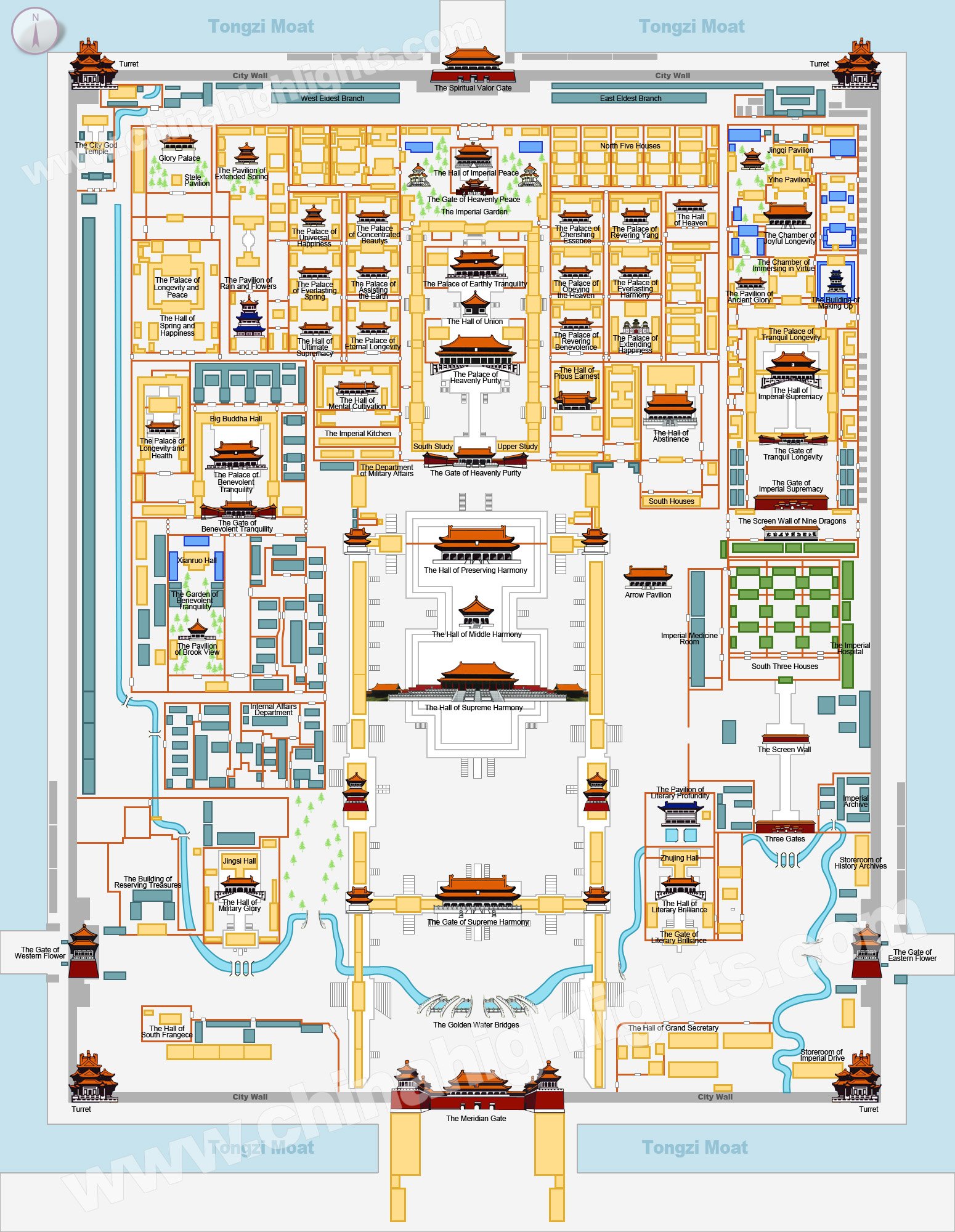
Now we’re walking to the Forbidden City, and it seems like we’re walking for miles and we’re practically exhausted before we get started on the main tour.  I’m not sure if we received a map of the city, but one is certainly needed so that you can navigate the many features, buildings, and walkways.
There are tour groups everywhere in the large courtyard outside the gate, most likely getting a lecture on the last of the Chinese emperors about that time Sun Yat-Sen proclaimed the new China around 1912.  We were no exception, and it was an interesting way to spend the time waiting to get in.  It was a tale of intrigue, interwoven with a 3-year-old emperor, and a scheming concubine who becomes the Emperor’s favorite, enough to bear him a son and successor.

Bribery and corruption at its best.

But its history runs something like this:

The Forbidden City is was once the imperial and state residence of the Emperor of China, as well as the center of government, from the Ming Dynasty to the Qing Dynasty, or 1420 to 1924.

It was built from 1406 to 1420 when the Yongle Emperor moved the capital from Nanking to Beijing and consists of about 980 buildings, and 8,886 bays of rooms (not the 9,999 as prescribed in myth) and covers 180 acres.  Over the 14 years, a million workers used whole logs of wood from the jungles of southwestern China, marble from quarries near Beijing, specially made golden bricks from Suzhou

Since 1925 it has been a museum and is the largest number of preserved wooden structures in the world.

The city is surrounded by a wall 7.9 meters high, and a moat that is 6 meters deep and 52 meters wide.  A tower sits at each of the four corners.  Each side has a gate, the north is called the Gate of Divine Might, the south is called the Meridian gate.  East and west are called East Glorious Gate and West Glorious Gate respectively.

But, back in the courtyard, we are ready to go in and follow the tour guide who has switched from her amplified microphone to a whisper device we all wear in our ears.  She talks and we listen.

We all make it through and regroup on the other side. This is where the fun begins because we are about to meet a large percentage of the 80,000, they let for the day.
It seems to me they have all arrived at the same time, although by the time we get to the entrance gate, it is very well organized, bags are scanned, people are scanned, and you’re in.

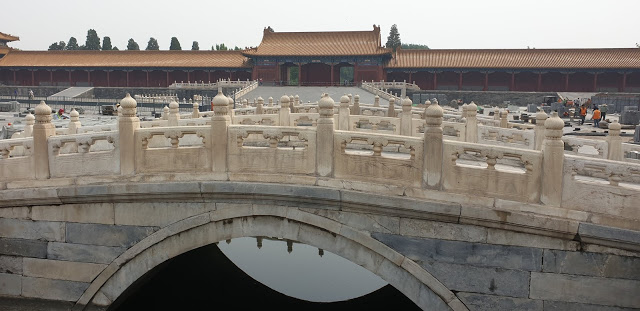
After crossing one of the seven Golden Water bridges, you begin to get some idea of the size and scope of the City, and in the distance, the first of the buildings, The Gate of Supreme Harmony.  On a hot day, that could be a long and thirsty walk.
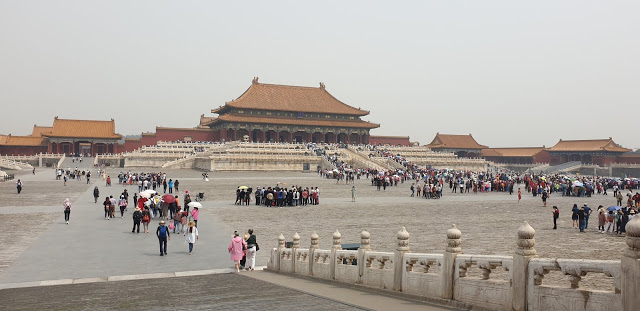
From there it is one pagoda after another with buildings that surround the edge of the whole Forbidden City, as does the moat.

By the time we get to the second courtyard, it was time to have ice cream as a refresher.  Others head up to another exhibit, and it’s just too many stairs for us.

After this, it’s a walkthrough another courtyard, heading up and down some more stairs, we go and see the museum, with priceless relics from past emperors.
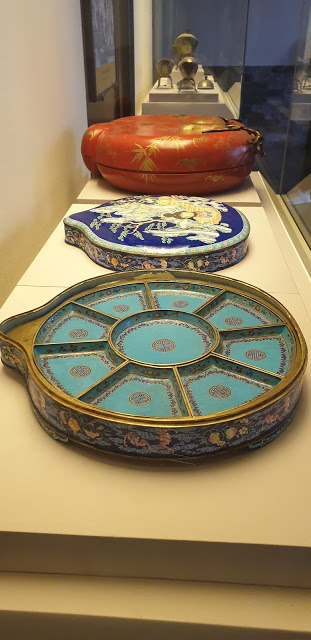
There are areas like the outer courtyard, the inner courtyard, yet another courtyard, and the gardens where the concubines walked and spent their leisure time.  It is not far from the emperor’s wives living quarters, though there’s precious little left of the furniture, other than a settee and two rather priceless so-called Ming dynasty vases.

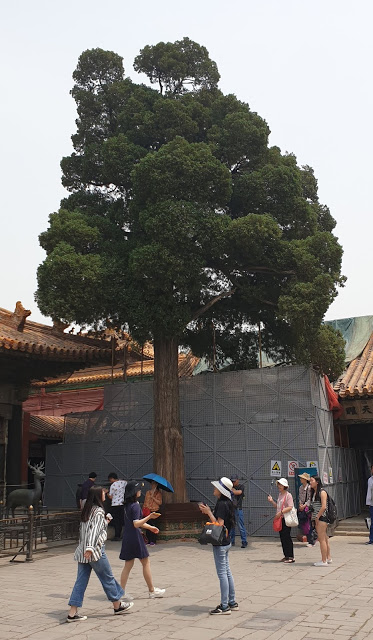
We get into the bad habit of calling all of the vases Ming dynasties.  Above is one of the inner courtyards there were living quarters, and that tree is over 300 years old.
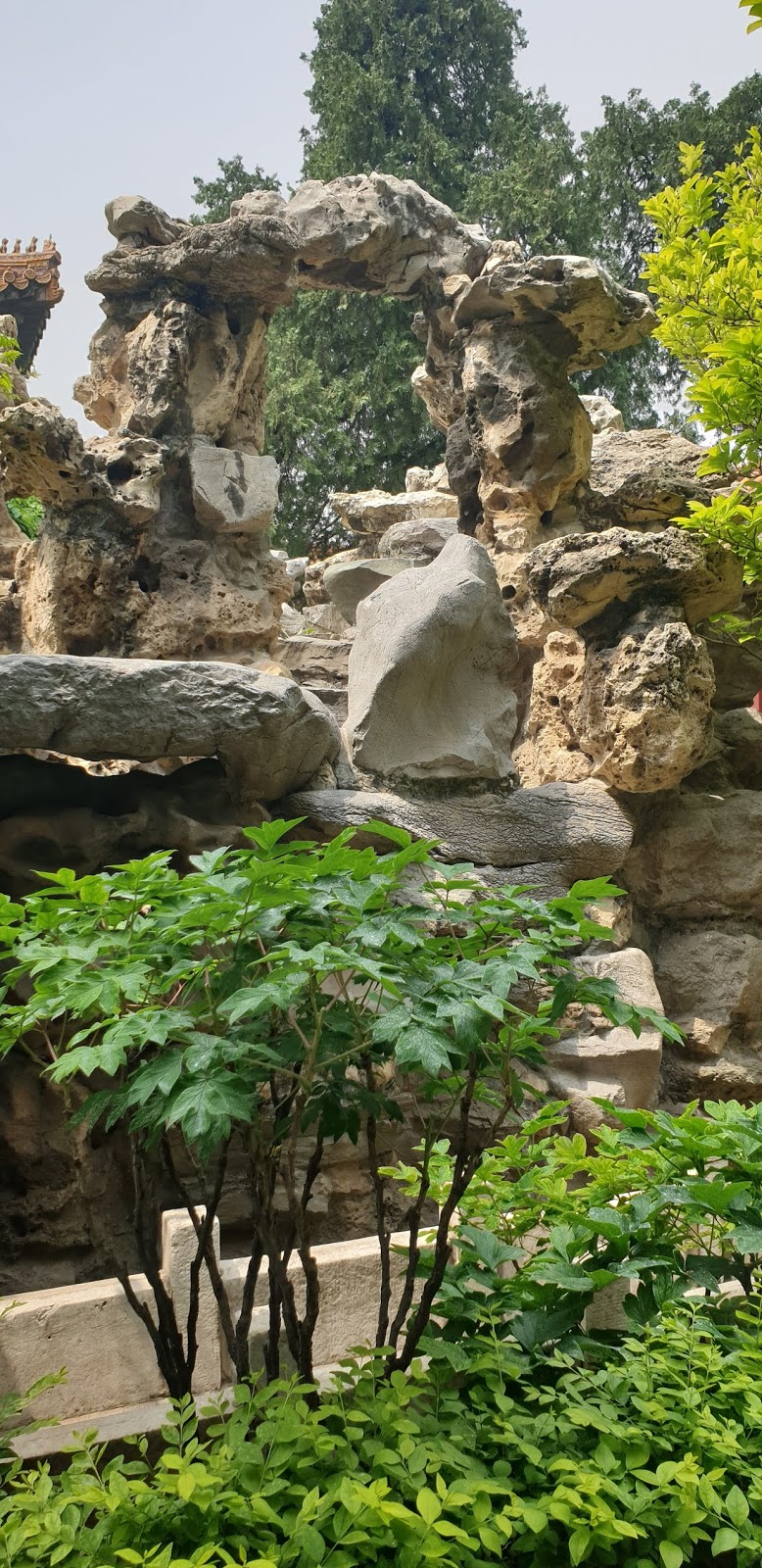
Out through some more alleyways and through an entrance that led to the area where the concubines lived, very spacious, bright, and filled with trees, plants, and walkways through rocky outcrops.

The whole area was made up of living quarters and waterways, rocks and paths, all very neatly set out, and it looked to be a very good place to live.

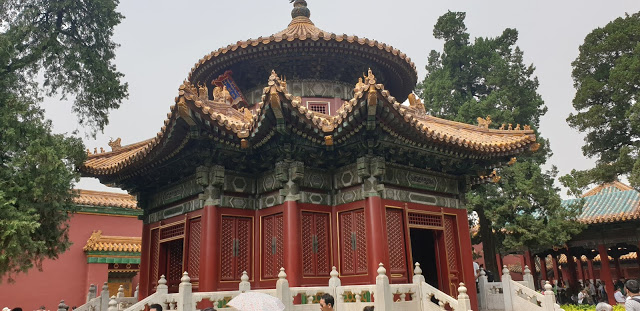
This is an example of the living quarters, overlooking the gardens

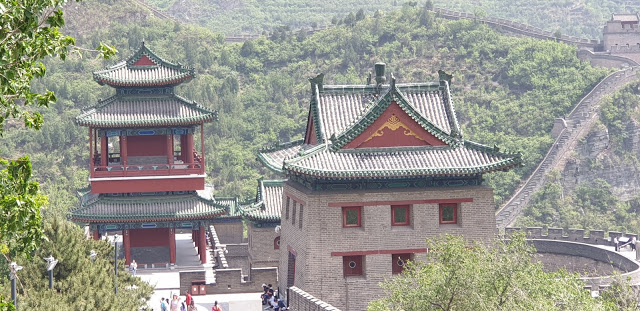
And there were several pagodas
From there its a quick exit out the northern entrance, and another longish walk to our bus, which arrives at the meeting point shortly after we do.

That done, the Beijing tour guide has completed her section of our China experience, and we’re ready to move onto the next.


Searching for locations: The Forbidden City, Beijing, China

Now we’re walking to the Forbidden City, and it seems like we’re walking for miles and we’re practically exhausted before we get started on the main tour.  I’m not sure if we received a map of the city, but one is certainly needed so that you can navigate the many features, buildings, and walkways.

There are tour groups everywhere in the large courtyard outside the gate, most likely getting a lecture on the last of the Chinese emperors about that time Sun Yat-Sen proclaimed the new China around 1912.  We were no exception, and it was an interesting way to spend the time waiting to get in.  It was a tale of intrigue, interwoven with a 3-year-old emperor, and a scheming concubine who becomes the Emperor’s favorite, enough to bear him a son and successor.

Bribery and corruption at its best.

But its history runs something like this:

The Forbidden City is was once the imperial and state residence of the Emperor of China, as well as the center of government, from the Ming Dynasty to the Qing Dynasty, or 1420 to 1924.

It was built from 1406 to 1420 when the Yongle Emperor moved the capital from Nanking to Beijing and consists of about 980 buildings, and 8,886 bays of rooms (not the 9,999 as prescribed in myth) and covers 180 acres.  Over the 14 years, a million workers used whole logs of wood from the jungles of southwestern China, marble from quarries near Beijing, specially made golden bricks from Suzhou

Since 1925 it has been a museum and is the largest number of preserved wooden structures in the world.

The city is surrounded by a wall 7.9 meters high, and a moat that is 6 meters deep and 52 meters wide.  A tower sits at each of the four corners.  Each side has a gate, the north is called the Gate of Divine Might, the south is called the Meridian gate.  East and west are called East Glorious Gate and West Glorious Gate respectively.

But, back in the courtyard, we are ready to go in and follow the tour guide who has switched from her amplified microphone to a whisper device we all wear in our ears.  She talks and we listen.

We all make it through and regroup on the other side. This is where the fun begins because we are about to meet a large percentage of the 80,000, they let for the day.

It seems to me they have all arrived at the same time, although by the time we get to the entrance gate, it is very well organized, bags are scanned, people are scanned, and you’re in.

After crossing one of the seven Golden Water bridges, you begin to get some idea of the size and scope of the City, and in the distance, the first of the buildings, The Gate of Supreme Harmony.  On a hot day, that could be a long and thirsty walk.

From there it is one pagoda after another with buildings that surround the edge of the whole Forbidden City, as does the moat.

By the time we get to the second courtyard, it was time to have ice cream as a refresher.  Others head up to another exhibit, and it’s just too many stairs for us.

After this, it’s a walkthrough another courtyard, heading up and down some more stairs, we go and see the museum, with priceless relics from past emperors.

There are areas like the outer courtyard, the inner courtyard, yet another courtyard, and the gardens where the concubines walked and spent their leisure time.  It is not far from the emperor’s wives living quarters, though there’s precious little left of the furniture, other than a settee and two rather priceless so-called Ming dynasty vases.

We get into the bad habit of calling all of the vases Ming dynasties.  Above is one of the inner courtyards there were living quarters, and that tree is over 300 years old.

Out through some more alleyways and through an entrance that led to the area where the concubines lived, very spacious, bright, and filled with trees, plants, and walkways through rocky outcrops.

The whole area was made up of living quarters and waterways, rocks and paths, all very neatly set out, and it looked to be a very good place to live.

This is an example of the living quarters, overlooking the gardens

And there were several pagodas

From there its a quick exit out the northern entrance, and another longish walk to our bus, which arrives at the meeting point shortly after we do.

That done, the Beijing tour guide has completed her section of our China experience, and we’re ready to move onto the next.

Searching for locations: The Great Wall of China, near Beijing, China

This is in a very scenic area and on the first impression; it is absolutely stunning in concept and in viewing.

As for the idea of walking on it, well, that first view of the mountain climb when getting off the bus, my first question was where the elevator is?  Sorry, there is none.  It’s walk on up or stay down the bottom.

Walk it is.  As far as you feel you are able.  There are quite a few who don’t make it to the top.  I didn’t.  I only made it to the point where the steps narrowed.

But as for the logistics, there’s the gradual incline to the starting point, and what will be the end meeting place.  From there, it’s a few steps up to the guard station no 7, and a few more to get up to the start of the main climb.  The top of the wall is guard station no 12.

Ok, those first few steps are a good indication of what it’s was going to be like and it’s more the awkwardness of the uneven heights of the steps that’s the killer, some as high as about 15 inches.  This photo paints an illusion, that it’s easy.  It’s not.

If you make it to the first stage, then it augers well you will get about 100 steps before you both start feeling it in your legs, particularly the knees, and then suffering from the height if you have a problem with heights as the air is thinner.  And if you have a thing with heights, never look down.

This was from where we stopped, about a third of the way up.  The one below, from almost at the bottom.  One we’re looking almost down on the buildings, the other, on the same level.

It requires rest before you come down, and that’s when you start to feel it in the knees, our tour guide called it jelly legs, but it’s more in the knees down.  Descending should be slow, and it can be more difficult negotiating the odd height steps, and particularly those high ones.  You definitely need to hang onto the rail, even try going backward.

And, no, that rail hasn’t been there as long as the wall.

While you are waiting for the guide to return to the meeting place at the appointed time, there should be time to have some jasmine tea.  Highly refreshing after the climb.

Searching for locations: The Great Wall of China, near Beijing, China

This is in a very scenic area and on the first impression; it is absolutely stunning in concept and in viewing.

As for the idea of walking on it, well, that first view of the mountain climb when getting off the bus, my first question was where the elevator is?  Sorry, there is none.  It’s walk on up or stay down the bottom.

Walk it is.  As far as you feel you are able.  There are quite a few who don’t make it to the top.  I didn’t.  I only made it to the point where the steps narrowed.

But as for the logistics, there’s the gradual incline to the starting point, and what will be the end meeting place.  From there, it’s a few steps up to the guard station no 7, and a few more to get up to the start of the main climb.  The top of the wall is guard station no 12.

Ok, those first few steps are a good indication of what it’s was going to be like and it’s more the awkwardness of the uneven heights of the steps that’s the killer, some as high as about 15 inches.  This photo paints an illusion, that it’s easy.  It’s not.

If you make it to the first stage, then it augers well you will get about 100 steps before you both start feeling it in your legs, particularly the knees, and then suffering from the height if you have a problem with heights as the air is thinner.  And if you have a thing with heights, never look down.

This was from where we stopped, about a third of the way up.  The one below, from almost at the bottom.  One we’re looking almost down on the buildings, the other, on the same level.

It requires rest before you come down, and that’s when you start to feel it in the knees, our tour guide called it jelly legs, but it’s more in the knees down.  Descending should be slow, and it can be more difficult negotiating the odd height steps, and particularly those high ones.  You definitely need to hang onto the rail, even try going backward.

And, no, that rail hasn’t been there as long as the wall.

While you are waiting for the guide to return to the meeting place at the appointed time, there should be time to have some jasmine tea.  Highly refreshing after the climb.

“Trouble in Store” – Short stories my way: Editing (2)

The story fleshed out for the second section, discussed in Point of View


Annalisa looked at the two men facing her, a shopkeeper who, despite his protestations, was a dealer, and the other man, a customer scared shitless.

The poor bastard was not the only one scared. 

It was meant to be simple, arrive at the shop just before closing, force the shopkeeper to hand over the shit, and leave.

What had happened?

The shopkeeper laughed at them and  told them to get out.  Simmo started ranting and waving the gun around, then all of a sudden collapsed. 

There was a race for the gun which spilled out of Simmo’s hand, and she won.  No more arguments, the shopkeeper was getting the stuff when the customer burst into the shop.

This was worse than any bad hair day, or getting out of the wrong side of bed day, this was, she was convinced, the last day of her life.

Her mother said she would never amount to anything, and here she was with a drug addict coming apart because she had been cut off from her money and could no longer pay for his supply, which had led them to this inevitable ending.

She heard a strange sound come from beside her and looked down.  Simmo was getting worse, like he had a fever, and was moaning.


If Alphonse had thought his day was going to get any better after the delivery disaster earlier that day, he was wrong.

If he thought he could maintain his real business and his under the counter business with no one finding out, in that he was wrong too.  He’s know, inevitably, some useless punk would come and do exactly what Simmo was doing.

It might have been salvageable before the customer came in the door, but now it was not.  The customer had heard the words, and given him ‘the look’.  A drug addict telling the cops he was a dealer, it was his word against an  unreliable addict, but this local chap, he had that air of respectability the cops would listen too.

Damn.

But he had to try and salvage the situation, there was a lot of money involved, and other people depending on him.  He looked at the boy, on the floor, then  the girl.

“Listen to me, young lady, I have no idea what you are talking about.  Please, put the gun down before someone gets hurt.  Your friend needs medical help and I can call an ambulance.”

The girl switched her attention back to him.  “Shut up, let me think.  Shit.”

The storekeeper glanced over at the customer.  He’s been in once or twice, probably lived in the neighborhood, but looked the sort who’d  prefer to be anywhere but in his shop.  More so now.  If only he hadn’t burst in when he did.  He would have the gun, called the police, and brazened his way out of trouble.  Now, that remedy was off the table.

Now he had to deal with the fallout, especially if the girl started talking.


© Charles Heath 2016-2020

“Trouble in Store” – Short stories my way: Editing (2)

The story fleshed out for the second section, discussed in Point of View


Annalisa looked at the two men facing her, a shopkeeper who, despite his protestations, was a dealer, and the other man, a customer scared shitless.

The poor bastard was not the only one scared. 

It was meant to be simple, arrive at the shop just before closing, force the shopkeeper to hand over the shit, and leave.

What had happened?

The shopkeeper laughed at them and  told them to get out.  Simmo started ranting and waving the gun around, then all of a sudden collapsed. 

There was a race for the gun which spilled out of Simmo’s hand, and she won.  No more arguments, the shopkeeper was getting the stuff when the customer burst into the shop.

This was worse than any bad hair day, or getting out of the wrong side of bed day, this was, she was convinced, the last day of her life.

Her mother said she would never amount to anything, and here she was with a drug addict coming apart because she had been cut off from her money and could no longer pay for his supply, which had led them to this inevitable ending.

She heard a strange sound come from beside her and looked down.  Simmo was getting worse, like he had a fever, and was moaning.


If Alphonse had thought his day was going to get any better after the delivery disaster earlier that day, he was wrong.

If he thought he could maintain his real business and his under the counter business with no one finding out, in that he was wrong too.  He’s know, inevitably, some useless punk would come and do exactly what Simmo was doing.

It might have been salvageable before the customer came in the door, but now it was not.  The customer had heard the words, and given him ‘the look’.  A drug addict telling the cops he was a dealer, it was his word against an  unreliable addict, but this local chap, he had that air of respectability the cops would listen too.

Damn.

But he had to try and salvage the situation, there was a lot of money involved, and other people depending on him.  He looked at the boy, on the floor, then  the girl.

“Listen to me, young lady, I have no idea what you are talking about.  Please, put the gun down before someone gets hurt.  Your friend needs medical help and I can call an ambulance.”

The girl switched her attention back to him.  “Shut up, let me think.  Shit.”

The storekeeper glanced over at the customer.  He’s been in once or twice, probably lived in the neighborhood, but looked the sort who’d  prefer to be anywhere but in his shop.  More so now.  If only he hadn’t burst in when he did.  He would have the gun, called the police, and brazened his way out of trouble.  Now, that remedy was off the table.

Now he had to deal with the fallout, especially if the girl started talking.


© Charles Heath 2016-2020