Life’s little experiences seem to have disappeared

I’m on a riverboat, sailing slowly down the Nile, ahead of us the Pyramids, a sight, I’m told, to behold despite the ravages of time.

There are others, a curious bunch of people, drawn from all over the globe, and from different classes, in a time when that seemed to matter.

Of course, it’s 1935.

And it’s all in my head.  Something I’d seen somewhere, or read perhaps, and now that I come to think of it, it was an Agatha Christie murder mystery.

Even now, nearly a hundred years later, it may have been possible to replicate it, only a world war, British Empire aspirations and later abandonment, and civil rife made it difficult but not impossible.

COVID 19 did that.

For someone who likes to travel the world, looking for locations, and inspiration, for my stories, the current travel ban has made life far more unbearable than just having to remain locked up for fear of catching it.

It’s the same as sitting at an outside cafe overlooking the main piazza in San Gimignano, having a pizza, an authentic pizza, and a bottle of Moretti.

Or like wandering the narrow cobbled streets of Florence, staying in what was once a 12th-century monastery, having wild boar pasta, and just a short distance away, a gelato.

Or wandering around similarly narrow and cobbled laneways in Montmartre, stopping at a corner crepe restaurant, where the crepes are to die for.

Taking that away is like taking away a hand, or a leg.

How long will it be before the world returns to normal, or will it?

In my conspiracy theory mind it seems to me there is more going on than just a virus spreading, it has overtones of world domination, or worse, watching the destruction of the world economy, and capitalism for want of a better word, at the same pace that climate change is changing the planet.

Neither occurrence is new, it’s happened time and time again over many millennia, it’s just we don’t seem to learn from it.   Well, maybe not in my lifetime.  Let’s hope generations to come do.


In a word: Choice

We are often told that it’s the choices we make that shape our lives.

It’s true.

What distinguishes the basis of those choices is the circumstances of the individual.

What a lot of people don’t realize is the diversity of backgrounds of everyone, and that in a minority of cases, the few that really have no choices at all.

Yes, there are those who have no control over their circumstances, and therefore no choice whatsoever.

Inevitably, the people who are first to criticize those who apparently made the wrong choice, are those that have never found themselves in similar circumstances.

And probably never will.

This perhaps is the biggest problem with governments who are staffed with advisors who do not understand the plight of the common man.

I never had the same opportunities as those who could afford a university education.  My family were working class and were relatively poor.  Had I not hot a scholarship who knows what sort of education I would have got, if any.

Certainly, my father never got an opportunity to get a good education, but, at the time, during the great depression, his choices were limited, whereas those with any sort of wealth it was a different story.

And his lack of choices reflected on us, and that lack of opportunity haunted all of us as time passed.

It was always a case of the haves and the have not’s.

Yes, we all have choices, but sometimes it really is the lesser of two evils, and not whether we will have the fillet or the rib eye steak.

When you ask the right (or wrong) question…

These are what can dumfound the strongest man, and terrify the most resolute woman.

Simple sentences of words placed in a particular order that designed to elicit a response.

Of course, no one tells you that your life may depend upon the answer you give.

So, when a man is asked a simple question like, ‘do I look good in this dress’, there are so many wrong answers that no matter what he says, the marriage, relationship, romance is over.

Similarly, that simple question, ‘how do you feel’, can be like opening the floodgates, or met with stony silence, or, more than likely, met with a dismissive ‘I feel good’.

There are questions asked in examination papers, the sort that is based on the year’s work, or what was supposedly covered in study groups.  As children, these questions hold varying amounts of terror, if you have failed to study.

There are questions asked at job interviews, and sometimes these don’t quite make any sense. For instance, ‘If you were in a store serving a customer and a man came in brandishing a gun, what would you do.’  I’m not sure what answer they are looking for.

Then there is that terrifying question you hoped would never be asked, ‘what do think your weaknesses are?’  I was fine with strengths, that’s easy, but weaknesses, that’s where the job application ended.

There is one other that has a simple answer but it often met with silence, a witticism, but rarely the truth.  Asking a woman, ‘what is your age?’

That’s a romance killer right there.  Right up there with, ‘where were you on the night of the 14th between the hours of 6pm and 12 pm.  You can hardly say you were in bed with your best friends wife, can you?

Can you see the bare bones of a mystery coming on?

20 questions for each suspect and witness, if any, then plot the crime from these testimonies.

I need a few days away from my current book and it seems a good idea for a short story.

In a word: Cell

For those who break the law, they will be very familiar with the eaning of the word cell.  It’s a room a jail, not very big, with an uncomfortable bed, and no sharp edges.

And I’m sure the prisoners are not supplied with knives so they can dig through the mortar and remove bricks on their way to the great escape.  That, I’m sure only happens at the movies.

A cell can also be a building block in the creation of humans, animals, fish, and plants.  No doubt there are a million other things that require cells.

Perhaps the most interesting aspect of this cellular activity is whether or not there is life, and therefore cells, on Mars.  I’m guessing we’ll have to wait a little longer to find out.

We can have a cell phone, which in some parts of the world is also the name of a mobile phone.

Don’t get me started on what I think of cell phones, or how intrusive they are on our everyday lives, the number of people who seem to be continually glued to the screen, or how many near misses there are in the street and crossing the road.

On the other hand cell phones in the hands of a writer are very useful because when we get flashes of story or plotlines in one of those once awkward moments, we can now jot it down on a cell phone scribbling pad.

A cell can also be used to describe a smaller unit within a larger organisation, or, if you are a thriller writer who dabbles in espionage, you will be very familiar with the concept of a sleeper cell.

Who knows, in reality, there might be some living next door to us and we would never know.  Oops, been watching too much television again.

Digging deeper into the more obscure definitions of the word cell, we come up with a single transparent sheet that has a single drawing on it, one of many that make up an animated film, or film.  If a film runs at 32 frames per second, that means there are 32 cells.

There are fuel cells

There are dry cell batteries

And as a general warning, don’t go too near cell towers or you will be a victim of radiation that might be extremely harmful to your health.

In a word: Ghost

Have you seen one?  I haven’t.  Yet.

I’ve stayed in a few places where ghosts were purported to be roaming the passages at night, but apparently not the night I was staying.

And that’s something else that I have a problem with, why is it ghosts only come out at night, or is that just the perception I have hot from reading up on the subject.

Maybe my view of ghosts is somewhat stilted, after all, I think my first introduction to ghosts was watching The Centerville Ghost, a movie I saw on t.v. when I was very young.

You have to admit Hollywood’s perception of ghosts is quite interesting.


But…

Do you think they are real?  Do I think they are real?

I think I would have to be presented with some fairly solid evidence they exist, but perhaps not to the point of meeting one.

There are, it seems countless examples of ethereal forces, you know, wind blowing where there’s no wind or draught outside, room temperatures dropping for no apparent reason, knocking, rattling of chains, strange noises like low moaning.


And yet…

There are hotels you can stay in such as the Chelsea Hotel in New York, where it’s possible to run into Sid Vicious.

Sorry, not staying there any time soon.

Then there’s the Hollywood Roosevelt Hotel in Los Angeles where it’s possible to run into Marylin Monroe, who lived in room 229.

That could be an interesting encounter.

Another is the Westin St Francis in San Francisco where the actress Virginia Rappe died while attending a party held in Fatty Arbuckle’s room, Arbuckle’s room, who was later accused of assaulting and murdering her, and whose career tanked after the incident.

Her ghost is seen moving about the hotel tearing her hair out.  It seems all of the spectral activity occurs on the 12th floor.


Good to know if I decide to stay there.  I wonder if they have a 13th floor?

Perhaps in too old to be running the gamut of paranormal experiences, the old heart is not as strong as it used to be.

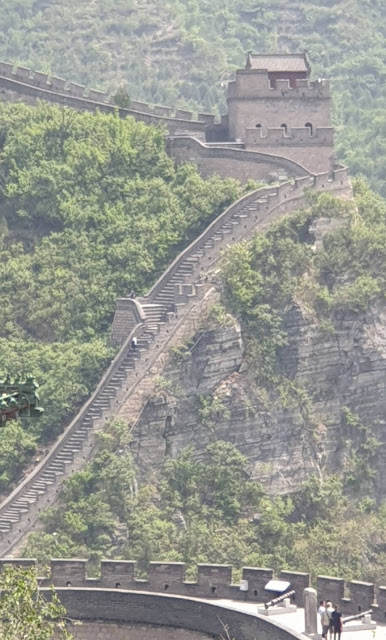
Searching for locations: The Great Wall of China, near Beijing, China

This is in a very scenic area and on the first impression; it is absolutely stunning in concept and in viewing.

As for the idea of walking on it, well, that first view of the mountain climb when getting off the bus, my first question was where the elevator is?  Sorry, there is none.  It’s walk on up or stay down the bottom.

Walk it is.  As far as you feel you are able.  There are quite a few who don’t make it to the top.  I didn’t.  I only made it to the point where the steps narrowed.

But as for the logistics, there’s the gradual incline to the starting point, and what will be the end meeting place.  From there, it’s a few steps up to the guard station no 7, and a few more to get up to the start of the main climb.  The top of the wall is guard station no 12.

Ok, those first few steps are a good indication of what it’s was going to be like and it’s more the awkwardness of the uneven heights of the steps that’s the killer, some as high as about 15 inches.  This photo paints an illusion, that it’s easy.  It’s not.

If you make it to the first stage, then it augers well you will get about 100 steps before you both start feeling it in your legs, particularly the knees, and then suffering from the height if you have a problem with heights as the air is thinner.  And if you have a thing with heights, never look down.

This was from where we stopped, about a third of the way up.  The one below, from almost at the bottom.  One we’re looking almost down on the buildings, the other, on the same level.

It requires rest before you come down, and that’s when you start to feel it in the knees, our tour guide called it jelly legs, but it’s more in the knees down.  Descending should be slow, and it can be more difficult negotiating the odd height steps, and particularly those high ones.  You definitely need to hang onto the rail, even try going backward.

And, no, that rail hasn’t been there as long as the wall.

While you are waiting for the guide to return to the meeting place at the appointed time, there should be time to have some jasmine tea.  Highly refreshing after the climb.

In a word: Brevity

Now, brevity is something that I have not been able to fully wrap my head around.

The dictionary explains Brevity as

‘concise and exact use of words in writing and speech’

So…

I remember working with a writer a long time ago who explained certain authors styles, and for James A Michener of Hawaii fame, he said Michener wrote sentences instead of words, paragraphs instead of sentences, pages instead of paragraphs and chapters instead of pages.

It was a little harsh considering I’d just read the book and had liked it, despite its length and the time it took.

But some time later I realized he was not criticizing Michener, but trying to tell me, in his, what I came to discover, interesting way, that I should strive to write more compactly.

I then came across a book by Brian Callison which was exactly that, the concise version, a story that fitted into about 200 pages.

That too was a good book and it took me a day to read it, and by his use of that economy of words, it read quickly.

Of course, I have tried over the years to emulate both styles, and to a certain degree, failing, because I think I have created my own style which is somewhere in between.

Still, when editing, it is always in the back of my mind that I should be

Using words instead of sentences

Using sentences instead of paragraphs

Using paragraphs instead of pages, and

Using pages instead of chapters.

The chapters, he said, with an air of amusement, will always take care of themselves.


In a word: Vision

I had one myself once, whether it was a peek into my future, or whether it was just playing out a scene for one of my stories, it was rather intense.

That variation of the word vision is one that uses one’s imagination. I do it quite a lot, and I call it the cinema of my dreams.

But…

Vision, in the simplest sense of the word, is sight, what you see.

People can try to make it better, like movie studios, who have called it rather interesting titles such as VistaVision or Panavision, either of which sounds quite remarkable, and it may have been back in the day, but it’s probably quite ordinary these days.

A vision, in another sense, might be something like a dream as mentioned before, which might happen when we are asleep, but if awake, it might be because we are very bored with our job and we’re imagining what it would be like at Santorini or the Bahamas, or anywhere but where you are now.

It might also describe our particular slant on what else we would like to happen, whether at work or somewhere else, but it’s usually confined to our closest circle of friends. Bosses never invite nor want to hear plebs ideas of improving their lot.

Hence, I have a vision…

But no one will listen. Perhaps if I was Martin Luther King, things might be different.

Then, at the end of it all…

There are visions and then there are visions, like seeing something that no one else can see, whether driven by hallucinogenic drugs or magic mushrooms, or you just happened to be there to see what no one else could.

Dragons, lizard people, or the Virgin Mary.

And no, I have not seen any of the above.

Yet.

Looking to Hollywood to create characters

I’m not sure how other people see your characters but sometimes I think mine are based on actors and actresses in various roles.

Ok, in the first instance, they are an amalgum of people I’ve met or seen before, but they always seem to have what might be called an avatar in the back of my mind.

So, as a case in point, some years ago I was writing a story, but I didn’t have a clear picture of what my character looked like.  I knew most everything else, but it made it difficult to go beyond a certain point.

Then I saw Bruce Willis in the original Die Hard, and the character suddenly took form in my mind.  Of course, Bruce Willis wouldn’t recognize that my character was based on him, but if the film of the book was ever made, back then, he would have been ideal cast as the main protagonist.

In another instance, I was writing a YA story for my granddaughter and after she read the first 10 chapters I asked her what she thought.  It was a good story, but the characters needed another dimension.

We then sat down and discussed who we might ask to play roles if we were casting a movie version.

It was unanimous, Lily James was Marigold.  Probably not now, but when we first saw her.  Emma Thompson was the Queen, and Jeremy Irons the King.  We had others for the captain of the guards, the good witch, and the bad witch.

Sometimes it takes a casting call to picture how your character might take physical form, and if the actors selected are very versatile there are so many traits you can pick up.

The question is, do you cast your characters?

Digging into the past

It seems rather strange reading letters that were written by my parents before they were married.

They’re not love letters, but just words, words that knowing my father and mother as I do, seem so totally at odds with that knowledge.

The thing is, I never knew anything of theirs from that era existed, even though I knew my mother was a hoarder, and we didn’t discover the extent of that phobia until it was time to move them from their last residence to the retirement home.

There were cases and boxes filled with papers, letters, cuttings, and everything else in between.  Nothing had been thrown out.

And whilst I knew those letters existed, there was the yuk factor involved, such that I would never want to read them because, well, that was my parents’ stuff.

So, all of it was sorted, most of it thrown away, and only what we thought was of any intrinsic value was kept.  Those letters were part of the ‘keep’ pile and ended up in an old metal steamer trunk, and there they have lived for about ten years.

With the recent cleaning of my office, much to Chester’s disdain, the trunk suddenly looked out of place in a clean room.

My grandchildren ‘found’ this trunk and started looking through the contents and finished up with the letters.

And, being the curious people, they were, they started reading them, of course, stumbling over understanding the handwriting, which was based on what we learned in school, cursive script.  That meant I had to interpret the writing for them.

Talk about morbid curiosity!

And like I said, in reading them, formed the impression that these two correspondents were nothing like the people I knew growing up.

These letters dated from 1948 and 1949 when they were married in June of 1949.  There was no doubt it was a different time, and they were different people.  My mother came from a country town and went to work in Melbourne around that time.  I know that during the war, those years from 1939 to 1945 she was a student at Dandenong High School.

It was odd to realize that considering we eventually moved to Dandenong, and that may have had something to do with it.

My father served in the war till 1946, and then after being discharged from the army, worked as a projectionist until he went overseas for nearly a year, ostensibly to see how the war had affected Europe.  After that, he went back to being a projectionist at the Athenaeum in Melbourne, and later on, not knowing much of his work history, he would always tell us about the movies, especially those that came up on television.

There’s more I’m sure, like the fact my mother had another chap on the go at the same time, but it seems he was not interested in settling down.

Perhaps more will come to light in further reading, but like it said, it seems very strange to be reading those letters, much like walking over a grave; it gives me the odd shiver down the spine.

No doubt, the next time the grandchildren visit there will be another installment.

They, at least, think the story is fascinating.