Searching for locations: Shanghai, China, by night.

When we arrive at the embarkation site we find at least 100 buses all lined up and parked, and literally thousands of Chinese and other Asians streaming through the turnstiles to get on another boat leaving earlier than ours.

Buses were just literally arriving one after the other stopping near where we were standing with a dozen or so other groups waiting patiently, and with people were everywhere it could only be described as organized chaos.

Someone obviously knew where everyone was supposed to go, and when it was our turn, we joined the queue.  There were a lot of people in front of us, and a lot more behind, so I had to wonder just how big the boat was.

We soon found out.

And it was amusing to watch people running, yes, they were actually running, to get to the third level, or found available seating.  Being around the first to board, we had no trouble finding a seat on the second level.

I was not quite sure what the name of the boat was, but it had 3 decks and VIP rooms and it was huge, with marble staircases, the sort you could make a grand entrance on.  The last such ornate marble staircase we had seen was in a hotel in Hong Kong, and that was some staircase.

But who has marble staircases in a boat?

We’re going out across the water as far as the Bund and then turn around and come back about 30 to 40 minutes.   By the time everyone was on board, there was no room left on the third level, no seats on the second level nor standing room at the end of the second level where the stairs up to the third level were.

No one wanted to pay the extra to go into the VIP lounge.

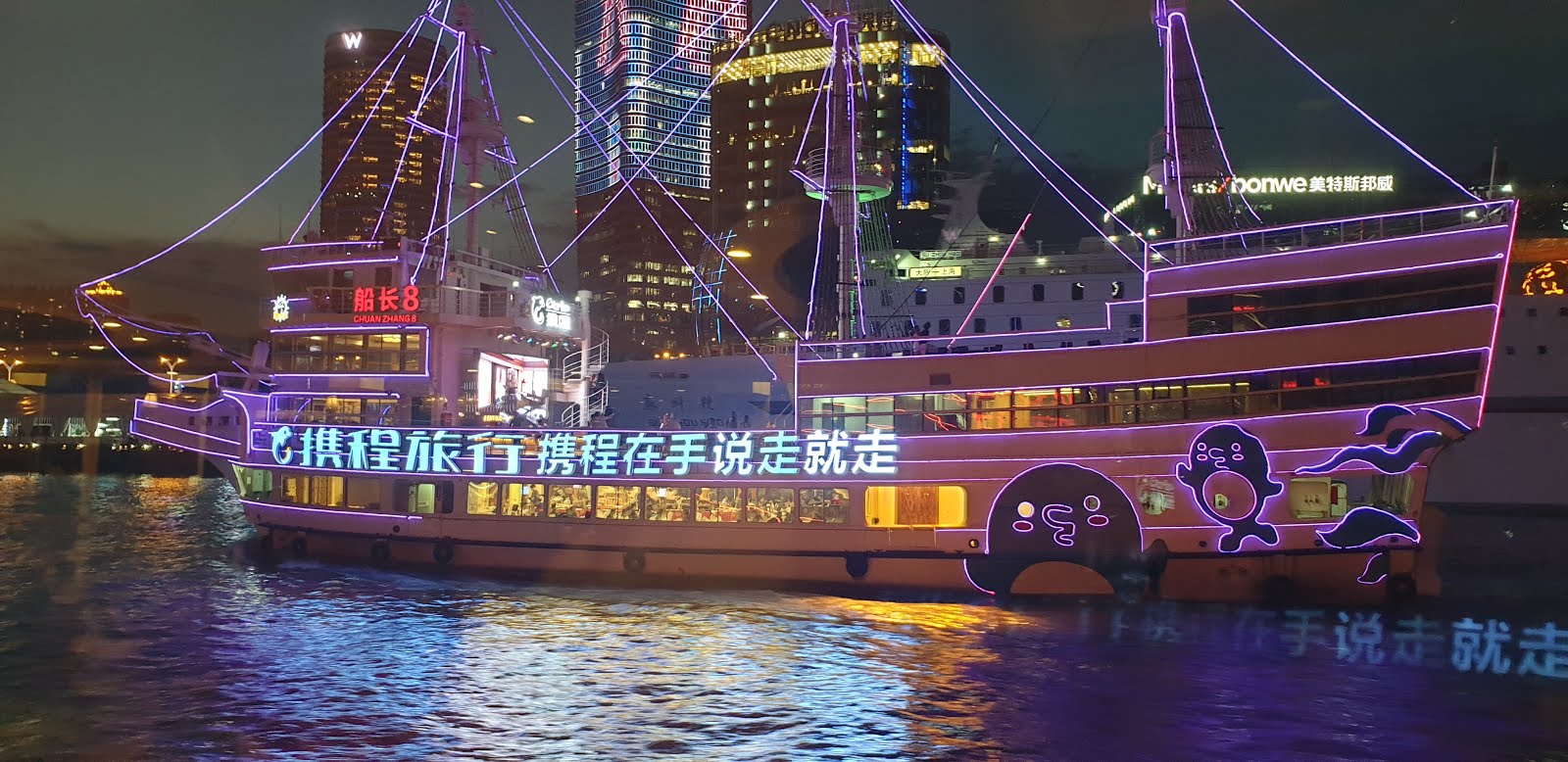
We were sitting by very large windows where it was warm enough watching the steady procession of the colored lights of other vessels, and outside the buildings.

It was quite spectacular, as were some of the other boats going out on the harbor.

All the buildings of the Bund were lit up

And along that part of the Bund was a number of old English style buildings made from sandstone, and very impressive to say the least.

On the other side of the harbour were the more modern buildings, including the communications tower, a rather impressive structure.

I had to go to the rear of the vessel to get a photo, a very difficult proposition given here was no space on the railing, not even on the stairs going up or down.  It was just luck I managed to get some photos between passengers heads.

And, another view of that communications tower:

There was no doubt this was one of the most colourful night-time boat tours I’ve ever been on.  Certainly, when we saw the same buildings the following day, they were not half as spectacular in daylight.

I never did get up to the third level to see what the view was like.

In a word: Maybe

This word, where I live, had taken on a new meaning.  We have telephone scammers who ask your name when you answer the phone, and when you say yes, they hang up.

It doesn’t take much imagination how they can use that recording.

So, I now answer the phone with maybe, which confuses the real callers who want to know if it is you.

Of course, maybe is one of those words that have so many meaning, but the best one is to use it while you have time to think of a proper answer.

For example, did you get the potatoes?  You haven’t been out, it slipped your mind, or you just plain forgot, but run with a ‘maybe’ so you can judge the reaction.

Angry face, you know no matter what, you’re in trouble.

Genial face, you know that it didn’t really matter and all is forgiven.

Then there’s the person who doesn’t know you and comes up to you in a crowded room.  Are you [put name here]?

Maybe.  We want to know if we’re in trouble, or if it for something good.

Using ‘maybe’ in writing probably isn’t the best word to us, but I like defying the experts.  You can always find a maybe or two in any of my books.

In a word: Stern

It’s what I’d always expected of my teachers, having to stand up the front of the classroom and look like they were in control.

These days, not so much, but back in my day, teachers, and particularly the men, were to be feared, and stern expressions were the features of an effective teacher.

So, in this context, it means a hardness or severity of manner.

Whilst in a sense that was frightening to us kids, another form of the word also can be used to express a forbidding or gloomy appearance.

Grandfathers also have that stern look, but it’s more forbidding, more authoritarian, more severe, more austere, well, you get the picture.  A six-year-old would be trembling in his or her boots.

There again, in facing up to either possibility above, you could stand firm with a stern resolve not to buckle under the pressure.

Of course, not a good idea if you’re facing a tank (with a stern-looking tank master)

Then…

If you’re standing at the end of the boat, not the front, but the rear, you would be standing at the stern of the boat, or ship.

Oddly, when issuing instructions to go in reverse, not something you would say if you were on the bridge, you would instead say, or possibly yell, full speed astern, because you’re about to hit an iceberg.

Or some idiot in a jet ski who likes to think he or she can beat the bullet (or 65,000 tonnes of a ship that has very little mobility).

The devil features prominently in a lot of sayings

For instance, I’ve heard someone mutter, “the devil you say…”

Or another, who was telling his friend, who, at the time was in a spot of bother, ‘You’re between the devil and the deep blue sea.”

Wrong.  We all know the sea is green, not blue.

But whatever the circumstances, the devil seems to pop up a lot.

For instance,

Better the devil you know than the devil you don’t.

It seems I’ve heard that somewhere before, or at least a part of it.  Hmmm.

Maybe you’ve “gone to the devil”.  Can that be paired with “going downhill at a rapid rate of knots”?

OK, it’s impossible to go downhill using the speed measure of knots, that only applies to boats, so who came up with that saying, a landlubber sailor?

Hang on, isn’t there a team called the New Jersey Devils?  Funny, I didn’t see if the players had horns or not, and they were using hockey sticks not tridents.

Maybe I misheard.

Neutral men are the devil’s allies, therefore there must be a lot of devils in Switzerland

The devil finds work for idle hands, oh yes, my grandmother used this often on me whenever she caught me doing nothing, or digging around in her magazine room … which was a lot

But my favorite,

When in hell, only the devil can show you the way out.

I’m still trying to find him!

Searching for locations: The Forbidden City, Beijing, China

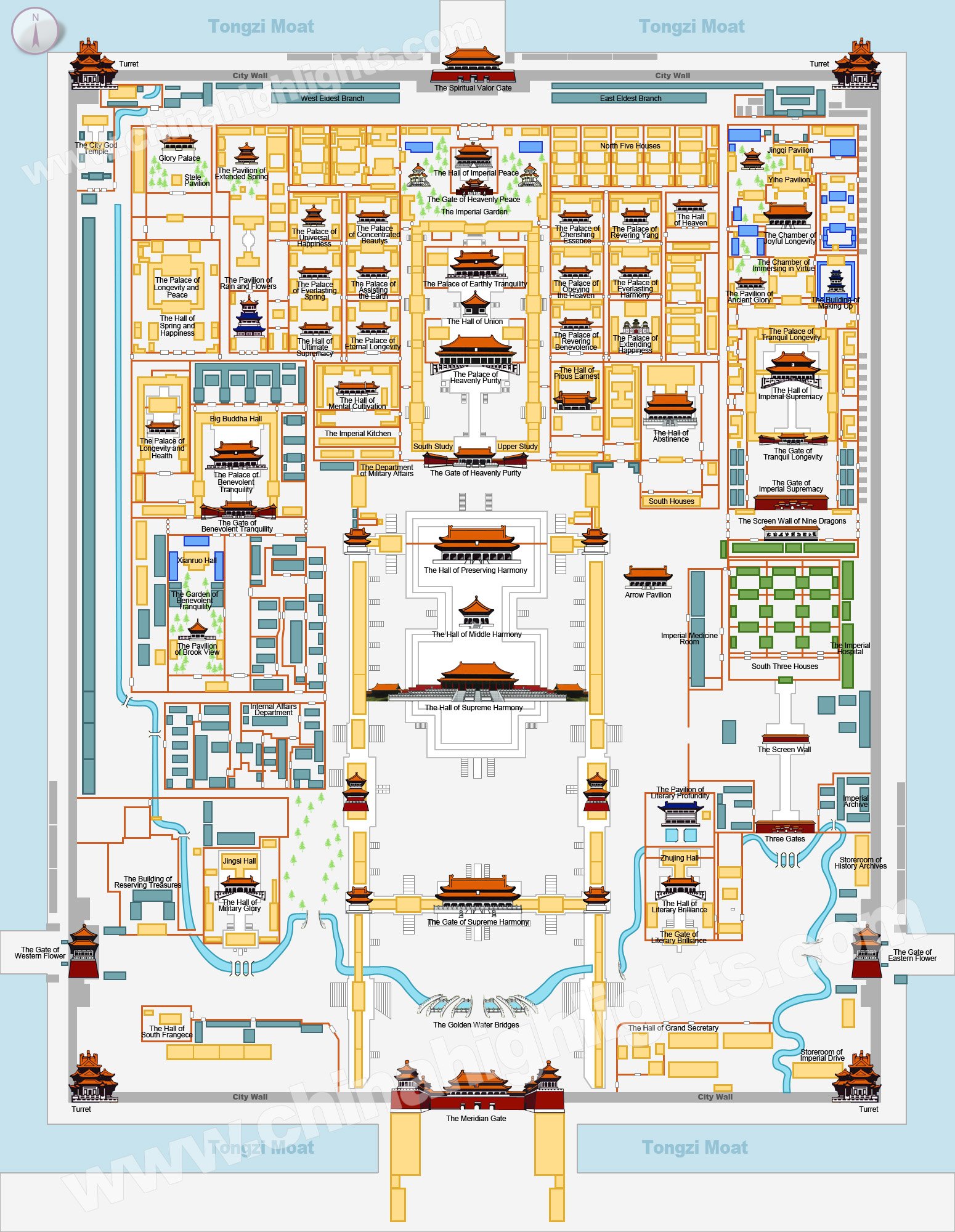
Now we’re walking to the Forbidden City, and it seems like we’re walking for miles and we’re practically exhausted before we get started on the main tour.  I’m not sure if we received a map of the city, but one is certainly needed so that you can navigate the many features, buildings, and walkways.
There are tour groups everywhere in the large courtyard outside the gate, most likely getting a lecture on the last of the Chinese emperors about that time Sun Yat-Sen proclaimed the new China around 1912.  We were no exception, and it was an interesting way to spend the time waiting to get in.  It was a tale of intrigue, interwoven with a 3-year-old emperor, and a scheming concubine who becomes the Emperor’s favorite, enough to bear him a son and successor.

Bribery and corruption at its best.

But its history runs something like this:

The Forbidden City is was once the imperial and state residence of the Emperor of China, as well as the center of government, from the Ming Dynasty to the Qing Dynasty, or 1420 to 1924.

It was built from 1406 to 1420 when the Yongle Emperor moved the capital from Nanking to Beijing and consists of about 980 buildings, and 8,886 bays of rooms (not the 9,999 as prescribed in myth) and covers 180 acres.  Over the 14 years, a million workers used whole logs of wood from the jungles of southwestern China, marble from quarries near Beijing, specially made golden bricks from Suzhou

Since 1925 it has been a museum and is the largest number of preserved wooden structures in the world.

The city is surrounded by a wall 7.9 meters high, and a moat that is 6 meters deep and 52 meters wide.  A tower sits at each of the four corners.  Each side has a gate, the north is called the Gate of Divine Might, the south is called the Meridian gate.  East and west are called East Glorious Gate and West Glorious Gate respectively.

But, back in the courtyard, we are ready to go in and follow the tour guide who has switched from her amplified microphone to a whisper device we all wear in our ears.  She talks and we listen.

We all make it through and regroup on the other side. This is where the fun begins because we are about to meet a large percentage of the 80,000, they let for the day.

It seems to me they have all arrived at the same time, although by the time we get to the entrance gate, it is very well organized, bags are scanned, people are scanned, and you’re in.

After crossing one of the seven Golden Water bridges, you begin to get some idea of the size and scope of the City, and in the distance, the first of the buildings, The Gate of Supreme Harmony.  On a hot day, that could be a long and thirsty walk.

From there it is one pagoda after another with buildings that surround the edge of the whole Forbidden City, as does the moat.

By the time we get to the second courtyard, it was time to have ice cream as a refresher.  Others head up to another exhibit, and it’s just too many stairs for us.

After this, it’s a walkthrough another courtyard, heading up and down some more stairs, we go and see the museum, with priceless relics from past emperors.

There are areas like the outer courtyard, the inner courtyard, yet another courtyard, and the gardens where the concubines walked and spent their leisure time.  It is not far from the emperor’s wives living quarters, though there’s precious little left of the furniture, other than a settee and two rather priceless so-called Ming dynasty vases.

We get into the bad habit of calling all of the vases Ming dynasties.  Above is one of the inner courtyards there were living quarters, and that tree is over 300 years old.

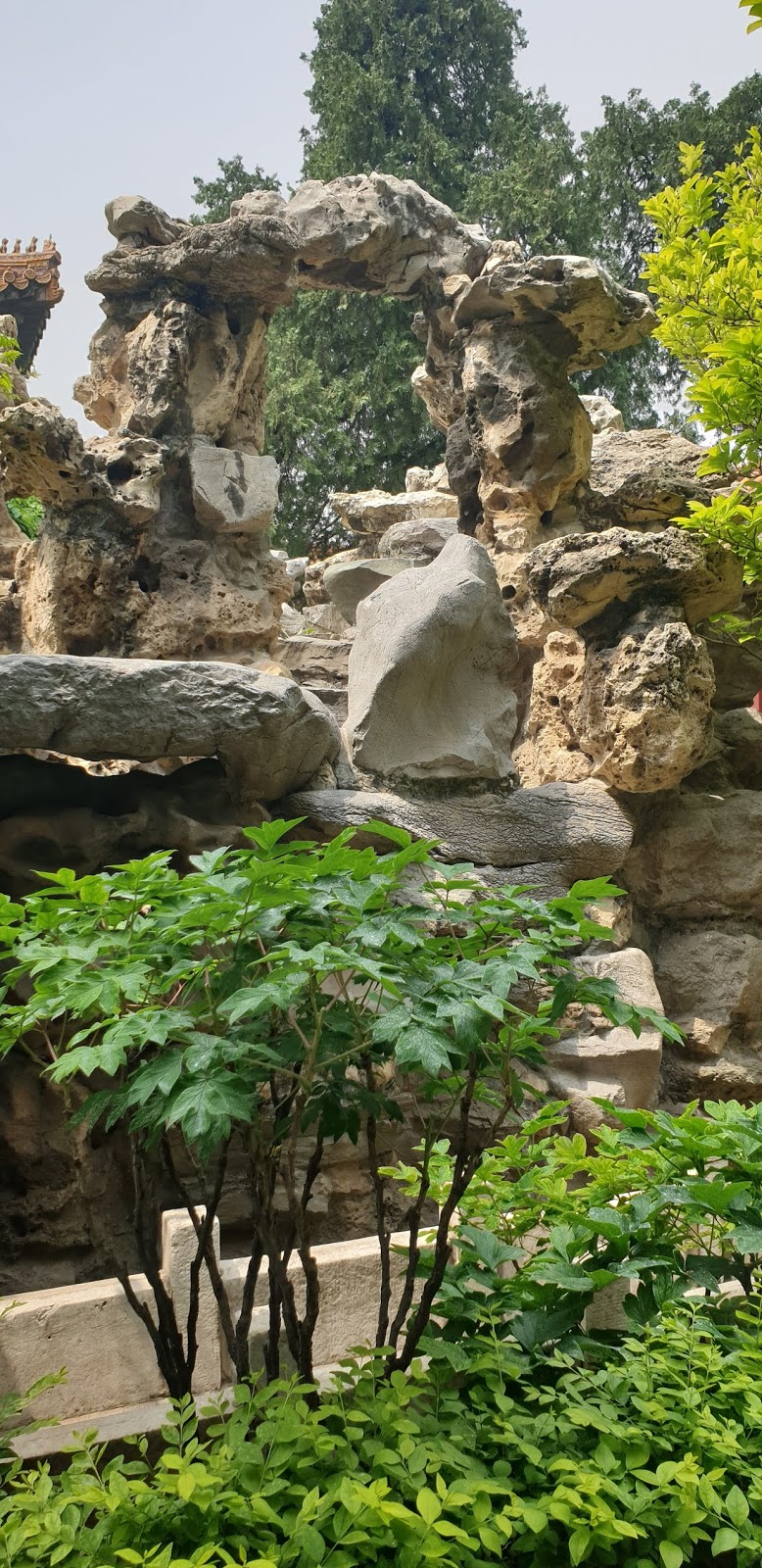
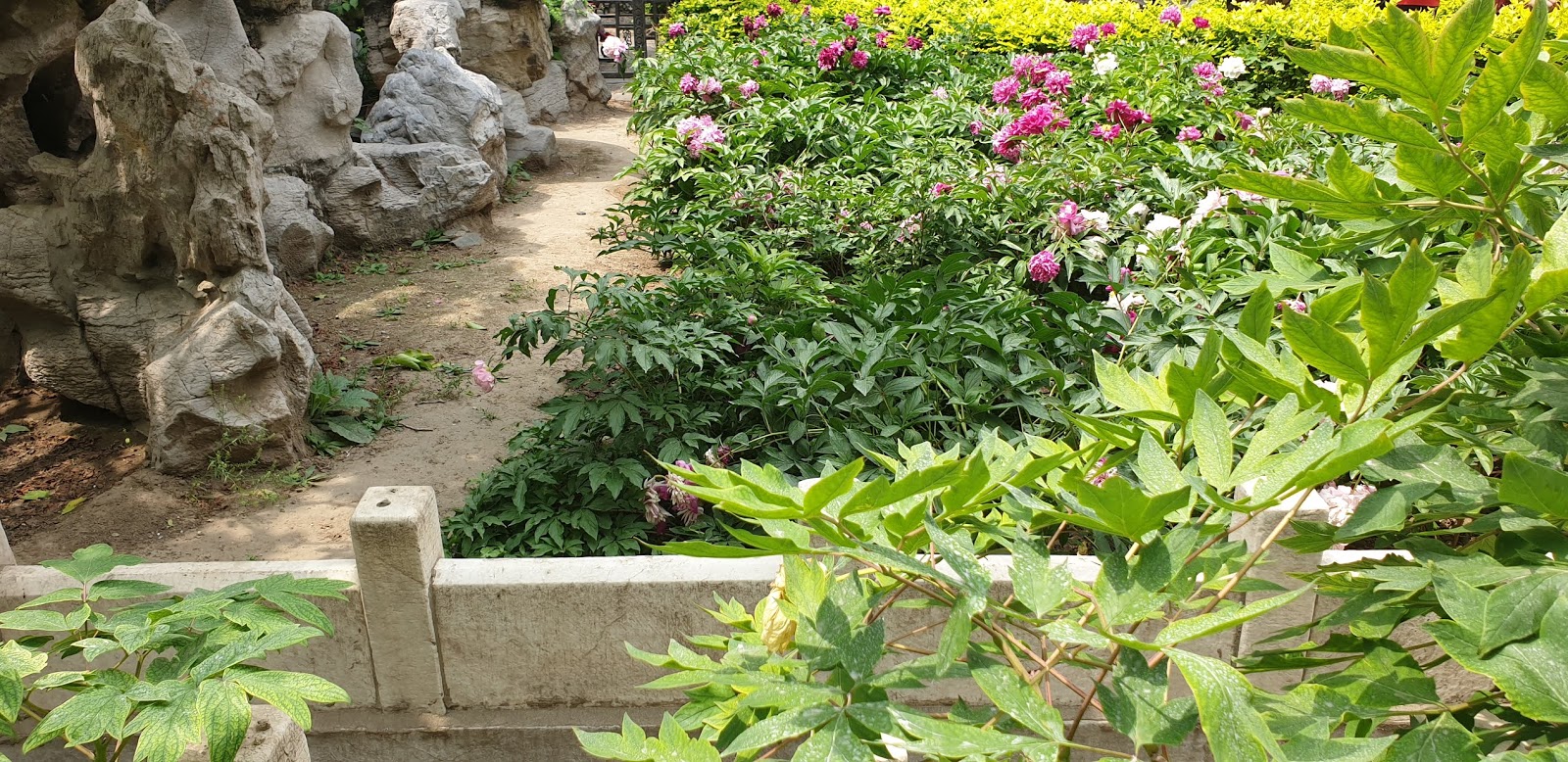
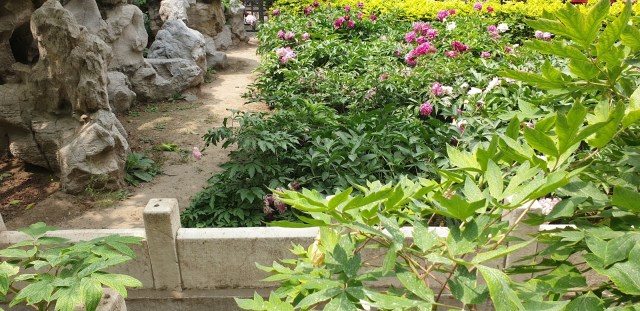
Out through some more alleyways and through an entrance that led to the area where the concubines lived, very spacious, bright, and filled with trees, plants, and walkways through rocky outcrops.
The whole area was made up of living quarters and waterways, rocks and paths, all very neatly set out, and it looked to be a very good place to live.

This is an example of the living quarters, overlooking the gardens
And there were several pagodas

From there its a quick exit out the northern entrance, and another longish walk to our bus, which arrives at the meeting point shortly after we do.

That done, the Beijing tour guide has completed her section of our China experience, and we’re ready to move onto the next.

In a word: Blank

Yes, I’m drawing a blank, which means I have no idea

It seems that I do this a lot these days, perhaps one of the perils of being a writer

But…

Using blank in a story doesn’t necessarily convey the antagonist is clueless, more likely he or she just used one in a gun, put there by a person who didn’t want to get shot.

No, still drawing a blank on this one.

A blank space means there’s nothing in it, and you see a lot of these in crosswords and sudoku, even when the user has been toiling for hours

I’m thinking anyone who met me might misinterpret my blank expression, well, it’s not too expressive in the first place

Perhaps before the coin becomes a coin; it is a piece of blank metal to begin with.  How good would it be to get a one-sided coin, that’d be worth a lot?

And the very worst description of blank; having a blank piece of paper in front of you, and you really are drawing a blank!

In a word: well

At first, you would think this word has something to do with your health.

You’d be right.  “Are you well?” or “Are you well enough?”

Of course, it can cause some confusion, because how do you measure degrees of wellness.

Reasonably well, very well, not well, or just well.  Not a good descriptive word for the state of your health, maybe.

How about what if the team played well.  Not health this time, but a standard.

There’s ordinary, mediocre, as a team, brilliantly, and then there’s well.

It seems it can be used to describe an outcome.

Well, well.

Hang on, that’s something else again.

What about, then, we use the word to describe a hole in the ground with water at the bottom.

Or not if it is a drought.

A lot of people get water from a well, in fact in the olden days that was a common sight in a village.

What about those environment destroyers, oilmen.  They have oil wells, don’t they?

And when I went to school, there were ink wells on every desk.

Messy too, because I was once the ink monitor.

But if the well’s dried up?

It becomes a metaphor for a whole new bunch of stuff.

OR what about a stairwell?

And at the complexity of it all, for such a small word, tears well up in my eyes.

Searching for locations: Queenstown, New Zealand, from the top of a mountain

You take the gondola up to the Skyline and get some of the most amazing views.

Below is a photo of The Remarkables, one of several ski resorts near Queenstown.

You can see the winding road going up the mountainside.  We have made this trip several times and it is particularly frightening in winter when chains are required.

theremarkables3

In the other direction, heading towards Kingston, the views of the mountains and the lake are equally as magnificent.

theviewfromthegondolaquwwnstown

Or manage to capture a photo of the Earnslaw making its way across the lake towards Walter Peak Farm.  It seems almost like a miniature toy.

In a word: Pad

Here is another of those three letter words that can have so many meanings that it is nigh on impossible to pin it down.

You have to use it in a sentence which all but explains it.

For instance,

A pad might be a writing pad, or a note pad, something on which you can write, notes, stories, anything really, even doodles.

Cats, dogs, a lot of animals have padded feet.  I’d say, for a cat, those pads would be like shock absorbers.

You can pad an expense account with false expenditure in an accounting sense, I’m sure a lot of people are tempted to do so.

I know places, where a single man might live, is called a bachelor pad.  So many men like to think they may have one, but it takes money to buy the accouterments of seduction.

Then there’s a medical dressing, a square of gauze called a pad, usually absorbent and soaked in disinfectant to help protect and repair a wound.

Shoulder pads, for broader shoulders

KInee pads, for when crashing off a bike

Shin pads for soccer, and ice hockey players

A helipad which is for helicopter landings and takeoffs, much the same as a launch pad for rockets.  Unfortunately, rockets do not generally have a tendency to land, not unless they are bombs, like the V1 and V2 rockets of WW2.

It could also be someone walking around a house in socks, the man stealthily approached the thief, padding silently in his socks so he wouldn’t be heard.

And lastly,

A place for frogs to hang out, ie, the flat leaves of a water Lilly.

Any more?

I’m sure there is, just let me know.


Just one of many reading lists – part 2

**Please don’t assume that you have to, nor would I ever expect you to,  read any or all of these books.  You don’t.**

Everyone, it seems, will publish what they call the top 100 books that you should read.  Some are voted on, some belong to the opinion of the editor of the book review section of a newspaper, and, as you know, there are a lot of newspapers, a lot of editors, and a lot of opinions.

I’m not a newspaper, I’m not an editor, but I have a list, based on personal experience, and many, many years of reading.

It’s in no particular order.

21.  Passage of Arms by Eric Ambler, I have to say I have read most of his novels and they are very good

22.  Jane Eyre by Charlotte Bronte, a very powerful story of a courageous, independent woman

23.  The Riddle of the Sands by Erskine Childers, a 1903 secret service story, and a good example of an early espionage novel

24.  The Father Brown stories by G. K. Chesterton, which features a Roman Catholic priest who is also an amateur detective

25.  The Grantchester Mysteries by James Runcie, similar to the above, but featuring an Anglican vicar Sidney Chambers and set in the 1950s.  Recently brought to life on television.

26.  The High Commissioner by Jon Cleary, an Australian author, this novel introduces Sargeant Scobie Malone, in the first of many adventures

27.  A Tale of Two Cities by Charles Dickens, the first Dickens book I read, possibly because it was one of the shortest, and paved the way to read all of his books.  Who could forget Madame Defarge

28.  Brideshead Revisited by Evelyn Waugh, another of those delightful but depressing stories of the 20s through to the 40s, perhaps for some, the golden age.  What could be said, in the end, about the Flytes?

29.  The Godfather by Mario Puzo, is the story of the Corleone mafia family, and for me, the most interesting part was that of the horse’s head, and of course, the death and mayhem

30.  The Shipping News by Annie Prouix, a Pulitzer Prize winner, and a story about a man, Quoyle, who against all odds puts his life slowly back together

31.  Detection Unlimited by Georgette Heyer, noted mostly for her Regency romances, she also wrote a series of detective novels.  This was her last detective novel published in 1953

32.  Poldark by Winston Graham, a series of stories about the Poldarks and Cornwall, and his arch-nemesis, George Warleggan

33.  Our Man in Havana by Graham Greene, one of many very interesting novels, this the first I read, followed by the Quiet American and Travels With My Aunt.  Seeing movies of some didn’t enhance the reading experience.

34.  The Mayor Of Casterbridge by Thomas Hardy, another of his interesting but sometimes hard to read novels of rural England.  This led to Jude the Obscure and others in the ‘series’.  It all started with Tess of the D’Urbervilles.

35.  A Farewell to Arms by Ernest Hemingway, set during the Italian campaign of World War 1.  He also wrote The Old Man of the Sea

36.  Lucky Jim by Kingsley Amis, I don’t think he was all that lucky

37.  Whiskey Galore by Compton MacKenzie, the story of the ‘rescue’ of several hundred cases of whiskey and the locals’ efforts to hide it.  Also famous for writing Monarch of the Glen, later a television series

38.  The Expedition of Humphry Clinker by Tobias Smollett, a collection of satirical observations of English life in the 1700s in spa towns and seaside resorts

39.  Barchester Towers by Anthony Trollope, part of the series known as The Chronicles of Barsetshire and features the unpopular Bishop Proudie and Mrs. Proudie

40. The Mysterious Affair at Styles by Agatha Christie, Christie’s first book published in 1920, and introduced Poirot, Arthur Hastings, and Inspector Japp.  Who knew so many books would follow

The list continues