Searching for locations: San Gimignano, Italy

We have visited this town on a hill, famous for its fourteen towers, twice.  The first time we stayed in a hotel overlooking the main piazza, and the second time, for a day visit, and return to a little restaurant tucked away off the main piazza for its home cooking.

No cars are allowed inside the town and parking is provided outside the town walls.  You can drive up to the hotel to deliver your baggage, but the car must return to the carpark overnight.

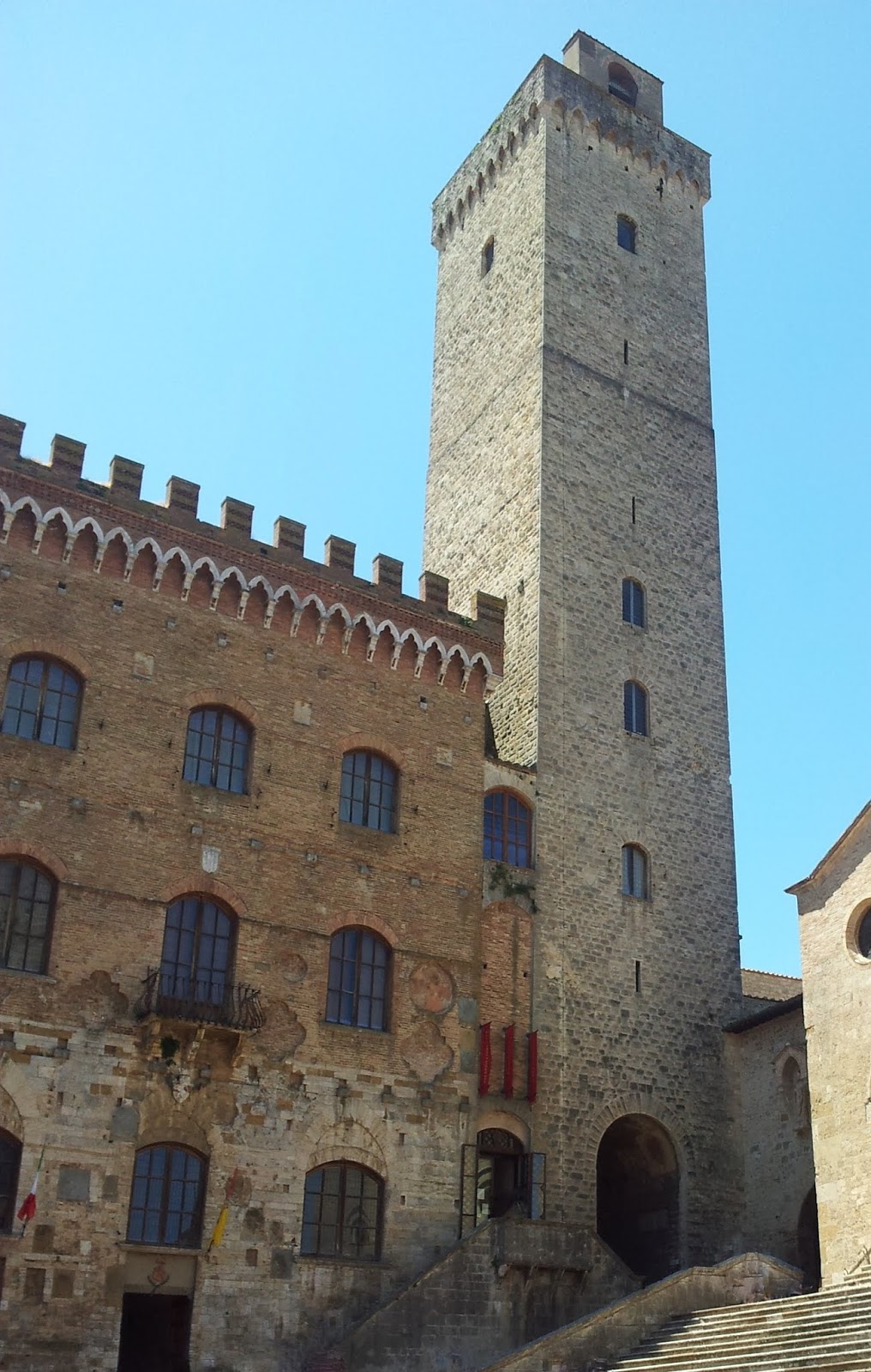
This is one of the fourteen towers

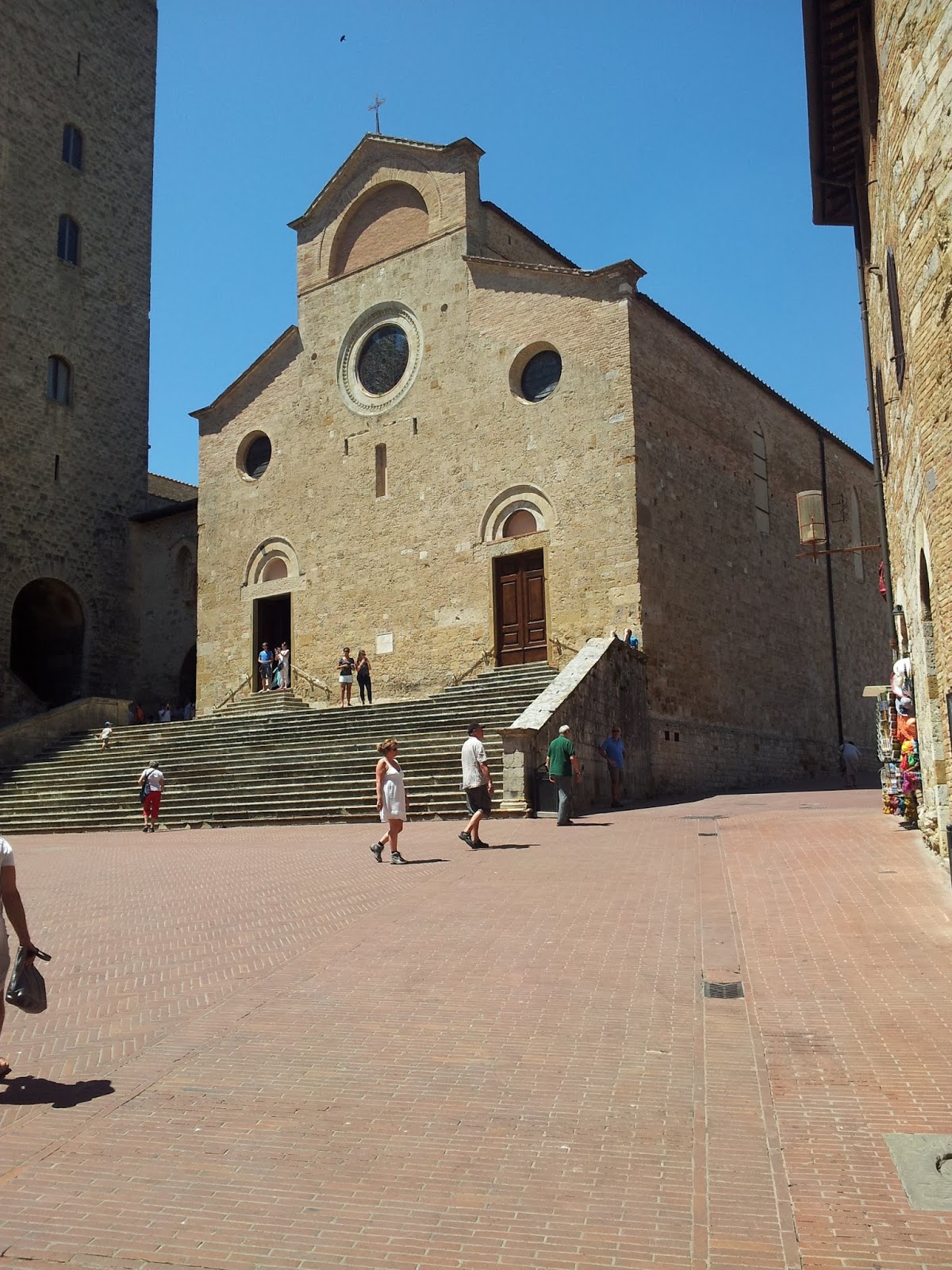
I didn’t attempt to climb to the tower, which you can do in some of them, just getting up the church steps was enough for me.  Inside the building was, if I remember correctly, a museum.

Looking up the piazza towards some battlements, and when you reach the top and turn left, there is a small restaurant on the right-hand side of the laneway that had the best wild boar pasta.

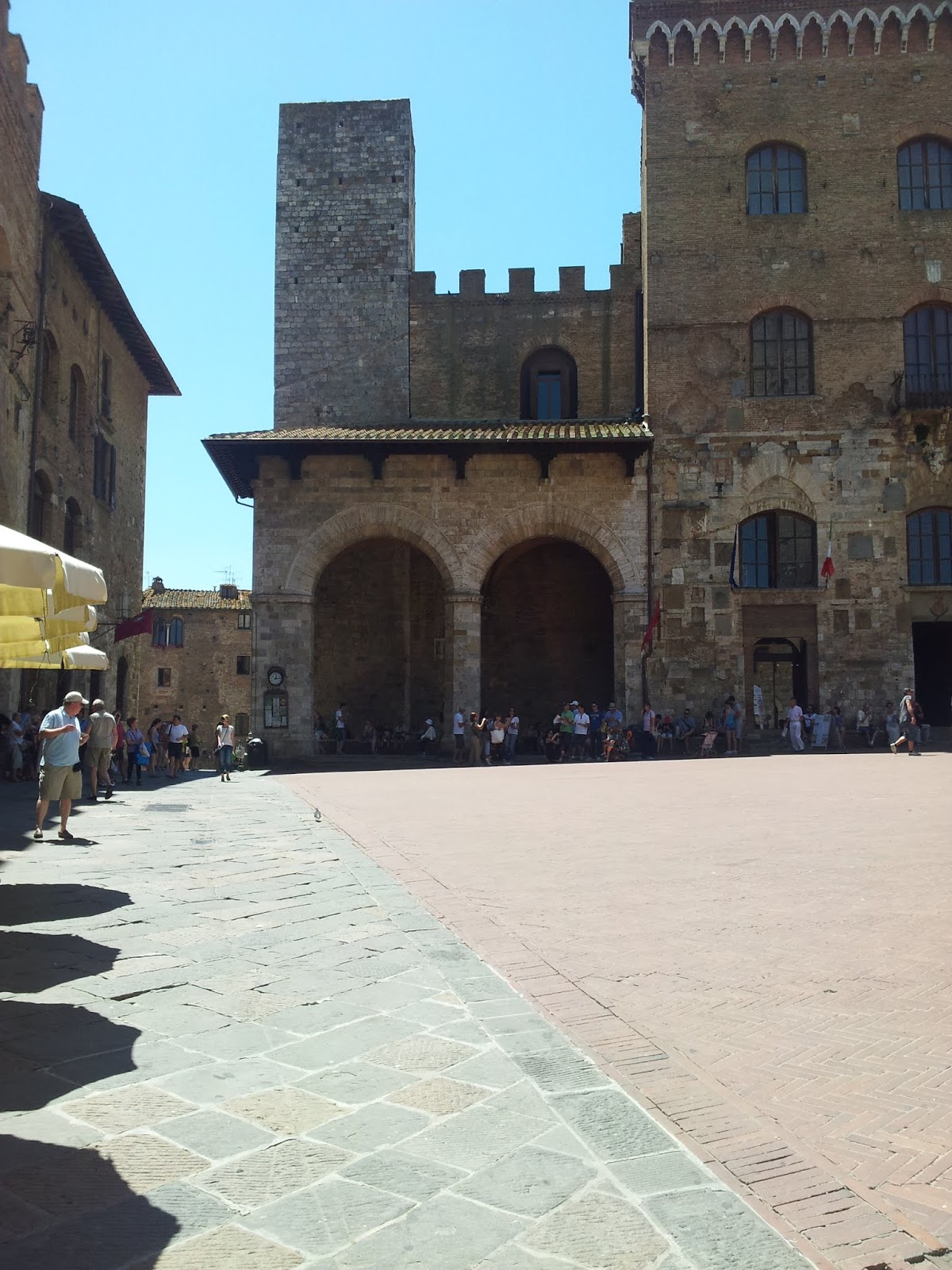
Another of the fourteen towers, and through the arch, down a lane to the gated fence that surrounds the town.  The fortifications are quite formidable and there are several places along the fence where you can stand and look down the hill at the oncoming enemy (if there was one).

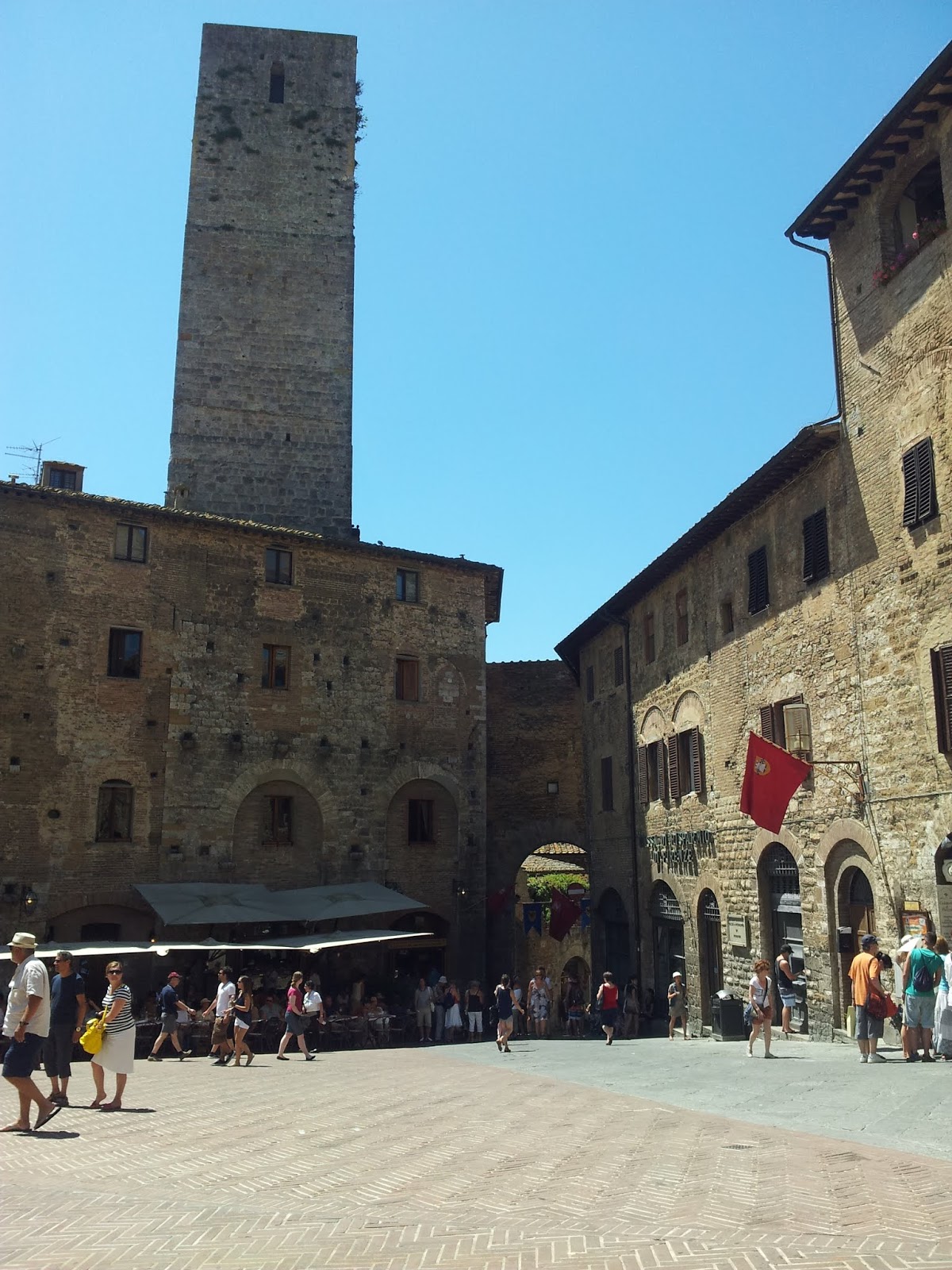
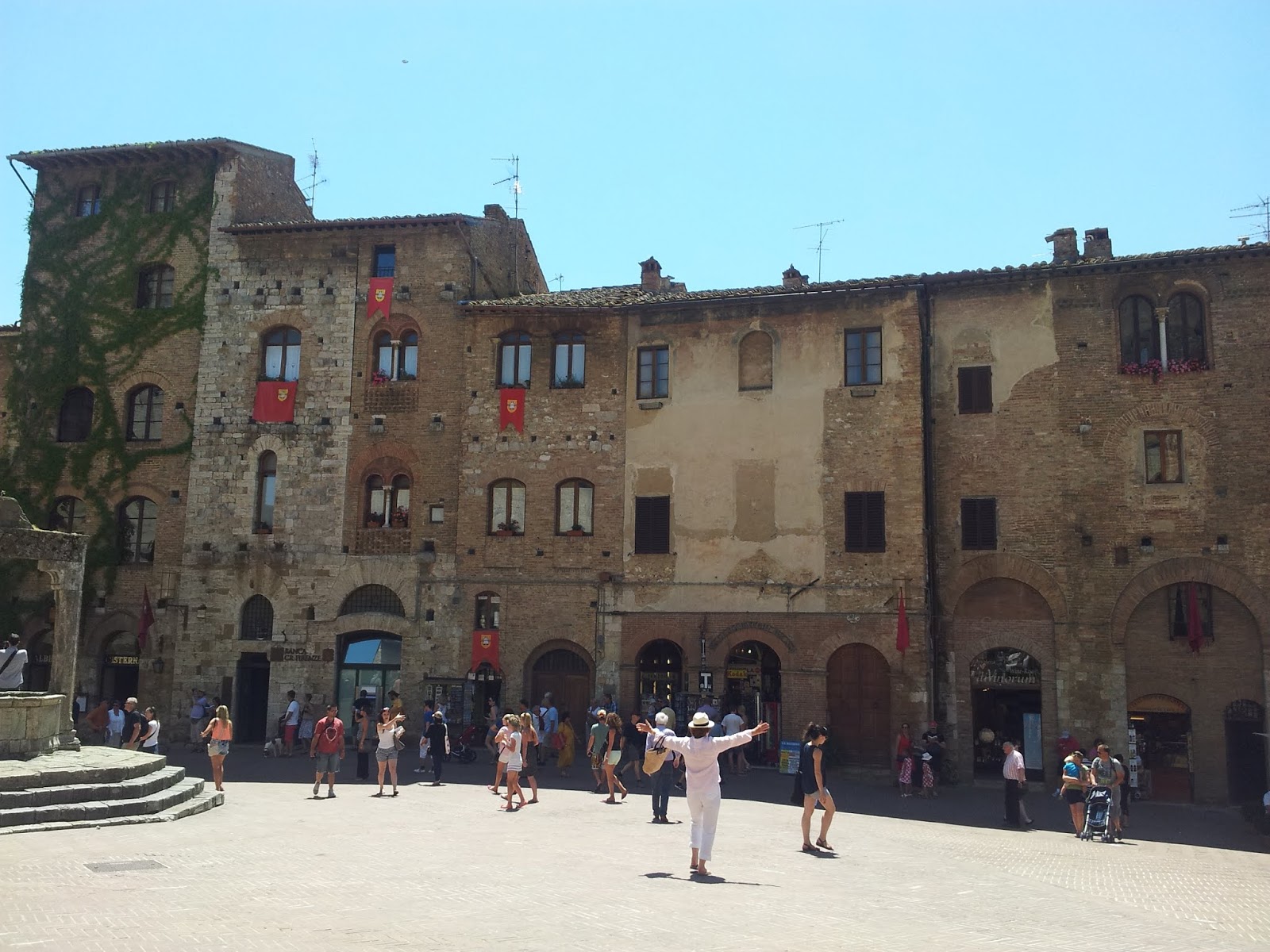
Part of the main piazza which is quite large, and on the right, the wishing well where my wish for a cooler day was not granted.

Officially, the Piazza della Cisterna is the most beautiful square of the town, San Gimignano.  The well was built in 1273 and enlarged in 1346 by Podestà Guccio dei Malavolti.

And not to be outdone by any other the other old towns, there is an old church, one of several.  It is the Collegiate Church or the Duomo di San Gimignano, a monument of Romanesque architecture built around 1000 and enlarged over time.

Next door is the Museum of Sacred Art.

And I guess it’s rather odd to see television aerials on top of houses that are quite literally about a thousand years old.  I wonder what they did back then for entertainment?

In a word: Blank

Yes, I’m drawing a blank, which means I have no idea

It seems that I do this a lot these days, perhaps one of the perils of being a writer

But…

Using blank in a story doesn’t necessarily convey the antagonist is clueless, more likely he or she just used one in a gun, put there by a person who didn’t want to get shot.

No, still drawing a blank on this one.

A blank space means there’s nothing in it, and you see a lot of these in crosswords and sudoku, even when the user has been toiling for hours

I’m thinking anyone who met me might misinterpret my blank expression, well, it’s not too expressive in the first place

Perhaps before the coin becomes a coin; it is a piece of blank metal to begin with.  How good would it be to get a one-sided coin, that’d be worth a lot?

And the very worst description of blank; having a blank piece of paper in front of you, and you really are drawing a blank!

Searching for locations: Arezzo, Italy

There’s nothing like being a few days early or a few days late for a major festival.

We have the dubious honor of being able to both without thinking. I guess this is why you should try to plan your holiday around events, if possible.

We love Italy.

We’ve been a number of times, but the last visit was the best. Of course, it was not without a lot of hiccups just getting there, but in the end, later than we expected, actually about five minutes before they closed Florence airport, we made it.

So, little did we know there was such a thing as Calcio Fiorentino an early form of football and rugby that originated in 16th-century Italy and thought to have started in the Piazza Santa Croce in Florence. But we were in Florence, at the right time, and even got to see the procession through the streets of Florence.

You can read more about the game and rules at https://en.wikipedia.org/wiki/Calcio_Fiorentino

We were not so lucky in Siena where we were about a week early for the Palio di Siena which was to take place on 2nd July.

Nor were we in Arezzo at the right time for the Saracen Joust which was held on the penultimate Saturday in June. It is held at the Piazza Grande in the heart of Arezzo and is one of the most beautiful piazzas in Tuscany.

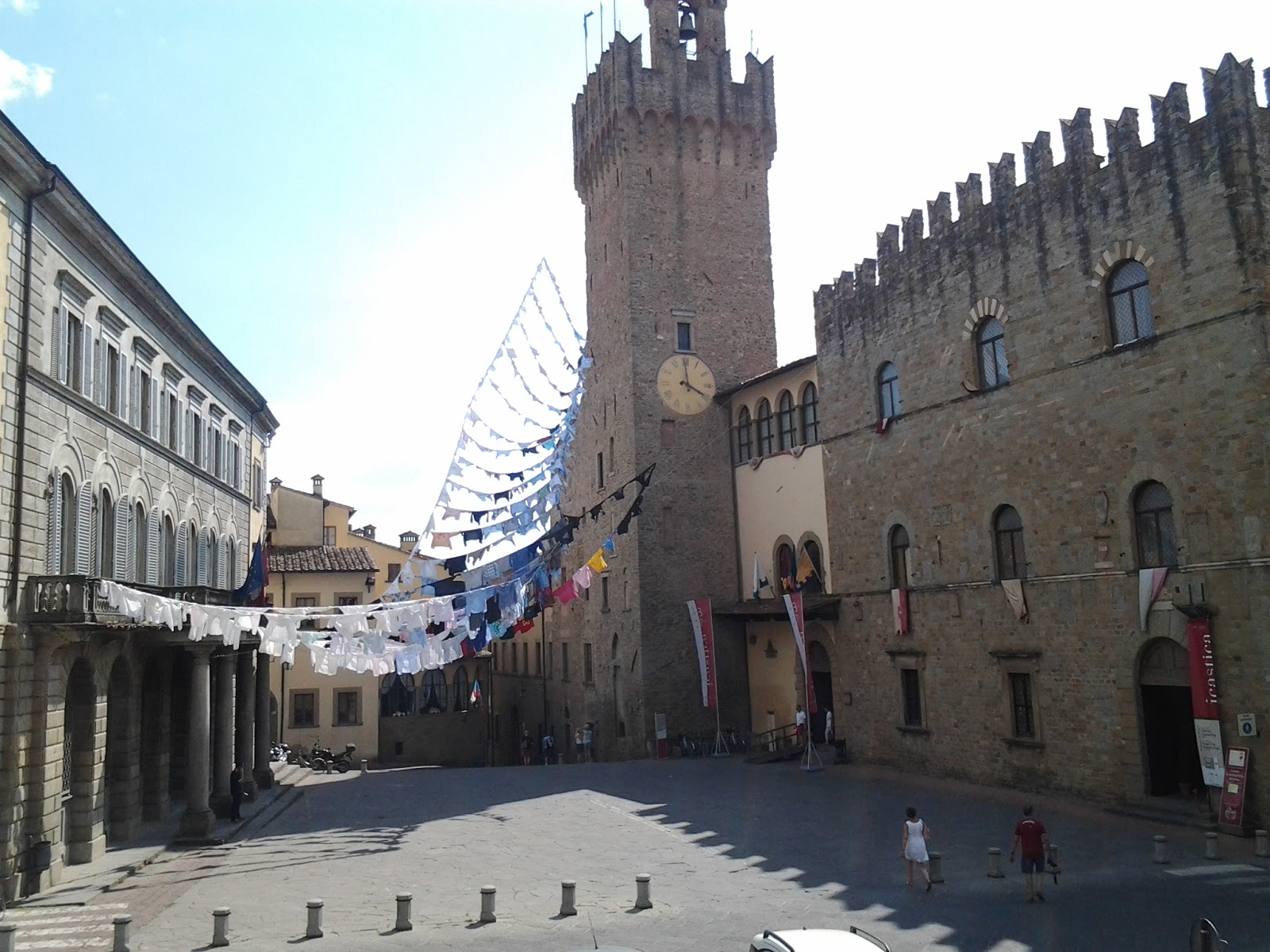
The Piazza Della Liberta and the Town Hall tower

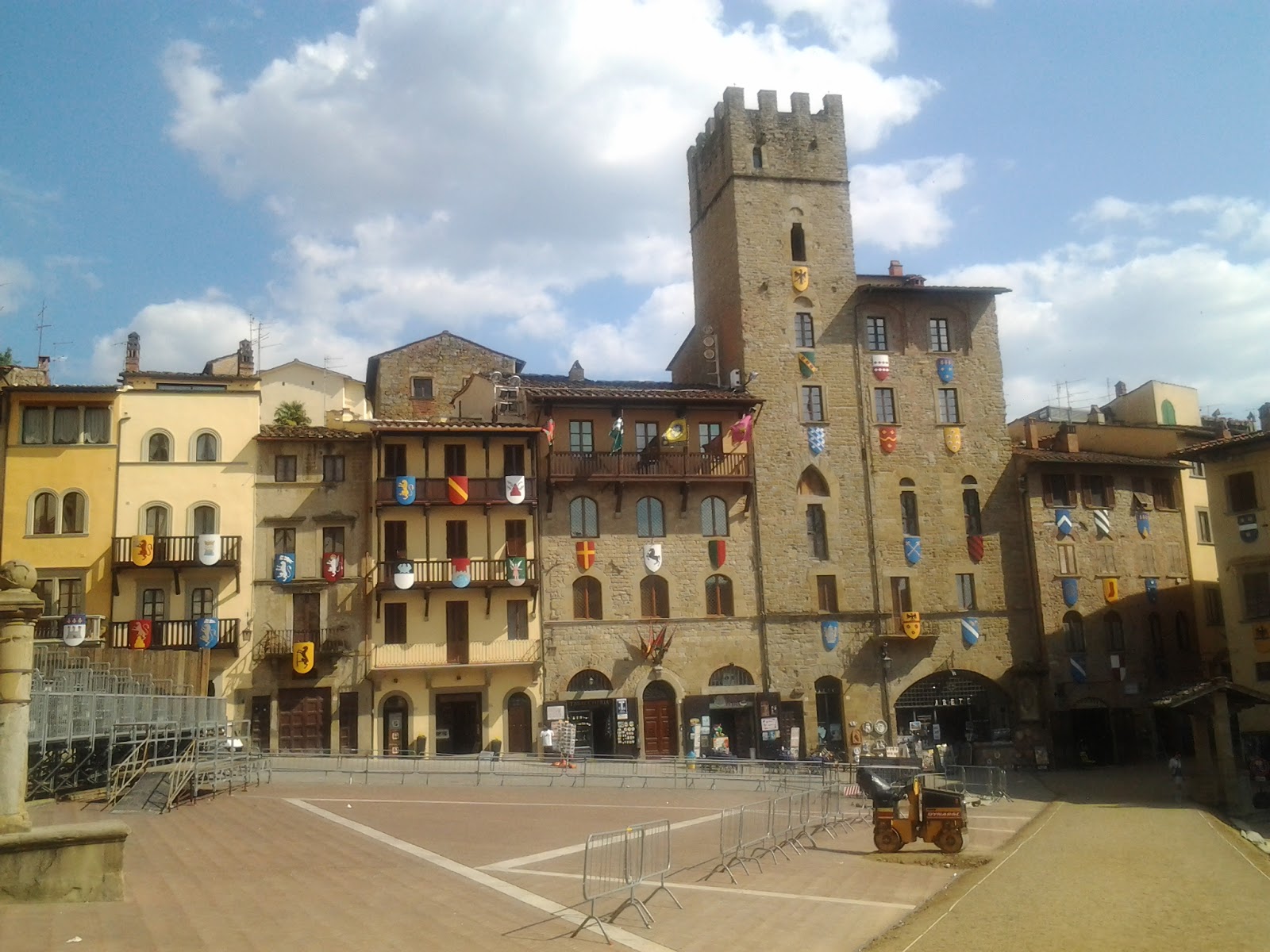
The Piazza Grande, also known as Piazza Vasari, is said to be situated on the site of the ancient Roman Forum.  Here, it is being set up for the coming Joust.

A different view of Arezzo Cathedral | Cattedrale dei Santi Pietro e Donato

In a word: Stern

It’s what I’d always expected of my teachers, having to stand up the front of the classroom and look like they were in control.

These days, not so much, but back in my day, teachers, and particularly the men, were to be feared, and stern expressions were the features of an effective teacher.

So, in this context, it means a hardness or severity of manner.

Whilst in a sense that was frightening to us kids, another form of the word also can be used to express a forbidding or gloomy appearance.

Grandfathers also have that stern look, but it’s more forbidding, more authoritarian, more severe, more austere, well, you get the picture.  A six-year-old would be trembling in his or her boots.

There again, in facing up to either possibility above, you could stand firm with a stern resolve not to buckle under the pressure.

Of course, not a good idea if you’re facing a tank (with a stern-looking tank master)

Then…

If you’re standing at the end of the boat, not the front, but the rear, you would be standing at the stern of the boat, or ship.

Oddly, when issuing instructions to go in reverse, not something you would say if you were on the bridge, you would instead say, or possibly yell, full speed astern, because you’re about to hit an iceberg.

Or some idiot in a jet ski who likes to think he or she can beat the bullet (or 65,000 tonnes of a ship that has very little mobility).

In a word: Zip

Which, unfortunately, I do not have a lot of in my step.

At last, we have reached the end of the alphabet because I’m running out of zip to write these blogs.

So…

Zip is the sing, the energy, the spring we have in our step, that usually gets us from a to b quickly.  Without this zest, we would need to take a bus, train, or cab.

Then comes the variations like …

Zip code, we all have one of these, though in some countries it is called a postcode.

Zip it up, meaning do not speak, especially if you’re about to spill a secret.

A zip, which is a part of some types of clothing, usually in trousers, jeans, and skirts to name a few.  Some dresses have long zips, some short, all seem to get tangled at one time or another, or, in the most embarrassing of situations, split.

Then there is a colloquial use of the word zip, meaning nothing, zilch, zero, in other words, a basis for of z words.

And that’s about as much zeal I’m going to show for writing this blog, and I’m going to close the book on it.

Thank you, and goodnight.

An excerpt from “Betrayal” – a work in progress

It could have been anywhere in the world, she thought, but it wasn’t.  It was in a city where if anything were to go wrong…

She sighed and came away from the window and looked around the room.  It was quite large and expensively furnished.  It was one of several she had been visiting in the last three months.

Quite elegant too, as the hotel had its origins dating back to before the revolution in 1917.  At least, currently, there would not be a team of KGB agents somewhere in the basement monitoring everything that happened in the room.

There was no such thing as the KGB anymore, though there was an FSB, but such organisations were of no interest to her.

She was here to meet with Vladimir.

She smiled to herself when she thought of him, such an interesting man whose command of English was as good as her command of Russian, though she had not told him of that ability.

All her knew of her was that she was American, worked in the Embassy as a clerk, nothing important, who life both at work and at home was boring.  Not that she had blurted that out the first tie she met, or even the second.

That first time, at a function in the Embassy, was a chance meeting, a catching of his eye as he looked around the room, looking, as he had told her later, for someone who might not be as boring as the function itself.

It was a celebration, honouring one of the Embassy officials on his service in Moscow, and the fact he was returning home after 10 years.  She had been there one, and still hadn’t met all the staff.

They had talked, Vladimir knew a great deal about England, having been stationed there for a year or two, and had politely asked questions about where she lived, her family, and of course what her role was, all questions she fended off with an air of disinterested interest.

It fascinated him, as she knew it would, a sort of mental sparring as one would do with swords, if this was a fencing match.

They had said they might or might not meet again when the party was over, but she suspected there would be another opportunity.  She knew the signs of a man who was interested in her, and Vladimir was interested.

The second time came in the form of an invitation to an art gallery, and a viewing of the works of a prominent Russian artist, an invitation she politely declined.  After all, invitations issued to Embassy staff held all sorts of connotations, or so she was told by the Security officer when she told him.

Then, it went quiet for a month.  There was a party at the American embassy and along with several other staff members, she was invited.  She had not expected to meet Vladimir, but it was a pleasant surprise when she saw him, on the other side of the room, talking to several military men.

A pleasant afternoon ensued.

And it was no surprise that they kept running into each other at the various events on the diplomatic schedule.

By the fifth meeting, they were like old friends.  She had broached the subject of being involved in a plutonic relationship with him with the head of security at the embassy.  Normally for a member of her rank it would not be allowed, but in this instance it was.

She did not work in any sensitive areas, and, as the security officer had said, she might just happen upon something that might be useful.  In that regard, she was to keep her eyes and ears open, and file a report each time she met him.

After that discussion she got the impression her superiors considered Vladimir more than just a casual visitor on the diplomatic circuit.  She also formed the impression the he might consider her an ‘asset’, a word that had been used at the meeting with security and the ambassador.

It was where the word ‘spy’ popped into her head and sent a tingle down her spine.  She was not a spy, but the thought of it, well, it would be fascinating to see what happened.

A Russian friend.  That’s what she would call him.

And over time, that relationship blossomed, until, after a visit to the ballet, late and snowing, he invited her to his apartment not far from the ballet venue.  It was like treading on thin ice, but after champagne and an introduction to caviar, she felt like a giddy schoolgirl.

Even so, she had made him promise that he remain on his best behaviour.  It could have been very easy to fall under the spell of a perfect evening, but he promised, showed her to a separate bedroom, and after a brief kiss, their first, she did not see him until the next morning.

So, it began.

It was an interesting report she filed after that encounter, one where she had expected to be reprimanded.

She wasn’t.

It wasn’t until six weeks had passed when he asked her if she would like to take a trip to the country.  It would involve staying in a hotel, that they would have separate rooms.  When she reported the invitation, no objection was raised, only a caution; keep her wits about her.

Perhaps, she had thought, they were looking forward to a more extensive report.  After all, her reports on the places, and the people, and the conversations she overheard, were no doubt entertaining reading for some.

But this visit was where the nature of the relationship changed, and it was one that she did not immediately report.  She had realised at some point before the weekend away, that she had feelings for him, and it was not that he was pushing her in that direction or manipulating her in any way.

It was just one of those moments where, after a grand dinner, a lot of champagne, and delightful company, things happen.  Standing at the door to her room, a lingering kiss, not intentional on her part, and it just happened.

And for not one moment did she believe she had been compromised, but for some reason she had not reported that subtle change in the relationship to the powers that be, and so far, no one had any inkling.

She took off her coat and placed it carefully of the back of one of the ornate chairs in the room.  She stopped for a moment to look at a framed photograph on the wall, one representing Red Square.

Then, after a minute or two, she went to the mini bar and took out the bottle of champagne that had been left there for them, a treat arranged by Vladimir for each encounter.

There were two champagne flutes set aside on the bar, next to a bowl of fruit.  She picked up the apple and thought how Eve must have felt in the garden of Eden, and the temptation.

Later perhaps, after…

She smiled at the thought and put the apple back.

A glance at her watch told her it was time for his arrival.  It was if anything, the one trait she didn’t like, and that was his punctuality.  A glance at the clock on the room wall was a minute slow.

The doorbell to the room rang, right on the appointed time.

She put the bottle down and walked over to the door.

A smile on her face, she opened the door.

It was not Vladimir.  It was her worst nightmare.

© Charles Heath 2020

Wishful thinking…

My phone, being smart and all, has been creating a notification that tells me I have some memories stored on it for this day a year ago, or two years, or many years.

The pictures it is showing are of our trip to Coffs Harbour one year, and Melbourne another year.

It serves as a reminder, but I wonder if those that came up with the idea might have considered that some people might not want to be reminded of events and places in the past.

Like now, when we are forced to stay at home and not travel because of the pandemic.  More and more this pandemic is impinging on us living what we might call normal life, thinking nothing of getting on a plane and going someplace else, other than home.

Of course, there are those who wrap this desire up in a package called ‘human rights’ and then go out to protest the fact we cannot do these things, failing to realise in their selfishness that we are in a pandemic, the virus hasn’t gone away, and it takes very little to create a second, or third, or even a fourth wave.

Perhaps I’m old enough to understand that rights aren’t been trampled, and it’s just a matter of prevention is better than cure.  Now, that prevention has managed to make our state, at least, safe enough to travel small distances, and to some other, but not all, states if we want to.

I don’t.  Not yet.  Not until there is a preventative measure in place, being one of the more vulnerable.  But something those selfish people don’t get or understand, we are learning that if you get it and survive, you don’t always return to your former health.  People who got it months ago, and so-called recovered, haven’t really, so if there is a second wave, they join us in becoming vulnerable, and could die.

So, enough of the bad news.

The good news, we can now visit nearby family and friends.

That’s the other side of the coin with these reminders.  It pops up photos of our grandchildren, reminders that one day all will be well again.

And until then, it’s not a bad thing my smartphone is going to keep sending me gentle reminders of what it was like in another lifetime.

Back to that starship…

And, getting out of the elevator, this time no erratic behaviour but still not filling me with confidence, I step onto the bridge.

The forward screen has changed.

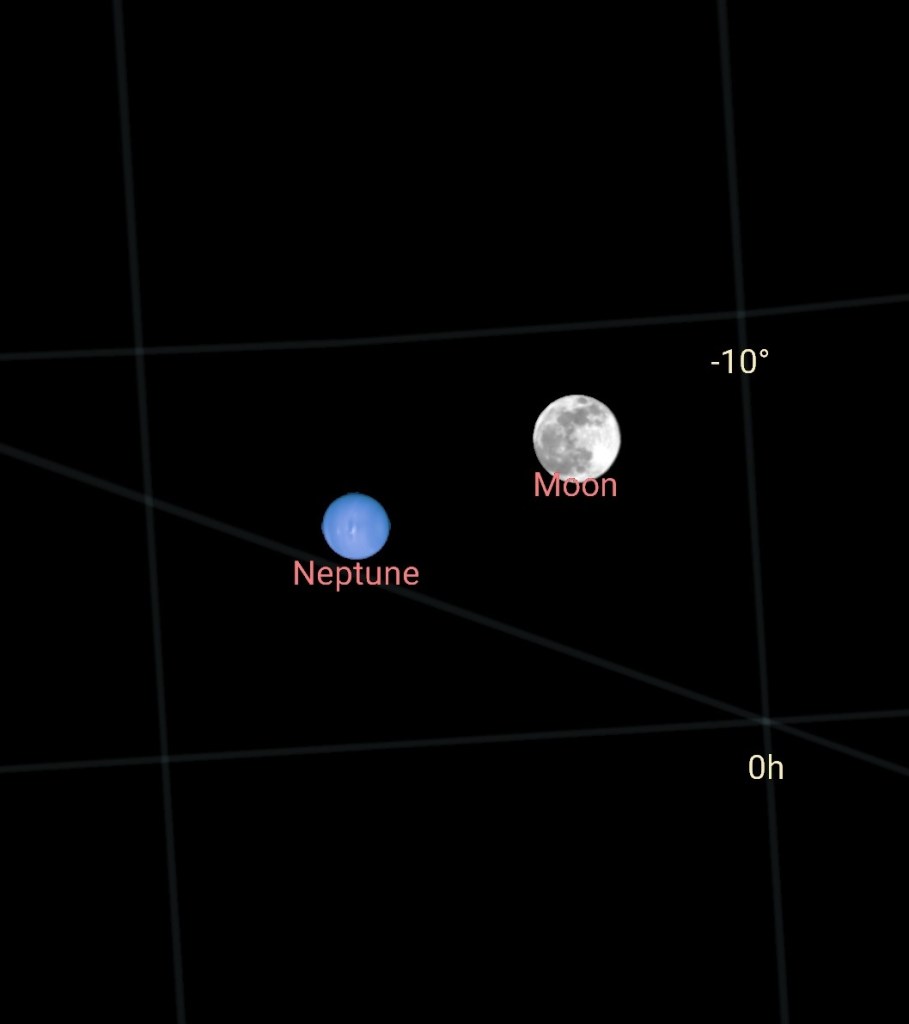
It seems we are going to Neptune via the moon.

The Captain is on the bridge, obviously coming out of his day room on the news that the Chief Engineer had fixed everything.

“Ah, number one, we’ve hung around here long enough.”

He walked back to his chair and sat.

I decided to remain behind the navigator. I could see that the co-ordinated had been entered for Neptune, so the moon was not going to be a stop off.

The Chief engineer’s voice came over the tannoy. “Ready when you are, Captain.”

I forgot, for a moment, that the Chief and the Captain had served before, and someone had mentioned the fact the Captain had asked for him to be assigned to this ship.

“Mr Jacobs, take us out, slowly, and try not to bump into anything this time.”

In a rather rather sheepish tone, Mr Jacobs said, “Taking the ship out carefully, sir.”

It was hard to tell if the ship was moving, but the tell tale sign was the movement of the objects on screen. And the fact I could see through the side windows as we moved forwards, leaving the dock superstructure behind.

Also on the screen I could see the movements of other vessels, several freighters waiting to leave, and one coming in, but standing off until we departed.

Then, suddenly, we were in clear space.

Jacobs turned to the Captain, expecting the next order.

“Let’s take it easy. Level one, when your ready.”

Jacobs was ready, even eager to get this ship under way. It had performed faultlessly in trials, now we were going to put it through it’s paces.

“Level one, as you wish.”

He pushed the button, there was a moment when nothing happened, then with just the slightest movement inside the bridge, we were under way.

Next stop, Neptune.

© Charles Heath 2020

In a word: well

At first, you would think this word has something to do with your health.

You’d be right.  “Are you well?” or “Are you well enough?”

Of course, it can cause some confusion, because how do you measure degrees of wellness.

Reasonably well, very well, not well, or just well.  Not a good descriptive word for the state of your health, maybe.

How about what if the team played well.  Not health this time, but a standard.

There’s ordinary, mediocre, as a team, brilliantly, and then there’s well.

It seems it can be used to describe an outcome.

Well, well.

Hang on, that’s something else again.

What about, then, we use the word to describe a hole in the ground with water at the bottom.

Or not if it is a drought.

A lot of people get water from a well, in fact in the olden days that was a common sight in a village.

What about those environment destroyers, oilmen.  They have oil wells, don’t they?

And when I went to school, there were ink wells on every desk.

Messy too, because I was once the ink monitor.

But if the well’s dried up?

It becomes a metaphor for a whole new bunch of stuff.

OR what about a stairwell?

And at the complexity of it all, for such a small word, tears well up in my eyes.

What makes a character – 1 – The beginnings of a writer

My characters are many, a diverse group of people that are based on people I know, people I’ve known, people I’ve met, or seen, or interacted with. Some of them make up a single character with several traits.

Some are like me, but most are people I would have like to have been rather than the dull as ditchwater person I am. No-one wants to read about dull people, they want someone larger than life, someone who can do the impossible, or at the very least, the improbably.

I’ve always wanted to be someone else. For a long time I never liked who I was, and, to a certain extent, I still don’t. That was a result of the early stages of my life, those years the form who we are going to be.

And, had you asked me 50 years ago whether I would be the person I am now, I’d probably laugh and say it would be impossible. Yet here I am, and it’s nothing like what I thought I would be.

But, for now, lets look at the traits that live in some of my characterisations.

For instance, to understand the influences people have on us, I use my father, a man always voted for a particular political party, and that alone was an influence on who I would vote for when I got old enough, after listening for years his reasons for hating the opposition. For years he aired his grievances, which, at the time, he believed were real and caused by that opposition party.

Politics can be very polarising. There’s also a saying, throw enough mud, some of it sticks. That, of course applied to a great many things. Another was only the rich could afford a University education, and for years I believed that. It was, he said, how the rich kept their influence over, and suppress the poor.

It was a similar case with religion, another polarising topic, and my family were Protestants and therefore didn’t like other religions such as Catholics. It didn’t strike me till much later in life why this was so. But as a child we were sent to Sunday school and, irregularly, to church services of the Presbyterian faith.

Then there were our relatives, none of whom we ever really met. I knew we had relatives, my fathers parents because for a while we used to visit them every month or so where my father would cut their lawn, and my mother had a mother, he father had died not long after I’d been born.

My father had a lot of brothers and a sister. My mother had a brother and a sister. She also had an aunt that I’m sure I met several times before she died. But these are fleeting memories. We saw my father’s brothers and sister rarely, so rarely now I don’t remember them. The same applied to my mother’s sister, of whom I got the impression she was immensely jealous of.

I never understood why. Not then, any way.

But as for my mother’s mother, our grandmother, she was a likable soul who lived in the country, and she never came to see us, we went to see her, but those visits were long after we stopped seeing my father’s parents.

At the time we were young, she lived in the country, and we had to drive there which took time we didn’t seem to have.

Later in my pre teens my brother and I used to stay at her house for a week or two during the school holidays. It was a very large house on a large block, very old with high ceilings and large rooms, and we always had lots to eat, and delicious food at that, and we couldn’t understand why we didn’t have the same with our parents.

Of course there was a reason for that too, but this only became clear a few years ago when my brother started collecting information for a family history. My brother hunted down all of the relatives that were still alive and began to learn why we never saw them. It was not because of them, but because of my parents.

One stark revelation was that nearly all of them were better off than we were.

So here was my early childhood in equally stark reality.

It would be easy to blame parents for everything, but that’s the easy way out, and probably what every child who felt they were deprived of a proper life would do. More than likely, for years, that’s exactly how I felt, and, equally, the reason why I withdrew into a whole different world, or worlds, of my own.

I might not have put words on paper, but in my mind stories were beginning and evolving, stories that I told others to hide what I really was, and what I felt.