This case has everything, red herrings, jealous brothers, femme fatales, and at the heart of it all, greed.
Coming soon!
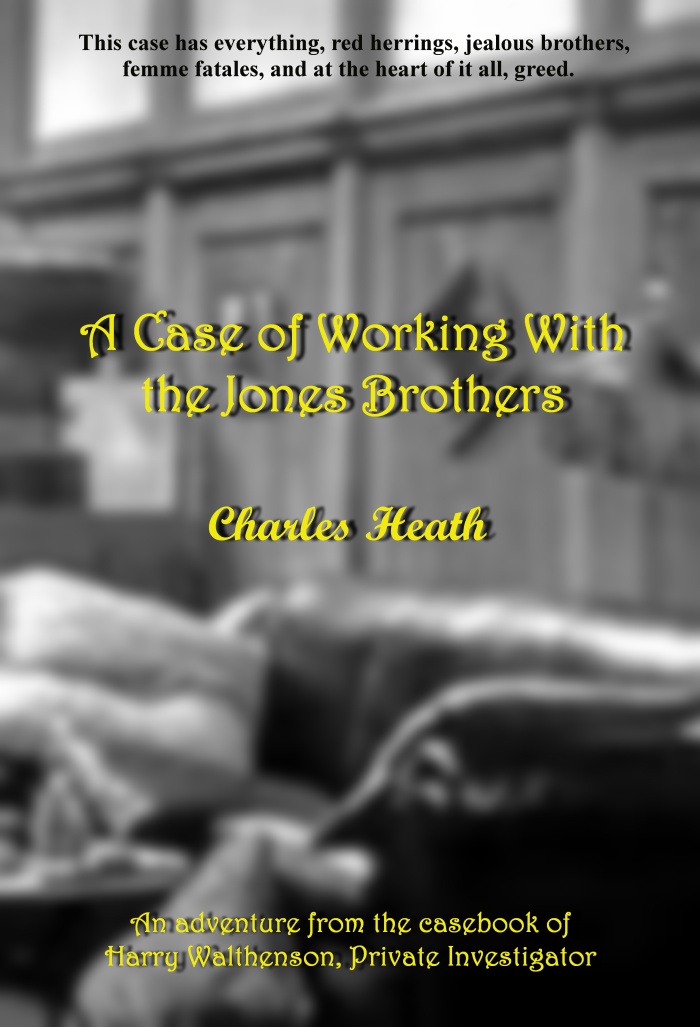
This case has everything, red herrings, jealous brothers, femme fatales, and at the heart of it all, greed.
Coming soon!
For a story that was conceived during those long boring hours flying in a steel cocoon, striving to keep away the thoughts that the plane and everyone in it could just simply disappear as planes have in the past, it has come a long way.
Whilst I have always had a fascination in what happened during the second world war, not the battles or fighting, but in the more obscure events that took place, I decided to pen my own little sidebar to what was a long and bitter war.
And, so, it continues…
Jack was the first to realise that Marina was coming back, hearing her outside long before I did. He stood up and looked in the direction of where he expected to see her.
A minute later she appeared, looking and sounding out of breath, as if she had been in a hurry?
Chased, or had some urgent news?
“Is everything OK?” I asked, waiting till she came in and shut the door behind her.
The building we were in used to be a factory or a repair shop. The strange smell I’d picked up a few hours ago was that of machine oil.
“We need to have a chat with the two who picked you up.”
“Where are they now?”
“I’ve organised to meet them at another facility we have. Not everyone comes here. It’s why we are still here. Francesco nor any of the resistance he took with him were aware of this location.
I considered myself lucky to be among the few.
“Is there a reason why I need to be there?”
“Yes. But it’ll wait until we get there. Let’s go.”
She had barely got in the door, nor caught her breath. It was just enough time to collect a spare clip of ammunition for a gun she had on her, but I couldn’t see.
I followed her out into the darkness, not realising it was night, for the first time since I’d arrived, and once outside, realised that it was an underground bunker rather than a building on an allotment, so it couldn’t be easily seen from any direction. It was surrounded by trees and bushes, looking as though they had not been tended properly for some time.
It was as much as I could see, close by because it was a moonless night.
We went up some stairs and came out in a clump of bushes, and walked several yards where there was a disguised walkway zig-zagging through the bushes. It, too, would be hard to see from a distance. When we came out the other side, I could just barely see a car parked under a tree, looking rather worse for wear, and I thought it had been abandoned there.
When Marina told me to get in, I realised it was, like everything else, well disguised.
The surrounding area was that of forest and farms. It was hard to imagine that this part of the world was in the grip of a world war, and not too far away, there was the castle, and further north, the Germans and what was left of the Italian military forces dug in for a last-ditch effort. The tide was turning, but ever so slowly.
It was hard to imagine just how dangerous it was for those defectors to try and get through without being shot.
And, just for good measure, Marina said, there were quite a few soldiers, disguised as ordinary workers who had infiltrated the villages, and surrounding farms, and reporting back what they saw and heard.
We were, in going about in the vehicle, attracting unwanted attention, but it was why we were doing this at night, she said, perhaps gleaning from my expression the fact I was worried about getting caught.
“The people at the castle tend not to go out at night for fear of being picked off. I’m surprised you didn’t learn this when you were there.”
“I suspect the suspended any activities from the moment I arrived. One of the prisoners told me that all movements of people had stopped, and they were waiting to be shipped out. Obviously, they thought I might discover what was going on. They definitely stopped me from going below the main floor.”
“I was told you have some knowledge of the castle layout?”
“Some. We have old plans back in London, but I suspect those would be out of date now and since the German occupation. The only time I got to look downstairs was when I tried to escape and found an old below ground exit, then when they locked me in a cell, and then when I was set free. It matched much of what I remember seeing on the plans. But, I suspect there’s more because I didn’t get to see the holding cells with the other prisoners.”
“Perhaps Carlo can help you with that.”
“We spoke about it. I think he’s going to pay them a visit and exact revenge.”
“I told him we have to wait for some reinforcements.”
“No word from London?”
“Not yet.”
We stopped and parked the car between a church and what was left of what might have been a rectory, set aside from some other buildings that looked like part of a village. It was not that dark that I couldn’t see that several of the buildings had been bombed, minus roofs, and one had the front section reduced to rubble. No attempt had been made to clean it up.
“German tanks,” Marina said. “An early landing party of your army parachuted in about a kilometre behind the church. The local commander mobilised his forces and chased them into those buildings, which, at the time, housed four families. They were given the option to surrender. They didn’t, so the commander gave the order to raze the buildings to the ground, with them in there. Along with the four innocent families. No one survived.”
“The church?”
“The commander thought it would be bad luck to destroy the house of God. The soldiers should have hidden in there. They shot the priest anyway.”
It seemed odd to me that any sort of group would parachute into this part of Italy for any reason, castle withstanding. There was, as far as I knew, nothing of interest or importance here. Perhaps I’d ask when I made it back to London. If I made it back.
I followed her through the rubble and in through a side entrance to the church. Inside it was dark, and Marina was using her torchlight sparingly in case someone was watching. From what I could see, the inside of the church was untouched, but everything was covered in dust from disuse.
“No one thought to send another priest?” I asked.
“No. When they heard what happened to the last one, they decided to wait until the war was over. Besides, with everything that’s happened, the people around here believe God has abandoned them.”
Perhaps he had. I know that I wasn’t all that religious to begin with, but a lot of people I knew had lost their faith in a God that allowed such tragedies to happen.
We passed through a door at the back of the church, behind the nave, and into what looked like the vestment room. To one side was another door, and then steps down. The church had a cellar.
At the bottom of the stairs, there was a large storage area lit by a portable lantern.
Carlo was standing to one side, his weapon ready to use.
Opposite him were a man and a woman, the woman I’d seen before, she was the one who shot me with the tranquilizer. The man, I’d not seen him before.
© Charles Heath 2019
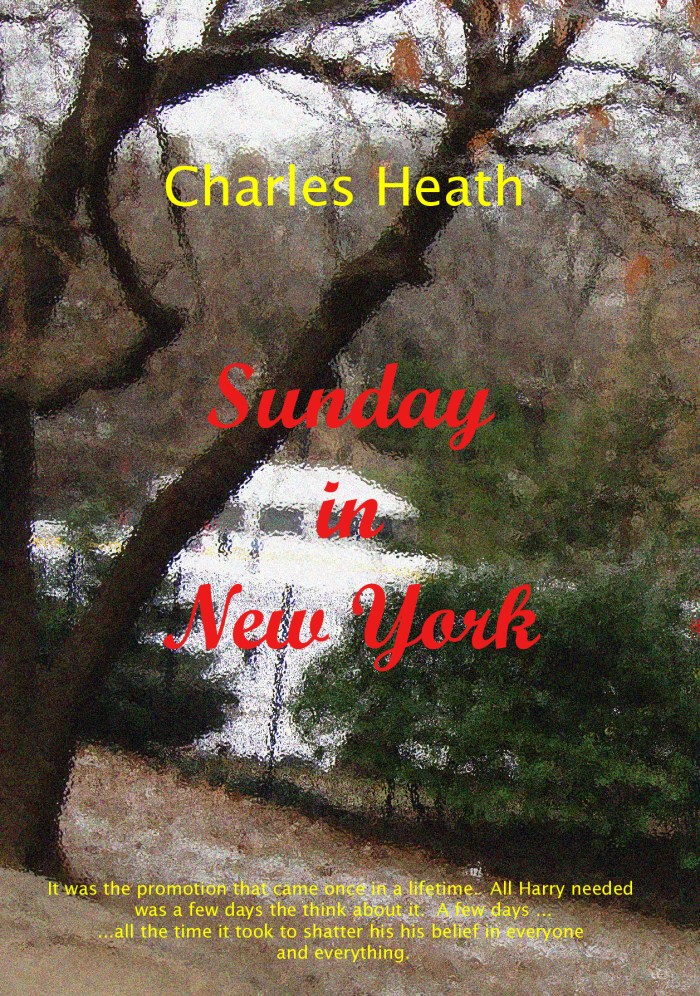
“Sunday in New York” is ultimately a story about trust, and what happens when a marriage is stretched to its limits.
When Harry Steele attends a lunch with his manager, Barclay, to discuss a promotion that any junior executive would accept in a heartbeat, it is the fact his wife, Alison, who previously professed her reservations about Barclay, also agreed to attend, that casts a small element of doubt in his mind.
From that moment, his life, in the company, in deciding what to do, his marriage, his very life, spirals out of control.
There is no one big factor that can prove Harry’s worst fears, that his marriage is over, just a number of small, interconnecting events, when piled on top of each other, points to a cataclysmic end to everything he had believed in.
Trust is lost firstly in his best friend and mentor, Andy, who only hints of impending disaster, Sasha, a woman whom he saved, and who appears to have motives of her own, and then in his wife, Alison, as he discovered piece by piece damning evidence she is about to leave him for another man.
Can we trust what we see with our eyes or trust what we hear?
Haven’t we all jumped to conclusions at least once in our lives?
Can Alison, a woman whose self-belief and confidence is about to be put to the ultimate test, find a way of proving their relationship is as strong as it has ever been?
As they say in the classics, read on!
Purchase:
http://tinyurl.com/Amazon-SundayInNewYork
Is love the metaphorical equivalent to ‘walking the plank’; a dive into uncharted waters?
For Henry the only romance he was interested in was a life at sea, and when away from it, he strived to find sanctuary from his family and perhaps life itself. It takes him to a small village by the sea, s place he never expected to find another just like him, Michelle, whom he soon discovers is as mysterious as she is beautiful.
Henry had long since given up the notion of finding romance, and Michelle couldn’t get involved for reasons she could never explain, but in the end both acknowledge that something happened the moment they first met.
Plans were made, plans were revised, and hopes were shattered.
A chance encounter causes Michelle’s past to catch up with her, and whatever hope she had of having a normal life with Henry, or anyone else, is gone. To keep him alive she has to destroy her blossoming relationship, an act that breaks her heart and shatters his.
But can love conquer all?
It takes a few words of encouragement from an unlikely source to send Henry and his friend Radly on an odyssey into the darkest corners of the red light district in a race against time to find and rescue the woman he finally realizes is the love of his life.
The cover, at the moment, looks like this:

It’s amazing just how fast the weeks are slipping by.
And how I don’t seem to be getting much done. It’s like looking at a big circle that charts your times for the week.
Staring into space looking for inspiration, 85%
Getting distracted, 13%
Writing, 1%
Undecided, 1%
But I guess I am getting a lot of the preparatory work done, like setting up the next 5 Being Inspired posts – adding the photographs to be used as inspiration
See an example: http://bit.ly/2lXcRrw
Adding the next few episodes of PI Walthenson’s first case, and re-writing as the second draft along the way prior to posting them. The good news, I just posted the last episode
See an example: http://bit.ly/2PQBeWv
Then I had to create Twitter ads for the last 15 or so blog entries, which I’ve been putting off
See an example: http://bit.ly/349udmn
But what I finally got done, and is probably the most important job, was fix my author website.
See it here https://cwhmailuser.wixsite.com/authorcharles
Did I get to read? No. Unless you count a number of blog posts from bloggers I follow.
Did I get to work on any of the WIP books? Some, but writing five or six stories on the go can be a little daunting at times. It certainly makes for confusing dreams and crossovers which are practically unintentional.
So, perhaps next week will have a more positive aspect.
Tune in to find out!
**Please don’t assume that you have to, nor would I ever expect you to, read any or all of these books. You don’t.**
Everyone, it seems, will publish what they call the top 100 books that you should read. Some are voted on, some belong to the opinion of the editor of the book review section of a newspaper, and, as you know, there are a lot of newspapers, a lot of editors, and a lot of opinions.
I’m not a newspaper, I’m not an editor, but I have a list, based on personal experience, and many, many years of reading.
It’s in no particular order.
41. The Hound of the Baskervilles by Sir Arthur Conan Doyle, as well as a host of other Sherlock Holmes stories
42. The Secret Agent by Joseph Conrad, one of Conrad’s later political novels, set in London in 1886 and deals with anarchism and espionage. In those days spies were called anarchists.
43. The Ipcress File by Len Deighton, introducing us to Harry Palmer, who was personified by Michael Caine and led to Horse Under Water, and Funeral in Berlin. More of Len Deighton later on in the list
44. The Remorseful Day by Colin Dexter introducing the somewhat enigmatic detective, Morse, his first name not revealed for a long time but oddly, Endeavour. John Thaw brought him to life
45. Crime and Punishment by Fyodor Dostoevsky, hard to pronounce and even harder to read, but perhaps worth it in the end. By the time I read this I was wishing for a Russian writer had could use an economy of words
46. Dr. Zhivago by Boris Pasternak wasn’t it. A vast and lengthy dissertation on lost love, I felt very sad for Zhivago in the end. I saw a stage play of the same name, and I’m sorry, but it’s a few hours of my life I will never get back
47. Casino Royale, the first of the James Bond novels by Ian Fleming. I have to say these are among my favorite spy books. I must say I preferred the new James Bond in Casino Royale, though Sean Connery still rules!
48. The Day of the Jackal by Frederick Forsythe, a fascinating story about an assassin
49. Anything written by John Le Carre, but in particular, the George Smiley collection. Finally unmasking his nemesis the Russian spymaster made it all so satisfying.
50. The Bourne Identity by Robert Ludlam, inspiring a long series by both Ludlam and Eric Lustbader makes entertaining reading, but the first, the man who did not know who or what he really was, was excellent. Matt Damon didn’t harm his persona either.
51. Murder Must Advertise by Dorothy Sayers, whose detective is Lord Peter Whimsey, a 1933 mystery novel that’s eighth in the series
52. Gorky Park by Martin Cruz Smith. You have to admit that his Russian detective Arkady Renko is up against it when his investigation goes in a direction that uncovers corruption and dishonest in his superiors
53. The Way of All Flesh by Samuel Butler, a semi-autobiographical novel written between 1987 and 1884, and published in 1903. The story of the Pontifex family.
54. Howards End by E. M. Forster, first published in 1910, is an interesting insight into the behavior of the, and between the classes, with the Schlegels acting as the catalyst.
55. Washington Square by Henry James, originally published as a serial, and covers the conflict between daughter and father. I must say I prefer The Ambassadors to Washington Square.
56. Ulysses by James Joyce, a day in the life of an ordinary man, Leopold Bloom, why could it not be the 7th June rather than the 16th, for obvious reasons
57. The Go-Between by L. P. Hartley is a view of society at the end of the Victorian period through the eyes of a young boy. I read this while still at school and had no clue why, but later, when I read it again, I understood the meaning
58. Atonement by Ian McEwan, I saw the film and then read the book. Never a good idea. Basically, a young girl makes a bad mistake and tries to atone for it.
59. Gone With The Wind by Margaret Mitchell, the War and Peace of Americal novels, and as long by comparison. The only book written by Mitchell, and the second most read book by Americans. The film was interesting but awfully long.
60. The English Patient by Michael Ondaatje, with a man with severe burns and the effect he had on three others. Colin Firth is villain one day and hero the next, this time in the cinematic version, an out and out cad.
More to come…
**Please don’t assume that you have to, nor would I ever expect you to, read any or all of these books. You don’t.**
Everyone, it seems, will publish what they call the top 100 books that you should read. Some are voted on, some belong to the opinion of the editor of the book review section of a newspaper, and, as you know, there are a lot of newspapers, a lot of editors, and a lot of opinions.
I’m not a newspaper, I’m not an editor, but I have a list, based on personal experience, and many, many years of reading.
It’s in no particular order.
21. Passage of Arms by Eric Ambler, I have to say I have read most of his novels and they are very good
22. Jane Eyre by Charlotte Bronte, a very powerful story of a courageous, independent woman
23. The Riddle of the Sands by Erskine Childers, a 1903 secret service story, and a good example of an early espionage novel
24. The Father Brown stories by G. K. Chesterton, which features a Roman Catholic priest who is also an amateur detective
25. The Grantchester Mysteries by James Runcie, similar to the above, but featuring an Anglican vicar Sidney Chambers and set in the 1950s. Recently brought to life on television.
26. The High Commissioner by Jon Cleary, an Australian author, this novel introduces Sargeant Scobie Malone, in the first of many adventures
27. A Tale of Two Cities by Charles Dickens, the first Dickens book I read, possibly because it was one of the shortest, and paved the way to reading all of his books. Who could forget Madame Defarge
28. Brideshead Revisited by Evelyn Waugh, another of those delightful but depressing stories of the 20s through to the 40s, perhaps for some, the golden age. What could be said, in the end, about the Flytes?
29. The Godfather by Mario Puzo, is the story of the Corleone mafia family, and for me, the most interesting part was that of the horse’s head, and of course, the death and mayhem
30. The Shipping News by Annie Prouix, a Pulitzer Prize winner, and a story about a man, Quoyle, who against all odds puts his life slowly back together
31. Detection Unlimited by Georgette Heyer, noted mostly for her Regency romances, she also wrote a series of detective novels. This was her last detective novel published in 1953
32. Poldark by Winston Graham, a series of stories about the Poldarks and Cornwall, and his arch-nemesis, George Warleggan
33. Our Man in Havana by Graham Greene, one of many very interesting novels, this the first I read, followed by the Quiet American and Travels With My Aunt. Seeing movies of some didn’t enhance the reading experience.
34. The Mayor Of Casterbridge by Thomas Hardy, another of his interesting but sometimes hard to read novels of rural England. This led to Jude the Obscure and others in the ‘series’. It all started with Tess of the D’Urbervilles.
35. A Farewell to Arms by Ernest Hemingway, set during the Italian campaign of World War 1. He also wrote The Old Man of the Sea
36. Lucky Jim by Kingsley Amis, I don’t think he was all that lucky
37. Whiskey Galore by Compton MacKenzie, the story of the ‘resue’ of several hundred cases of whiskey and the locals’ efforts to hide it. Also famous for writing Monarch of the Glen, later a television series
38. The Expedition of Humphry Clinker by Tobias Smollett, a collection of satirical observations of English life in the 1700s in spa towns and seaside resorts
39. Barchester Towers by Anthony Trollope, part of the series known as the Chronicles of Barsetshire and features the unpopular Bishop Proudie and Mrs. Proudie
40. The Mysterious Affair at Styles by Agatha Christie, Christie’s first book published in 1920, and introduced Poirot, Arthur Hastings, and Inspector Japp. Who knew so many books would follow
The list continues
**Please don’t assume that you have to, nor would I ever expect you to, read any or all of these books. You don’t.**
Everyone, it seems, will publish what they call the top 100 books that you should read. Some are voted on, some belong to the opinion of the editor of the book review section of a newspaper, and, as you know, there are a lot of newspapers, a lot of editors, and a lot of opinions.
I’m not a newspaper, I’m not an editor, but I have a list, based on personal experience, and many, many years of reading.
It’s in no particular order.
The list continues …
David is a man troubled by a past he is trying to forget.
Susan is rebelling against a life of privilege and an exasperated mother who holds a secret that will determine her daughter’s destiny.
They are two people brought together by chance. Or was it?
When Susan discovers her mother’s secret, she goes in search of the truth that has been hidden from her since the day she was born.
When David realizes her absence is more than the usual cooling off after another heated argument, he finds himself being slowly drawn back into his former world of deceit and lies.
Then, back with his former employers, David quickly discovers nothing is what it seems as he embarks on a dangerous mission to find Susan before he loses her forever.

Don’t we all?
And, then something goes awry, like the telephone rings, someone forgot to tell you something last night, the boss calls and tells you you have thirty minutes after getting in to give a ‘smash it out of the park’ presentation, or a friend or workmate is ringing to give you a heads-up that something awful just happened.
Or worse!
Or, if you can get as far as the bus stop without forgetting something vital that you needed later on, and have to go back home, making you at least an hour late, just the morning you wanted to get in and clear away the cobwebs.
Yes, you can feel it coming, just because everything is going so well…
I had those good intentions.
i was going to work on the last revision of a novel that I’d been putting off for a while and had done all the pre the night before, just to let the ideas run around in my head while I was asleep.
And, yes, those ideas were there while I was in the shower, you know how it is, it’s one of the times when all those great ideas come, and there’s nowhere to write them down, and using a whiteboard marker of the white tiles, well, it just gets washed away.
How would a voice-activated tape recorder do?
Somehow I don’t think I want to listen to myself talking jibberish in the shower, much less the next-door neighbours. It’s unfortunate that builders seem to like the idea of putting bathrooms on the side closest to next door. Thank God they don’t sing in the shower!
Still on track, keeping the mental notes alive, I arrive at my desk.
Oh…
Just a little online banking to do, answer a few e-mails that I’ve been putting off, got a phone call to remind me the sheets needed extra soap in the washing machine, a post-it note on the keyboard reminding me to use the oldest eggs first, and that I might want to put some fuel in the car if I was intending to go anywhere.
Mental notes slowly dissipating.
Loading Word.
It seems I have a technical problem with my Microsoft account and I need to fix it. Word, otherwise loads, but I cannot edit any documents until it is fixed.
Then there’s a warning that hard disk space is running out, and I need to do a cleanup, or the machine wants to do a cleanup.
Can anything else go wrong?
Even rhetorically, I knew I shouldn’t have asked.

