“The Things We Do For Love” – Coming soon

Is love the metaphorical equivalent to ‘walking the plank’; a dive into uncharted waters?

For Henry the only romance he was interested in was a life at sea, and when away from it, he strived to find sanctuary from his family and perhaps life itself.  It takes him to a small village by the sea, s place he never expected to find another just like him, Michelle, whom he soon discovers is as mysterious as she is beautiful.

Henry had long since given up the notion of finding romance, and Michelle couldn’t get involved for reasons she could never explain, but in the end both acknowledge that something happened the moment they first met.  

Plans were made, plans were revised, and hopes were shattered.

A chance encounter causes Michelle’s past to catch up with her, and whatever hope she had of having a normal life with Henry, or anyone else, is gone.  To keep him alive she has to destroy her blossoming relationship, an act that breaks her heart and shatters his.

But can love conquer all?

It takes a few words of encouragement from an unlikely source to send Henry and his friend Radly on an odyssey into the darkest corners of the red light district in a race against time to find and rescue the woman he finally realizes is the love of his life.

The cover, at the moment, looks like this:

lovecoverfinal1

Inspiration, maybe

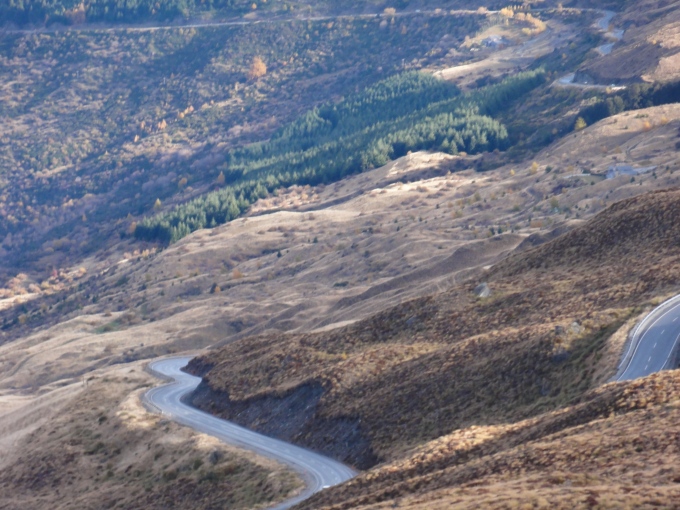
A picture paints … well, as many words as you like.  For instance:

lookingdownfromcoronetpeak

And the story:


It was once said that a desperate man has everything to lose.

The man I was chasing was desperate, but I, on the other hand, was more desperate to catch him.

He’d left a trail of dead people from one end of the island to the other.

The team had put in a lot of effort to locate him, and now his capture was imminent.  We were following the car he was in, from a discrete distance, and, at the appropriate time, we would catch up, pull him over, and make the arrest.

There was nowhere for him to go.

The road led to a dead-end, and the only way off the mountain was back down the road were now on.  Which was why I was somewhat surprised when we discovered where he was.

Where was he going?


“Damn,” I heard Alan mutter.  He was driving, being careful not to get too close, but not far enough away to lose sight of him.

“What?”

“I think he’s made us.”

“How?”

“Dumb bad luck, I’m guessing.  Or he expected we’d follow him up the mountain.  He’s just sped up.”

“How far away?”

“A half-mile.  We should see him higher up when we turn the next corner.”

It took an eternity to get there, and when we did, Alan was right, only he was further on than we thought.”

“Step on it.  Let’s catch him up before he gets to the top.”

Easy to say, not so easy to do.  The road was treacherous, and in places just gravel, and there were no guard rails to stop a three thousand footfall down the mountainside.

Good thing then I had the foresight to have three agents on the hill for just such a scenario.


Ten minutes later, we were in sight of the car, still moving quickly, but we were going slightly faster.  We’d catch up just short of the summit car park.

Or so we thought.

Coming quickly around another corner we almost slammed into the car we’d been chasing.

“What the hell…” Aland muttered.

I was out of the car, and over to see if he was in it, but I knew that it was only a slender possibility.  The car was empty, and no indication where he went.

Certainly not up the road.  It was relatively straightforward for the next mile, at which we would have reached the summit.  Up the mountainside from here, or down.

I looked up.  Nothing.

Alan yelled out, “He’s not going down, not that I can see, but if he did, there’s hardly a foothold and that’s a long fall.”

Then where did he go?

Then a man looking very much like our quarry came out from behind a rock embedded just a short distance up the hill.

“Sorry,” he said quite calmly.  “Had to go if you know what I mean.”


I’d lost him.

It was as simple as that.

I had been led a merry chase up the hill, and all the time he was getting away in a different direction.

I’d fallen for the oldest trick in the book, letting my desperation blind me to the disguise that anyone else would see through in an instant.

It was a lonely sight, looking down that road, knowing that I had to go all that way down again, only this time, without having to throw caution to the wind.

“Maybe next time,” Alan said.

“We’ll get him.  It’s just a matter of time.”


© Charles Heath 2019

Find this and other stories in “Inspiration, maybe”  available soon.

InspirationMaybe1v1


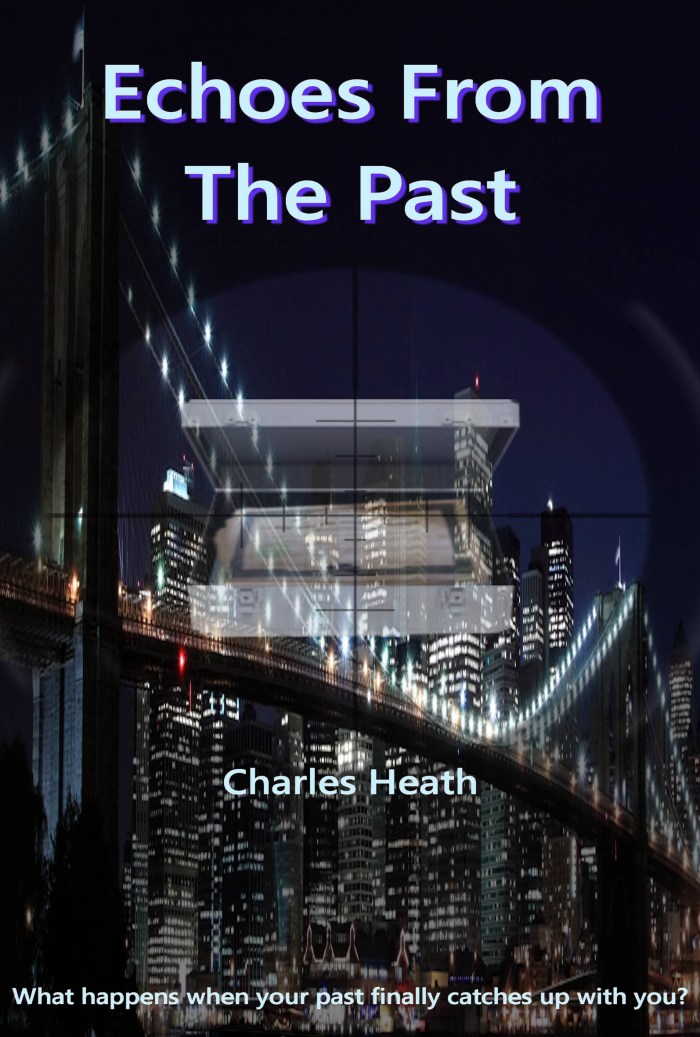
“Echoes From The Past”, buried, but not deep enough

On special, now only $0.99 for the next few weeks.


What happens when your past finally catches up with you?

Christmas is just around the corner, a time to be with family. For Will Mason, an orphan since he was fourteen, it is a time for reflection on what his life could have been, and what it could be.

Until a chance encounter brings back to life the reasons for his twenty years of self-imposed exile from a life only normal people could have. From that moment Will’s life slowly starts to unravel and it’s obvious to him it’s time to move on.

This time, however, there is more at stake.

Will has broken his number one rule, don’t get involved.

With his nemesis, Eddie Jamieson, suddenly within reach, and a blossoming relationship with an office colleague, Maria, about to change everything, Will has to make a choice. Quietly leave, or finally, make a stand.

But as Will soon discovers, when other people are involved there is going to be terrible consequences no matter what choice he makes.

https://amzn.to/2CYKxu4

newechocover5rs


I’ve always wanted to go on a Treasure Hunt – Part 34

Here’s the thing…

Every time I close my eyes, I see something different.

I’d like to think the cinema of my dreams is playing a double feature but it’s a bit like a comedy cartoon night on Fox.

But these dreams are nothing to laugh about.

Once again there’s a new installment of an old feature, and we’re back on the treasure hunt.


When I woke the next morning, it was to the sound of voices in the front of the house.  One of the voices was my mothers.  The other I had trouble placing, and I initially thought it was Benderby, calling in on the way to work.

When I threw on some clothes and came out, still a little bleary-eyed, I found it was the Sherriff.  It seemed, all of a sudden, my mother had become the most popular girl in town.

The thing is, I knew little of the history of what went on in my mother’s time in a city where she had been born, raised, and remained.  Married and divorced her high school sweetheart, there was talk of her being one of the popular girls at school, coincidentally the same school I went to, and there was evidence everywhere of her there.

I had not lived up to the family name.

Not that she expected me too, nor did she acknowledge those wild and hazy days where she had not been weighed down by a useless drunken husband, and struggle to pay the bills, hold onto the house, and both work and be a mother.  Life had not gone the way she had expected.

But curiously those times were also those of Sherriff Johnson, in the same grade, along with Benderby, a few years ahead, and both Boggs’ mother and father who were contemporaries along with others including Nadia and Vince’s mother.  They had been friends once until she married Cossatino and she ‘changed’.

Now they were an ocean apart on the social or any scale.

“Ah, Sam.  How are you now?”

“Better.  I’ll be more careful next time.  Got any leads on who it was?”

“Ghosts.  We have a few.  Some of them are Cossatino’s, the others Benderby.  Pity no one is willing to name names.”

“I didn’t see them, Sherriff.  They wore masks.”

“Of course.”

“Is there anything more about the Frobisher case?”

“You seem very interested in police matters Sam.”

“He was an antique dealer, according to the papers, and there’s a lot of talk going around about the infamous treasure maps and you can’t help but put two and two together.  Especially when Rico is related to Boggs whose father was the one responsible for creating those treasure maps.  You think Rico was trying to get some answers out of him?”

“Hardly the sort of thing that any sane man would kill for, don’t you think?”

I doubted he would tell me if he knew anything, but he had taken more interest in what I was saying.  It was stuff he’d know, or at least should know, since he had been the one to investigate Boggs’ father’s disappearance.

“Who said Rico was sane.  He was a terrifying sort of guy when he lost his temper which I’ve seen him do in front of Boggs.  But you have to agree, Rico had to know about Boggs’ father’s role in creating the maps for the Cossatino’s.”

The sheriff shook his head.

“Those are not the sort of rumors you want to be spreading around town, not unless you want an army of Cossatino’s layers on your doorstep.  They are just that, rumors.  Nothing was ever proven, and there was no evidence that the Cossatino’s had anything to do with Boggs’ father’s disappearance.”

“And Rico?”

“Rico is a harmless fool who talks big and that’s all.  He did his time for running a map scam that he claims was run by Boggs senior.  No one could prove it so he copped it sweet.  Now, he should know better.  But I will say this, Frobisher was not here to see Rico, but Benderby.  Benderby apparently had some old coins he’s scooped up off the ocean floor on a dive and thought they might be worth something.  Frobisher took them to be assessed and valued but got no further than Rico’s boat.  And the coins are now missing.”

“Sounds to me like there’s going to be another treasure hunt.”

There’d been another some years before fuelled by news an authentic treasure map had been found, showing the location of Captain Markaby’s plunder stashed away for another day somewhere on our shores.

It all ended with Boggs senior’s disappearance.

“It might, but we can only hope what happened to the father in the last one, doesn’t happen to the son in this one.  It’s why I called in.  Your mother tells me you have some influence on young Boggs.  Please tell him to stop stirring the pot with this notion he has the real map.  He doesn’t.  No one does.  The plain truth is, there isn’t one.  Someone needs to get through to him before something really bad happens to him.  He’s already had one close shave.  I’ll deal with the Cossatino’s and the Benderby’s.  I expect you to deal with Boggs.  Am I clear?”

Put to me in that authoritarian voice, it was very clear.  But to Boggs, it was going to be like a red rag to a bull.

I nodded and went back to my room.

How did I manage to get in the middle of this mess?

© Charles Heath 2019-2020

Past conversations with my cat – 44

20160902_123157

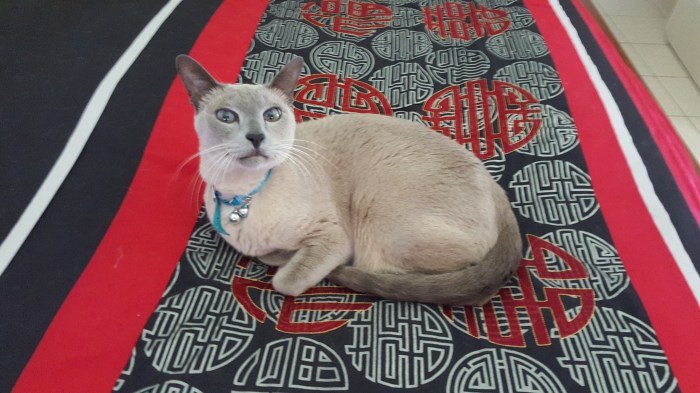
This is Chester.  I’ve just dropped the bombshell we’re thinking of getting a dog.

So, the first response from him:  Well, the last dog didn’t turn out so well, did it?

We didn’t tell him what happened to the dog, but maybe he’s psychic.

Or is that psycho?

Anyway, the last dog we had moved to my son’s place when he moved, and shortly after, broke his hip and had to be put down.

So I say, that dog moved when my son left.  I don’t have any more sons living in, so that won’t be a problem.

It’s going to be a mistake.

Oh, how?

You know they all start out like soft furry balls, like cat’s I’ll admit, but then they grow up, and up, and up, and up.  And eat you out of house and home.  Not like us lovable cats, we stay small furry balls, and don’t eat all that much.

No, you’re just fussy, and it’s like hell on earth getting you to eat.

Then stop buying the cheap stuff.

Cheap?  Cheap?  That last lot of food cost an arm and a leg.  At least with a dog, it will eat anything, including scraps from the table.

He gives me that condescending look reserved for people who think they own or know cats.

As you wish, my Lord.

Then he walks off, head in the air and tail swishing in annoyance.

A Chapter from “Echoes from the Past”

Currently available from Amazon:  https://amzn.to/2CYKxu4


I looked down on 5th Avenue and could just see, in the distance, Saks, and opposite, the Rockefeller Center.  Recently I’d gone ice skating there with a woman I had begun to care for more than I should, and who liked spending time with me.

It was a relationship that had evolved slowly and was now moving into dangerous territory.  From the moment our eyes first met across the ice, I knew that outing had been a mistake.  Whatever I’d been thinking it couldn’t happen, but against better judgment, I had let it happen.

It was not her fault, it was mine.  I was not the person she thought I was, the person I wanted to be, and if the circumstances of my past were not as they were, the person she was most likely looking for.

It had happened before, and it would happen again, and the result would be the same.  I would move on, find a new city, a new job, a new life, and continue to hide in plain sight.

Waiting for an eventuality that may never happen, but if it did, it would happen to me alone, not the woman I loved.

I sighed inwardly, thinking of how unfair life could be.  And how much, this time, I wanted it to be different.

From my office window, high up in the sky, I could see several Fire Department vehicles going though yet another drill and could just hear the sound of the sirens floating up to the 32nd floor.  Darkness was closing in, and the fast-moving red strobing lights stood out against the neon signs, the street lighting, and the Christmas decorations.

It was that time of the year again, a time that brought back very sad memories.  For most people, it was when families came together to celebrate.  That was not possible for me.  I’d thought with the passing of time it would no longer hurt so much, but it did.  I felt a tear in my eye and pulled a tissue out of the box on my desk to wipe it away.

Enough with the sentimentality.

Behind me, I heard files being dropped on my desk.  It was Friday when Maria from Accounting brought me the latest customers who were overdue in paying their investment contributions.  The stack was getting bigger every week.

I turned to face her.  She was only three years younger than me but looked ten.  Italian parents, conservative dressed, reserved manner, but usually friendly and outgoing, she was well-liked by all.  What surprised me, out of all the people she could choose as a friend, and since our ice skating expedition something more than that, she chose me.

I was not exactly the easiest of people to get along with, for obvious reasons.

I soon discovered this was the only time she and I could meet in the office without the prying eyes of our workmates making more of it than it was.  Office romances, not that either of us would acknowledge we were having one, were frowned upon.  Worse, rumors were very easily started, and much harder to quash.

“To be honest, I’m glad I don’t have your job, Will.”

She looked at the stack and then gave me a special look, one I wanted to believe was reserved just for me.  Her smile always tugged at a heartstring or maybe two.  This night it did more than that.

I shrugged and tried to be casual.  “I was told I had a gift.”

“Ah, the statement of faith, just before the sucker punch.”

Everyone knew to call customers in distress was a difficult job at best.  It required tact and diplomacy, a trait I’d acquired over time because of my situation.  It had been a strange match of opportunity and unrealized talent when a disgruntled customer had come into the office and verbally attacked Mr. Bartleby, a senior partner.

I’d talked the customer down, and talked myself into the job.  I’d only agreed to do it because it came with the promise of a promotion.  Now I was considering an exit strategy, it probably didn’t matter.

“Doing anything for the weekend?”  She asked the same question every Friday.  The last time, I surprised her by asking if she skated on ice, not expecting she did.  She said yes.

It didn’t take long to realize she would have said yes to climbing Mount Everest.  It was her first time on skates, and we learned a lot about each other over the half-hour she managed to stay upright.

For her bravery, I took her to dinner and then took her home.  She asked me to stay for a while, to patch up her wounds, perhaps the modern-day equivalent of ‘would you like to come up and see my paintings’.

Whatever her intentions or my desires, we just talked over a bottle of wine and then coffee.  I didn’t have to leave, but it was better for both of us that I did.

I closed my eyes to break the connection.  I could feel it.  I was starting to fall in love with this girl, this woman, and I knew I had to be careful.  It would not be long before the questions started; questions I couldn’t answer.

“No.  I wasn’t intending to do much.”

“Then perhaps you might consider joining the rest of us monkeys for beer, wine and a lively discussion about anything but work.   Harry’s found a new bar, upon 6th Avenue.”

Harry was our social director, not a real one but self-appointed, and he organized most of the unofficial staff gatherings.  He was a bit too self-important for me, an ‘I am’ sort of guy, but he went to Harvard and had probably earned the right.  I wasn’t on his social radar so he rarely invited me to anything.  If he did, I generally declined.  Those gatherings were the hunting grounds of the go-getters, the rookies looking for an edge to climb the corporate ladder.  I was all about keeping a low profile.

“Is he asking, or you?”

A momentary frown settled on her face.  We’d had a similar discussion once before, and I’d realized then she tried only to see the good in people.  Perhaps that was why I was so lucky.

“Does it matter?”

I pretended to think about it for a minute, and then said, “No.”

Her smile returned.  “Do you want me to come to fetch you?”

“As appealing as that sounds, I have a couple of matters to tidy up.  You go, and I’ll drop in later.”

The expression on her face told me she didn’t believe me.  It was not without merit, because I had told her the same before and not followed through.  Then, it didn’t matter because I hadn’t known her all that well.  Now, it seemed everything had changed.

“You are not just saying that to get rid of me, are you?”  The tone matched the doubtful expression.

Blunt, but fairly accurate.  I didn’t want to underestimate this girl.  In normal circumstances, I might have considered something else, other than drinks.  Instead, I said, “I would have preferred a walk in Central Park, but I don’t think the weather is going to behave.”

Then I had a moment where I thought if I told her something closer to the truth, it might help me climb my way out of the deep hole I was digging for myself.  “To be honest, I’m not very good at these social gatherings.”

Another change in expression, she had many faces for many occasions.  This one was of surprise, or was it an agreement?

“Then you and I could go somewhere else if you like.”

Not exactly the result I was looking for.

“We could, but then you would miss out on being with your friends and most likely miss the next scandal to envelop us.”

The last one was about Bartleby junior and a certain socialite.  Everyone knew what he was like except one person, his current fiancée Katrina.

“True.”  She shrugged.  I had just become a lost cause.  “I will look out for you.  But remember, I will be disappointed if you don’t come.”

She gave me a last look, somewhat whimsical I thought, as I watched her walk across the floor to the elevator lobby.  It was like watching the love of my life leaving, without turning back.


I’d promised myself a long time ago that I would not get involved with a woman, but I soon learned how difficult a promise like that was to keep, especially when the woman’s name was Katrina.

I’d not known real love before, and it was not difficult to fall under her spell.  She was as beautiful as she was beguiling.

A long time ago, in what felt like another lifetime, Katrina Winslow and I worked together.  She taught me my first job at Bentley, Bowman and Bartleby, Accountants.  And, as with anyone with whom you work so closely, we became friends, and then something more than that.

By the time I realized what had happened, it was too late.  She was the daughter of parents who cared about their daughter, and the people with whom she associated.  They had me investigated.

I remember that Monday morning as if it was yesterday when she came into my office.  We had spent a perfect weekend together, and when I left her Sunday night, I was full of those starry-eyed dreams people in love had.

An hour later, all of those dreams had been shattered, not only for me but for her too.  I had no answers to her questions, answers the investigators could not find.  I knew from the first day I met her she was out of my league, but I honestly believed love could conquer all.

Her father didn’t.  It ended, and in time I realized it was for the best.  I had nothing to offer her, and I could never give answers to any of the questions she might ask.

Not long after, Maria told me about her engagement to Marcus Bartleby, son of the remaining live partner whose name graced the building, and signs throughout the city.  I told myself he would be the sort of man her father believed she deserved, but in my heart, I knew what sort of person Marcus was, and equally, there was nothing I could do about it.

I had a secret, one that I could never tell anyone.  And until I could find a way of reconciling my past I could never contemplate having a future, make any friends, or find any sort of peace or happiness.

With Katrina, with Maria, or anyone else.


The truth is my life was the equivalent of a metaphorical train wreck.  You wouldn’t know it, looking at me, but how I looked now, how I acted and reacted was a product of many years of practice.  From the moment I had seen my parents murdered at the age of fourteen, I’d been on the run.  Being that young, it was tough on the road, and I had to get street smart, and defensive, very quickly.  I’d learned the hard way, through the school of hard knocks.  By comparison, the Bartleby’s of this world had got it easy.

But, don’t get me wrong.  It was not something I was bitter about.  It was what it was.  I did what I had to do, and what I have to.  I accepted they had and always would have everything handed to them on a platter.  It was the way of the world.

On the upside, I had only myself to please.  I did not have to rely on anyone else, nor was I responsible for anyone but myself.  I had no family to speak of, or that I would acknowledge.

My father had been an orphan and had spent a relatively lonely life up to the point where he married my mother.

The family I had on my mother’s side was the reason I ran away and kept running, and fortunately, I had not seen any of them since the day I finally escaped.

On the downside, I’d never stayed in one place too long, and never had the time to get a good education, a prerequisite for a good job.  Instead, I had a lot of experience in jobs that didn’t have much of a career path.

I’d thought of night school, even tried it once, but it didn’t work out.  That was the catalyst for joining the army, the one place where people like me finished up.  It was a place to call home wherever they dumped you, and you made friends that didn’t care who or what you were, or cared too much about your past.

I was sent to Iraq, the first time around, with a great bunch of guys, until most of the platoon was killed in a suicide bombing, and the few that survived, including me, were physically repaired and discharged.

In the years since I’d stopped in ten cities.  New York was the most recent, and I’d been here the longest.  I’d carved a path across America from the Mid West, a place called Columbus, Nebraska, through to New York, with a lot of places in between.  It was an interesting way to see the country when in normal circumstances I would have little reason to leave my home town.

Now, after all the running, all the looking over my shoulder, there was a desire to stop.  The problem was I couldn’t.  I couldn’t afford to feel safe, because the moment I did, the moment I let down my guard, it would be when I’d make a mistake, a mistake that could have horrific consequences.  Not only for me but for others around me.

I’d learned that lesson well, soon after I had run away from home, but before I left my home town.  Escape was a relief, and when they had not caught up with me after a week, I started to feel safe.

I let down my guard.  I allowed my trust of the one person in that family I thought was my friend to influence my actions.  She had unwittingly led the family to me after being used as a decoy.  I hadn’t thought of that possibility.

They handed me to the man who murdered my parents.  He told me he’d been willing to track me to the ends of the earth, as long as it took.  He held me captive for a few hours until I escaped, and I had no intention of being caught again.

From that day, I never trusted anyone again.

I remembered the demonic look in his eyes when he told me he would never stop looking.  He was out there, somewhere, and I had to remain vigilant.  The passing of time, for this murderer, was irrelevant.

And, standing there, looking out the window and down 5th Avenue, I could feel the itch, the one I couldn’t scratch.  The one that told me my pursuer, a man who went by the name of Edward Jamieson, wasn’t very far away.


© Charles Heath 2015-2020


Writing about writing a book – Day 22

More of Bill’s backstory, and, if it’s possible, I’m beginning to like this guy.

I suspect, for him as well as many others, it wasn’t easy, but in war zones, it’s either hot or cold, but never any pleasant in any weather conditions, and perhaps if there was a possibility of a fine, balmy, day, there would be no time to enjoy it.


Sleep was difficult. 

Sleep was always difficult, if not impossible. 

Whilst I had lived in barracks, in the tropics as part of my training and acclimatization, it was nothing like this.  Nothing could have prepared me for the endless, oppressive heat.

It started from the day the plane had landed on the tarmac at Saigon airport, the crew opened the door to the cabin, and we walked down the stairs.  The heat came from above, and from the tarmac below.  We were soaked in sweat by the time we reached the buildings.

And it was difficult not to be exhausted, even if you were lucky enough to get a few hours sleep.  That constant feeling of exhaustion was the biggest enemy, and what caused many of the unnecessary deaths.  In the end, for many, it was just too much.  For me, it was training that kept me alive, because of that little voice in my head that kept me vigilant.

That and a keen sense of self-preservation.

Our platoon was still recovering from the shock of seeing the death of two of our mates the previous day.  Although in the camp only a week, already it felt like a year.  We’d been sent out on a patrol, trying to find a group of the enemy who was responsible for cutting one of the supply lines, and it hadn’t taken long for us to realize we didn’t really know if it was the Viet Cong or the people we were supposed to be protecting.  They all looked the same to me, and we had to rely on our South Vietnamese Army liaison to ensure we didn’t shoot the wrong people.

After an eventless day, if you discounted the rain, the heat, and the scares, the Lieutenant ordered us to make camp, just before darkness set in.  We had not seen the enemy, and, as I was finally getting to understand, we probably wouldn’t until they were prepared to show themselves.

At that moment of maximum unpreparedness, when our attention was diverted, and after a long and debilitating day, they chose to attack.

I had no doubt they had been tracking us, and for quite some distance.  I had that effect of hair standing up on the back of my neck.  It actually saved me from getting shot.

The attack killed three of our men and shattered our confidence.

No one slept that night, either from fear the attackers would return, or because we were just plain terrified.  I volunteered for guard duty.  It was easier to be up and about instead of on a camp stretcher staring at the roof of the tent waiting for the inevitable.

Seeing our mates killed so horrifically, before our eyes, had the desired effect.  In the beginning, we expected it to be a walk in the park, with some hoping that we would just stumble around in the jungle for a week or so, then go back to the camp for a well-earned rest.  None had counted on the reality of war, or the fact some of us might die.  Some were even hoping they would not have to shoot their gun.

All of those illusions had now gone after three months had passed, and as reality set in.

Some had sobbed openly, such was their preparedness.  I had to say, I was a little more prepared, but had hoped for a little more time before the battle.  And it surprised me how calm I was when all around me it was chaos.


“Bastards,” Killer muttered.

We called him ‘Killer’ because it was the nickname the Army had given him.  We were sharing the guard duty and had spoken briefly over the watch, but up till then, the silence had stretched over an hour or so.  It didn’t take long for anyone to realize he was a man of few words.

He’d been in the regular army for years and asked for the posting.  He’d made Sergeant several times, only to lose those same stripes for fighting, usually after R&R and a bout of heavy drinking.  Now assigned to our platoon to lend his experience, the conscripts were expecting him to ‘look after’ them.  Other than myself and the Lieutenant, he was the only other regular soldier.  Unfortunately for them, he hated both conscripts and the Viet Cong in varying degrees, and depending on his mood there was little tolerance left for the rest of us.

“The people who sent us here or the people trying to kill us?” I asked before I realized I’d spoken.

I didn’t hear the reply, the skies opening up with another torrential downpour that lasted for about five minutes, and going as fast as it came.  When the sun finally came up, it would make the atmosphere steamy, hot, and unbearable.  It was quite warm now, and I was feeling both uncomfortable, and fatigued.

Killer looked just as stoic as he had before the rain.  He looked at me.  “Damn weather.  Worse than home.”

“Scotland?”

“Scapa Flow, Kirkwall.  I should have been an engineer on ships like my father, but I was too stupid.  Joined the Army, finished up here.  What’s your excuse?”

“Square peg in a round hole.  The army seems to handle us in its stride.”  It was more or less the truth.  I joined the Army to get away from my parents.

“That it does.  That it does.”

The rain came and went, during which the rest of the camp roused and went about its business.  It had been a long night for some, still getting over the shock of the attack, and the ever-pervading thought the enemy was still out there, biding their time.  It would be, for them, a waiting game, waiting for the conditions to wear us down, and lose concentration as inevitably we would.

Certainly, by the time we were relieved from sentry duty, I felt I was in no condition to match wits with a donkey, let alone the enemy on his own home ground.  When I stumbled over to the mess area and looked at the tired and haggard looks on the faces of the platoon, I realized that went for all of us.

Killer and I managed to get about an hour’s rest before the call came to move out, rain or no rain, and after a breakfast to make anyone ill, we left.  For hours it rained.  No one spoke as we strained to listen over the rain spattering on the undergrowth, all the time expecting the unexpected.  That was the benefit of the surprise attack; we no longer took for granted we would be safe.

Water gathered in pools along the trail, hiding any chance of seeing landmines.  Rainwater and sweat ran into our eyes, making it difficult to see.  Water leaked everywhere, making it very uncomfortable.  This was not a war; this was utter stupidity.

I was about to remark on the futility of it all to the Lieutenant, who had taken the lead, when one second he was talking to me and the next he crashed to the ground, a sniper’s bullet killing him instantly.   Someone yelled “Contact” and we hit the ground, bullets flying all around us. 

Too late, I thought, as I felt the hit of what seemed to be a large rock, then the searing pain in my leg, just as I hit the ground…


© Charles Heath 2016-2020

In a word: Hair

You comb it every day, or brush it, it can be tangled, fine, smooth and silky or shiny.

It can fall out, you can have none, it can be red, brown, black, blonde, white, and a million shades in between.

Yes, it’s hair.

It can be pesky stuff, especially from animals who tend to moult and leave it everywhere.  We have a cat and well know the foibles of hair loss.

You can get it cut, get it coloured, trimmed, permed by a hairdresser in a salon, where lots of subjects are discussed, and even movies have been made around salons.

I haven’t been within a hairsbreadth of either living or dying, but I’m sure someone has.  That hairsbreadth is not very wide, and I’d rather have bullets, arrows or fists missing by that margin.

You can be in another’s hair, that is, being a pest.

There’s the hair of the dog, supposedly a hangover cure.

And, going to scary places will make your hair stand on end.


This is not to be confused with the word heir which means something completely different, namely it described the legatee or inheritor of the family fortune.

Or not.  Ages ago, only sons were seen as heirs, and that was even more prevalent among royal families.  It also applied to heirs when it came to titles, and the family wealth and property, which went to the eldest son.

It makes a good plotline for many a murder mystery.

Also, let’s be clear, there is also an heiress and an heirloom.


Then there is another, hare, which is a cousin of the rabbit and considered a pest.

I’m not quite sure how someone came up with the descriptor harebrained, which has nothing to do with the hare.

It could mean to run quickly and usually in a careless manner.

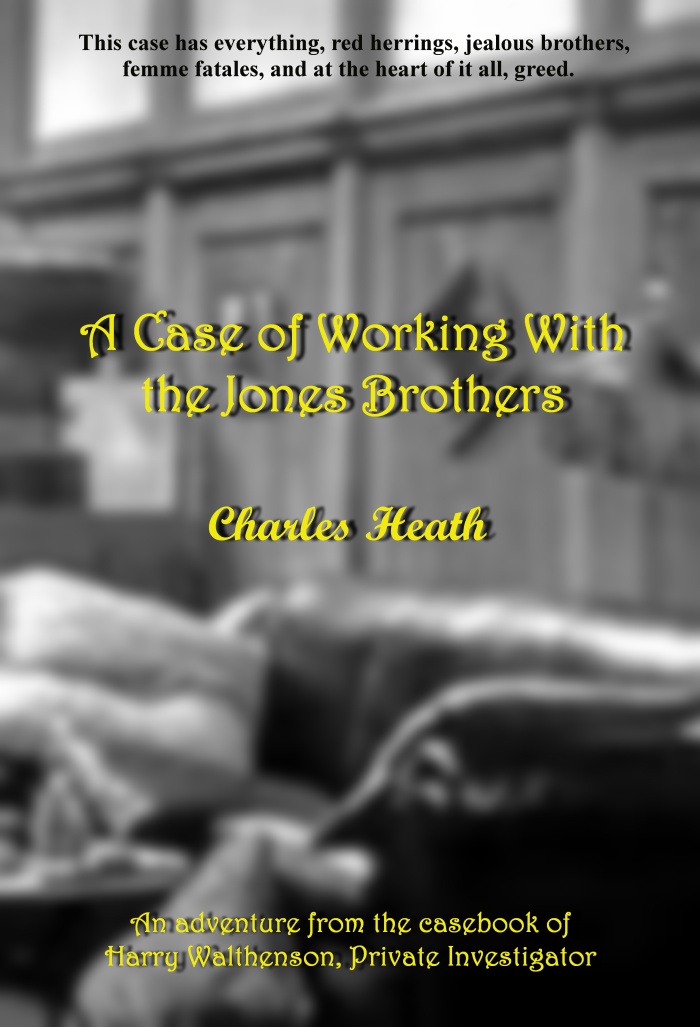
The first case of PI Walthenson – “A Case of Working With the Jones Brothers”

This case has everything, red herrings, jealous brothers, femme fatales, and at the heart of it all, greed.

See below for an excerpt from the book…

Coming soon!

PIWalthJones1


An excerpt from the book:


When Harry took the time to consider his position, a rather uncomfortable position at that, he concluded that he was somehow involved in another case that meant very little to him.

Not that it wasn’t important in some way he was yet to determine, it was just that his curiosity had got the better of him, and it had led to this: sitting in a chair, securely bound, waiting for someone one of his captors had called Doug.

It was not the name that worried him so much, it was the evil laugh that had come after the name was spoken.

Doug what?  Doug the ‘destroyer’, Doug the ‘dangerous’, Doug the ‘deadly’; there was any number of sinister connotations, and perhaps that was the point of the laugh, to make it more frightening than it was.

But there was no doubt about one thing in his mind right then: he’d made a mistake.  A very big. and costly, mistake.  Just how big the cost, no doubt he would soon find out.

His mother, and his grandmother, the wisest person he had ever known, had once told him never to eavesdrop.

At the time he couldn’t help himself and instead of minding his own business, listening to a one-sided conversation which ended with a time and a place.  The very nature of the person receiving the call was, at the very least, sinister, and, because of the cryptic conversation, there appeared to be, or at least to Harry, criminal activity involved.

For several days he had wrestled with the thought of whether he should go.  Stay on the fringe, keep out of sight, observe and report to the police if it was a crime.  Instead, he had willingly gone down the rabbit hole.

Now, sitting in an uncomfortable chair, several heat lamps hanging over his head, he was perspiring, and if perspiration could be used as a measure of fear, then Harry’s fear was at the highest level.

Another runnel of sweat rolled into his left eye, and, having his hands tied, literally, it made it impossible to clear it.  The burning sensation momentarily took his mind off his predicament.  He cursed and then shook his head trying to prevent a re-occurrence.  It was to no avail.

Let the stinging sensation be a reminder of what was right and what was wrong.

It was obvious that it was the right place and the right time, but in considering his current perilous situation, it definitely was the wrong place to be, at the worst possible time.


It was meant to be his escape, an escape from the generations of lawyers, what were to Harry, dry, dusty men who had been in business since George Washington said to the first Walthenson to step foot on American soil, ‘Why don’t you become a lawyer?” when asked what he could do for the great man.

Or so it was handed down as lore, though Harry didn’t think Washington meant it literally, the Walthenson’s, then as now, were not shy of taking advice.

Except, of course, when it came to Harry.

He was, Harry’s father was prone to saying, the exception to every rule.  Harry guessed his father was referring to the fact his son wanted to be a Private Detective rather than a dry, dusty lawyer.  Just the clothes were enough to turn Harry off the profession.

So, with a little of the money Harry inherited from one of his aunts, he leased an office in Gramercy Park and had it renovated to look like the Sam Spade detective agency, you know the one, Spade and Archer, and The Maltese Falcon.

There’s a movie and a book by Dashiell Hammett if you’re interested.

So, there it was, painted on the opaque glass inset of the front door, ‘Harold Walthenson, Private Detective’.

There was enough money to hire an assistant, and it took a week before the right person came along, or, more to the point, didn’t just see his business plan as something sinister.  Ellen, a tall cool woman in a long black dress, or so the words of a song in his head told him, fitted in perfectly.

She’d seen the movie, but she said with a grin, Harry was no Humphrey Bogart.

Of course not, he said, he didn’t smoke.

Three months on the job, and it had been a few calls, no ‘real’ cases, nothing but missing animals, and other miscellaneous items.  What he really wanted was a missing person.  Or perhaps a beguiling, sophisticated woman who was as deadly as she was charming, looking for an errant husband, perhaps one that she had already ‘dispatched’.

Or for a tall, dark and handsome foreigner who spoke in riddles and in heavily accented English, a spy, or perhaps an assassin, in town to take out the mayor.  The man was such an imbecile Harry had considered doing it himself.

Now, in a back room of a disused warehouse, that wishful thinking might be just about to come to a very abrupt end, with none of the romanticized trappings of the business befalling him.  No beguiling women, no sinister criminals, no stupid policemen.

Just a nasty little man whose only concern was how quickly or how slowly Harry’s end was going to be.

© Charles Heath 2019


What happens after the action packed start – Part 36

Our hero knows he’s in serious trouble.

The problem is, there are familiar faces and a question of who is a friend and who is foe made all the more difficult because of the enemy, if it was the enemy, simply because it didn’t look or sound or act like the enemy.

Now, it appears, his problems stem from another operation he participated in, and because of it, he has now been roped into what might be called a suicide mission.


The next stretch of road was from Aba to Nagero, the gateway to the Garamba National Park.  This was a road where we would have to be more careful because it was possible, now we were off the main road, even though it was designated a highway, or perhaps that was a little too optimistic since it had a number N26, which ran into the R240 at a place nominally named Faradje, but did have a place to stay called the Residence Robert Ball.

I guess I missed that.

Beyond Faradje the road was a little more intense, but something else that worried me, there was more scope for us to be ambushed.  To be honest, I had expected trouble for the last 100 kilometers, but trucks and people were plentiful enough to keep any surprises away.  Now, that element of safety had gone and for quite some distance now we’d been moving slowly, and everyone was on alert.

My fears were not misplaced.

We’d hit a rather rough patch and had to slow down, and coming into a creek crossing the road narrowed, and the trees came down to the side of the road, providing any would-be attacker plenty of cover.  I had been considering how I would arrange an ambush when, suddenly the car in front stopped suddenly, and we, caught unawares, slid almost into the back of them.

My other radio crackled, Monroe was reporting in.  “Houston, we’ve got a problem.”

A flooded creek that was impassable, or a rockfall.  There had been one of each so far, but both had been relatively easy to negotiate.

Then she added, “A gentleman in army gear with a gun.  He’s brought a few friends to the party.”

“Real army, or…”

“The or, I think.  Some of his ‘men’ are, well, not men.”

A local militia.  Ahead I could see several more of the ‘soldiers’ filtering down to cover each of the vehicles until a real soldier stopped near ours, gun aimed and ready to fire.

“Send in our guide and get him to sort the matter out.”

No one was asking us to leave the vehicles yet, so this might but just a ‘request’ for a passing fee.  Jacobi had said this might happen once we left the mainstream roads.  I had hoped, the Garamba National Park is internationally known, all roads in and out would be ‘protected’.  Perhaps that was only for convoys protected by Government troops, a service we had to forego due to the nature of our business.

Five minutes passed, then the next update.

“Jacobi is going now.  We’ve finally got past any possible misunderstandings.  Good thing he knows the language.”

Mindful of where the soldier covering us was standing and his line of sight into the car, I said into the other radio, “Mobley?”

“Sir?”

“Where are you?”

“About a k behind you.”

“Stop.  Park, and approach on foot.  We have a small problem, about 10 militiamen have stopped us at a choke point.”

“Done.  I will be there shortly.  Take them out?”

“Get a position and standby.”

Forward of us little was happening.  I could now see Jacobi and the group commander standing to one side of the lead vehicle, talking.  Jacobi was gesturing, and the soldier was looking defensive.

Seconds dragged by like they were minutes.

Davies came back to life.  “Why have we stopped?”

“Checkpoint.”

“There isn’t meant to be a checkpoint here, is there?”

“No.”

Before we started out Davies had hidden a sidearm under her seat, in a place where I had hoped would not be checked by the border officials.  They had made a cursory scan in the front of the car but hadn’t seen it.  Now she had reached down and had it in her hand, at the same time making sure she had eye contact with the militiaman on her side of our car.

Our personal detail had doubled in the last minute or so.  I had just watched Jacobi return to the lead vehicle, get in, but leave the door open.

The radio crackled again.  “They want five thousand US dollars, and we can proceed.”

“We got five thousand.”

“Jacobi says two should do it.”

“Give it a go.”

I watched and waited as it took a few more minutes before Jacobi, with a bulky envelope, got out of the car and walked towards the soldier.

Showing we had money and were willing to hand it over might lead to further demands, particularly if the soldier though he was being disrespected.  It all depended on Jacobi’s negotiating skills.

Mobley reported in.  He had a position where he could see the men at the head of the convoy.

I spoke into the radio to the others, “Has everyone got a clear shot on their covering guards, just in case this goes sideways.”

“They’re not exactly soldiers,” I heard Barnes say.

“But they’ll shoot to kill you all the same.  Unfortunately, we’re on a mission-critical timeline here, and whilst I don’t like it, it’s going to be one of those at all costs decisions.”

A series of ‘ready’ came over the radio.

Several more minutes passed, and more animated conversation between Jacobi and the commander, then Jacobi returned to the car, minus the envelope.

Was it successful?

Monroe.  “Seems he wants ten thousand now.  Orders?”

“Negotiations are over.”

Several shots rang our, taking down the three men at the front of the convoy in quick succession, the signal for the others to take out their guards almost simultaneously.  It was a miracle none of the guards got a shot off, but, then, they were standing a little too close for their own good.


Five minutes later we were back on the road, the militiamen having their arms removed, and removed from sight, just in case anyone came looking for them.  It might be a forward group from the kidnappers, looking for some extra cash, or, if the negotiations had dragged on, looking to take the ransom and then demand another when we turned up empty-handed.

Whatever had happened, it was over.

Ten minutes later Mobley had re-joined the convoy behind me.


© Charles Heath 2019-2020