In a word: Bar

There’s more than one way … er, perhaps it’s better to say, there are many ways to use the word bar, which is not bad for a three letter word.


Bar, the one you associate with drinks, in hotels, restaurants and we’ll, just bars.

Probably the best type of bar you might find me in is a Sports Bar, where you can snack on buffalo wings a tall glass of beer and watch with ice hockey in winter or baseball in summer.

It’s one I use from time to time when asked, what will we do, and the reply is often let’s go to a bar.  The best bars are underground, dark and dingy, full of eclectic people, with a band playing almost passable music or better still jazz


Bar, as in the legal variety

There are so many legal references to using bar, that the one that I am most familiar with is being admitted to the bar which means that you can now practice law.

Raising the bar, if that’s possible, where the bar is that imaginary level which offers sinks very low.  When someone says they’re going to try and raise the bar, you may be assured there will be a long battle ahead, simply because people generally find it hard to change.


Bar, as in we are not going to let you in here.  Yes, this is the irksome one where you find yourself, often for reasons unknown, barred from somewhere or something.  This may also be referred to by saying everyone may enter bar you.  


Bar, as in an iron bar, the sort that is sometimes used as a blunt force object by villains to remind the victim they owe any one of a loan shark, bookie or the mafia.  God help you if it is all three.

There are also iron bars of a different sort, those that are set in concrete outside a window most likely in a prison where the objective is to prevent escape.

It gives rise to an old expression, that person should be behind bars.


Then there is just a bar, such as a bar of gold, which I’m sure we’d all like to have stashed away, but not necessarily in the mattress, or the more common variety, a chocolate bar, which I have one now.  What’s your favorite?


And just to add to the list of meanings you can always refer to sashes or stripes as bars.

Confused?  Well, there’s still music, and the bane of yachtsmen, sand bars but I think we’ll leave it there.

Welcome to the English language

The power of words

They can destroy relationships

They can tear apart friendships

They can start wars

We are sometimes at a loss for words

Sometimes we can’t find the words

And then there those horrible things called crosswords.

There are antonyms and synonyms

Sometimes we use words we don’t know the meaning of because of their similarity with others we do

Then there one or more words that make other words as in anagrams

There are substitute words, words we use around children like fudge instead of, well you get what I mean

There’s no doubt we would be lost without words

Words are to be chosen carefully and thoughtfully

They need to be delivered in an appropriate manner, not in haste, and not in anger

We need to believe in what we’re saying before others will believe it

We need to learn how to express our feelings

We should take advantage of learning English (or any other native language) when at school

We need to start reading as soon as we can and keep up reading as we get older.  One should never underestimate the power reading and writing gives us no matter who we are.

Always have a dictionary by your side.  It is the most valuable book you can own.

And always remember the power of speech can at times move mountains

Does our education define us?

It’s 2am here, and I’m feeling philosophical, instead of being sleepy and going to bed.

It’s probably the problem most writers have when they’re working on a novel, a short story, or a blog post, or something else.

The other day a thought ran through my mind, whether or not my first school was still standing and if so, would it remember me?

Probably not.  I went there in 1958, I think when I was five.  I stayed there till I finished Grade six and then moved onto secondary school.

In those days, we could stay at secondary school till Form four and then, if we were 15 or over, we could leave.  I went to a technical school, i.e. one that taught a trade, rather than going to a High School which was for the more academically minded and who would go on to University.

But in my day, you had to have rich parents to get into a University, and we were decidedly poor.  It was a technical trade for me, and become a builder was to be my lot in life.

I wasn’t very good and sheet metal, the precursor to plumbing, or machine ship practice the forerunner to being a mechanic, or technical drawing, the forerunner to being a draughtsman

I could have just as easily been a farmer or gardener, it too was on the curriculum.

Where is this going?

Oh, yes.  My old primary school.  Yes, it’s still there, and it still looks like the gothic nightmare it used to.  Gothic or not, I guess those years in that school were good, and I don’t seem to have any bad memories, except,. of course, of the teachers, but that’s only natural.

secondary school, that was a nightmare, so different, and much like going to university, with different classes, different teachers, different rooms, and a lot of other kids who were older, larger, meaner, and made the navigation of early teens an annabilus horribilis four times over.

So the question did my education define me?

No.  I was a builder for a while, but my aspirations led me towards office work, the sort where you start at the bottom and languish there till you’re noticed.

Failing that, you work for a relative, then get headhunted, watch that opportunity slip away, and become an IT teacher that leads to computer programming.

But, as they say, always have a backup plan.

Yep!  Writing.  Been doing it since I was fifteen.

Now, those years I was at school have provided me with a diverse collection of people who have become characters in my stories, and I’m still waiting for the know on the door from the process server to tell me one of them finally recognized him or herself and didn’t like my impression of them.

Hasn’t happened yet.

Searching for locations: Windsor Castle, London, England

A fine day, on this trip a rarity, we decided to take the train to Windsor and see the castle.

This is a real castle, and still in one piece, unlike a lot of castles.

Were we hoping to see the Queen, no, it was highly unlikely.

But there were a lot of planes flying overhead into Heathrow.  The wind must have been blowing the wrong day, and I’m sure, with one passing over every few minutes, it must annoy the Queen if she was looking for peace and quiet.

Good thing then, when it was built, it was an ideal spot, and not under the landing path.  I guess it was hard to predict what would happen 500 years in the future!

2013-06-30 12.09.56

I’m not sure if this was the front gate or back gate, but I was wary of any stray arrows coming out of those slits either side of the entrance.

You just never know!

2013-06-30 13.58.11

An excellent lawn for croquet.  This, I think, is the doorway, on the left, where dignitaries arrive by car.  The private apartments are across the back.

2013-06-30 13.58.00

The visitor’s apartments.  Not sure who that is on the horse.

2013-06-30 14.07.25

St George’s Chapel.  It’s a magnificent church for a private castle.  It’s been very busy the last few months with Royal weddings.

2013-06-30 12.12.29

The Round Tower, or the Keep.  It is the castle’s centerpiece.  Below it is the gardens.

2013-06-30 13.59.57

Those stairs are not for the faint-hearted, nor the Queen I suspect.  But I think quite a few royal children and their friends have been up and down them a few times.

2013-06-30 12.13.04

And well worth the effort to reach the bottom.

2013-06-30 14.00.40

Any faces peering out through the windows?

In a word: Flight

There is a saying, if God wanted us to fly then he would have given us wings.

Unfortunately, he didn’t, so we do not get to know what it’s like to be in flight,

Unless…

We take an aeroplane, which usually has a flight number such as QF607, or in conversation, ‘I’ll be taking the 6 o’clock flight’.

If someone runs away, then we say they have taken flight.

If we roll back a few years, say about 80, to World War 2, flight tales on a whole new meaning.

It refers to a group of planes, in one case a number of spitfires, or,

The man in charge, a flight lieutenant, also colloquially known as ‘flight’.

This is not be confused with the word flite which has several very obscure meanings,

First, it means to quarrel or argue, or engage in a debate, and

Second, to make a complaint.

But one that sticks in my my mind is Flyte, from Brideshead Revisited.  they were a very interesting family.

An excerpt from “What Sets Us Apart”, a mystery with a twist

See excerpt from the story below, just a taste of what’s in store…

http://amzn.to/2Eryfth

whatsetscover


McCallister was old school, a man who would most likely fit in perfectly campaigning on the battlefields of Europe during the Second World War.  He’d been like a fish out of water in the army, post-Falklands, and while he retired a hero, he still felt he’d more to give.

He’d applied and was accepted as head of a SWAT team, and, watching him now as he and his men disembarked from the truck in almost military precision, a look passed between Annette, the police liaison officer, and I that said she’d seen it all before.  I know I had.

There was a one in four chance his team would be selected for this operation, and she had been hoping it would be one of the other three.  While waiting for them to arrive she filled me in on the various teams.  His was the least co-operative, and the more likely to make ad-hoc decisions rather than adhere to the plan, or any orders that may come from the officer in charge.

This, she said quite bluntly, was going to end badly.

I still had no idea why Prendergast instructed me to attend the scene of what looked to be a normal domestic operation, but as the nominated expert in the field in these types of situations, it was fairly clear he wasn’t taking any chances.  It was always a matter of opinion between us, and generally I lost.

In this case, it was an anonymous report identifying what the authorities believed were explosives in one of the dockside sheds where explosives were not supposed to be.  The only reason why the report was given any credence was the man, while not identifying himself by name, said he’d been an explosive expert once and recognized the boxes.  That could mean anything, but the Chief Constable was a cautious man.

With his men settled and preparing their weapons, McCallister came over to the command post, not much more than the SUV my liaison and I arrived in, with weapons, bulletproof vests, and rolls of tape to cordon off the area afterward.  We both had coffee, steaming in the cold early morning air.  Dawn was slowly approaching and although rain had been forecast it had yet to arrive.

A man by the name of Benson was in charge.  He too had groaned when he saw McCallister.

“A fine morning for it.”  McCallister was the only enthusiastic one here.

He didn’t say what ‘it’ was, but I thought it might eventually be mayhem.

“Let’s hope the rain stays away.  It’s going to be difficult enough without it,” Benson said, rubbing his hands together.  We had been waiting for the SWAT team to arrive, and another team to take up their position under the wharf, and who was in the final stages of securing their position.

While we were waiting we drew up the plan.  I’d go in first to check on what we were dealing with, and what type of explosives.  The SWAT team, in the meantime, were to ensure all the exits to the shed were covered.  When I gave the signal, they were to enter and secure the building.  We were not expecting anyone inside or out, and no movement had been detected in the last hour since our arrival and deployment.

“What’s the current situation?”

“I’ve got eyes on the building, and a team coming in from the waterside, underneath.  Its slow progress, but they’re nearly there.  Once they’re in place, we’re sending McKenzie in.”

He looked in my direction.

“With due respect sir, shouldn’t it be one of us?”  McCallister glared at me with the contempt that only a decorated military officer could.

“No.  I have orders from above, much higher than I care to argue with, so, McCallister, no gung-ho heroics for the moment.  Just be ready to move on my command, and make sure you have three teams at the exit points, ready to secure the building.”

McCallister opened his mouth, no doubt to question those orders, but instead closed it again.  “Yes sir,” he muttered and turned away heading back to his men.

“You’re not going to have much time before he storms the battlements,” Benson quietly said to me, a hint of exasperation in his tone.  “I’m dreading the paperwork.”

It was exactly what my liaison officer said when she saw McCallister arriving.


The water team sent their ‘in position’ signal, and we were ready to go.

In the hour or so we’d been on site nothing had stirred, no arrivals, no departures, and no sign anyone was inside, but that didn’t mean we were alone.  Nor did it mean I was going to walk in and see immediately what was going on.  If it was a cache of explosives then it was possible the building was booby-trapped in any number of ways, there could be sentries or guards, and they had eyes on us, or it might be a false alarm.

I was hoping for the latter.

I put on the bulletproof vest, thinking it was a poor substitute for full battle armor against an exploding bomb, but we were still treating this as a ‘suspected’ case.  I noticed my liaison officer was pulling on her bulletproof vest too.

“You don’t have to go.  This is my party, not yours,” I said.

“The Chief Constable told me to stick to you like glue, sir.”

I looked at Benson.  “Talk some sense into her please, this is not a kindergarten outing.”

He shrugged.  Seeing McCallister had taken all the fight out of him.  “Orders are orders.  If that’s what the Chief Constable requested …”

Madness.  I glared at her, and she gave me a wan smile.  “Stay behind me then, and don’t do anything stupid.”

“Believe me, I won’t be.”  She pulled out and checked her weapon, chambering the first round.  It made a reassuring sound.

Suited up, weapons readied, a last sip of the coffee in a stomach that was already churning from nerves and tension, I looked at the target, one hundred yards distant and thought it was going to be the longest hundred yards I’d ever traversed.  At least for this week.


A swirling mist rolled in and caused a slight change in plans.

Because the front of the buildings was constantly illuminated by large overhead arc lamps, my intention had been to approach the building from the rear where there was less light and more cover.  Despite the lack of movement, if there were explosives in that building, there’d be ‘enemy’ surveillance somewhere, and, after making that assumption, I believed it was going to be easier and less noticeable to use the darkness as a cover.

It was a result of the consultation, and studying the plans of the warehouse, plans that showed three entrances, the main front hangar type doors, a side entrance for truck entry and exit and a small door in the rear, at the end of an internal passage leading to several offices.  I also assumed it was the exit used when smokers needed a break.  Our entry would be by the rear door or failing that, the side entrance where a door was built into the larger sliding doors.  In both cases, the locks would not present a problem.

The change in the weather made the approach shorter, and given the density of the mist now turning into a fog, we were able to approach by the front, hugging the walls, and moving quickly while there was cover.  I could feel the dampness of the mist and shivered more than once.

It was nerves more than the cold.

I could also feel rather than see the presence of Annette behind me, and once felt her breath on my neck when we stopped for a quick reconnaissance.

It was the same for McCallister’s men.  I could feel them following us, quickly and quietly, and expected, if I turned around, to see him breathing down my neck too.

It added to the tension.

My plan was still to enter by the back door.

We slipped up the alley between the two sheds to the rear corner and stopped.  I heard a noise coming from the rear of the building, and the light tap on the shoulder told me Annette had heard it too.  I put my hand up to signal her to wait, and as a swirl of mist rolled in, I slipped around the corner heading towards where I’d last seen the glow of a cigarette.

The mist cleared, and we saw each other at the same time.  He was a bearded man in battle fatigues, not the average dockside security guard.

He was quick, but my slight element of surprise was his undoing, and he was down and unconscious in less than a few seconds with barely a sound beyond the body hitting the ground.  Zip ties secured his hands and legs, and tape his mouth.  Annette joined me a minute after securing him.

A glance at the body then me, “I can see why they, whoever they are, sent you.”

She’d asked who I worked for, and I didn’t answer.  It was best she didn’t know.

“Stay behind me,” I said, more urgency in my tone.  If there was one, there’d be another.

Luck was with us so far.  A man outside smoking meant no booby traps on the back door, and quite possibly there’d be none inside.  But it indicated there were more men inside, and if so, it appeared they were very well trained.  If that were the case, they would be formidable opponents.

The fear factor increased exponentially.

I slowly opened the door and looked in.  A pale light shone from within the warehouse itself, one that was not bright enough to be detected from outside.  None of the offices had lights on, so it was possible they were vacant.  I realized then they had blacked out the windows.  Why hadn’t someone checked this?

Once inside, the door closed behind us, progress was slow and careful.  She remained directly behind me, gun ready to shoot anything that moved.  I had a momentary thought for McCallister and his men, securing the perimeter.

At the end of the corridor, the extent of the warehouse stretched before us.  The pale lighting made it seem like a vast empty cavern, except for a long trestle table along one side, and, behind it, stacks of wooden crates, some opened.  It looked like a production line.

To get to the table from where we were was a ten-yard walk in the open.  There was no cover.  If we stuck to the walls, there was equally no cover and a longer walk.

We needed a distraction.

As if on cue, the two main entrances disintegrated into flying shrapnel accompanied by a deafening explosion that momentarily disoriented both Annette and I.  Through the smoke and dust kicked up I saw three men appear from behind the wooden crates, each with what looked like machine guns, spraying bullets in the direction of the incoming SWAT members.

They never had a chance, cut down before they made ten steps into the building.

By the time I’d recovered, my head heavy, eyes watering and ears still ringing, I took several steps towards them, managing to take down two of the gunmen but not the third.

I heard a voice, Annette’s I think, yell out, “Oh, God, he’s got a trigger,” just before another explosion, though all I remember in that split second was a bright flash, the intense heat, something very heavy smashing into my chest knocking the wind out of me, and then the sensation of flying, just before I hit the wall.


I spent four weeks in an induced coma, three months being stitched back together and another six learning to do all those basic actions everyone took for granted.  It was twelve months almost to the day when I was released from the hospital, physically, except for a few alterations required after being hit by shrapnel, looking the same as I always had.

But mentally?  The document I’d signed on release said it all, ‘not fit for active duty; discharged’.

It was in the name of David Cheney.  For all intents and purposes, Alistair McKenzie was killed in that warehouse, and for the first time ever, an agent left the Department, the first to retire alive.

I was not sure I liked the idea of making history.

“The Devil You Don’t”, be careful what you wish for

Now only $0.99 for a short time at  https://amzn.to/2Xyh1ow


John Pennington’s life is in the doldrums.  Looking for new opportunities, prevaricating about getting married, the only joy on the horizon was an upcoming visit to his grandmother in Sorrento, Italy.

Suddenly he is left at the check-in counter with a message on his phone telling him the marriage is off, and the relationship is over.

If only he hadn’t promised a friend he would do a favour for him in Rome.

At the first stop, Geneva, he has a chance encounter with Zoe, an intriguing woman who captures his imagination from the moment she boards the Savoire, and his life ventures into uncharted territory in more ways than one.

That ‘favour’ for his friend suddenly becomes a life-changing event, and when Zoe, the woman who he knows is too good to be true, reappears, danger and death follows.

Shot at, lied to, seduced, and drawn into a world where nothing is what it seems, John is dragged into an adrenaline-charged undertaking, where he may have been wiser to stay with the ‘devil you know’ rather than opt for the ‘devil you don’t’.

newdevilcvr3

*** On special – $0.99 – On Special ***

Two novels are on special for $0.99 for the next two weeks.

They are

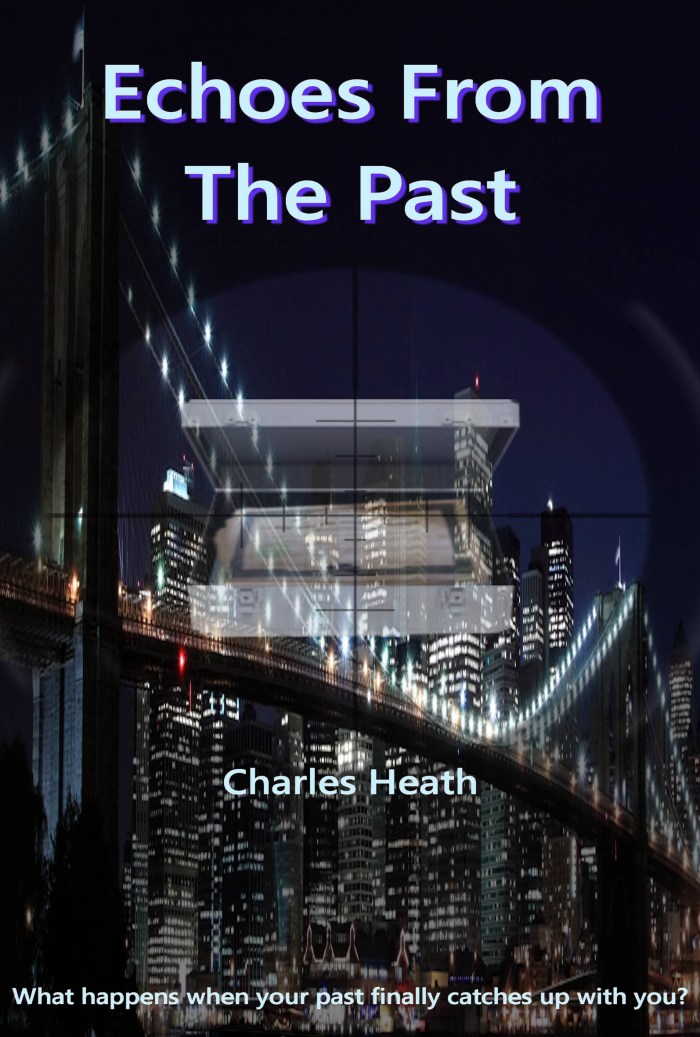
newechocover5rs

for “Echoes from the Past” go to  https://amzn.to/2CYKxu4

newdevilcvr3

for “The Devil You Don’t” go to  https://amzn.to/2Xyh1ow

A matter of life and … what’s worse than death? – Episode 26

For a story that was conceived during those long boring hours flying in a steel cocoon, striving to keep away the thoughts that the plane and everyone in it could just simply disappear as planes have in the past, it has come a long way.

Whilst I have always had a fascination with what happened during the second world war, not the battles or fighting, but in the more obscure events that took place, I decided to pen my own little sidebar to what was a long and bitter war.

And, so, it continues…


Mayer realized something was terribly wrong when they reached the outskirts of Weimar and passed through the checkpoint on the outskirts of the city.

It was the sixth such checkpoint and each time the Standartenfuhrer told the sentries that they were escorting a valuable prisoner, and being mere German Army soldiers, most of the Obergefreiter rank, and not willing to argue with an SS Colonel.

Then he remembered there was a large Government building in the city and assumed that was where they were talking to him.

Except they were either lost or taking the long way to get there because they were taking back streets.  When he asked why, he was told to be quiet, or they would silence him.

When they reached the outskirts of the city on the other side, still heading south, he knew something else was going on.  It was then he started to think that these men might not necessarily be Nazi’s.  After all, there had to be other people who were sickened by the atrocities that were going on, particularly to the labor from the camps.

He understood the need for labor, just not the way his superiors went about getting it.

They passed through the next checkpoint without any questions and soon caught up to a convoy of trucks with what looked like prisoners in the back.

It was the first time he had seen either of the two officers look worried.

Then a soldier on a motorcycle turned around and came back to check on the vehicle and its occupants.  He flagged them to the side of the road, got off his bike and there was no mistaking the itchy trigger finger on the gun he was loosely holding.

In front of their car, the last truck in the convoy turned a corner and disappeared.

“Where are you going?” the motorcyclist asked.

Mayer noticed he was not army but SS of a lower rank Scharfuhrer, and though of a lower rank, there was still the superiority of just being SS.

The Standartenfuhrer looked the soldier up and down and then opened the door to the car and got out.  He took two steps towards the cyclist.

“Do you know who you are addressing Scharfuhrer, what is your name?  I will take this insubordination to your superior officer.”

Mayer had seen similar men in his unit back at Nordhausen, including one, when in a hotel having lunch heard one of a group of army soldiers being rowdy.  He singled the loudest of them, told him to be less noisy and the soldier laughed at him.

The next thing he remembered was the other solders carrying their dead leader out of the hotel.  The Standartenfuhrer had shot him, on the same charge, insubordination.  Would this Standartenfuhrer do the same?

He had learned that day the SS, especially the higher-ranked officers, didn’t tolerate anything, and as one, he was expected to do the same.

“Sir.  It is my job to ask questions, as you are fully aware.  I was given orders, and I obey those orders.”  Suddenly the man was less confident.

“I understand that.  It is of no concern to you where we are going, only that it is on urgent and classified Reich business.  It is of no concern to anyone but the Oberfuhrer I report to, and I will have to report to him on why I was delayed.  You name Scharfuhrer?”

“I have no wish to delay you, sir.”  He saluted, got back on his motorcycle and left, speeding up to catch up to the rest of the convoy.

The Standartenfuhrer got back in the car.

“That was close,” the driver said.  In English.

Mayer was proficient in English as his father had told him that it would stand him in good stead one day.  He just omitted to tell anyone he worked with, or when he was recruited.  They had asked, and he thought it wisest to say no.

Now, these two men were speaking English.  It was not unknown for SS officers to speak English, as well as several other languages like Dutch, French and Italian. He had a little French, and less Italian.

“Who are you?” Mayer asked again but sticking to German.

The Standartenfuhrer glared at his driver.

“This is the point where it depends on how you answer the next question whether we execute you here, or we continue.  Bear in mind that if you tell us a lie, you will be shot.”  The Standartenfuhrer also spoke in German.

The English Mayer decided was to correct to be from an Englishman, only a German who had learned it as a second language, and definitely as an SS officer.  Perhaps these two were charged with interrogating English prisoners, though that didn’t explain why they had taken him.

All of a sudden, he had a very bad feeling about this kidnapping.  It was a kidnapping, and these men were taking him to a different location, perhaps to torture him.  He had heard rumors, but since it came from a fellow SS officer, he considered it to be true.

“The question?” he stammered, nerves getting the better of him.

“Do you want to get out of Germany?”

What?  IT wasn’t [possible that anyone could know that.  He’d only admitted that sentiment to one person, and he knew he could trust them not to tell anyone.  OR could he?

And, was this a trick question.  If he answered no, it meant they could charge him with crimes against the Reich for having the blueprints of the V2 rocket?  And if he said yes, would they execute him here on the side of the road?

There was no answer that wouldn’t see him shot.

So better to say he was fed up with the conditions he’d been working under, get shot, and never return.

“Yes.”  Of course, there was a pertinent question to add to that reply, “How did you know?”

“You had the plans and specifications outside the bunker.  An executable offense.  I believe you do not like the idea of the German High Command using these rockets as weapons.”

“Most of us on the project do not, but we have to do as we are told.  For obvious reasons.”

“So far so good,” the Standartenfuhrer switched back to English.  “We know you speak English, in fact we know quite a lot about you.  As you’ve obviously guessed, we are not going to and interrogation site, but further south to Italy where there is an escape route set up by the resistance.”

“Who do you work for?”

“OSS.  We are probably worse off than you in that if we get caught, we will be shot as spies.  But, so far we’ve had good luck, except for that nosy motorcyclist.  I expect he will not keep his mouth shut and report us.”

“You won’t get that far.  With petrol rationing, this car is going to run out long before we get to the border.”

“Don’t you worry about the details.  That’s our job.  You just sit back, do as we ask, and everything should be alright.  Very few people question an SS officer of my rank.” 

He looked at his driver. 

“Now, let’s get the hell out of here before that nosy fool comes back with reinforcements.”


© Charles Heath 2020

Writing about writing a book – Day 23

I’ve been thinking a lot about Bill’s service, and the characters he meets along the way, some of whom shape the man he became, others he remained friends with after he was discharged, and those that were killed.

Several have a direct bearing in the main story, for instance, Brainless, a rather ubiquitous nickname, given to him because of his actions, that is to say, he acts without thinking, sometimes when in great peril, a man who never quite recovered, but is, for all intents and purposes Bill’s friend and someone he feels responsible to look after, perhaps because of how many times he saved Bill from death, or worse.

There is also Manilow, but we’ll save him for later.

So, this is where ‘Brainless’ get’s his introduction:


It was the first time I’d been hit by a bullet, and it hurt.  It was a steep learning curve, realizing you have been hit, and then the brain going into overdrive to tell you first it going to hurt like hell, and then begin to assess the damage, running every scenario from ‘it’s a flesh wound’ to ‘Oh God, I’m going to die’.

At least, that was what had happened to me for my first time.

Seconds, or minutes, or hours later, a man who doubled as a Medic came scrabbling over to me and looked at the wound.  A silly thought, how did he know I’d been shot?  Had I screamed?  He made a quick assessment, told me I’d live, and dressed it as good and as quickly as he could.

There were other casualties.

I lasted until I was brought into a clearing some miles further on, after the enemy had been killed, or had retreated, and loaded onto a helicopter.  There I was told everything would be OK and then the lights went out.


My first visit to a mobile army hospital, after being hit, was a novelty.  It was nothing like a real hospital.  Nor was the staff.  It took a different sort of medical personnel to man a front-line hospital where you were just as likely to become a casualty yourself.

The doctor was quite jovial about the whole matter saying I would be back out again in no time, not exactly a prospect I was looking forward to.  It was almost a mend job without anesthetic and the memory of it remained with me for some time.  Facilities were not primitive, but they just appeared that way.

I was one of the less needy casualties that day.  After being stitched up, a nurse took me to a bed in a ward with a mixture of serious and not so seriously wounded.

The nurse, whose name was Wendy, had the same sense of humor I had.  She insisted we be on first name terms from the start.  How she kept her humor was a mystery, for most noticeable was her tired look as if she had been doing the same thing for too long.

The bed was comfortable, the temperature bearable, and the food edible.  Being, and remaining, injured had its good points.

I slept well the first night.  I presumed the injection she’d given me was to ensure I had a restful sleep.  It was long overdue and much needed.

The next morning the numbers had thinned.  Two men had died, several others returned to duty.  To my left was a sad and distant private, who, from time to time, would start moaning.  He’d been in the middle of a mortar attack and was both deaf and had serious psychological problems.

To my right, there was a large man who barely fit in the bed.  He was a perpetually unhappy person, with only minor injuries, a bullet wound to his upper leg.  Nothing serious, he said, and just wanted to leave as soon as possible.  Brainless, the nurse called him.  Always wanted to get back to the war and kill some more of the enemy.  An obsession, she said.

He was staring morosely at the ceiling when I woke.  It took a few minutes to regain full consciousness, a sign I’d been in a drugged sleep.

“What are you in for?” he asked.

“Leg wound.  Nothing serious.”  You?”

“Leg.  Bastards snuck up on me.  And the useless rearguard didn’t do his job properly.”

“Landmine?”

“Sniper.”

I’d seen both.  Tread in the wrong place, and you didn’t do it again.  Sniper’s fire came from almost anywhere, taking out soldiers and civilians indiscriminately.  You could never hear the bullet, just feel it.

“Mongrel,” I said with feeling.

“Yours?”

“Probably the same.  I didn’t see it coming.  I hate it when you can’t see the bastards.  There ought to be some law they send you a message first.  Give you a chance….”

“Chap other side killed himself.  Had enough.  It was written all over his face.  What kind of sooks are we bringing over here?”

“National service,” I said quietly.

“You?” he asked.

I could feel his contempt for ‘Nashos’ and to be glad I was not one.  “I believe I volunteered.”

He didn’t ask what I meant, and even if he had, I probably would have made up a lie.  I hardly thought if I said my father in law hated me that much he would send me here, would make any sense, particularly to this man beside me.

He snorted.  “More the fool you, then.”


We were both released on the same day.  His unit had suffered major casualties, and the story he gave me in the hospital was not quite true.  He’d gone down trying to save what men he could in an ambush.  Heroics came to mind, but his selfless actions were much more than that.  Without a unit, he joined ours.

Wendy remained in my mind for some time after that visit.  When I returned the next time, my injuries being more serious, I enquired as to her whereabouts, only to discover she was dead too, a victim of her own hand, simply because she could not cope with the death, mutilation, and waste.

There was no doubt it affected all of us in different ways.  Some didn’t like the idea of going back out into the jungle and found their own peace.  Others, like Wendy, needed something more, but all too often, no-one recognized what the solution was until it was too late.


Now that I have paved the way, I must get back to the main story and write the part where Brainless enters the picture.


© Charles Heath 2016-2020