Searching for locations: Hong Kong Park, Hong Kong

After arriving in Hong Kong early in the morning, we were taken to the Hong Kong Conrad Hotel where we were staying for several days.  We had a short sleep, then I took the grandchildren for a walk and we found Hong Kong park, with a Fountain Plaza, waterways, a waterfall, and turtles.

2013-12-28 11.24.02

Part of the fountain area.

2013-12-28 11.31.57

Turtles resting on a rock

2013-12-28 11.31.36

A turtle about to go in the water

2013-12-28 11.35.26

The waterfall.

It was a pleasant surprise to find this park in such a highly built-up area.

Nearby was a multi-story underground shopping center that was huge, and very conveniently accessible from our hotel.

I have to stop thinking…

Have you ever wondered what you might have been back in the 1700s, or the 1800s in England, or whatever country you reside.

I live in Australia, so I suspect I would be a convict or the descendant of a convict. Certainly in those past years, there is nothing to suggest that I would have been much else, based on the fact I used to be a tradesman, and later a computer programmer, only one of which existed back then.

In England I have often imagined what it would be like for the underclasses, and very definitely where I;pd finish up. A servant maybe, like a stable boy or footman, or an agricultural worker before the industrial resolution, or a coal miner after it. Poor people it seemed had no prospects.

In the 1900s, my time on earth, and before the computer era, I trained in a trade school, doing woodwork, machine shop practise, and sheet metal. There was also farming. For the select few there was Accounting and business studies, but to be a clerk you had to go to a different school.

My family couldn’t afford it.

When I left school, as soon as I could, and therefore without the benefit of a good education, my prospects for work didn’t amount to much, and among my first jobs was mail sorter, telegram delivery boy, a packer for a book wholesaler, an odd job boy in an abattoir, and later a clerk.

Perhaps then I formed an idea that one day I might be a writer. I certainly had a go, but never did anything with it. I guess, even then, I knew my limitations borne from what I perceived was my station in life.

What did I want to do though? It didn’t matter. People from our social strata couldn’t afford university fees so I was never going to get a tertiary education. That just about ruled out everything.

So what happpened to change all that?

Reading.

From as young as I could, I read. Not only stories about people who lived so very different lives to me, but reference books about everything. It gave me an understanding of what it might be like to be something else, then gave me the impetus to actually apply for what I would call ‘a real job’.

Whether I could do it or not was irrelevant. I just wanted the chance.

It took a wile but then someone gave me that chance. That door was prised open just a little, enugh for me to get a foot in.

I had several tenets to abide by, don’t speak unless your spoken to, respect your elders, and don’t say anything unless it’s relevant.

First job was mail boy under a very crotchety old man who thought I was a waste of space. I learned everything he knew, listened to everything he said, and did everything I was told, better than everyone else.

I moved up to shipping clerk, creating manifests for ships cargo. It was the golden age just before computers, the days of the mainframes that had the computing power of an IBM XT.

They fascinated me.

My next job was for a new company, working for a mining and shipping company, as a distribution clerk maintaining a shipping timetable. That led to a role in communications, the days of telexes and internal couriers and memos, and memorandums for board meetings.

It wasn’t heady stuff, but I was in management, learned communications, and understood accounting.

When I left there, I became a computer programmers. It was dumb luck, my brother in law was an insurance salesman, created listings of investment outcomes using insurance products, and his individualised reports used to take in a week or so, restricting the number of clients he had.

This was the days of the first Apples, and IBM’s. I had a small personal computer, and told him I could create a program to work out his calculations in seconds not days, and he gave me the opportunity.

The rest is history.

So, it makes me wonder had I been back in those 1700s and 1800s, whether or not I may have started small, and made something of myself. A lord of the manor I would not be, but perhaps something more comfortable than a coal miner maybe.

I guess I’ll never know.

I fell asleep in front of the computer screen

And when I woke up, I realised that I had just had a very bad dream. Or don’t they call bad dreams nightmares?

Can you diagnose yourself as having depression?

Of course, if you were to tell someone else, in one of this very serious tones, “I think I have depression” they will ask you what you’ve got to be depressed about.

It’s a good question. My first answer would be, “why did the doctor put my on anti depressants?” You know the stuff they give you, some derivative of serapax,

Then, if you tell anyone you’re on that stuff, they turn around and tell you just how bad it is and get off it right now.

That’s all very well, but you tell them you still have depression, and so the argument goes on.

But…

These days, they use low doses of anti depressants to manage pain, and in my case back pain. The first pill they gave me was lyrica, which slowly took my memory away so that I couldn’t remember what anyone had said earlier in the day.

I thought I had early onset Alzheimer’s, or worse, dementia.

So I got off that, got the pain back, and moved to anti depressants. Now I’m seeing things.

That might help with the imagination for writing stories sometimes, but telling people you see the patterns on tiles moving is not a good start to any conversation.

Back to depression, though. It might be caused by being locked down and not being able to go anywhere, but that has never bothered me because I hate going out.

It might be a result of my childhood coming back to haunt me, and, believe me, you would not want the childhood I had, but it’s a maybe. A lot of old people find their past creeping up on them, and what happened 60 years ago seems more relevant than what happened 60 minutes ago.

You might think you’re badly done by, that everyone else is responsible for the mess you made of your life, if it is indeed a mess, but no, that isn’t true. My life is exactly what it’s meant to be, though how I got here remains the biggest of mysteries.

It’s why I’m writing the autobiography of a very ordinary nobody.

OK, that might be a hint, thinking I’m a nobody. After all, when I go out I always feel like I’m invisible.

A friend of mine tells me he always cries when there’s a sad part of a film on, and that’s his determination of depression.

I do too, but I don’t think it’s that.

After all, I did psychology and should understand the nuances of the human psyche, what makes us happy, what makes us sad, what makes us us.

So, rightly or wrongly I’ve stopped taking the anti depressants.

If suddenly my blog suddenly stops, you’ll know I’ve made the wrong decision.

I find myself in a very strange world

And I don’t know how I got here. I have a sneaking suspicion that I stepped through a portal, only I didn’t recognise it as one until I reached this side.

I say this side, because the world I’m in now is not the world I remember from a while back, well, perhaps a year or so. Time passes very slowly here.

Before, everything made sense, China didn’t hate us, and we had just finished touring some of the most remarkable sights of that very country.

There was no coronavirus and I didn’t fear for my life, and the fact I had a compromised immune system didn’t matter a hoot, except for the constant pain in my lower back and hands, the result of psoriatic arthritis going berserk as I get older.

My grandchildren were in school, alternately loving and hating it, and every Friday I would get one from school and she would tell me how her world was hell, and I had no idea what it was like.

Another would start all her sentences with ‘basically’, and the other would end hers with ‘like’.

I would lament the fact our schools no longer teach proper English, and we could sit around and talk about the YA novel I was writing for them, and that they were the characters in this mythical kingdom. And, yes, they are princesses, if not crotchety one day, and all smiles and goodness the next.

And, in an instant that whole world was blown away.

Am I angry? I was. A year is too long to be mad at everyone and everything.

Have I a different outlook on life? Yes, I live every day as if it was my last, because the truth is, it just might be.

Can I travel anywhere? No. There’s too much risk in a world where few people under the age of 65 care about consequences.

Is there a reason to live? You may well ask.

I have thought about this often, lying awake in bed every morning, asking myself why I would bother getting up. I can’t go anywhere, I can’t do very much.

But…

We have here an almost remarkable record in keeping the coronavirus at bay, so we have some freedom. WE can’t leave the country, and every other month a state or two closes it’s borders, so travelling outside the state is too risky. The schools are back, and I resumed pick up duties last Friday, and, yes, the sweetness of the complaints about school life are like music to my ears.

Have I a reason to live? Yes. There’s three girls, grandchildren, one 11, on 14 and one 17. The 11 year old is in the last year of primary school, the 14 year old lamenting the third year of secondary school, and the 17 year old is in the last year of secondary school. She can also drive herself, a shred of independence that has changed her outlook, going from child to someone more mature.

I hadn’t realised how much their lives were in such a constant state of change. Nor had I realised how much they prefer to tell me about it rather than their parents.

So, the answer to that deep and meaningful question, is there a reason to live?

Yes. We can have so many things we think are essential to live our lives taken away, but in the end they are all but superficial. You can lose a car, some of your mobility, a house, any sort of chattel, but they are insignificant. What matters most, and always will, is family. I’m lucky, and indeed, extremely grateful, to have mine so near.

Now I suppose I should be getting to bed. Tomorrow, I have just been informed, I’m rostered on in what is known as ‘poppy’s taxi’.

And ready to hear the next enthralling episode of school life these days.

Searching for locations: Just how hard can it be to see some snow?

You would think it is a relatively simple thing to get to the snow.

Of course, there are a few necessities like skis, boots, poles, and warm dry clothing, but that can all be bought or rented when you get there, or if you are an enthusiast, you already have the gear.

So, you get in the car, set the navigator, and off you go.  Till you get within 20 k of the ski field, it’s all plain sailing, everyone is excited, and mentally preparing.

Then it all starts to go sideways.

Those last few kilometers to the top are going to be arduous particularly if it’s been snowing and the roads are icy, but the weather is fine with blue skies and no recent snow falls.  Were expecting a slow drive and a parking spot.

The road is open.

But…

So late in the morning, a sign at the bottom of the mountain warns all the car parks at the ski field are full, but we venture on anyway.

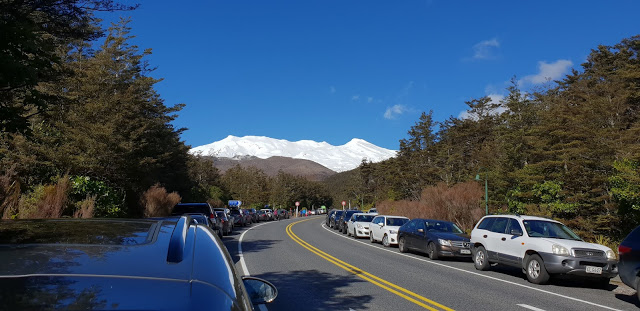
As you can see, the cars are parked so far away from the ski fields, the prospective skiers have to almost run a marathon before they get there!

And for some odd reason, we picked the very day everyone in New Zealand also wanted to go up to the ski fields so parking, even near the Chateau Tongariro was gone and there were endless cars looking for parking spots and traffic wardens had their hands full trying to keep traffic moving
So, for us and everyone else, everything stops at Chateau Tongariro, and from there the only vehicles allowed up are buses.

It’s about 10:30 and we are advised the only way we were getting to see snow was to take a bus

Now, there are two types of busses.  You can go up on a local bus, from Whakapapa Village that costs $20 a person which in the context of the cost of skiing not very much, but if you’re not, it’s quite expensive.

The second, one we were advised to use, operates from a place called National Park, about 9 km away, a snow shuttle that costs $6 each.  The trouble is by the time we were ready to go there, to catch a shuttle, there were no more shuttles.

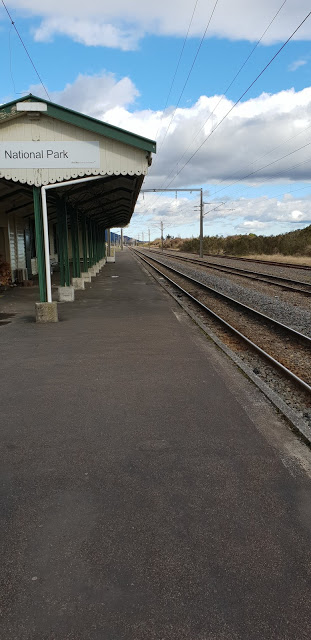
We did not know what to expect when we got to ‘National Park’, but being a railway station makes sense.  It’s the only place with a very large carpark!

Oh, well, there’s always tomorrow.

In a word: bark

Yes, this is exactly what a dog does, sometimes annoyingly all night, that sharp explosive cry of a dog or, believe it or not, a seal

Much better if the dog is a guard dog, because then you need it to bark when there is intruders

Then there’s another form of bark, that which grows on a tree, and makes excelled burning material, if not a little smoky, for a BBQ.

Ot that the bark of some trees can be used as material for carving, and of others, like the paperbark, to make was seems like paper to write on.

Then there are expressions that start to make you think, concerning this word, such as:

He was a boss that liked to bark orders.  I had one like that, almost looked like a dog too.  Never could ask someone kindly.

He was barking up the wrong tree.  Never seen a dog do this, but many people gave so the literal meaning is to waste your time looking in the wrong place

Then there’s bark or barque, the name of a certain type of boat or masted ship with three or more masts, dating back to sailing days

And then, just top it all off, someone goes and says your barking mad.  Probably just after you were barking up the wrong tree, looking for the barking dog on a barque.

Searching for locations: The apartments at Greve in Chianti, Tuscany, Italy

When we first planned to stay in Tuscany for a few days, we wanted to be in a central area.  We had thought of staying in Florence and making daily treks, but the tour operator we selected told us it would be better if we stayed closer to Arezzo.

We picked Greve in Chianti, and a place called Antico Pastificio, we booked a standard apartment with two bedrooms, and it was about as authentic Italian you could get.  The building we stayed in was the yellow pasta factory, and the apartment named ‘Iris’.

It was only steps away from the main square, shops, restaurants, and at the opposite end, the quaint ringing of church bells at various times during the day.

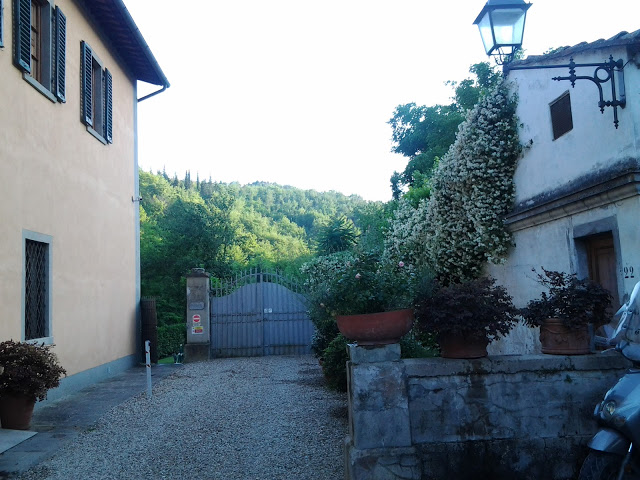
Gaining access was through a very narrow arch which required some deft driving and then up the road.  There were villas and two large apartment blocks.

You can just see the archway at the end of the road. 
This was the entrance to our room,

 along a passage and up the stairs, turning left at the top.

 Going straight ahead through the gate to the car park, 

and access to the grounds behind the buildings.

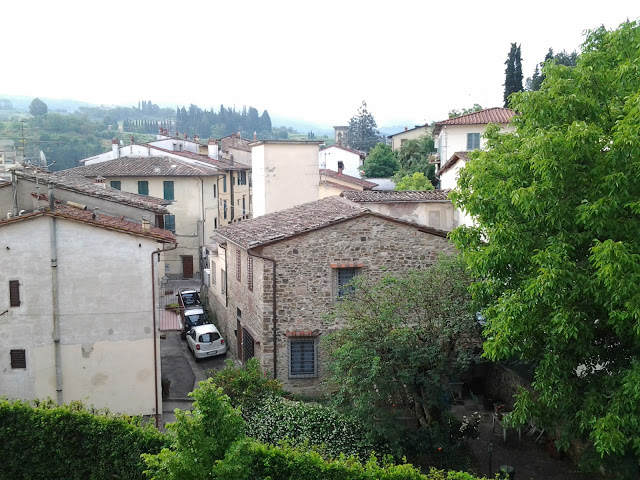
This was the view from the lounge/living room.  The days were hot, and on several evenings it rained, breaking the heat and making the evenings sitting by the window cool and refreshing.

 And the last view is looking towards the town piazza and the church

In a word: Blue

Of course we all know this word is a colour, or color depending on where you live.

You know, blue sky, deep blue sea, blonde hair blue eyes.  Very descriptive.

But it can also mean you are down in the dumps, a rather strange, for some, expression that means you are sad or unhappy.

For others to have a blue means to have a fight with someone

And oddly, and I know this from first hand experience, that a red haired person will be called bluey, or less pleasing either carrot top or blood nut.  I used to ignore those people who used those expressions, except for my father in law.

You can do something until you are blue in the face, which means do it without result until exhaustion, another way of saying your wasting your time.

And if something comes out of the blue, it usually means its entirely unexpected.  For me, that’s always a bill I wasn’t expecting, for someone else an inheritance.

And in some parts of the world, blue is used as a synonym for conservative political party, for insistence, the Liberal party in Australia, and the Democrats in the United States

Blue should not be confused with the word blew, which is the past tense of blow, which is wind causing an air current, or blowing air through pursed lips.

That doesn’t mean that if something blew up it was just a giant air mass exploding because it can’t.  If a bomb blew up it means it detonated.

And if that sounds complicated:

What if something blew my mind?  Does that mean my head exploded?  No, it just means its incomprehensible, whether good or bad.

Or

What if I blew a fortune on a three legged horse?  We all throw good money after bad, but you can easily lose a fortune, or blew it.

Its the same thing with opportunities, for instance, he had a chance and he blew it.  Yes, obviously something better came along, not, or he just ignored a sterling opportunity.

Searching for locations: Venice, Murano, and glass blowing

The first time we visited Venice, there was not enough time left to visit the glass blowing factories on Murano.  We saved this for the next visit, and now more comfortable with taking the vaporetto, boarded at San Marco for the short journey.

The view looking towards the cemetery:

The view looking down what I think was the equivalent to the main street, or where several of the glass blowing factories and display shops were located:

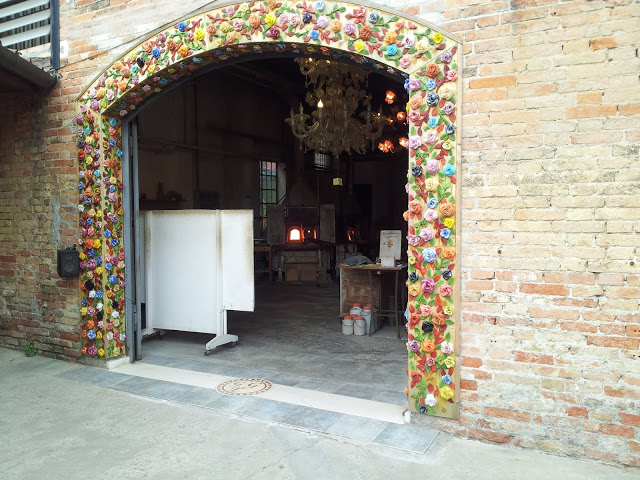
Looking towards a workshop, this one costs us each a Euro to go in and observe a demonstration of glass blowing, and it still surprises me that some people would not pay

The oven where the glass is heated

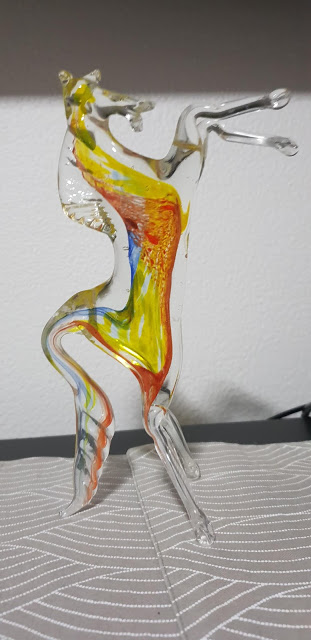
And the finished product, the retail version of the horse that the glass blower created during the demonstration:

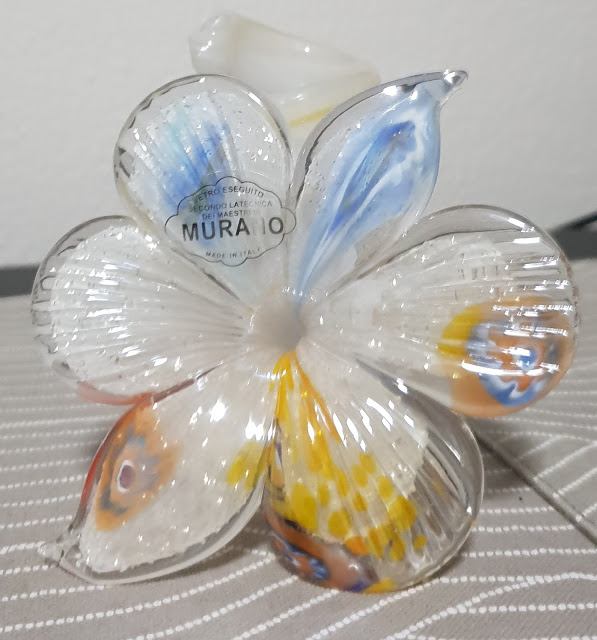
Then we bought some other glassware from the retail storefront, a candle holder

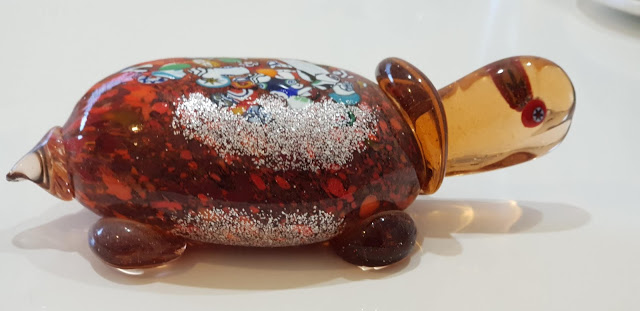
and a turtle.

In a word: crane

Yes, it’s that huge device that is attached to a tall building and either raises or lowers building materials.  I’ve often wondered how the drive, so far up in the air can see where to pick up or drop a load.

Typically cranes are used to move large or heavy loads, like large fiberglass swimming pools from the roadside into the front or back yard.

The are train breakdown cranes, dock side cranes and broken down cranes, usually on the road in the middle of rush hour.

They used to have dog men, people who hung on grimly, going up or down with the load.  Not me when the building is sixty or seventy floors up.

There can be smaller cranes built on trucks that are for smaller jobs like lifting boats, sometimes parts of houses.  We had one near us once lifting a swimming pool into a front yard.

Then there is the crane, a bird.  Cranes are usually tall birds with long legs.

In Asia the crane symbolises happiness and eternal youth whereas in Japan the crane symbolises good fortune and longevity.

And other uses such as:

The boy craned his neck to see the batter hit a home run.  

Usually if I crane my neck, it causes days of muscular pain, ie literally the definition of a pain in the neck!

It means to distort your body or neck in order to see something more clearly, especially if you are in a bad position, like behind a pylon or tree.

It can also be used to describe a trolley with a large boom with a camera attached.