In a word: lesson

I went to school and learned a lesson. We often hope that our children learn from these lessons, but sometimes the lesson learned was not the one intended.

This could be called a useful piece of practical wisdom, and for me that was, don’t get into fights at the back of the schoolyard.

The former lesson can be, on one hand, a section of school work, from a larger continuous topic, or, part of a book, which can be an exercise.

Then there’s the study of the past and the hope that we can learn from the lessons of the past.

Sadly, in a lot of cases, we don’t and are therefore doomed to repeat the past, only with far more devastating consequences.

A lesson can also be a passage from the bible.

Or is it lessen, where we reduce the costs which means lessen means reduce, to make less.

I could lessen the load if I gave someone else some of the work.

Or if I stopped eating candy, I could lessen the chances of clotting arteries.

No, I don’t think I will, just have less.

It’s raining, it’s pouring…

Yes, and with the residual summer heat, it’s almost unbearable. I guess it might have something to do with climate change.

But, assumptions aside, I guess that’s about all we can expect from being nearly at the end of summer.

Outside, its been overcast most of the day, but I have to go out so I’m sure we’re going to get rain.

It’s been threatening for the last few days, and the meterology department, who rarely get the weather right, have been telling us there’s big storm movements coming our way.

The other night we got a hint of it with a few short sharp heavy falls, but then nothing.

So, half past two in the afternoon and I’m off on the grand child pickup run, one from the school up the road, and one from the railway stations some distance away.

Sitting in the car, I’m watching the dark clouds gather, whilst in the other direction the sky is blue. A rather fascinating contrast. Then, suddenly, as it hit 3 pm, time to collect the child, you guessed it, it began to rain.

Not five minutes before, not=r five minutes after, but just as I stopped at the slot for her to get in.

One wet child in the back.

We then head for the railway station, about three km away, and half way there, stuck in a traffic jam, the rain stops. I get a call from the child on the train, just to make sure I have remembered to pick her up.

The clouds are black and low, but there’s no rain.

Instead we have a lightning display, and sit in the car counting the seconds after the bright lightning strike. Younger grand daughter is trying to be brave, but the cracking thunder scares the both of us.

The train is arriving, and, you guessed it, the rain suddenly becomes torrential, and poor elder grand daughter gets drenched in the short distances from the train to the car.

A few minutes later it stops.

Weather is unpredictable, and sometimes a complete pain. At least I didn’t have to get out of the car, but the damp children, that will live on for a day or so as all wet material does, and for some reason seems to be worse in cars.

Let’s see if the weather can be kinder to us tomorrow.

Oh, and something else, we need the rain, specially for my garden. Water is very expensive these days, where once it was not.

Searching for locations: The Pagoda Forest, near Zhengzhou City, Henan Province, China

The pagoda forest

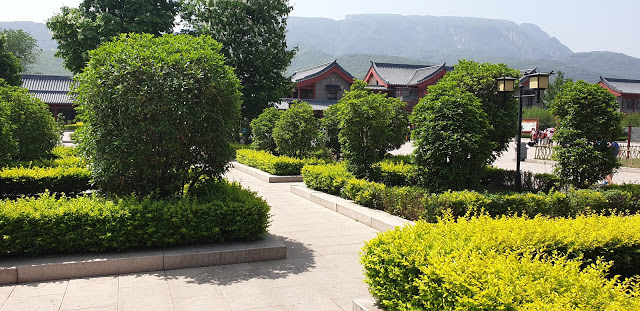
After another exhausting walk, by now the heat was beginning to take its toll on everyone, we arrived at the pagoda forest.

A little history first:

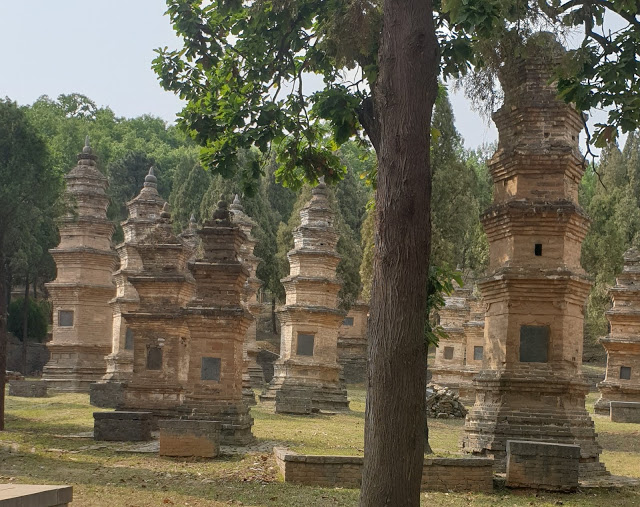
The pagoda forest is located west of the Shaolin Temple and the foot of a hill.  As the largest pagoda forest in China, it covers approximately 20,000 square meters and has about 230 pagodas build from the Tang Dynasty (618-907) to the Qing Dynasty (1644-1911).

Each pagoda is the tomb of an eminent monk from the Shaolin Temple.  Graceful and exquisite, they belong to different eras and constructed in different styles.  The first pagoda was thought to be built in 791.

It is now a world heritage site.

No, it’s not a forest with trees it’s a collection of over 200 pagodas, each a tribute to a head monk at the temple and it goes back a long time.  The tribute can have one, three, five, or a maximum of seven layers.  The ashes of the individual are buried under the base of the pagoda.

The size, height, and story of the pagoda indicate its accomplishments, prestige, merits, and virtues. Each pagoda was carved with the exact date of construction and brief inscriptions and has its own style with various shapes such as a polygonal, cylindrical, vase, conical and monolithic.

This is one of the more recently constructed pagodas

There are pagodas for eminent foreign monks also in the forest.

From there we get a ride back on the back of a large electric wagon

to the front entrance courtyard where drinks and ice creams can be bought, and a visit to the all-important happy place.

Then it’s back to the hotel.

In a word: Wall

There’s nothing like ‘hitting the wall’.  It’s a rather quaint expression used when you have used up all your energy and there’s nothing left.  A lot of sportspeople are very familiar with this expression.

But it doesn’t have anything to do with hitting a real wall, you know the sort, made out of plaster, or bricks, or timber.  Some people hit the wall in this case too, and soon find out what it’s like to have a broken hand.

There’s wall street, you know the one, it has a bull in it, and it’s in New York, down that end of the city where the Twin Towers used to be.  It’s rumoured lots of ‘jiggery-pokery’ goes on there.

Try stonewalling, you know, give answers to questions that don’t answer the questions, or find something else to do and put off being questioned.  I’m not sure, however, that’s how Stonewall Jackson got his name.

We can climb the walls, metaphorically speaking, but it is something we don’t actually do when we’re bored.

And, I’m sure everyone has heard of the Great Wall of China.  Even those who travel in space have seen it, from a long, long way away.  I’ve tried walking along it, and up it, yes, parts of it go up the sides of mountains, and it’s challenging.  Maybe you should try it sometime.

Perhaps a few others, just to finish with, like

I got hit by a wall of water – yep, watch out for them tidal waves

There’s a wall between us, nope, not gonna talk to you

His stomach wall is failing, which means he’s in very bad shape, and

He couldn’t get through the wall of players, oh, well, maybe we’ll win the FA cup final next year!

Searching for locations: Hutongs, Beijing, China

What are Hutongs?

In Beijing Hutongs are formed by lines of traditional courtyard residences, called siheyuan.  Neighborhoods were formed by joining many hutongs together. These siheyuan are the traditional residences, usually occupied by a single or extended family, signifying wealth, and prosperity. 

Over 500 of these still exist.Many of these hutongs have been demolished, but recently they have become protected places as a means of preserving some Chinese cultural history.  They were first established in the Yuan Dynasty (1279-1368)Many of these Hutongs had their main buildings and gates built facing south, and lanes connecting them to other hutongs also ran north to south.

Many hutongs, some several hundred years old, in the vicinity of the Bell Tower and Drum Tower and Shichahai Lake are preserved and abound with tourists, many of which tour the quarter in pedicabs.

The optional tour also includes a visit to Shichahai, a historic scenic area consisting of three lakes (Qianhai, meaning Front Sea; Houhai, meaning Back Sea and Xihai, meaning West Sea), surrounding places of historic interest and scenic beauty and remnants of old-style local residences, Hutong and Courtyard.  

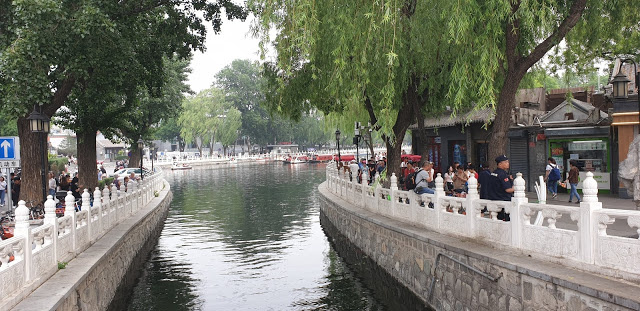
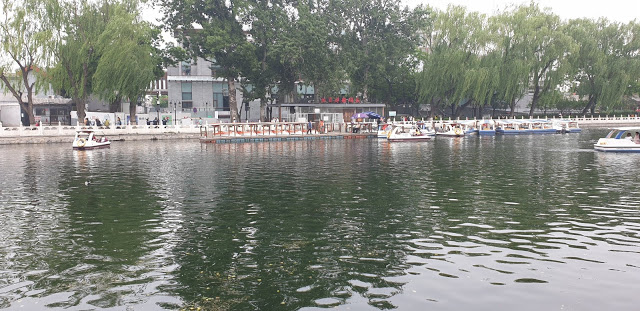
First, we had a short walk through the more modern part of the Hutong area and given some free time for shopping, but we prefer just to meander by the canal.  

There is a lake, and if we had the time, there were boats you could take.

With some time to spare, we take a quick walk down one of the alleyways where on the ground level are small shops, and above, living quarters.

Then we go to the bell and drum towers before walking through some more alleys was to where the rickshaws were waiting.
The Bell tower

And the Drum tower. Both still working today.

The rickshaw ride took us through some more back streets where it was clear renovations were being made so that the area could apply for world heritage listing.  Seeing inside some of the houses shows that they may look dumpy outside but that’s not the case inside.

The rickshaw ride ends outside the house where dinner will be served, and is a not so typical hose but does have all the elements of how the Chinese live, the boy’s room, the girl’s room, the parent’s room, the living area, and the North-south feng shui.

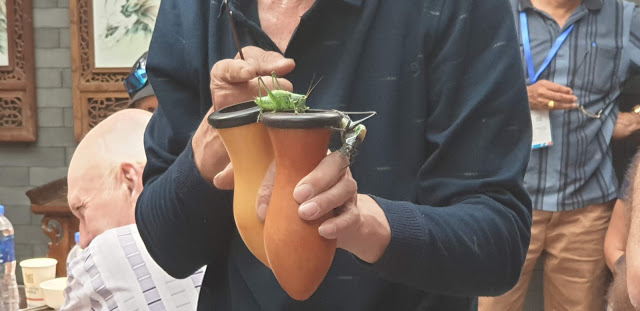
Shortly after we arrive, the cricket man, apparently someone quite famous in Beijing arrives and tells us all about crickets and then grasshoppers, then about cricket racing.  He is animated and clearly enjoys entertaining us westerners.

I’m sorry but the cricket stuff just didn’t interest me.  Or the grasshoppers.

As for dinner, it was finally a treat to eat what the typical Chinese family eats, and everything was delicious, and the endless beer was a nice touch.

And the last surprise, the food was cooked by a man.

In a word: Mine

Well, that’s his, and this is mine.  Possession is 9 points of the law, or so they say.

What’s mine is mine and what’s his is mine.  Sound like a divorce settlement?  Sure is!

There are often a lot of arguments over the possession of goods, and who they belong to.  Perhaps it’s best to own nothing, then no one can take it from you.

Sound like a lawyer contesting his own divorce?  Probably.

But that’s not the only mine.  Take for instance a land mine or a sea mine.

Devilish things to walk on, or brush up against.  It spawned a new type of ship, a minesweeper, and I’ve read a few books about the exploits of those aboard, and how close they come to death when a ship hits one.

And land mines, the damage they can cause.

Then, of course, you can go underground, way underground, into a mine.

Gold in South Africa, coal in Wales, tin in Sumatra, copper in New Guinea.

And it doesn’t have to be underground.  You can have an open cut mine, which accounts for a lot of coal mines in Australia.

Oddly, you can mine data, the sort that’s stored in databases on computers.  I’ve done a bit of that in a former life.

You can mine talent,

Or you can mine bitcoin, but that’s a whole different ballgame, and everyone seems to be in on some sort of scam when it comes to bitcoin.  It seems to me the only way you would make money out of bitcoin was to buy units the very first day it was released.

It’s not, and never will be, something I’ll dabble in.

Leaving a legacy…

I’ve been reading a few blog posts off and on today, and one that caught my eye was about leaving a legacy.

This I presumed to be ‘something to be remembered by’.

I have always suspected that when I pass on, the memory will not linger very long, except when someone, in the years ahead, pulls out a an old photo, and says, “Who’s this old man?”

I’m sure the answer would hover somewhere between “You don’t really want to know,” to “He’s the eccentric side of the family.”

The thing is, I’ve discovered that children in this family seem to have an insatiable appetite for discovering information about their forebears. It also seems to be that the school they go to makes a big deal about the children learning genealogy, and get an assignment either in year 5 or year 6 where they have to trace their forebears back as far as they can.

I have to say I’ve always been curious, but never really did anything about it, except go back a few generations, i.e. those people we could remember, and, yes, we had eccentric aunts and uncles, grandmothers, and grandfathers.

But my older brother, he got the bug, and went into genealogy in a big way, got himself a university degree, and then takes a trip or two overseas every year delving into the murky past of the Heaths and the Auhls.

The Heaths apparently came from Dorset in England, and the Auhls, somewhere in Germany. He told me, but I’ve forgotten, but I do have a file somewhere that tells me.

And being in Australia, it’s like gold if you have a forebear who was a convict, but unfortunately we didn’t, though I recently learned one of our forebears who came out to Tasmania, was a pseudo Luddite (he was arraigned as guilty by association, but he was no Luddite) in the 1860’s.

But finding a legacy somewhere amongst all those relatives is no mean feat, because it seems none of us were famous, and I haven’t broken the mold, or at least not yet. I might still get to be a (famous?) writer or blogger.

So I am sitting here wondering what the real definition of legacy is, if it can’t apply to wealth or fame. Could it be the next generation of Heaths, the grandchildren? Could one call them a legacy? We will no doubt eventually leave them behind to continue, and maybe one of them will be famous.

The youngest has a desire to be an artist, and she is quite good at drawing, The middle granddaughter wants to be a scientist, and is doing well at school. Of course, there are the middle years, where boys are not yet a distraction, so who knows what the future will bring. As for the eldest, being 16 going on 17 is just too hard.

How could you possibly know at 16 or 17 what it is you want to be? When I was that age I had a choice of being academic, ie maths and science, or hand’s on, a carpenter, sheet metal worker or mechanic.

I did work as a builder for a while, but moved to night switchboard operator/postman, shipping clerk, services manager, and then computer programmer, which none of my learning while at school had any bearing on, except perhaps for maths.

So I’m guessing my legacy was my children, and their legacy is their children, and so on.

As for fame, I don’t think it’s all it’s cracked up to be.

Wishful thinking will not get us there any faster!

My phone, being smart and all, has been creating a notification that tells me I have some memories stored on it for this day a year ago, or two years, or many years.

The pictures it is showing are of our trip to China last year.

Not much chance of going back, and, back then, neither of us could imagine that everything that has happened in the last six months could happen.

But, it did.

And one of the effects of those events is no more overseas travel

No more travel of any sort at the moment with the travel restrictions in place.  We can’t even fly to another state.  Come to that, we might not have an airline to fly on.

Travel, of course, is the main escape, where we can get away from our daily lives, and go somewhere quite different from where we live and experience a different world.  The people, the food, the sights.

What is probably more significant is that we might not be able to go away again, if there is no cure for the virus.  No one will want to risk catching it in another country, simply because of the medical expenses, the chances are that travel insurance will not cover you for the Coronavirus.

And no cover, no travel, even if you are able to.

So, it means that any travel we will be doing, when we can, will be in our own country.  We can do this without a vaccine because we have so few active cases, and the measures we have is stopping it in its tracks.

So too for New Zealand, and we may be able to travel there.

One day.

Until then, my smartphone is going to keep sending me gentle reminders of what it was like in another lifetime.

Searching for Locations: Waitomo caves house, North Island, New Zealand

A relatively unassuming lane leads to what could be described as a grand hotel, called Waitomo Caves Hotel.

The original hotel was built in 1908, and it was later extended in 1928.  Part of it is ‘Victorian’, based on an eastern Europe mountain chalet, and part of it is ‘Art Deco’, the concrete wing, and a feature, if it could be called that, is none of the four corners are the same.

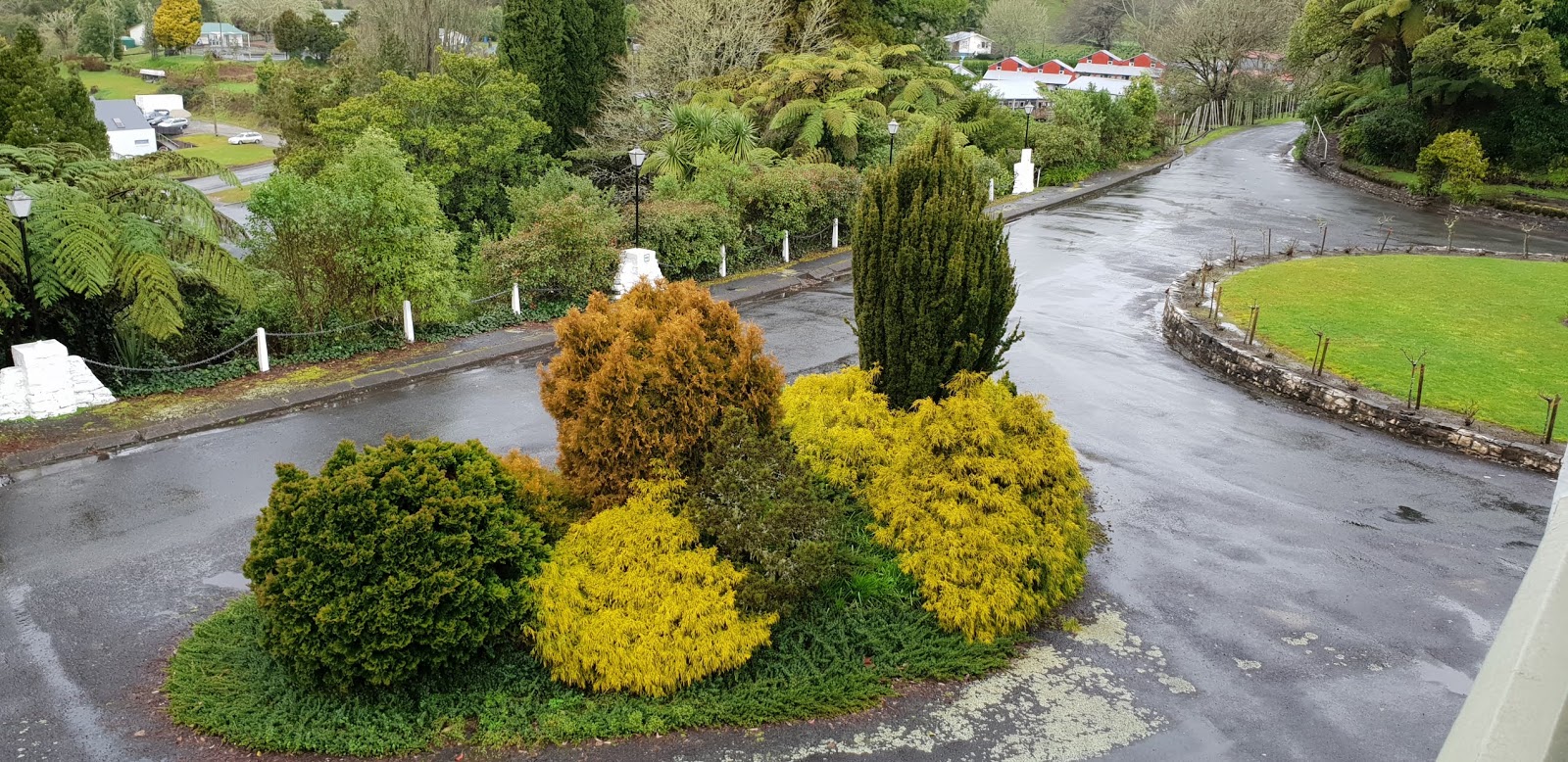
Views from the balcony show part of the surrounding gardens

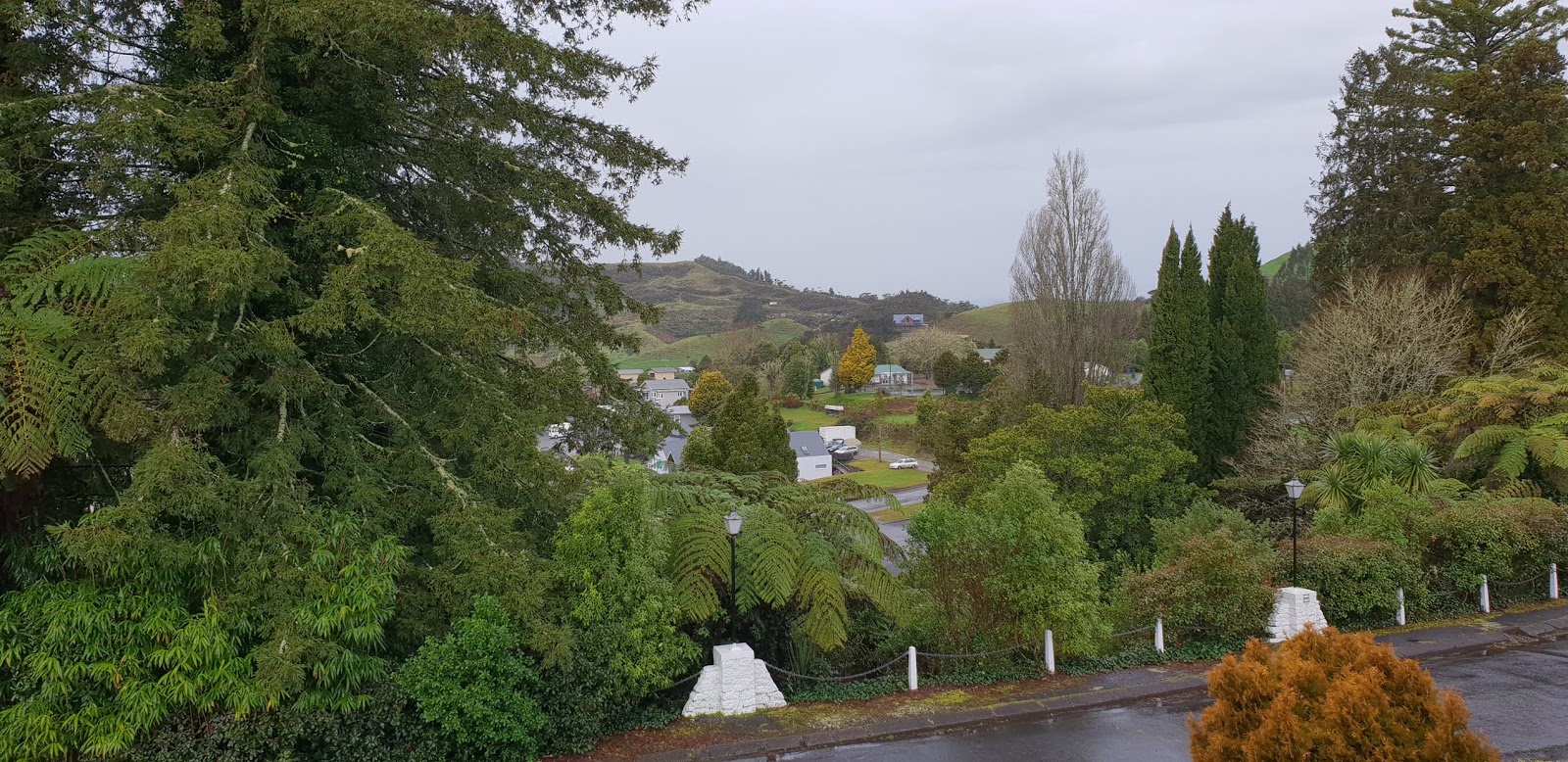
and the town of Waitomo in the distance.

In gloomy weather, it does look rather spooky, and I suspect there may be a ghost or two lurking somewhere in the buildings.

In a word: Lot

I’ve got a lot of time on my hands…

Or not.  It’s just an expression, where a lot means plenty.  Only the rich and idle seem to have a lot of time on their hands, and a lot of money, sometimes more than they know what to do with.

It spawns another saying, the devil finds work for idle hands.

This is distinct from the other form of a lot; a piece of land that can be used to build a house, an office building or warehouse, or just land to graze cattle or sheet.

For those with a lot of money, they can buy two lots or four lots.

Lot can also mean everything, i.e. he bought the lot.

Now it’s getting confusing, as only the English language can.

How about, there’s a lot of love in the room.   Well, it’s certainly not at a political debate that’s for sure!

Then, still having more money than sense I went to an auction and bid for two lots.  Unfortunately, there was someone else who had more money than I did.

My mother had a lot of quaint expressions; once we were sitting opposite a man of dubious character and she said, he’s a bad lot.

Back in the old days, and sometimes these, the word lot was used instead of lottery when names were put in a hat and one drawn as the winner.  Today its a little more sophisticated, balls are put in a cage.

And I was never happy with my lot in life.  Not till I got older, anyway.