For instance, I’ve heard someone mutter, “the devil you say…”
Or another, who was telling his friend, who, at the time was in a spot of bother, ‘You’re between the devil and the deep blue sea.”
Wrong. We all know the sea is green, not blue.
But whatever the circumstances, the devil seems to pop up a lot.
For instance,
Better the devil you know than the devil you don’t.
It seems I’ve heard that somewhere before, or at least a part of it. Hmmm.
Maybe you’ve “gone to the devil”. Can that be paired with “going downhill at a rapid rate of knots”?
OK, it’s impossible to go downhill using the speed measure of knots, that only applies to boats, so who came up with that saying, a landlubber sailor?
Hang on, isn’t there a team called the New Jersey Devils? Funny, I didn’t see if the players had horns or not, and they were using hockey sticks not tridents.
Maybe I misheard.
Neutral men are the devil’s allies, therefore there must be a lot of devils in Switzerland
The devil finds work for idle hands, oh yes, my grandmother used this often on me whenever she caught me doing nothing, or digging around in her magazine room … which was a lot
But my favorite,
When in hell, only the devil can show you the way out.
Our airport experiences are all without incident, although from time to time the sight of police or soldiers patrolling with guns can be disconcerting.
We have also experienced the odd problem in London at Heathrow, firstly trying to get help from the designated help staff and then to find the check-in desk of an airline apparently no one available knew existed. They were not very good ‘help’ staff.
The fact we couldn’t find the airline counter left us cursing the travel agent. It existed in name, we found it in the phone book and on the internet, but …
The phone rang out – ugh!
The internet site could not be used to check in or manage the booking on the same day as the flight!
Double ugh!
Until a little footwork found the agents desk and the misunderstanding was sorted out.
By the way, the airline itself was a pleasure to fly on, the staff was very helpful and most of all we arrived just before the airport closed. It was odd to discover that some airports closed, particularly Florence. It was the second time we were the last people out and having to turn off the lights. And, because I booked the transfer to the hotel myself, he was there waiting for us!
Holiday over, the joys of visiting relatives we hadn’t seen for a long time, and an unusual but wonderful New Year’s Eve and a wedding two days later, only a flight stands between us and getting home. After days, sometimes weeks, it is that moment we all look forward to; sleeping on our own beds, making our own food and getting to the gym to work off those extra kilos put on by delicious hotel food or local fare where calorie counting is not part of the dining experience.
Of course getting to the airport from the hotel can be an experience in itself whether by taxi, perhaps the taxi driver from hell who knows only two speeds fast and stop and is also, unfortunately, color blind. Or whether you have arranged for a transfer only to discover it’s not coming because the company went out of business or you changed hotels and someone forgot to tell them. Or the travel agent made a mistake or forgot to confirm the booking. Oh yes, it happens.
We have a hire car and will be returning it t the same place. Let’s hope the signage at the airport makes it easy to find the rental place. In London we had a hell of a time trying to find it; good thing we were hours earlier than we should be. In Chicago, the car rental depot was miles from the airport.
And just because the sign says ‘rental returns’ for the lane you’re in it doesn’t necessarily follow it’s the right lane. Then as you miss the exit, and get stuck on the one-way road system, all of a sudden you have left the airport and you’re heading back to the city.
If you’re running late …
But if everything goes to plan you can get to the airport with time to spare.
Sydney to Beijing – Qantas A330-200 Boarding 11:45, everyone on board by 12:02, for a 12:10 departure. Pushing back 12:12 Take off 12:27
Lunch Airline food is getting better but the fact they serve it up to you in a metal tray with a thick aluminum lid does nothing for the quality of the food inside. I get what the chef is trying to do but often there is too little of one thing and too much of another and what you finish up with is slop in a tray. Sometimes it’s edible sometimes it’s not. Sometimes the meat is tender and other times it’s like boot leather. As it is today. I think it’s pork, I should have had the chicken. Or perhaps it was chicken. I hate it when you can’t tell what it is that you’re eating. But, the drinks were good.
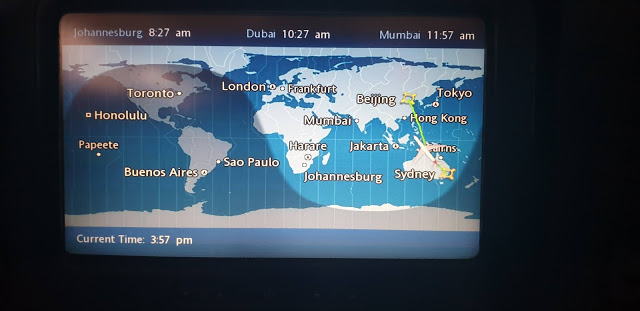
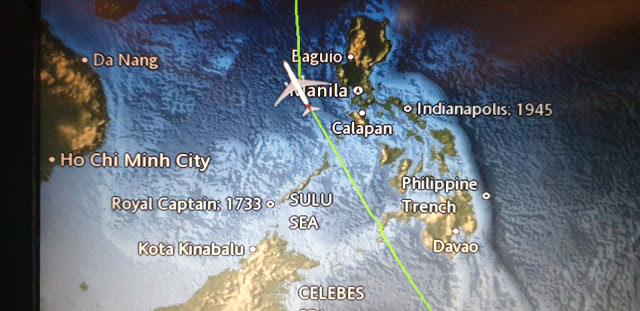
Rest or Sleep, maybe It’s going to take 11 hours and 20 minutes from Sydney to Beijing, a long time to sit in a plane with nothing much to do other than crosswords, read a book or newspaper or magazine, listen to music on your own device, or the in-flight entertainment, watch a movie again by the in-flight entertainment – if it works – or try to get some sleep. I started with the crosswords but got bored quickly. I fiddled with the in-flight entertainment, looked at the movies and tv shows but none really interested me, not then at least, so I set it to the flight path. Not exactly stellar entertainment, but it’s always interesting to know where the plane is. Or is it? If we crash, what good would it do me to know it’s somewhere over the ocean, not far from Manila, or somewhere else. It’s not as if I could phone someone up, on the way down, to let them know where we are. But, just after dinner, we still haven’t left Australia
However, by the time I’ve finished fiddling with and dismissing all of the entertainment alternatives, it’s back to the flight path and now we are…
Somewhere approaching the Sulu Sea, which I’ve never heard of before, so it looks like I’ll have to study up on my geography when I get home.
OK, Manila looks like somewhere I’ve heard of, so we have to be flying over the Philippines. Not far left of that is Vietnam. Neither of those places is on my travel bucket list, so I’ll just look from up here and be satisfied with that.
Working, or not Chronic boredom is setting in by the time we are just past halfway to our destination. We are over 6 hours into the flight and there no possible way I’m going to get any sleep. I brought my Galaxy Tab loaded with a few of my novel outlines, and planning for missing chapters, thinking I might get a little thinking time in. Plane rides, I find, are excellent for getting an opportunity to write virtually unhindered by outside interruptions, if, of course, you discount the number of times people brush past, knocking your seat, the person in front lowering the seat into your face, or people around you continually asking you to turn off your light because they’re trying to sleep. Sorry, I say, but you can suffer my pain with me. It’s one of the joys of flying with over two hundred others in a claustrophobic environment. Besides, aren’t the lights supposed to be slanted so only I get the rays of light? Except, I guess when the fixed light doesn’t line up with where the airline has fixed the seat (usually so they can squash more people in).So, sorry, not sorry, take it up with the airline.
Back to work, and I put in some quality time on a part of the story that had been eluding me for a while. I knew what I wanted to write, but not how I was going to approach it, so that blissfully quiet and intense time worked in my favor, something that would not have happened back hope. I won’t bore you with the synopsis, just suffice to say it’s finally down on paper, digitally that is, and it’s a huge step forward towards finishing it. There is, of course, the end play, the reading of the will but not before there’s a few thrusts and parry’s by some of the players, but all in all the objective was to showcase a group of people with their strengths and weaknesses pushing their characters in various directions, some at odds with what is expected of them. But enough of that. A quick check of our position shows we’re still over water but closer to our destination, so much so, we might start the pre-landing rituals, starting with food.
Dinner 7:00 – Dinner is served, well, the lights go on and a lot of tired people try to shake the sleep, and sleeplessness, out of their systems. Then flight attendants that are far too cheerful, and must have beamed in from somewhere else, serve another interesting concoction that says what’s in it but you can’t really be sure of the ingredients. It comes and it goes.
9:10 – We begin our descent into Beijing, you know, that moment when the engines almost stop and there’s a sickening lurch and the plane heads downward. 9:56 – We touch down on the runway, in the dark and apparently it has been raining though from inside the plane you’d never know. 10:10 – the plane arrives at the gate, the usual few minutes to open the door, and, being closer to the front of the plane this time, it doesn’t take that long before the queue is moving.
Early or late, it doesn’t matter. After clearing customs and immigration, we have to go in search of our tour guide, waiting for us somewhere outside the arrivals terminal.
There is nothing worse than, when lying in bed unable to get to sleep, you hear every noise in the house and out, but none worse than a dripping tap.
Its often not because someone forgot to turn the tap off, but a washer is on its last legs.
There are taps for the fallen brave, but aside from the fact that is the name of a piece of music, I think it’s also the title of a film. But taps itself is a bugle call at dusk, and also played at military funerals.
Then there’s that income stream that you can tap into, other than your next-door neighbours power supply.
But what would be far more interesting than to tap into a phone line and listen in? Despite the fact that eavesdroppers never hear anything good about themselves, you could learn something you didn’t want to know.
Then we can go back to the 1930s and a series of films that starred one of my favourite actors Fred Astaire, who was, of course, a tap dancer, along with Ginger Rogers.
In fact, my middle granddaughter is quite a good tap dancer.
And, lastly, was that a tap on the door, or a tap in the window?
Instead of making a grand entrance, arriving in style and being greeted by important dignitaries, we are slinking in via an airplane, late at night. It’s hardly the entrance I’d envisaged. At 9:56 the plane touches down on the runway. Outside the plane, it is dark and gloomy and from what I could see, it had been raining. That could, of course, simply be condensation.
Once on the ground, everyone was frantically gathering together everything from seat pockets and sending pillows and blankets to the floor. A few were turning their mobile phones back on, and checking for a signal, and, perhaps, looking for messages sent to them during the last 12 hours. Or perhaps they were just suffering from mobile phone deprivation.
It took 10 minutes for the plane to arrive at the gate. That’s when everyone moves into overdrive, unbuckling belts, some before the seatbelt sign goes off, and are first out of their seats and into the overhead lockers. Most are not taking care that their luggage may have moved, but fortunately, no bags fall out onto someone’s head. The flight had been relatively turbulent free.
When as many people and bags have squeezed into that impossibly small aisle space, we wait for the door to open, and then the privileged few business and first-class passengers to depart before we can begin to leave. As we are somewhere near the middle of the plane, our wait will not be as long as it usually is. This time we avoided being at the back of the plane. Perhaps that privilege awaits us on the return trip.
Once off the plane, it is a matter of following the signs, some of which are not as clear as they could be. It’s why it took another 30 odd minutes to get through immigration, but that was not necessarily without a few hiccups along the way. We got sidetracked at the fingerprint machines, which seemed to have a problem if your fingers were not straight, not in the center of the glass, and then if it was generally cranky, which ours were, continue to tell you to try again, and again, and again, and again…That took 10 to 15 minutes before we joined an incredibly long queue of other arrivals,
A glance at the time, and suddenly it’s nearly an hour from the moment we left the plane.
And…
That’s when we got to the immigration officer, and it became apparent we were going to have to do the fingerprints yet again. Fortunately this time, it didn’t take as long. Once that done, we collected our bags, cleared customs by putting our bags through a huge x-ray machine, and it was off to find our tour guide.
We found several tour guides with their trip-a-deal flags waiting for us to come out of the arrivals hall. It wasn’t a difficult process in the end. We were in the blue group. Other people we had met on the plane were in the red group or the yellow group. The tour guide found, or as it turned out she found us, it was simply a matter of waiting for the rest of the group, of which there were eventually 28.Gathered together we were told we would be taking the bags to one place and then ourselves to the bus in another. A glance in the direction of the bus park, there were a lot of busses.
Here’s a thought, imagine being told your bus is the white one with blue writing on the side.
Yes, yours is, and 25 others because all of the tourist coaches are the same. An early reminder, so that you do not get lost, or, God forbid, get on the wrong bus, for the three days in Beijing, is to get the last five numbers of the bus registration plate and commit them to memory. It’s important. Failing that, the guide’s name is in the front passenger window.
Also, don’t be alarmed if your baggage goes in one direction, and you go in another. In a rather peculiar set up the bags are taken to the hotel by what the guide called the baggage porter. It is an opportunity to see how baggage handlers treat your luggage; much better than the airlines it appears.
That said, if you’re staying at the Beijing Friendship Hotel, be prepared for a long drive from the airport. It took us nearly an hour, and bear in mind that it was very late on a Sunday night.
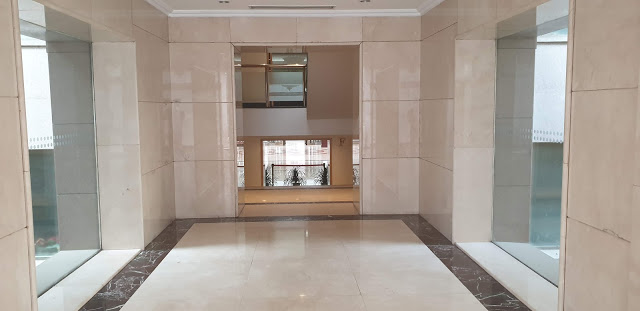
Climbing out of the bus after what seemed a convoluted drive through a park with buildings, we arrive at the building that will be our hotel for the next three days. From the outside, it looks quite good, and once inside the foyer, that first impression is good. Lots of space, marble, and glass. If you are not already exhausted by the time you arrive, the next task is to get your room key, find your bags, get to your room, and try to get to be ready the next morning at a reasonable hour.
Sorry, that boat has sailed.
We were lucky, we were told, that our plane arrived on time, and we still arrived at the hotel at 12:52. Imagine if the incoming plane is late.
This was taken the following morning. It didn’t look half as bland late at night.
This is the back entrance to Building No 4 but is quite representative of the whole foyer, made completely of marble and glass. It all looked very impressive under the artificial lights, but not so much in the cold hard light of early morning.
This the foyer of the floor our room was on. Marble with interesting carpet designs. Those first impressions of it being a plush hotel were slowly dissipating as we got nearer and nearer to the room. From the elevator, it was a long, long walk.
So…Did I tell you about the bathroom in our room?
The shower and the toilet both share the same space with no divide and the shower curtain doesn’t reach to the floor. Water pressure is phenomenal. Having a shower floods the whole shower plus toilet area so when you go to the toilet you’re basically underwater.
Don’t leave your book or magazine on the floor or it will end up a watery mess.
And the water pressure is so hard that it could cut you in half. Only a small turn of the tap is required to get that tingling sensation going.
This is sometimes how we must feel when overlooked or ignored, like a nobody.
And some people will treat you like a nobody, i.e someone who is just not important.
That’s just one use of the word.
Another might be…
Who did that to your room?
‘Nobody’ is the plaintiff reply. The infamous Mr. Nobody. We’ve never met him, but he’s always there. And, what’s more, he seems to be able to be in more than one place at a time.
Then there’s that time when there’s nobody in the room, nobody agreed with me, hell, that happens all the time, and when I rang your phone nobody answered.
Nobody? Was I expecting Mr. Nobody to answer? Surely the response should have been, ‘and you didn’t answer’.
Of course, let’s not delve too deep here, lest we might find out something we didn’t want to know.
I went to your house last night, but nobody was home.
How is it we refer to the people whom we know live in that house as ‘nobody’. Shouldn’t we be saying, ‘none of you was at home’?
It seems nobody is one of those words we often use in vain.
Yes, the question on everybody’s lips, how do you fit 200 plus people into a room clearly designed to fit 50 comfortably?
The answer; pure mayhem, and a lot of people missing out on breakfast, or at the very least trying to eat in the awkwardest of positions, by balancing on edges of chairs or just standing at the bar. This is a zero out of ten for the tour company.
Seven plus tours all leaving at the same time and no possible way of fitting them in. Good for the hotel if they charged you for breakfast, because at various times there was nothing to eat, and definitely no milk for coffee if you could get coffee.
Still, as we keep saying, it is what it is.
It’s rather hit and miss with breakfast, sometimes there’s adequate catering, a large enough room, and enough food set out for a very large group all turning up at the same time.
So, after the lucky few who did manage to get a seat and equally something to eat, we all pile into the bus, after having to get our suitcases onto the bus because we’re moving on to Shanghai after the day’s activities…
…and then have to wait for the other seven to move off. In the end, we reverse into the traffic and get underway. I’m not sure what the other buses were going to do.
But, getting out of the hotel car park was only the first part of the morning’s adventure, the next part was not exactly going to be any easier. 8:00 in the morning means peak hour traffic, and here peak hour traffic takes on a whole new meaning.
Four or five lanes completely full and at a standstill, and the odd daredevil, including our bus driver, thinking he can change lanes.
Having a window seat can be fraught with danger; you get to see some of the most incredible maneuvers Chinese driver’s attempt and amazingly often succeed.
I want to keep the car. Especially if it’s a Lamborghini and it didn’t cost $500,000.
This form of the word simply means to hang on to something, or up the proper definition, to have or retain possession of
Paring it with other words is where it gets complicated.
For instance,
Keepings off, make sure that the ball doesn’t get into someone else’s possession.
Keep it to yourself, yes, here’s your chance to become the harbinger of secrets and not tell anyone else. Not unless a lot of money is involved, or a Lamborghini.
You guessed it, the car is the running joke on this post.
How about, keep a low profile, been there tried that, it’s a lot harder than you think.
What about keeping your cards close to your chest, yes, this had both a literal and figurative meaning which makes it sort of unique.
That might follow the second definition, to continue, or cause to continue a particular state.
Another way of using keep is by delaying or stopping someone from doing something or getting somewhere; ie, I was kept waiting at the doctor’s surgery because he was late.
There are any number of examples of using the word keep in tandem with other words
One that specifically doesn’t relate to all the former examples, is simply the word keep.
What is it?
Usually the strongest part of the castle, and the last to fall in an attack.
Yes, it’s that simple word that we use to call someone affectionately.
Or sometimes, with a little accent on the word; yes, dear and no, dear.
In other words, it’s a person regarded with deep affection.
It can also mean expensive, by saying, that’s a bit dear, isn’t it, when we’re really saying it’s way overpriced.
I can’t remember how many times I’ve said something is ‘too dear’ to the children.
Grannies tend to use the expression, ‘be a dear and…’, to get you do do something for them.
Friends, sometimes tongue in cheek, will say, ‘oh dear, I’ve upset you’, when that was exactly what they meant to do. Friends you say? Yes, friends indeed.
And then we always start a letter (always? Who writes letters any more?) with
Dear John (oops, not one of THOSE letters)
Dear Sir/Madam
Of course, instead of swearing, you could simply say ‘Oh dear, you’ve let us down again!’.
And when you lose your job, which is happening a lot at the moment, it is said it would cost you dear, though sometimes it would be more appropriate to use the adverb, dearly.
It is not to be confused with the word deer which is an animal, the males of which have antlers.
There are a number of different types of deer, such as reindeer and elk. In Canada, they are called caribou.
In Robin Hood’s day, killing deer brought you very harsh punishment.
And one of my favourite meats is venison, meat from a deer, which are farmed in New Zealand along with sheep.
I’m getting to the point where I don’t want to turn on the tv anymore.
I get it. We’re in the middle of a pandemic, and everyone wants to get back to work, but is it worth the cost of lives?
It raises the question, how much is a single life worth?
Apparently, to some, nothing. We see various countries rebelling against the so-called notion we should be social distancing, staying at home, and stopping the spread of the coronavirus.
It seems some countries, and a section of their population, just don’t care.
And the pity of it is, all those that do the right thing will inevitably forgive those that break the rules, even if they spread the disease because of their foolhardiness.
Our citizens will die, but we will be reluctant to call them murderers. They will find some way to hold the more sensible nations to ransom, simply because they have something we all need, something we turned over to them because we were naive. In a sense we still are.
Consumerism and capitalism, and dare I say it, greed, at its very worst.
But, the alternatives, fascism, communism, and dictatorships is unpalatable.
Something else we have discovered because of this world pandemic is our own stupidity in considering that a global economy was the way to go. All of a sudden everything we had moved to China, and elsewhere offshore, has come back to bite us. No whitegoods, no clothes, everything but food. At least we haven’t sold all of that down the river. Yet.
This is one hell of a wake-up call.
We need to address that self-sufficiency we no longer have. We need to bring back manufacturing, we need, in other words, to become self-sufficient again. No matter what the cost. It seems ems that in sending away everything meant that we sent away out national pride as well.
Made in Australia is something of a hollow joke. Now we get labels that no longer say, Made in Autraliaits now what percentage is made in this country, and that isn’t a lot.
I suspect it’s the same for a lot of so-called western countries, including the United States.
This isn’t going to be the first or the last time this sort of problem will happen. ln fact, it’s only going to get worse. The thing is, are we going to learn from it?
Yes, we need to fit into the rest of the world but, no, we don’t need to sell our souls to do it.
We need to do something about it, now, while we can. This pandemic might just have a silver lining, if only we recognize the opportunity for what it is.