Under by itself is a rather boring word, you know, under the moon, under the sea, under the influence, which is not hard to be if you’ve been hypnotised or after a few drinks.
Under is anything beneath something else.
But lts add it to some other words like,
Under rated, which means it is better that what others give it credit.
Under wear, what you would wear underneath your clothes.
Under study, the person who takes over a lead role when the lead is incapacitated. And how many understudys are guilty of harming the lead, in order to get a big break?
And not get away with it?
Under stood, an agreement that might or might not be in writing that something will happen, that is, it is understood that I will be the next president.
Or not. Who on earth would really want to be president of anything.
So in the spirit of trying to cionfuse everyone all of the time, I have a conundrum in thr form of a question, whar is the difference between under and underneath.
To me there is none, you can be under the sea or underneath the sea, or under the table or underneath the table, but then there’s another, you can be under the influence but not underneath the influence, though technically you could, if you wanted to used confusing English.
And, just to add to the confusion further, I can say that the submarine sailed under the sea, underneath the sea, but, in actual fact, it doesnt.
What is under the sea is the sand, or sea bed, and a submarine does not plow its way through the sand, does it.
What we really should be saying is that a submarine moves through water.
West Lake is a freshwater lake in Hangzhou, China. It is divided into five sections by three causeways. There are numerous temples, pagodas, gardens, and artificial islands within the lake.
Measuring 3.2 kilometers (2 miles) in length, 2.8 kilometers (1.7 miles) in width, and 2.3 meters (7.5 feet) in average depth, the lake spreads itself in an area totaling 6.5 square kilometers (2.5 square miles).
The earliest recorded name for West Lake was the “Wu Forest River”, but over time it changed to two distinct names. One is “Qiantang Lake”, due to the fact that Hangzhou was called “Qiantang” in ancient times. The other, “West Lake”, due to the lake being west of the city
It’s about to get busy, with a number of activities planned, and the warmth of the day is starting to make an impact.
The tour starts in the car park about a kilometer away, but the moment we left the car park we were getting a taste of the park walking along a tree-lined avenue.
When we cross the road, once again dicing with death with the silent assassins on motor scooters.
We are in the park proper, and it is magnificent, with flowers, mostly at the start hydrangeas and then any number of other trees and shrubs, some carved into other flower shapes like a lotus.
Then there was the lake and the backdrop of bridges and walkways.
.
And if you can tune out the background white noise the place would be great for serenity and relaxation.
That, in fact, was how the boat ride panned out, about half an hour or more gliding across the lake in an almost silent boat, by an open window, with the air and the majestic scenery.
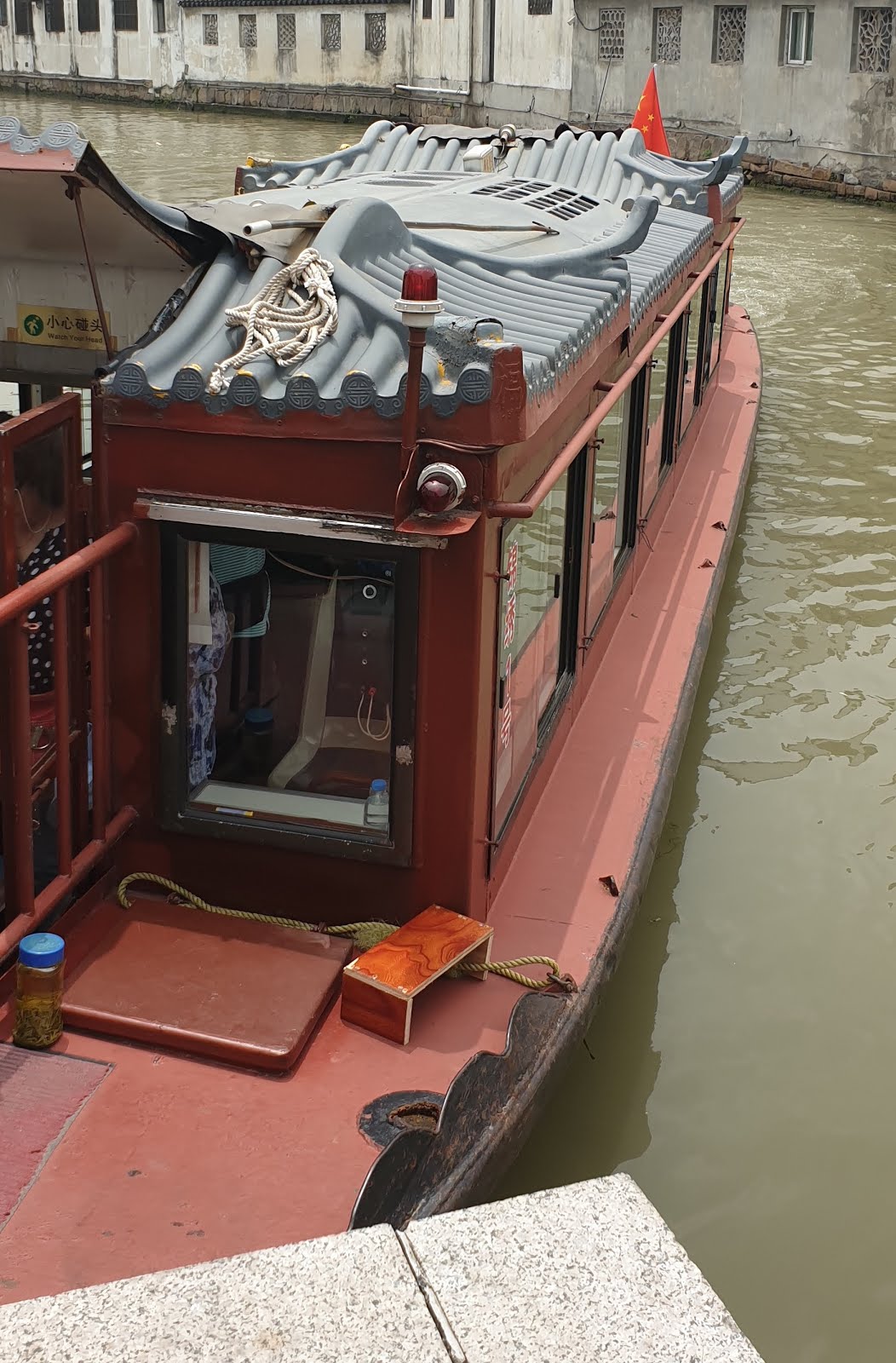
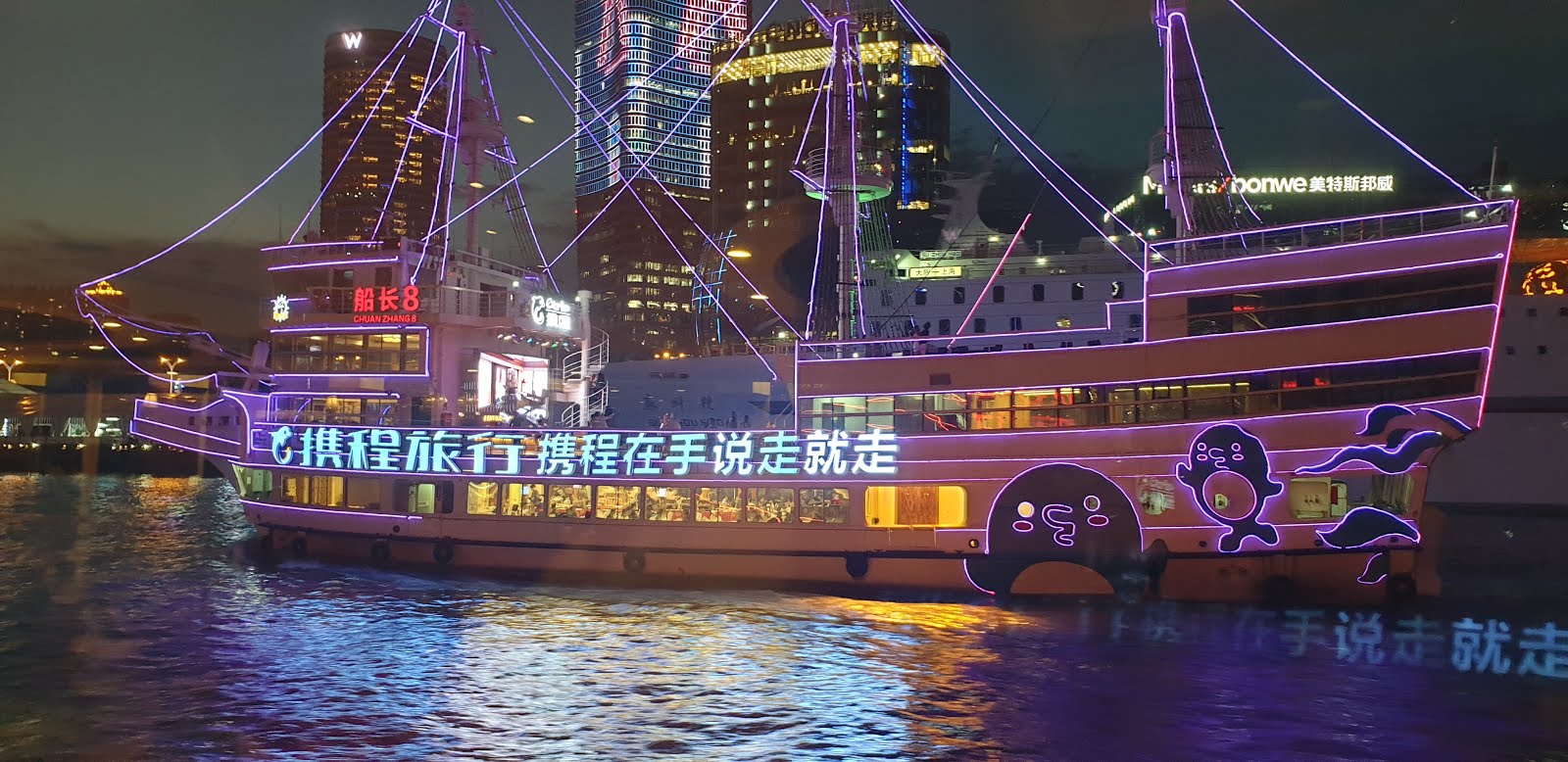
No, not that boat, which would be great to have lunch on while cruising, but the boat below:
Not quite in the same class, but all the same, very easy to tune out and soak it in.
It was peaceful, amazingly quiet, on a summery day
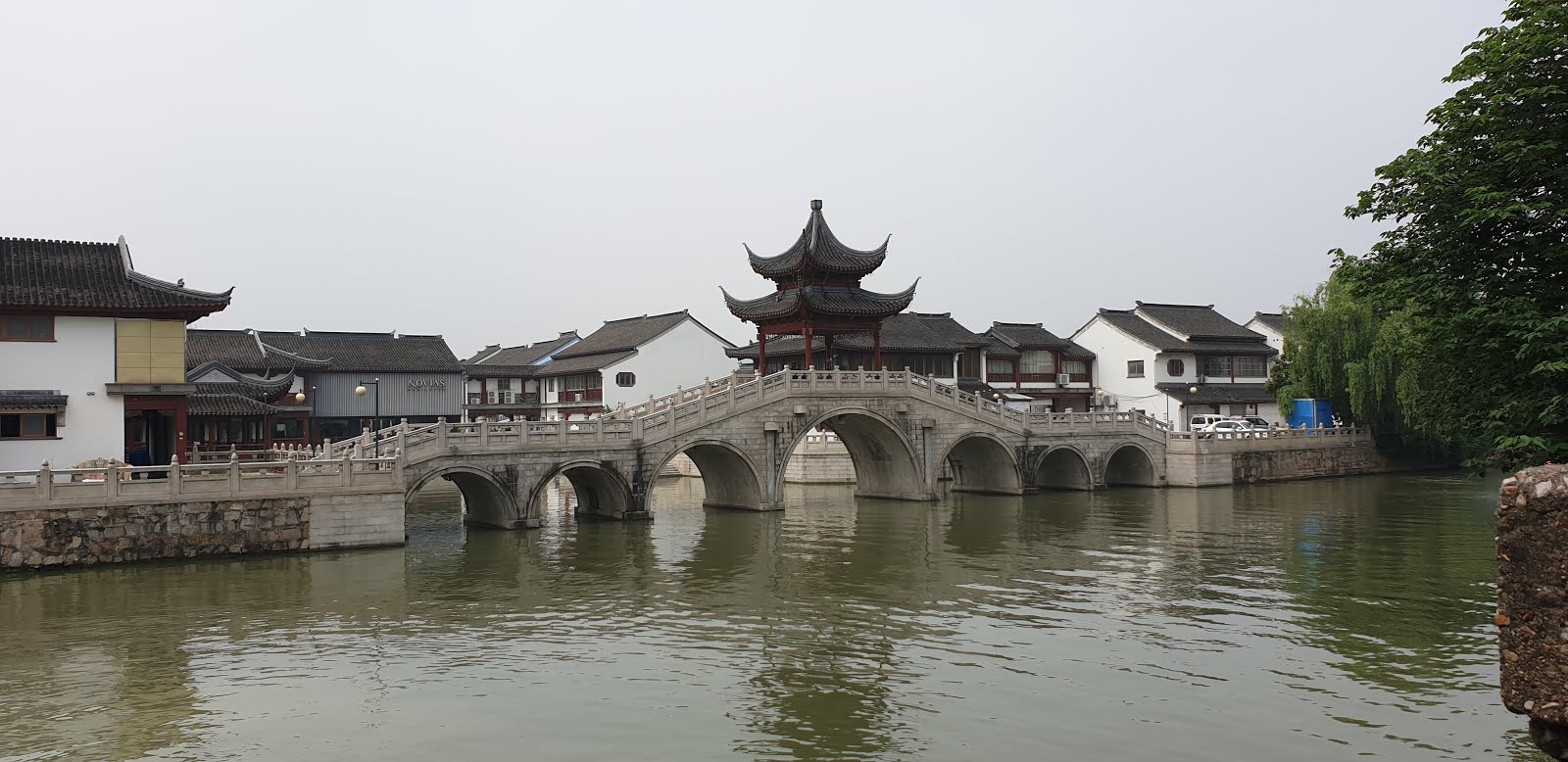
A pagoda in the hazy distance, an island we were about to circumnavigate.
Of all the legends, the most touching one is the love story between Bai Suzhen and Xu Xi’an. Bai Suzhen was a white snake spirit and Xu Xi’an was a mortal man.
They fell in love when they first met on a boat on the West Lake, and got married very soon after.
However, the evil monk Fa Hai attempted to separate the couple by imprisoning Xu Xi’an. Bai Suzhen fought against Fa Hai and tried her best to rescue her husband, but she failed and was imprisoned under the Leifeng Pagoda by the lake.
Years later the couple was rescued by Xiao Qing, the sister of Baisuzhen, and from then on, Bai Suzhen and Xu Xi’an lived together happily.
The retelling of the story varied between tour guides, and on the cruise boat, we had two. Our guide kept to the legend, the other tour guide had a different ending.
Suffice to say it had relevance to the two pagodas on the far side of the lake.
There was a cafe or restaurant on the island, but that was not our lunch destination.
Nor were the buildings further along from where we disembarked.
All in all the whole cruise took about 45 minutes and was an interesting break from the hectic nature of the tour.
Oh yes, and the boat captain had postcards for sale. We didn’t buy any.
Lunch
At the disembarkation point there was a mall that sold souvenirs and had a few ‘fast food’ shops, and a KFC, not exactly what we came to China for, but it seemed like the only place in town a food cautious Australian could eat at.
And when tried to get in the door, that’s where at least 3 busloads were, if they were not in the local Starbucks. Apparently, these were the places of first choice wherever we went.
The chicken supply by the time we got to the head of the line amounted to pieces at 22.5 RMB a piece and nuggets. Everything else had run out, and for me, there were only 5 pieces left. Good thing there were chips.
And Starbucks with coffee and cheesecake.
At least the setting for what could have been a picnic lunch was idyllic.
As some may be aware, but many not, Chester, my faithful writing assistant, mice catcher, and general pain in the neck, passed away some months ago.
Recently I was running a series based on his adventures, under the title of Past Conversations with my cat.
For those who have not had the chance to read about all of his exploits I will run the series again from Episode 1
These are the memories of our time together…
This is Chester. It’s going to be an interesting morning.
When I finally make it out to the writing room, I find him sitting on my desk, next to the keyboard, with a rather benign expression.
Remembering that cats can’t have expressive expressions, it worried me that he’s working overtime to make me think he has one.
I can feel his eyes boring into me, following me around the room, watching and waiting.
Waiting for what I wonder.
I also remember that cats are hunters and killers. If he was a lion or a tiger I’d be in a great deal of trouble now. He’d pounce, and that would be the end.
Is this we hat he’d be doing if I let him outside?
Is he sending me a warning?
I finish what I’m doing on the other side of the room and come over to the seat.
Are you done giving me the death stare? I ask him.
A slight shake of the head, and if I wanted to write anything into it, that would be a no.
A few seconds pass, then he jumps down to the floor and walks off.
Job done, I suspect he’s thinking.
Back to his least favourite dinner tonight, I’m thinking.
The Kingston Flyer was a vintage train that ran about 14km to Fairlight from Kingston, at the southern end of Lake Wakatipu, and back.
This tourist service was suspended in December 2012 because of locomotive issues.
However, before that, we managed to go on one of the tours, and it was a memorable trip. Trying to drink a cup of tea from the restaurant car was very difficult, given how much the carriages moved around on the tracks.
The original Kingston Flyer ran between Kingston, Gore, Invercargill, and sometimes Dunedin, from the 1890s through to 1957.
There are two steam locomotives used for the Kingston Flyer service, the AB778 starting service in 1925, and the AB795 which started service in 1927.
The AB class locomotive was a 4-6-2 Pacific steam locomotive with a Vanderbilt tender, of which 141 were built between 1915 and 1927 some of which by New Zealand Railways Addington Workshops.
No 235 is the builder’s number for the AB778
There were seven wooden bodied passenger carriages, three passenger coaches, one passenger/refreshments carriage and two car/vans. The is also a Birdcage gallery coach. Each of the rolling stock was built between 1900 and 1923. They were built at either of Addington, Petone, or Hillside.
I suspect the 2 on the side means second class
The passenger coach we traveled in was very comfortable.
This is one of the guard’s vans, and for transporting cargo.
The Kingston Railway Station
and cafe.
A poster sign advertising the Kingston Flyer
The running times for the tourist services, when it was running.
Some call time off from work whether it is for a day, a few days, and couple of weeks, or maybe longer, a holiday.
Or leave, leave of absence, annual leave, or long service leave.
Others may call it vacation.
It depends on what part of the world you live in.
But the end result is the same, you do not go to work, so you stay home and do all those things that have mounted up, you drive up, and for some reason it is always up, to the cabin, for a little hunting shooting a fishing, or you get on a planr or a ship and try to get as far away from home and work as possible.
That’s called going overseas. It seems if there is an ocean between w there you go and where you live, no one will be able to disturb you.
Sorry, I bet you didn’t leave that mobile phone or iPad home did you?
But, of course there are a few other obscure references to the word holiday.
For instance,
It can be a day set aside to commemorate an event or a person, a day when you are not expected to work, e.g. Memorial Day, Christmas Day, Good Friday. In Britain they used to be called Bank Holidays.
It can be a specified period that you may be excused from completing a task, or doing something such as getting a one year tax exemption, which maifh also be called a one year tax holiday.
Yes, now that is an obscure reference, particularly when no tax department would ever grant anyone an exemption of any sort.
This morning started with a visit to the car rental place in Vancouver. It reinforced the notion that you can be given the address and still not find the place. It happened in Washington where it was hiding in the back of the main railway station, and it happened again in Vancouver when it was hidden inside a hotel.
We simply walked straight past it. Pity there wasn’t a sign to let people know.
However…
We went in expecting a Grand Jeep Cherokee and walked out with a Ford Flex, suitable for three people and four large suitcases. It actually seats 7, but forget the baggage, you’d be lucky to get two large suitcases in that configuration.
It is more than adequate for our requirements.
Things to note, it was delivered with just over a quarter of a tank of gas, and it had only done about 11,000 km, so it’s relatively new. It’s reasonably spacious, and when the extra seats are folded down, there is plenty of baggage space.
So far, so good.
We finally leave the hotel at about half-past ten, and it is raining. It is a simple task to get on Highway 1, the TransCanada Highway, initially, and then onto Highway 5, the Coquihalla Highway for the trip to Kamloops.
It rains all the way to the top of the mountain, progress hampered from time to time by water sprays from both vehicles and trucks. The rain is relentless. At the top of the mountain, the rain turns into snow and the road surface to slush. It’s 0 degrees, but being the afternoon, I was not expecting it to turn to ice very quickly.
On the other side of the mountain, closer to Kamloops, there was sleet, then rain, then nothing, the last 100kms or so, in reasonably dry conditions.
Outside Kamloops, and in the town itself, there was evidence of snow recently cleared, and slushy roads. Cars in various places were covered in snow, indicating the most recent falls had been the night before.
We’re staying at the Park Hotel, a heritage building, apparently built in the later 1920s. In the style of the time, it is a little like a rabbit warren with passages turning off in a number of directions, and showing it is spread across a number of different buildings.
It has the original Otis elevator that can take a maximum of four passengers, and a sign on the wall that says “no horseplay inside the elevator” which is a rather interesting expression that only someone of my vintage would understand. And, for those without a sense of humor, you definitely couldn’t fit a horse in it to play with.
The thing is, how do you find a balance between keeping the old world charm with modern-day expectations. You can’t. Some hotels try valiantly to get that balance. Here, it is simply old world charm, which I guess we should be grateful for because sooner rather than later it’s going to disappear forever.
In my writer’s mind, given the importance of the railways, this was probably a thriving place for travelers, and once upon a time, there were a lot more hotels like this one.
Now we’re walking to the Forbidden City, and it seems like we’re walking for miles and we’re practically exhausted before we get started on the main tour. I’m not sure if we received a map of the city, but one is certainly needed so that you can navigate the many features, buildings, and walkways.
There are tour groups everywhere in the large courtyard outside the gate, most likely getting a lecture on the last of the Chinese emperors about that time Sun Yat-Sen proclaimed the new China around 1912. We were no exception, and it was an interesting way to spend the time waiting to get in. It was a tale of intrigue, interwoven with a 3-year-old emperor, and a scheming concubine who becomes the Emperor’s favorite, enough to bear him a son and successor.
Bribery and corruption at its best.
But its history runs something like this:
The Forbidden City is was once the imperial and state residence of the Emperor of China, as well as the center of government, from the Ming Dynasty to the Qing Dynasty, or 1420 to 1924.
It was built from 1406 to 1420 when the Yongle Emperor moved the capital from Nanking to Beijing and consists of about 980 buildings, and 8,886 bays of rooms (not the 9,999 as prescribed in myth) and covers 180 acres. Over the 14 years, a million workers used whole logs of wood from the jungles of southwestern China, marble from quarries near Beijing, specially made golden bricks from Suzhou
Since 1925 it has been a museum and is the largest number of preserved wooden structures in the world.
The city is surrounded by a wall 7.9 meters high, and a moat that is 6 meters deep and 52 meters wide. A tower sits at each of the four corners. Each side has a gate, the north is called the Gate of Divine Might, the south is called the Meridian gate. East and west are called East Glorious Gate and West Glorious Gate respectively.
But, back in the courtyard, we are ready to go in and follow the tour guide who has switched from her amplified microphone to a whisper device we all wear in our ears. She talks and we listen.
We all make it through and regroup on the other side. This is where the fun begins because we are about to meet a large percentage of the 80,000, they let for the day.
It seems to me they have all arrived at the same time, although by the time we get to the entrance gate, it is very well organized, bags are scanned, people are scanned, and you’re in.
After crossing one of the seven Golden Water bridges, you begin to get some idea of the size and scope of the City, and in the distance, the first of the buildings, The Gate of Supreme Harmony. On a hot day, that could be a long and thirsty walk.
From there it is one pagoda after another with buildings that surround the edge of the whole Forbidden City, as does the moat.
By the time we get to the second courtyard, it was time to have ice cream as a refresher. Others head up to another exhibit, and it’s just too many stairs for us.
After this, it’s a walkthrough another courtyard, heading up and down some more stairs, we go and see the museum, with priceless relics from past emperors.
There are areas like the outer courtyard, the inner courtyard, yet another courtyard, and the gardens where the concubines walked and spent their leisure time. It is not far from the emperor’s wives living quarters, though there’s precious little left of the furniture, other than a settee and two rather priceless so-called Ming dynasty vases.
We get into the bad habit of calling all of the vases Ming dynasties. Above is one of the inner courtyards there were living quarters, and that tree is over 300 years old.
Out through some more alleyways and through an entrance that led to the area where the concubines lived, very spacious, bright, and filled with trees, plants, and walkways through rocky outcrops.
The whole area was made up of living quarters and waterways, rocks and paths, all very neatly set out, and it looked to be a very good place to live.
This is an example of the living quarters, overlooking the gardens
And there were several pagodas
From there its a quick exit out the northern entrance, and another longish walk to our bus, which arrives at the meeting point shortly after we do.
That done, the Beijing tour guide has completed her section of our China experience, and we’re ready to move onto the next.
It would be very interesting if duelling was still allowed. There are a few people I’d like to stand toe to toe with, take ten paces, then test my ability to shoot with an old style flint duelling pistol.
What’s this got to do with anything?
It’s where our word of the day comes in. If I lose my nerve, or I know my opposite number is a better shot, my second would have to stand in my place.
It’s, if anything, an older use of the word.
Of course, it mainly means, on one hand, coming second in a race or a competition, not exactly the place you really want to be, simply because no one really remembers who came second.
It plays host to a plethora of statements using second as part of the saying, such as,
Second rate, second hand, even if it had more than one owner, second best.
But then there’s a few more that mean something else like a second look, mainly because you didn’t trust your eyes, second nature, it’s been drilled into you (a rather painful idiom if it truly was) and second sight, though this might not necessarily be a verifiable attribute.
And, of lesser note, I’m not necessarily sure I’m second to none.
On the other hand, and pardon the pun using this definition, it also describes a length of time, very short in fact, and it takes 60 of them to make a minute.
Hang on, it’ll only take a second. Yes, we often use the word in vain. I doubt there is any one of us who could do anything useful in a second.
It’s always a given that whatever city you stay in unless it’s overnight, you go on a tour and see the sights.
Even when you’re staying a short distance from the city, you may go to the effort of catching a train or bus, then get on the hop on hop off tour. There’s always one in just about every city you visit.
Vancouver was no exception.
Except…
We arrived in the rain, went to sleep while the rain came down, woke up to the rain, and a heavy dose of jet lag, or perhaps it was more than we had spent 24 and a half hours traveling from Brisbane to Vancouver vis Shanghai.
We had an excellent view out the window of our room looking towards the shopping mall, and the steady fall of rain.
I felt sorry watching the construction workers on the building site that was the main vista we had to look at.
It could have been worst. Endless mountains with snow on them.
What to do. Venture out in the rain and go on the tour, on pop over to the shopping mall and pick up a few boxing day bargains, no, sorry, boxing week bargains.
We have had some experience going on ha op on hop off tours in open-top buses in the rain. And the last time was not a pleasant experience, even though we learned a valuable lesson, not to stand in front of c as mons and yell ‘fire’. Apparently, that’s how Admiral Nelson lost his arm.
But…
The shopping mall won.
We’d wait and see if the weather improved. Hang on, isn’t Vancouver near Seattle, and doesn’t it rain the 300 days of the year?
Not holding my breath.
I feel sorry for the construction workers again. Still raining, still cold, and still no reason to get out of bed.
Day 2 in Vancouver turned out to be the same as day 1.
Hang on, there’s a development.
We’re on the 16th floor and up at those lofty heights, we can see not only the rain but intermingled with it a few flakes of snow.
Whilst we procrastinate about what we’re going to do, the snowflakes increase into small flurries.
Yep, we’re off to the mall again and go for a walk in the snow.
On the way back we drop into the Boston Pizza, which has a sports bar and there you can sit, drink, eat, and watch the ice hockey, or whatever sort is going at the time.
Today it’s a junior ice hockey tournament, but Canada was not playing. Just the same, a long cold beer and ice hockey?
I can now cross that off the bucket list.
Day 3, we’re going on a great rail journey, well, we are going to get the train to the city and collect the rental car, on the booking form, supposedly a Jeep Grand Cherokee or similar.
Of course, ‘or similar’ are the words to be feared here because in truth the rental company can throw anything at you, so long as it matches the brief, three people and three large suitcases.