Searching for locations: The Shaolin Temple, near Zhengzhou City, Henan Province, China

The Shaolin Temple

Where is the Shaolin Temple?

Dengfeng Maps, Map of Shaolin Temple & Mount Song

It is located in Dengfeng Ave, Dengfeng, Zhengzhou, Henan, China, at the southern foot of Mount Song, 13 km northwest of Dengfeng City, Zhengzhou City, Henan Province.

A map of the Temple grounds, which would come in handy before you enter the grounds, so that you have some idea of what there is to see:

The structures and architecture of Shaolin Temple | Kung fu ...

A bit of history:

The Shaolin Temple was originally built in 495 during the Northern Wei Dynasty (368-534).  For over 1500 years, Shaolin Temple has developed through good and bad times.  The temple was firstly destroyed in the Northern Zhou Dynasty (557-581), then rebuilt much later as the Zhihu Temple.  In the Sui Dynasty (581-618) the temple was renamed Shaolin and became one of the largest Buddhism monasteries in North China.

Good fortune in the early Tang Dynasty (618-907) was followed by bad fortune in the later of Tang Dynasty, it improved during the Song Dynasty (960-1279) until 1312 in Yuan Dynasty (1271-1368) where it returned to its former glory.  The Ming Dynasty (1368-1644) also made contributions to the development of Shaolin Temple.

Due to the wars of the modern era much of the Temple was destroyed.

The Shaolin Temple, nestled in the forested mountains of Henan, its the birthplace of Kung Fu and Zen Buddhism. The Shaolin Temple embraces many exciting attractions, such as the Hall of Heavenly Kings (Tianwangdian), and the Mahavira Hall (Daxiongbaodian)

This is not a single building, that’s not how the Chinese work.  It’s a whole host of buildings, the first of which is up some steps, through a gate, then along a tree-lined avenue with monument stones to some more steps, past a cauldron burning incense, and then to the temple.  There are several monks inside.

The front entrance:

Inside the entrance building, there are some large statues that I’m guessing are there to scare away the wrong sort of people

Once past these characters, you are on a walkway between pagodas where there are trees, and sculptures

and through the next pagoda brings you to the first of the temples.  There are three doors and three buddas.  This is through the middle door

And no you can’t go inside, you just stand on the outside looking in.

In one part of the temple there were three monks, and, believe it or not, they were all on their mobile phones.

This is certainly not ancient times, so what did the monks do before mobile communications?

Up some more stairs to the next building,

And so on till we reach the one at the top.  Outside each is a cauldron burning incense, and that aroma hangs on the air everywhere you go in the compound.

Then it’s a case of what goes up must come down, and strangely enough, it doesn’t take as long to go back down, and in doing so we got to see and hear a bit of singing by the monks.

There was a story to go with the various buildings and other aspects but I didn’t hear half of it, and couldn’t understand our guide for the rest.

All in all, it was an interesting place, but still not worth the money we paid.

Searching for locations: Terracotta Warriors and Horses Museum, X’ian, China

Terracotta Warriors and Horses Museum

A little history, and anecdotal advice first:

In 1974 a 26-year-old farmer, Yang Jide, was drilling a well and found fragments of the terracotta soldiers and bronze weapons.

What was discovered later was one of the biggest attended burial pits of China’s first feudal Emperor, Qin Shi Huang.  In the following years remains had been found in 3 pits, yielding at least 8,000 soldiers and horses, and over 100 chariots.  The soldiers were infantry, cavalry, and others.

Emperor Qin was born in 259 BC and died in 210 BC.  He began building a mausoleum for himself at the foot of Mount Li when he was 13.  Construction took 38 years, from 247 BC to 208 BC.  It was divided into 3 stages and involved 720,000 conscripts.

The pits of pottery figures are 1.5 km east of Emperor Qin’s mausoleum.  Pit 1 has about 6,000 terracotta armored warriors and horses and 40 wooden chariots.  Pit 2 is estimated to have over 900 terracotta warriors and 350 terracotta horses with about 90 wooden chariots.  Pit 3 had so far yielded only 66 pottery figures and one chariot drawn by four horses.

Official records say it was discovered later that it was likely Xiang Yu, a rebel, intentionally damaged the Mausoleum and the soldiers in the pits, by setting fire to the wooden roof rafters, and these fell on and broke the warriors into pieces.

However, we were told that after the terracotta warriors were completed, the Emperor ordered the builders to be killed so that they would not tell anyone about the warriors, and then of those that remained alive deliberately smashed all of the artifacts.

The thing is, all of the terracotta figures that have been found are in pieces, and they need computers to piece them back together again.

The visit:
The first impression is the size of the car park and the number of buses parked in the lot, and a hell of a lot more outside up the road an off on side streets.  Obviously, it costs money to park in the parking lot.

The other first impressions; the numbers waiting to get in were not as many as yesterday outside the forbidden city, in fact, a lot less.

Be warned there’s a long walk from the entrance gate where your bags are scanned and a body scan as well, before admittance.  This walk is through a landscaped area which it is expect might sometime in the future reveal more soldiers, or other artifacts.

At the end of the walk that takes about ten minutes, you can get a one-way ride to the second checkpoint, but we opted not to as no one else in our group did.

That walk is the warm-up exercise to an organized viewing of the exhibits after going through a second ticket checkpoint.  On the other side, we had to hand our tickets back to the tour guide which was disappointing not to end up with a memento of actually having been there.

So, on the other side in the courtyard, the guide told us the most important parts of the exhibition, that we should spend most of the time looking at pit 1, and then spent a little time in 2 which is only there in the first stages of excavation.  Then move onto the museum if only to see the replica chariots.

We do.

The chariots were small but interesting

The horses were better and intricately detailed

These are soldiers, perhaps complete examples of those types found in the end pit.

This is one of the archers.  You can tell by the way he wears his hair.

Pit 2

The excavation of this pit has only just begun, so it is possible to see where they have carefully removed the top cover, and you can see the broken parts of the warriors lying in a heap.

Some parts of the warriors are more discernible closer up

These parts are carefully extracted and taken to the ‘hospital’ where they are digitised and the computer will match each part with the warrior it belongs to.

Pit 1

This has quite a number of standing soldiers that have been glued back together, but not necessarily complete and I notice a number if the statues were incomplete. And if they cannot find the missing pieces, then they are not added to or filled in.

The scale of the pit is enormous, and they have hardly scratched the surface in the restoration process.

What is there is a number of horses as well.

That’s at the front of the pit, a long line of statues, and what is clear is the location of the well where the first fragments were found by a farmer.

There are about eight lines of soldiers, and some lining the sides.

Midway down there is a large area currently under excavation

At the back is the hospital where the soldiers are reassembled.  There’s nearly a hundred in the various stages of rebuilding.  These days the soldiers are rebuilt using computer imaging.

The hospital area is where they are put back together

And these are some of the statues in various stages of reconstruction

Another two views of the size and scale of the reconstruction project

The coffee shop is also a sales centre, but there are too many people waiting for coffee and too few places to sit down.

Searching for locations: The canals of Suzhou, China

This morning is a boat ride that will take us along a small portion of the main canal, and we head through a number of back streets, to a landing where there are a number of boats all vying with each other to get us passengers on boats.

But…

These boats don’t have a wharf to tie up to and then put out a stable gangplank.  No.  They just more into a concrete step and you take your life in your hands getting on.  One wrong step and you’re in the canal.  And not a very clean one at that.

That’s if another boat doesn’t come along and bumps you, knocking you off balance.  We managed not to lose anyone in boarding the vessel.

This is where we get on the boat

We go along what appears to be downstream towards another larger canal, past tree-lined streets until the canal narrows and we’re looking at the backs of houses, which look very dilapidated.

And the canals?  Well, it’s not quite like it is in Venice

Though some parts of the canal look better than others

What doesn’t bear thinking about is the electrical wiring which is a nightmarish spider web of cables going off in all directions.  How anyone could troubleshoot problems is beyond me.

We pass under a number of bridges, and then, about 30 minutes after leaving, we reach a larger canal and do a 180-degree turn, and head back to a drop off point the will enable us to walk through a typical everyday Chinese market for food and the other items.

This drop off point is much the same as the starting point, a concrete step which is as hazardous as the first.  At least we don’t have to compete with other boats for the landing spot.

We take a leisurely stroll down a small section of Pingjiang Road with small shops on either side, selling all manner of goods

but my interest is in the food and the prices, which at times seem quite expensive for so-called local people, so maybe because the tourists go down this street every day, the prices have been inflated accordingly.

I find it rather disappointing.

We walk to the bridge, go under to the other side crossing the canal and find the coffee shop which is also the meeting place.

So…

When is a coffee shop not a coffee shop, when it takes an eternity to make a cup of coffee, we waited 25 minutes?

We also ordered beef black pepper rice and it took 20 minutes before it arrived, but it was well worth the wait.  Strands of perfectly cooked beef with onion, carrot, and capsicum, with a very peppery and spicy sauce, with a side of boiled rice.

A pizza was ordered too but it did not arrive at all before we left.

There are so many things I haven’t done

Does it really matter, you ask?

Perhaps not, but now seems to be an appropriate time, past the age of 67, to take stock.

We have achieved a lot in the last 15 or so years once the children had grown up and could look after themselves.

Unlike a lot of more modern couples who are doing the traveling in their 20’s and 30’s then having children, we chose to do it the other way around.

To me, it seemed easier to deal with teenagers when we were in our 40’s rather than our 60’s.  With the benefit of hindsight, I can truthfully say we were right.

We were older and wiser when we traveled and more aware of the dangers around us, sometimes overlooked or ignored by a youthful devil may care attitude.

But, in saying that ….

No, I don’t think I’ll be getting to see Mt Kilimanjaro, observing the wild animals in the Serengeti, climbing Mt Everest, or seeing the ancient pyramids.

Which is a sad state of affairs given the world has changed so much in recent years and has pretty much ruled out going to a lot of places, and in particular, the middle east, and because of COVID 19, just about everywhere else.

But, if it is ever possible before I die, I still want to go to the Greek Islands, and, Santorini is at the top of my travel bucket list.

We’ve been to London.  We’ve been to Paris and Euro Disney.  We’ve been to Rome and seen the ancient ruins.  We’ve been to Vienna, Schonbrunn Palace, and, particularly for us, a visit to Swarovski crystal world, near Innsbruck, we’ve been to Salzburg, and been on the Sound of Music tour.

We’ve been to Florence and loved it, we’ve been to Venice and loved that too, and we’ve spent a few days in the heart of Tuscany, and want to go back for longer, much longer.

In fact, that’s the second item on the travel bucket list.

We’ve also been to Singapore and Hong Kong, at first out of necessity as an airline stopover, but then we went back to see the city and tourist, and non-tourist attractions.

I will not forget staying at the Hong Kong Conrad hotel as a Diamond Hhonors member.  Oh, the memories.

We’ve also stayed on the French Riviera, in a timeshare apartment in Antibes where every morning when out back you had a view of the shimmering Mediterranean if the sun was out.

Nice, Cannes, Monte Carlo, the billionaire’s yachts in Antibes harbor, Monte Carlo and ‘that’ casino, taking the same drive along the coast as Grace Kelly did in To Catch a Thief, and feeling like James Bond arriving for a new adventure, minus the half-million-dollar sports car.

But, now, crashing back to earth with a very hard thump ….

Travel in the future is looking difficult for both of us, not only financially but from a health aspect.  We are both not as sprightly as we used to be.  Of course COVID is still lurking and despite the good news about a vaccine, it’s still a long long way away.

Yet given the restraints and if it is at all possible, aside from the Greek Islands and Tuscany, the next items on the list are:

Germany, visiting both Berlin, from a cold war aspect, the Brandenburg gate springs to mind, and Munich at the time of the Octoberfest.  As a beer drinker that is also high on the bucket list.

Scotland, more so since we’ve started watching Outlander, and besides being a beer drinker, I am also partial to a good Single Malt, the Whiskey trail.

Ireland, because my wife’s previous name was Murphy and at some point, in the long distant past some relatives emigrated to Australia, and she would like to visit the country of her forebears.

But with the current state of the world, our health issues, and that all-important requisite money, or the lack of it, perhaps it’s time to visit other parts of our own country.

Perhaps it’s time to do a culinary trip, particularly down south.  It’s practical and achievable and safe.

And it’s a big country.

Meijiawu Tea Village (Longjing Tea Plantation), Hangzhou, China

The Tea House at Meijiawu Tea Village

Our destination is about 10 kilometers (6 miles) from downtown Hangzhou.

Meijiawu Tea Village is located in the west of the world-known West Lake and hailed as “ten miles Meiwu” for its vast area along the Meiling Road, is an ancient village with a history of 600 years.  It is the main production base and a protected area of the fragrant West Lake Dragon Well Tea.

The tea leaves from Meijiawu are beautiful in green color, graceful in shape, strong in fragrance and rich in flavor.

So, first, we get to look at the tea bushes, which are much larger than the bushes we’ve seen on the side of the road.  I’m not up for becoming a tea picker any time soon, so I’ll leave it to the professionals.

All tea leaves are picked by women.  It takes about 8 hours to pick two kilos of leaves.

Tea leaves are still picked by hand three times a year, the first spring, by young girls about 15 or 16, the second, summer tea, picked by girls about 20 years old, and the autumn tea, called grandma tea, picked by older women.

Next, we go to the drying demonstration, three tubs with tea leaves, that have to be stirred by hand for a number of hours.

We then get the sales pitch, which extols the benefits of the green tea, which apparently good for everything.  So, now we have tea and supplement pills.

The teapot fountain in the gardens is a nice touch.

Still, we had a cup or two of tea discovered the right way to make it and had a stroll about the grounds.  And for that hour in the morning, it was very pleasant.

This is a about 1kg package of tea leaves.  Don’t ask me how many cups of tea that will make!

In a word: Yellow

It was an easy choice from the start, yellow is a colour, in any number of shades from very pale to very dark.

We have yellow egg yolks, yet another y word, and depending on whether the eggs are farmed in cages or free range can dictate the shade of yellow.  Free-range gives the brightest yellow, by the way.

We have yellow cabs, but oddly enough these cabs are orange, not yellow as in this country, though the same may not be the case overseas, particularly in New York.  Good thing they are bright yellow so you can see them coming if you are crossing the road, perhaps illegally.

We have yellow bananas and lemons, probably the most common answers when asked, what is yellow?  That, and perhaps the yellow rose of Texas.

Then there is a more sinister meaning of the word, and it is associated with cowardice, and cowards are said to have a yellow streak down their backs.

If you have yellow fever then you are in a whole world of pain.

You can sometimes have what appears to be yellow skin, a sign of jaundice.

There is a yellow sea, and then there are the yellow pages, sometimes a substitute name for a telephone directory of businesses.

And lastly, an expression that comes out of the past, and not used so much these days, but people from Asia were thought to have yellow skin.

Searching for locations: The Lingering Gardens, Suzhou, China

The Lingering Garden

These gardens are very tightly put together and are interspersed with buildings that you can go in and look at as distinct from just looking in from the outside.

There are lots of paths that wind around interspersed with rocks which may or may not be sculpted, and equally interspersed with trees, bushes, and small plants.  In the middle is a lake which usually has lotus plants in bloom, but they are not in season.

The gardens were built around a small lake that was filled with fish of all sizes and colours

The buildings were also a contrast for those built for the men

and those for the women

In the middle of the garden was a significant rock pillar

surrounded by certain areas of the garden that had smaller rock formations


At the end of the garden is a large collection of bonsai trees, some of which are quite exquisite.

Searching for locations: Shanghai, China, by night.

When we arrive at the embarkation site we find at least 100 buses all lined up and parked, and literally thousands of Chinese and other Asians streaming through the turnstiles to get on another boat leaving earlier than ours.

Buses were just literally arriving one after the other stopping near where we were standing with a dozen or so other groups waiting patiently, and with people were everywhere it could only be described as organized chaos.

Someone obviously knew where everyone was supposed to go, and when it was our turn, we joined the queue.  There were a lot of people in front of us, and a lot more behind, so I had to wonder just how big the boat was.

We soon found out.

And it was amusing to watch people running, yes, they were actually running, to get to the third level, or found available seating.  Being around the first to board, we had no trouble finding a seat on the second level.

I was not quite sure what the name of the boat was, but it had 3 decks and VIP rooms and it was huge, with marble staircases, the sort you could make a grand entrance on.  The last such ornate marble staircase we had seen was in a hotel in Hong Kong, and that was some staircase.

But who has marble staircases in a boat?

We’re going out across the water as far as the Bund and then turn around and come back about 30 to 40 minutes.   By the time everyone was on board, there was no room left on the third level, no seats on the second level nor standing room at the end of the second level where the stairs up to the third level were.

No one wanted to pay the extra to go into the VIP lounge.

We were sitting by very large windows where it was warm enough watching the steady procession of the colored lights of other vessels, and outside the buildings.

It was quite spectacular, as were some of the other boats going out on the harbor.

All the buildings of the Bund were lit up

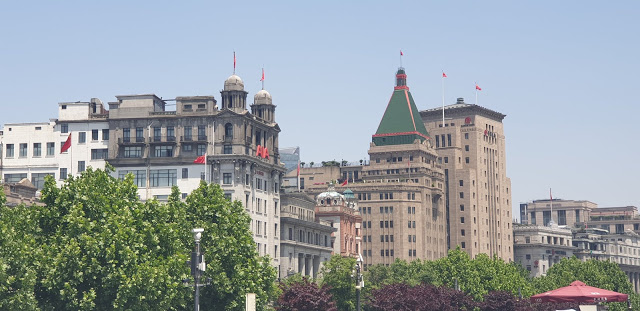
And along that part of the Bund was a number of old English style buildings made from sandstone, and very impressive to say the least.

On the other side of the harbour were the more modern buildings, including the communications tower, a rather impressive structure.

I had to go to the rear of the vessel to get a photo, a very difficult proposition given here was no space on the railing, not even on the stairs going up or down.  It was just luck I managed to get some photos between passengers heads.

And, another view of that communications tower:

There was no doubt this was one of the most colourful night-time boat tours I’ve ever been on.  Certainly, when we saw the same buildings the following day, they were not half as spectacular in daylight.

I never did get up to the third level to see what the view was like.

In a word: Page

We as authors always like to see two little words in every review, page turner.

Alas, sometimes they’re not, but usually this applied to non fiction simple because they’re reference books. Then another two words apply: boat anchor.

The good stuff is usually over the page.

Page in this instance refers to a leaf in a book, which generally has many pages.

Then the is a page boy, not what you’d find lurking around these days but were more common in days past, but refers to a boy in training to become a knight, or an errand boy for a nobleman.

These days a page boy opens doors and runs messages in a hotel.

Another variation is being paged over the P.A. system, always a major cause of embarrassment because you and everyone else thinks your in trouble.

Of course, before there were mobile phones, there were pagers, and sometimes in the deathly silence of the classroom, it went off. Definitely not advisable to have one on you if you are trying to sneak up on someone. Same goes for the modern equivalent, the mobile phone.

For the person who uses a word processor, you are familiar with pages, and having the software generate page numbers, of course, not for the title page, and a different numbering for other pages like an index, before the story starts.

Complicated? Sometimes.

And many years ago a boss of mine often used to say I needed to turn over a new page, and it did make much sense to me. That might have been because I was young and stupid. But, later on I realised what he was really saying was that I needed to turn over a new leaf.

Kind of strange, but then a lot saying are.

And did I?

Eventually.

And just to end on a high note, Paige is also the name of a girl, I think, and one I’ve decided to use in a story.

Searching for locations: The Great Wall of China, near Beijing, China

This is in a very scenic area and on the first impression; it is absolutely stunning in concept and in viewing.

As for the idea of walking on it, well, that first view of the mountain climb when getting off the bus, my first question was where the elevator is?  Sorry, there is none.  It’s walk on up or stay down the bottom.

Walk it is.  As far as you feel you are able.  There are quite a few who don’t make it to the top.  I didn’t.  I only made it to the point where the steps narrowed.

But as for the logistics, there’s the gradual incline to the starting point, and what will be the end meeting place.  From there, it’s a few steps up to the guard station no 7, and a few more to get up to the start of the main climb.  The top of the wall is guard station no 12.

Ok, those first few steps are a good indication of what it’s was going to be like and it’s more the awkwardness of the uneven heights of the steps that’s the killer, some as high as about 15 inches.  This photo paints an illusion, that it’s easy.  It’s not.

If you make it to the first stage, then it augers well you will get about 100 steps before you both start feeling it in your legs, particularly the knees, and then suffering from the height if you have a problem with heights as the air is thinner.  And if you have a thing with heights, never look down.

This was from where we stopped, about a third of the way up.  The one below, from almost at the bottom.  One we’re looking almost down on the buildings, the other, on the same level.

It requires rest before you come down, and that’s when you start to feel it in the knees, our tour guide called it jelly legs, but it’s more in the knees down.  Descending should be slow, and it can be more difficult negotiating the odd height steps, and particularly those high ones.  You definitely need to hang onto the rail, even try going backward.

And, no, that rail hasn’t been there as long as the wall.

While you are waiting for the guide to return to the meeting place at the appointed time, there should be time to have some jasmine tea.  Highly refreshing after the climb.