A case for Harry Walthenson PI, episode by episode

How thrilled Harry Walthenson, Private Detective, had been to see his name painted on the translucent glass window in the door to his office.

Located in Gramercy Park, in an old building full of atmosphere, he had a space renovated to resemble that of Spade and Archer in a scene right out of the Maltese Falcon.

His desk had an antique phone like those used in the 1930s, and a lamp that cast eerie shadows at night.  Along one wall was a couch, his bed for more nights than he wanted to remember, and on the other a filing cabinet, waiting for the big case files.

Up till now it had been missing cats and dogs.

Then, everything changed…

Starts at episode 1 – The Wrong Place, The Wrong Time

http://bit.ly/2J4aEBP

The latest episode:  Episode 64 – Analysing Sykes

http://bit.ly/2I32M6c

Enjoy

Yet another idea for a story…

Why is it ideas come at the least expected and most inconvenient time?

I thought I’d trained my thoughts to assemble when I was having a shower.  It seems that has not worked so well, and now the telephone rings instead.

Don’t you hate that?

I wasn’t considering a new idea for yet another book; I have so many on the go already.  But, the sad truth is, you have no control over it.

When I sit down, listening to Ravel, or some other classical music, I close my eyes and drift along to the music, waiting for the imagination to kick in.

Can’t force it, can you?

But, five minutes to three, after a frantic call announcing yet another storm in a teacup, I’m racing out the door, setting the alarm, locking the door, and …

… bing …

The idea is there, out of left field, in front of me.


Here’s the pitch:

Detroit, ghost town, a nightwatchman, formerly a high flyer on Wall Street, is doing the rounds.

Yep, different location, same story as a dozen others, you say.

Pitch on:

With him, his work partner, from Mexico, a woman with a checkered past, maybe an illegal, maybe not, but who would work for the kind of pay they got if there was not something they were either running or hiding from?

A man and a woman thrown together by fate.  Seriously?

Pitch on:

They’re guarding a large factory, looking exactly the same as it had the day the doors closed, only there are no people, no work, and no likelihood of it reopening.

It’s night.  It’s dark.  Only the security lighting casts a dim glow over everything, casting shadows.  The walls and roof creaks as the building moves, as all do in a wind.

From here it could go anywhere, ghosts, murder, mayhem, or …

Pitch on:

Every night is the same, go to point B, the extent of the guard’s run, and no further.  Punch a card to say you’ve done the check, then back to the office.

That’s it.

As for the rest of the factory, don’t worry.  They were told that beyond point B was taken care of by another team.  It was a large factory, and neither had questioned their orders.  A job was a job in a city where jobs were at a premium.

Six months, from the office to point B and back.

Of course, the story has to suddenly come alive, like when you’re sitting alone in a dark room watching a horror moving, and the music hypes the fear factor to 1000% and you nearly jump out of your skin.

Not so easy to do in writing, but we try.

Pitch on:

Six months and one day later, it was time to find out what was beyond point B.

What they found was to change the fabric and course of their lives.


Reads like blurb inside the cover of a bestseller, doesn’t it?

All it will take is somewhere between 50,000 and 100,000 words, and the time to write them.

Changing personality to suit the current story

I have often wondered just how much or how little of the author’s personality and experiences end up in a fictional character, and, in writing it, do I have to change into someone else, something else, in order to play the part?

Will they have to climb mountains, escape from what is almost the inescapable, be shot, tortured, get dumped, get divorced, become world travelers, or get locked up in a foreign jail, or just a dark smelly hole and forgotten?

What we don’t know about we have to research, read up on, and, I guess, experience some or all of the above on the way to getting the book written, but it’s perhaps an interesting fundamental question.

Who am I today?

Or it can be a question, out of right field, in an interview; “Who are you really?”

My initial reaction was to say, “I’m a writer.”  But that wasn’t the answer the interviewer is looking for.

Perhaps if she had asked, “Who are you when you are writing your stories?”

It would make more sense, and give me a lot more scope, but in that moment I would have to channel the interviewee persona.

Am I myself?

Am I some fictional character made up of a lot of different people?

Have I got someone definite in mind when I start writing the story?

The short answer might be, “I usually want to be someone other than what I am now.  It’s fiction.  I can be anyone or anything I want, provided, of course, I know the limitations of the character.”

“So,” she asks with a degree of whimsicality, “what if you want to be a fireman?”

“I don’t want to be a fireman.”

“But what if the story goes in the direction where you need a fireman…”

It seems to be a sticking point.

“What is this thing you have with firemen?”  I’m shaking my head.  How did we get off track?

“Just saying.”

“Then I’d have to research the role, but I’m not considering adding a fireman anytime soon.”

She sighs.  “Your loss.”

It’s clear she had a ‘thing’ for firemen.  Moving on.

Yet I suspect all of this has been leading to another very interesting question; “Who would you like to be if you could be someone else?”

That’s an easy question.

I would like to be a writer in that period between the wars, perhaps an F Scott Fitzgerald or Ernest Hemingway, in Paris, or if it is a fictional character, Jay Gatsby.

He’s just the sort of person who is an enigma wrapped up in a mystery.

A shattered dream, perhaps, or just wishful thinking?

There was time, quite a few years back I had a dream, well, it was more wishful thinking than anything else.

I was going to run a bookshop.  You know, that quaint little storefront in a tucked away little town somewhere by the ocean, where the clientele would be both travelers and locals alike, people who liked to read.

It would have an area set aside, somewhere within the shelves where there would be a fire in winter, and opened windows and fresh air in summer, a place where you could drink coffee or tea, with scones or cake, and read prospective tomes, or start on that purchase you just made.

There would be not only new books but old, second, third or having been through many hands, books with the aroma of time seeping up from every page, hard covered books with crackly spines, pages that have the stains of age.

And perhaps the name of one of its owners scribble on the front page, along with the price, what it cost all those years back when it was new.

Of course, those places still exist, somewhere in the literary universe, but the idea of owning one such establishment now would mean that you had to be independently wealthy, with a pile of money in the bank, because you would not be relying on profits to keep it going.

If I was a successful author, yes, it would make sense, existing in a literary world where I could read, or write, or talk to other readers or writers, or just do nothing.

And, yes, there would have to be a cat.  There’s always a cat, somewhere, sitting in the window and looking out on the world passing by, or curled up by the fire, reliving those halcyon years of mice catching.

Hang on, where had my fairy godmother gone?

I am my own worst enemy!

I think most authors are.

Just when you think that the story is done, and you’re on the third re-read, just to make sure…

Damn!

I don’t like the way that scene reads.

It doesn’t matter the last three times you read it, it was just fine, or, the editor has read it and the scene passed without comment.

What is the matter with me?

I find sometimes after leaving a finished story for a month before the next reading, the whole picture must formulate itself in my head, so when I re-read, there was always a problem, one I didn’t want to think about until the re-read.

Even then it might survive a second pass.

I know the scene is in trouble when I get to it and alarm bells are going off.  I find anything else to do but look at it.

So, here I am, third re-read, making major changes.

At least now I am satisfied with it.

Only 325 pages to go!

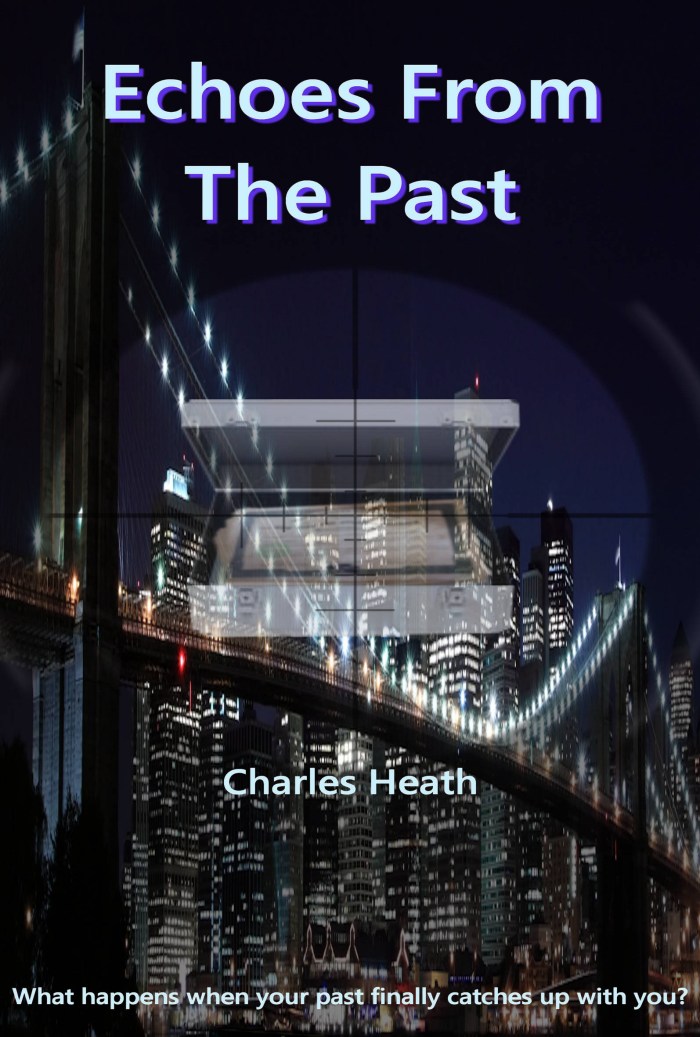
“Echoes From The Past”, buried, but not deep enough

What happens when your past finally catches up with you?

Christmas is just around the corner, a time to be with family. For Will Mason, an orphan since he was fourteen, it is a time for reflection on what his life could have been, and what it could be.

Until a chance encounter brings back to life the reasons for his twenty years of self-imposed exile from a life only normal people could have. From that moment Will’s life slowly starts to unravel and it’s obvious to him it’s time to move on.

This time, however, there is more at stake.

Will has broken his number one rule, don’t get involved.

With his nemesis, Eddie Jamieson, suddenly within reach, and a blossoming relationship with an office colleague, Maria, about to change everything, Will has to make a choice. Quietly leave, or finally, make a stand.

But as Will soon discovers, when other people are involved there is going to be terrible consequences no matter what choice he makes.

http://amzn.to/2F7gqAL

newechocover5rs


#AtoZChallenge — E is for Egg

AtoZ2019E

This is another of those words that can be used for manly different situations.

But…

What happened to it being just an egg, you know the sort you can have for breakfast, fried, scrambled or boiled.  Or eggs Benedict.

Or…

We can go down that path where the discussion is about what came first, the chicken or the egg?  Don’t ask me, it could be both.

So, now it seems egg has a few other meanings that could be considered somewhat obscure, such as,

He is a good egg.

Wow, comparing someone to an egg?  I guess I’d hate to be compared to a rotten egg.


What about, the crowd egged the man on to start a fight.

Well, perhaps a couple of rowdy schoolboys looking for some action behind the shelter shed, or at least that’s what we called it when I went to school (when I’m told, dinosaurs walked the earth)


Then,

If you do something embarrassing, then you are said to finish up with egg on your face.

Oh dear, been there a few times.


Or…

If you were to put all your money into that match tree forest in Ecuador, that’s the equivalent to putting all your eggs in one basket.

In other words, when you discover that the match tree forest in Ecuador was really your financial advisor’s private bank account and he’s now living in a non-extradition country, you understand just what that expression means.

In other words, diversify.

And lastly, if the above happens to you, then it’s time to go on an expedition, to find the goose that laid the golden egg.

I think I woke up in the middle of a nightmare

The world is a strange place, and, after you have lived in it for a long time, you begin to wonder if it’s you that’s been left behind, dwelling on a past that has long since disappeared into, well, I’m not quite sure what.

A portal, maybe.

Wouldn’t it be great if you could step back, if only to observe, what it was life in a different time, one where you weren’t swamped with bills requiring both parents (if there were two parents in the picture) to work long hours, having to put up with recalcitrant children whose idea of life is not from family interaction, but the Disney channel, an underground system that wasn’t failing, and newspapers that have lost their way trying to compete with the immediacy and inaccuracy of that new thing called the internet.

Ah, yes, those days when you could sit down with a newspaper, read what could be described as news, and at the end of it, do the crossword over a decent cup of coffee, served by uiniformly dressed, and cheery, serving staff.  I’m not sure what finds it’s way into a throwaway cup at a lot of the coffee shops these days.

I don’t think, now I look back, that there wasn’t a time when the subways weren’t going through some sort of upheaval, expansion, or repairs, but it just seemed to be better.  Perhaps it’s the blame game that makes it seem worse than it is.  Rush hour was still rush hour but it seemed more civilized.  Or maybe it’s just me.

I can live without the internet, and mobile phones.  Sure, they are very convenient and give you the immediacy of contacting people instead of having to find, and then use a payphone, and finding the money to feed it, but wasn’t it more fun to get lost, not having a GPS, or having to try and read a map and basically know where you had to go before stepping foot outside the front door?

And what happened to nightclubs and meeting people over a few drinks and polite conversation.  Of course, there was radio and television, and movies, but human interaction was once a thing.  So was dancing, not that I was any sort of rival for Arthur Murray.  Now, it’s all texting and social media conversations in abbreviated mumbo jumbo, and very little face to face time even when sitting next to each other.

And I’m not sure what people do these days, but it certainly isn’t dancing.  A few drinks are now more about binge drinking until you’re wasted or worse, and it seems you need to have a cocktail of drugs just to keep up with everyone else, or presumably to have a good time, not that you would remember any of it.

Hang on, did I say I woke in the middle of a nightmare.

I was wrong.

I woke up in the year 2019, didn’t I?  60 years into the future where I don’t feel like I belong anymore.

Maybe if I go back to sleep I might wake up and find the Dodgers are still playing at Ebbet’s Field.  And I think I could take the semblance of a cold war over terrorism any day of the week.


I always wanted to go on a treasure hunt – Part 8

Here’s the thing.

Every time I close my eyes, I see something different.

I’d like to think the cinema of my dreams is playing a double feature but it’s a bit like a comedy cartoon night on Fox.

But these dreams are nothing to laugh about.

Once again there’s a new installment of an old feature, and back on the treasure hunt.


I lasted the week in the warehouse, and, surprising myself, I actually liked it.

And, had I been like all the other workers employed there, keeping their heads down and getting on with the job, everything would have remained the same.

My problem, it seemed, was Alex Benderby.  He had been a bully at school, and he was a bully in the workplace, hiding behind his father’s name and reputation, not that his father was much better, just a little more discreet.

Day 2, Alex discovered I was working in the warehouse, his domain.  For some reason it amused him that I should be there, working for the Benderby’s, something I’d been very vocal about it not working for them, even if, he reminded me, they were the last people on earth.

He confronted me with two of his bully friends.  Alex was not someone to walk around alone.  He knew what would happen if he did.

“What changed, Smidge.”

The nickname he gave me, though I never quite understood why.  English and language had never been his strong point.

“The poverty line.  Sometimes people have to swallow their pride.  It’s not a big deal, Alex.”

“Is to me, to see how the mighty have fallen.  I’ve got my eye on you Smidge.  One wrong foot, and, well, we shall see.”

The salacious grin, as he walked away, was the key.  He could and no doubt would hold my job over me like he did with countless others.  At that moment I think I made a promise to myself, to help Boggs find the treasure, and bury Alex in a hoe so deep not even he, or his father’s money and influence could save him.


Hours later, still rankling over the confrontation, I nearly ran into Alex again, just managing to avoid him by slipping behind the shelving to wait until he passed by.

When he didn’t, I decided to wait till he walked past, and then head in the other direction.  But, after a few minutes and he hadn’t appeared, I peered around the corner of the shelving and saw him sitting on a half-emptied pallet of boxes.

Waiting.

Waiting for what, or more to the point, whom?

Five minutes later I found out.  A long, cool woman in a tall black dress, a woman I’d seen before but couldn’t quite place.

“Nadia.”

“Alex.  What do you want?”  Her tone was far from conciliatory, and if she was not happy about being there, why was she?

“A favor.”

“You’ve run out of favors Alex.”

“Then how about I tell your father exactly what you were doing when you were doing something else?”

A moment’s silence before the fury.  “We had an agreement.”

“I need a favor.  You’re the only one I can trust.  After this, I promise, we’re done.”

Another quick look around the corner of the shelves.  One person looking smug, the other looking very, very angry.

But, it appeared, Alex had the leverage.

“What is it?”

“Rico has a map.  I want it.  You bring it to me, you’re off the hook.”

She gave him a long hard stare.  “I deliver the map, and I see you again, you’re a dead man.  Your father might think he runs this part of town, but I can assure you there are far scarier people than him and his henchmen.  Remember that Alex.”

If she had a gun I think she might have shot him, but instead left him with a latent threat.  It was good to see that he was, for once, the one with the worried look.


© Charles Heath 2019
#AtoZChallenge — B is for Brevity

AtoZ2019B

Now, brevity is something that I have not been able to fully wrap my head around.

The dictionary explains Brevity as

‘concise and exact use of words in writing and speech’

So…

I remember working with a writer a long time ago who explained certain authors styles, and for James A Michener of Hawaii fame, he said Michener wrote sentences instead of words, paragraphs instead of sentences, pages instead of paragraphs and chapters instead of pages.

It was a little harsh considering I’d just read the book and had liked it, despite its length and the time it took.

But some time later I realized he was not criticizing Michener, but trying to tell me, in his, what I came to discover, interesting way, that I should strive to write more compactly.

I then came across a book by Brian Callison which was exactly that, the concise version, a story that fitted into about 200 pages.

That too was a good book and it took me a day to read it, and by his use of that economy of words, it read quickly.

Of course, I have tried over the years to emulate both styles, and to a certain degree, failing, because I think I have created my own style which is somewhere in between.

Still, when editing, it is always in the back of my mind that I should be

Using words instead of sentences

Using sentences instead of paragraphs

Using paragraphs instead of pages, and

Using pages instead of chapters.

The chapters, he said, with an air of amusement, will always take care of themselves.