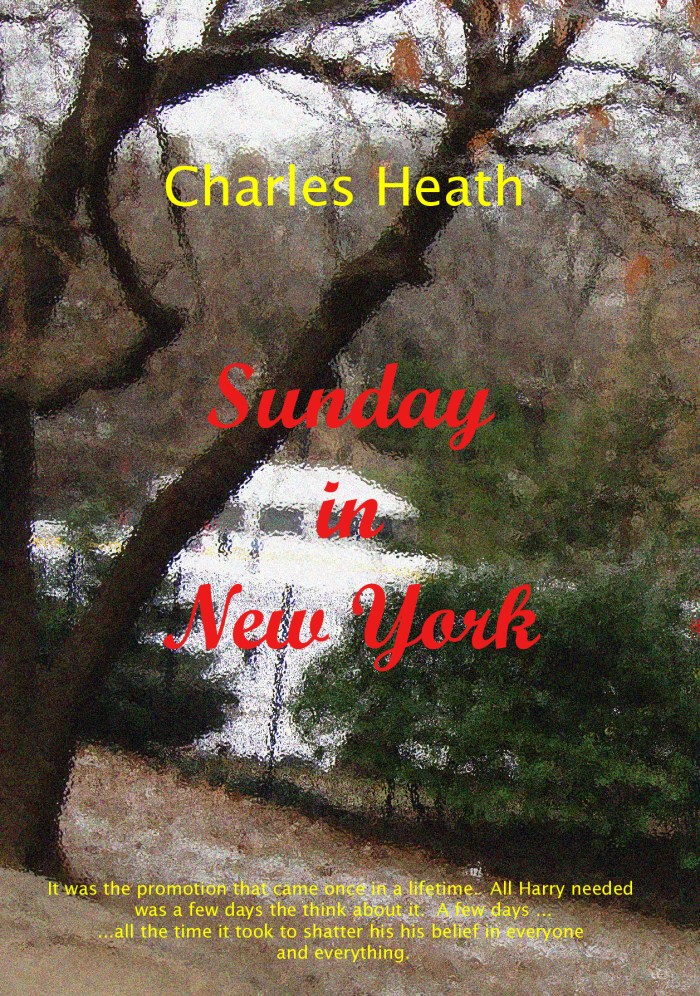
“Sunday in New York”, it’s a bumpy road to love

“Sunday in New York” is ultimately a story about trust, and what happens when a marriage is stretched to its limits.

When Harry Steele attends a lunch with his manager, Barclay, to discuss a promotion that any junior executive would accept in a heartbeat, it is the fact his wife, Alison, who previously professed her reservations about Barclay, also agreed to attend, that casts a small element of doubt in his mind.

From that moment, his life, in the company, in deciding what to do, his marriage, his very life, spirals out of control.

There is no one big factor that can prove Harry’s worst fears, that his marriage is over, just a number of small, interconnecting events, when piled on top of each other, points to a cataclysmic end to everything he had believed in.

Trust is lost firstly in his best friend and mentor, Andy, who only hints of impending disaster, Sasha, a woman whom he saved, and who appears to have motives of her own, and then in his wife, Alison, as he discovered piece by piece damning evidence she is about to leave him for another man.

Can we trust what we see with our eyes or trust what we hear?

Haven’t we all jumped to conclusions at least once in our lives?

Can Alison, a woman whose self-belief and confidence is about to be put to the ultimate test, find a way of proving their relationship is as strong as it has ever been?

As they say in the classics, read on!

Purchase:

http://tinyurl.com/Amazon-SundayInNewYork

An excerpt from “If Only” – a work in progress

Investigation of crimes don’t always go according to plan, nor does the perpetrator get either found or punished.

That was particularly true in my case.  The murderer was very careful in not leaving any evidence behind, to the extent that the police could not rules out whether it was a male or a  female.

At one stage the police thought I had murdered my own wife though how I could be on a train at the time of the murder was beyond me.  I had witnesses and a cast-iron alibi.

The officer in charge was Detective Inspector Gabrielle Walters.  She came to me on the day after the murder seeking answers to the usual questions when was the last time you saw your wife, did you argue, the neighbors reckon there were heated discussions the day before.

Routine was the word she used.

Her Sargeant was a surly piece of work whose intention was to get answers or, more likely, a confession by any or all means possible.  I could sense the raging violence within him.  Fortunately, common sense prevailed.

Over the course of the next few weeks, once I’d been cleared of committing the crime, Gabrielle made a point of keeping me informed of the progress.

After three months the updates were more sporadic, and when, for lack of progress, it became a cold case, communication ceased.

But it was not the last I saw of Gabrielle.

The shock of finding Vanessa was more devastating than the fact she was now gone, and those images lived on in the same nightmare that came to visit me every night when I closed my eyes.

For months I was barely functioning, to the extent I had all but lost my job, and quite a few friends, particularly those who were more attached to Vanessa rather than me.

They didn’t understand how it could affect me so much, and since it had not happened to them, my tart replies of ‘you wouldn’t understand’ were met with equally short retorts.  Some questioned my sanity, even, for a time, so did I.

No one, it seemed, could understand what it was like, no one except Gabrielle.

She was by her own admission, damaged goods, having been the victim of a similar incident, a boyfriend who turned out to be a very bad boy.  Her story varied only in she had been made to witness his execution.  Her nightmare, in reliving that moment in time, was how she was still alive and, to this day, had no idea why she’d been spared.

It was a story she told me one night, some months after the investigation had been scaled down.  I was still looking for the bottom of a bottle and an emotional mess.  Perhaps it struck a resonance with her; she’d been there and managed to come out the other side.

What happened become our secret, a once-only night together that meant a great deal to me, and by mutual agreement, it was not spoken of again.  It was as if she knew exactly what was required to set me on the path to recovery.

And it had.

Since then we saw each about once a month in a cafe.   I had been surprised to hear from her again shortly after that eventful night when she called to set it up, ostensibly for her to provide me with any updates on the case, but perhaps we had, after that unspoken night, formed a closer bond than either of us wanted to admit.

We generally talked for hours over wine, then dinner and coffee.  It took a while for me to realize that all she had was her work, personal relationships were nigh on impossible in a job that left little or no spare time for anything else.

She’d always said that if I had any questions or problems about the case, or if there was anything that might come to me that might be relevant, even after all this time, all I had to do was call her.

I wondered if this text message was in that category.  I was certain it would interest the police and I had no doubt they could trace the message’s origin, but there was that tiny degree of doubt, whether or not I could trust her to tell me what the message meant.

I reached for the phone then put it back down again.  I’d think about it and decide tomorrow.

© Charles Heath 2018-2020

Just one of many reading lists – part 3

**Please don’t assume that you have to, nor would I ever expect you to,  read any or all of these books.  You don’t.**

Everyone, it seems, will publish what they call the top 100 books that you should read. Some are voted on, some belong to the opinion of the editor of the book review section of a newspaper, and, as you know, there are a lot of newspapers, a lot of editors, and a lot of opinions.

I’m not a newspaper, I’m not an editor, but I have a list, based on personal experience, and many, many years of reading.

It’s in no particular order.

41.  The Hound of the Baskervilles by Sir Arthur Conan Doyle, as well as a host of other Sherlock Holmes stories

42.  The Secret Agent by Joseph Conrad, one of Conrad’s later political novels, set in London in 1886 and deals with anarchism and espionage.  In those days spies were called anarchists.

43.  The Ipcress File by Len Deighton, introducing us to Harry Palmer, who was personified by Michael Caine and led to Horse Under Water, and Funeral in Berlin.  More of Len Deighton later on in the list

44.  The Remorseful Day by Colin Dexter introducing the somewhat enigmatic detective, Morse, his first name not revealed for a long time but oddly, Endeavour.  John Thaw brought him to life

45.  Crime and Punishment by Fyodor Dostoevsky, hard to pronounce and even harder to read, but perhaps worth it in the end.  By the time I read this I was wishing for a Russian writer had could use an economy of words

46.  Dr. Zhivago by Boris Pasternak wasn’t it.  A vast and lengthy dissertation on lost love, I felt very sad for Zhivago in the end.  I saw a stage play of the same name, and I’m sorry, but it’s a few hours of my life I will never get back

47.  Casino Royale, the first of the James Bond novels by Ian Fleming.  I have to say these are among my favorite spy books.  I must say I preferred the new James Bond in Casino Royale, though Sean Connery still rules!

48.  The Day of the Jackal by Frederick Forsythe, a fascinating story about an assassin

49.  Anything written by John Le Carre, but in particular, the George Smiley collection.  Finally unmasking his nemesis the Russian spymaster made it all so satisfying.

50.  The Bourne Identity by Robert Ludlam, inspiring a long series by both Ludlam and Eric Lustbader makes entertaining reading, but the first, the man who did not know who or what he really was, was excellent.  Matt Damon didn’t harm his persona either.

51.  Murder Must Advertise by Dorothy Sayers, whose detective is Lord Peter Whimsey, a 1933 mystery novel that’s eighth in the series

52.  Gorky Park by Martin Cruz Smith.  You have to admit that his Russian detective Arkady Renko is up against it when his investigation goes in a direction that uncovers corruption and dishonest in his superiors

53.  The Way of All Flesh by Samuel Butler, a semi-autobiographical novel written between 1987 and 1884, and published in 1903.  The story of the Pontifex family.

54.  Howards End by E. M. Forster, first published in 1910, is an interesting insight into the behavior of the, and between the classes, with the Schlegels acting as the catalyst.

55.  Washington Square by Henry James, originally published as a serial, and covers the conflict between daughter and father.  I must say I prefer The Ambassadors to Washington Square.

56.  Ulysses by James Joyce, a day in the life of an ordinary man, Leopold Bloom, why could it not be the 7th June rather than the 16th, for obvious reasons

57.  The Go-Between by L. P. Hartley is a view of society at the end of the Victorian period through the eyes of a young boy.  I read this while still at school and had no clue why, but later, when I read it again, I understood the meaning

58.  Atonement by Ian McEwan, I saw the film and then read the book.  Never a good idea.  Basically, a young girl makes a bad mistake and tries to atone for it.

59.  Gone With The Wind by Margaret Mitchell, the War and Peace of Americal novels, and as long by comparison.  The only book written by Mitchell, and the second most read book by Americans.  The film was interesting but awfully long.

60.  The English Patient by Michael Ondaatje, with a man with severe burns and the effect he had on three others.  Colin Firth is villain one day and hero the next, this time in the cinematic version, an out and out cad.

More to come…


“Echoes From The Past”, a past buried, but not deep enough


What happens when your past finally catches up with you?

Christmas is just around the corner, a time to be with family. For Will Mason, an orphan since he was fourteen, it is a time for reflection on what his life could have been, and what it could be.

Until a chance encounter brings back to life the reasons for his twenty years of self-imposed exile from a life only normal people could have. From that moment Will’s life slowly starts to unravel and it’s obvious to him it’s time to move on.

This time, however, there is more at stake.

Will has broken his number one rule, don’t get involved.

With his nemesis, Eddie Jamieson, suddenly within reach, and a blossoming relationship with an office colleague, Maria, about to change everything, Will has to make a choice. Quietly leave, or finally, make a stand.

But as Will soon discovers, when other people are involved there is going to be terrible consequences no matter what choice he makes.

https://amzn.to/2CYKxu4

newechocover5rs

Searching for locations: Taurangi, it’s an interesting town

Located at the bottom of Lake Taupo, in New Zealand, staying here would make more sense if you were here for the fishing, and, well, the skiing or the hiking, or just a relaxing half hour in the thermal pools.

I saw a sign somewhere that said that Taurangi was New Zealand’s premier fishing spot. I might have got the wrong, but it seems to me they’re right. On the other side of town, heading towards Taupo, there’s a lodge that puts up fly fishermen, and where you can see a number of them in an adjacent river trying their luck.

It’s what I would be doing if I had the patience.

But Taurangi is a rather central place to stay, located at the southernmost point of the lake. From there it is not far from the snowfields of Whakapapa and Turoa. Equally, at different times of the year, those ski fields become walking or hiking tracks, and the opportunity to look into a dormant volcano, Ruapehu.

It is basically surrounded by hills and mountains on three sides and a lake on the other. Most mornings, and certainly everyone is different, there is a remarkable sunrise, particularly from where we were staying on the lake, where it could be cloudy, clear, or just cold and refreshing, with a kaleidoscope of colors from the rising sun.

I don’t think I’ve been there to see two days the same.

However, Taurangi, on most days we’ve visited, is even more desolate than Taupo, both on the main street and the central mall. The same couldn’t be said for the precinct where New World, the local supermarket, a Z petrol station can be found. There it is somewhat more lively. The fact there’s a few more shops and a restaurant might help traffic flow.

There is also a mini golf course, and in the middle of winter, it is a bleak place to be, especially in the threatening rain, and the wind. It had also seen better days and in parts, in need of a spruce up, but it’s winter, and there are no crowds, so I guess it will wait till the Spring.

In the mall, there’s the expected bank, newsagent, gift shop and post office combined, and a number of other gift shops/galleries. But the best place is the café which I’ve never seen empty and has an extended range of pies pastries and cakes, along with the fast food staples of chips and chicken.
Oh, and you can also get a decent cup of coffee there.

There are two other coffee shops but we found this one the first time we came, we were given a warm welcome and assistance, and have never thought to go anywhere else, despite two known change of owners.

But despite all these reasons why someone might want to stay there, we don’t.

We have a timeshare, and there’s a timeshare in Pukaki called Oreti Village. That’s where we stay.

“The Things We Do For Love” – Coming soon

Is love the metaphorical equivalent to ‘walking the plank’; a dive into uncharted waters?

For Henry the only romance he was interested in was a life at sea, and when away from it, he strived to find sanctuary from his family and perhaps life itself.  It takes him to a small village by the sea, s place he never expected to find another just like him, Michelle, whom he soon discovers is as mysterious as she is beautiful.

Henry had long since given up the notion of finding romance, and Michelle couldn’t get involved for reasons she could never explain, but in the end both acknowledge that something happened the moment they first met.  

Plans were made, plans were revised, and hopes were shattered.

A chance encounter causes Michelle’s past to catch up with her, and whatever hope she had of having a normal life with Henry, or anyone else, is gone.  To keep him alive she has to destroy her blossoming relationship, an act that breaks her heart and shatters his.

But can love conquer all?

It takes a few words of encouragement from an unlikely source to send Henry and his friend Radly on an odyssey into the darkest corners of the red light district in a race against time to find and rescue the woman he finally realizes is the love of his life.

The cover, at the moment, looks like this:

lovecoverfinal1

In a word: Idle

It can relate to an object such as an engine in a car when sitting at traffic lights. Then the engine is not in gear or under any load, therefore it is idle.

That he is idle might mean he is currently not working or refuses to work. Then it could be said he is bone idle which is to say he is any or all of lazy, or shiftless, even indolent

It could refer to the time when nothing is happening.

It could also refer to money in accounts not earning any interest

How many of us indulge in idle chatter, which is meaningless?

And how many of us have made an idle threat, especially to a child who refuses to go to bed, or sleep.


This is not to be confused with idol

An idol is generally thought of as a representation of a god, one used as an object of worship.

An idol can also be a person who is greatly admired, like a celebrity or superstar or a hero.

It could also be a figment of the imagination.


Then there is idyll which could be an extremely happy place, or a picturesque period or situation, one that is unsustainable

It could also be a short verse about rustic life.

I am my own worst enemy, again!

I think most authors are.

Just when you think that the story is done, and you’re on the third re-read, just to make sure…

Damn!

I don’t like the way that chapter reads, and what’s worse, it’s about the tenth time I’ve looked at it.

It doesn’t matter the last three times you read it, it was just fine, or, the editor has read it and the chapter passed without any major comment.

I think the main problem I have is letting go.  For some odd reason, certain parts of a story sometimes seem to me as though they are not complete, or can be missing a vital clue or connection for the continuity of the story.

That, of course, happens when you rewrite a section that is earlier on in the story, and then have to make ongoing changes.

Yes, I hear the stern warnings, that I should have made a comprehensive outline at the beginning, but the trouble is, I can change the ending, as I’m writing it and then have to go back and add the hooks earlier on.  Not the best method, but isn’t that what an editor is for, to pick up the missed connections, and out of the blue events that happen for no reason?

I find that often after leaving a finished story for a month before the next reading, the whole picture must formulate itself in my head, so when I re-read, there was always a problem, one I didn’t want to think about until the re-read.

Even then it might survive a second pass.

I know the scene is in trouble when I get to it and alarm bells are going off.  I find anything else to do but look at it.

So, here I am, making major changes.

But, at least now I am satisfied with where it’s going.

Only 325 pages to go!

“Strangers We’ve Become”, a sequel to “What Sets Us Apart”

Stranger’s We’ve Become, a sequel to What Sets Us Apart.

The blurb:

Is she or isn’t she, that is the question!

Susan has returned to David, but he is having difficulty dealing with the changes. Her time in captivity has changed her markedly, so much so that David decides to give her some time and space to re-adjust back into normal life.

But doubts about whether he chose the real Susan remain.

In the meantime, David has to deal with Susan’s new security chief, the discovery of her rebuilding a palace in Russia, evidence of an affair, and several attempts on his life. And, once again, David is drawn into another of Predergast’s games, one that could ultimately prove fatal.

From being reunited with the enigmatic Alisha, a strange visit to Susan’s country estate, to Russia and back, to a rescue mission in Nigeria, David soon discovers those whom he thought he could trust each has their own agenda, one that apparently doesn’t include him.

The Cover:

strangerscover9

Coming soon


Why can’t you get a good website for a reasonable cost?

There’s nothing more certain that a favourite web site you go to and use often, sooner or later starts charging a subscription ‘fee’.

I remember when the NANOWRIMO site had been updated, and the changes look good.  At that moment the site was free, but you do get a lot of emails and requests to purchase products, which I think is a reasonable way to raise money for keeping the site free.

But, how long is this going to last before a ‘fee’ is introduced, and then a ‘fee’ to enter your book?

It’s the airline principle, once it was a flat charge for the ticket, now you pay for this tax, that tax, fuel tax, baggage tax, tax on the tax, and then if that’s not enough, a charge for the food and water.  Soon it will be a charge for toilets, and then the air you breathe.

It’s inevitable, and once these charges start they don’t stop and only get higher with each passing year.

A lot of the sites I use are free.  Some have since started to charge and have put up a firewall to stop you getting any free information.

I’m not a rich author, so sadly I have to discontinue using these sites.

Perhaps the problem is that the owner of the site has come up with a good idea, thousands of people sign up, and suddenly a small web site becomes a big one, and hosting costs suddenly go through the roof.

Like airlines, it’s the user that pays.

Often I see or get an email from, various people with what looks to be a useful site.  Some start out by giving you a month free to have a look and use the facilities.  In some cases they are quite good, in other, well, there’s a dozen others like it that are still free.

But, after a month, you have to pay.  What gets me with some of them, they are asking somewhere between 50 and 100 US dollars a month, you heard that right, a month, which you can basically double that for me after the exchange rate and a dozen bank fees.

Sometimes there are different levels, but basically, if you look at the fine print, the lowest level set, which gives you very little, is set low deliberately.  Say it’s 10 dollars a month.  It’s no different to the free version except they probably don’t have annoying ads and advertise, what for many, is non-existent 24/7 help (via an email, no guarantee they look at it more than once a week, if at all).  Money for jam for the site owner, as the saying goes.

Why can’t there be a more reasonable option?

But I get it.  Everyone wants to get rich quick, it’s an objective that’s built into all of us, but it seems I missed the inoculation given the day after you’re born.

I also get it that these people worked hard on coming up with the web sites and facilities, and they deserve a reward for that hard work, but to me it would make more sense if they sold the service for 10 dollars or even 20 dollars a month if the systems were available and they worked.  And flowing from that wouldn’t 20,000 sales at 20 dollars, be better than 2000 at a 100 dollars?

The same seems to go for the so-called decent web site hosts, like WordPress, Wix and GoDaddy.  The free option is good but just for show and tell, but I’m sure they deliberately nobble it so it’s slow and kludgy just the sort of attributes that turn potential visitors off.

I thought if I paid a monthly charge for Wix, and reading the inclusions for what my site could do over the free one was very persuasive, so I signed up.  The site was no better than it was before and half the options that were on the list weren’t available, and still aren’t.  But I suspect if I paid them 100 plus dollars a month or more for their premium package I’d get it.

But, to pay for it I would have to be selling a million books a month, and I doubt, no matter how good my web site is, it wouldn’t attract that kind of business.

Not one of the basic packages, read affordable for me, has the ability to allow downloads after sales.  You can’t even have a sales page where you can actually sell books to people like you were a bookshop.  That’s in all of the premium packages, so they say, and that costs far too much.

GoDaddy were by far the worst, telling me if I signed up to the 60 dollars a month package I could have sales and downloads.  I tried to add it to the web page, which I might add was as difficult to create as all hell, and when it didn’t work, rang up to ask why I couldn’t have downloading after sales and was met with silence.

No, that’s not available at the moment, I was told, and not likely in the future.  What am I paying all this money for?  I don’t have a GoDaddy site any more.  I had a Wix site that I paid for, and I don’t have that any more.  They don’t offer anything useful, and they too, make it virtually impossible to create a useful site, so it sits out there in the ether with disappointment written all over it.

Perhaps others have had better luck, or things have changed in the last few years but I won’t be going back.

Maybe one day someone might understand the needs of the majority who can afford to pay exorbitant monthly charges but just not as much as we are expected to, for very little in return.

What’s that saying, hope springs eternal.

PS Sorry about the rant!