In a word: Drink

Everyone loves a drink, and that interesting expression, ‘what’s your poison’ often resonates at a bar when among friends.

The thing is, we are supposed to know what our friends drink, me, for instance, I like beer, preferably in a bottle and not local mass-produced brew if I can avoid it.

But, some like white wine, no preference to type, some like cocktails like a Manhattan, or a Long Island Iced Tea, very dangerous if made correctly which quite often it isn’t, or champagne, the real thing not just leftover wine carbonated and given a name like ‘sparkling …’ something.

Every now and then we need to have more than one drink, and that desire is fuelled by our emotions.  A celebration, it’s two or three, just enough to allow the euphoria to seep in.  A tragedy of any sort means more than a few, usually prefixed with a statement like, ‘I need to get hammered’, but not literally.

Perhaps that’s why it’s called drowning our sorrows.

Of course, there are other meanings for the word ‘drink’ and often poets, and romance novelists will refer to a phrase such as ‘drink in…’ where it may refer to a loving gaze or a look of adulation.  You could also, at a stretch, drink in the sight of a magnificent landscape.

Then, at the end of that drinking session, good or bad, where you may have had the opportunity to drink in looks or locations, you might, if you didn’t play your cards right, get thrown in the drink.

Not in the glass, that’s a bit small, but it means a much larger body of water such as a pool, a lake, or the ocean.

And lastly, but probably not the only context for the word ‘drink’, it could be said you were ‘driven to drink’, and I don’t mean by another drinker to the hotel, bar, restaurant or party.

Driven to drink means you blame someone else for your recently acquired desire to drink as much as you can so that it blots out something or someone.

I’m officially blaming my dog for my drinking problem.  He drove me to drink.

And that’s all I have to say about it.

Pour me another drink, will you?

It’s that time of the year again

Isn’t it good that Christmas comes only once a once a year?

I don’t think we could afford it. Christmas presents, Christmas lunch or dinner, Christmas parties, the list goes on.

It all starts about the beginning of December, and slowly builds up to fever pitch when suddenly a great many of us suddenly realise we haven’t had time to do that Christmas shopping.

Last minute takes on a whole new meaning.

Suddenly shops are open all night and those last minute shoppers come out of the woodwork. It’s not exactly panic setting in, but it’s amazing just how many people put it off until the very last minute.

We’re exactly the opposite. Christmas shopping starts at the Boxing Day sales, especially for next years Christmas decorations, and then buying gifts all throughout the year when sales pop up.

Some people we know do their Christmas shopping after Christmas when everything is a great deal cheaper, and then give presents.

We just bought most of the food for Christmas lunch and dinner. Except some of the seafood. Lunch usually runs to about $500, but it is for 9, and is enough for lunch and dinner. Eating out it would cost upwards of $125 each, plus drinks, so it doesn’t seem so bad.

But, when you add it all up, including the presents, you’re often looking at thousands. Multiply that by the number of people lining in your city, it’s why Christmas is worth billions.

The hardest job is is putting up the Christmas tree, and it’s not a job that anyone but children like doing. Putting the tree together, then adding lights, ornaments, then tinsel, takes time. The only worse job is pulling it down again before new year’s day.

This morning we spent over 6 hours wrapping presents. It’s hard work, but it’s done.

All that’s left is the lunch, setting up which we do the day before, and it too takes time and effort, and then on the day, cooking, cooking, and more cooking.

Who said Christmas was a holiday.

Writing about writing a book – Day 5

6:30 am, can’t sleep.  Too many notes to self!

Time to read 101 things you need to be a writer, and 101 items to consider when writing a book.

You need:

Pen, check.  Paper, check.  Enthusiasm, not the greatest at this hour, but check.  Writing software, I’ve got Scrivener, what have you got?  Word?  So have I, so I see you, and raise it with Y-Writer.  Not sure how to use either yet, but some proficiency with Word.  Still using pen, paper, and typewriter.  Till I run out of ribbons … do they actually make ribbons anymore?

Writing the book:

The plot, well that will evolve as I’m writing, like the reader I don’t want to know the end yet.  Well, I have an idea how it will end, but that could change.

Characters, yes, they are works in progress.

Oh, while I remember, Bill has a past which he doesn’t remember, the events so traumatic, he knows something happened, spent time in the hospital, but was not sure what it was.  It will come back, triggered by another traumatic event.  It will also fuel dreams or nightmares.

And we need a master criminal, and he is going to be a character called Colonel Davenport.  A career soldier turned disillusioned and finds a way to make a living out of the war.  A very good living.  Led a group, some of whom still exist as his henchmen, the sort who kill without conscience.

Outline, isn’t that written after the book is complete?  No?  Ok, then the story so far:

1 – Bill is on holidays

2 – Benton calls, emergency, the network is down – Company name Transworld (PK, boring)

3 – Other problems – a dead body for one (Richardson, the Accountant), departmental members unavailable

4 – Police – introduce a new character, Chief Inspector Gator

5 – Arrival at work, meeting with Managers, discuss the situation – new character Aitchison – he is involved somehow ??  The first suggestion is, there is a network within a network

6 – Locating the problem – Introduce Giles the IT officer, Bill meets with Gator, speak about files on servers gone missing (ok, a bit of geek speak here)

7 – Introduce Jennifer, explore their relationship – more geek speak with added humor

8 – Lunch – then Aitchison calls, and everything goes to hell in a handbasket.

So far so good.


8:00 am, coffee in hand, to the writing room (well, desk anyway!)

A little more profiling on Bill, now with the last name Chandler.  Still not sure if I want to keep up the first person narrative, but I’ll worry about that later …


Looking at the mess constituting my room and my life, slob may have been an appropriate description.  I considered myself old, overweight though not necessarily fat, hair greying at the edges, and few wrinkles around the eyes, there were no real plusses in my description.

Some said I had a kindly face, but perhaps I had the look of a paternalistic grandfather.  There were several men in the office who were the same age and had grandchildren.  And some who had children at a time when they should be planning for retirement, not parenthood.

World-weary and perpetually tired, I’d passed mid-life crisis, wondering what it was that affected other men my age.  I’d never had the desire for fast cars and even faster women.  I had trouble keeping up with Ellen.

I used to think I’d missed a lot in half a lifetime.

Now, I didn’t know what to think.

Did I deserve pity?  No.

Did I deserve sympathy?  No!

The only person who could get me out of the rut was myself.  For years I’d traded on Ellen’s good nature.  She deserved better, left me, and was now happier in the arms of a man who I wanted to believe treated her far better than I.  She had told me so herself, and judging by her manner, it had to be true.  Only recently had she got her smile back, the one that lit her face up, one that infectiously spread happiness to anyone near her.

There were reasons why I became the person I was now.  Some might say they were valid.  In the cold, hard light of dawn, I could see it was time I stopped using my past as a crutch and got on with the business of living.

Perhaps today would be the first day of the rest of my life.


OK, Jennifer is there, and things are about to change.


© Charles Heath 2016 – 2019

In a word: Holiday

Some call time off from work whether it is for a day, a few days, and a couple of weeks, or maybe longer,  a holiday.

Or leave, leave of absence, annual leave, or long service leave.

Others may call it a vacation.

It depends on what part of the world you live in.

But the end result is the same, you do not go to work, so you stay home and do all those things that have mounted up, you drive up, and for some reason it is always up, to the cabin, for a little hunting shooting a fishing, or you get on a plane or a ship and try to get as far away from home and work as possible.

That’s called going overseas.  It seems if there is an ocean between w there you go and where you live, no one will be able to disturb you.

Sorry, I bet you didn’t leave that mobile phone or iPad home did you?

But, of course, there are a few other obscure references to the word holiday.

For instance,

It can be a day set aside to commemorate an event or a person, a day when you are not expected to work, e.g. Memorial Day, Christmas Day, Good Friday.   In Britain, they used to be called Bank Holidays.

It can be a specified period that you may be excused from completing a task or doing something such as getting a one-year tax exemption, which might also be called a one year tax holiday.

Yes, now that is an obscure reference, particularly when no tax department would ever grant anyone an exemption of any sort.


“The Devil You Don’t”, be careful what you wish for

Now only $0.99 for a short time at  https://amzn.to/2Xyh1ow


John Pennington’s life is in the doldrums.  Looking for new opportunities, prevaricating about getting married, the only joy on the horizon was an upcoming visit to his grandmother in Sorrento, Italy.

Suddenly he is left at the check-in counter with a message on his phone telling him the marriage is off, and the relationship is over.

If only he hadn’t promised a friend he would do a favour for him in Rome.

At the first stop, Geneva, he has a chance encounter with Zoe, an intriguing woman who captures his imagination from the moment she boards the Savoire, and his life ventures into uncharted territory in more ways than one.

That ‘favour’ for his friend suddenly becomes a life-changing event, and when Zoe, the woman who he knows is too good to be true, reappears, danger and death follows.

Shot at, lied to, seduced, and drawn into a world where nothing is what it seems, John is dragged into an adrenaline-charged undertaking, where he may have been wiser to stay with the ‘devil you know’ rather than opt for the ‘devil you don’t’.

newdevilcvr3

Light at the end of the tunnel

It’s a long-standing joke that the light at the end of the tunnel is the headlight of an express train coming right at you.

Metaphorically speaking this is quite often true if you are a pessimist, but since I’ve converted to being an optimist, a bit like changing religions, l think I’ve seen the ‘light’.

It’s a lot like coming up from the bottom of a deep pool, breaking the surface and taking that first long gulp of air.

Along with that elated feeling that you’re not going to drown.

What’s this got to do with anything, you ask?

Perhaps nothing.

As an allegory, it represents, to me, a time when l finally got over a period of self-doubt, a period where a series of events started to make me question why l wanted to be a writer.

I mean, why put yourself through rejections, sometimes scathing criticism, and then have the people whom you thought were your friends suddenly start questioning your choices after initially wholeheartedly supporting them.

Are we only successful or supportable if we are earning a sufficient wage?

Or sold a million copies?

Is this why so many people don’t give up their day job and then find themselves plying the ‘other’ trade into the dark hours of the night, only to find themselves being criticized for other but no less disparaging reasons?

It seems like a no-win situation, but these are the times when your mettle is tested severely.  But, in the end, it is worth it when the book is finished and published, even if it is only on Amazon.

You can sit back and say with pride; l did that.

That metaphorical light, you may ask.

When you make that first sale.

Conversations with my cat – 70

20161004_162739

This is Chester.  He’s checking the outside temperature.

And the heat goes on with no relief in sight.

Chester has taken to spreading out on the cool tiles floor, trying to get some sleep.

He tells me its too hot for the mice to come out.

I believe him.

I was going to chat about the so-called climate emergency, but here’s the thing. It’s been this hot before, endless days of relentless heat, days where the temperature hits 40 degrees centigrade in the shade.

It happened when we came to Queensland for a holiday 30 odd years ago, and long before Chester was thought of.

The first day it rained. After that it was nearly two weeks of very hot days.

We live in the tropics. You could expect more rain, but rain is a fickle thing.

We have bushfires everywhere, and Chester can’t sit at the doorways because of the pervading smoke permeating in the atmosphere.

I should be writing he says, but instead I’m on a settee in the living room, under a slowly rotating fan.

He jumps up and joins me, the sitting on my lap, not exactly the coolest spot to be. He’s getting the effects of the fan, I’m not and I’m guessing that’s the point.

I tell him he can go for a run outside, something I’ve never let him do.

He sees it for the gesture it is and climbs down, back to the cool floor. I get a long cold stare, and then he leaves me in peace.

No work today, for either of us. I can do without the verbal sparring.

Perhaps there will be a cool change tomorrow.

In a word: Brevity

Now, brevity is something that I have not been able to fully wrap my head around.

The dictionary explains Brevity as

‘concise and exact use of words in writing and speech’

So…

I remember working with a writer a long time ago who explained certain authors styles, and for James A Michener of Hawaii fame, he said Michener wrote sentences instead of words, paragraphs instead of sentences, pages instead of paragraphs and chapters instead of pages.

It was a little harsh considering I’d just read the book and had liked it, despite its length and the time it took.

But some time later I realized he was not criticizing Michener, but trying to tell me, in his, what I came to discover, interesting way, that I should strive to write more compactly.

I then came across a book by Brian Callison which was exactly that, the concise version, a story that fitted into about 200 pages.

That too was a good book and it took me a day to read it, and by his use of that economy of words, it read quickly.

Of course, I have tried over the years to emulate both styles, and to a certain degree, failing, because I think I have created my own style which is somewhere in between.

Still, when editing, it is always in the back of my mind that I should be

Using words instead of sentences

Using sentences instead of paragraphs

Using paragraphs instead of pages, and

Using pages instead of chapters.

The chapters, he said, with an air of amusement, will always take care of themselves.


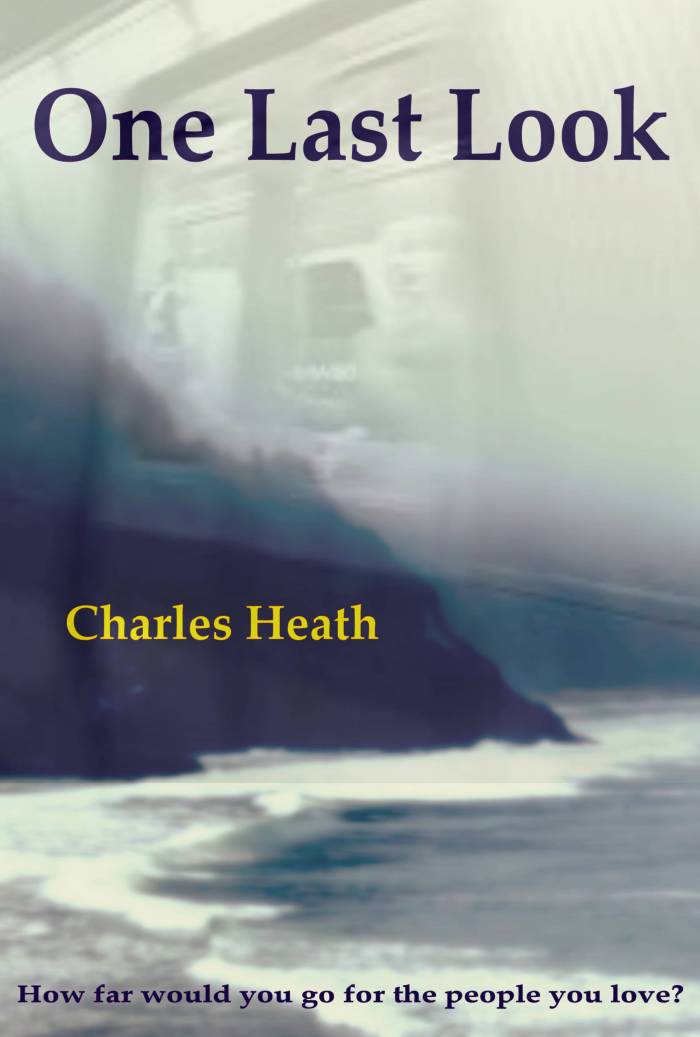
“One Last Look”, nothing is what it seems

A single event can have enormous consequences.

A single event driven by fate, after Ben told his wife Charlotte he would be late home one night, he left early, and by chance discovers his wife having dinner in their favourite restaurant with another man.

A single event where it could be said Ben was in the wrong place at the wrong time.

Who was this man?  Why was she having dinner with him?

A simple truth to explain the single event was all Ben required.  Instead, Charlotte told him a lie.

A single event that forces Ben to question everything he thought he knew about his wife, and the people who are around her.

After a near-death experience and forced retirement into a world he is unfamiliar with, Ben finds himself once again drawn back into that life of lies, violence, and intrigue.

From London to a small village in Tuscany, little by little Ben discovers who the woman he married is, and the real reason why fate had brought them together.

http://amzn.to/2CqUBcz

onelastlookcoverfinal2

Writing about writing a book – Day 4

Of course, by this time, a lot has changed and what I had discussed before now needs a few changes, so I have made the necessary amendments where required to the narrative, but that doesn’t mean I won’t revisit it sometime in the future.


It was a late night last night, reading and rereading, considering plot lines, new characters, and demolishing a six-pack.

It’s debatable if it is helping the creative process.  It has left me with a slight headache.

I drag myself out of bed and look out the window.  Bright sunshine, blue sky, slight breeze.

11:00 am.  Half the day is gone.

My stomach rumbles, I need something to eat.  I stagger out to the kitchen and look in the fridge.  OK, too busy to go shopping, time to make time.  A writer has to eat!


Three hours have passed and it’s mid-afternoon.  A new plan is required.  I need to make sure I don’t waste the day and write a certain number of words, otherwise, this book will never get written.

Bed: midnight

Rise: 7:00 am, go for a run to clear the head

Breakfast: 8:00 am

Writing: 9:00 am to ??

Let’s just see if that works tomorrow.


I sit down and stare at the pad.

Plotting:  Our main character is an IT department manager, whose main responsibility from the start, and at that time, he was alone and not the manager of anything, was setting up and keeping the network running.  These were the early days of Ethernet, token ring, and 3-Com, in moving from mainframes to desktops and servers.

I remember it well, and my first client/server network was 3-Com and Ethernet.

In the story scenario, Bill literally is indispensable because the job he performs is single point sensitive, even though Benton refuses to act on employing another network engineer.  This is art imitating life because so many places have similar situations.

So the reason why Benton is calling Bill; there is a crisis.

Some accountant is found shot dead at his desk, novel but not unheard of.  I know a few accountants who deserve just that.

That’s not the problem though, it’s the fact the network is down, and Benton is almost hysterical (after he makes a promise to his superiors that he can’t keep!).  Nothing unusual there with the sort of person he is, and like many in similar situations.


Scribble, scribble …


Another five minutes, then the phone began its shrill insistence again.  Before it rang again, I’d moved it from the floor to the bed.  I counted the rings, to ten, and then picked up the receiver.

“Bill?  Don’t hang up.”  Almost pleading.

“Why?  You said I should go, away from work, away from the phones, away to recharge my batteries, I believe you said.”

“That was Friday.  This is Monday. You’re needed.  Richardson has been found shot dead by his desk.  All hell has broken loose!”  Benton rarely used adjectives, so I assumed when he said all hell had broken loose, it meant something had happened he couldn’t fix.  His flowery language and telegram style had momentarily distracted my attention from Richardson’s fate.

Harold Richardson was an accountant, rather stuffy, but good at his job.  I’d spoken to him probably twice in as many years, and he didn’t strike me as the sort who would kill himself.  So why did I think that?  Benton had only said he was shot.

Benton’s voice went up an octave, a sure sign he was going into meltdown.  “It’s a circus down here.  Jennifer is missing, Giles is not in yet, the network is down, and that bunch of nincompoops you call support staff are running around the office like headless chooks.”

It all came out in a nonstop sentence, followed by a gasp for air.  It gave me time to sift the facts.  Jennifer, the Assistant Manager, and responsible for data entry and accounts maintenance, was not there, which in itself was unusual, because she kept longer hours than me, Peter Giles, my youthful assistant, just out of university and still being beaten into shape was also not in, and that was usual, so it could only mean one thing.

The network was down.

It was my responsibility since I’d recommended it and then won the support of management over his objections, and following that it had become a point of continual contention, a petty war neither of us was going to win.

I tried to keep the joy out of my voice. 

He’d also vetoed my recommendation for an extra full-time network engineer as my alternative, and in doing so Benton had made my job become single point sensitive.  There was no one to replace me if anything went wrong.


Richardson has nothing to do with the plot, he just happened to be in the wrong place at the wrong time, but someone else further up the chain of command will be.  That’s something to look forward to, though I’ve yet to decide what happens.

As for Benton, he will linger around for a while, but has no real part to play, except perhaps as the comic light relief.  He will get a rude awakening at the end.

Try not to make it too technical, no one really wants to know about computer systems, just the machinations of the people who are creating the problems and why.


© Charles Heath 2016 – 2019