In a word: Mark

A teacher will mark a test in order to give the student a mark out of 100.  Yes, to mark a test means to ascertain right and wrong answers and score it accordingly, and getting a mark out of 100 could determine a great many different outcomes at school.

Whereas a mark on your clothes could mean you’ve been playing with fire, rolled in the mud or if much older having a salacious affair with an unexplainable lipstick mark on your collar.

A mark is someone that a con man believes will be easily deceived.

A mark is a catch in certain types of football.

You can have an identifying mark on some item of property.

it’s literally the x marks the spot for someone who cannot write, i.e. make your mark

There can be a mark on a rope that indicates the depth of water.

And many, many more…

But not to be confused with marque, which could be the make or model of a particular type of car

Or marc with is the refuse of grapes after being pressed


Was it just another surveillance job – Episode 19

I’m back home and this story has been sitting on a back burner for a few months, waiting for some more to be written.

The trouble is, there are also other stories to write, and I’m not very good at prioritising.

But, here we are, a few minutes opened up and it didn’t take long to get back into the groove.

Nothing good ever comes of snooping


I jumped down from the first level of the fire escape, halfway down an alley which was empty.  Keeping close to the wall so I couldn’t be seen, I headed back towards the main street, and then to a café not far from the front of the building.

Would Fred call in the police?  Surely at the very least, he would have to call an ambulance, finding an unconscious woman on the floor of a trashed flat.  He would also have to report the break-in, so I waited.

And waited.

No ambulance came.  If she had been unconscious and he’d reported it, there would be an almost instant response.  Unconscious bodies were given high priority.

After an hour passed, and no sign of a police car, or any police on foot, I thought there might be a crime wave going on, and it was taking time for the police to get there.

The fact no ambulance had turned up told me she must have regained consciousness, obviating the need for medical help.

Two hours, still nothing.

Three hours, I was left with the assumption, Jan didn’t want Fred to call the police.  It would be interesting to know what those reasons were.

My plan was to wait until she came out and follow her.  Beyond that, I would be making it up as I went.  After three hours, I had to switch cafes because of the looks the girl who made the coffee was giving me.

Apparently, people didn’t spend three hours drinking four cups of coffee unless they were working on their computer or reading a book, or paper, none of which I had.

It forced a move to another café further away and with an indistinct view of the front door, so I had to be extra vigilant.

As dusk was falling, a man nearer the doorway accidentally dropped his cup, and, when I looked up to see what the commotion was about, I saw what looked like Jan leaving, and, lucky for me, heading my way on the opposite side of the street.

Time to go back into surveillance mode.

She had changed into different clothes, and something else, though I wasn’t quite sure what it was that made her look different.  It almost made me think I’d got it wrong, and it was someone else.

Then, when she walked past me, not 20 feet away, I knew it was her.

What was different, she had suddenly become a brunette with long hair than the original shoulder-length blonde hair.  A change in persona.  Not the sort of thing a normal person did.  Unless, of course, she had a night job, one which she didn’t want anyone to recognise her.

I followed from the other side of the street.

Around a corner, past an underground station entrance, which was a huge bonus because she wasn’t going anywhere by train, not that it would matter to me.  It would if she caught a taxi.

Once or twice she looked behind her, on the same side of the street.  She looked over the other side too, in a careless sort of manner, but I was well hidden in plain sight because she wouldn’t recognise me as her assailant.

Around the corner, down another street, then stopped at a bus stop.  Still not a problem because there was no bus in sight.  On the way, I’d bought a copy of the evening paper and strolled up to the stop and sat down.  She gave me a once over and then ignored me.

The bus came and we got on.  She went upstairs I stayed downstairs, easier to get off at the same stop without raising her suspicions.

It was heading into the city, via Putney.  I had time to read the news, nothing of which was interesting, and keep one eye out for her.  She got off the bus without glancing in my direction at Putney and walked to the railway station.

After she headed for the platform, I checked where she might be going, and the service ended at Waterloo station if she went that far.  I waited a few minutes, then went down to the platform just as a train arrived.

She got on about halfway along, and I remained at the end.  I resisted the urge to move closer to her carriage where I could maintain visual contact, but since there was only one in this surveillance team, I had to be careful she didn’t see me.

The train terminated at Waterloo, and everyone had to get off.  For a few minutes, I thought I’d lost her among the other passengers.  Then I just managed to catch a glimpse of her going through the platform exit gate out into the station.

By the time I had got there, she was gone.

When you lost sight of the target, don’t panic.  And don’t act like someone who just lost a target because that will bring attention to yourself.  Take a long careful look in every direction, then move in the last direction you saw the target heading.

I did everything in accordance with my training.

The problem with Waterloo station?  There are several exits, and an entrance to the underground in the direction she had been heading.

Anyone could lead me in the wrong direction.

I went upstairs to a café, and looked down on the station floor, taking advantage of the height.

Until I felt something prodding me in the back, and a voice behind me saying, “Who are you, and why are you following me?”

Jan.


© Charles Heath 2019

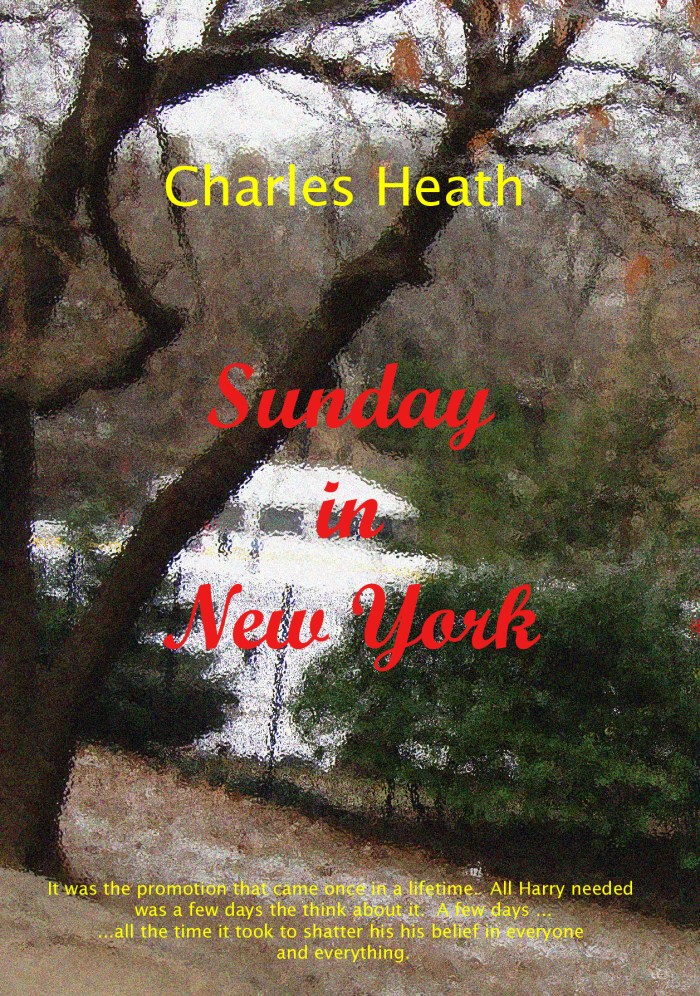
“Sunday in New York”, it’s a bumpy road to love

“Sunday in New York” is ultimately a story about trust, and what happens when a marriage is stretched to its limits.

When Harry Steele attends a lunch with his manager, Barclay, to discuss a promotion that any junior executive would accept in a heartbeat, it is the fact his wife, Alison, who previously professed her reservations about Barclay, also agreed to attend, that casts a small element of doubt in his mind.

From that moment, his life, in the company, in deciding what to do, his marriage, his very life, spirals out of control.

There is no one big factor that can prove Harry’s worst fears, that his marriage is over, just a number of small, interconnecting events, when piled on top of each other, points to a cataclysmic end to everything he had believed in.

Trust is lost firstly in his best friend and mentor, Andy, who only hints of impending disaster, Sasha, a woman whom he saved, and who appears to have motives of her own, and then in his wife, Alison, as he discovered piece by piece damning evidence she is about to leave him for another man.

Can we trust what we see with our eyes or trust what we hear?

Haven’t we all jumped to conclusions at least once in our lives?

Can Alison, a woman whose self-belief and confidence is about to be put to the ultimate test, find a way of proving their relationship is as strong as it has ever been?

As they say in the classics, read on!

Purchase:

http://tinyurl.com/Amazon-SundayInNewYork

Sunday In New York

A ‘killer’ biography! What is that?

Since Twitter moved from 140 characters to 280 characters, it’s like having a new lease on life.

Not.

Still agonizing over what constitutes a ‘killer’ bio.

So much so that I have been trawling through thousands of other bio’s trying to understand what makes a good one.

Quite a lot preface theirs with Dad to or Mom to x wonderful children.  I think that goes without saying, so moving on.

Quite a lot advertise services using hashtags which is a great idea, perhaps in the hope people are looking for said services and DM them for more information.  I don’t think many people would take much notice of that, and move on.

But …

That brings up the relevance of using hashtags in the bio.  That gives me a bit more scope to make it to the point.

A quick search of relevant hashtags reveals:

writer, author, thriller, mystery, adventure, writing etc.

All are useful but it doesn’t really carry any pulling power.  We need something that grabs the reader’s attention and do it in the shortest, most succinct manner.

I am a writer, a wordsmith, who, I was once told, swallowed a dictionary.  But, in the light of the current task, you’d think it would be just a ‘walk in the park’ instead of the proverbial ‘pain in the neck’.

Perhaps I could compose a riddle that comes back to the answer of who I am, but who has the time to sit and work it out.

I think that might be a little pretentious.

So, how about, ‘published author’, technically correct as my books are published on Amazon.  I could use ‘aspiring to become the best selling author’.  But that one worries me, because a lot of authors use that, and er all can’t be ‘vest’ selling authors.

Or can we?

Perhaps I might say, ‘an author aspiring to become a successful author, who published five novels on Amazon and adding more soon’.

Better, but not great.

Maybe I’ll keep working on it.

I’ve always wanted to go on a Treasure Hunt – Part 28

Here’s the thing…

Every time I close my eyes, I see something different.

I’d like to think the cinema of my dreams is playing a double feature but it’s a bit like a comedy cartoon night on Fox.

But these dreams are nothing to laugh about.

Once again there’s a new instalment of an old feature, and we’re back on the treasure hunt.


I didn’t get to go wandering into the next ward to see Boggs, if he was there, because the head of ER had decided I was well enough to be discharged.  It seems they had kept me there just in case there might be problems with concussion after being whacked on the head.

I still had a dull ache in my head, but they gave me a few days supply of pain killers and sent me on my way.  After I signed some papers to that said anything happened to me outside the hospital was my fault, and that I’d been duly warned about the possible consequences of concussion.

That list of consequences always ended in death, but that could happen by being run over by an ambulance arriving outside the ER just as I was leaving.

I don’t know why, but I’d expected someone to be there, though I was not sure who.

It was a short walk to the main entrance to the hospital, and then a bit of a puzzle to be solved in trying to find the appropriate person who could tell me where Boggs was.

Twenty minutes later I came to an abrupt woman in a hospital uniform with a clipboard in her hand, and a solemn look on her face.  If the brick wall could be personified, this was it.

Nurse Jamieson.  No first name.  No sense of humour.

She looked up at me with utter disgust that someone would dare interrupt what she was doing, something I had not worked out yet unless staring at a screen saver on her computer could be said doing something.

“Can you tell me where Wiliam Boggs is, please,”  I said it nicely, and politely.

“Are you a relative?”

“No, I’m his best friend.”

“That’s not what I asked.  You can hear properly can you?”

“Yes.”

Then, what did I ask you, just before?”

“Was I a relative?”

“And the answer?” followed by what I thought she said, “not that we don’t already know the answer to that one.”

“No.”

“The go away.  Close relatives only.”

“Then if I can’t see him, can you tell me how he is?”

Too late.  Nurse Jamieson had gone back to the mesmerising screen saver.  Perhaps it was being used by some intergalactic alien to brainwash her.

I shook my head and headed back towards the main entrance.

“Excuse me?”

I heard a voice from behind, approaching quickly but quietly.  Another nurse, a different coloured uniform.  Bad nurse, good nurse, was this the latter?

I turned as she reached me.  “Yes?”

“I heard you were looking for Boggs.”

Last name, only used by friends, not that he had many, and none who were female unless he’d been holding out on me.  No, he didn’t know any girls.

“Yes.  He’s my best friend.  Do you know him?”

“A friend of his cousin, Annabelle.  I can take you to him, but you won’t be able to stay very long.”

Annabelle?  I don’t remember him telling me anything about a cousin called Annabelle, but he did say there were family members he still hadn’t met, but that was because of longstanding feuds.

“Is he alright?”

“Nothing a little rest won’t cure.  He looks worse than he is.”

I followed her back along a passage off the main foyer to an elevator, and then up to the sixth floor.  

A sign on one of the ways pointed to what was called ‘Recovery’.  We walked halfway down that passage then stopped at a room.

“He’s in there.”

The door was open, but there was a screen pulled across the entrance blotting out those who walked past from looking it.  I pushed the screen back a short distance and saw the end of the bed.

When I stepped in and reclosed the screen, I realized the bed was empty, though someone had been in it.  I stepped further into the room, and around the corner, sitting in a chair, was Nadia.

© Charles Heath 2019

“Second Thoughts”, a short story

Get me to the church on time.

It was a tune out of My Fair Lady, and it was in my head the moment I woke up that morning.  And this day was, to quote some immortal’s line, was supposed to be the happiest day of my life.

But, somehow, it didn’t feel like that and lying under the warm covers of my bed, perhaps for the last time at my parent’s home, the last place I thought I’d find myself, I began to consider how it was I had ended up in this situation.

It was not a question of who the bride was, we had been friends from an early age and used to joke about getting married, but at the age of six or seven, that was a concept rather than something we might act on in the future.

Except that was how it panned out, and, not for the reasons one might think would lead to such an eventuality.

Yes, we were close friends till the early teens, then my family went in one direction, New York, and her family went in another, San Francisco, and in each place both families built successful businesses.

Josephine, the intended bride, and I met off and on over the next fifteen years, some of that mutually when we were at university together, and, I might add, living together.  Even then, there had been no suggestion of permanency because we each had to go home to eventually work in the family business.

In those few years, it had been easy because there had been no expectations by either of us.  We simply came together, stayed together, and parted at the end both happy to have enjoyed the experience.

Then, several events changed the course of our lives.

My father died unexpectedly at a crucial point in the company’s expansion, and without his direction, it began to flounder.  Then, Josephine arrived in New York to open a branch of her family’s business, and just happened to arrive on the day of my father’s funeral.

I thought it a coincidence and was grateful for her support at a time when I needed it.

A month after that, one of the lead investors in the new expansion plan pulled out, as was his right because the loan had been contingent on my father overseeing the project.  It was the end of a very bad week, and instead of being the last to leave the office, I left early, called up an old friend, Rollo, who had followed us to New York, and we went to his favourite bar.

He suggested a night on the town was called for and I agreed with him.  I think by that time I’d had enough of the problems for a few days.  But with Rollo, I learned no invitation was without its twists and turns, so when he said his sister was bringing a friend, I had to act happy even if I didn’t feel like it.  Her friends could be a little strange.

Another coincidence, the friend was Josephine.  Hearing from her once maybe, but twice in the same week, I didn’t think so, so I let it pass.  Yet despite my reservations, in the end, I had to admit I was glad to see her because the last thing I wanted to do was entertain a quirky woman I didn’t know.

Long story short, Josephine’s family business came aboard as the replacement investor, but not without some rather stringent requirements, and though no one on either side would admit it, it was suggested that perhaps Josephine and I would make an excellent match.  After all, we were childhood friends, had lived together without the problems that sometimes came with it, and we would be working very closely together.

I proposed, she accepted, and everyone was happy.

Well, not everyone.


I was down in the dining room getting breakfast, before the wedding, when Rollo arrived.  It went without saying Rollo was going to be the best man.

Curiously, he was neither surprised nor shocked to learn of my proposal, but it was a surprise to learn, in a roundabout way, he wasn’t exactly happy for me.  It was not anything I could put my finger on, but more of a feeling I had.  And, to be honest, before I had proposed to her, I was sure that Rollo had feelings for her, and at times I thought how much more sense it would make if they were together.

I’d even asked him once or twice if he liked her, and he just said they were friends.

The other side of that equation was his sister, Adrienne, who was, I thought, charming, funny, and sometimes a little offbeat, which is why I was drawn to her.  Over time, I think I may have developed feelings for her, but by the time those feelings were rising to the surface, I was advised that a woman of Josephine’s standing was more my type.

My mother could be very annoying at times, and whilst she might be looking after her son’s best interests, she was also looking after the company’s interests as best she could.  I suspect Josephine’s parents were the same, hoping their daughter would marry advantageously.

Rollo, being on the outside, had summed it up perfectly, ‘if this had been the eighteenth century there’s no doubt you two would be the perfect match’.

“You look as happy as I feel,” I said when I saw him.

“It’s going to be a big day, church wedding, in Latin of all languages, then the society event of the year.  What’s not to be happy about?”

Put like that, I shrugged.  “A registry office, burger and chips at the local diner, then a few days in the Catskills would have sufficed.”

“And on what planet do you think you are right now?”

I didn’t answer.  I simply poured another cup of black coffee and sat down.  It was a large room, with seats for a dozen, and I was the only one up.  I had expected a room full of family members, of which at least twenty were upstairs right now recovering from last night’s festivities.

Rollo poured some tea into a cup and sat opposite.  “OK.  What’s wrong?  Wedding day jitters?”

Could he read my mind?

“It just doesn’t seem right.  I mean, it seems we have been on this track forever, but you know, there’s something missing.”

“Love?”

Exactly.  It was another of those thoughts I had just before I got out of bed.  I liked her, maybe I loved her once, when I didn’t really know what love was, but now?  I don’t know what it was I felt about her.  I had been expecting those mythical thunderbolts to strike, but as the days, weeks, and months wore on, it just didn’t happen.

It was almost if we were going through the motions.

“It feels like it’s going to be a marriage of convenience.”  There, I said it.

And I expected Rollo to start having a fit.  Instead, he concentrated on putting three spoonful’s of sugar into his tea and stirring.  And stirring.  And stirring.

“Say something,” I said.  “Anything.  Tell me I’m being stupid, tell me to get out of my funk and screw my courage to the sticking place, or whatever it is you say in times like this.”

“It’s not like you to drop a bomb like this at a time like this…”

I felt he had more to say, the good part where he’d call me an ass, and then tell me to get my shit together.  It wouldn’t be the first time.

“But…”

“But I rather get the impression this wedding might not be going ahead.”

“It has to.  God knows how many people have put themselves out to be here.  It was, my mother said, a logistical nightmare.”

“It wouldn’t be the first time this has happened.”

“You’re supposed to be arguing for the wedding, not against it.”

“I would if I knew your heart was in it.  But it isn’t, is it?  I think you’ve spent so much time trying to please everyone else, that you have forgotten about yourself.  I know you’re not happy.  I also happen to know that Jo isn’t either.”

“You’ve spoken to her?”

“Just before I got here.  Call her.  You two need to talk.  In the meantime, you’re going to have to repay a huge debt after I somehow manage to sort this mess out.  My car’s outside.  Leave now, and I’ll let you know when it’s safe to return.”

“Where will I go?”

He smiled.  “I’m sure you’ll know by the time you get in the car.”

It was reckless and would cause a lot of pain and anguish for my mother, but I considered how much more pain it would cause to Josephine if I didn’t call it off.

I made the call on the way upstairs to finish dressing.

“I’m assuming you’ve spoken to Rollo?”  She didn’t wait for me to speak.

“You feel the same way?”

“It started out with the best of intentions, but I can’t help thinking if we were right for each other we would have married after university.  We are best friends, Alan, and I don’t think it’s ever going to progress from there.  I know you feel that too, it’s just the pressure from our families has managed to mask our true feelings.”

“Do you have any idea what sort of storm is about to erupt?”

“Everyone will get over it.  There’s too much at stake on both sides for there to be any real or lasting consequences.  I guess Rollo is going to have his work cut out for him.  I’ll see you one the other side.”

She didn’t say what other side, but I suspect it meant when the dust had settled.

I literally ran downstairs, mainly because I heard movement and didn’t want to run into anyone, and out the door towards Rollo’s car.

Once again I had to admire the fact he had exquisite taste in cars, and the one he’d brought was no exception, a Lamborghini, yellow, fast, and he knew I wanted to drive it.

What I didn’t expect. His sister, Phoebe, sitting in the passenger seat.


© Charles Heath 2019
I’ve been working on a bucket list

It’s amazing how quickly life goes by and there are a lot of things I haven’t yet done.

Does it really matter, you ask?

Perhaps not, but now seems to be an appropriate time, past the age of 60, to take stock.

We have achieved a lot in the last 15 or so years once the children had grown up and could look after themselves.

Unlike a lot of more modern couples who are doing the travelling in their 20’s and 30’s then having children, we chose to do it the other way around.

To me it seemed easier to deal with teenagers when we were in our 40’s rather than our 60’s.  With the benefit of hindsight I can truthfully say we were right.

We were older and wiser when we travelled and more aware of the dangers around us, sometimes overlooked or ignored by a youthful devil may care attitude.

But, in saying that ….

No, I don’t think I’ll be getting to see Mt Kilimanjaro, observing the wild animals in the Serengeti, climbing Mt Everest, or seeing the ancient pyramids.

Which is a sad state of affairs given the world has changed so much in recent years and has pretty much ruled out going to a lot of places, and in particular, the middle east.

Given the state of the world, it is getting more dangerous to go to such places as Africa, Russia and Egypt.  Even places like Bangkok and Athens and other parts of Greece can be relatively unsafe.  But, whilst I have no intention of going to Thailand, I still want to go to the Greek Islands, and,

Santorini is at the top of my travel bucket list.

We’ve been to London.  We’ve been to Paris and Euro Disney.  We’ve been to Rome and seen the ancient ruins.  We’ve been to Vienna, Schonbrunn palace, and, particularly for us, a visit to Swarovski crystal world, near Innsbruck, we’ve been to Salzburg, and been on the Sound of Music tour.

We’ve been to Florence and loved it, we’ve been to Venice and loved that too, and we’ve spent a few days in the heart of Tuscany, and want to go back for longer, much longer.

In fact, that’s the second item on the travel bucket list.

We’ve also been to Singapore and Hong Kong, at first out of necessity as an airline stopover, but the we went back to see the city and tourist, and non tourist attractions.

I will not forget staying at the Hong Kong Conrad hotel as a Diamond Hhonors member.  Oh, the memories.

We’ve also stayed on the French Riviera, in a time share apartment in Antibes where every morning when out back you had a view of the shimmering Mediterranean, if the sun was out.

Nice, Cannes, Monte Carlo, the billionaires yachts in Antibes harbor, Monte Carlo and ‘that’ casino, taking the same drive along the coast as Grace Kelly did in To Catch a Thief, and feeling like James Bond arriving for a new adventure, minus the half million dollar sports car.

But, now, crashing back to earth with a very hard thump ….

Travel in the future is looking difficult for both of us, not only financially but from a health aspect.  We are both not as sprightly as we used to be.

Yet given the restraints and if it is at all possible, aside from the Greek Islands and Tuscany, the next items on the list are:

Germany, visiting both Berlin, from a cold war aspect, the Brandenburg gate springs to mind, and Munich at the time of the Octoberfest.  As a beer drinker that is also high on the bucket list.

Scotland, more so since we’ve started watching Outlander, and besides being a beer drinker, I am also partial to a good Single Malt, the Whiskey trail.

Ireland, because my wife’s previous name was Murphy and at some point in the long distant past some relatives emigrated to Australia, and she would like to visit the country of her forebears.

But with the current state of the world, our health issues, and that all important requisite money, or the lack of it, perhaps it’s time to visit other parts of our own country.

Perhaps it’s time to do a culinary trip, particularly down south.  It’s practical and achievable and safe.

And it’s a big country.

Past conversations with my cat – 16

Character development

20161008_135142

This is Chester, he thinks he is an expert on people

He has meandered in checking out what I’m doing, or maybe he’s here because the room is cooler.

He gives me the ‘What are you doing’ look.

It doesn’t matter how many times I’m a writer, it’s like talking to a brick wall.

I say I’m working on developing a new character.

Name?

I’m thinking of John.

A shake of the head and the eyes roll.  Can you be a little more inventive, like, well, Chester?

Predictable.  How about Xavier?

Would you call your kid Xavier?  He’s going to have a very rough time of it at school.  Unless this character has a tortured soul.

Good point.  How about William?

Bill, that’s what you get in the mail.  Another shake of the head.  You’re not very good at this, are you?

Apparently not.  Haven’t you got some mice to catch?

He yawns, then curls up on the seat.  Wake me when you’ve got some better ideas.

Maybe not.  I’ve come up with a name, Daniel, and I don’t care what he thinks.

For now.

“What Sets Us Apart”, a mystery with a twist

David is a man troubled by a past he is trying to forget.

Susan is rebelling against a life of privilege and an exasperated mother who holds a secret that will determine her daughter’s destiny.

They are two people brought together by chance. Or was it?

When Susan discovers her mother’s secret, she goes in search of the truth that has been hidden from her since the day she was born.

When David realizes her absence is more than the usual cooling off after another heated argument, he finds himself being slowly drawn back into his former world of deceit and lies.

Then, back with his former employers, David quickly discovers nothing is what it seems as he embarks on a dangerous mission to find Susan before he loses her forever.

http://amzn.to/2Eryfth

whatsetscover

Living in another time

I’ve often thought that I should have been born in the early 1900s and lived through what might be called the halcyon days of the ’20s and ’30s.

Of course, it is only a matter of opinion if those days were good or bad, depending on who you were.

If I’d been the heir apparent to become Lord of the manor, or from any part of upper classes with a University education, I have no doubt that I would not have been spared the horrors of war along with rest of the young men who went to serve and never returned.

The only saving grace might be as Officer it might have been easier than being un the ranks, but at that age, I doubt if I’d be as cautious as I should be, as of all youth I’d throw caution to the wind.

But in all likelihood, I would not have been part of the aristocracy but more than likely a clerk or farm worker who might by wit and guile have survived the war, if not a little traumatized by what I had seen and done in the name of defending the Empire.

It had prompted Hemingway to use the phrase ‘the lost generation’ at the end of one of his books, but perhaps it was first used by Gertrude Stein who had said in not many words that these people who survived the war were more content to drink themselves to death.

I guess if the war hadn’t taken you, and you survived the great flu epidemic that followed it, then you would probably believe you were in some way invincible.

So, in those post-war days where writers and others congregated in Paris in those mid-twenties, what some regard as the halcyon years before the great depression and later the next world war.  I suspect a lot of the American writers left because of prohibition and wanted the more liberal lifestyle in Paris during these years.

Certainly there was a group of writers and artists who lived that bohemian lifestyle, perhaps a result of the horrors of war, using alcohol and promiscuity to drown the bad memories.

I doubt if anyone could return from a war like that and not be damaged in some way.  Perhaps the only way to escape the horror was to immerse oneself in a different world, and if I had been back in those days, I know I would be putting pencil to paper making endless notes for later use.

And I prefer to believe if I survived it was because my desire to become a writer would eventually be fulfilled.  Perhaps, in the end, it might be more likely because I had had a lifetime love affair with words, and to me, it would be more than enough to make a reasonable living from it.

Certainly I would have sought out others like me as mentors and compatriots.

It was a time when the likes of F Scott Fitzgerald, Ernest Hemingway, Edith Wharton, and James Joyce, all of whom I have no doubt would be happy to be the role models one needed.

And if you could afford to take a trip to Paris, well, enough said.

It would probably take a lot of luck to be included in their group and no doubt hanging out at the Shakespeare and Company bookshop, owned by Silvia Beach and Adrienne Monnier, might have been a step in the right direction.

But, having not been there at the time, who knows what might have happened.

Perhaps one day when someone invents the time machine, I might be able to go back and find out.