The cinema of my dreams – I always wanted to write a war story – Episode 39

For a story that was conceived during those long boring hours flying in a steel cocoon, striving to keep away the thoughts that the plane and everyone in it could just simply disappear as planes have in the past, it has come a long way.

Whilst I have always had a fascination with what happened during the second world war, not the battles or fighting, but in the more obscure events that took place, I decided to pen my own little sidebar to what was a long and bitter war.

And, so, it continues…

Leonardo was a fool, not that any of those who followed him would say that to his face, but all of them knew it and accepted that he made the best leader.

The reason for that, they all knew if anything went wrong, then the leader would be the first to be held accountable.

They all also knew that what Leonardo had done to Martina and Chiara, and the cold-blooded murder of the villagers, justifying it by saying they were collaborators, was also wrong, and had refused to take part in it.

Leonardo just thought they didn’t have the stomach to do what was necessary, failing to realize he was committing a crime, war or not.

Alberto, arguably the next man to take over the resistance group if anything happened to Leonardo, was nominally second in command and was there because he had the respect of the men, far more than their current leader.

He was the one who suspected there was something wrong at the castle, that the British soldiers there were not quite doing what they said they were there for.  He had seen, even directed, Germans seeking sanctuary in England in exchange for information, come, but not go.  Not like they did in the beginning.

And that man called Atherton, the one who arrived just before the paratroopers, he was British, and they had captured him.  The talk was that he was a German collaborator, but Alberto wasn’t convinced.

But, not having the full allegiance of all the resistance fighters, he could not say anything or try to organize the men to be more careful in their approach to those at the castle.  Leonardo still held sway with them. 

For now.

.

The Italians had their own section of the cells in the dungeons where they stayed, Leonardo, deeming it not safe in the village.  Alberto agreed because he had made several forays down there, only to discover that Leonardo would be shot on sight if he showed his face there again.  Some resistance they made, he thought, where they didn’t have the confidence of their own people.

Leonardo was up supping with the devil, as Alberto had been known to say, put of Leonardo’s earshot, and several of the men were resting.  The others, more loyal to Leonardo were in the cellar cell drinking their way through the wine stock and were most likely drunk and passed out.

Alberto didn’t care for the vintage, a subject that he was well versed in because before the war he had worked for the family of winemakers.  The wines stored, he had recognized when they’d first discovered them, as being of inferior quality, and had been left there rather than throwing it away.  Leonardo would not have known the difference.

“Something is not right.”  A voice from the corner, belonging to a man named Bolini, broke his reverie.  The truth was, he was tired and wished it were all done with.

“What makes you say that?” He asked.

“Killing the villagers.  What did they do wrong, other than just trying to survive?  It’s what we’re all trying to do.  It’s not our war.”

“You know what it’s like, stuck in the middle.  It’s a bit like the in-laws.  You don’t want them, but you’re stuck with them.”

“In-laws.  Don’t get me started.”  The other, a man named Christo, weighed in.  

“You do realize we may be held accountable for what happened back at the village,” Bolini had obviously been thinking about the repercussions.

“We brought the only witnesses here, and they sure as hell aren’t going to last long.  Not after what Leonardo did to them.”

“That’s possible, but we all know what happened.”

“But there are others outside who also know what happened, and if we want to keep out of trouble, we are going to have to take care of them,” Bolini said.

Alberto hadn’t quite got through considering the ramifications of what Fernando just did, and the fact they’d helped him.  Bolini was right, even if they hadn’t been as reckless, they were still going to be tarred with the same brush.

And Atherton was still out there.

The trouble with trying to clean up a mess is that eventually there’s a bigger mess to deal with.  Maybe it was time to get rid of Fernando.

The man called Wallace, the one who seemed to be in charge, came around the corner and stopped when he saw Alberto.

“Where’s your leader?”

Alberto pointed his head in the direction of the wine cellar.

Wallace shook his head, knowing what that meant.  “Tell him he’s got another pickup.  Two hours in the village.  A family, with two children.  Tell him to sober up, and if he doesn’t in time, you have my permission to shoot him.”

Surely the man wasn’t serious.

“Well, what are you sitting around for?  Get moving.”

Wallace cast a disapproving glance over the three, shook his head again, and left.

© Charles Heath 2020-2021

Searching for locations: Shanghai, China, by night.

When we arrive at the embarkation site we find at least 100 buses all lined up and parked, and literally thousands of Chinese and other Asians streaming through the turnstiles to get on another boat leaving earlier than ours.

Buses were just literally arriving one after the other stopping near where we were standing with a dozen or so other groups waiting patiently, and with people were everywhere it could only be described as organized chaos.

Someone obviously knew where everyone was supposed to go, and when it was our turn, we joined the queue.  There were a lot of people in front of us, and a lot more behind, so I had to wonder just how big the boat was.

We soon found out.

And it was amusing to watch people running, yes, they were actually running, to get to the third level, or found available seating.  Being around the first to board, we had no trouble finding a seat on the second level.

I was not quite sure what the name of the boat was, but it had 3 decks and VIP rooms and it was huge, with marble staircases, the sort you could make a grand entrance on.  The last such ornate marble staircase we had seen was in a hotel in Hong Kong, and that was some staircase.

But who has marble staircases in a boat?

We’re going out across the water as far as the Bund and then turn around and come back about 30 to 40 minutes.   By the time everyone was on board, there was no room left on the third level, no seats on the second level nor standing room at the end of the second level where the stairs up to the third level were.

No one wanted to pay the extra to go into the VIP lounge.

We were sitting by very large windows where it was warm enough watching the steady procession of the colored lights of other vessels, and outside the buildings.

It was quite spectacular, as were some of the other boats going out on the harbor.

All the buildings of the Bund were lit up

And along that part of the Bund was a number of old English style buildings made from sandstone, and very impressive to say the least.

On the other side of the harbour were the more modern buildings, including the communications tower, a rather impressive structure.

I had to go to the rear of the vessel to get a photo, a very difficult proposition given here was no space on the railing, not even on the stairs going up or down.  It was just luck I managed to get some photos between passengers heads.

And, another view of that communications tower:

There was no doubt this was one of the most colourful night-time boat tours I’ve ever been on.  Certainly, when we saw the same buildings the following day, they were not half as spectacular in daylight.

I never did get up to the third level to see what the view was like.

It’s winter, it should be raining

Here’s the thing.

People just don’t like rain.  All I ever hear is complaints because they want to go away camping, they want to go shopping, or they have to go to children’s sports.

Not, of course, because they can’t mow the lawn!

And that pesky rain, well, it just makes everything more difficult.  Mud and dirt get trampled inside, the washing can’t be hung out to dry, it causes floods, it stops games being played, well, sometimes.  The pitch would have to be six feet under water before that happens.

But…

Let’s think about the rain for a moment.

What if we didn’t get any rain?

There would be a drought.  There might not be any water.  Everything outside that needed water to survive, the sort of water rain provides, would die.  Then we’d have no flowers, no trees, no grass, oh, quite possibly no food, or oxygen.

A bit radical don’t you think, no food, no water, and no oxygen?

Hey, wouldn’t that be an interesting premise for an apocalyptic novel?

Usually, in a post-apocalyptic world, there’s still rain, water, and oxygen, you’d p[robably have to fight for food, but no one seems to go down that unthinkable path of losing everything.

Seems that happened around the time of the dinosaurs, when that comet hit the earth, blotted out the sun, and everything died, well, nearly everything.  It’s what I think is called an Earth Life Extinction Event.

Some say the same might happen if we have a nuclear holocaust, say America and Russia deciding to launch nuclear weapons on each other for some insane reason, knowing full well they would be condemning the whole world to a terrible end.

Nearly happened, I’m guessing.  That would make a good story.  Hang on, it’s been done before, a dozen or more times, and usually saved by a single man or woman whose actions never reach the ears of what would be a grateful public.

We’re a long way from simply wishing the rain to go away and come again some other day, aren’t we?

Let’s let someone else worry about the big picture.

And let’s not start thinking about post-apocalyptic novels that could get scarily real one day.

Sigh!   Only three more months of winter to endure, and it’ll be spring again.

Oh, and it’s raining again outside.

The cinema of my dreams – I always wanted to write a war story – Episode 38

For a story that was conceived during those long boring hours flying in a steel cocoon, striving to keep away the thoughts that the plane and everyone in it could just simply disappear as planes have in the past, it has come a long way.

Whilst I have always had a fascination with what happened during the second world war, not the battles or fighting, but in the more obscure events that took place, I decided to pen my own little sidebar to what was a long and bitter war.

And, so, it continues…

It didn’t surprise Johannesen there were about twenty prisoners down in the dungeons, though he was surprised to find that the dungeon area was quite large, and in several sections. The fact they smelled of wine told him that once, the cells were used at storage areas for bottles of wine.

Several of the cells that were furthest from the downstairs entrance, and recently boarded over caused several overzealous resistance fighters of Leonardo’s to start smashing walls looking for it.

Johannsen tried not to think about Leonardo. He was the very worst of men, a pig even by German standards.

Martina had been put in a cell not far from Leonardo’s wine cache. There was purpose in that, he could get drunk and then take it out of the woman who had made him look stupid. Come to think of it, he thought, it wouldn’t be too hard for a ten-year-old to do that.

The cell door was locked, but Johannsen had a key. He had meticulously gone through all the keyrings and loose keys that had been found and those that didn’t have an immediate use had been stored in the dungeon guardroom.

Matching keys to locks had been one of his secret tasks, under the disguise of being given the job by Wallace to match keys to locks for them. There were a few short in the end, keys to rooms, and cells that seem to serve no purpose. One had become Johannessen’s hideaway.

It was part of a plan he had been formulating, one where he could take prisoners and hide them. Of course, it wouldn’t work for the moment because the prisoners had to be moved on as soon as possible, and staying in the castle, even if the others didn’t know where they were, would invite a microscopic search. It would need Atherton’s knowledge of the castle, and whether there was another escape route they could use.

It was another of his works in progress, one that was highly likely to fail.

He stood back from the door and looked at the crumpled heap on the floor that was once the leader of the resistance. Leonardo had interrogated her before bringing her back, half-dead, to the castle, and in doing so had made it impossible for anyone to interrogate her further. Had that been the reason why Leonardo had bashed her senseless?

He saw a hand move by her side, and a low groan.

He spoke quietly, in English, “Are you able to come closer to the door?” He knelt down, trying to get a better look at her injuries. Abrasions, and bruising. Swollen eyes, possible broken nose, blood spatter everywhere on her clothing which remarkably was relatively intact. He had suspected Leonardo of doing a lot worse and may still have.

She lifted her head slightly, “Who are you?”

“I could be a friend.”

She laughed, then coughed, and blood came out of her mouth. Broken ribs possibly, and a punctured lung. She might be too injured to move.

“There are no friends in this place, just Tedeschi.” She lowered her head and closed her eyes. Her breathing was irregular and shallow. Definitely broken ribs, he thought. And not likely to survive another interrogation. Not if Jackerby was going to conduct it.

“I’d like to help you if I can.”

“Everyone in here, we’re beyond help. You know that because you’re one of them.”

“Some of us care what happens to people.”

She pushed hard to move around slightly to face him, laying her head on the side to face him. “Which one are you?”

“Johannsen.”

“Yes, Johannesen. Atherton mentioned you. As untrustworthy as the rest. But for me, I’m all but dead, but I’ll humor you. Get me out of here and away from that bastardo Leonardo, and I might believe you.”

Atherton. This might be an opportunity to find out how he could get in contact with him, knowing of course, she wasn’t going to tell him where Atherton was.

“If you want to get away from here, we need Atherton. He’s the only one who knows this place inside out.”

He could see her shaking her head, as painful as that might be.

“He’s not.”

“Then is there anyone who does?”

“There is.”

“Who?”

Again she laughed and it sounded like the death rattle of her last breath. “You think I’m that far gone that I would tell you anything?”

“If you want to escape, I can only get you so far.”

“There is no escape. Believe me. If there was, I would be gone. Save your trickery and lies for someone who might be gullible enough to believe you. I’m quite prepared to die, the fact I’ve lived this long is what some would call a miracle.”

With that she turned away, coughed, and went silent. She wasn’t dead, but death wasn’t far away.

When Johannesen reluctantly left the cell, he only made it to the turn towards the steps up when he ran into Jackerby.

Had Jackerby been somewhere near and overheard their conversation.

“You have a rather interesting interrogation technique,” Jackerby said.

Johannesen groaned inwardly. He had heard.

“Sometimes it’s better to try and infuse hope in the subject rather than resignation. I was trying to get her to tell me where Atherton is.”

“And did she?”

“What do you think. After what Leonardo did, she’s not likely to tell us anything. I’m sure if we had taken a different approach…”

“Yes, softly softly. Doesn’t work. Just leave the heavy lifting to us, and don’t bother coming down to revisit the prisoners. Otherwise, I might believe you really are trying to help them escape.”

© Charles Heath 2020-2021

I have to finally get this story done

One can never quite predict when a story might be done, where the line in the sand has been drawn, and that’s it, stop tinkering.

Finally, I’ve drawn that line in the sand.

But are we ever satisfied the story is done, can we not make one more change, it’s just a little tweak, it won’t take long.

Please!

My editor tolerated three ‘minor’ changes.

Firstly, a change of name for a character

Secondly, consistency of word use, such as times and contractions

Thirdly, I wasn’t happy with the overall story, and it needed some more action

It took three weeks to sort out all of those issues, and last night I send the final draft to the Editor.

It’s like watching your child go to school of their first day.  Not knowing what will happen but expecting everything will be fine.

This morning I sat in front of the computer, a blank sheet of paper on the screen.  I know it’s not a matter of starting the next story from scratch; I have so many started and finished, sitting in the wings to be ‘tinkered with’.

It’s my way of savoring the moment.

Just before I dive back into the murky waters.

The A to Z Challenge – V is for “Very clear about this…”


Kane was in a very difficult position.

It was not for the first time, but this time was significant because he had basically agreed in principle to vote for both sides.

And, when he realized what had happened, he had, depending on how you looked at it, been tricked.

Not good for someone who was well respected by both sides, and whose vote would count towards picking up those who were undecided.

That was just pointed out to him by Amy, his personnel assistant, the moment he arrived back in the office.

He leaned back in his chair and stared at a point just past her head, a copy of a painting by one of the old masters, still an object of beauty.

“So, when did Cheney change sides?” He asked, dragging his attention back to the problem in hand.

He suddenly realized what had happened, and it was a well thought out scheme.  Cheney had always been on board with the Board’s recommendation until he accepted Kane’s invitation to come to a meeting that would attempt to explain why the board’s recommendation was wrong.

He should have been skeptical of Cheney’s sudden change of mind, and then of the discussions he had attended with Cheney’s allies, with the objective of changing their minds too.  In fact, he had left with the impression he had persuaded them, saying, in essence, they should all vote against.

Seeing Cheney that morning with the leader of the group agreeing to vote for the motion, should have set off alarm bells.  The phone call from Williams, the head of the group voting for the board’s recommendation, saying he was pleased that Kane had finally seen ‘the light’ as he called it, had been interesting, to say the least, especially when he mentioned in passing, how very much the board appreciated Kane’s confidence in them.

He had done no such thing.

Instead, Cheney had put him on the spot, and his words were now being taken out of context.

“This morning.  I just got word from Ellie, who told me he had a breakfast meeting with Jacobs and Meadows. She said he came back looking very pleased with himself.”

Jacobs was the chairman of the board and Meadows was the CEO who was pushing the new plan, which would break up, and sell-off, or disband, the underperforming divisions of the company.  By having Meadows in attendance, Jacobs could basically offer Cheney anything he wanted.

And top of his list was my division.

“Yes, and I think we can guess why.  He wants this division.  Of course, if they gave it to him, it would not be the magic bullet he thinks it will be.  Nor would it line the shareholders, and therefore the board members pockets as it has in the past.”

“Is this situation the proverbial double-edged sword?”

“It depends.  I doubt you could quit out of dissatisfaction with a crappy board decision.  I doubt anyone could in the current financial climate.  But you won’t have to worry.  It might mean going back to the pool for a while if you don’t want to work with Cheney.”

“No problem there.  Ellie had already told me my days are numbered.”

Understandable.  Ellie and Amy had put themselves forward for the role of Jake’s personal assistant, and Ellie had tried very hard to convince him Amy was not suitable for a variety of reasons, none of which he found valid, and appointed her.  Ellie was not one who forgot or forgave easily.

Although he didn’t like denigrating anyone, he had said more than once to Amy, both Ellie and Cheney suited each other.  Neither cared who or what they destroyed to get what they wanted.

“Then it looks like you and I are heading for the scrap heap.”

“Sounds like an excuse for a long lunch.”  She smiled.  For a woman who was about to lose a dream job, she was in remarkably good spirits.

“Ask me again in an hour.  I have a few things to do.”

“Call in some favors, maybe?”

People didn’t rise in a company over several decades without making friends, making enemies, and stumbling over information which may or may not be used depending on circumstances at the time.  He had a few interesting tidbits in his arsenal, but whether he would use them or not wasn’t uppermost in his mind.

“We’ll have to see.”

Jake watched her leave, and, not for the first time, he wondered what life with her might be like.  He had never married, but had, for a number of years had a more or less relationship with the Chairman’s daughter, before she broke it off.  He suspected the Chairman had instigated it given the number of times she had tried to contact him since parting.

That door had closed. As for Amy, she had a husband who was a member of the armed services and had been killed in Afghanistan.  She had weathered that event and finally come out the other side of some very dark days, some of which he had witnessed personally, and tried to help where he could.  But was she up to dipping her foot into the dating thing.  He wasn’t prepared to ask.  Not yet.

He sighed and picked up the phone.  It was time to call Jacobs.  It was the day I knew he would be in his office, not at the factory site where we all were housed, but in the top floor of a prestigious building in the city, twenty miles away  You could call it an ivory tower, but the board did oversee the functioning of seven different and diversified companies.

Some time ago they had called for ideas on how to integrate a lot of the similar processes of those diversified companies, but in the end, they had paid a ‘crony’ a million dollars for an unworkable plan, and it had not gone any further.  Now, the conglomerate was bleeding cash, someone had come up with a new, knee jerk, plan.

Jacobs was surprised to hear from him.

“I was told,” he said, “everyone is now on board.”

“They probably are.  It’s just that it is no longer a problem for me.  You’ll have my resignation on your desk by close of business.”

That statement was met with silence.  Stunned, or was it smug satisfaction.  He had always viewed Kane as a thorn in his side.

“Is that really necessary?”

“I think you know why, and whatever the plan was, it has backfired.  I don’t need the job, nor do I need the aggravation of scheming and plotting.”

“I think you’re making a mistake, but let’s be very clear about this, you leave, there’s no coming back. If I were you, I would consider my position very carefully.”

Interesting reaction.  The only conclusion from his reaction was that the thorn was now removed.

I expected just such a reaction.

Now, for the next job.  Kane went down to the factory floor and called in all the production managers.  Like himself, he knew most of them didn’t really have to stay, some could retire, some could go into business by themselves, most could walk into another job, even a better job, the next day.

Kane left that meeting a half-hour later, telling them the decision to stay and work under Cheney, a man none of them liked, was their decision but he was moving on.

He called Amy, asked if she had sent his resignation letter, which she had, and to pick the restaurant for lunch, the more expensive the better, and that he would pick her up outside the front of the office block.

For Kane, it was the 107th day of what he called the rest of his life.  He was woken by the sun streaming in through the window of his hotel room.  He had reached Singapore and had been told that Raffles Hotel was the place to stay.

He agreed.  Old but new, the place just reeked of nostalgia.

The figure beside him stirred, opened her eyes, and smiled.

“Good morning, Amy.”

“It is a good morning, isn’t it Kane?”

Over lunch that fateful day 107 days ago, he took the chance of asking her if she would be interested in dating him.  Nothing heavy, no strings, he would understand if she thought it inappropriate.

She didn’t think it was inappropriate, just wanted to know why it had taken him so long.

The had got married in Rome, 42 days ago, in a quaint little church, and after a week, moved to Venice for the honeymoon.  They hadn’t set a limit on how long it should be.  There was no reason to go back.

Of course, just when it’s least expected, the phone would ring.  His cell phone.  It was the first time in months.

“Hello?”

He was surprised it was Jacobs.  He’d followed the fortunes of the company he had abruptly left, as it tried to implement the plan that Cheney and his ‘friends of the board’ had voted for.  One problem after another; in three months the stock value of the parent company had lost 90% of its value.  As Kane had expected, every one of his management team resigned the day after, knowing full well, once Cheney was installed as manager, the transition would fail.

Now, faced with hostile shareholders, a corporate watchdog investigation, someone had to turn around the company’s fortunes or it would slide into liquidation before the week was out.

“It seems that we have serious problems implementing the restructure.  We have made some mistakes, but I think if I could tell the receivers that we have a plan and you would be heading up a new management team, we could save the company and all of the employees.”

The 2,500 left.  They should have left well alone, and the whole 8,000 that had been there the day Kane left would still be employed.

The Board and upper management would do well out of the company going under.  The staff, well, they always lost.

“I’m sorry to hear that.  Now, if you don’t mind, I have business to attend to.  Goodbye.”

I turned the phone off and put it back on the bedside table.

“Who was that?”

“Someone from another lifetime.  Now, where were we?”

© Charles Heath 2020-2021
The cinema of my dreams – I always wanted to write a war story – Episode 37

For a story that was conceived during those long boring hours flying in a steel cocoon, striving to keep away the thoughts that the plane and everyone in it could just simply disappear as planes have in the past, it has come a long way.

Whilst I have always had a fascination with what happened during the second world war, not the battles or fighting, but in the more obscure events that took place, I decided to pen my own little sidebar to what was a long and bitter war.

And, so, it continues…

Johannsen hadn’t signed up for this. He’d been in the room when Leonardo reported to Wallace, to tell him that the villagers had been neutralised, and he brought the ring leaders of the so-called resistance to the castle.

By his reckoning, Leonardo and his men had killed probably 20 or so people who had nothing to do with the war, other than try to live around the war going on in their backyard.

In fact, when he had arrived at the castle, the intention was to work with the locals and the resistance to facilitate the onward movement of prized defectors. Until Jackerby arrived, and the dynamic changed.

Johannsen hadn’t realised that Wallace was a double agent, not until it was too late.

The thing of it was, Wallace thought he was a double agent too, a belief Johannsen had taken extreme care not to dispel. And, where it was possible, he had tried to help those caught up in Wallace’s trap.

Wallace was already in situ at the castle when Johannsen arrived with another four men to join those already there, on order from London to vet the incoming defectors. Those four he had met at the plane, and he hadn’t realised they were not who they were supposed to be. By the time the four who had been replaced were found, it was too late to stop the mission.

That brought the complement to 10 including Wallace and himself. Then he received a message, one he assumed was from Thompson, advising the arrival of a further 5, Jackerby and four soldiers.

He soon discovered that those orders were false.

When Jackerby reported to Wallace, and the fact Wallace sent him out of the room, he stayed behind, hidden, to listen to the conversation. There he discovered he was in the midst of an enemy operation that had enlisted a number of double agents across Euprope from the German Army.

He then tried to warn Thompson in a coded message, but that had been substituted by Wallace with another, causing another lamb to be sent to the slaughter, Atherton. When Jackerby first arrived, he advised Wallace, not Johannsson, that Atherton was not one of them, so an attempt was made on,his life, but failed.

For a while that was the equivalent of throwing a cat among the pigeons.

By the time the paratroopers arrived, there was no effort to hide who they were or what they were doing. The castle was, for all intents and purposes, a Nazi stronghold, there to collect and execute defectors. All he had to do was play his part, and try not to rouse the suspicions of Jackerby, whom, it seemed, trusted no one.

Wallace wasn’t all that interested in being as suspicious as Jackerby, who had to be gestapo, or worse, one of the SS.

But luck was on Johansson side when he took a plan to Wallace that would essentially free Atherton, and then have Atherton lead them to the other resistance. It was also a master stroke to select Burke, a simple man who liked to think everything was his idea.

That Atherton had got away was no fault of his, but those charged with following him. Jackerby had tried to mess with him, but Wallace intervened, telling Jackerby that he had had missing people too and should be out there looking for them.

With any luck, Johansson thought, they would be dead, a likely result since none of them had come back yet.
Now, all he could do was sit and wait for Atherton and whoever was left from the resistance to come and stop Wallace, and especially Jackerby.

Johansson knew that Atherton had a good working knowledge of the castle’s architecture, because on one occasion they had discussed archaeology. Johansson was not an archaeologist, but had worked with one and an assistant, before the war, at several digs.

He was hoping Atherton had a idea where there might be a secret entrance to the castle. It was old, and in his spare time, he had been pacing out room measurements, looking for nooks and crannies, and anything else that would be useful.

He had found a room full of swords, not exactly in fighting condition, but might be useful in a situation that called for a weapon. After all, he had taken a few sword fighting lessons at the university.

He had traversed several stone passageways, found two different passageways from the upstairs down to the radio room, and beyond that, where there was an exit or entrance, what in modern terminology would be called the tradesman’s entrance.

It was for all intents and purposes, a back door.

He had also gone around the whole perimeter of the outer castle wall, looking for holes. When he thought about it, leaving holes in the wall was asking for trouble because the idea was to keep people out, not to leave quickly and quietly in the middle of a siege.

And this castle had seen a few sieges in its time. More than once if he could travel back in time, he would have like to see what it was like 200 years ago, or more.

But there were only three entrances or exits that he knew of. There were no grates on the ground, or anywhere within 20 yards of the exterior wall, or conveniently hidden in the surrounding forests.

He was also sure there were hidden passageways inside the castle that must go somewhere, a result of checking internal measurements of rooms, and a few came up oddly short a few yards.

Still down in the dungeon on another of his subterfuges, the new arrivals guard had just appeared.

“The woman is awake.”

“Thanks.”

Now, if he could just get some sense out of her.

© Charles Heath 2020-2021

Searching for locations: West Lake, Hangzhou, China

West Lake is a freshwater lake in Hangzhou, China. It is divided into five sections by three causeways. There are numerous temples, pagodas, gardens, and artificial islands within the lake.

Measuring 3.2 kilometers (2 miles) in length, 2.8 kilometers (1.7 miles) in width, and 2.3 meters (7.5 feet) in average depth, the lake spreads itself in an area totaling 6.5 square kilometers (2.5 square miles).

The earliest recorded name for West Lake was the “Wu Forest River”, but over time it changed to two distinct names.  One is “Qiantang Lake”, due to the fact that Hangzhou was called “Qiantang” in ancient times.  The other, “West Lake”, due to the lake being west of the city

It’s about to get busy, with a number of activities planned, and the warmth of the day is starting to make an impact.

The tour starts in the car park about a kilometer away, but the moment we left the car park we were getting a taste of the park walking along a tree-lined avenue.

When we cross the road, once again dicing with death with the silent assassins on motor scooters.

We are in the park proper, and it is magnificent, with flowers, mostly at the start hydrangeas and then any number of other trees and shrubs, some carved into other flower shapes like a lotus.

Then there was the lake and the backdrop of bridges and walkways.

.

And if you can tune out the background white noise the place would be great for serenity and relaxation.

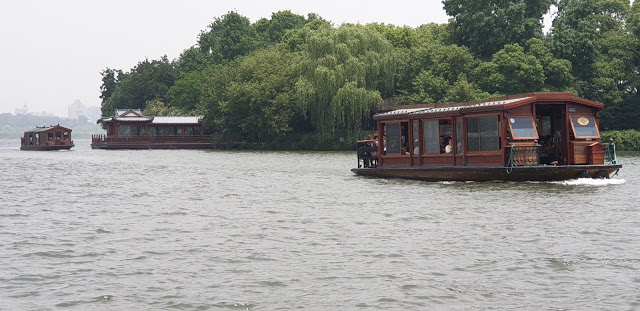
That, in fact, was how the boat ride panned out, about half an hour or more gliding across the lake in an almost silent boat, by an open window, with the air and the majestic scenery.

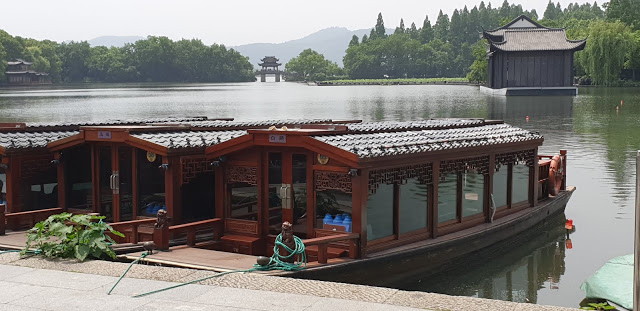
No, not that boat, which would be great to have lunch on while cruising, but the boat below:

Not quite in the same class, but all the same, very easy to tune out and soak it in.

It was peaceful, amazingly quiet, on a summery day

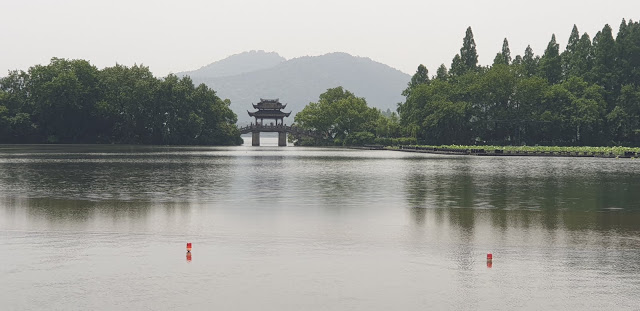
A pagoda in the hazy distance, an island we were about to circumnavigate.

Of all the legends, the most touching one is the love story between Bai Suzhen and Xu Xi’an. Bai Suzhen was a white snake spirit and Xu Xi’an was a mortal man.

They fell in love when they first met on a boat on the West Lake, and got married very soon after.

However, the evil monk Fa Hai attempted to separate the couple by imprisoning Xu Xi’an. Bai Suzhen fought against Fa Hai and tried her best to rescue her husband, but she failed and was imprisoned under the Leifeng Pagoda by the lake.

Years later the couple was rescued by Xiao Qing, the sister of Baisuzhen, and from then on, Bai Suzhen and Xu Xi’an lived together happily.

The retelling of the story varied between tour guides, and on the cruise boat, we had two.  Our guide kept to the legend, the other tour guide had a different ending.

Suffice to say it had relevance to the two pagodas on the far side of the lake.

There was a cafe or restaurant on the island, but that was not our lunch destination.

Nor were the buildings further along from where we disembarked.

All in all the whole cruise took about 45 minutes and was an interesting break from the hectic nature of the tour.

Oh yes, and the boat captain had postcards for sale.  We didn’t buy any.

Lunch

At the disembarkation point there was a mall that sold souvenirs and had a few ‘fast food’ shops, and a KFC, not exactly what we came to China for, but it seemed like the only place in town a food cautious Australian could eat at.

And when tried to get in the door, that’s where at least 3 busloads were, if they were not in the local Starbucks.  Apparently, these were the places of first choice wherever we went.

The chicken supply by the time we got to the head of the line amounted to pieces at 22.5 RMB a piece and nuggets.  Everything else had run out, and for me, there were only 5 pieces left.  Good thing there were chips.

And Starbucks with coffee and cheesecake.

At least the setting for what could have been a picnic lunch was idyllic.

The End is never The End

Can you actually say you know the exact moment a story is done, finished, and that’s it?

For me, the end never quite seems to be the end, that point where you finally draw a line in the sand and say, that’s it, I’m done, step away from the typewriter.

But are we ever satisfied the story is done, can we not make one more change, it’s just a little tweak, it won’t take long.

Please!

My editor tolerated three ‘minor’ changes.

Firstly, a change of name for a character

Secondly, consistency of word use, such as times and contractions

Thirdly, I wasn’t happy with the overall story, and it needed some more action. More writing, more editing, more prevaricating.

It took three weeks to sort out all of those issues, and last night I send the final draft to the Editor.

It’s like watching your child go to school on their first day. Not knowing what will happen but expecting everything will be fine.

This morning I sat in front of the computer, a blank sheet of paper on the screen. I know it’s not a matter of starting the next story from scratch; I have so many started and finished, sitting in the wings to be ‘tinkered with’.

It’s my way of savoring the moment.

Just before I dive back into the murky waters.

The cinema of my dreams – I always wanted to go on a treasure hunt – Episode 45

Here’s the thing…

Every time I close my eyes, I see something different.

I’d like to think the cinema of my dreams is playing a double feature but it’s a bit like a comedy cartoon night on Fox.

But these dreams are nothing to laugh about.

Once again there’s a new installment of an old feature, and we’re back on the treasure hunt.

The shrill ring tone of my phone woke me.

And, for a moment I was in a state of panic because I’d woken in unfamiliar surroundings.  Until my eyes cleared and I realized I was still at Nadia’s.

And it was morning.

What the….

The phone was still ringing, and Nadia, lying on the bed beside me rolled over and said, sleepily, “Are you going to answer that?”

I picked up the phone off the bedside table and pressed the green button.  

I already knew it was Boggs.

“Don’t you know what time it is?”  It was nine, a respectable hour of the morning to call.  It was just that I was tired.

“Where are you?”

I could lie, or I could tell the truth.  I don’t think I should say at home because I suspect that was where Boggs was now.  And my mother would be there, wondering what happened to me.

“Out and about.  Nice day for some exercise.  Why?”

“Your mother is not happy you didn’t come home.  And I’m surprised.  Where were you?”

Good question.  One that needed time to consider, time I didn’t have.

“Surveillance.  I’ve been watching Alex and his friends.  It’s been a long night.  What do you want?”

“I was going to head down towards Kentville, check on the other river.  We need to drive down there.”

“Well, right now I’m busy, so it will have to wait until tomorrow morning.  Sorry.  I have a job to do, and then I have to get home before I go to work.”

“What was Alex up to?”

“Not over the phone.  I’ll tell you when I see you.  Come back home about lunchtime.”
I could tell by the silence he wasn’t happy. 

“OK.”  He hung up.

I glared at the phone and put it back on the table, then turned to look at Nadia.  First thing I noted, we were both still in the clothes we were wearing the previous night.

“What happened?”

“Nothing.”  A momentary look of disappointment crossed her face.  “You were tired and I told you to stay.”

“Nothing can happen, or I’ll become Vince fodder.”

“I wouldn’t tell him.”

“He’d find out.  He has walls as spies.”  I looked around the room looking for potential spy cameras or bug locations.

“He wouldn’t dare.”

I climbed off the bed and smoothed out my clothes.  It didn’t make much difference to the crumpled look.  “At least it looks like I’ve been on an all-night surveillance assignment.”

“What are you going to tell Boggs.”

“Nothing.  There’s nothing concrete to tell him yet, just that Alex is, like the rest of us, running around in circles.

Nadia remained on the bed, and even though she looked as messy as I did, hers was a far more alluring messy.  I could feel the pangs of a forbidden desire.  Time to go.

“Come back tonight.  We can go on a voyage of discovery, see the mall as you’ve never seen it before.”

“Sounds like a Discovery Channel documentary advert.”

She sat up then stood and teased the knots out of her hair.  It was the first time I’d seen it out.  It gave her a whole new, softer look.

“Is that a look of desire I see in your eyes, Smidge?”

And the whole moment was shot to pieces.

“Don’t call me that.  I’ll see you tonight, though I’m not sure why.”

I let myself out, after carefully checking to see if the way out was clear.  The last thing I wanted, or needed, was to tangle with Vince.

Or ending up letting the dream become reality.

 
© Charles Heath 2020