In a word: Keep

Yes, this is an easy one.

I want to keep the car.  Especially if it’s a Lamborghini and it didn’t cost $500,000.

This form of the word simply means to hang on to something, or up the proper definition, to have or retain possession of

Paring it with other words is where it gets complicated.

For instance,

Keepings off, make sure that the ball doesn’t get into someone else’s possession.

Keep it to yourself, yes, here’s your chance to become the harbinger of secrets and not tell anyone else.  Not unless a lot of money is involved, or a Lamborghini.

You guessed it, the car is the running joke on this post.

How about, keep a low profile, been there tried that, it’s a lot harder than you think.

What about keeping your cards close to your chest, yes, this had both a literal and figurative meaning which makes it sort of unique.

That might follow the second definition, to continue, or cause to continue a particular state.

Another way of using keep is by delaying or stopping someone from doing something or getting somewhere; ie, I was kept waiting at the doctor’s surgery because he was late.

There are any number of examples of using the word keep in tandem with other words

One that specifically doesn’t relate to all the former examples, is simply the word keep.

What is it?

Usually the strongest part of the castle, and the last to fall in an attack.

At least, that was the theory.

The story behind the story: A Case of Working With the Jones Brothers

To write a private detective serial has always been one of the items at the top of my to-do list, though trying to write novels and a serial, as well as a blog, and maintain a social media presence, well, you get the idea.

But I made it happen, from a bunch of episodes I wrote a long, long time ago, used these to start it, and then continue on, then as now, never having much of an idea where it was going to end up, or how long it would take to tell the story.

That, I think is the joy of ad hoc writing, even you, as the author, have as much idea of where it’s going as the reader does.

It’s basically been in the mill since 1990, and although I finished it last year, it looks like the beginning to end will have taken exactly 30 years.  Had you asked me 30 years ago if I’d ever get it finished, the answer would be maybe?

My private detective, Harry Walthenson

I’d like to say he’s from that great literary mold of Sam Spade, or Mickey Spillane, or Phillip Marlow, but he’s not.

But, I’ve watched Humphrey Bogart play Sam Spade with much interest, and modelled Harry and his office on it.  Similarly, I’ve watched Robert Micham play Phillip Marlow with great panache, if not detachment, and added a bit of him to the mix.

Other characters come into play, and all of them, no matter what period they’re from, always seem larger than life.  I’m not above stealing a little of Mary Astor, Peter Lorre or Sidney Greenstreet, to breathe life into beguiling women and dangerous men alike.

Then there’s the title, like

The Case of the Unintentional Mummy – this has so many meanings in so many contexts, though I imagine that back in Hollywood in the ’30s and ’40s, this would be excellent fodder for Abbott and Costello

The Case of the Three-Legged Dog – Yes, I suspect there may be a few real-life dogs with three legs, but this plot would involve something more sinister.  And if made out of plaster, yes, they’re always something else inside.

But for mine, to begin with, it was “The Case of the …”, because I had no idea what the case was going to be about, well, I did, but not specifically.

Then I liked the idea of calling it “The Case of the Brother’s Revenge” because I began to have a notion there was a brother no one knew about, but that’s stuff for other stories, not mine, so then went the way of the others.

Now it’s called ‘A Case of Working With the Jones Brothers’, finished the first three drafts, and at the editor for the last.

I have high hopes of publishing it in early 2021.  It even has a cover.

PIWalthJones1

Third son of a Duke – The research behind the story – 8

All stories require some form of research, quite often to place a character in a place at a particular time, especially if it is in a historical context. This series will take you through what it was like in 1914 through 1916.

Soldiers cycled in the trenches of WW1

The Chronological Duty Cycle of a British Enlisted Soldier on the Western Front: April 1915 to Demobilisation

The service trajectory of a British enlisted soldier who volunteered in April 1915 was defined by the transition from enthusiastic volunteerism to the grinding attrition of static warfare, followed by the complex administrative challenge of post-Armistice demobilisation. This analysis follows the soldier’s duty cycle through initial training, deployment, the structured reality of front-line rotation, infrequent periods of leave, and the priority systems governing his return to civilian life four and a half years later.


I. Enlistment and Preparation: The Kitchener Volunteer (April 1915)

The individual enlisting in April 1915 was part of the colossal wave of manpower raised by Lord Kitchener, the Secretary of State for War. Although the initial enthusiasm of August 1914 had peaked, volunteers continued to surge forward throughout 1915, prior to the implementation of conscription in January 1916.1 This soldier became part of the “New Army,” likely belonging to the K4 or K5 cohort, designed to replace the devastating losses suffered by the original British Expeditionary Force (BEF).3

I.A. The Recruitment and Administrative Context

The process of becoming a soldier began with immediate registration and a mandatory series of medical and fitness tests.5 While these examinations were intended to ensure recruits met the physical demands of war, the sheer “stampede of volunteers” wanting to fight meant that the official process was often rushed.5 Recruitment offices utilised public buildings, and staff struggled to process the thousands of eager men.5 The identity of this cohort, men who volunteered well before being compelled to serve, would later grant them a specific priority during demobilisation.6

I.B. Initial Training Phase: Acceleration and Deployment

The duration and quality of training were dictated entirely by the urgent demands of the front. Pre-war training for a regular infantry recruit lasted three months, and a Special Reservist received five months of preliminary full-time training.7 For the Kitchener volunteer of 1915, this schedule was significantly compressed. The goal articulated by Kitchener was to have these New Army divisions fully trained and ready for a decisive blow in mid-1916.3 However, the reality of attrition forced the British Army to accelerate deployment. The first major actions involving Kitchener’s Army units occurred prematurely at the Battle of Loos in September–October 1915.3

Given an April 1915 enlistment date, the soldier’s basic training would have been condensed, lasting approximately five to seven months, primarily conducted in large camps across the United Kingdom.5 These conditions were often rudimentary, and critical equipment supplies (such as uniforms and rifles) were initially limited due to the Army’s struggle to kit out the millions of new recruits.5 By late 1915, potentially December, this soldier would have been considered ready for combat and deployment to France.

This acceleration of the training schedule, driven by high casualty rates, necessitated a critical compromise in battlefield readiness. Kitchener’s original planning for exhaustive training was overridden by the strategic necessity of providing immediate reinforcements. Consequently, the April 1915 volunteer, upon arriving at the Western Front, possessed a level of preparation that was inherently inadequate for the highly technical and specialised nature of industrialised trench warfare, potentially increasing his vulnerability during his initial introduction to the fighting.

Estimated Pre-Deployment Timeline: April 1915 Volunteer

PhaseStart DateEstimated DurationEnd Date
Recruitment/AttestationApril 19151–3 WeeksApril/May 1915
Basic Training (Infantry)May 19155–7 MonthsOct/Nov 1915
Deployment to France (BEF)Dec 19151–3 WeeksEarly Jan 1916

II. Transit and Logistical Deployment to the BEF (Late 1915/Early 1916)

The movement of the newly trained soldier from the UK to the Western Front constituted a major logistical undertaking, demonstrating the pivotal role of transport and supply in modern warfare.9

II.A. The Logistical Journey

The deployment necessitated a sea passage across the English Channel, relying on ports and harbours that linked the British and French railway systems.10 While specialised personnel, such as drivers for the Army Service Corps (ASC), could be kitted out and dispatched to France in as little as three weeks 11, the movement of an entire infantry battalion was integrated into broader logistical schedules.

Upon arrival in France, the soldier would pass through an Infantry Base Depot (IBD) near the coast. From there, troop trains moved men and material toward the active front line.9 The BEF had grown exponentially, expanding from six divisions in 1914 to nearly a million men by the close of 1915.4 The logistical infrastructure struggled severely to cope with this rapid scale-up.

II.B. Entering a Strained System

The volunteer arrived at the continent just as the British supply system was experiencing acute operational stress. During 1915, the initial, sometimes clumsy, methods of supplying the rapidly growing BEF—often characterized by a tradition of “muddle through”—began to fail, culminating in the “shell crisis”.12 Though later streamlined by specialists like Sir Eric Geddes, who rationalized transport into five key components (docks, railways, canals, light railways, and roads) 12, the soldier’s initial exposure to operational life was defined by the strain of this system.

The consequence of this infrastructural struggle was profound for the morale of the arriving volunteer. Men who had enlisted with high ideals encountered a system marred by systemic deficiency, where supplies—from ammunition and rations to basic material for trenches—were often poorly managed and delivered.12 This environment of logistical friction and material shortages rapidly dispelled the initial idealistic fervour, shifting the soldier’s focus from achieving a rapid victory to surviving the brutal, poorly provisioned reality of continuous endurance.


III. The Standard Operational Cycle (1916–1918)

Once deployed to a divisional sector in early 1916, the soldier became integrated into the mandatory rotation system essential for maintaining unit cohesion and managing psychological stress under the continuous danger of trench warfare.14

III.A. The Necessity of the Rotation System

Trench warfare was a gruelling form of conflict marked by perpetual stalemate and mutual artillery bombardment, ensuring hundreds of casualties occurred daily even when no major attacks were underway.16 To prevent complete physical and psychological collapse, battalions were continuously cycled through various positions behind the front. The standard timetable for an infantry soldier in the British Army on the Western Front was approximately a 16-day cycle.16

III.B. The 16-Day Rotation Breakdown

This cycle ensured that units spent only short periods in the most hazardous zones before being withdrawn for rest and reorganisation:

  1. Front Line: The most dangerous phase, typically lasting 4 days.18 Duties included sentry duty, aggressive patrolling (raids into no man’s land), repairing parapets, and preparing for defence. This exposed the soldier directly to snipers, machine gun fire, and immediate artillery barrages.
  2. Support Line/Reserve Trenches: Lasting approximately 4 days.16 While slightly sheltered, this position was still well within the range of enemy artillery. This period was dominated by fatigue duties—the back-breaking labour of carrying vital supplies (ammunition, rations, wire, construction materials) forward to the front line, maintaining communication wires, and undertaking extensive trench repair work, often under cover of darkness.19
  3. Rest Camps/Training Areas: The final phase, lasting approximately 8 days (often divided into 4 days in brigade reserve and 4 days at rest camps).16 Located several miles behind the line, often far enough back to be out of the range of most heavy artillery, this was the critical period for recovery, cleaning uniforms, delousing, receiving medical checks, and conducting essential physical training.20

It is important to recognize that the image of the soldier spending endless weeks on the fire step is a misconception. The high rate of rotation meant that the average soldier spent the majority of his time—roughly 75% of his service—in support, reserve, or rest areas, rather than in the immediate front line trench.21

Standard Western Front Trench Rotation Cycle (BEF Infantry)

LocationTypical DurationRisk ProfilePrimary Duties
Front Line (Parapet)4 DaysMaximum (Direct contact, Sniping, Raids)Active defense, observation, wiring, fighting.
Support Line/Reserve Trenches4 DaysHigh (Targeted Artillery, Logistics)Fatigue duties, carrying parties, rapid response reserve.
Reserve/Training Area8 DaysMedium-Low (Rear Area Shelling/Labor)Training, large work details, cleaning, administrative tasks, rest.

III.C. The Operational Reality Versus Regulation

The standard 16-day cycle was an ideal structure implemented to manage manpower and sustain readiness. However, during periods of sustained offensive action—which dominated the soldier’s experience from 1916 onward, including the Battles of the Somme (1916) and Third Ypres (1917) 4—the rotation system often collapsed. When the army experienced severe manpower shortages or during the intensity of a major engagement, units were frequently forced to remain continuously “in the line” for periods exceeding thirty days.16 There are recorded instances, such as the 13th Yorkshire and Lancashire Regiment, enduring fifty-one consecutive days in the line.16

Furthermore, the act of moving away from the front line did not guarantee safety. While the four-day rotation in the forward trench was designed to prevent psychological breakdown, the continuous nature of warfare ensured that danger permeated all layers of the duty cycle. One study determined that one-third of all casualties on the Western Front were killed or wounded while in the relatively protected trenches, typically due to the relentless and indiscriminate shelling from enemy artillery.16 Thus, for the combatant, rotational movement merely exchanged the immediate, intense risk of small arms fire for the pervasive, random threat of heavy ordnance, demonstrating that the battle environment constituted an ever-present zone of attrition rather than a definable line of contact.


IV. Interruption of Service: Leave, Wounds, and Recovery

The long service term (1916–1918) for the April 1915 volunteer ensured that his continuous duty cycle would inevitably be broken, either by scheduled leave or by the high probability of wounding.

IV.A. Home Leave Policy and Disparity

Recognising the strain of continuous combat, the British Army, starting in 1915, gradually implemented leave periods to sustain troop morale.22 However, the policy was characterised by profound disparity and unpredictability. The granting of leave was explicitly stated as being “entirely at the discretion” of the Commander-in-Chief, meaning it was constantly subject to operational demands and military conditions at various parts of the line.23

For the enlisted soldier, leave was a rare occurrence. Historical records indicate that while officers often received leave approximately every three months, the average enlisted soldier was permitted home leave only once every fifteen months.24 Early leave periods were short—for example, four days plus travel time in 1915 25—but were later extended, typically to ten days, plus the time required for travel between the front and the UK.25 The infrequent nature of this connection to civilian life meant that the soldier relied heavily on correspondence for communication, making the short, sparse home visits emotionally disruptive, as many soldiers reported feeling indifferent or alienated upon returning to civilian society.22

IV.B. The Recovery Path: Wounds as Involuntary Respite

Given the brutal average attrition rate, which saw hundreds of casualties daily 26, a combat veteran serving multiple years on the Western Front had a high statistical likelihood of being wounded. Wounds offered the most assured pathway to a sustained, involuntary removal from the front.

The immediate goal upon injury was rapid evacuation from the trenches to clearing stations, located 500 to 1,000 yards behind the line, and then onward to base hospitals in France or England.27 Innovations during the war, such as the widespread adoption of the Thomas splint by 1915, significantly reduced the mortality rate from battlefield fractures 28

For a non-fatal, but serious injury (e.g., bone fracture or severe soft tissue damage), the recuperation and rehabilitation process required months. A realistic assessment places the recovery and convalescence period, before a soldier could be medically reclassified and returned to his unit as a reinforcement, at at least three months.29 Once deemed fit, the veteran would return via the Base Depots to the front, resuming the operational rotation cycle, often with a new unit if his original battalion had suffered heavy losses.

The extremely wide gap between officer and enlisted leave frequency (three months versus fifteen months) meant that for the rank-and-file soldier, a survivable wound functioned as the only predictable method of obtaining extended, systematic relief from continuous duty on the front lines. This operational reality underscored a systemic inadequacy in soldier welfare, whereby the most reliable form of rest was contingent upon experiencing physical trauma.


V. Demobilisation and Return to Civilian Life (1918–1919)

The cessation of hostilities on November 11, 1918, did not equate to an immediate end of service. The government faced the immense task of demobilising over three million men.30 An immediate, chaotic release was deemed unfeasible, threatening social disorder, massive unemployment, and jeopardising ongoing military commitments in occupied Germany, Russia, and the Empire.6

V.A. The Demobilisation Scheme and Priority Conflict

The British military implemented a complex, phased demobilisation scheme, initially comprising fourteen phases and organised into various groups.31 Crucially, the initial priority structure was based on civilian utility rather than length of military service or combat exposure.

  1. Immediate Release Priority: This group consisted of “Demobilisers” (personnel in administrative corps like the RASC and RAMC required to run the process) and “Pivotal Men”.33 Pivotal Men were those with essential industrial skills (Group 1: miners, agricultural workers, banking staff) whose immediate return was vital for national economic reconstruction.31 These men were entitled to immediate release irrespective of their war service duration.33
  2. The Veteran’s Status: The April 1915 volunteer, unless he happened to possess a rare industrial skill qualifying him as a Pivotal Man, fell into the general service categories. However, his status as an early volunteer entitled him to priority treatment over the later cohorts, particularly the conscripts raised in 1916 or the eighteen-year-olds drafted in 1918.6

V.B. The Timeline of Release

The prioritisation of economic expediency over military seniority led to widespread discontent among long-serving combat troops who saw late-enlisted pivotal men released first.30 This structural imbalance ultimately required policy adjustments (later factoring in length of service and wounds), but the initial delay was unavoidable for many.

For the general infantry soldier who enlisted in April 1915, and who was not released early as a Pivotal Man or through a contract with a pre-war employer 31, his demobilisation draft would likely be processed in early to mid-1919, once the essential industrial groups were back in the labour market. The official procedure ensured that most men who had volunteered for war service were back in civilian life by the end of 1919.6

V.C. The Final Administrative Process

Before leaving his unit, the soldier would report to a transit camp (IBD) for medical and administrative closure.6 He received several crucial forms designed to facilitate his transition:

  • Army Form Z22: This document allowed the soldier to make a claim for any disability arising from his military service.6
  • Army Form Z44 (Plain Clothes Form): This authorised him to obtain civilian attire.6
  • Army Form Z18 (Certificate of Employment): A key document detailing his service and military occupation, intended to assist him in securing civilian employment.6

The soldier was then dispatched to a Dispersal Draft centre in the UK for final discharge, concluding his duty cycle that spanned four and a half years of service to the BEF.6


Conclusion

The full cycle of duty for the enlisted British soldier who volunteered in April 1915 was marked by intense chronological compressions and subsequent bureaucratic delays. His journey began with accelerated training, forced by operational necessity, which resulted in a compromised state of readiness upon deployment in late 1915/early 1916. His experience on the Western Front was characterised not by perpetual time on the fire step, but by a 16-day rotational rhythm dominated by essential, exhaustive labour and logistics, all conducted under the ubiquitous threat of artillery fire. The mechanisms of relief were deeply unequal, forcing the enlisted man to endure fifteen months between authorised leaves, where a serious, survivable wound inadvertently became the most reliable source of sustained rest. Finally, his post-war service was extended into 1919, as the prioritisation of national economic recovery over the rewarding of combat seniority delayed the return of the long-serving volunteer to civilian life. This trajectory reveals a complex system that, while functional in its capacity for mass mobilisation and logistical management, imposed disproportionate physical and emotional strain on the frontline enlisted veteran.

“Do you believe in g..g..ghosts…?”, a short story

Inside the old building, it was very quiet and almost cold.

Strange, perhaps, because outside the temperature was bordering on the record hottest day ever, nearly 45 degrees centigrade.

The people who’d built this building nearly a hundred years before must have known how to keep that heat at bay, using sandstone.

Back then, the sandstone would have looked very impressive, but now after many years of being closed off and left abandoned, the outside was stained by modern-day pollutants giving it a black streaky look, and inside layers of dust, easily stirred up as we walked slowly into the main foyer.

It was huge, the roof, ornate, with four huge chandelier lights hanging down, and wood paneling, giving way to a long counter with brass serving cages highlighting its former use; a bank.

In its day it would have conveyed the power and wealth so that its customers could trust the money to. Of course, that was before the global economy, online banking, and a raft of the new and different institutions all vying for that same money.

Then it was a simple choice of a few, now it was a few thousand.

“How many years had this been closed up?” I asked.

“Close to twenty, maybe twenty-five. It was supposed to be pulled down, but someone got it on the heritage list, and that put an end to it. “

Phil was the history nut. He’s spent a month looking into the building, finding construction plans, and correspondence dating back to before and during the construction.

Building methods, he said, that didn’t exist today and were far in advance of anything of its type for the period. It was the reason we were standing in the foyer now.

We were budding civil engineers, and the university had managed to organize a visit, at our own risk. The owner of the building had made sure we’d signed a health and safety waiver before granting access.

And the caretaker only took us as far as the front door. He gave us his cell number to call when we were finished. When we asked him why he didn’t want to come in with us, he didn’t say but it was clear to me he was afraid of something.

But neither of us believed in ghosts.

“You can see aspects of cathedrals in the design,” Phil said. ” You could quite easily turn this space into a church.”

“Or a very large wine cellar.” I brought a thermometer with me, and inside where we were standing it was the ideal temperature to store wine.

Behind the teller cages were four large iron doors to the vaults. They were huge, and once contained a large amount of cash, gold, and whatever else was deemed valuable.

They were all empty now, the shelves and floor had scattered pieces of bank stationery, and in a corner, several cardboard boxes, covered in even more dust.

Behind the vaults were offices, half-height with glass dividers, the desks and chairs still in place, and some with wooden filing cabinets drawers half-open.

Others had benches, and one, set in the corner, very large, and looked like the manager’s office. Unlike the other office which had linoleum tiles, this one had carpet. In a corner was a large mirror backed cabinet, with several half-empty bottles on it.

“Adds a whole new meaning to aged whiskey, don’t you think.” Phil looked at it but didn’t pick it up.

“I wonder why they left it,” I muttered. The place had the feel of having been left in a hurry, not taking everything with them.

I shivered, but it was not from the cold.

We went back to the foyer and the elevator lobby. They were fine examples of the sort of caged elevators that belonged in that time, and which there were very few working examples these days.

The elevators would have a driver, he would pull back an inner and outer door when the car arrived on a floor, and close both again when everyone was aboard.

Both cars were on the ground floor, with the shutter doors closed, and when I tried to open one, I found it had been welded shut. The other car was not sitting level with the floor and the reason for that, the cable that raised and lowered it was broken.

Restoring them would be a huge job and would not be in their original condition due to occupational health and safety issues.

The staircase wound around the elevator cage, going up to the mezzanine floor or down to the basement.

“Up or down?” He asked.

“Where do you want to go first?”

“Down. There’s supposed to be a large vault, probably where the safety deposit boxes are.”

And the restrooms I thought. Not that I was thinking of going.

As we descended the stairs it was like going down into a mine shaft, getting darker, and the rising odor of damp, and mustiness. I suspect it would have been the same back when it was first built being so close to the shoreline of the bay, not more than half a mile away.

The land this building and a number of others in a similar style, was built on was originally a swamp, and it was thought that the seawater still found its way this far inshore. But the foundations were incredibly strong and extensive which was why there’d been no shifting or cracking anywhere in the ten-story structure.

At the bottom, there was a huge arch, with built-in brass caging with two huge gates, both open. It was like the entrance to a mythical Aladdin’s cave.

There was also an indefinable aura coming from the depths of that room. That, and a movement of cold air. Curiously, the air down there was not musty but had a tinge of saltiness to it.

Was there a natural air freshener effect coming from somewhere within that vault.

“Are we going in?”

I checked my torch beam, still very bright. I pointed it into the blackness and after a minute checking, I said, “We’re here, so why not.”

We had to walk down a dozen steps then pass under through the open gates into the room. There was a second set of gates, the same as the first, about thirty feet from the first, and, in between, a number of cubicles where customers collected their boxes.

Beyond the second set of gates was a large circular reinforced safe door high enough for us to walk through.

This cavernous space stretched back quite a distance, and along the walls, rows, and rows of safety deposit boxes, some half hanging out of their housing, and a lot more stacked haphazardly on the floor.

I checked a few but they were all empty.

I shivered again. It felt like there was a presence in the room. I turned to ask Phil, but he wasn’t there. I hadn’t heard him walk away, and there were only two sets of footprints on the floor, his and mine, and both ended where I was standing.

It was as if he had disappeared into thin air.

I called out his name, and it echoed off the walls in the confined space. No answer from him.

I went further into the room, thinking he might have ventured towards the end while my back was turned, but he hadn’t. Nor had he left because there were only footprints coming in, not going out.

I turned to retrace my steps and stopped suddenly. An old man, in clothes that didn’t belong to this era, was standing where Phil had last been.

He was looking at me, but not inclined to talk.

“Hello. I didn’t see you come down.”

Seconds later the figure dissolved in front of me and there was no one but me standing in the room.

“Joe.”

Phil, from behind me. I turned and there he was large as life.

“Where were you?”

“I’ve been here all the time. Who were you just talking to?”

“There was an old man, standing just over there,” I said pointing to somewhere between Phil and the entrance.

“I didn’t see anyone. Are you sure you’re not having me on?”

“No. He’s right behind you.” The old man had reappeared.

Phil shook his head, believing I was trying to fool him.

That changed when the man touched his shoulder, and Phil shrieked.

And almost ran out of the room. It took a few minutes for him to catch his breath and steady the palpitating heart.

“Are you real?” I asked, not quite sure what to say.

“To me, I am. To anyone else, let’s just say you are the first not got faint, or run away.”

“Are you a ghost?” Phil wasn’t exactly sure what he was saying.

“Apparently I am and will be until you find out who killed me “

Ok, so what was it called, stuck in the afterlife or limbo until closure?

“When?”

“25 years ago, just before the bank closed. It’s the reason why it’s empty now.”

“And you’re saying we find the killer and you get to leave?”

“Exactly. Now shoo. Go and find him.”

We looked at each other in surprise, or more like shock, then back to the man. Only he was no longer there.

“What the…” Phil sail. “It’s time to go.”

“What about the man and finding his killer?”

“What man? We saw nothing. We’re done here.”

I shrugged. Phil turned to leave, but only managed to take three steps before the gates at the entrance closed with a loud clang.

When he crossed the room to stand in front, he tried pulling them open.

“Locked,” he said. Flat, and without panic, he added, “I guess it looks like we have a murder to solve.”

© Charles Heath 2019-202

The 2am Rant: All I wanted was a cup of coffee

How can something so simple become so complicated and complex?

In New York, it seemed impossible to get exactly what you would like.  The coffee there is driven by what the machine interprets you want, aside from the language constraints due to the fact that English (or American) comes in a zillion different flavours.

So, what do I like (you notice I don’t say ‘want’)

A double shot Latte with two sugars and half a shot of vanilla.  That’s in a large cup.

As we all know coffee can come in a regular, large, or extra-large cup, but, hang on, these cup sizes sometimes have names, and you need to know what these names are.

My efforts of pointing to the cup size in New York often had horrendous consequences, when the cup piles were close together.  Sometimes it was a double shot in a regular, and a single shot in an extra-large cup.

One even had the name benti, or bento, or something like that.

Being old and decrepit, my memory for cup sizes isn’t all that great, so using a name in one shop that doesn’t have that size, well, you get it.

It seems not only coffee makers in New York have a problem producing consistent coffee.

Perhaps, then that’s half the charm of drinking it, the fact that no cup is ever the same.

And, when an outlet gets it right, finally, they go and change the coffee bean supplier, and all of a sudden, it’s bitter, or it’s lighter, as coffee shops try to reduce their costs and maximise profits.

Six dollars is a lot of money for a cup of coffee unless of course, you have to feed that addiction in which case, you’ll have a cup at whatever the cost.

I need coffee right now, so its off te the cupboard to see what’s available.

Maccona instant, which is not bad

A Nespresso long black – ok, don’t get me started with Nespresso because they have numbers from 1 to 12, possibly more, recognising strengths, and I usually have a double shot using a 10 and a 12.

And, yes, they fool around with the type of beans they use because there seem to be inconsistencies in potency from time to time.

Then there’s coffee bags, much the same as tea bags, which produces and interestingly flavoured brew which I’m still trying to figure out.  It tastes like coffee, but there’s something else there, like … paper?

I opt for an instant.

Yes, I needed a coffee after writing this.

Writing a book in 365 days – 325

Day 325

The Zero Draft – that old devil in the ointment, Writer’s block

The Tricksy Zero Draft: Taming the Beast of Writer’s Block

Writer’s block – that mythical monster that lurks in the deepest recesses of our minds, waiting to pounce and paralyse our creative output. Many a writer has fallen prey to its insidious grasp, staring blankly at a blinking cursor or a stack of pristine paper, unable to conjure even a single inspired sentence.

Among the most formidable foes in this battle is the Zero Draft. This elusive entity is the antithesis of progress, a paltry, unformed mass that masquerades as a first draft. It’s the when-in-Rome, throw-every-idea-against-the-wall, see-what-sticks approach that can leave even the most seasoned writers floundering in a sea of confusion and self-doubt.

So, how do you vanquish this devious demon and finally break free from its stranglehold on your writing muse? Here are a few battle-tested strategies to help you rise triumphant over the Zero Draft:

  1. Lower Your Expectations: Recognise that your first pass at a piece of writing will rarely, if ever, be perfect. It’s the rough blueprint, the scaffolding upon which you’ll build something more substantial later on. Don’t expect to craft a masterpiece in a single, inspired burst; instead, focus on getting words on the page, no matter how messy or imperfect they may be.
  2. Set a Timer and Write Drunk: Inspired by the famous Ernest Hemingway anecdote, this technique involves setting a timer for a fixed interval (20-30 minutes works well) and writing as freely and uninhibitedly as possible during that time. The resulting output may be chaotic, but it’s often a rich source of raw material to mine for later polishing and refinement.
  3. Change Your Environment: Sometimes, a change of scenery can work wonders for sparking creativity and banishing the Zero Draft. Try writing in a different location, or at a different time of day. Even a simple rearrangement of your usual writing space can help jumpstart your imagination.
  4. Collaborate with a Writing Buddy: The old adage “misery loves company” holds true when it comes to writer’s block. Having a fellow writer to share the struggle with can provide a much-needed motivational boost. Set a regular writing schedule with your partner and hold each other accountable for making progress, no matter how small.
  5. Reward Progress, Not Perfection: Give yourself small rewards for reaching certain milestones, even if your writing is still far from polished. This could be something as simple as a favourite meal, a walk in the park, or an extra hour of reading time. By focusing on the journey rather than the destination, you can maintain a sense of momentum and purpose even when the words aren’t flowing as freely as you’d like.

In the end, the Zero Draft is merely a challenge to be overcome, a hurdle on the path to crafting something truly remarkable. By adopting these strategies and maintaining a stubborn commitment to the writing process, even the most intractable blocks can be breached, and the creative floodgates can finally be unleashed. So steel yourself, grab your pen (or keyboard), and march forth into the fray – your inner author is waiting to emerge, Zero Draft be damned.

Top 5 sights on the road less travelled – Seoul

Beyond the Palaces: 5 Unexpected Seoul Delights Off the Beaten Path

Seoul. The name itself conjures images of shimmering skyscrapers, ancient palaces, and the pulsating energy of K-Pop. And while those iconic sights are undeniably breathtaking, what if you’re looking for something a little… different? What if you’ve already ticked off Gyeongbokgung and conquered the Namsan Tower, and your wanderlust craves a Seoul that whispers secrets rather than shouts them?

Fear not, intrepid traveller! Seoul’s magic extends far beyond the well-trodden tourist trails. If you’re ready to immerse yourself in the city’s multifaceted soul, here are five alternative experiences that will leave you with unique memories and a deeper appreciation for this dynamic metropolis.

1. Get Lost (and Found) in a Local Market’s Labyrinth

While Namdaemun and Gwangjang are famous for good reason, venture into one of Seoul’s lesser-known Dongdaemun (east gate) markets for a truly authentic adventure. Think Migun-dong Electronics Market or the sprawling Tongin Market (though it’s gaining popularity, it still offers a more intimate feel than its mega-market counterparts).

Here, you won’t just find souvenirs. You’ll witness the daily rhythm of Seoul locals. Wander through aisles overflowing with everything from vintage cameras and artisanal crafts to the freshest produce and sizzling street food. Engage with vendors, practice your basic Korean greetings, and savor the thrill of discovering treasures you never knew you needed. The vibrant chaos, the cacophony of sounds, and the intoxicating aromas are an experience in themselves.

2. Step Back in Time at a Traditional Tea House in Seongbuk-dong

While Insadong offers a taste of traditional Korea, the charming Seongbuk-dong neighbourhood offers a more serene and authentic tea house experience. Tucked away in its hilly streets are hidden gems like Moonbird Porcelain or O’Sulloc Tea House (Seongbuk Branch).

Imagine this: stepping out of the bustling city into a tranquil haven adorned with traditional Korean architecture. You’ll be presented with delicate porcelain cups, fragrant teas like omija (five-flavour berry) or barley tea, and perhaps a plate of traditional Korean sweets (hangwa). It’s an opportunity to slow down, disconnect, and engage in a centuries-old ritual of mindfulness and conversation. The quiet elegance of these spaces is a welcome antidote to the urban rush.

3. Ascend the Less-Climbed Peaks for Panoramic Views

When most people think of Seoul views, Namsan Tower comes to mind. But for a more rewarding and less crowded panoramic experience, consider hiking some of Seoul’s other magnificent peaks. Bukhansan National Park is a hiker’s paradise, but for a slightly more accessible yet equally stunning vista, try Achasan Mountain.

The trail to Achasan is relatively moderate, and the reward at the summit is immense. You’ll be greeted with breathtaking views of the Han River snaking through the city, with the iconic buildings of Gangnam and Lotte World Tower in the distance. It’s a fantastic spot for sunrise or sunset, offering a different perspective of Seoul’s sprawling beauty. Bonus points if you pack a simple picnic to enjoy amidst nature.

4. Delve into Subculture at a Themed Cafe or an Independent Bookstore

Seoul’s cafe culture is legendary, but move beyond the mainstream and discover its quirky corners. Explore the Hongdae area (beyond the main shopping street) for its abundance of independent bookstores and uniquely themed cafes. Think cat cafes, sheep cafes, board game cafes, or even cafes dedicated to specific K-Pop groups.

For book lovers, Chronicler B’s or Village offer curated selections of art, design, and independent publications, often with cozy reading nooks. These spaces are not just for sipping coffee; they are vibrant hubs of creativity and community, offering a glimpse into Seoul’s subcultures and passions.

5. Discover the Art of Hanji at a Traditional Paper Workshop

Hanji, traditional Korean paper, is renowned for its durability and beauty. While you can admire Hanji crafts in museums, why not try your hand at creating something yourself? Seek out a Hanji workshop in areas like Bukchon Hanok Village or inquire at cultural centres.

These workshops offer a hands-on experience where you can learn about the intricate process of making Hanji, from the Mulberry bark to the final paper. You might even get to create your own small piece of art, try your hand at calligraphy on Hanji, or craft a beautiful lantern. It’s a deeply satisfying way to connect with a traditional Korean craft and take home a truly unique, handmade souvenir.

So, the next time you find yourself in Seoul, dare to stray from the well-worn paths. Embrace the spirit of exploration, and you’ll discover a city that’s not just grand and modern, but also intimate, quirky, and brimming with hidden wonders waiting to be unearthed. Happy adventuring!

What I learned about writing – Author interviews can ask difficult questions

As accomplished as we can be at putting words on paper, what is it that makes it so difficult to sit in a chair with a camera on you, and saying words rather than writing them?

Er and um seem to crop up a lot in verbal speech.

OK, it was a simple question; “What motivates you to write?”

Damn.

My brain just turned to mush, and the words come out sounding like a drunken sailor after a night out on the town.

The written answer to the question is simple; “The idea that someone will read what I have written, and quite possibly enjoy it; that is motivation enough.”

It highlights the difficulties of the novice author.

Not only are there the constant demands of creating a ‘brand’ and building a ‘following’, there is also the need to market oneself, and the interview is one of the more effective ways of doing this.

If only I can settle the nerves.

I mean, really, it is only my granddaughter who is conducting the interview, and the questions are relatively simple.

The trouble is, I’ve never had to do it before, well, perhaps in an interview for a job, but that is less daunting.  That usually sticks to a predefined format.

Here the narrative can go in any direction.  There are set questions, but the interviewer, in her inimitable manner, can sometimes slide a question in out of left field.

For instance, “Your character Zoe the assassin, is she based on someone you know, or an amalgam of other characters you’ve read about or seen in movies?”

That was an interesting question, and one that has several answers, but the one most relevant was; “It was the secret alter ego of one of the women I used to work with.  I asked her one day if she wasn’t doing what she was, what she would like to do.  It fascinated me that other people had a desire to be something more exotic in an alter ego.”

Of course, the next question was about what I wanted to be in an alter ego.

Maybe I’ll tell you next time.

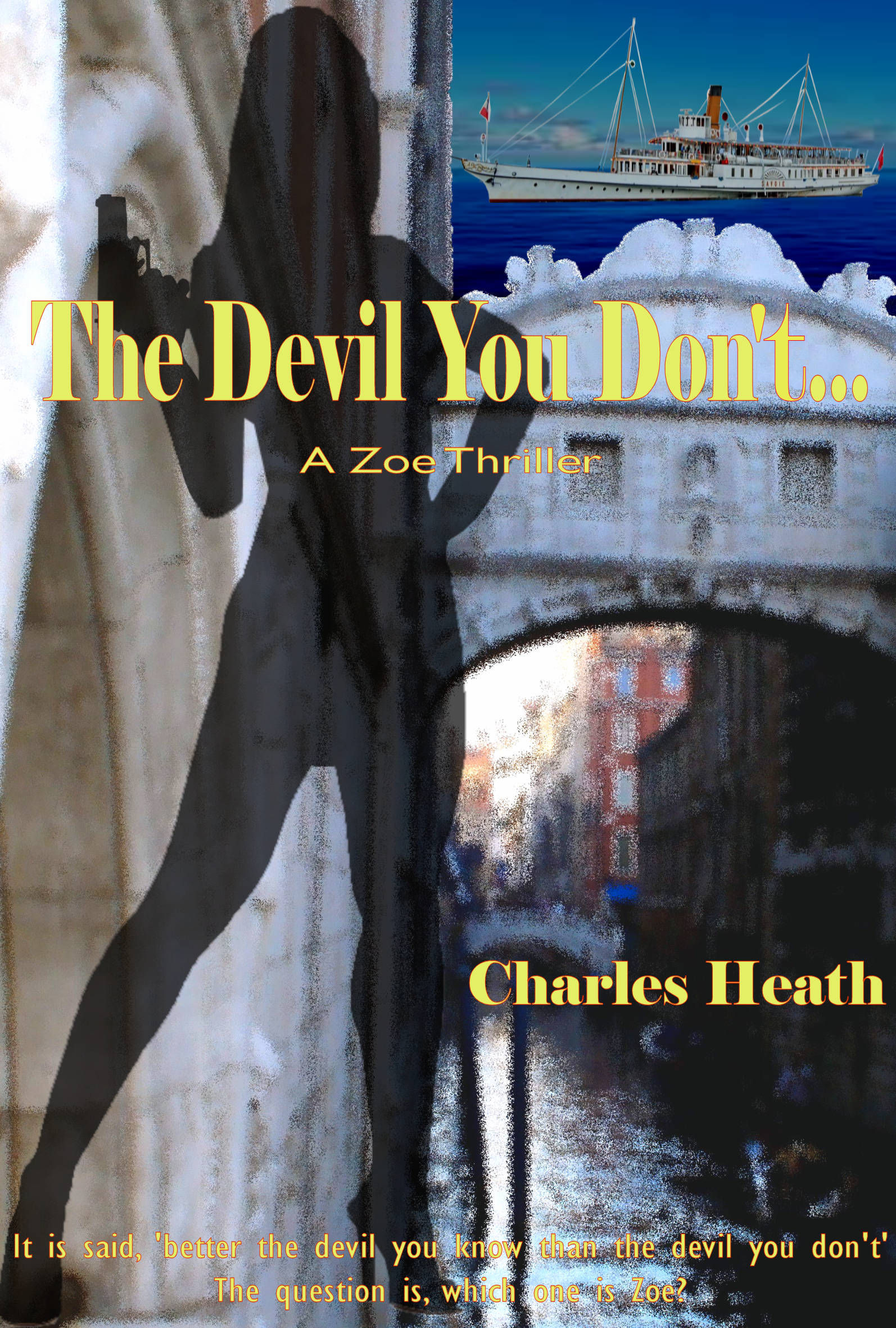
An excerpt from “The Devil You Don’t”

Available on Amazon Kindle here:  https://amzn.to/2Xyh1ow

By the time I returned to the Savoie, the rain had finally stopped, and there was a streak of blue sky to offer some hope the day would improve.

The ship was not crowded, the possibility of bad weather perhaps holding back potential passengers.  Of those I saw, a number of them would be aboard for the lunch by Phillippe Chevrier.  I thought about it, but the Concierge had told me about several restaurants in Yvoire and had given me a hand-drawn map of the village.  I think he came from the area because he spoke with the pride and knowledge of a resident.

I was looking down from the upper deck observing the last of the boarding passengers when I saw a woman, notable for her red coat and matching shoes, making a last-minute dash to get on board just before the gangway was removed.  In fact, her ungainly manner of boarding had also captured a few of the other passenger’s attention.  Now they would have something else to talk about, other than the possibility of further rain.

I saw her smile at the deckhand, but he did not smile back.  He was not impressed with her bravado, perhaps because of possible injury.  He looked at her ticket then nodded dismissively, and went back to his duties in getting the ship underway.  I was going to check the departure time, but I, like the other passengers, had my attention diverted to the woman in red.

From what I could see there was something about her.  It struck me when the light caught her as she turned to look down the deck, giving me a perfect profile.  I was going to say she looked foreign, but here, as in almost anywhere in Europe, that described just about everyone.  Perhaps I was just comparing her to Phillipa, so definitively British, whereas this woman was very definitely not.

She was perhaps in her 30’s, slim or perhaps the word I’d use was lissom, and had the look and manner of a model.  I say that because Phillipa had dragged me to most of the showings, whether in Milan, Rome, New York, London, or Paris.  The clothes were familiar, and in the back of my mind, I had a feeling I’d seen her before.

Or perhaps, to me, all models looked the same.

She looked up in my direction, and before I could divert my eyes, she locked on.  I could feel her gaze boring into me, and then it was gone as if she had been looking straight through me.  I remained out on deck as the ship got underway, watching her disappear inside the cabin.  My curiosity was piqued, so I decided to keep an eye out for her.

I could feel the coolness of the air as the ship picked up speed, not that it was going to be very fast.  With stops, the trip would take nearly two hours to get to my destination.  It would turn back almost immediately, but I was going to stay until the evening when it returned at about half eight.  It would give me enough time to sample the local fare, and take a tour of the medieval village.

Few other passengers ventured out on the deck, most staying inside or going to lunch.  After a short time, I came back down to the main deck and headed forward.  I wanted to clear my head by concentrating on the movement of the vessel through the water, breathing in the crisp, clean air, and let the peacefulness of the surroundings envelope me.

It didn’t work.

I knew it wouldn’t be long before I started thinking about why things hadn’t worked, and what part I played in it.  And the usual question that came to mind when something didn’t work out.  What was wrong with me?

I usually blamed it on my upbringing.

I had one of those so-called privileged lives, a nanny till I was old enough to go to boarding school, then sent to the best schools in the land.  There I learned everything I needed to be the son of a Duke, or, as my father called it in one of his lighter moments, nobility in waiting.

Had this been five or six hundred years ago, I would need to have sword and jousting skills, or if it had been a few hundred years later a keen military mind.  If nothing else I could ride a horse, and go on hunts, or did until they became not the thing to do.

I learned six languages, and everything I needed to become a diplomat in the far-flung British Empire, except the Empire had become the Commonwealth, and then, when no-one was looking, Britain’s influence in the world finally disappeared.  I was a man without a cause, without a vocation, and no place to go.

Computers were the new vogue and I had an aptitude for programming.  I guess that went hand in hand with mathematics, which although I hated the subject, I excelled in.  Both I and another noble outcast used to toss ideas around in school, but when it came to the end of our education, he chose to enter the public service, and I took a few of those ideas we had mulled over and turned them into a company.

About a year ago, I was made an offer I couldn’t refuse.  There were so many zeroes on the end of it I just said yes, put the money into a very grateful bank, and was still trying to come to terms with it.

Sadly, I still had no idea what I was going to do with the rest of my life.  My parents had asked me to come back home and help manage the estate, and I did for a few weeks.  It was as long as it took for my parents to drive me insane.

Back in the city, I spent a few months looking for a mundane job, but there were very few that suited the qualifications I had, and the rest, I think I intimidated the interviewer simply because of who I was.  In that time I’d also featured on the cover of the Economist, and through my well-meaning accountant, started involving myself with various charities, earning the title ‘philanthropist’.

And despite all of this exposure, even making one of those ubiquitous ‘eligible bachelor’ lists, I still could not find ‘the one’, the woman I wanted to spend the rest of my life with.  Phillipa seemed to fit the bill, but in time she proved to be a troubled soul with ‘Daddy’ issues.  I knew that in building a relationship compromise was necessary, but with her, in the end, everything was a compromise and what had happened was always going to be the end result.

It was perhaps a by-product of the whole nobility thing.  There was a certain expectation I had to fulfill, to my peers, contemporaries, parents and family, and those who either liked or hated what it represented.  The problem was, I didn’t feel like I belonged.  Not like my friend from schooldays, and now obscure acquaintance, Sebastian.  He had been elevated to his Dukedom early when his father died when he was in his twenties.  He had managed to fade from the limelight and was rarely mentioned either in the papers or the gossip columns.  He was one of the lucky ones.

I had managed to keep a similarly low profile until I met Phillipa.  From that moment, my obscurity disappeared.  It was, I could see now, part of a plan put in place by Phillipa’s father, a man who hogged the limelight with his daughter, to raise the profile of the family name and through it their businesses.  He was nothing if not the consummate self-advertisement.

Perhaps I was supposed to be the last piece of the puzzle, the attachment to the establishment, that link with a class of people he would not normally get in the front door.  There was nothing refined about him or his family, and more than once I’d noticed my contemporaries cringe at the mention of his name, or any reference of my association with him.

Yet could I truthfully say I really wanted to go back to the obscurity I had before Phillipa?  For all her faults, there were times when she had been fun to be with, particularly when I first met her when she had a certain air of unpredictability.  That had slowly disappeared as she became part of her father’s plan for the future.  She just failed to see how much he was using her.

Or perhaps, over time, I had become cynical.

I thought about calling her.  It was one of those moments of weakness when I felt alone, more alone than usual.

I diverted my attention back to my surroundings and the shoreline.  Out of the corner of my eye, I could see the woman in the red coat, making a move.  The red coat was like a beacon, a sort of fire engine red.  It was not the sort of coat most of the women I knew would wear, but on her, it looked terrific.  In fact, her sublime beauty was the one other attribute that was distinctly noticeable, along with the fact her hair was short, rather than long, and jet black.

I had to wrench my attention away from her.

A few minutes later several other passengers came out of the cabin for a walk around the deck, perhaps to get some exercise, perhaps checking up on me, or perhaps I was being paranoid.  I waited till they passed on their way forward, and I turned and headed aft.

I watched the wake sluicing out from under the stern for a few minutes, before retracing my steps to the front of the ship and there I stood against the railing, watching the bow carve its way through the water.  It was almost mesmerizing.  There, I emptied my mind of thoughts about Phillipa, and thoughts about the woman in the red coat.

Until a female voice behind me said, “Having a bad day?”

I started, caught by surprise, and slowly turned.  The woman in the red coat had somehow got very close me without my realizing it.  How did she do that?  I was so surprised I couldn’t answer immediately.

“I do hope you are not contemplating jumping.  I hear the water is very cold.”

Closer up, I could see what I’d missed when I saw her on the main deck.  There was a slight hint of Chinese, or Oriental, in her particularly around the eyes, and of her hair which was jet black.  An ancestor twice or more removed had left their mark, not in a dominant way, but more subtle, and easily missed except from a very short distance away, like now.

Other than that, she was quite possibly Eastern European, perhaps Russian, though that covered a lot of territory.  The incongruity of it was that she spoke with an American accent, and fluent enough for me to believe English was her first language.

Usually, I could ‘read’ people, but she was a clean slate.  Her expression was one of amusement, but with cold eyes.  My first thought, then, was to be careful.

“No.  Not yet.”  I coughed to clear my throat because I could hardly speak.  And blushed, because that was what I did when confronted by a woman, beautiful or otherwise.

The amusement gave way to a hint of a smile that brightened her demeanor as a little warmth reached her eyes.  “So that’s a maybe.  Should I change into my lifesaving gear, just in case?”

It conjured up a rather interesting image in my mind until I reluctantly dismissed it.

“Perhaps I should move away from the edge,” I said, moving sideways until I was back on the main deck, a few feet further away.  Her eyes had followed me, and when I stopped she turned to face me again.  She did not move closer.

I realized then she had removed her beret and it was in her left side coat pocket.  “Thanks for your concern …?”

“Zoe.”

“Thanks for your concern, Zoe.  By the way, my name is John.”

She smiled again, perhaps in an attempt to put me at ease.  “I saw you earlier, you looked so sad, I thought …”

“I might throw myself overboard?”

“An idiotic notion I admit, but it is better to be safe than sorry.”

Then she tilted her head to one side then the other, looking intently at me.  “You seem to be familiar.  Do I know you?”

I tried to think of where I may have seen her before, but all I could remember was what I’d thought earlier when I first saw her; she was a model and had been at one of the showings.  If she was, it would be more likely she would remember Phillipa, not me.  Phillipa always had to sit in the front row.

“Probably not.”  I also didn’t mention the fact she may have seen my picture in the society pages of several tabloid newspapers because she didn’t look the sort of woman who needed a daily dose of the comings and goings, and, more often than not, scandal associated with so-called celebrities.

She gave me a look, one that told me she had just realized who I was.  “Yes, I remember now.  You made the front cover of the Economist.  You sold your company for a small fortune.”

Of course.  She was not the first who had recognized me from that cover.  It had raised my profile considerably, but not the Sternhaven’s.  That article had not mentioned Phillipa or her family.  I suspect Grandmother had something to do with that, and it was, now I thought about it, another nail in the coffin that was my relationship with Phillipa.

“I wouldn’t say it was a fortune, small or otherwise, just fortunate.”  Each time, I found myself playing down the wealth aspect of the business deal.

“Perhaps then, as the journalist wrote, you were lucky.  It is not, I think, a good time for internet-based companies.”

The latter statement was an interesting fact, one she read in the Financial Times which had made that exact comment recently.

“But I am boring you.”  She smiled again.  “I should be minding my own business and leaving you to your thoughts.  I am sorry.”

She turned to leave and took a few steps towards the main cabin.

“You’re not boring me,” I said, thinking I was letting my paranoia get the better of me.  It had been Sebastian on learning of my good fortune, who had warned me against ‘a certain element here and abroad’ whose sole aim would be to separate me from my money.  He was not very subtle when he described their methods.

But I knew he was right.  I should have let her walk away.

She stopped and turned around.  “You seem nothing like the man I read about in the Economist.”

A sudden and awful thought popped into my head.  Those words were part of a very familiar opening gambit.  “Are you a reporter?”

I was not sure if she looked surprised, or amused.  “Do I look like one?”

I silently cursed myself for speaking before thinking, and then immediately ignored my own admonishment.  “People rarely look like what they are.”

I saw the subtle shake of the head and expected her to take her leave.  Instead she astonished me.

“I fear we have got off on the wrong foot.  To be honest, I’m not usually this forward, but you seemed like you needed cheering up when probably the opposite is true.  Aside from the fact this excursion was probably a bad idea.  And,” she added with a little shrug, “perhaps I talk too much.”

I was not sure what I thought of her after that extraordinary admission. It was not something I would do, but it was an interesting way to approach someone and have them ignoring their natural instinct.  I would let Sebastian whisper in my ear for a little longer and see where this was going.

“Oddly enough, I was thinking the same thing.  I was supposed to be traveling with my prospective bride.  I think you can imagine how that turned out.”

“She’s not here?”

“No.”

“She’s in the cabin?”  Her eyes strayed in that direction for a moment then came back to me.  She seemed surprised I might be traveling with someone.

“No.  She is back in England, and the wedding is off.  So is the relationship.  She dumped me by text.”

OK, why was I sharing this humiliating piece of information with her?  I still couldn’t be sure she was not a reporter.

She motioned to an empty seat, back from the edge.  No walking the plank today.  She moved towards it and sat down.  She showed no signs of being cold, nor interested in the breeze upsetting her hair.  Phillipa would be having a tantrum about now, being kept outside, and freaking out over what the breeze might be doing to her appearance.

I wondered, if only for a few seconds if she used this approach with anyone else.  I guess I was a little different, a seemingly rich businessman alone on a ferry on Lake Geneva, contemplating the way his life had gone so completely off track.

She watched as I sat at the other end of the bench, leaving about a yard between us.  After I leaned back and made myself as comfortable as I could, she said, “I have also experienced something similar, though not by text message.  It is difficult, the first few days.”

“I saw it coming.”

“I did not.”  She frowned, a sort of lifeless expression taking over, perhaps brought on by the memory of what had happened to her.  “But it is done, and I moved on.  Was she the love of your life?”

OK, that was unexpected.

When I didn’t answer, she said, “I am sorry.  Sometimes I ask personal questions without realizing what I’m doing.  It is none of my business.”  She shivered.  “Perhaps we should go back inside.”

She stood, and held out her hand.  Should I take it and be drawn into her web?  I thought of Sebastian.  What would he do in this situation?

I took her hand in mine and let her pull me gently to my feet.  “Wise choice,” she said, looking up at the sky.

It just started to rain.

© Charles Heath 2015-2023

newdevilcvr6

Top 5 sights on the road less travelled – Sydney

Beyond the Icons: Five Hidden Sydney Gems on the Road Less Travelled

Sydney is one of the world’s most beautiful cities, but let’s be honest: once you’ve seen the Opera House sails sparkle and crossed the Harbour Bridge, you might feel like you’ve checked the box.

But for the traveller yearning for authenticity—the one who prefers the local pub to the tourist trap, and a hidden bush track over a crowded promenade—Sydney holds secrets. If you’re touring New South Wales and looking to uncover the true soul of the Harbour City, you need to drive past the postcards.

Here are the top five things to do in Sydney on the road less travelled, reserved for those willing to venture just slightly off the beaten track.


1. Trace Ancient History at Ku-ring-gai Chase National Park

While the Royal National Park gets most of the glory (and the weekend crowds), the vast, stunning wilderness of Ku-ring-gai Chase, located in the north, often slips under the radar for international visitors. This is the perfect spot for a Sydney day trip that feels like a true escape from urban life.

Why it’s on the road less travelled: This park is not just known for its phenomenal bushwalking and sprawling waterways; it is a repository of irreplaceable history. Ku-ring-gai is home to some of the most significant and well-preserved Aboriginal rock art and engraving sites in the Sydney basin.

The Must-Do: Head to the captivating West Head Lookout, which offers panoramic, uninterrupted views across the juncture of the Hawkesbury River, Broken Bay, and Barrenjoey Headland. On your way back, stop and walk the short loop trail at the Basin Track to view Aboriginal engravings of marine life and human figures, remnants of the Guringai people who have called this land home for millennia.


2. Harbour Views Without the Crowds: The Hermitage Foreshore Walk

Everyone knows the walk from Bondi to Coogee, but Sydney’s most exquisite harbour views are often found on the quieter paths along the Eastern Suburbs. The Hermitage Foreshore Walk, connecting Nielsen Park to Rose Bay, is the perfect example of secluded city beauty.

Why it’s on the road less travelled: This 1.8 km track meanders through lush, protected rainforest, leading you to tiny, secret beaches that feel utterly remote, despite being minutes from million-dollar homes. You get postcard-perfect views of the Sydney Harbour Bridge and Opera House—but from across the water, framed by trees and exclusive little coves.

The Must-Do: Pack a picnic and stop at Milk Beach, a glorious sliver of sand that is largely inaccessible except via this track or boat. It is one of the most romantic spots in Sydney, ideal for watching the yachts sail by without the presence of tour buses or selfie sticks.


3. Step Back in Time (and Ruin): Cockatoo Island

Located right in the middle of Sydney Harbour, Cockatoo Island is a UNESCO World Heritage site and one of the world’s most unique islands. It’s an industrial ghost town, a former prison, shipyard, and reformatory school, offering a fascinatingly gritty contrast to the polished surrounding suburbs.

Why it’s on the road less travelled: While easily accessible by ferry from Circular Quay, most tourists jump off at Taronga Zoo or Manly. Those who make the short trip to Cockatoo Island find a raw, sprawling historical site where the massive industrial machinery and sandstone penal buildings have been left largely intact.

The Must-Do: Take a self-guided audio tour that delves into the island’s dark convict past and its role in building Australia’s naval strength. For the truly adventurous, book a waterfront glamping tent or apartment for the night. Waking up on a silent, historical island, watching the sun rise over the harbour, is an experience few visitors ever get to claim.


4. Explore Inner West’s Industrial Transformation: The Tramsheds

Sydney’s Inner West is famous for its hipster cafes and vintage shops, but the Tramsheds in Forest Lodge offer a specific culinary and architectural experience that screams “local.”

Why it’s on the road less travelled: This is not a standard food court; it’s a beautifully restored Rozelle Tram Depot, built in 1904. The massive, soaring industrial space, complete with old tram tracks and repurposed steel infrastructure, now houses a selection of artisanal retailers, high-quality restaurants, and providores focusing on local Australian produce.

The Must-Do: Skip the chain restaurants and grab lunch at a specialist venue like Bodega 1904 or pick up fresh seafood. The atmosphere is buzzing but intimate, giving you a real feel for Sydney’s industrial heritage fused seamlessly with modern dining culture. It’s a perfect pitstop for lunch if you are driving through the Inner West towards the city.


5. Discover the Tranquil Waters of Pittwater via Ferry

For a Sydney experience that truly requires a sense of adventure (and a slightly longer drive north), head to Church Point or Palm Beach and leave the car behind to explore the hidden waterways of Pittwater.

Why it’s on the road less travelled: Pittwater is Sydney’s serene northern counterpart to the bustling Harbour. It is edged by protected national parks and sprinkled with tiny, virtually car-less communities only accessible by private ferry or water taxi. This area feels less like Sydney and more like a secluded holiday destination.

The Must-Do: Catch the little commuter ferry from Church Point across to Scotland Island or The Basin (part of Ku-ring-gai Chase). The Basin offers brilliant, calm, lagoon-like swimming and excellent walking tracks leading to lookouts over the pristine water. This ferry journey itself is a charming slice of local life—you’ll be sharing the trip with residents doing their grocery runs and kids heading home from school.


Your Sydney Adventure Starts Now

Sydney’s iconic sights are worth the visit, but the true brilliance of the city lies just beyond the tourist trails. By taking the road less travelled, you don’t just observe Sydney; you immerse yourself in its history, its wild geography, and its genuine, local spirit.

So, ditch the guidebook, fire up the GPS, and go find the hidden beaches and industrial ruins that the locals try to keep secret.


Have you discovered a hidden Sydney gem that should be on this list? Share your favourite off-the-beaten-path spot in the comments below!