Top 5 sights on the road less travelled – Belgrade

Uncovering the Hidden Gems of Belgrade: 5 Off-the-Beaten-Path Experiences

Belgrade, the vibrant capital of Serbia, is a city that seamlessly blends Eastern and Western cultures, offering a unique and exciting travel experience. While most tourists flock to the famous Kalemegdan Fortress and Saint Sava Temple, there’s more to Belgrade than meets the eye. As a seasoned traveller, I’m excited to share with you the top five other things to do in Belgrade that will take you off the beaten path and into the heart of this fascinating city.

1. Explore the Street Art Scene in Savamala

Tucked away in the Savamala neighbourhood, Belgrade’s street art scene is a treasure trove of creativity and self-expression. This former industrial area has been transformed into a vibrant arts district, featuring stunning murals, graffiti, and quirky installations. Take a self-guided walking tour to discover the works of local and international artists, and experience the city’s edgy, avant-garde side. Be sure to check out the famous “Savamala” mural, which has become a symbol of the neighbourhood’s revitalisation.

2. Visit the Nikola Tesla Museum

While many visitors to Belgrade are familiar with the famous scientist’s name, few know about the fascinating museum dedicated to his life and work. The Nikola Tesla Museum is a must-visit for anyone interested in science, technology, and innovation. Located in a beautiful villa, the museum showcases an impressive collection of Tesla’s personal belongings, experiments, and inventions, including his famous Tesla coil. The museum’s interactive exhibits and guided tours offer a unique glimpse into the mind of a genius.

3. Take a Stroll through the Botanical Garden

Escape the hustle and bustle of the city and find serenity in the beautiful Botanical Garden, also known as the Jevremovac Botanical Garden. This peaceful oasis is home to over 1,000 plant species, including some rare and endangered ones. As you wander through the gardens, you’ll discover a variety of flora, from roses and lavender to cacti and succulents. The garden’s tranquil atmosphere and stunning natural beauty make it an ideal spot for relaxation and contemplation.

4. Discover the Vinča Culture at the Vinča Archaeological Site

Located just outside Belgrade, the Vinča Archaeological Site is a fascinating glimpse into the city’s ancient past. This Neolithic settlement, dating back over 7,000 years, is one of the oldest and most important archaeological sites in Europe. Explore the excavated ruins, which feature remnants of ancient homes, pottery, and tools, and learn about the daily lives of the Vinča people. The site’s museum offers a wealth of information and artifacts, providing a unique insight into the region’s rich cultural heritage.

5. Enjoy a Night Out in the Cvetni Trg Neighbourhood

For a truly authentic Belgrade experience, head to the Cvetni Trg (Flower Square) neighbourhood, known for its lively atmosphere, charming cafes, and eclectic nightlife. This trendy area is home to a variety of bars, clubs, and live music venues, offering everything from jazz and rock to traditional Serbian folk music. As you explore the neighbourhood, you’ll discover a mix of old and new, with historic buildings, street performers, and modern art installations adding to the area’s vibrant energy. Be sure to try some of the local cuisine, including delicious ćevapi and pljeskavica, at one of the many restaurants and food stalls.

In conclusion, Belgrade is a city that offers so much more than its famous landmarks. By venturing off the beaten path, you’ll discover a wealth of hidden gems, from street art and science museums to ancient archaeological sites and vibrant nightlife. Whether you’re a culture vulture, a foodie, or an adventure-seeker, Belgrade has something for everyone. So come and explore the real Belgrade, and experience the city’s unique blend of tradition, innovation, and warmth.

365 Days of Writing, 2026 – 194

Day 194 – Characters and their conversations

Beyond the Final Word: Why Character Intentions Drive the Best Conversations in Fiction

“Dialogue should be a series of pitched battles in which the characters are trying to get what they want.”

Every fiction writer eventually encounters a scene where two characters are talking, yet the pages feel utterly lifeless. The exchange is grammatically correct, it moves the plot forward, and it delivers the necessary information. And yet, it bores the reader to tears.

Why? Because the characters are simply arriving at what they want to say, rather than wrestling with the turbulent, messy journey of how they get there.

To master the art of subtext and realistic human interaction, we can look to one of the 20th century’s most brilliant stylists. The celebrated Anglo-Irish novelist and short-story writer Elizabeth Bowen had profound insights into the architecture of conversation. Bowen understood that in great fiction, dialogue is rarely about the destination; it is about the struggle of intention.

In this post, we’ll explore why characters should focus more on what they intend to say rather than the tidy sentences they finally arrive at, drawing inspiration from Elizabeth Bowen’s literary philosophy.


The Elizabeth Bowen Perspective: Conversation as a Secret War

Elizabeth Bowen viewed the surface of life—and polite conversation especially—as a delicate, often deceptive crust over boiling depths. To Bowen, dialogue was never just an exchange of data. It was a social dance, a power struggle, a form of concealment, and an act of psychological warfare all at once.

In her critical writings and through the immaculate prose of novels like The Death of the Heart and The House in Paris, Bowen demonstrated that people rarely say exactly what they mean. Instead, they circle their desires. They hint, they deflect, they use small talk as a shield, and they weaponise silence.

When characters’ conversation is overly streamlined—when they immediately arrive at crisp, articulate summaries of their feelings—the psychological realism evaporates. Real people are hampered by pride, fear, social conditioning, and a lack of self-awareness.

Bowen’s characters speak not to deliver exposition, but to assert themselves against a hostile or indifferent world. The magic happens in the gap between what is intended and what is actually uttered.


What Happens When Characters “Arrive” Too Fast?

Let’s look at the two approaches: dialogue driven by arrival versus dialogue driven by intention.

The Trap of the “Arrival” Dialogue

When a writer focuses on what a character arrives at saying, the dialogue often falls into the trap of “on-the-nose” writing or pure exposition.

  • Example (Arrival):Mark: “I am leaving you because you never pay attention to my emotional needs, Sarah.” Sarah: “That’s not fair. I’ve been stressed about my mother’s illness, but if you’re going to be selfish, maybe we should break up.”

Why it fails: It’s efficient, but it feels robotic. Real human beings in the middle of a breakup rarely diagnose their relationship with the clinical precision of a marriage counsellor in the first three seconds. They are defending their egos, deflecting blame, and masking panic.

The Power of “Intention” Dialogue

When characters are driven by what they intend to say—the subtextual desire to wound, to plead, to hide, or to conquer—the conversation becomes a living, breathing thing.

  • Example (Intention):Mark slammed the refrigerator door harder than necessary, rattling the jars inside. “You leave that wet towel on the counter every single day.” Sarah didn’t look up from her phone. “Some of us have actual responsibilities outside of interior decorating, Mark.” Mark: “Right. Responsibilities. Must be nice.”

Why it works: Mark intends to say, “I feel neglected and invisible in this house,” but that requires vulnerability. Instead, he arrives at a petty complaint about a towel. Sarah intends to say, “Don’t make me feel guilty; I am drowning under pressure,” but she arrives at a counter-attack. The tension comes from the reader feeling the heavy, unspoken weight of their true intentions beneath the trivial words.


3 Ways to Apply Bowen’s Wisdom to Your Writing

If you want to shift your character conversations away from neat arrivals and toward messy, intention-driven power struggles, try these three techniques:

1. Give Every Character a Hidden Agenda

Before writing a scene, ask yourself: What does this character want from the other person by the end of this conversation?

  • Do they want validation?
  • Do they want to hide a secret?
  • Do they want to provoke a reaction without taking the blame for starting a fight?

When characters have an active internal agenda, their dialogue will naturally become evasive, tactical, and charged with subtext.

2. Interrupt the Thought Process

In real life, we edit ourselves mid-sentence. We start to say one thing, realise how it sounds, and pivot sharply.

  • Let your characters trail off.
  • Let them change subjects abruptly when they feel vulnerable.
  • Use action beats (gestures, glances, fidgeting) to show the friction between their brain and their mouth.

As Elizabeth Bowen showed us, the most telling moments in a conversation are often the things left unsaid, or the sentences that fracture before they can be completed.

3. Let Misunderstandings Breed Conflict

When characters are aiming for an intention rather than a neat conclusion, they will inevitably miss each other’s points. Character A is speaking from a place of fear; Character B is interpreting it as an attack.

This friction creates authentic dramatic irony. The reader understands the tragic or comedic mismatch between what the characters intend to communicate and how their words are actually landing.


Conclusion: Embrace the Mess

Great dialogue is never a straight line. It is a zigzag path of sidesteps, false starts, defensive maneuvers, and buried longings.

By following Elizabeth Bowen’s implicit advice—prioritising the volatile, underlying intentions of your characters over the neat, polished sentences they eventually arrive at—you will breathe authentic life into your scenes. Stop letting your characters say exactly what they mean right away. Let them struggle to say it, let them fail, and watch your fiction transform into something unforgettable.


What are your favourite examples of subtext-heavy dialogue in literature? How do you handle character intentions in your own writing? Let us know in the comments below!

Inspiration, Maybe – Volume 2

50 photographs, 50 stories, of which there is one of the 50 below.

They all start with –

A picture paints … well, as many words as you like.  For instance:

And, the story:

Have you ever watched your hopes and dreams simply fly away?

Everything I thought I wanted and needed had just left in an aeroplane, and although I said I was not going to, I came to the airport to see the plane leave.  Not the person on it, that would have been far too difficult and emotional, but perhaps it was symbolic, the end of one life and the start of another.

But no matter what I thought or felt, we had both come to the right decision.  She needed the opportunity to spread her wings.  It was probably not the best idea for her to apply for the job without telling me, but I understood her reasons.

She was in a rut.  Though her job was a very good one, it was not as demanding as she had expected, particularly after the last promotion, but with it came resentment from others on her level that she, the youngest of the group, would get the position.

It was something that had been weighing her down for the last three months, and if she noticed it, the late nights, the moodiness, sometimes a flash of temper.  I knew she had one; no one could have such red hair and not, but she had always kept it in check.

And then there was us, together, and after seven years, it felt like we were going nowhere.  Perhaps that was down to my lack of ambition, and though she never said it, lack of sophistication.  It hadn’t been an issue, well, not until her last promotion, and the fact that she had to entertain more, and frankly, I felt like an embarrassment to her.

So, there it was, three days ago, the beginning of the weekend, and we had planned to go away for a few days and take stock.  We both acknowledged we needed to talk, but it never seemed the right time.

It was then that she said she had quit her job and found a new one.  Starting the following Monday.

Ok, that took me by surprise, not so much that it was something I sort of guessed might happen, but that she would just blurt it out.

I think that right then, at that moment, I could feel her frustration with everything around her.

What surprised her was my reaction.  None.

I simply asked who, where, and when.

A world-class newspaper in New York, and she had to be there in a week.

A week.

It was all the time I had left with her.

I remember just shrugging and asking if the planned weekend away was off.

She stood on the other side of the kitchen counter, hands around a cup of coffee she had just poured, and that one thing I remembered was the lone tear that ran down her cheek.

Is that all you want to know?

I did, yes, but we had lost the intimacy we used to have, where she would have told me what was happening, and we would have brainstormed solutions. I might be a cabinet maker, but I still had a brain, was what I overheard her tell a friend once.

There’s not much to ask, I said.  You’ve been desperately unhappy and haven’t been able to hide it all that well, you have been under a lot of pressure trying to deal with a group of troglodytes, and you’ve been leaning on Bentley’s shoulder instead of mine, and I get it, he’s got more experience in that place,  and the politics that go with it, and is still an ally.

Her immediate superior was instrumental in her getting the position, but unlike some men in his position, he had not taken advantage of the situation like some might.  And even if she had made a move, which I doubted, that was not the sort of woman she was, he would have politely declined.

One of the very few happily married men in that organisation, so I heard.

So, she said, you’re not just a pretty face.

Par for the course for a cabinet maker whose university degree is in psychology.  It doesn’t take rocket science to see what was happening to you.  I just didn’t think it was my place to jump in unless you asked me, and when you didn’t, well, that told me everything I needed to know.

Yes, our relationship had a use-by date, and it was in the next few days.

I was thinking, she said, that you might come with me; you can make cabinets anywhere.

I could, but I think the real problem wasn’t just the job.  It was everything around her and going with her that would just be a constant reminder of what had been holding her back. I didn’t want that for her and said so.

Then the only question left was, what do we do now?

Go shopping for suitcases.  Bags to pack, and places to go.

Getting on the roller coaster is easy.  At the beginning, it’s a slow, easy ride, followed by the slow climb to the top.  It’s much like some relationships; they start out easy, they require a little work to get to the next level, followed by the adrenaline rush when it all comes together.

What most people forget is that what comes down must go back up, and life is pretty much a roller coaster with highs and lows.

Our roller coaster had just come out of the final turn, and we were braking so that it would stop at the station.

There was no question of going with her to New York.  Yes, I promised I’d come over and visit her, but that was a promise with crossed fingers behind my back.  After a few months in the new job, the last thing she’d want was a reminder of what she left behind.  New friends, new life.

We packed her bags, threw out everything she didn’t want, a free trip to the op shop with stuff she knew others would like to have, and basically, by the time she was ready to go, there was nothing left of her in the apartment, or anywhere.

Her friends would be seeing her off at the airport, and that’s when I told her I was not coming; that moment, the taxi arrived to take her away forever.  I remember standing there, watching the taxi go.  It was going to be, and was, as hard as it was to watch the plane leave.

So, there I was, finally staring at the blank sky, around me a dozen other plane spotters, a rather motley crew of plane enthusiasts.

Already that morning, there had been 6 different types of planes departing, and I could hear another winding up its engines for take-off.

People coming, people going.

Maybe I would go to New York in a couple of months, not to see her, but just to see what the attraction was.  Or maybe I would drop in, just to see how she was.

As one of my friends told me when I gave him the news, the future is never written in stone, and it’s about time you broadened your horizons.

Perhaps it was.


© Charles Heath 2020-2026

Coming soon.  Find the above story and 49 others like it in:

The cinema of my dreams – I always wanted to write a war story – Episode 38

For a story that was conceived during those long boring hours flying in a steel cocoon, striving to keep away the thoughts that the plane and everyone in it could just simply disappear as planes have in the past, it has come a long way.

Whilst I have always had a fascination with what happened during the second world war, not the battles or fighting, but in the more obscure events that took place, I decided to pen my own little sidebar to what was a long and bitter war.

And, so, it continues…

It didn’t surprise Johannesen there were about twenty prisoners down in the dungeons, though he was surprised to find that the dungeon area was quite large, and in several sections. The fact they smelled of wine told him that once, the cells were used at storage areas for bottles of wine.

Several of the cells that were furthest from the downstairs entrance, and recently boarded over caused several overzealous resistance fighters of Leonardo’s to start smashing walls looking for it.

Johannsen tried not to think about Leonardo. He was the very worst of men, a pig even by German standards.

Martina had been put in a cell not far from Leonardo’s wine cache. There was purpose in that, he could get drunk and then take it out of the woman who had made him look stupid. Come to think of it, he thought, it wouldn’t be too hard for a ten-year-old to do that.

The cell door was locked, but Johannsen had a key. He had meticulously gone through all the keyrings and loose keys that had been found and those that didn’t have an immediate use had been stored in the dungeon guardroom.

Matching keys to locks had been one of his secret tasks, under the disguise of being given the job by Wallace to match keys to locks for them. There were a few short in the end, keys to rooms, and cells that seem to serve no purpose. One had become Johannessen’s hideaway.

It was part of a plan he had been formulating, one where he could take prisoners and hide them. Of course, it wouldn’t work for the moment because the prisoners had to be moved on as soon as possible, and staying in the castle, even if the others didn’t know where they were, would invite a microscopic search. It would need Atherton’s knowledge of the castle, and whether there was another escape route they could use.

It was another of his works in progress, one that was highly likely to fail.

He stood back from the door and looked at the crumpled heap on the floor that was once the leader of the resistance. Leonardo had interrogated her before bringing her back, half-dead, to the castle, and in doing so had made it impossible for anyone to interrogate her further. Had that been the reason why Leonardo had bashed her senseless?

He saw a hand move by her side, and a low groan.

He spoke quietly, in English, “Are you able to come closer to the door?” He knelt down, trying to get a better look at her injuries. Abrasions, and bruising. Swollen eyes, possible broken nose, blood spatter everywhere on her clothing which remarkably was relatively intact. He had suspected Leonardo of doing a lot worse and may still have.

She lifted her head slightly, “Who are you?”

“I could be a friend.”

She laughed, then coughed, and blood came out of her mouth. Broken ribs possibly, and a punctured lung. She might be too injured to move.

“There are no friends in this place, just Tedeschi.” She lowered her head and closed her eyes. Her breathing was irregular and shallow. Definitely broken ribs, he thought. And not likely to survive another interrogation. Not if Jackerby was going to conduct it.

“I’d like to help you if I can.”

“Everyone in here, we’re beyond help. You know that because you’re one of them.”

“Some of us care what happens to people.”

She pushed hard to move around slightly to face him, laying her head on the side to face him. “Which one are you?”

“Johannsen.”

“Yes, Johannesen. Atherton mentioned you. As untrustworthy as the rest. But for me, I’m all but dead, but I’ll humor you. Get me out of here and away from that bastardo Leonardo, and I might believe you.”

Atherton. This might be an opportunity to find out how he could get in contact with him, knowing of course, she wasn’t going to tell him where Atherton was.

“If you want to get away from here, we need Atherton. He’s the only one who knows this place inside out.”

He could see her shaking her head, as painful as that might be.

“He’s not.”

“Then is there anyone who does?”

“There is.”

“Who?”

Again she laughed and it sounded like the death rattle of her last breath. “You think I’m that far gone that I would tell you anything?”

“If you want to escape, I can only get you so far.”

“There is no escape. Believe me. If there was, I would be gone. Save your trickery and lies for someone who might be gullible enough to believe you. I’m quite prepared to die, the fact I’ve lived this long is what some would call a miracle.”

With that she turned away, coughed, and went silent. She wasn’t dead, but death wasn’t far away.

When Johannesen reluctantly left the cell, he only made it to the turn towards the steps up when he ran into Jackerby.

Had Jackerby been somewhere near and overheard their conversation.

“You have a rather interesting interrogation technique,” Jackerby said.

Johannesen groaned inwardly. He had heard.

“Sometimes it’s better to try and infuse hope in the subject rather than resignation. I was trying to get her to tell me where Atherton is.”

“And did she?”

“What do you think. After what Leonardo did, she’s not likely to tell us anything. I’m sure if we had taken a different approach…”

“Yes, softly softly. Doesn’t work. Just leave the heavy lifting to us, and don’t bother coming down to revisit the prisoners. Otherwise, I might believe you really are trying to help them escape.”

© Charles Heath 2020-2021

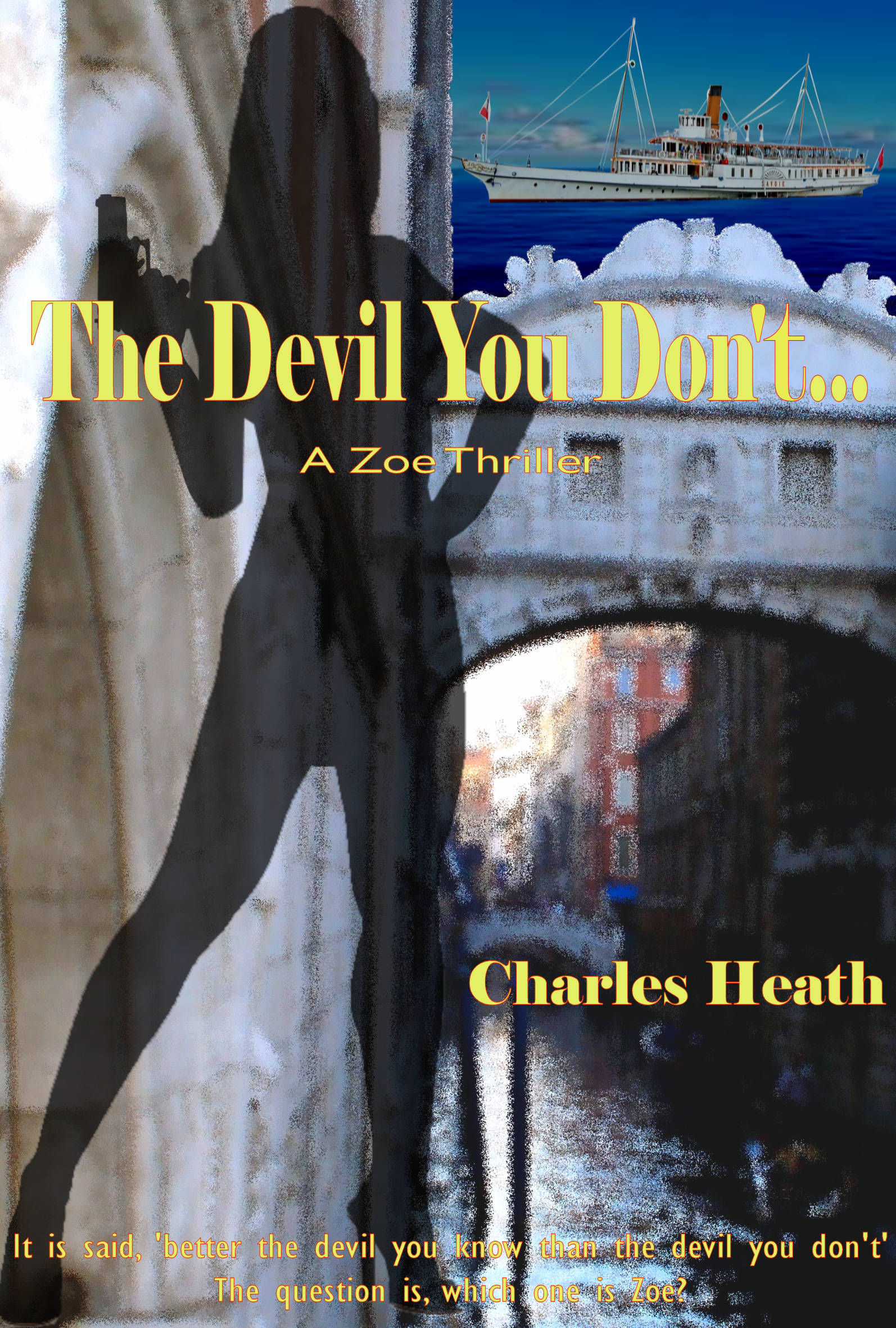
‘The Devil You Don’t’ – A beta reader’s view

It could be said that of all the women one could meet, whether contrived or by sheer luck, what are the odds it would turn out to be the woman who was being paid a very large sum to kill you?

John Pennington is a man who may be lucky in business, but not so lucky in love. He has just broken up with Phillipa Sternhaven, the woman he thought was the one, but relatives and circumstances, and perhaps because she was a ‘princess’, may also have contributed to the end result.

So, what do you do when you are heartbroken?

That is a story that slowly unfolds, from the first meeting with his nemesis on Lake Geneva, all the way to a hotel room in Sorrento, where he learns the shattering truth.

What should have been solace after disappointment turns out to be something else entirely, and from that point, everything goes to hell in a handbasket.

He suddenly realises his so-called friend Sebastian has not exactly told him the truth about a small job he asked him to do, the woman he is falling in love with is not quite who she says she is, and he is caught in the middle of a war between two men who consider people becoming collateral damage as part of their business.

The story paints the characters, cleverly displaying all their flaws and weaknesses. The locations add to the story at times, taking me back down memory lane, especially to Venice, where, in those back streets, I confess it’s not all that hard to get lost.

All in all, a thoroughly entertaining story with, for once, a satisfying end.

Available on Amazon here: https://amzn.to/2Xyh1ow

The cinema of my dreams – I always wanted to go on a treasure hunt – Episode 39

Here’s the thing…

Every time I close my eyes, I see something different.

I’d like to think the cinema of my dreams is playing a double feature, but it’s a bit like a comedy cartoon night on Fox.

But these dreams are nothing to laugh about.

Once again there’s a new instalment of an old feature, and we’re back on the treasure hunt.


A shiver went down my spine, and I took it for the omen it was.

Nothing good came of being in a place where you were not supposed to be.

I shook it off.

“Does that look like someone we knew, once?”

He looked at the mannequin, then shook his head.  “No, should it?”

“Seems odd they didn’t come back to collect their stock.  I’m sure it wasn’t as bad as this when the cracks first appeared.”

“Here it was.  Walls crumbled, and in places the roof collapsed.  Two shop staff got hit by a falling beam.  One later died.  There was a long court battle over that.”

I did not remember much of what happened.  My mother said it was just another tragedy brought on by greed.  It was probably why I had such contempt for the rich.

Boggs did a rotation with his light, and in the direction of the marina, there was a central square over which was a skylight, only it was dirty and little light was getting through.  It was just enough to see that the plants had all overgrown and taken over, and it was strange to see pylons covered in creeper, and shrubs growing through seats.

There had been a pond in the middle of that square, but it was probably empty now, and if it had water, it would be contributing to the smell.

In the other direction, there was darkness, the mall heading towards the front entrance.

Boggs started walking towards the square.

That was when I realised he had brought an old map of the shopping centre and had been looking at it when I joined him.

From the square, there were elevators and steps up to the second level where there were restaurants and entertainment areas, as well as the entrance to the multiplex cinemas.  The stairs went down to the carpark.

There were two levels of carpark under the main building, and it was the lower car park that had occasionally flooded.

When we reached the square, it seemed lighter than I first thought, but that was because my eyes had adjusted to the semi-darkness, making objects clearer.  We had to brush past some of the tree branches to reach the pond.

I was wrong.  There was water in it, and it was reasonably clear.  I guess without man to pollute it, nature had taken over.  Here the aroma was more like a park after the lawns had been mowed.

Boggs had turned off his light as we approached the pond, and it was fortunate he had.  We both heard the sound of a brick, or rock, hitting the floor, and a moment later, the faint glow of torchlight.

Other people exploring the wilderness.

“How many people know about that entrance?”

It sounded to me like they were coming back from the marina.

“I don’t know.  I wasn’t expecting anyone to be here if that’s what you’re thinking.”

It wasn’t.  Not my first thought, anyway.

He headed towards the stairs next to the elevator lobby, remarkably clear of rubble and undergrowth, and started walking down the stairs, into the darkness. I followed, reluctantly, and inwardly sighed in relief when he stopped on the first landing.  There was a rumour that there were ghosts down on the car park levels.

We went just far enough down to be hidden from the other visitors.  Unless they decided to use this particular staircase.

The light was less intense as it approached the square, and then we saw two figures.

At least one was a male, tall, and smoking a cigarette.

“God knows why the boss wanted us to check this hell hole.  There’s no one here but us.”  It was the tall man speaking.

He waved his torch around, including once in our direction.  At the distance they were from us, the light had no effect.

“You know the boss, he has an active imagination.  Perhaps if he hadn’t buried the bodies down here, it wouldn’t be an issue.  Come on, this place gives me the creeps.”

Another man, and, now, I could see they were dressed in what looked like security guards’ clothes.  Why on earth would anyone want to keep an eye on this place?  And who was their boss?

Another wave of the torches and they continued their way towards the front of the mall.

“So,” Boggs said with a curious inflection in his tone, “there are bodies buried down here.”

“A figure of speech,” I said.  “No one would be that stupid to bury bodies down here.”

“Why not.  No one comes here, except adventurers like us, so it’s a perfect place for either the Cossatino’s or the Benderby’s to hide stuff down here.  How many people do you think either of them has killed over the years?”

Allegedly quite a few.  It was, when I thought about it, quite a good place to hide a body.  I just hoped we didn’t find one.

We waited another five minutes, just in case they came back, but they didn.t.  I followed Boggs up the stairs and we headed towards the center of the square.

“Where are we going?”

“To the Marina.  Got to check something first.”

© Charles Heath 2019-2026

© Charles Heath 2020

The 2am Rant: There are so many things I haven’t done

Does it really matter, you ask?

Perhaps not, but now seems to be an appropriate time, nearing the age of 72, to take stock.

We have achieved a lot in the last twenty or so years once the children have grown up and can look after themselves.

Unlike a lot of more modern couples who are travelling in their 20s and 30s and then having children, we chose to do it the other way around.

To me, it seemed easier to deal with teenagers when we were in our 40s rather than our 60s.  With the benefit of hindsight, I can truthfully say we were right.

We were older and wiser when we travelled and more aware of the dangers around us, sometimes overlooked or ignored by a youthful devil-may-care attitude.

But, in saying that ….

No, I don’t think I’ll be getting to see Mt Kilimanjaro, observing the wild animals in the Serengeti, climbing Mt Everest, or seeing the ancient pyramids.

But, if it is ever possible before I die, I still want to go to the Greek Islands, and, Santorini is at the top of my travel bucket list.

We’ve been to London.  We’ve been to Paris and Euro Disney.  We’ve been to Rome and seen the ancient ruins.  We’ve been to Vienna, Schönbrunn Palace, and, particularly for us, a visit to Swarovski crystal world, near Innsbruck, we’ve been to Salzburg, and been on the Sound of Music tour.

We’ve been to Florence and loved it, we’ve been to Venice and loved that too, and we’ve spent a few days in the heart of Tuscany, and want to go back for longer, much longer.

In fact, that’s the second item on the travel bucket list.

We’ve also been to Singapore and Hong Kong, at first out of necessity as an airline stopover, but then we went back to see the city and tourist, and non-tourist attractions.

I will not forget staying at the Hong Kong Conrad Hotel as a Diamond Hilton Honors member.  Oh, the memories.

We’ve also stayed on the French Riviera, in a timeshare apartment in Antibes where every morning when out back you had a view of the shimmering Mediterranean if the sun was out.

Nice, Cannes, Monte Carlo, the billionaire’s yachts in Antibes harbour, Monte Carlo, and ‘that’ casino, taking the same drive along the coast as Grace Kelly did in To Catch a Thief, and feeling like James Bond arriving for a new adventure, minus the half-million-dollar sports car.

But now, crashing back to earth with an extremely hard thump ….

Travel in the future is looking difficult for both of us, not only financially but from a health aspect.  We are both not as sprightly as we used to be.

Yet given the restraints and if it is at all possible, aside from the Greek Islands and Tuscany, the next items on the list are:

Germany, visiting both Berlin, from a Cold War aspect, the Brandenburg gate springs to mind, and Munich at the time of the Octoberfest.  As a beer drinker that is also high on my bucket list.

Scotland, more so since we’ve started watching Outlander, and besides being a beer drinker, I am also partial to a good Single Malt, the Whiskey Trail.

Ireland, because my wife’s previous name was Murphy and at some point, in the long distant past some relatives emigrated to Australia, and she would like to visit the country of her forebears.

But with the current state of the world, our health issues, and that all-important requisite money, or the lack of it, perhaps it’s time to visit other parts of our own country.

Perhaps it’s time to do a culinary trip, particularly down south.  It’s practical, achievable, and safe.

And it’s a big country.

What I learned about writing – Everyday life is not always boring

The Unsung Epic: How Everyday Life Becomes Riveting Prose

“Drama is life with the dull bits cut out.”

It’s a line that resonates deeply with anyone who loves a good story. We crave the heightened stakes, the emotional rollercoasters, the twists and turns that define our favourite books, films, and series. But what if I told you that the “dull bits” aren’t always so dull? What if the real magic lies not in eliminating them, but in learning to see the drama hidden beneath their unassuming surface?

The challenge is enticing: Can we take everyday events and turn them into riveting prose? My answer, unequivocally, is yes. And in doing so, we don’t just write better stories; we learn to live a richer, more observant life.

Beyond Explosions: What Is Drama, Really?

First, let’s redefine “drama.” It’s not always grand gestures or world-ending stakes. At its core, drama is about conflict, tension, and emotion. It’s about a character wanting something and facing obstacles in getting it. It’s about choices, consequences, and the raw vulnerability of being human.

Consider that infamous “dull bits” pile: commuting, waiting in line, doing laundry, making coffee. On the surface, these are the unglamorous necessities of existence. But with a writer’s eye, they become potential stages for micro-dramas.

The Writer’s Superpower: Perspective and Pressure

The secret weapon for transforming the mundane is perspective. It’s about zooming in, acknowledging the internal monologue, and applying pressure.

  1. Zoom In: A spilled coffee isn’t just a stain; it’s the sudden, hot shock, the ruined shirt on the morning of a crucial presentation, the ripple effect of lateness. The drama isn’t the coffee itself, but what it means to the person experiencing it.
  2. Internal Monologue: We rarely share the full, rich narrative of our minds. What anxieties bubble up while waiting for a delayed train? What silent arguments play out as we fold a partner’s forgotten items? The internal world is a universe of untold stories, rife with hope, fear, regret, and determination.
  3. Apply Pressure: Take any everyday event and ask: What if something goes wrong? What if the stakes are slightly higher for this particular character?
    • The Commute: It’s not just a drive; it’s a desperate race against the clock to pick up a child from daycare before late fees kick in. The brake lights ahead aren’t just an inconvenience; they’re a physical manifestation of rising panic.
    • The Grocery Store: It’s not just a shopping trip; it’s the careful balancing act of an elderly person on a fixed income, trying to make healthy food last an entire week from a dwindling budget. Every price tag is a small, quiet battle.
    • The Awkward Conversation: It’s not just polite small talk; it’s a son trying to delicately broach a sensitive subject with his aging father, hoping to connect before it’s too late, fearing misinterpretation or dismissal.

Unearthing the Micro-Conflicts

Everyday life is brimming with small conflicts:

  • Person vs. Self: The internal debate over whether to speak up, to forgive, to take a risk, or to stick to the comfort of routine.
  • Person vs. Nature/Environment: The unexpected downpour when you forgot your umbrella, the power outage during a critical deadline, the unreliable public transport.
  • Person vs. Person (Subtle): The passive-aggressive note from a roommate, the slight that goes unaddressed, the unspoken tension across a dinner table, the small power plays in a queue.

These mini-struggles, when given the prose treatment, become relatable and powerful. They remind readers of their own quiet battles and hidden heroics.

The Art of Observation and Sensory Detail

To write riveting prose from the ordinary, you must become an exceptional observer.

  • What do you see? Not just objects, but the way light falls, the subtle expressions on faces, the wear and tear of time.
  • What do you hear? The hum of the refrigerator, the distant rumble of traffic, the specific cadence of a voice.
  • What do you feel? The cold ceramic of a mug, the ache in tired muscles, the prickle of irritation.
  • What do you smell and taste? The comforting aroma of baking bread, the metallic tang of fear, the bitterness of burnt toast.

These details ground your reader in the moment, making even the most mundane scene vivid and immersive.

So, Can We Do It?

Absolutely. By acknowledging the inherent drama in our struggles, choices, and interactions – no matter how small – we unlock a boundless reservoir of material. We aren’t cutting out the dull bits; we’re illuminating the hidden drama within them.

Next time you’re waiting in line, stuck in traffic, or simply watching the world go by, challenge yourself. What’s the story here? What’s at stake for the person beside you? What internal monologue is playing out in your own mind?

The world isn’t just a stage for grand narratives; it’s a collection of countless, intricate, and often riveting personal epics, waiting for us to notice, understand, and perhaps, to write them down.


What “dull bit” of your day do you think holds a hidden story? Share in the comments below!

365 Days of Writing, 2026 – 192/193

Days 192 and 193 – Writing exercise

I woke to the sound of a very large explosion, yet it wasn’t exactly that; it was the blood-curdling scream that came after.

It wasn’t panic I felt in those few seconds of silence that followed the scream.  It was like I knew it was going to happen, and I could feel a sense of utter calm come over me.

I got out of bed and threw on the nearest clothes near me, then the coat at the back door where I had hung it the previous evening, and the torch I had left nearby in case I needed it.

I did.  It was still dark outside, but dawn would soon be here.  It was also cold, colder than it should be for the last days of winter.  At least it was not snowing.  Snow had a way of making things more difficult than they should be.

My first instinct was to go out via the back door.  Looking across the backyard, I could see other neighbours stirring, internal house lights going on.

From the front I could hear vehicles and then saw the kaleidoscope of red and blue flashing lights on police cars and the sound of an approaching fire engine.

I took in all the movement and sounds that carried on the night air, disjointed pieces of conversation, the murmur of people talking quietly as they headed towards their front gates.

I stepped down off the veranda and went up the side of the house, and as I came out at the front wall I could see the majority of activity was further down the street, outside, if I was not mistaken, the Johnson residence.

A few more steps and I was on the sidewalk, the full extent of the scene apparent.  The cars and truck were outside the Johnson place.

It was no surprise.

The police made regular visits because the Johnson children were prone to getting into trouble, a polite way of saying they were thieves, liars, bullies and troublemakers. 

Old man Johnson, the patriarch of the clan, had once greeted me with a hunting rifle.  To say he terrorised the neighbourhood was an understatement.

My next door neighbour was on his sidewalk, watching.  He had come out with a weapon ready to defend himself if necessary.

“It’s a war zone,” he said, shaking his head.

“I don’t see any bomb craters,” I said, thinking it might lighten the mood.

“I hear someone had enough of that family and tried to blow them up.”

Unlikely, but the neighbours, some at the end of their tether with the Johnson children, would be happy if that was the case.

Riley, my neighbour one house along from me but further away, came to join us.

He too has an opinion: “I hope those fools just blew up their basement meth lab, and they’re all dead.”

As he said it, three ambulances sped past on their way to the bomb/meth lab site.

“The Johnsons are just bad people, and I don’t believe they have either a meth lab or enemies that would want to blow them up.”

Mrs James from over the street came over.  She knew everything that happened in the street, sometimes before it happened.

“Herbert says it was a gas leak. Someone struck a match…”

It was a rational explanation, but then Herbert said that his garden had been overrun by aliens three mornings ago.  Saw them himself, he said, and had to fight them off with a samurai sword.

He’d been out before dawn sweeping the path with an old broom, brandishing it at an invisible enemy.

Herbert should be in a facility; such was the deterioration of his sanity.  In my last conversation with him, he asked me if I had seen the lizard people too.

Riley and Herbert were not talking at the moment, an innocent remark at the last block party getting under Riley’s skin.

“Herbert…”

I interrupted before he said something he would later regret, “I’ll go down and see what’s really going on.  I suspect it is probably something perfectly explainable, and we are all only too willing to call it something else.”

“I’d take care,” Foredyce, the man everyone loved to hate, simply because he had money he couldn’t explain adequately.  “I hear Johnson has the police in his back pocket.”

Odd that I thought, after leaving him, that it was more like he had the police in his back pocket.

Seconds later I ran into a policeman who was setting up perimeter tape, the sort that had the words “Do Not Cross”.  He didn’t let me cross, so I stood against the tape as a personal act of defiance.

Two police cars had been angled so that traffic could not pass in the street, and the same was happening a hundred yards away.

Other police were shunting spectators back to their properties.  I was now one of about a dozen that had come to the line, people I recognised from block parties, but didn’t speak to often.

There were also people I didn’t know or recognise.

I think one was a reporter.  I had seen her photo in the paper, though I couldn’t be sure.  I looked around, but I couldn’t see the film crew she usually had in tow.

My cell phone vibrated; an incoming message.
“When they leave, come.”

I replied with the appropriate emoji and just got my phone back in my pocket before the reporter, or whoever she was, burrowed her way through the small group to end up next to me.  She hadn’t exactly tried to bump me out of the way, but I was going to defend my territory if she tried.

She had her cell phone in her hand, ear pods and a vacant expression.  If I was to guess, she was listening in on the police band.

She moved slightly, and I gently nudged back.

Her attention went from the broadcast to me, a scathing look.

“What are the police saying this is?” I asked, before she could remonstrate.

“What?”  Abrupt.  It reminded me of an article I’d read where she had been accused of being over zealous in the gathering of information, got her facts wrong, published and caused an innocent person trouble.

“What are the police saying?”

“Don’t you have better things to be doing than rubber necking?”

“And you do, barging your way like an out-of-control motor bus.”  It was the best I could come up with at short notice.

That was when I realised those who had been behind her had drifted away to find better vantage points.

“Of course, these clowns are news.”

“Those clowns are trouble.”

“More than you know.”

I’d noticed a woman talking to several police officers outside the front of the house, then scanning the rope line, and eventually stopping, and looking fiercely at me, or more likely the woman I was standing with.  A few more words with another officer, she started walking towards us.

“You have a friend in the police.”

“Not exactly.”

The woman gave me a glare and nodded to the woman beside me, then lifted the tape line.  I watched them walk along the perimeter until no one could overhear them.

I watched two paramedics come out with a gurney with a body bag on it, and then transfer the bag to the ambulance, then go back into the house.

One dead person.  How many were there?

The paramedics repeated the process four times, then they drove off.  Four collections.  Four dead, or four smuggled away.

I saw the reporter see the last person loaded, exchanged what I thought were heated words, then came back walking quickly.

She seemed annoyed.

“What did the cops say?”  I thought I’d ask.  I might get an answer.

“Nothing.  It was staged to get them away.  There’s an assassin coming, or already here; they don’t know.”

“More likely an angry mob of neighbours, me included.  I hope they’re not coming back.”

She shook her head then headed towards her car.  I guess she was going to follow the ambulance and see where they were being taken.

With the ambulance leaving, the police cars gradually left until there was only one, belonging to the local sheriff’s department.

The deputy was in the process of retrieving the perimeter tape.  The emergency, if it could be called that, was over. 

I knew him.  He had found one of my kids being a jackass at the mall and brought him home after giving him a warning.  He could have locked him up, but chose a less problematic way of dealing with the problem.  Telling us and we handed out the punishment.

“Ned.”

“Mr Raven.  Not a lot going on here now.”

“What happened?”

“County and federal stuff.  We just get to clean up the mess they left behind.”

“The Johnsons?”

“Best not to know.  They won’t be giving you or anyone around here any more trouble.”

“Dead.”

“Exactly, if you get my drift.”

In other words, taken away to end up in another town to annoy them.  I could hear in his tone that he would have preferred to shoot them.

“Good.”

“Trust me.  There’s nothing more to see.”

“Is it alright if I go and see where some of my tools Johnson borrowed are?  If he’s not coming back, he won’t need them.”

“No.  I guess you’re right.”  He shrugged.  “I can’t see why not.  The place is empty; just try not to touch anything that’s not yours.”

I didn’t go via the front.  There were still a few people waiting, for what, though, was not clear, but perhaps they thought the Johnsons might come back.

Instead, there was an alley behind that line of properties, recently built as our estate got bigger, with our road the closest to the farming land behind it.

The man who had owned it had sold a few acres to raise funds to keep the farm going.  It wouldn’t be for much longer; a local businessman was planning a much larger housing development with a mall and a public park ready for the influx of workers needed for a huge distribution centre.

That was a more interesting story than the Johnsons; the centre was looking to use robots built at a high-tech robot assembly plant nearby, part of a technology park.

Maybe.

All manner of propositions were being tossed about by local politicians, each claiming they were saving our town.

At the back fence line to the Johnsons’ property, I peered through the crack in the fence, the one I think they used to keep an eye on people, saw no one in the rear yard and went in.

It was a short distance from the back fence to the rear veranda, and once inside the structure, built to add more space to the house to have outdoor cooked meals in summer and keep dry and warm in winter.

I waited and listened to see if there was anyone still in the house.  Peering through the kitchen windows, overlooking the veranda, I couldn’t see anyone, but they had left the lights on when they left.

I let five minutes pass, then knocked.  Not loudly, just enough that if there was anyone inside they’d hear it.

Someone did; a moment later the back door opened slightly and a hissed, “get in here,” was issued.

I just got through the door when it was closed again. A woman old enough to be my daughter was standing by the door, out of line of sight.

“You took your time.”

“It was just a little busy out there.  Are you ready?”

“I was never ready for this.  He sure as hell didn’t tell me his father was a rat, and we would be dragged across the country because of his mistakes.”

I got a call about a week ago from my sister, who lives on the other side of the country.  Her daughter had married the son of a CEO.  She had always maintained there was something odd about him, and when he had to go into hiding, it confirmed her suspicions.

She had just learned that her daughter had moved to my city, and asked her mother for help to get away from them.  She called me.

She said she had drawn a line under the experience and wanted out, and away from her husband, who wouldn’t take it kindly to her leaving.  Thing was, she was under no obligation to stay, and her life was in danger.

I was not sure what I could do, but Eloise wouldn’t take no for an answer.

I still hadn’t found them, or recognised the daughter when I went looking for her at the mall.  It had been a long shot, until the explosion.

I went to the front of the house, and peered through the cracks in the shutters.  The deputy was leaning against his car, smoking.  Several people were still standing around. Talking and gesturing, looking at the walls as if they could see through them.

I came back.  We could go out the back door but not go to the front of the house.

“How did you get away from the others?” 

“I told them I wasn’t going with them.  John wasn’t happy about it, but I was tired of running, looking over my shoulder.”

“You still will be.  You can’t just go back to your old life.”

“I’m nothing to them.  It’s the old man they want.  He was the one who dobbed them in.”

“It doesn’t work like that.”

She gave me a look of exasperation.  I don’t think she was willing to accept the truth just yet.  As much as I couldn’t believe they simply left her behind.  Not if they cared about her safety.

There was a knock on the front door, not loud, but loud enough.

“Are you expecting someone, anyone?”

“No.”  The exasperation had changed to desperation.  She looked genuinely scared.

The knock was louder and more impatient.

“Hide.  I’ll see who it is.”

She went up the passage and out of sight.  I waited; the next knock now signalling the person on the other side’s next step was to kick the door down.

I took a deep breath and opened the door.  I was expecting the deputy.  It was the reporter.

“Where is she?”

“Who?”

She barged past me, looking in every direction.

“Don’t play dumb.”

I looked at her, and realised her demeanour had changed completely.  I was mistaken as to her identity.

“You are the assassin.”

She glared at me, that same severe expression as before.  “Are you naturally stupid, or what?”

“You’d be surprised if I told you.”

She shrugged.  “Leave now, and I’ll forget you were here.”

In that moment we both heard a noise, a box or case hitting the ground.  Next second she had reached into her voluminous handbag, and I could just see the shape of a gun.

Next second I shot her gun hand then upper leg; she went down, and I was stepping towards her carefully, gun aimed at her head.

Good thing I remembered to bring a silenced weapon, just in case.

The girl came running up the passage and stopped when she saw the reporter, or more likely assassin.

“You,” she said, recognising the assassin. 

“What can I say?  It pays better.”

The girl reached into the assassin’s handbag and pulled out the gun.

I was still processing the fact they knew each other.

She aimed it at the woman on the ground.  I thought it surprising she was not screaming.  I knew what it was like to get shot in the hand.

“Why are you after me?  I did nothing to upset anyone.”

“Guilt by association.  You’re on their list.  Kill me, and they’ll just send someone else.  Let me go, and I’ll forget I saw you.”  She turned to look at me.  “Who the hell are you?:

“Ex Cop.  I thought I’d settled into retirement.  Now I’m going to have to go after some more bad people.  I’m going to give you a choice.  Tell me who sent you or die.  And don’t go with the I got an anonymous call who didn’t leave his or her name.”

“You and I both know who it was.  He gave four of us the assignment.  One fails; there are three others.  And no, I don’t know who the other three are.”

“Were you ever a reporter?”

“Yes.  Gets me places others can’t.  Not very good though, but it doesn’t matter.  This was going to be my last job.  One way or another.  Do what you have to.”

I shrugged.  I wasn’t that sort of person

My sister’s daughter was.  Spending time with the Johnsons had turned her into a monster. Or maybe living with her mother.

Or…

“You were left behind specially for this reason.  You didn’t really need me.”

She looked down at the dead reporter.  “Cleaning up after their mess.  You’re right, though; I didn’t.  My mother said you were always a horrible child that made her life hell.  It seemed like a two birds with one stone moment.”

She aimed the gun at me.

“I’ll tell mother you said hi.”

Pity.  Killers who like the idea of announcing their intentions never get to live long lives.  I’d met a few and recognised the signs.  Added to the fact my sister never liked me and I thought it odd she had wanted me to do anything for her other than die.

Another reason why I brought the gun.

She was dead before she hit the ground.  It was a waste of life, and I hated killing people.  It was basically why they retired me early.  I wouldn’t get tough on the criminals.

This was a waste of two lives.  Reporter/assassins and wannabe bad girls.  I took my gun and cleared any fingerprints. I was not new to the game of ensuring no evidence pointed the gun to me, then staging the scene so it looked like the two of them killed each other.

Been there and done that a few times.

It was, all in all, a very strange situation. 

I had two calls to make.

My sister answered on the second ring.  “Tell me you killed the bastard.”

I rang my sister on her daughter’s phone, suspecting she would answer the way she did.  The number was on speed dial.  “She might have, had she been smarter, but she was as dumb as you are.  She got killed by an assassin before she could shoot me.  Don’t tell me your plan was for her to assume I’d come, and then kill me.”

“Caught in the crossfire, it seemed good at the time.”

“You never considered the consequences of your actions, never have.  She lived long enough to ask God to rain fire and hell down on me.  I guess that sort of hatred was fed to her by you.”

“You were always such a selfish, self-righteous pain.”

“You were always telling us mere mortals how common and useless wrong we were.  I think the self-righteous label belongs elsewhere.  But whatever was supposed to happen didn’t.  I’m sorry for your loss.  I doubt we will be speaking again.”

I put the phone back where it belonged after bricking it.  There would be a record of a phone call to her mother but not what it was about.  I had no doubt she would try to implicate me, but what did I have to gain?

Her attempt to smear me would fail.

Then I went out the front door, slightly panicky and calling for the deputy.  He saw me and came over, and there, with just the right hint of breathless panic, I related the story of what happened.

He went in and checked them immediately, then called for backup.  He went through all the right steps for a crime scene, asking all the right questions.

Then, over the next three hours, I had those same questions plus more asked over and over.  At least the police department and the sheriff himself knew I was a decorated big-city police officer who knew the ropes, and remembered not to contaminate the scene, but if stray prints were found, there was a legitimate reason.

After that I was free to go, but be available if there were more questions.  There would be, if they did a thorough job.  Not to implicate me; but get a clearer idea why they shot each other.

Then there was only one call left.

A last phone call, one I’d hoped I wouldn’t have to make, and wouldn’t if my niece had left with the rest of her new family.

No one answered the phone.  I just said, “Target four dispatched, debt paid.  You now have a new enemy.”

That was it.  The receiver of the call would know exactly what the message meant.  I looked at my watch.  Just enough time to get home for the family Zoom call.

Who said life in the countryside was going to be boring?

©  Charles Heath  2026

Top 5 sights on the road less travelled – Belgrade

Uncovering the Hidden Gems of Belgrade: 5 Off-the-Beaten-Path Experiences

Belgrade, the vibrant capital of Serbia, is a city that seamlessly blends Eastern and Western cultures, offering a unique and exciting travel experience. While most tourists flock to the famous Kalemegdan Fortress and Saint Sava Temple, there’s more to Belgrade than meets the eye. As a seasoned traveller, I’m excited to share with you the top five other things to do in Belgrade that will take you off the beaten path and into the heart of this fascinating city.

1. Explore the Street Art Scene in Savamala

Tucked away in the Savamala neighbourhood, Belgrade’s street art scene is a treasure trove of creativity and self-expression. This former industrial area has been transformed into a vibrant arts district, featuring stunning murals, graffiti, and quirky installations. Take a self-guided walking tour to discover the works of local and international artists, and experience the city’s edgy, avant-garde side. Be sure to check out the famous “Savamala” mural, which has become a symbol of the neighbourhood’s revitalisation.

2. Visit the Nikola Tesla Museum

While many visitors to Belgrade are familiar with the famous scientist’s name, few know about the fascinating museum dedicated to his life and work. The Nikola Tesla Museum is a must-visit for anyone interested in science, technology, and innovation. Located in a beautiful villa, the museum showcases an impressive collection of Tesla’s personal belongings, experiments, and inventions, including his famous Tesla coil. The museum’s interactive exhibits and guided tours offer a unique glimpse into the mind of a genius.

3. Take a Stroll through the Botanical Garden

Escape the hustle and bustle of the city and find serenity in the beautiful Botanical Garden, also known as the Jevremovac Botanical Garden. This peaceful oasis is home to over 1,000 plant species, including some rare and endangered ones. As you wander through the gardens, you’ll discover a variety of flora, from roses and lavender to cacti and succulents. The garden’s tranquil atmosphere and stunning natural beauty make it an ideal spot for relaxation and contemplation.

4. Discover the Vinča Culture at the Vinča Archaeological Site

Located just outside Belgrade, the Vinča Archaeological Site is a fascinating glimpse into the city’s ancient past. This Neolithic settlement, dating back over 7,000 years, is one of the oldest and most important archaeological sites in Europe. Explore the excavated ruins, which feature remnants of ancient homes, pottery, and tools, and learn about the daily lives of the Vinča people. The site’s museum offers a wealth of information and artifacts, providing a unique insight into the region’s rich cultural heritage.

5. Enjoy a Night Out in the Cvetni Trg Neighbourhood

For a truly authentic Belgrade experience, head to the Cvetni Trg (Flower Square) neighbourhood, known for its lively atmosphere, charming cafes, and eclectic nightlife. This trendy area is home to a variety of bars, clubs, and live music venues, offering everything from jazz and rock to traditional Serbian folk music. As you explore the neighbourhood, you’ll discover a mix of old and new, with historic buildings, street performers, and modern art installations adding to the area’s vibrant energy. Be sure to try some of the local cuisine, including delicious ćevapi and pljeskavica, at one of the many restaurants and food stalls.

In conclusion, Belgrade is a city that offers so much more than its famous landmarks. By venturing off the beaten path, you’ll discover a wealth of hidden gems, from street art and science museums to ancient archaeological sites and vibrant nightlife. Whether you’re a culture vulture, a foodie, or an adventure-seeker, Belgrade has something for everyone. So come and explore the real Belgrade, and experience the city’s unique blend of tradition, innovation, and warmth.