What I learned about writing – Do not write flowery prose

Day 38

Today’s trick of the trade dovetails very neatly with the previous day’s exploration of keeping the reader’s attention.

This time it is about not writing flowery prose. Perhaps you might know it by another name, writing about the background, the location, characters, anything but advance the story.

Here’s the thing.

Most readers get bored with flowery prose.

Of course, it is always a matter of opinion what is flowery prose and what isn’t, but I find that sometimes a detailed description of the place and time will match the mood and temperament of the characters.

Thus, a day could be very hot, then training, and then steaming, and a character could be sweating profusely, getting soaking wet, and then getting all steamed up, and not necessarily because it’s wet and hot.

Readers, as writers, need their senses stimulated in time to the cadence of the novel. We’ve been there. and sometimes it’s nice to read about someone who is, after all, like us. We don’t want all our characters to be beyond our reach or comprehension.

Just the same as a description of our characters, who has;t had the typical school mistress, tracking nun who is a monster, teacher who was a disciplinarian, or a friend who stabbed us in the back, or who we thought was a friend.

Descriptions yes, flowery maybe, but necessary, yes.

“Sunday in New York”, a romantic adventure that’s not a walk in the park!

“Sunday in New York” is ultimately a story about trust, and what happens when a marriage is stretched to its limits.

When Harry Steele attends a lunch with his manager, Barclay, to discuss a promotion that any junior executive would accept in a heartbeat, it is the fact his wife, Alison, who previously professed her reservations about Barclay, also agreed to attend, that casts a small element of doubt in his mind.

From that moment, his life, in the company, in deciding what to do, his marriage, his very life, spirals out of control.

There is no one big factor that can prove Harry’s worst fears, that his marriage is over, just a number of small, interconnecting events, when piled on top of each other, points to a cataclysmic end to everything he had believed in.

Trust is lost firstly in his best friend and mentor, Andy, who only hints of impending disaster, Sasha, a woman whom he saved, and who appears to have motives of her own, and then in his wife, Alison, as he discovered piece by piece damning evidence she is about to leave him for another man.

Can we trust what we see with our eyes or trust what we hear?

Haven’t we all jumped to conclusions at least once in our lives?

Can Alison, a woman whose self-belief and confidence is about to be put to the ultimate test, find a way of proving their relationship is as strong as it has ever been?

As they say in the classics, read on!

Purchase:

http://tinyurl.com/Amazon-SundayInNewYork

In a word: Order

I gave the order to my assistant to order the supplies we needed in order to maintain stock levels.

Oh, yes, the word order is one of my favourites, because it can confuse the hell out of many people in its simplicity and yet complexity.

I gave the order, it’s what happens in the armed forces, and a lot of other places, but mostly we would associate it with organisations that have hierarchical authority.

The military, for one, cut orders, the means of sending one of its minions to another place, or to do a specific job.

Order supplies, well, just about anyone can order something from somewhere, usually on the internet, and sometimes require or are given an order number so it can be tracked.

In order to maintain, in order to get what I want, in order to get elected, this is just another way of using the word, with the aim of achieving something, though I’m sure there’s probably a better way of expressing these sentiments.

Law and order, well, doesn’t everyone want this, and doesn’t it always turn up in an election campaign, and seems to be the first thing sacrificed after the election.  The thing is, no one can guarantee law and order.

There is the law and there is administering it.  There is no order that comes with it, we just hope that order is maintained, and deplore the situation when it isn’t.

Perhaps in order to maintain law and order, we might need more police.

Then, of course, there is alphabetical order, and numerical order, where things can be designated from A to Z, like this challenge, or from 1 to 10, or more.  We can sort words alphabetically, numbers numerically and data items by keys or an index.

This is naturally called a sort order.

Then there is my car, or bike, or washing machine, or mixmaster.  They are currently in good working order, though that might not last.

And lastly, in deference to all those out there who are thinking of becoming dictators, it’s always possible, one day, there will be a new world order.  They might actually be in their own particular order, whose intellect might be (?) of the highest order.

Surely that is one order too many.

“Echoes From The Past”, the past doesn’t necessarily stay there


What happens when your past finally catches up with you?

…

Christmas is just around the corner, a time to be with family. For Will Mason, an orphan since he was fourteen, it is a time for reflection on what his life could have been, and what it could be.

Until a chance encounter brings back to life the reasons for his twenty years of self-imposed exile from a life only normal people could have. From that moment Will’s life slowly starts to unravel and it’s obvious to him it’s time to move on.

This time, however, there is more at stake.

Will has broken his number one rule, don’t get involved.

With his nemesis, Eddie Jamieson, suddenly within reach, and a blossoming relationship with an office colleague, Maria, about to change everything, Will has to make a choice. Quietly leave, or finally, make a stand.

But as Will soon discovers, when other people are involved there is going to be terrible consequences no matter what choice he makes.

https://amzn.to/2CYKxu4

newechocover5rs

The Cinema of My Dreams – It ended in Sorrento – Episode 51

Questions for Juliet

…

I called Juliet and then got Cecelia to run interference while I left the hotel.  No point in having unwanted guests when I was talking to her.

We met at a café not far from the small hotel the three women were staying at.  I was reminded when I saw her approaching on foot, that she was still as attractive as she had been before her troubles, and there could have been something between us if the circumstances were different.

There was no furtiveness about her movements as if she didn’t have a care in the world.  And that for a woman who had already had one attempt on her life, was odd.  To me at least.

I waited until she had seen me before I ordered coffee and cake.

When she sat, I waited until she was comfortable, then, with just a small hint of annoyance in my tone, said, “For a person whose life might be in danger, you don’t seem to care.”

“Not if they don’t know where we are.”

“Do you believe that?  The place where the inheritance documents are going to be signed, a fact everyone seems to know.  I was followed here, as far as Pompei, but they will know exactly when I was going.  In fact, I was just speaking with another person who was following me, and I brought her with me.  She was very interested to know you were in Sorrento.”

The look of smugness disappeared.  “Are you mad?”

“No.  Keep your friends close and your enemies closer.  I know where she is, and I also have leverage if her friends turn up.  As far as I’m aware she works for investigators hired by the Burkehardt’s to locate the countess.  They know about you, though, so jauntily running around town may get you kidnapped or killed, or both.”

“Then why should I worry when you said you were here to protect me.”

“That was before I knew what I know now.  Have you got anything to tell me that would be useful to know before the shooting starts.”

There was now fear in place of smugness.  If she didn’t think she was a real target, now she did.  But the question had to be, was she really the daughter of the count, or someone else.  A photo of her in the gardens of the Count’s residence meant very little.  The fact the count had told people he had an illegitimate daughter didn’t mean Juliet was that daughter.

People kept telling me she was, but were they trying too hard to push what could be a lie.  It bothered me that I hadn’t spent enough time to find the truth myself.

The coffee and cake arrived.

So had a suspicious man who had so far made three circuits of the block, walking a dog.  If her was surveillance, he was going to extra mile to make himself fit into the landscape.  There were three others walking dogs.

“What could I tell you?”

“Tell me about your mother Vittoria?”

“I have vague memories of her when I was little, then a few more when I was a teenager, and we went to Italy.  Like any young girl, I was in awe of the surroundings.  Having not seen her for a long time, I was surprised when she turned up on my doorstep.  There was no mention of a fortune in the beginning, and I was happy to see her.”

‘Now you’re not so sure?”

“You’re here, and when you arrive, trouble follows.  Very bad trouble.”

“I didn’t ask Larry to involve you in any business between him and I.  That was on Larry, and not he’s paid the ultimate price.  I didn’t kill him, by the way, someone else did that.  That’s why I ask.  If Vittoria is another of those strange business partners of yours that had some hold over you, best to tell me now, and I’ll deal with it.”

“Do you think you have a legitimate claim on the Count’s estate?”

“Based on the birth certificate, and what I’m told, yes.”

“Birth certificates can be forged, and people tell lies to further their own ends.  Has your so-called mother asked you to negotiate a deal in which you will forsake any claim on the estate for a princely sum, say a million euros?”

She didn’t have to.  Rule number one in an inheritance scam.  Make it real enough so the real heirs can see competition, and then make a demand that’s not too outrageous that they will settle.  And quickly before they have time to scrutinise the proof.

A what if had just come into my head.  Do a deal with the fake Countess, verify her identity, renege any rights to the estate, and in turn when the fake countess gets the inheritance, get the payout promised.  Win-win-win.  Who better to verify the countess’s identity than her biggest rival?

“If only that were true, Evan.  I’d be rich for the first time in my life.  But we both know that will never happen.  For the record, I’m not interested in the inheritance.  That’s my mother’s issue.  She says she was treated badly, but she got a lot of money from the count for my upkeep.  I don’t want to be in the middle of this, but what choice do I have?”

I shrugged.  She had choices but kept making bad ones.

“Well, just keep a low profile until I come and get the three of you, and we go to the signing.  You might want to tell the countess there are three separate parties looking for her.”

“Are you not coming to protect us in person.  Or your friend?”

“No.  I don’t want to be killed in the crossfire.  Stay where you are, we are the only five who know exactly where you are.  Don’t tell anyone and you’ll be safe.”

And if she knew the countess staying with them wasn’t the real countess, she did a very good job of hiding it.

© Charles Heath 2023

The cinema of my dreams – Was it just another surveillance job – Episode 52

This story is now on the list to be finished so over the new few weeks, expect a new episode every few days.

The reason why new episodes have been sporadic, there are also other stories to write, and I’m not very good at prioritizing.

But, here we are, a few minutes opened up and it didn’t take long to get back into the groove.

Things are about to get complicated…


We took the elevator down to one of the basement levels, and then along a long poorly lit passageway which in my estimation had taken us to another building.

It would not have surprised me if it had been part of a large underground complex used in the second world war, safe from the overhead bombing raids.  Certainly, a lot of the fittings and paintwork looked very, very old, and I could imagine armed soldiers stationed along the length of the corridor each in his own little cutaway.

At the end, the building was a lot more modern and bright.

There was a large open space, and we headed towards one of the corners where the walls had wallpaper scenic views that if you didn’t know it was a photograph, it could almost be mistaken for a view overlooking the Thames.

It made that corner space more liveable.

There were two desks, more computers, and another girl who appeared like she had been waiting for us.

“I was told you wanted to view CCTV for the day of the recent street bombing.”

If the girl knew what I was looking for, then Monica would already have seen it and most likely had it analyzed by a team of experts.  If it wasn’t for the fact I wanted to see it myself, I might have just gone to her for the official report.

“Yes.”

I sat down beside her, and Joanne remained standing, behind us.

“OK.  There are seven cameras in that location, five of which were working at the time.  There is one across the road from the café, and it provided a good view of the actual explosion.”

She brought it up on the screen and ran it from shortly before O’Connell passed the front.  Then he came into view, walking as though he was purposefully going from one place to the next, almost stopping to look sideways into the café.  A prolonged moment looking through the window told me he had seen the reporter.

We could not see the reporter from our viewpoint.

But it was clear that O’Connell had seen something else because his pace quickened.

Then the explosion happened, and he was caught up in the aftermath, as was I as I had just entered the frame, following diligently.  My effort to look nonchalant, and not following O’Connell was not very good.  If this was a training tape on what not to do, that was me.

Watching it was horrifying, watching myself being blown a short distance across the pavement, followed by rubble.  Watching a dozen other people suffering far worse injuries were far worse.

I saw myself getting gingerly up off the ground, then seeing two men running past in the opposite direction, one of whom was McConnell.  I hadn’t realized at the time it was him.  Then we disappeared out of frame.

“Is there a camera farther along?”

She checked the list, picked a site, and brought up the feed for that timeframe, and just in from on the left-hand side was me, pinned to the ground by two men, and a street policeman, covered in dust walking up to us.

A discussion ensued, then the two men got in the car and drove off.

McConnell then suddenly reappeared from the right-hand side of the frame, walking past me and the policeman now on the ground.

Where had he come from?  How did he manage to get back to the bomb site, if that was where he had gone?

“Can we go back to the bomb site from where we left off before?”

A few seconds before the footage recommenced.

A minute, perhaps a little longer passed as those who had survived were trying to get up, McConnell reappeared from an alley two shops along from café, almost untouched by the blast, and crossed the road.

A few seconds later another person came out of the alley and followed him.

“Can you focus on that person who came out of the alley?”

She stopped the feed, zoomed in, and then cleaned up the blurry image until it showed a woman’s face.

“Who is she?”

She brought up the comments that went with the footage.  It had been already reviewed previously, as part of the investigation into the bombing. 

“They couldn’t formally identify her.”

“Anyone hazard a guess?”

“No.  She’s still a person of interest though.”

I gave the girl a piece of paper with a list of seven of the scientists from the laboratory.  “See if you can find wives of the male scientists.”

Joanne had been intrigued the whole time we had watched the event unfolding.

“That was you caught up in the explosion, wasn’t it?”

The pictures had been grainy and indistinct, so all I looked like was an anonymous blob.  Monica had obviously not told her of my involvement.

“Yes.  And McConnell.  I suspect McConnell did get the hand-off, but not from the journalist.  The journalist was in the café with the wife of the scientist who stole the information, though it would only be speculation to assume they were together, or whether she was there to sell the information, and give it to McConnell.”

“Anna Jacovich, wife of Erich Jacovich.  Microbiologist,” the girl said.

McConnell had lied.

…

© Charles Heath 2020-2022

A photograph from the inspirational bin – 49

What story does it inspire?

…

…

This photo was taken at a Castello in Tuscany, Italy, and was quite interesting.

I was fascinated as to what was behind the door in front, and up the stairs to the right. I was guessing, up the stairs was the exit from the ballroom, but it might be something else quite banal.

Behind me was the room that had all the names of the family who had lived at the castle.

More interesting was the fact there was the old castle, going back centuries, and the new castle, not so old.

But…

One could cast their minds back to the 1500s perhaps and imagine the castle, on a hill, overlooking what are now vineyards, but could once have been the forest.

Extensive gardens at the back could have been where the jousting and other games could have taken place.

There would be a feasting hall, the kitchens, the servants, and there was a keep.

Italy had a rich history of each of the towns launching raids on other towns, and these towns were walled in, like San Gimignano, with 14 watch towers around the perimeter, where the fortifications were such they kept out the oncoming marauders.

Siena is much the same, a walled town.

Each had a large central square, and Siena famously holds the Il Palio di Siena every year in theirs.

Just being in Tuscany is almost inspiration enough for any sort of story with Tuscany as the backdrop.

Writing a book in 365 days – 37

Day 37

We’re back to words of wisdom, in which the true writer has nothing to say, what counts is the way he says it.

Does this mean everything we write must be compelling? Certainly, that remark I once read on the front of a thriller novel I once bought simply because of it, holds true. The remark, “Grabs the reader by the scruff of the neck and drags them through to the last crowded page”.

And oddly enough it was true, I read the book in a single sitting.

It also lit the fire under me to write spy novels, too.

I’m guessing that the whole reason behind the simple few words is to make us writers sit up and think about how we’re going to engage the reader.

I read a lot, and it’s generally the first few pages that will draw me in or turn me off. I had written quite a few stories, and it took me a while to realise that boring introductory stuff can be spread sparingly through the pages, whilst all the edge-of-the-seat stuff is going on around it.

I call it writing the James Bond start, that from the first sentence you’ve been dropped into an erupting volcano, and you’ve got about fifteen seconds to work out how to get out of it. Of course, there is that circling helicopter gunship firing machine guns at you at the same time, shredding the parachute that just caught fire.

It’s why, going way back in cinema land in the previous century, the serials that ran before the main picture always had a cliffhanger ending.

The same should apply, in a sense, to the story, always leaving it in such a way that the reader has to read on.

I try.

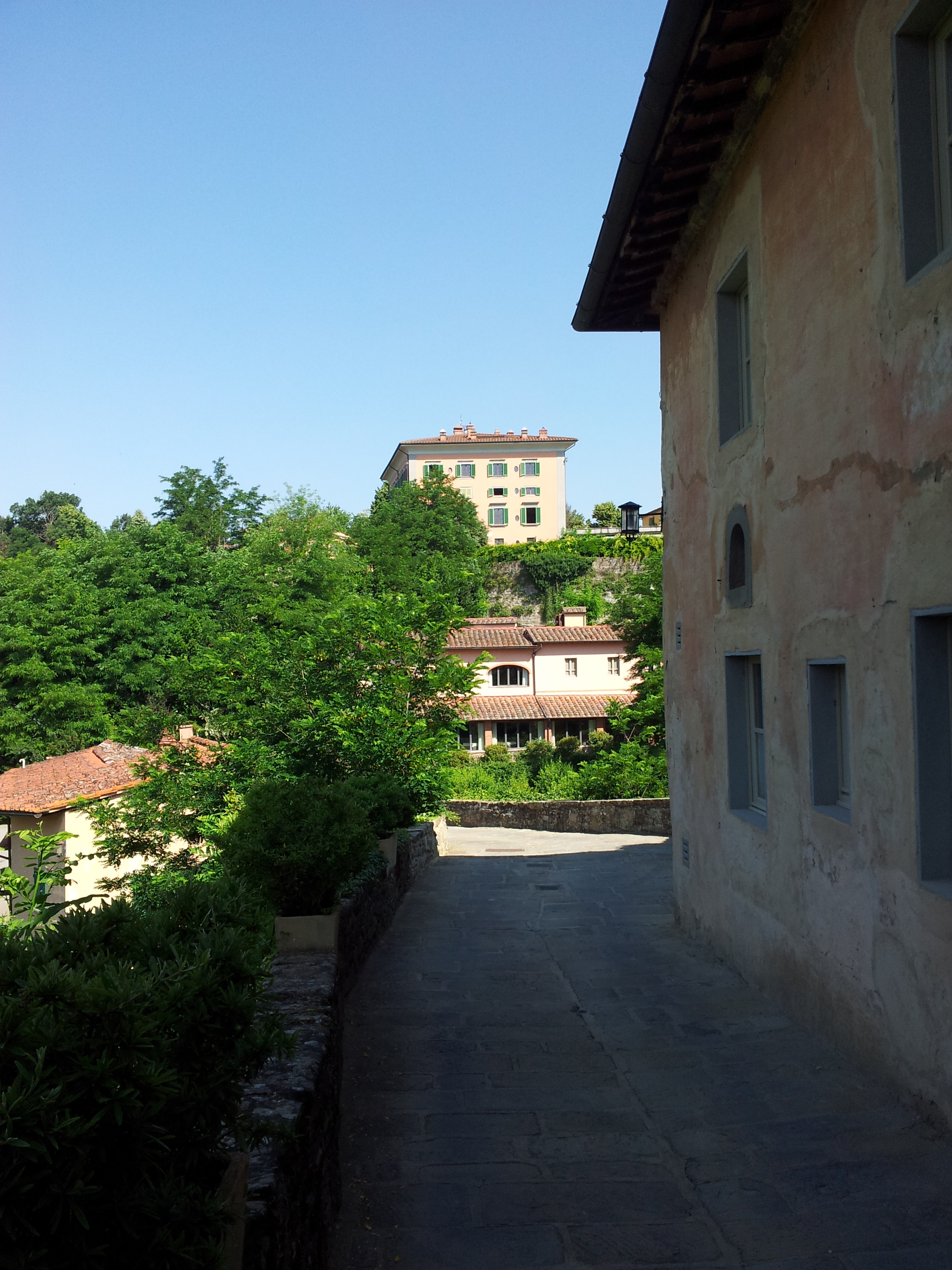
Searching for locations: Somewhere in Tuscany, Italy, a hilltop town

It’s a town we visited in Italy when on a private tour.  Of course, I wrote it down on a notepad app on my phone at the time, and, yes, not long after that, an accidental reset lost all the data.

Now, I have no idea with the name of the town is, just that it was a picturesque stopover in the middle of a delightful private tour of Tuscany.

2013-06-20 10.12.54

There are narrow laneways that I suspect no one 300 hundred years ago planned for cars

2013-06-20 10.17.36

Narrower walkways that lead to very dark places


Walkways on the side of the hills that look down on the picturesque valleys

2013-06-20 10.15.27

And rather interesting hillsides, some of which provided inspiration for Leonardo da Vinci

2013-06-20 10.15.48

Or maybe it was this landscape, though it is difficult to see what could be found as inspiration in such a bland hillside

2013-06-20 10.15.55

A lot of houses, some of them quite large, nestled in amongst the trees

2013-06-20 10.17.41 (2)

Gardens, of sorts, balcony’s, not so big, and hidden doorways

2013-06-20 10.17.53 (2)

Even not so secret passageways between houses.

All in all, it was an interesting visit, and it made me wonder what it would be like to live here, all crowded together, rather than living on our relatively isolated quarter-acre blocks.

Does our education define us?

It’s 2am here, and I’m feeling philosophical, instead of being sleepy and going to bed.

It’s probably the problem most writers have when they’re working on a novel, a short story, or a blog post, or something else.

The other day a thought ran through my mind, whether or not my first school was still standing and if so, would it remember me?

Probably not.  I went there in 1958, I think when I was five.  I stayed there till I finished Grade six and then moved onto secondary school.

In those days, we could stay at secondary school till Form four and then, if we were 15 or over, we could leave.  I went to a technical school, i.e. one that taught a trade, rather than going to a High School which was for the more academically minded and who would go on to University.

But in my day, you had to have rich parents to get into a University, and we were decidedly poor.  It was a technical trade for me, and become a builder was to be my lot in life.

I wasn’t very good and sheet metal, the precursor to plumbing, or machine ship practice the forerunner to being a mechanic, or technical drawing, the forerunner to being a draughtsman

I could have just as easily been a farmer or gardener, it too was on the curriculum.

Where is this going?

Oh, yes.  My old primary school.  Yes, it’s still there, and it still looks like the gothic nightmare it used to.  Gothic or not, I guess those years in that school were good, and I don’t seem to have any bad memories, except,. of course, of the teachers, but that’s only natural.

secondary school, that was a nightmare, so different, and much like going to university, with different classes, different teachers, different rooms, and a lot of other kids who were older, larger, meaner, and made the navigation of early teens an annabilus horribilis four times over.

So the question did my education define me?

No.  I was a builder for a while, but my aspirations led me towards office work, the sort where you start at the bottom and languish there till you’re noticed.

Failing that, you work for a relative, then get headhunted, watch that opportunity slip away, and become an IT teacher that leads to computer programming.

But, as they say, always have a backup plan.

Yep!  Writing.  Been doing it since I was fifteen.

Now, those years I was at school have provided me with a diverse collection of people who have become characters in my stories, and I’m still waiting for the know on the door from the process server to tell me one of them finally recognized him or herself and didn’t like my impression of them.

Hasn’t happened yet.