365 Days of writing, 2026 – 33

Day 33 – Point of view

Point of View: A Simple Lens or a Complex Prism?

When you pick up a novel, a short story, or even a piece of creative nonfiction, the very first thing you notice (even before you meet the characters) is who is telling the story. That “who” is what writers call point of view (POV), and it’s the invisible scaffolding that shapes everything you read—from the smallest visual detail to the deepest emotional undercurrent.

At first glance, POV might look as straightforward as this: “Find a spot in the story, look around, and write what you see.” In other words, the narrator is just a neutral observer, jotting down facts like a journalist on a beat. But seasoned writers and literary scholars will tell you that POV is far more complicated—a multi‑layered, often deliberately ambiguous choice that can turn a bland recount into an unforgettable experience.

In this post, we’ll peel back the layers of point of view, explore why it matters, and give you concrete tools to decide which “lens” best serves your story. By the end, you’ll see that POV is both a place to stand and a set of choices that shape perception, meaning, and emotional resonance.


1. The Classic Taxonomy: “Finding a Spot” in the Narrative Landscape

Before we dive into the nuances, let’s recap the textbook categories most writing courses teach. Think of them as the basic “views” you can take from a hilltop:

POV CategoryWhat It Looks LikeTypical “Spot” on the Hill
First‑person (I/We)“I walked into the kitchen, and the smell of cinnamon hit me.”The narrator is inside the story, a character who sees, feels, and thinks.
Second‑person (You)“You step onto the cracked sidewalk, and the rain catches you off guard.”A rarely‑used “you” that drags the reader directly into the action.
Third‑person limited“She stared at the clock, wishing she could turn back time.”An external observer who knows only what one character thinks/feels.
Third‑person omniscient“While Amelia worried about the presentation, James was already rehearsing his jokes.”An all‑seeing bird’s‑eye view that can dip into any mind at any moment.
Objective (camera‑eye)“The rain fell. The bus pulled away. A man waited.”The narrator records only what could be observed externally—no thoughts, no internal commentary.

These categories are useful starting points. They give you a practical way to “find a place” and describe what you see (or don’t see). But they also hide the richness that makes POV a literary weapon, not just a grammatical label.


2. Beyond the Labels: Why POV Is More Than “What You See”

A. Narrative Voice ≠ Narrative Knowledge

A narrator can have a distinct voice—the way they phrase sentences, their rhythm, their humor—while having limited knowledge. A first‑person narrator can be witty, cynical, or poetic, yet still only know what they personally experience. Conversely, an omniscient narrator can adopt a neutral, detached tone yet peek into any mind.

Example: In The Great Gatsby, Nick Carraway narrates in first person with a reflective, almost scholarly voice, yet he admits he only knows Gatsby through “the rumors and gossip that swirled.” His voice and his knowledge are deliberately mismatched, creating an unreliable yet compelling narrator.

B. Reliability (or Its Absence)

A narrative can be reliable (you trust the narrator’s version of events) or unreliable (the narrator misinterprets, lies, or omits). Unreliability isn’t limited to first person. An omniscient narrator can be unreliable if the story is framed as a historical account that may have been distorted, or if the narrator is a fictional editor who chooses which facts to present.

Example: Gillian Flynn’s Gone Girl is famous for its dual first‑person narrators. Each chapter forces readers to reconsider the truth, showing that POV shapes not just what we see but whether we trust what we see.

C. Subjectivity of Perception

Even “objective” camera‑eye descriptions are filtered through a selection process. Deciding to mention the rain, the bus, and the waiting man—and to omit a stray cat—already tells you something about the narrator’s focus, bias, or thematic agenda.

Example: Ernest Hemingway’s Hills Like White Snow is told in a third‑person objective style, but the choice of dialogue and sparseness makes us feel the tension between the couple without ever stating it directly. The POV is “objective,” yet the narrative’s emotional weight is built upon what’s left unsaid.

D. Temporal Manipulation

POV can also dictate when the story is told. A first‑person narrator might recount events years later, inserting hindsight and revision. An omniscient narrator can hop forward in time to show consequences before cause. The temporal horizon—how far back or ahead the narrator can see—adds further complexity.

Example: In One Hundred Years of Solitude, Gabriel García Márquez uses an omniscient narrator who jumps across centuries, giving readers a panoramic view of a family’s destiny while also sprinkling in foreknowledge that creates a sense of inevitable tragedy.

E. Cultural and Social Lens

Point of view is rarely neutral; it carries the narrator’s social position, cultural background, and worldview. By choosing a narrator from a specific demographic, the writer implicitly (or explicitly) comments on issues of power, privilege, marginalisation, and representation.

Example: The Absolutely True Diary of a Part-Time Kid uses a teenage narrator from a low‑income, biracial background. His first‑person voice is peppered with humor and self‑deprecation, which provides an authentic lens on the challenges of poverty and identity.


3. How to Choose the “Right” POV for Your Story

If POV were just “find a spot and write what you see,” you could pick any perspective at random. In reality, the decision should be strategic, aligning with the story’s goals, themes, and emotional arc.

Decision PointQuestions to AskPossible POV Choice
What does the reader need to know?Do they need intimate access to a character’s thoughts? Or a broader social context?First‑person / limited for intimacy; omniscient for breadth.
Who is the story about?Is the protagonist also the narrator, or is the story about a group?First‑person if central; third‑person limited if following a protagonist but keeping a slight distance.
Do you want to play with reliability?Will you use twists that hinge on reader deception?Unreliable first‑person or biased omniscient (e.g., a “historian” narrator).
What tone do you aim for?Formal, humorous, lyrical, gritty?Voice can be independent of POV, but certain combos feel natural (e.g., second‑person for immersive, experimental tone).
Is the narrative temporal?Do you need flashbacks, foreshadowing, or a non‑linear structure?First‑person with retrospective narration; omniscient for free‑wheeling time jumps.
Who is missing?Whose perspective is absent but could add depth?Consider multiple POVs (alternating chapters) or a chorus of narrators.

Tip: Write a short scene in two or three different POVs. You’ll instantly see how the emotional texture changes. If you feel a version “locks the door” on certain revelations, that’s a clue about what the rest of your story should (or should not) reveal.


4. Experimenting with Hybrid and Unconventional POVs

Modern literature is full of hybrid approaches that blur the textbook categories:

Hybrid TechniqueHow It WorksWhy It Can Be Powerful
Multiple first‑person narratorsAlternating chapters narrated by different characters, each in “I”.Creates a kaleidoscopic view; readers assemble a fuller truth.
Epistolary POVStory told through letters, diary entries, emails.Gives a sense of authenticity and immediacy; the gaps between messages become narrative tension.
Narrator as character + editorA narrator claims to be retelling someone else’s story, adding footnotes or commentary.Allows meta‑commentary and questions about storytelling itself.
Unreliable omniscientAn all‑knowing narrator who admits to gaps or errors.Subverts the expectation that omniscience equals truth; adds a layer of mystery.
Second‑person immersion“You hear the rustle of leaves…” invites the reader to become the protagonist.Engages readers directly; works well in interactive fiction or “choose‑your‑own‑adventure” style stories.
Collective or “We” narrators“We walked the streets of the old town…”Evokes community, shared experience, or cultural memory.

These forms demonstrate that point of view can be a narrative experiment, not just a grammatical decision. They also illustrate how POV can reveal or conceal information in creative ways, affecting pacing, suspense, and thematic depth.


5. Common Mistakes (and How to Fix Them)

MistakeWhy It HappensFix
“Head‑hopping” without signalsSwitching characters’ inner thoughts mid‑paragraph confuses readers.Keep POV switches clear—new paragraph, chapter break, or explicit cue (“Meanwhile,…”).
Using first‑person for a story that needs broad scope“I” feels intimate but can’t naturally convey events far from the narrator.Either expand the narrator’s reach (e.g., through letters, news reports) or switch to limited/omniscient.
Writing an “objective” camera‑eye that still slips into thoughtsThe urge to explain motives leads to hidden omniscience.Stay strictly to observable actions, dialogue, and sensory detail—or choose limited POV.
Forgetting the narrator’s voiceTreating POV as a mechanical label without developing its tone.Give the narrator distinct diction, rhythm, and worldview—treat them as a character.
Using unreliable POV without payoffUnreliable narrators intrigue but must reveal the unreliability eventually.Plant clues (contradictions, missing details) and deliver a reveal that reshapes the story’s meaning.

6. A Mini‑Exercise: From “What You See” to “What You Feel”

Step 1 – Pick a Scene
Write a brief description of a coffee shop: the clatter of cups, the barista’s smile, the rain outside.

Step 2 – Choose Three POVs

  1. First‑person (intimate) – “I tugged my coat tighter as the rain splashed against the window. The scent of espresso wrapped around me like a warm blanket, but my stomach knotted with the interview I’d just missed.”
  2. Third‑person limited (focused) – “Mara watched the rain slide down the glass, feeling the tremor of nerves that made her fingers tremble as she lifted the coffee cup.”
  3. Third‑person omniscient (panoramic) – “The rain hammered the city, flooding streets and pooling in the coffee shop’s doorframe. Inside, the barista rehearsed his smile while the regulars whispered about the storm’s arrival, each lost in their own thoughts.”

Step 3 – Reflect
Notice how each version does more than describe; it filters reality through feelings, backstory, and scope. The “place” you found in the story is now a gateway into a particular emotional world.


7. Bottom Line: POV Is Both a Spot and a Strategy

  • Yes, point of view does involve physically locating yourself in the story—deciding whether you’re a participant, a bystander, or an all‑seeing bird.
  • But it also encompasses voice, knowledge, reliability, temporal reach, cultural lens, and narrative intent. Those layers turn a simple “what you see” into a complex prism that refracts meaning.

When you write, ask not only “Where am I standing?” but also “What do I want the reader to feel, know, or question because of where I’m standing?” The answer will guide you to a POV that does more than report; it creates the story’s emotional architecture.

Takeaway Checklist

  • ☐ Identify the core emotional aim of your piece.
  • ☐ Choose a POV that naturally grants the right amount of knowledge.
  • ☐ Develop the narrator’s voice as a character in its own right.
  • ☐ Decide on reliability—and plant clues if you’re going unreliable.
  • ☐ Keep POV switches clear and purposeful.
  • ☐ Remember that even an “objective” narrator is a selection—be intentional about what you include and exclude.

By treating point of view as both geography (the spot you occupy) and architecture (the design of perception), you’ll transform your storytelling from a simple walk‑through into a richly layered journey that readers can see, feel, and ultimately never quite forget. Happy writing!

“One Last Look”, nothing is what it seems

A single event can have enormous consequences.

A single event driven by fate, after Ben told his wife Charlotte he would be late home one night, he left early, and by chance discovers his wife having dinner in their favourite restaurant with another man.

A single event where it could be said Ben was in the wrong place at the wrong time.

Who was this man? Why was she having dinner with him?

A simple truth to explain the single event was all Ben required. Instead, Charlotte told him a lie.

A single event that forces Ben to question everything he thought he knew about his wife, and the people who are around her.

After a near-death experience and forced retirement into a world he is unfamiliar with, Ben finds himself once again drawn back into that life of lies, violence, and intrigue.

From London to a small village in Tuscany, little by little Ben discovers who the woman he married is, and the real reason why fate had brought them together.

It is available on Amazon here:  http://amzn.to/2CqUBcz

An excerpt from “The Things We Do for Love”; In love, Henry was all at sea!

In the distance, he could hear the dinner bell ringing and roused himself.  Feeling the dampness of the pillow and fearing the ravages of pent-up emotion, he considered not going down but thought it best not to upset Mrs Mac, especially after he said he would be dining.

In the event, he wished he had reneged, especially when he discovered he was not the only guest staying at the hotel.

Whilst he’d been reminiscing, another guest, a young lady, had arrived.  He’d heard her and Mrs Mac coming up the stairs and then shown to a room on the same floor, perhaps at the other end of the passage.

Henry caught his first glimpse of her when she appeared at the door to the dining room, waiting for Mrs Mac to show her to a table.

She was in her mid-twenties, slim, with long brown hair, and the grace and elegance of a woman associated with countless fashion magazines.  She was, he thought, stunningly beautiful with not a hair out of place, and make-up flawlessly applied.  Her clothes were black, simple, elegant, and expensive, the sort an heiress or wife of a millionaire might condescend to wear to a lesser occasion than dinner.

Then there was her expression; cold, forbidding, almost frightening in its intensity.  And her eyes, piercingly blue and yet laced with pain.  Dracula’s daughter was his immediate description of her.

All in all, he considered, the only thing they had in common was, like him, she seemed totally out of place.

Mrs Mac came out of the kitchen, wiping her hands on her apron.  She was, she informed him earlier, chef, waitress, hotelier, barmaid, and cleaner all rolled into one.  Coming up to the new arrival, she said, “Ah, Miss Andrews, I’m glad you decided to have dinner.  Would you like to sit with Mr Henshaw, or would you like to have a table of your own?”

Henry could feel her icy stare as she sized up his appeal as a dining companion, making the hair on the back of his neck stand up.  He purposely didn’t look back.  In his estimation, his appeal rating was minus six.  Out of a thousand!

“If Mr Henshaw doesn’t mind….”  She looked at him, leaving the query in mid-air.

He didn’t mind and said so.  Perhaps he’d underestimated his rating.

“Good.”  Mrs Mac promptly ushered her over.  Henry stood, made sure she was seated properly and sat.

“Thank you.  You are most kind.”  The way she said it suggested snobbish overtones.

“I try to be when I can.”  It was supposed to nullify her sarcastic tone, but it made him sound a little silly, and when she gave him another of her icy glares, he regretted it.

Mrs Mac quickly intervened, asking, “Would you care for the soup?”

They did, and, after writing the order on her pad, she gave them each a look, imperceptibly shook her head, and returned to the kitchen.

Before Michelle spoke to him again, she had another quick look at him, trying to fathom who and what he might be.  There was something about him.

His eyes mirrored the same sadness she felt, and, yes, there was something else, that it looked like he had been crying.  There was a tinge of redness.

Perhaps, she thought, he was here for the same reason she was.

No.  That wasn’t possible.

Then she said, without thinking, “Do you have any particular reason for coming here?”  Seconds later, she realised she’d spoken it out loud, hadn’t meant to actually ask, it just came out.

It took him by surprise, obviously not the first question he was expecting her to ask of him.

“No, other than it is as far from civilisation, and home as I could get.”

At least we agree on that, she thought.

It was obvious he was running away from something as well.

Given the isolation of the village and lack of geographic hospitality, it was, from her point of view, ideal.  All she had to do was avoid him, and that wouldn’t be difficult.

After getting through this evening first.

“Yes,” she agreed.  “It is that.”

A few seconds passed, and she thought she could feel his eyes on her and wasn’t going to look up.

Until he asked, “What’s your reason?”

Slightly abrupt in manner, perhaps, because of her question and how she asked it.

She looked up.  “Rest.  And have some time to myself.”

She hoped he would notice the emphasis she had placed on the word ‘herself’ and take due note.  No doubt, she thought, she had completely different ideas of what constituted a holiday than he, not that she had said she was here for a holiday.

Mrs Mac arrived at a fortuitous moment to save them from further conversation.

Over the entree, she wondered if she had made a mistake coming to the hotel.  Of course, there had been no conceivable way she could know that anyone else might have booked the same hotel, but she realised it was foolish to think she might end up in it by herself.

Was that what she was expecting?

Not a mistake then, but an unfortunate set of circumstances, which could be overcome by being sensible.

Yet, there he was, and it made her curious, not that he was a man, by himself, in the middle of nowhere, hiding like she was, but for quite varied reasons.

On discreet observation, whilst they ate, she gained the impression his air of light-heartedness was forced, and he had no sense of humour.

This feeling was engendered by his looks, unruly dark hair, and permanent frown.  And then there was his abysmal taste in clothes on a tall, lanky frame.  They were quality but totally unsuited to the wearer.

Rebellion was written all over him.

The only other thought crossing her mind, and incongruously, was that he could do with a decent feed.  In that respect, she knew now from the mountain of food in front of her, he had come to the right place.

“Mr Henshaw?”

He looked up.  “Henshaw is too formal.  Henry sounds much better,” he said, with a slight hint of gruffness.

“Then my name is Michelle.”

Mrs Mac came in to take their order for the only main course, gather up the entree dishes, and then return to the kitchen.

“Staying long?” she asked.

“About three weeks.  Yourself?”

“About the same.”

The conversation dried up.

Neither looked at the other, but rather at the walls, out the window, towards the kitchen, anywhere.  It was, she thought, unbearably awkward.

Mrs Mac returned with a large tray with dishes on it, setting it down on the table next to theirs.

“Not as good as the usual cook,” she said, serving up the dinner expertly, “but it comes a good second, even if I do say so myself.  Care for some wine?”

Henry looked at Michelle.  “What do you think?”

“I’m used to my dining companions making the decision.”

You would, he thought.  He couldn’t help but notice the cutting edge of her tone.  Then, to Mrs Mac, he named a particular White Burgundy he liked, and she bustled off.

“I hope you like it,” he said, acknowledging her previous comment with a smile that had nothing to do with humour.

“Yes, so do I.”

Both made a start on the main course, a concoction of chicken and vegetables that were delicious, Henry thought when compared to the bland food he received at home and sometimes aboard my ship.

It was five minutes before Mrs Mac returned with the bottle and two glasses.  After opening it and pouring the drinks, she left them alone again.

Henry resumed the conversation.  “How did you arrive?  I came by train.”

“By car.”

“Did you drive yourself?”

And he thought, a few seconds later, that was a silly question; otherwise, she would not be alone, and certainly not sitting at this table. With him.

“After a fashion.”

He could see that she was formulating a retort in her mind, then changed it, instead, smiling for the first time, and it served to lighten the atmosphere.

And in doing so, it showed him she had another, more pleasant side despite the fact she was trying not to look happy.

“My father reckons I’m just another of ‘those’ women drivers,” she added.

“Whatever for?”

“The first and only time he came with me, I had an accident.  I ran up the back of another car.  Of course, it didn’t matter to him that the other driver was driving like a startled rabbit.”

“It doesn’t help,” he agreed.

“Do you drive?”

“Mostly people up the wall.”  His attempt at humour failed.  “Actually,” he added quickly, “I’ve got a very old Morris that manages to get me where I’m going.”

The apple pie and cream for dessert came and went, and the rapport between them improved as the wine disappeared and the coffee came.  Both had found, after getting to know each other better, that their first impressions were not necessarily correct.

“Enjoy the food?” Mrs Mac asked, suddenly reappearing.

“Beautifully cooked and delicious to eat,” Michelle said, and Henry endorsed her remarks.

“Ah, it does my heart good to hear such genuine compliments,” she said, smiling.  She collected the last of the dishes and disappeared yet again.

“What do you do for a living?” Michelle asked in an offhand manner.

He had a feeling she was not particularly interested, and it was just making conversation.

“I’m a purser.”

“A what?”

“A purser.  I work on a ship doing the paperwork, that sort of thing.”

“I see.”

“And you?”

“I was a model.”

“Was?”

“Until I had an accident, a rather bad one.”

“Oh, I’m sorry.”

So that explained the odd feeling he had about her.

As the evening wore on, he began to think there might be something wrong, seriously wrong with her because she didn’t look too well.  Even the carefully applied makeup, from close, didn’t hide the very pale, tired look, or the sunken, dark-ringed eyes.

“I try not to think about it, but it doesn’t necessarily work.  I’ve come here for peace and quiet, away from doctors and parents.”

“Then you will not have to worry about me annoying you.  I’m one of those fall-asleep-reading-a-book types.”

Perhaps it would be like ships passing in the night, and then he smiled to himself about the analogy.

Dinner over, they separated.

Henry went back to the lounge to read a few pages of his book before going to bed, and Michelle went up to her room to retire for the night.

But try as he might, he was unable to read, his mind dwelling on the unusual, yet compellingly mysterious person he would be sharing the hotel with.

Overlaying that original blurred image of her standing in the doorway was another of her haunting expressions that had, he finally conceded, taken his breath away, and a look that had sent more than one tingle down his spine.

She may not have thought much of him, but she had certainly made an impression on him.

© Charles Heath 2015-2024

lovecoverfinal1

In a word: More

Well, I want more!  Don’t we all, in fact, the more we get, the more we want.

That form of more is almost always attainable.

Or in other circumstances, I could like chicken legs more than chicken wings.

Or should we say, not to be confused with moor.

Like moor the boat, tug, ship, raft, canoe, or anything that floats.

Like taking a long walk across the moor, a piece of uncultivated land that is well grassed, or sometimes, in spooky stories, even swampy.

Just avoid the moor where the hound of the Baskervilles is lurking.

And here’s something obscure, More is the language of the Mossi from Burkino Faso

Or a Moor is a member of north-western African Muslim of mixed Arab and Berber descent

Harry Walthenson, Private Detective – the second case – A case of finding the “Flying Dutchman”

What starts as a search for a missing husband soon develops into an unbelievable story of treachery, lies, and incredible riches.

It was meant to remain buried long enough for the dust to settle on what was once an unpalatable truth, when enough time had passed, and those who had been willing to wait could reap the rewards.

The problem was, no one knew where that treasure was hidden or the location of the logbook that held the secret.

At stake, billions of dollars’ worth of stolen Nazi loot brought to the United States in an anonymous tramp steamer and hidden in a specially constructed vault under a specifically owned plot of land on the once docklands of New York.

It may have remained hidden and unknown to only a few, if it had not been for a mere obscure detail being overheard …

… by our intrepid, newly minted private detective, Harry Walthenson …

… and it would have remained buried.

Now, through a series of unrelated events, or are they, that well-kept secret is out there, and Harry will not stop until the whole truth is uncovered.

Even if it almost costs him his life.  Again.

The cinema of my dreams – I always wanted to write a war story – Episode 55

For a story that was conceived during those long boring hours flying in a steel cocoon, striving to keep away the thoughts that the plane and everyone in it could just simply disappear as planes have in the past, it has come a long way.

Whilst I have always had a fascination with what happened during the Second world war, not the battles or fighting, but in the more obscure events that took place, I decided to pen my own little sidebar to what was a long and bitter war.

And, so, it continues…

We were not leaving the castle the way we had found it, but we would blame the Germans.  Carlo understood because he was the one who had selectively destroyed parts of it, but I knew after we’d gone, he would blame us.

When Carlo discovered the empty cells below in the dungeons, he and the boy went back outside and looked for them.  I didn’t have the heart to tell him that Wallace would have ordered them removed and executed because Meyer had been the objective and everything else was a distraction.

Two of Blinky’s soldiers were assigned to bring back Chiara.

Blinky and the rest of his men moved into better quarters and had their first real meal in a week.  We posted sentries, but I didn’t think any Germans would be coming to see what happened.  The sentries were more to tell us when Meyer and his escort arrived.

Blinky would then be the official escort for Meyer back to England.  A plane was on standby waiting for our signal.

Several hours after Carlo left, he returned with Martina and Johanneson, the latter looking very worse for wear.

The last of the traitors.

Carlo shoved him into a chair and bound him very tightly.

“We found the prisoners, all shot.  Fernando’s remnants killed them.  I will make it my business to find every last one of them.  What do you want to do with this traitor?”  He nodded in Johannesen’s direction.

Martina had slumped into a chair.  She still wore the very recent scars of a severe beating and was out on her feet.  Despite that, I got the impression she was glad to be alive.

“Was he responsible for anything that happened while you were in the cells?” I asked her.

“He saved me if that could be called an act of kindness.  He did nothing to save the others.”

“If you had a choice?”

“I’d shoot him.”

“Now hang on.  Since when did good Samaritans get punished?”  Johannesen was outraged.

I shrugged.  “You will be judged on past sins.”

Martina looked up.  “He was the leader of the group that destroyed the church.  It was our original headquarters, down in the basement.  We managed to get away, with a few injuries, but it took out our equipment and radio.”

“There,” he said.  “My intention was destroying infrastructure not lives.”

“Coincidental.”

I got up and walked over to Martina and gave her my gun.  “I’ve done enough killing for today.  Perhaps a small token of retribution for those lost.”

“Chiara?”

“She will be here shortly.  We found her just in time.”

“Thank God for that.”

I don’t think she had it in her to enjoy the moment she executed Johannesen, I don’t think it was worth celebrating a death, more lamenting the loss of yet another person in a war that seemed to be dragging on.

At least he accepted his fate and didn’t plead for his life.

It was mission accomplished.

Blinky’s radioman finally reconnected with Thompson and told him that we were awaiting the arrival of Meyer and that he could tell those up the pipeline it was safe to bring him to the village.  He would then signal when the plane was in the air.  Thompson was pleased enough to give me a ticket back to London.  All we had to do was collect Meyer.

That was Carlo and my job, and for the last time, I went back down into the village and waited.

I was not sure who was more relieved, Meyer or myself.  I’d met him once before the war, at a University in Hamburg where he was working on a top-secret project, and I was studying the archaeology of some old castles nearby.

I’d been tasked to find out what he was doing, my rather bright future in archaeology was never going to take off in those dark months that followed Chamberlain’s peace treaty.  Everyone but him seemed to know that war was inevitable.

He’d spent time telling me about the stars and planets, and how wonderful it would be to visit them one day in the not-too-distant future.  From that, we inferred that the Germans were working on space travel, though you never really could tell what they were up to.

It simply meant if things went bad, we needed to touch base every now and then with Meyer, which I did, in a friendly manner and never directly asking what he was up to.  That contact had paid off, and he had made contact asking me if it was possible to come live in England.

Thompson had been very pleased.

“Herr Atherton,” he said, rather relieved to see me.

“Herr Meyer.”

We shook hands, and then he hugged me like an old friend would.  “You came.”

“You asked.  I do my best?”

“We leave now?’

“We very definitely leave now.”

I left Carlo with the escorts to explain the new arrangements, far away from the castle, and I took Meyer back to the castle.  Along the way we talked, not of rockets and death, but of old times in Berlin, and how Germany used to be before this crazy person called Hitler had sent them down the path to self-destruction.

Perhaps, he said, one day he might be able to return.

I hoped I would not, not until the war ended, but that being a forlorn hope, not until I had a very long, well-earned rest.

But this was Thompson we were talking about, and his favourite saying was ‘There’s no rest for the wicked’.

© Charles Heath 2021-2023

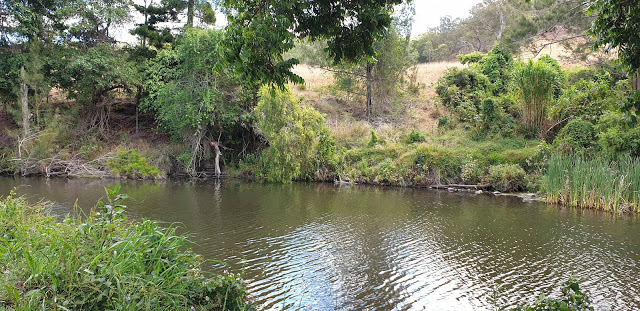
A photograph from the inspirational bin – 19

Does a rainy, cold, miserable sort of day usually reflect your mood?

It could be said the outlook is bleak, but from where I’m sitting, it might be more picturesque.

This photo was taken from the veranda of one of four cottages that have, one one side, a macadamia farm, and on the other, a valley with a small river running through it.

I’m told there is reasonably good fishing in the river.

But, on a good day, with blue skies and sunshine, the outlook is completely different.

This is the sort of place you go to do nothing, perhaps read a book, do a crossword, but nothing substantial.

We come here to wind down, and take several days to do it.

But, as for a story…

I have in mind a theme of a man on the run, from his past, his demons, and a very dangerous criminal.

Yes, it’s that old story of someone witnessing what they shouldn’t, and paying the price because they did.

Now, hiding out in the country, it’s only a matter of time before they are discovered.

The cinema of my dreams – Was it just another surveillance job – Episode 38

I’m back home and this story has been sitting on a back burner for a few months, waiting for some more to be written.

The trouble is, there are also other stories to write, and I’m not very good at prioritizing.

But, here we are, a few minutes opened up and it didn’t take long to get back into the groove.

Chasing leads, maybe

I’d expected more questions from her, but the ride in the train to Wimbledon, and then to the car, she had very little to say.  There was no doubt she was intrigued by the offer, but there was some trepidation too.

But it didn’t auger well for her longevity if she trusted people this easily.  I had expected a lot more questions if only to find out what the job was.  

Then, by the time we reached my car, it seemed she had time enough to think about everything.

“How do I know you’re not going to kill me too?”

She was standing on the other side of the car, yet to open the door.  I was about to get in.

I looked at her across the roof.

“I could have done that ages Ago if that was my intention.”

“Not in a public space unless absolutely necessary.”

She was quoting the manual.

“So, I’m about to take you to a quiet spot in the country and shoot you?”

“Unlikely.  You don’t have a gun with you.”

“A knife then?”

“I’m sure you don’t have one of those either.  Besides, there’s a few other ways that don’t require weapons.”

I was astonished this was the conversation.

“I asked for your help, and that wasn’t to practice my killing skills.  But, where we’re going that might happen to either of us.”

“Where are we going?”

“To a residence in Peaslake.  Do you know of it?  It’s about an hour away, southwest, I think.  I’m not expecting to find anyone, but I am looking for a USB drive.”

“This O’Connell character’s?”

“Yes.”

A few seconds passed as she took that in, then, “If you are not expecting anyone to be there, why do you need me?”

“Rule whatever number it was, expect the unexpected.  And get back up if it’s available.  And there are other people looking for these documents, and the USB.  Not friendly people I might add.  I have no idea if they have the same information I have, so I’m expecting the unexpected.  We have worked together and you know me.”

We had performed several assignments together for training purposes, as each of us had with the other four.  She hadn’t been the best, but she hadn’t been the worst.

I saw her shrug.  Acceptance?

She opened the door and got in.

It took me 15 minutes to get to the A3 and head towards Guildford.

A few minutes later she asked, “What the hell did we sign up for?”

“What do you mean?  I thought it was pretty straight forward.  Something other than a dull as ditchwater 9 to 5 job behind a desk.”

“I mean, don’t you think it’s odd we do all of this stuff for 6 months, almost to the day, then get an assignment, and it all goes wrong.”

“That our instructors were frauds?”

“We didn’t know that, and apparently they didn’t either.  Do you know if any of it was real?”

“Seemed to me it was.  And we only have this Monica’s word that Severin and Maury are frauds.  I mean, I was surprised to learn they allegedly didn’t exist, but you and I both know that in organizations like the security services have wheels within wheels, departments unknown to other departments, event MI5 or the police, so who’s to say what really happened.”

“And you say you now work for this character Dobbin, whose another department head.  As is this Monica.”

Put like that, it seemed very confusing.

“There are others that I’ve run into, working for both Dobbin and for Severin.”

“You mean Severin is still out there?”

“Yes.  He tracked me down.”

And when I said it out loud, it crossed my mind why he hadn’t come after her, but the answer to that was he might have thought I was the only one that O’Connell hadn’t killed.

“And he thinks you are still working for him?”

“It’s complicated.  I’m kind of doing a soft shoe shuffle around all of them and trying to find out what the hell is going on while keeping them at arm’s length.  That might go horribly wrong which is also a good reason why I need help.  We really should find out what we got into.”

“I’d prefer not to.  He hasn’t come after me.”

“He will.  It’s only a matter of time.  You’re in the system, and I have no doubt he has access to that system.  You’ve just been lucky so far.  And you equally know as I do, there’s no such thing as luck in our line of work.”

Another minute or so passed.

Then she said, “If you’re trying to scare the hell out of me, it’s working.”

© Charles Heath 2020

365 Days of writing, 2026 – 31/32

Days 31 and 32 – Writing exercise – Use – “I really wish you would…”

There is this thing with mixed messages and intentions: unintentional consequences.

My parents, God rest their souls, brought me up to take everyone at face value.  A lot of others thought this was probably the most idiotic advice any parents could give their child, but it had served me well over the years.

People were generally good.

But, as anyone with the benefit of hindsight will tell you, there’s always someone who will let you down,
someone who says one thing and means something else, someone who will take advantage of a situation, and someone who is just not capable of making a commitment.

Sarah and I started as interns on the same day, two of twenty, the company’s commitment to taking 10 University graduates each half year.

After each of us went through a three-month probationary period, being introduced to all facets of the five main departments, Engineering, Supply, Accounting, Management and Distribution, we were then appointed to the Department where the Head had put in a request to HR.

We became administrative assistants and started at the bottom of the selected department.  I was selected to work in Accounting, Sarah Management.

Management was a first choice, Accounting was a last choice.  She was happy, I didn’t care.  At the orientation, we were told that after two years you would be free to select a different department, provided there was a role available.

There was also the possibility of going offshore, with the company having offices in the major cities worldwide.  Those were jobs that you would be appointed to if the committee considered you suitable.  That took time, sometimes up to 10 years, and openings were rare.  People literally had to die to create an opening.

Another saying my parents often used was, slow and steady wins the race.  Some people, of course, wanted it all – yesterday!

It was never a foregone conclusion that Sarah and I would have a relationship; to me, it seemed like it just happened.

One day, we were sitting in the cafeteria, and she was saying her roommate was getting married, and she was on the street. The next day, she was moving in.

To her, it ticked all the boxes, and we were sort of ‘aligned’.

She was a tireless worker and put in the hours and dedication she believed would make her worth being noticed and, therefore, earn a promotion.

I was the ‘work smarter, not harder’ type and spent the time to learn every job within my level, and then understand the mechanics of the department.  I had learned that a manager, when one became a manager, was the one who understood everyone’s job, every cog in the wheel, so when I was needed, I could step in.

Most of the people I worked with either struggled with the individual workload or didn’t want extra strings to their bow.  Only those with ambition stepped out of their comfort zone.  It was an attitude I didn’t get.  They were university graduates and meant to be competitive.  After all, they had made the effort to get employment with the company?

I knew Sarah was competitive and ruthless in her pursuit of achieving the most.  If there were a board that had points on it, she would be at the top.

I admired her work ethic, but over time, not so much the ‘by any means possible’.  I thought she was lamenting the lack of co-operation from other junior executives, but gradually realised she was not above using them as steps, or sabotaging them.

Because we were living together, I realised that the others thought I was tarred with the same brush, that notorious thing called guilt by association.  And it surprised me, until the day I discovered, quite by accident, that I was also in the firing line.

That was a bad day, and one where I deigned not to go home.  Instead, I booked into a posh hotel and decided to stay there for the week.

Something else I learned: a round of promotions was coming up, and one of our group would be considered, unprecedented after just a single year into our apprenticeship.

After the first night alone, I was sitting at my desk.  I had chosen not to take an office but be out with the rest of the staff, because it was so much easier to gauge the mood of the people you work with, and how things were going.

It was my exercise of a variation of the ‘leaning to be a leader’ book that I was hypothetically writing.

I had come in early.

Sarah must have had a surveillance system in place that warned her when I arrived at my desk.

She could move quickly and quietly like an assassin.

“Where were you last night?”

There was never a good morning, or how did you sleep? It was business or grumpiness.  Sarah was not a morning person.

“Slumming it in a bar.”  I could have been out with another woman, like Celia from Supply, but I wasn’t.
“I had a bit too much to drink, so I staggered to a hotel.”

“A good one?”

I was used to her interrogation techniques.

“Sleazy.  Subconscious I was probably reliving a distant memory.  The place felt familiar.”

“You don’t strike me as the type.”

That was an interesting comment coming from her.  We’d never been that close to have a deep and meaningful exchange.  I shrugged.  “We all harbour a few deep dark secrets, Sarah.  Have you got any?”

She glared at me because, being a master of her craft, she knew when it was being used back on her.

“You know me.”

She didn’t sit.  She prowled, and it could be disconcerting.

“Better that you might think.  Are you here for a reason?”

“I come to see how you are.  When you didn’t come home…”

“I didn’t think it mattered.  It’s not as if we were dating.”

“We live together.”

“Not the same thing.”  I tried to keep that small amount of resentment I was harbouring from leaking out.  “We had this same conversation two years ago, and things are still the same.  If you’re after the promotion, go for it.  I’m not interested at this stage.”

She gave me another look, this time wary.  Perhaps she decided that I was exercising some subtle plan to get her guard down and usurp the position.  I wasn’t going to tell her I told HR to excuse me from it.  They were surprised and not surprised.

“Why wouldn’t you want to advance if the company thinks you can do the job?”

“I don’t think I’m ready.  One thing I’ve learned in the year here is that you’ll be given the opportunity, but they’ll pile it on.  I’m sure you can handle it, you’ve had a few difficult problems dropped in your lap and passed with flying colours.  Truth be told, you’re more focused than I am.”

Her expression changed, and she dragged a seat across from the desk next to mine and flopped in it.  She was thinking, most likely, about what my game was. 

“What are you up to?”

Of course, it was not quite what I expected, but it was a predictable reaction. 

“I don’t think like you, Sarah.  Not everyone does.  It can be good, or it can be viewed in an entirely different way than your expectations.  But you must do what you think is necessary for you.”

Perhaps that wasn’t what she wanted to hear.

“What about us?”

“I think you might have heard this before, from far wiser people than me, but it doesn’t matter if you have to sacrifice your hopes and dreams.  You’re too young and good at what you do to give up so soon.  Relationships can’t survive ambition, especially in a place like this.  It’s why I’ve tried to keep several pages back so you have that freedom.  If you feel otherwise, then maybe we can talk about it?”

She leapt out of the seat, mind made up.  I could tell that whatever it was, I wasn’t in it, and I was fine with that.

She looked at her watch, her go-tov mannerism for escaping without explanation.

“Got to go.  Meetings, deadlines.”

Or an appointment with HR.  My spy in HR just sent me an email.  She would have received the notification on her watch.  She had a full range of electronic gadgets.

Me, I was mostly old-fashioned.

What surprised me was a call from HR two days later, without getting the usual heads-up from my spy.

In that time I had seen Sarah several times and spoke briefly to her once.  I was still at the hotel, and i think after the last conversation, she was avoiding me

I suspect that had something to do with her two-hour meeting with one of the HR managers.  She had not seen the department head.

The head of the department was Crafton, a woman who had the nickname Crafty because you could never know what she was thinking.  If you were lucky enough to see her.

She was rarely seen, so rare that she was a legend among the staff, some of whom believed she didn’t exist, and just the thought of her being somewhere or everywhere in the building was enough to keep the staff on their toes.

For us newbies, it worked.

I went up to the executive floor, stated my business and then waited in chairs that were far more comfortable than those issued to the staff.

Everything about the executive level was amazing.  This was only the second time in a year for me.  That for a newbie was unprecedented.

A door opened in front of me, and a young, immaculately dressed lady came out.

“Mr Denver?”

“Yes.”  I stood.

“Follow me.”

We went through the door and into a fairy wonderland, or that’s how my imagination painted it.  In reality, it was a series of office suites, each with a personal assistant and another, all working so hard, none looked up.

It was as if I didn’t exist.  I probably didn’t in their eyes.

Five suites along, we stopped at a door and she knocked.  A muffled ‘Come’ filtered through, and she opened the door.

She didn’t follow me in.  One Christian ready to be thrown to the lions.  The door shut, and my fate was sealed.

Behind a huge mahogany desk was an elderly woman, older than my grandmother and she was about 80.  She fitted into the room, very much a part of it.  There were painted portraits on the wall, one of her as a teenager, a mother and daughter, and a recent one.

Milestones?

“Please sit, Evan.  People standing make me nervous.”

It was not the voice of an elderly woman.

I did as I was told.

“Do you know who I am?”

“She who does not exist?”

I don’t know why I said that, but if she were tossing me back out in the street, I would speak freely.  Of course, my tone reflected the degree of awesome, making it very shaky.

“You didn’t call me Crafty.”

“I may be stupid, but I’m not suicidal.”

She smiled.  “You’re a strange one, Evan.  To tell you the truth, an employee file crosses my desk about once every five years.  This year I got two.  You, and a pesky creature by the name of Sarah.  Tell me about her?”

What was this, a test?  It was one of those questions where there was no right answer and only wrong answers.  But, on the other hand, not answering meant a fate worse than death.

“She was one of the last group.  Hard worker, puts her head down and tail up, gets the job done.  Focussed.”

She looked at me, and I could almost see her considering and evaluating my comments.  The last told me she didn’t think I was giving her what she asked for.

A smile.  That of an assassin?

“If I asked you for your true opinion, would you give it?”

Yep.  This woman could see through a yard of solid steel and right into your soul.  If I were smart, i would leave now.

“Is it necessary?”

She smiled, one that showed a whole different character.  Warm.

“For someone placed in the most underperforming section in the whole company and turning it into the most productive and happy, you seem to have a gift for analysing human beings and figuring out how to get the best out of them.  Your opinion will be highly regarded, if it’s the truth.”

“Isn’t that sort of assessment the preview of the senior staff in Human Resources?”

“Three people from HR tried and failed, and they’ve been involved with staff collectively for 60 years.  The answer is, this time, no.  What you say will never leave this room.  But, it’s up to you whether you trust me.”

This woman was scary.  But only I felt I could trust her. 

“Surely her supervisor…”

A look silenced that line of thought.

I sighed.  “She is a good worker.  Out of all of our group, she deserves a promotion.  The qualifier is that someone needs to impress upon her that the ends do not justify the means, and to respect her fellow workers below her as well as above.”

“You live with her.”

“We share my apartment.  We do not share a bed.  It is not that sort of relationship.”

“Would you want it to be?”

“Maybe at first.  But living together shows little things that come out, sometimes after the wedding, which can be problematic.  I don’t think I could handle her ambition because she would choose that over me every time.”

“Now, that wasn’t so hard?”

“It may or may not be true.”

“It is.  She was interviewed two days ago and said as much.  Her comments about you were freely given, along with half a dozen others she perceived to be rivals.  She was not as flattering as you were about her.”

No surprise there then.  Getting the promotion by any and all means necessary was her unspoken motto.

“Doesn’t mean she’s not right.”  I don’t know why I said that, perhaps thinking I had just sunk to her level.

“You don’t know what she said.”

“I can imagine.  We have conversations, and every now and then she’d slip in a, ‘I really wish you would…’ and then tell me what I was doing writing, in her eyes.  Perhaps she thought she was helping me be a better candidate.”

“It didn’t matter.  Your supervisor said basically the same things, but sometimes people only see what they want to see, or worse, see that you’re a threat to their position.  He achieved nothing until you arrived, and then was quick to take credit for the change.  He will be leaving at the end of the month.  You will be coming up here with my section.  If you want to, that is.”

“On this floor?”

“Of course.  You’ll have a team, and the mission will be to improve staff morale and productivity.  And after that, you might get my job.”

“And Sarah?”

“We’re sending her to London for a year.  I believe, like you, she is a good worker and focused, but trampling those under her is not a good trait.  Morgan in London will sort that out.  If he doesn’t, we will let her go.  Now, be off with you.  I have to disappear into the walls.  Yes, the walls do have ears.”

She smiled at her own joke.

“Keep this to yourself.  The board will be ratifying it next week.”

On the other side of the door, where the personal assistant glanced up as i walked past, I realised I didn’t ask what the pay and perks were.  Perhaps another time.

Sarah and I danced around each other, never quite meeting in the middle, until she called me and asked me to come home.

I could have said no, but I was curious what she would say.  I wasn’t going to ask, just let her set the agenda.

I didn’t knock, after all, it was my place, not hers, though at times it felt like it wasn’t.  If anything was to be learned from this, it was not to be too acquiescent.  Or what I heard someone say, be a pushover.

She was sitting on the kitchen counter, which was an unusual place.  Her bags were by the door, packed and ready to go.  Travelling light for her, and especially for an extended sojourn on the other side of the Atlantic.

There was a difference in her, the scowl gone and a much lighter demeanour.  Almost as if she could finally relax.

“Thank you for coming.  I wasn’t sure if you would.”

“Curiosity killed the cat.  I still have nine lives.”

“If I had done what I was considering, perhaps you might have spent two.”

Enigmatic and frivolous, a side of her I’d never seen before.  Was she capable of being fun-loving?

I changed the subject.  “You’re leaving.”  It was a statement rather than a question.

“You know I am.  London.  Probably to spend twelve months in the tower before being beheaded.”

“It’s not all bad.  Overseas posting.  Only for those who…”

“Are given a choice between being tossed out on their sorry ass, or promising to stop acting like they did at school.  I can fool most of the people some of the time and those who matter not at all.  I picked you as the one most likely to succeed and attached myself to your wagon.  I’m not proud of what I did, but it was all I knew about how to succeed.”  She shrugged.  “I was wrong, and I apologise.”

“You did what you thought you had to.  Right or wrong, it doesn’t matter.”

I was not sure if this was a tongue-in-cheek apology or something else.  I knew kids at school who used everyone else to get them through, by any and all means.  It took a while to see through her facade.

“Grandma told me you defended me even when you found out what I did.  Why?”

Grandma.  Don’t tell me she was related to Crafty.

“You’re a good worker, focused, except for the methodology.  In companies like this, results matter.”

“If it’s done properly.  Grandma does not like what she calls the ‘by any and all means’.”

“Who is this Grandma?”

“Crafty.  She never comes into the office, never has anything to do with the staff, except you.  She told me that if I were like you, well, you get the drift.  She told me from the beginning to work with you.  With.   I didn’t.   She says I’m lucky I’m going to London because anyone else would be fired.  She said I was a fool to take advantage of someone who clearly likes you, without knowing who you are.”

“Perhaps not as much as earlier in our apprenticeship.  I like you, and got a chance to get to know you…”

“Before you made a mistake?”

“People are who they are.  Now that you’ve told me who you are, it all makes sense.  Not a mistake, just you would have to change, and I wouldn’t ask you to do that.  Relationships that work are where both make compromises to make it work.”

“What if I said I would try?”

“Well, you have a year in London.  Penance, or an opportunity.  It’s up to you.  I might not be worth it.  I’m certainly not in your social circle, and certainly from the wrong side of the tracks.  What would Grandma think?”

“My ass is still sore from where she kicked me.  A year, huh?  You will come and see me?”

“We’ll see.  You could come and see me.”

“I don’t think so.  No allowance, only a salary, and no help finding my way.  I have to survive on my own.  It’s a bit mean, but I get it.  She’s trying to teach me some life lessons.”

She slid off the bench and stood in front of me, then kissed me on the cheek.

“It’s going to be cold and wet in London, isn’t it?”

“You’ll survive.  We all do.  And yes.  I’ll come and see you.  Now you have to go.”

I helped her down to street level and into a taxi.  No limousine for her.  It was the first day of the new and improved Sarah.

Maybe.

©  Charles Heath  2026

If I only had one day to stop over in – Warsaw – what would I do?

How to Make a One-Day Warsaw Stopover Unforgettable: Your Ultimate Guide

So, you’ve got a one-day stopover in Warsaw, and you’re wondering how to make the most of it. Maybe it’s a layover on your way to another European city, or perhaps it’s a quick visit squeezed into a packed itinerary. Either way, Warsaw—a city of resilience, history, and vibrant culture—is waiting to surprise you. With just 24 hours, it might seem impossible to capture the essence of Poland’s capital, but trust me: one place can make your day truly memorable.

The challenge? Warsaw is packed with incredible spots: the historic Old Town (a UNESCO World Heritage site), the hauntingly powerful Warsaw Uprising Museum, the lush Łazienki Park, and the bustling Nowy Świat street. But if you only have time for one standout experience, I’d point you straight to the Warsaw Uprising Museum.

Why the Warsaw Uprising Museum?

Yes, it’s a museum—but not just any museum. This is a visceral, immersive journey into the soul of Warsaw. In 1944, the city’s residents rose up against Nazi occupation in a brave, tragic 63-day struggle. The museum doesn’t just tell that story; it makes you feel it. From the moment you step inside, you’re surrounded by the sights, sounds, and emotions of that pivotal moment in history. It’s a tribute to courage, sacrifice, and the incredible rebirth of a city that was nearly destroyed.

What Makes It So Special for a Short Visit?

  1. Emotional Impact: You’ll leave moved and inspired. It’s a powerful reminder of why Warsaw is called the “Phoenix City”—rebuilt from ashes with unwavering spirit.
  2. Central Location: Easily accessible by public transport or taxi from the city centre or airport (Chopin Airport is just a 20-minute drive away).
  3. Efficient Experience: You can spend 2–3 hours here and come away feeling like you’ve truly connected with Warsaw’s heart. It’s time well spent, offering more depth than a quick stroll through tourist spots.

Making Your Stopover Memorable: A Quick Plan

  • Morning: Head straight to the Warsaw Uprising Museum (book tickets online to skip lines). Allow yourself to absorb the exhibits—don’t rush.
  • Afternoon: Grab a traditional Polish lunch at a nearby milk bar (like “Bar Bambino”) for pierogi or żurek soup. Then, take a short walk to the reconstructed Old Town to see the Royal Castle and Market Square—it’s a beautiful contrast to the museum’s history, showcasing Warsaw’s renewal.
  • Evening: If time allows, enjoy a coffee or craft beer in the trendy Powiśle district before heading back to the airport.

But What If Museums Aren’t Your Thing?

If you’re craving something lighter, Warsaw’s Old Town is a fantastic alternative. Stroll through its colourful streets, admire the meticulous post-war reconstruction, and climb the bell tower of St. Anne’s Church for panoramic views. It’s a testament to beauty rising from destruction.

Final Tips for Your One-Day Adventure

  • Transport: Use Warsaw’s efficient public transport or Bolt/Uber for convenience.
  • Currency: Have some Polish złoty for small purchases, though cards are widely accepted.
  • Mind the Time: Keep an eye on your flight schedule—allow ample time to return to the airport.

A one-day stopover in Warsaw doesn’t have to be a blur. By choosing one meaningful place—like the Warsaw Uprising Museum—you’ll take home more than just photos; you’ll carry a piece of Warsaw’s indomitable spirit. Whether you’re a history buff, a curious traveller, or someone seeking authentic experiences, this city will leave a lasting impression.

So, go ahead—turn that layover into a memorable chapter of your journey. Warsaw is ready to welcome you.