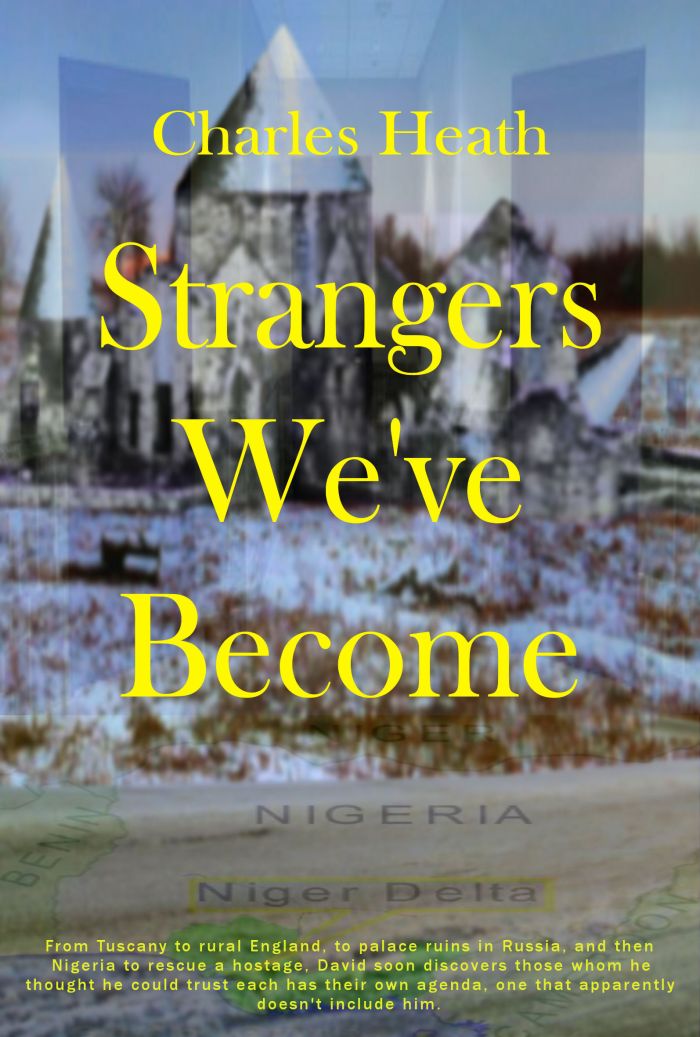
Coming soon – “Strangers We’ve Become”, the sequel to “What Sets Us Apart”

Stranger’s We’ve Become, a sequel to What Sets Us Apart.

The blurb:

Is she or isn’t she, that is the question!

Susan has returned to David, but he is having difficulty dealing with the changes. Her time in captivity has changed her markedly, so much so that David decides to give her some time and space to re-adjust back into normal life.

But doubts about whether he chose the real Susan remain.

In the meantime, David has to deal with Susan’s new security chief, the discovery of her rebuilding a palace in Russia, evidence of an affair, and several attempts on his life. And, once again, David is drawn into another of Predergast’s games, one that could ultimately prove fatal.

From being reunited with the enigmatic Alisha, a strange visit to Susan’s country estate, to Russia and back, to a rescue mission in Nigeria, David soon discovers those whom he thought he could trust each has their own agenda, one that apparently doesn’t include him.

The Cover:

strangerscover9

Coming soon


Writing a book in 365 days – 298/299

Days 298 and 299

Writing exercise – Using the most elaborate lie you have ever told, sell it to the reader

It was the sort of stuff spy novels had in abundance.

But it was my imagination, fueled by scores of those very same stories all rolled into one, that I used to explain why I was missing from school to classmates who thought I was the most boring and uninteresting person they had ever known.

I knew what they’d say, so I was going to take them on a journey, and in my childish mind, I was going to make it as believable as I could.

Of course, what a child imagines to be true and what actually is are two very different things.

But, like everything that ever happened to me, it didn’t start out as an opportunity to do the right thing; it was at the end of some very stinging barbs from Alistair Goodall, my tormentor and school bully.

I glared at him with all the hatred I could muster, which, considering he was a foot taller and about 50 pounds heavier than I, was really a waste of time.

He had just told everyone within hearing range that my absence had simply been because I was too scared to come to school, because he had threatened to beat me up.

It was true, but I wasn’t going to let that be my defining moment. Instead, I blurted out, “The whole family had to go into hiding because of things my father knew, and his life was in danger.”

Yes, we had gone away, but it was to another country, where my mother’s parents lived, and they had been killed in an accident. It was quite sudden; my mother and sister had gone first, and then my father and I followed. He had difficulty getting away, and it had been a last-minute decision.

He had to come back, and despite my pleas to leave me with my mother, he dragged me back, oblivious to the predicament I was in with Alistair Goodall.

Goodall looked at me incredulously at first, then with a smile. “Good try, squirt. You almost had me believing it. Your dad an informer? My dad’s a cop, so I’ll ask him, but we both know what he’s going to say.” He took a step closer. I braced for impact.

But then, realising I was digging a bigger hole, one that I might not get out of, “Your dad wouldn’t have a clue about witness protection. It wouldn’t be witness protection if everyone knew about it. This is stuff beyond his pay grade.”

I remembered a TV show I had seen while away, about witness protection, and how it was supposed to be secret, but the witness was sold out by the bad guy’s man in the police force.

“My dad’s very important,” he said, his voice raised an octave, a sure sign he was losing this war of words.

“Then if you went home and started asking questions about witnesses who are supposed to be in protection, then he would lose his job, or worse, go to jail for blabbing secrets.”

“Your blabbing secrets.”

“You’re threatening to beat me up if I don’t tell you where I’ve been. Just threatening me into telling you is gonna get you into a heap of trouble. I suggest you let it go, and we keep this between us. Or can’t you keep secrets?”

“I can too.”

The whine in his voice told me that I had bested him, but for how long was a moot question. He was not going to keep this a secret.

The school term ended in an uneasy truce between Alistair and me, and the whole school broke for the summer holidays. It meant I could escape Alistair’s persecution, at least for a few weeks, time enough for the rest of the family to return, and a semblance of normalcy to return.

I had just about put the great lie out of my mind when Alistair turned up outside my house with a smug smile. That idea of keeping secrets was not one of his strong points.

“You’re really for it, now, squirt. My dad knows nothing about this crap story of yours. In fact, he copped a serve at work, and he’s coming around to put the pair of you straight.”

Damn. Why could the miserable twisted arse just let it go?

“You wanna be anywhere but here when he gets here.”

He walked off laughing, thinking he’d bought me a whole new world of pain.

My father was home for a week, which was a shame, because he was never home, always busy, too busy to be bothered with any of us. It would have been better if he hadn’t, or my mother was here, which she was not, still delayed in her return.

I spent a good hour trying to think of how I was going to get out of this one, but whatever I did, there was no chance I was not going to get a beating for this. Goodall was a copper, and although my father said he was a bully and a terrible excuse for a local plod, as he called him, he was still the law. Previous infractions I had been accused of were all true, and it had got me into trouble and a warning; there had better not be a next time.

This was the next time, and it was a doozy.

There was only one path I could go down.

My father was in his study when I went to look for him. He was always working on something, with books and charts all over the desk. I never asked, and he never volunteered what his job was, but I would have to ask one day.

I knocked on the door and waited a minute or two before he asked me to come in.

“Did I hear you talking to someone before?”

“Alistair Goodall, bully son of the local copper. As bad as his father, he uses him as a shield. I’d complain about him, but you keep saying I have to man up. There’s no manning up against the likes of him.”

I had considered whinging about the kid, but I knew my father wouldn’t accept that as trying hard enough to find my own solution, and it was useless telling him there wasn’t one.

He looked at. “Your mother said you were being bullied. Why didn’t you come and see me?”

“You’re never home, and you reckon I have to sort it out myself. Bit hard when he’s taller and heavier than I am. And I don’t think you’d appreciate me hitting him with a baseball bat.”

“Drastic but effective, no doubt, but not worth the jail time. Why are you telling me this?”

He wanted to know why I was away recently. I couldn’t tell him; he threatened to beat me up, so I made up a lie. The truth was too lame for a moron like him.”

“What lie?”

I told him and watched the already dark features go a lot darker.

“And you expected he wouldn’t take it to his father for confirmation?”

“Plods don’t get told anything, of course, he wouldn’t know, and even if it was true, no one from up the chain would share that with a fool like Goodall. Even I know that much.”

“How do you know all this stuff?”

“Reading. I’ve read a lot of books, seen films and TV shows. I know a lot of it is make-believe, but there have to be elements of it that are true. The point is that I told Alistair that it was a secret and asked him to keep it. I mean, in real circumstances, we would be trusting him, which you would think from all the bluster that he could. If it had been a test, he failed spectacularly. As for his father, sure, he would understand the nature of witness protection and the necessity for secrecy, so blabbing it to his superiors was wrong on so many levels. I’m sure they would have said they knew nothing about it, even if they did.”

My father thought about that for a minute, perhaps looking to point out the flaws in the logic, but I couldn’t see any.

“I don’t like Goodall. Got on my wrong side when he first became a Sergeant. Too smug by half, and, as you say, a bully who uses his position. You were wrong to lie. Now, go upstairs. I’ll deal with Goodall.”

I was sitting behind the wall at the top of the stairs, waiting for Goodall to come. I wondered if he would bring the toad Alistair with him.

The pounding on the door almost made my heart stop. My father took his time to answer the door, and then, “Sergeant Goodall, what do we owe the honour of this visit?” It was the most pleasant tone I’d ever heard my father use, to anyone.

“Mr. Laramie…” Goodall senior only had one level of speaking, loud and confrontational.

“Sergeant Goodall, there are two things I expect from any visitor who comes to my door: that the visitor address me in a civil tone, and not make their cases on my doorstep. Now, if you give me your word you will be civil, I will invite you in.”

He must have nodded because I heard footsteps and the door closed. His office was on the ground floor, up the passage. I would be able to hear them if the door to the office wasn’t closed.

“Now, Sergeant Goodall, what exactly is the problem?”

“Your son is telling preposterous lies.”

“You son is a bully, and my son fears going to school because of him. I think you should be attending to your son’s proclivities rather tan worry about what my son says. Most kids his age speak utter gibberish at the best of times.”

A moments silence before, “It;s not the fact it;s lies its the nature of the lie.”

“Oh. The fact that we were away. Well, there’s something else you should be admonishing that wretch of a child of yours for. My son told him the truth. and gave him a warning that it was not to be put about, in fact, as I understand it, he told your son that it was to be kept secret, and because he believed your son, being the son of a respectable policeman who understands the nature of these sorts of secrets, could keep it. The fact that he couldn’t keep that simple secret disappointed my son, disappointed me, and disappointed the people who arranged our sojourn, while some very nasty people were put away. They are, at the very least, extremely disappointed that you were poking around in matters that were way above your pay grade. If my son comes home any time in the new year complaining about your son, I will forget about being magnanimous this one time, in the hope you can address the issues you have; if he comes home with a complaint, all bets are off. Do I make myself clear?”

“He was not lying?”

“He was trying to avoid being beaten up by a thug, Goodall. He trusted your boy, and he let him down badly. This matter should not be discussed, here or anywhere, and I expect by the time you pass through my front door, the matter of our sojourn will be forgotten, and the problem with your child will be on the way to being resolved. Now, if that’s all….”

A few seconds later, I heard Goodall being bundled out the door, and it closed firmly behind him.

My father took a risk, but it paid off.

By the end of the summer holidays, Goodall had moved on to another station and taken his wretched son with him.

Goodall wasn’t the only bully at that school, but I learned a new way to deal with them, one that didn’t include elaborate lies. Those I saved for the stories I started writing.

©  Charles Heath  2025

The story behind the story – Echoes from the Past

The novel ‘Echoes from the past’ started out as a short story I wrote about 30 years ago, titled ‘The birthday’.

My idea was to take a normal person out of their comfort zone and led on a short but very frightening journey to a place where a surprise birthday party had been arranged.

Thus the very large man with a scar and a red tie was created.

So was the friend with the limousine who worked as a pilot.

So were the two women, Wendy and Angelina, who were Flight Attendants that the pilot friend asked to join the conspiracy.

I was going to rework the short story, then about ten pages long, into something a little more.

And like all re-writes, especially those I have anything to do with, it turned into a novel.

There was motivation.  I had told some colleagues at the place where I worked at the time that I liked writing, and they wanted a sample.  I was going to give them the re-worked short story.  Instead, I gave them ‘Echoes from the past’

Originally it was not set anywhere in particular.

But when considering a location, I had, at the time, recently been to New York in December, and visited Brooklyn and Queens, as well as a lot of New York itself.  We were there for New Years, and it was an experience I’ll never forget.

One evening we were out late, and finished up in Brooklyn Heights, near the waterfront, and there was rain and snow, it was cold and wet, and there were apartment buildings shimmering in the street light, and I thought, this is the place where my main character will live.

It had a very spooky atmosphere, the sort where ghosts would not be unexpected.  I felt more than one shiver go up and down my spine in the few minutes I was there.

I had taken notes, as I always do, of everywhere we went so I had a ready supply of locations I could use, changing the names in some cases.

Fifth Avenue near the Rockefeller center is amazing at first light, and late at night with the Seasonal decorations and lights.

The original main character was a shy and man of few friends, hence not expecting the surprise party.  I enhanced that shyness into purposely lonely because of an issue from his past that leaves him always looking over his shoulder and ready to move on at the slightest hint of trouble.  No friends, no relationships, just a very low profile.

Then I thought, what if he breaks the cardinal rule, and begins a relationship?

But it is also as much an exploration of a damaged soul, as it is the search for a normal life, without having any idea what normal was, and how the understanding of one person can sometimes make all the difference in what we may think or feel.

And, of course, I wanted a happy ending.

Except for the bad guys.

Get it here:  https://amzn.to/2CYKxu4

newechocover5rs

In a word: Key

So, as we all know, a key is used to lock or unlock a door, gate, or something else.  It’s either made of shiny metal, brass, or rusty iron, it can be small, or very, very big, as is the key to a dungeon.

We can have one key or we can have many or even a master key that unlocks everything, very handy if you have a house full of locked rooms.

People always seem to want to steal them, especially in crime shows.

There is also an item called a key card.  Not the metal thing, but a plastic thing, that opens doors.  Odd that it’s called keyless entry!

Then there’s what is known as the key to something, i.e. you might have the key to his or her heart, metaphorically speaking.

And in that metaphorical sense, it opens up pandora’s box with a plethora of different meanings.

He had the key to the puzzle.

I wish sometimes I had the key to be able to write better, that that one particular key eludes me.

There are keys on a keyboard, the ones you use on computers and calculators.  They were originally on typewriters.  You can also find keys on a piano, or an accordion, and some other musical instruments.

A key can also be a master index field, or unique identifier, in a database, particularly those kept on computers.

And,

there’s a host of other uses for the word key, such as

roughening a surface

describing the shooting area on a basketball court

a group, or one, of small coral islets

matching words to pictures

or, you’re just too keyed up to sleep.


The first case of PI Walthenson – “A Case of Working With the Jones Brothers”

This case has everything, red herrings, jealous brothers, femme fatales, and at the heart of it all, greed.

See below for an excerpt from the book…

Coming soon!

PIWalthJones1

An excerpt from the book:

When Harry took the time to consider his position, a rather uncomfortable position at that, he concluded that he was somehow involved in another case that meant very little to him.

Not that it wasn’t important in some way he was yet to determine, it was just that his curiosity had got the better of him, and it had led to this: sitting in a chair, securely bound, waiting for someone one of his captors had called Doug.

It was not the name that worried him so much, it was the evil laugh that had come after the name was spoken.

Doug what? Doug the ‘destroyer’, Doug the ‘dangerous’, Doug the ‘deadly’; there was any number of sinister connotations, and perhaps that was the point of the laugh, to make it more frightening than it was.

But there was no doubt about one thing in his mind right then: he’d made a mistake. A very big. and costly, mistake. Just how big the cost, no doubt he would soon find out.

His mother, and his grandmother, the wisest person he had ever known, had once told him never to eavesdrop.

At the time he couldn’t help himself and instead of minding his own business, listening to a one-sided conversation which ended with a time and a place. The very nature of the person receiving the call was, at the very least, sinister, and, because of the cryptic conversation, there appeared to be, or at least to Harry, criminal activity involved.

For several days he had wrestled with the thought of whether he should go. Stay on the fringe, keep out of sight, observe and report to the police if it was a crime. Instead, he had willingly gone down the rabbit hole.

Now, sitting in an uncomfortable chair, several heat lamps hanging over his head, he was perspiring, and if perspiration could be used as a measure of fear, then Harry’s fear was at the highest level.

Another runnel of sweat rolled into his left eye, and, having his hands tied, literally, it made it impossible to clear it. The burning sensation momentarily took his mind off his predicament. He cursed and then shook his head trying to prevent a re-occurrence. It was to no avail.

Let the stinging sensation be a reminder of what was right and what was wrong.

It was obvious that it was the right place and the right time, but in considering his current perilous situation, it definitely was the wrong place to be, at the worst possible time.

It was meant to be his escape, an escape from the generations of lawyers, what were to Harry, dry, dusty men who had been in business since George Washington said to the first Walthenson to step foot on American soil, ‘Why don’t you become a lawyer?” when asked what he could do for the great man.

Or so it was handed down as lore, though Harry didn’t think Washington meant it literally, the Walthenson’s, then as now, were not shy of taking advice.

Except, of course, when it came to Harry.

He was, Harry’s father was prone to saying, the exception to every rule. Harry guessed his father was referring to the fact his son wanted to be a Private Detective rather than a dry, dusty lawyer. Just the clothes were enough to turn Harry off the profession.

So, with a little of the money Harry inherited from one of his aunts, he leased an office in Gramercy Park and had it renovated to look like the Sam Spade detective agency, you know the one, Spade and Archer, and The Maltese Falcon.

There’s a movie and a book by Dashiell Hammett if you’re interested.

So, there it was, painted on the opaque glass inset of the front door, ‘Harold Walthenson, Private Detective’.

There was enough money to hire an assistant, and it took a week before the right person came along, or, more to the point, didn’t just see his business plan as something sinister. Ellen, a tall cool woman in a long black dress, or so the words of a song in his head told him, fitted in perfectly.

She’d seen the movie, but she said with a grin, Harry was no Humphrey Bogart.

Of course not, he said, he didn’t smoke.

Three months on the job, and it had been a few calls, no ‘real’ cases, nothing but missing animals, and other miscellaneous items. What he really wanted was a missing person. Or perhaps a beguiling, sophisticated woman who was as deadly as she was charming, looking for an errant husband, perhaps one that she had already ‘dispatched’.

Or for a tall, dark and handsome foreigner who spoke in riddles and in heavily accented English, a spy, or perhaps an assassin, in town to take out the mayor. The man was such an imbecile Harry had considered doing it himself.

Now, in a back room of a disused warehouse, that wishful thinking might be just about to come to a very abrupt end, with none of the romanticized trappings of the business befalling him. No beguiling women, no sinister criminals, no stupid policemen.

Just a nasty little man whose only concern was how quickly or how slowly Harry’s end was going to be.

© Charles Heath 2019-2024

NANOWRIMO – November 2025 – Day 11

The Third Son of a Duke

So we are getting the back stories for a few of the passengers, a group forms, of which our protagonists are part of; my grandmother is there, but only as a floating member. I have given her a role that gels with the protagonist as a friend, though more aloof than the others.  As the son of a Duke, and therefore of aristocratic bearing, he and my grandmother will act as chaperones for the other girls who attach themselves to the group that gathers in the lounge.

He will prefer her as a companion while the likes of Louise tend to make a more romantic impact.  But, as one might expect of the time, he is uncertain of his arrangement with the arranged marriage, so he cannot commit to anything other than a respectable friendship, which he makes quite plain from the outset.

He is not looking for romance.  Others might be.

I also have a look at the reasons why so many disaffected young women are leaving England for a new life in Australia, far from the poverty, and worse, class distinction, the lack of opportunities for women, and the lack of acceptable husbands, not that they are looking.  There are also aspects of societal expectation that a woman doesn’t work and is meant to have children and look after their husbands.

This is a period where the unwritten rule of what society believes is a woman’s place in society is taking a beating, and women want more from their lives.  After all, suffragettes are fighting for electoral equality; at least in Australia, these girls will have a vote. 

1455 words, for a total of 16835 words.

Writing about writing a book – Day 23

I’ve been thinking a lot about Bill’s service, and the characters he meets along the way, some of whom shape the man he became, others he remained friends with after he was discharged, and those that were killed.

Several have a direct bearing in the main story, for instance, Brainless, a rather ubiquitous nickname, given to him because of his actions, that is to say, he acts without thinking, sometimes when in great peril, a man who never quite recovered but is, for all intents and purposes Bill’s friend and someone he feels responsible to look after, perhaps because of how many times he saved Bill from death, or worse.

There is also Manilow, but we’ll save him for later.

So, this is where ‘Brainless’ gets his introduction:

It was the first time I’d been hit by a bullet, and it hurt.  It was a steep learning curve, realizing you have been hit, and then the brain going into overdrive to tell you first it going to hurt like hell, and then begin to assess the damage, running every scenario from ‘it’s a flesh wound’ to ‘Oh God, I’m going to die’.

At least, that was what had happened to me for the first time.

Seconds, or minutes, or hours later, a man who doubled as a Medic came scrabbling over to me and looked at the wound.  A silly thought, how did he know I’d been shot?  Had I screamed?  He made a quick assessment, told me I’d live, and dressed it as well and as quickly as he could.

There were other casualties.

I lasted until I was brought into a clearing some miles further on, after the enemy had been killed, or had retreated, and loaded onto a helicopter.  There I was told everything would be OK and then the lights went out.

My first visit to a mobile army hospital, after being hit, was a novelty.  It was nothing like a real hospital.  Nor was the staff.  It took a different sort of medical personnel to man a front-line hospital where you were just as likely to become a casualty yourself.

The doctor was quite jovial about the whole matter saying I would be back out again in no time, not exactly a prospect I was looking forward to.  It was almost a mend job without anesthetic and the memory of it remained with me for some time.  Facilities were not primitive, but they just appeared that way.

I was one of the less needy casualties that day.  After being stitched up, a nurse took me to a bed in a ward with a mixture of serious and not-so-seriously wounded.

The nurse, whose name was Wendy, had the same sense of humour I had.  She insisted we be on first-name terms from the start.  How she kept her humour was a mystery, for most noticeable was her tired look as if she had been doing the same thing for too long.

The bed was comfortable, the temperature bearable, and the food edible.  Being, and remaining, injured had its good points.

I slept well the first night.  I presumed the injection she’d given me was to ensure I had a restful sleep.  It was long overdue and much needed.

The next morning the numbers had thinned.  Two men had died, and several others returned to duty.  To my left was a sad and distant private, who, from time to time, would start moaning.  He’d been in the middle of a mortar attack and was both deaf and had serious psychological problems.

To my right, there was a large man who barely fit in the bed.  He was a perpetually unhappy person, with only minor injuries, a bullet wound to his upper leg.  Nothing serious, he said, and just wanted to leave as soon as possible.  Brainless, the nurse called him.  Always wanted to get back to the war and kill some more of the enemy.  An obsession, she said.

He was staring morosely at the ceiling when I woke.  It took a few minutes to regain full consciousness, a sign I’d been in a drugged sleep.

“What are you in for?” he asked.

“Leg wound.  Nothing serious.”  You?”

“Leg.  Bastards snuck up on me.  And the useless rearguard didn’t do his job properly.”

“Landmine?”

“Sniper.”

I’d seen both.  Tread in the wrong place, and you didn’t do it again.  Sniper’s fire came from almost anywhere, taking out soldiers and civilians indiscriminately.  You could never hear the bullet, just feel it.

“Mongrel,” I said with feeling.

“Yours?”

“Probably the same.  I didn’t see it coming.  I hate it when you can’t see the bastards.  There ought to be some law they send you a message first.  Give you a chance….”

“Chap other side killed himself.  Had enough.  It was written all over his face.  What kind of sooks are we bringing over here?”

“National service,” I said quietly.

“You?” he asked.

I could feel his contempt for ‘Nashos’ and to be glad I was not one.  “I believe I volunteered.”

He didn’t ask what I meant, and even if he had, I probably would have made up a lie.  I hardly thought if I said my father-in-law hated me that much he would send me here, would make any sense, particularly to this man beside me.

He snorted.  “More the fool you, then.”

We were both released on the same day.  His unit had suffered major casualties, and the story he gave me in the hospital was not quite true.  He’d gone down trying to save what men he could in an ambush.  Heroics came to mind, but his selfless actions were much more than that.  Without a unit, he joined ours.

Wendy remained in my mind for some time after that visit.  When I returned the next time, my injuries being more serious, I enquired as to her whereabouts, only to discover she was dead too, a victim of her own hand, simply because she could not cope with the death, mutilation, and waste.

There was no doubt it affected all of us in different ways.  Some didn’t like the idea of going back out into the jungle and found their own peace.  Others, like Wendy, needed something more, but all too often, no one recognized what the solution was until it was too late.

Now that I have paved the way, I must go back to the main story and write the part where Brainless enters the picture.

© Charles Heath 2016-2025

The cinema of my dreams – I never wanted to go to Africa – Episode 34

Our hero knows he’s in serious trouble.

The problem is, there are familiar faces and a question of who is a friend and who is foe made all the more difficult because of the enemy, if it was the enemy, simply because it didn’t look or sound or act like the enemy.

Now, it appears, his problems stem from another operation he participated in, and because of it, he has now been roped into what might be called a suicide mission.

I had hoped we’d land in daylight, but I could see the benefits of arriving at the landing strip after darkness had fallen, and a more primitive form of landing lights had been used.

Less interest from the local people and no bright lights lighting up the runway.

The only lights I could see from the air were the primitive landing lights, fires burning in used fuel drums, and a glimmer of light emanating from two of the buildings set back from the airstrip.

It did worry me, probably more than it should, that the pilots would be landing a plane of this size in virtually a paddock, flying by the seat of their pants, and all credit to them if they got the plane on the ground.  I guessed they’d flown into more than one hot spot around the world, and at least at this one, they were not being shot at.

Their turn around would be quick, just enough time to take on a small amount of fuel and then leave.  No one had said if it would be a fuel tanker or by drums and hand pumps.

The plane had a short distance to go from the end of the runway to what might be called terminal buildings.  The moment the engines were cut, there was a flurry of movement, and after the fuselage door was quickly opened by the co-pilot, then the rear access ramp lowered and standing at the end, once it hit the ground, I could see a tanker and a Land Rover heading towards the rear of the plane, with only small headlamps on.

Monroe had joined me.  Behind me was a hive of activity as the team moved the crates of camera equipment to the end of the ramp, and then the individual packs.  Jacobi was escorted down on the ground by his two-man guard.

“Is this necessary,” he asked as he passed by me

I ignored him.

The Range Rover stopped just by the bottom of the ramp, and two men got out, one I assumed was Colonel Chiswick, former British Army, came over to train the local soldiers, and didn’t go home, and the other a Ugandan soldier with Sergeant stripes.  Perhaps this was one of their airfields feeding supplies and troops for border patrol duties.

Monroe went down first, and I followed.

Chiswick came up to me, holding out a hand.  “James, I presume?”  I shook it.

I nodded towards Jill, “And Monroe.”

“Welcome to nowhere in particular.”

In the distance, another three Range Rovers were heading towards the plane and then stopped within easy distance of the ramp to easily facilitate the moving of the camera equipment into the rear.  Drivers of the cars ushered them, taking their packs and putting them in the back.

I saw a meaningful look pass between Jacobi and Chiswick.  They knew each other.  No surprises there.  If Chiswick was running this base, then he’d have to know about Jacobi whom we knew had friends in all the high places on every side of the fence.

Another car pulled up, a jeep.  “For your man to get to the base.  I gather he has his instructions?”

Mobley nodded, threw his pack in the back, and the jeep drove off.

“Nice night,” Chiswick said, finally, “Glad it’s not raining, or it would have been a rather sticky landing.”

“How long before the plane leave?”

“About an hour.  Don’t worry.  Planes come and go here all the time, so no one really cares much.”

The crates, packs and other men were loaded and taken away.  Monroe had a final word to the pilot, now down on the ground and supervising the fuel loading, then joined me in the Colonel’s car.

“You’ll be leaving just before first light.  Best to get away before the villagers stir.  There will be one or two curious souls, but they’re harmless.  The soldiers here have been informed that you are here for a training exercise, nothing unusual as we get squads from all over from time to time.  As I said, your arrival will have caused little interest.”

From the locals.  It was anyone else other than the locals I was worried about. 

“Excellent.”


There was not much else to talk about in the few minutes it took to get to the compound at the back of the so-called terminal buildings.  It consisted of about ten large barracks, an administration building, and what looked to be a mess.

Pale lights were showing from one of the barracks, and seeing the cars parked out the front, I assumed this was where we would stay until we departed.

The Colonel didn’t get out of the car.  “We’ll be leaving at 04:00 tomorrow morning.  Make sure you’re ready to go.”

“You’re coming too?”

“Bamfield asked me.  Wants to make sure you had someone who knows the lie of the land.”

“I thought you’d delegate that to a few of the soldiers.”

“No.  Can’t have them involved in an incursion or there will be trouble.  This is an off the book’s operation.  Looking forward to it, actually.  There are a few people over there I’d like to have a talk to if we get the time.”

I shrugged.  Just one more problem to deal with.  The Colonel didn’t strike me as being a talker, but a man who let actions define who he was.  And just because Bamfield vouched for him didn’t mean he might be not be working on his own retirement fund.

© Charles Heath 2019-2022

Writing a book in 365 days – My Story 45

More about my story – What about a sequel?

Beyond ‘The End’: When Your First Novel Whispers ‘Sequel!’

They say everyone has one novel in them. That singular, definitive story waiting to be told. And if you’re deep in the trenches of writing that very first book – or perhaps just emerging, blinking, from the final draft – you know the magnitude of that achievement. It’s a mountain climbed, a world birthed, a dream realised.

But what if, as you type those triumphant final words, your story doesn’t feel quite… finished? What if your characters still have unresolved arcs, your world still hums with unexplored corners, and a new conflict is already brewing on the distant horizon?

This is the siren call of the sequel, the whisper of a series, beckoning you beyond “The End.” And the question isn’t if it will happen, but how you decide when your definitive first novel should become the definitive first step in a much larger journey.

The Organic Unfurling: When Ideas Spark Early

Sometimes, the seed of a series is planted before you even write chapter one. You might be world-building, and realise your magic system is too complex for a single adventure. Or you create a cast of characters so rich, you know their individual journeys can’t possibly culminate in one book.

This is the beauty of organic discovery. As you plot, you might hit a snag and realise a subplot isn’t fitting, but it would make a fantastic central conflict for a future story. Or you leave a minor mystery unsolved, not out of oversight, but with the deliberate thought: “That’s for book two.”

Key signs it might be more than a standalone (even early on):

  • Vast World-Building: Your setting feels like a continent, not just a town. There are untouched cultures, unvisited lands, or deep historical layers begging exploration.
  • Complex Character Arcs: Your protagonist’s journey is profound, but you can see clear paths for growth beyond this initial conflict. Or a compelling secondary character deserves their own spotlight.
  • Lingering Questions/Plot Threads: You’ve wrapped up the central conflict of Book 1, but there are larger societal issues, ancient prophecies, or personal vendettas that naturally spill over.

The Post-Draft Revelation: When Your Story Demands More

Often, the realization hits after you’ve finished the first draft – or even after a round of revisions. You might be reading through, feeling proud, and suddenly a new idea sparks. “What if X happened next?” “How would Y react to Z now?”

This is a beautiful moment, because it means you’ve built something robust enough to inspire more. Your subconscious is telling you there’s still creative gold in that particular mine.

How to approach this post-draft revelation:

  1. Does Book 1 Stand Alone? This is crucial. A “definitive first novel” must feel complete in itself. The central conflict should be resolved, and the protagonist should have achieved a significant milestone. Don’t write a cliffhanger just because you might write a sequel. Future books should deepen the experience, not fix the first one.
  2. Brainstorm the Arc: Dedicate a session (or several) to mapping out potential sequels. What’s the new central conflict? How have your characters changed? What new challenges do they face? This isn’t about writing, just exploring.
  3. Check for Crossover Appeal: Does the core premise of your first novel have enough appeal to sustain multiple stories? Are there fresh angles to explore, or would you merely be repeating yourself?
  4. Listen to Your Gut: Does the thought of continuing fill you with excitement or dread? While writing is always hard work, the initial spark for a series should feel invigorating.

Why Stop at One? The Power of “More”

The adage “everyone has one novel in them” is true. But the idea that you should only write one is a self-imposed limitation. If your imagination is already conjuring new adventures in the same world, if your characters are clamouring for more development, why stifle that creative energy?

A series allows for:

  • Deeper World Exploration: To truly immerse readers in a rich, complex world.
  • Rich Character Development: To show growth, setbacks, and evolving relationships over a longer timeline.
  • Unfolding Grand Narratives: To tackle epic conflicts or explore complex themes that simply can’t be contained in a single volume.

So, as you nurture that definitive first novel, remember to keep an ear open. Does your story hum with untold tales? Do your characters beckon you towards new horizons? If so, embrace the possibility. Your definitive first novel might just be the definitive first step into a much larger, more thrilling literary journey. Why write one when you have a whole universe waiting to unfurl?

Top 5 sights on the road less travelled – Madrid

Beyond the Postcards: 5 Unique Madrid Experiences on the Road Less Travelled

Madrid. The very name conjures images of grand boulevards, world-class art museums, and bustling tapas bars. And while the Prado, the Royal Palace, and Retiro Park are undeniably magnificent, there’s a whole other layer to Spain’s vibrant capital, waiting to be discovered by those willing to stray from the well-trodden path.

If you’re like me – a traveller who loves to peel back the layers and uncover the authentic pulse of a city – then pack your sense of adventure. Here are my top five “road less travelled” experiences that will show you Madrid most tourists never see.


1. Dive into the Multicultural Heart of Lavapiés & the Mercado de San Fernando

Forget the polished tourist markets; head straight to Lavapiés, one of Madrid’s most historic and multicultural neighbourhoods. This isn’t just about street art (though there’s plenty of incredible murals to discover); it’s about the aroma of spices, the sound of different languages, and the genuine buzz of local life.

Your main mission here? The Mercado de San Fernando. Unlike the famous Mercado de San Miguel, San Fernando is a working neighbourhood market that has embraced a new life while retaining its authentic charm. Here, you can buy “libros al peso” (books by weight), sample craft beers, indulge in delicious Ethiopian food, browse artisanal goods, or grab a traditional Spanish tapa alongside locals doing their daily shopping. It’s a sensory feast and a true microcosm of modern Madrid.

  • Why it’s special: Authentic, multicultural, affordable, and a peek into Madrid’s real daily life.
  • Don’t miss: The book stall, the craft beer vendors, and simply soaking in the atmosphere.

2. Catch Sunset (and a Panorama) at Parque de las Siete Tetas

Looking for the best panoramic view of Madrid, away from the tourist crowds? Ditch the rooftop bars and head to Parque del Cerro del Tío Pío, affectionately known by locals as “Parque de las Siete Tetas” (Park of the Seven Tits) due to its seven rolling hills.

Located in the Vallecas district (easily accessible by metro), this park offers an unparalleled, uninterrupted vista of the entire city skyline, with the majestic Sierra de Guadarrama mountains as a backdrop. Grab a picnic, a bottle of wine, and join Madrileños as they gather here to watch the sun dip below the horizon, painting the city in hues of orange and gold. It’s a truly magical and unpretentious experience.

  • Why it’s special: The best, most local sunset spot with breathtaking views.
  • Don’t miss: The golden hour – arrive 45 minutes before sunset for the full spectacle.

3. Step into a Tranquil Oasis at the Sorolla Museum

While the Prado and Reina Sofía are essential, escape the crowds at the beautiful Sorolla Museum, dedicated to the luminous works of Spanish impressionist Joaquín Sorolla. Housed in the artist’s former home and studio, this museum is a serene retreat.

Wander through light-filled rooms filled with his vibrant paintings, many depicting sun-drenched beaches and family life. But the real hidden gem here are the exquisite Andalusian-style gardens, designed by Sorolla himself. They offer a tranquil escape from the city bustle, making you feel as though you’ve stumbled into a private, sun-drenched oasis. It’s a personal and intimate experience with art and history.

  • Why it’s special: A stunning house-museum with beautiful art and serene gardens, far less crowded than the major museums.
  • Don’t miss: The gardens are as much a work of art as the paintings themselves.

4. Immerse Yourself in a Traditional Vermutería Experience

Forget the generic sangria; dive into a truly Madrileño tradition: the vermutería. While tapas bars are everywhere, a dedicated vermutería offers a unique glimpse into a cherished cultural ritual. Vermouth, often served on tap (vermut de grifo), is a fortified wine infused with botanicals, and it’s experiencing a massive revival.

Seek out a classic spot like Casa Camacho in Malasaña or Bodega de la Ardosa (also in Malasaña, though it’s more broadly a classic tavern). Order a “vermút de grifo” (vermouth on tap), often served with an olive and a slice of orange. Pair it with their specific, often pickle-laden, tapas. It’s a delicious, slightly bitter, and utterly authentic way to start your evening, surrounded by locals engaging in lively conversation.

  • Why it’s special: A distinct Madrid tradition, away from tourist traps, with a unique drink and specific food pairings.
  • Don’t miss: Trying a “yayo” at Casa Camacho – a local concoction of vermouth, soda, and gin.

5. Explore the Opulent World of the Museo Cerralbo

For a glimpse into the extravagant life of a 19th-century Spanish aristocrat, the Museo Cerralbo is an absolute treasure, yet surprisingly overlooked by many guidebooks. The Marqués de Cerralbo, a passionate collector, bequeathed his entire palace and its vast contents to the state.

Walking through its ornately decorated rooms, you’ll find an astonishing collection of art, weaponry, ancient artifacts, and opulent furnishings, all preserved as if the family just stepped out for the afternoon. It’s a time capsule that offers a fascinating contrast to the often more institutional feel of other museums, providing an intimate look at the aesthetics and lifestyle of Madrid’s elite.

  • Why it’s special: A beautifully preserved opulent palace and private collection, offering a unique historical perspective.
  • Don’t miss: The stunning grand staircase and the ballroom – imagine the parties that took place here!

Madrid is a city of endless discoveries, and sometimes the most memorable experiences are found when you venture just a little bit off the well-worn path. So, ditch the guidebook for an afternoon, follow your curiosity, and let Madrid truly reveal itself to you.

What are your favourite hidden gems in Madrid? Share them in the comments below!