Searching for locations: The Shaolin Temple, near Zhengzhou City, Henan Province, China

The Shaolin Temple

Where is the Shaolin Temple?

Dengfeng Maps, Map of Shaolin Temple & Mount Song

It is located in Dengfeng Ave, Dengfeng, Zhengzhou, Henan, China, at the southern foot of Mount Song, 13 km northwest of Dengfeng City, Zhengzhou City, Henan Province.

A map of the Temple grounds, which would come in handy before you enter the grounds, so that you have some idea of what there is to see:

The structures and architecture of Shaolin Temple | Kung fu ...

A bit of history:

The Shaolin Temple was originally built in 495 during the Northern Wei Dynasty (368-534).  For over 1500 years, Shaolin Temple has developed through good and bad times.  The temple was firstly destroyed in the Northern Zhou Dynasty (557-581), then rebuilt much later as the Zhihu Temple.  In the Sui Dynasty (581-618) the temple was renamed Shaolin and became one of the largest Buddhism monasteries in North China.

Good fortune in the early Tang Dynasty (618-907) was followed by bad fortune in the later of Tang Dynasty, it improved during the Song Dynasty (960-1279) until 1312 in Yuan Dynasty (1271-1368) where it returned to its former glory.  The Ming Dynasty (1368-1644) also made contributions to the development of Shaolin Temple.

Due to the wars of the modern era much of the Temple was destroyed.

The Shaolin Temple, nestled in the forested mountains of Henan, its the birthplace of Kung Fu and Zen Buddhism. The Shaolin Temple embraces many exciting attractions, such as the Hall of Heavenly Kings (Tianwangdian), and the Mahavira Hall (Daxiongbaodian)

This is not a single building, that’s not how the Chinese work.  It’s a whole host of buildings, the first of which is up some steps, through a gate, then along a tree-lined avenue with monument stones to some more steps, past a cauldron burning incense, and then to the temple.  There are several monks inside.

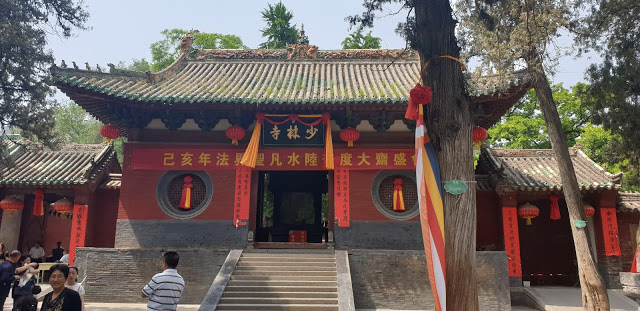
The front entrance:
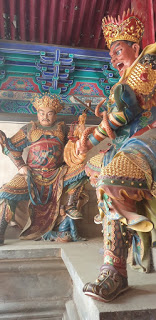
Inside the entrance building, there are some large statues that I’m guessing are there to scare away the wrong sort of people

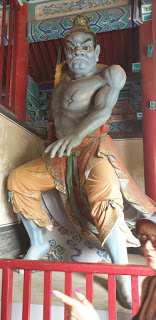
Once past these characters, you are on a walkway between pagodas where there are trees, and sculptures

and through the next pagoda brings you to the first of the temples.  There are three doors and three buddas.  This is through the middle door

And no you can’t go inside, you just stand on the outside looking in.

In one part of the temple there were three monks, and, believe it or not, they were all on their mobile phones.

This is certainly not ancient times, so what did the monks do before mobile communications?

Up some more stairs to the next building,

And so on till we reach the one at the top.  Outside each is a cauldron burning incense, and that aroma hangs on the air everywhere you go in the compound.

Then it’s a case of what goes up must come down, and strangely enough, it doesn’t take as long to go back down, and in doing so we got to see and hear a bit of singing by the monks.

There was a story to go with the various buildings and other aspects but I didn’t hear half of it, and couldn’t understand our guide for the rest.

All in all, it was an interesting place, but still not worth the money we paid.

Searching for locations: The Shaolin Temple, near Zhengzhou City, Henan Province, China

The Shaolin Temple

Where is the Shaolin Temple?

Dengfeng Maps, Map of Shaolin Temple & Mount Song

It is located in Dengfeng Ave, Dengfeng, Zhengzhou, Henan, China, at the southern foot of Mount Song, 13 km northwest of Dengfeng City, Zhengzhou City, Henan Province.

A map of the Temple grounds, which would come in handy before you enter the grounds, so that you have some idea of what there is to see:

The structures and architecture of Shaolin Temple | Kung fu ...

A bit of history:

The Shaolin Temple was originally built in 495 during the Northern Wei Dynasty (368-534).  For over 1500 years, Shaolin Temple has developed through good and bad times.  The temple was firstly destroyed in the Northern Zhou Dynasty (557-581), then rebuilt much later as the Zhihu Temple.  In the Sui Dynasty (581-618) the temple was renamed Shaolin and became one of the largest Buddhism monasteries in North China.

Good fortune in the early Tang Dynasty (618-907) was followed by bad fortune in the later of Tang Dynasty, it improved during the Song Dynasty (960-1279) until 1312 in Yuan Dynasty (1271-1368) where it returned to its former glory.  The Ming Dynasty (1368-1644) also made contributions to the development of Shaolin Temple.

Due to the wars of the modern era much of the Temple was destroyed.

The Shaolin Temple, nestled in the forested mountains of Henan, its the birthplace of Kung Fu and Zen Buddhism. The Shaolin Temple embraces many exciting attractions, such as the Hall of Heavenly Kings (Tianwangdian), and the Mahavira Hall (Daxiongbaodian)

This is not a single building, that’s not how the Chinese work.  It’s a whole host of buildings, the first of which is up some steps, through a gate, then along a tree-lined avenue with monument stones to some more steps, past a cauldron burning incense, and then to the temple.  There are several monks inside.

The front entrance:

Inside the entrance building, there are some large statues that I’m guessing are there to scare away the wrong sort of people
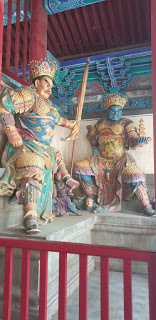
Once past these characters, you are on a walkway between pagodas where there are trees, and sculptures
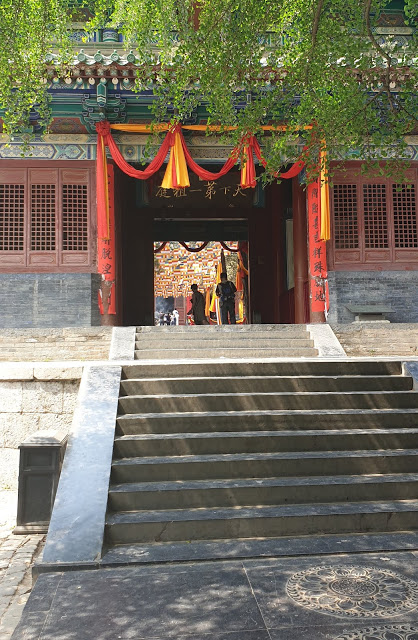
and through the next pagoda brings you to the first of the temples.  There are three doors and three buddas.  This is through the middle door
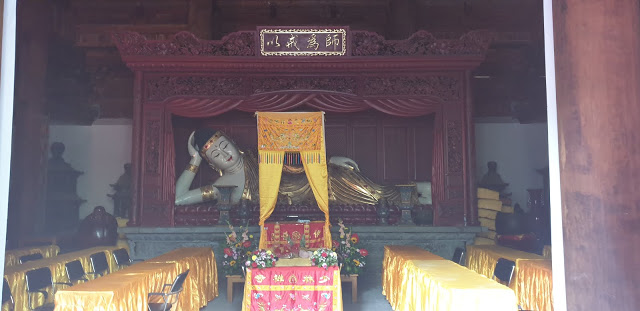
And no you can’t go inside, you just stand on the outside looking in.

In one part of the temple there were three monks, and, believe it or not, they were all on their mobile phones.

This is certainly not ancient times, so what did the monks do before mobile communications?

Up some more stairs to the next building,
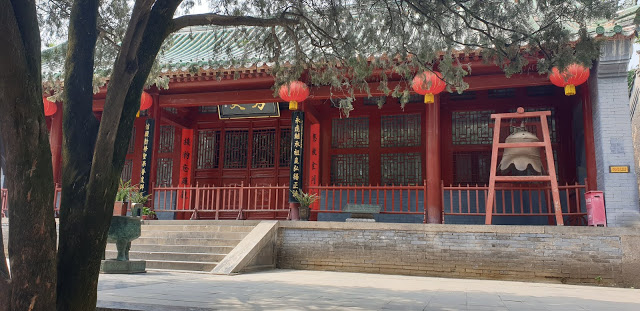
And so on till we reach the one at the top.  Outside each is a cauldron burning incense, and that aroma hangs on the air everywhere you go in the compound.
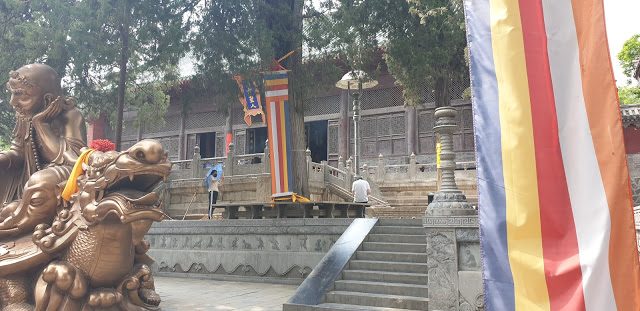
Then it’s a case of what goes up must come down, and strangely enough, it doesn’t take as long to go back down, and in doing so we got to see and hear a bit of singing by the monks.

There was a story to go with the various buildings and other aspects but I didn’t hear half of it, and couldn’t understand our guide for the rest.

All in all, it was an interesting place, but still not worth the money we paid.

Searching for locations: Shanghai, China, by night.

When we arrive at the embarkation site we find at least 100 buses all lined up and parked, and literally thousands of Chinese and other Asians streaming through the turnstiles to get on another boat leaving earlier than ours.

Buses were just literally arriving one after the other stopping near where we were standing with a dozen or so other groups waiting patiently, and with people were everywhere it could only be described as organized chaos.

Someone obviously knew where everyone was supposed to go, and when it was our turn, we joined the queue.  There were a lot of people in front of us, and a lot more behind, so I had to wonder just how big the boat was.

We soon found out.

And it was amusing to watch people running, yes, they were actually running, to get to the third level, or found available seating.  Being around the first to board, we had no trouble finding a seat on the second level.

I was not quite sure what the name of the boat was, but it had 3 decks and VIP rooms and it was huge, with marble staircases, the sort you could make a grand entrance on.  The last such ornate marble staircase we had seen was in a hotel in Hong Kong, and that was some staircase.

But who has marble staircases in a boat?

We’re going out across the water as far as the Bund and then turn around and come back about 30 to 40 minutes.   By the time everyone was on board, there was no room left on the third level, no seats on the second level nor standing room at the end of the second level where the stairs up to the third level were.

No one wanted to pay the extra to go into the VIP lounge.

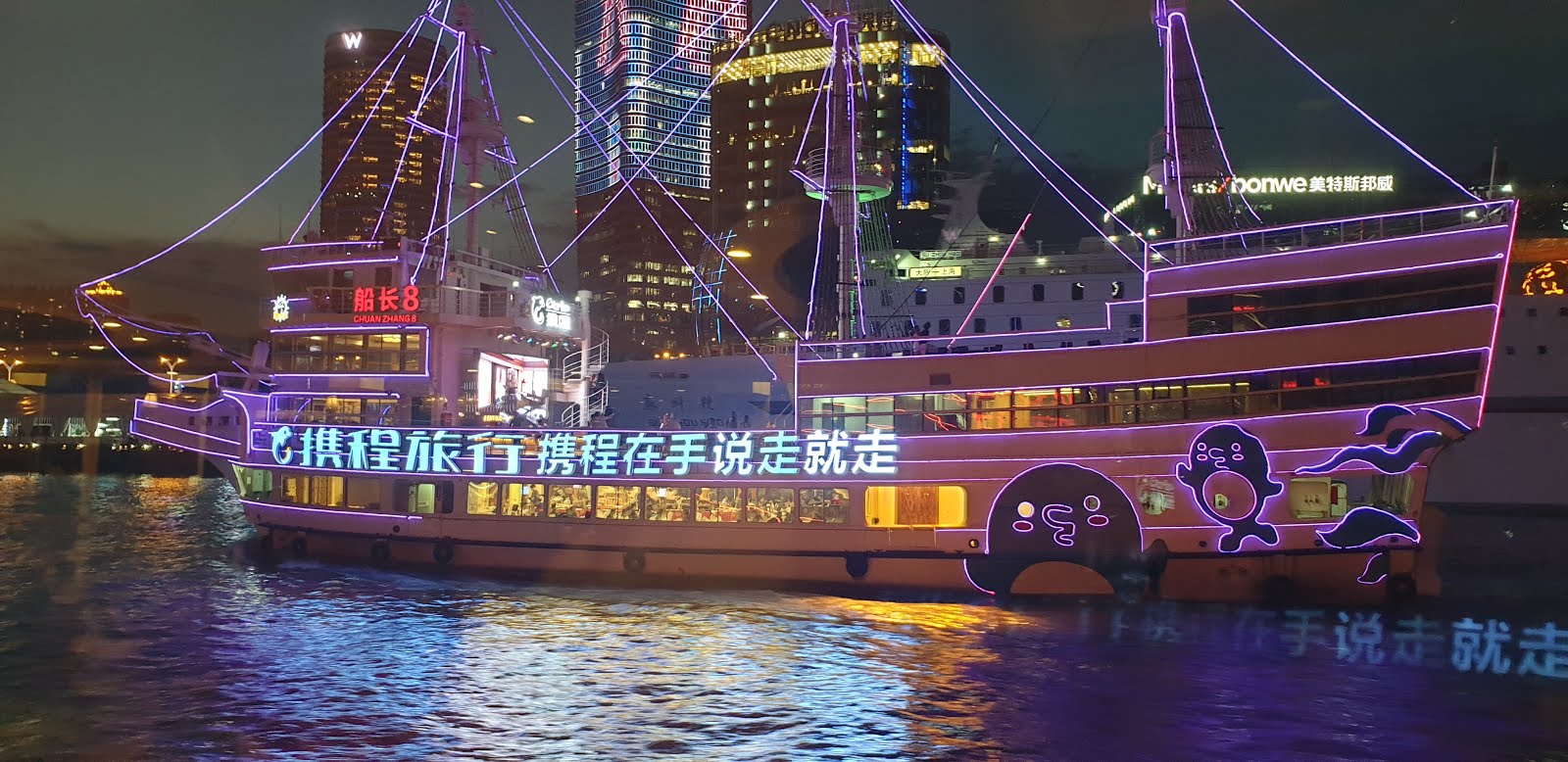
We were sitting by very large windows where it was warm enough watching the steady procession of the colored lights of other vessels, and outside the buildings.

It was quite spectacular, as were some of the other boats going out on the harbor.

All the buildings of the Bund were lit up

And along that part of the Bund was a number of old English style buildings made from sandstone, and very impressive to say the least.

On the other side of the harbour were the more modern buildings, including the communications tower, a rather impressive structure.

I had to go to the rear of the vessel to get a photo, a very difficult proposition given here was no space on the railing, not even on the stairs going up or down.  It was just luck I managed to get some photos between passengers heads.

And, another view of that communications tower:

There was no doubt this was one of the most colourful night-time boat tours I’ve ever been on.  Certainly, when we saw the same buildings the following day, they were not half as spectacular in daylight.

I never did get up to the third level to see what the view was like.

Searching for locations: Shanghai, China, by night.

When we arrive at the embarkation site we find at least 100 buses all lined up and parked, and literally thousands of Chinese and other Asians streaming through the turnstiles to get on another boat leaving earlier than ours.

Buses were just literally arriving one after the other stopping near where we were standing with a dozen or so other groups waiting patiently, and with people were everywhere it could only be described as organized chaos.

Someone obviously knew where everyone was supposed to go, and when it was our turn, we joined the queue.  There were a lot of people in front of us, and a lot more behind, so I had to wonder just how big the boat was.

We soon found out.

And it was amusing to watch people running, yes, they were actually running, to get to the third level, or found available seating.  Being around the first to board, we had no trouble finding a seat on the second level.

I was not quite sure what the name of the boat was, but it had 3 decks and VIP rooms and it was huge, with marble staircases, the sort you could make a grand entrance on.  The last such ornate marble staircase we had seen was in a hotel in Hong Kong, and that was some staircase.

But who has marble staircases in a boat?

We’re going out across the water as far as the Bund and then turn around and come back about 30 to 40 minutes.   By the time everyone was on board, there was no room left on the third level, no seats on the second level nor standing room at the end of the second level where the stairs up to the third level were.

No one wanted to pay the extra to go into the VIP lounge.

We were sitting by very large windows where it was warm enough watching the steady procession of the colored lights of other vessels, and outside the buildings.

It was quite spectacular, as were some of the other boats going out on the harbor.

All the buildings of the Bund were lit up

And along that part of the Bund was a number of old English style buildings made from sandstone, and very impressive to say the least.

On the other side of the harbour were the more modern buildings, including the communications tower, a rather impressive structure.

I had to go to the rear of the vessel to get a photo, a very difficult proposition given here was no space on the railing, not even on the stairs going up or down.  It was just luck I managed to get some photos between passengers heads.

And, another view of that communications tower:

There was no doubt this was one of the most colourful night-time boat tours I’ve ever been on.  Certainly, when we saw the same buildings the following day, they were not half as spectacular in daylight.

I never did get up to the third level to see what the view was like.

Searching for locations: Hong Kong Park, Hong Kong

After arriving in Hong Kong early in the morning, we were taken to the Hong Kong Conrad Hotel where we were staying for several days.  We had a short sleep, then I took the grandchildren for a walk and we found Hong Kong Park, with a Fountain Plaza, waterways, a waterfall, and turtles.

2013-12-28 11.24.02

Part of the fountain area.

2013-12-28 11.31.57

Turtles resting on a rock

2013-12-28 11.31.36

A turtle about to go in the water

2013-12-28 11.35.26

The waterfall.

It was a pleasant surprise to find this park in such a highly built-up area.

Nearby was a multi-story underground shopping center that was huge, and very conveniently accessible from our hotel.

Searching for locations: Hong Kong Park, Hong Kong

After arriving in Hong Kong early in the morning, we were taken to the Hong Kong Conrad Hotel where we were staying for several days.  We had a short sleep, then I took the grandchildren for a walk and we found Hong Kong Park, with a Fountain Plaza, waterways, a waterfall, and turtles.

2013-12-28 11.24.02

Part of the fountain area.

2013-12-28 11.31.57

Turtles resting on a rock

2013-12-28 11.31.36

A turtle about to go in the water

2013-12-28 11.35.26

The waterfall.

It was a pleasant surprise to find this park in such a highly built-up area.

Nearby was a multi-story underground shopping center that was huge, and very conveniently accessible from our hotel.

Searching for Locations: Hong Kong

Sometimes the experiences we have often find their way into stories.  This was certainly one of them:

Remarkably, the Peninsula Hotel experience began at the arrival gate.

The moment we stepped out of the air bridge and into the terminal building, a representative of the Hong Kong airport was waiting with a card with our name on it.  She was there, with driver and electric car (sometimes called a golf cart) to ease our way through the immigration and baggage formalities.

20180607_070908

No walking for us, which was fine by me.  It’s a train ride and a long walk from the gate to immigration.  And after all the sitting on the airplane, walking was not the first thing I was looking forward to.

The drive took a few minutes, slowed down by many other passengers walking towards the same destination, most wondering why two relatively young people like us (even if we are in our 60’s) were getting a ride.

After clearing immigration, which took very little time, and where there was a very short queue considering the number of arrivals they handle, we were met on the other side by our airport representative, and taken to the baggage carousel.

Another simple process, our bags were almost waiting for us.  From there we exited customs, and out representative handed us over to the representative of the hotel.  I thought he was the driver.

He took us through to the limousine lounge and directly to our car, a very clean shiny new looking green Rolls Royce, the ultimate in the airport to hotel transportation.

Inside it was immaculate, and astonishing, and very, very comfortable.  I could image the Queen riding in the back of one.  It took about 30 to 40 minutes, one of the quietest, most smooth rides I’d ever had, and worth every cent we paid for it.

The bucket list now has one less item on it.

20180607_080651

The arrival at the hotel was effortlessly handled.  We were met by two of the check-in staff and escorted to our room on the fourth floor.

There was just enough time to take in the amazing foyer, front entrance and twin staircases leading to a mezzanine floor, before getting into a waiting elevator and taken to our floor.  As an aside, the mirrors in the elevator were like something out of a hall of mirrors, you look into the mirror and see dozens of yourself looking back.

It’s an effect I’ll have to take a photo of.

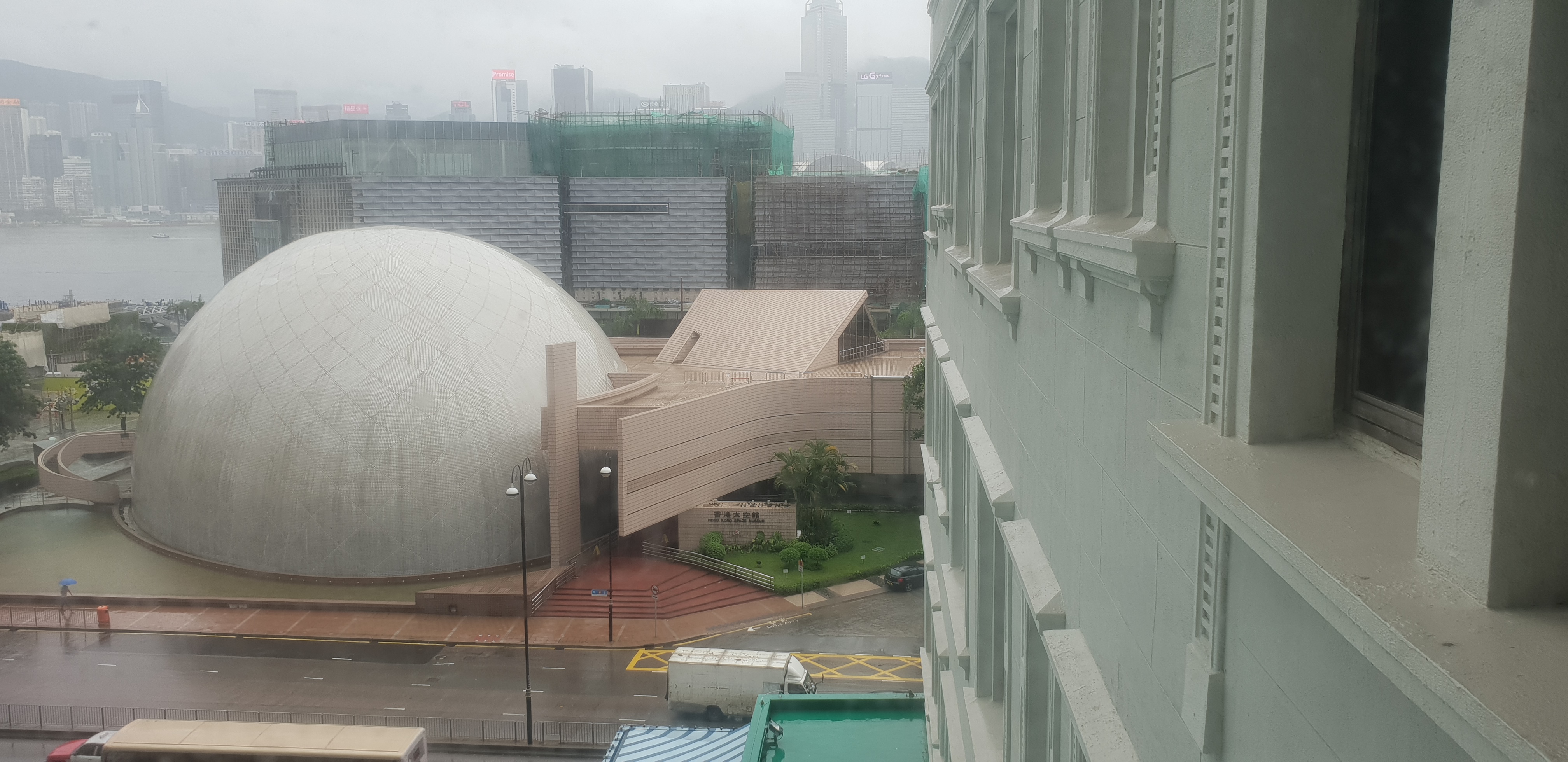
We have been upgraded, and out room is larger than the one originally allocated.  It has a view of the Space Museum, the Veranda Cafe roof, and parts of Hong Kong harbor.  It is overcast and raining so it does not matter about the view.

20180608_113856

It’s Hong Kong, and that view will change every hour.

Formalities over, we are left standing in stunned silence.

We have arrived.

20180607_153541

They say getting there is half the fun.

They’re wrong.

Or at least in the case of the Peninsular Hotel they are.

If just getting to the hotel via the signature Green Rolls Royce is any indication, there had to be a lot more in store.

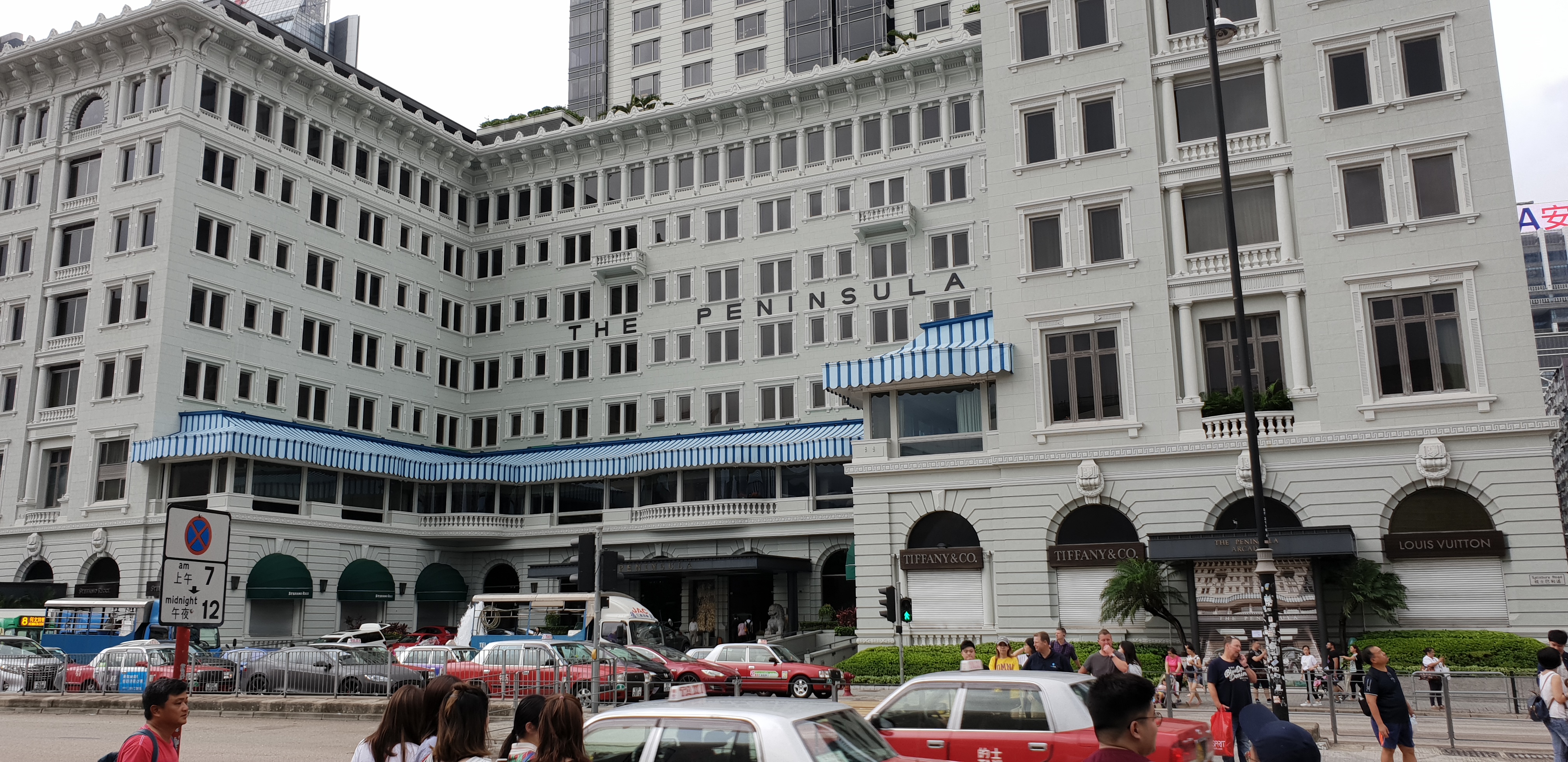
We booked a room in the ‘old’ hotel and it was categorized as ‘deluxe’.  The Peninsula adds a whole new meaning to the word Deluxe.  If this was one of their lower priced rooms, then I’d love to see their better rooms.

But the room itself is not the sum of the experience; it is also the aura within the building, the service, which is quiet and unassumingly polite and unobtrusive.  You are ushered from the front door, held open by a very elegantly dressed concierge, to your room without so much as a heartbeat.

The details, well, they are mere details that cause no concern, all taken care of before you arrived.  We arrived early, before the advertised check-in, and this fazed no one.  Room available, tired travelers sigh in relief, knowing a hot shower and several hours sleep would not be possible.

I was more than pleasantly surprised, and exploring the hotel would have to wait.

For a few hours anyway.

Searching for Locations: Hong Kong

Sometimes the experiences we have often find their way into stories.  This was certainly one of them:

Remarkably, the Peninsula Hotel experience began at the arrival gate.

The moment we stepped out of the air bridge and into the terminal building, a representative of the Hong Kong airport was waiting with a card with our name on it.  She was there, with driver and electric car (sometimes called a golf cart) to ease our way through the immigration and baggage formalities.

20180607_070908

No walking for us, which was fine by me.  It’s a train ride and a long walk from the gate to immigration.  And after all the sitting on the airplane, walking was not the first thing I was looking forward to.

The drive took a few minutes, slowed down by many other passengers walking towards the same destination, most wondering why two relatively young people like us (even if we are in our 60’s) were getting a ride.

After clearing immigration, which took very little time, and where there was a very short queue considering the number of arrivals they handle, we were met on the other side by our airport representative, and taken to the baggage carousel.

Another simple process, our bags were almost waiting for us.  From there we exited customs, and out representative handed us over to the representative of the hotel.  I thought he was the driver.

He took us through to the limousine lounge and directly to our car, a very clean shiny new looking green Rolls Royce, the ultimate in the airport to hotel transportation.

Inside it was immaculate, and astonishing, and very, very comfortable.  I could image the Queen riding in the back of one.  It took about 30 to 40 minutes, one of the quietest, most smooth rides I’d ever had, and worth every cent we paid for it.

The bucket list now has one less item on it.

20180607_080651

The arrival at the hotel was effortlessly handled.  We were met by two of the check-in staff and escorted to our room on the fourth floor.

There was just enough time to take in the amazing foyer, front entrance and twin staircases leading to a mezzanine floor, before getting into a waiting elevator and taken to our floor.  As an aside, the mirrors in the elevator were like something out of a hall of mirrors, you look into the mirror and see dozens of yourself looking back.

It’s an effect I’ll have to take a photo of.

We have been upgraded, and out room is larger than the one originally allocated.  It has a view of the Space Museum, the Veranda Cafe roof, and parts of Hong Kong harbor.  It is overcast and raining so it does not matter about the view.

20180608_113856

It’s Hong Kong, and that view will change every hour.

Formalities over, we are left standing in stunned silence.

We have arrived.

20180607_153541

They say getting there is half the fun.

They’re wrong.

Or at least in the case of the Peninsular Hotel they are.

If just getting to the hotel via the signature Green Rolls Royce is any indication, there had to be a lot more in store.

We booked a room in the ‘old’ hotel and it was categorized as ‘deluxe’.  The Peninsula adds a whole new meaning to the word Deluxe.  If this was one of their lower priced rooms, then I’d love to see their better rooms.

But the room itself is not the sum of the experience; it is also the aura within the building, the service, which is quiet and unassumingly polite and unobtrusive.  You are ushered from the front door, held open by a very elegantly dressed concierge, to your room without so much as a heartbeat.

The details, well, they are mere details that cause no concern, all taken care of before you arrived.  We arrived early, before the advertised check-in, and this fazed no one.  Room available, tired travelers sigh in relief, knowing a hot shower and several hours sleep would not be possible.

I was more than pleasantly surprised, and exploring the hotel would have to wait.

For a few hours anyway.

Searching for locations: Terracotta Warriors and Horses Museum, X’ian, China

Terracotta Warriors and Horses Museum

A little history, and anecdotal advice first:

In 1974 a 26-year-old farmer, Yang Jide, was drilling a well and found fragments of the terracotta soldiers and bronze weapons.

What was discovered later was one of the biggest attended burial pits of China’s first feudal Emperor, Qin Shi Huang.  In the following years remains had been found in 3 pits, yielding at least 8,000 soldiers and horses, and over 100 chariots.  The soldiers were infantry, cavalry, and others.

Emperor Qin was born in 259 BC and died in 210 BC.  He began building a mausoleum for himself at the foot of Mount Li when he was 13.  Construction took 38 years, from 247 BC to 208 BC.  It was divided into 3 stages and involved 720,000 conscripts.

The pits of pottery figures are 1.5 km east of Emperor Qin’s mausoleum.  Pit 1 has about 6,000 terracotta armored warriors and horses and 40 wooden chariots.  Pit 2 is estimated to have over 900 terracotta warriors and 350 terracotta horses with about 90 wooden chariots.  Pit 3 had so far yielded only 66 pottery figures and one chariot drawn by four horses.

Official records say it was discovered later that it was likely Xiang Yu, a rebel, intentionally damaged the Mausoleum and the soldiers in the pits, by setting fire to the wooden roof rafters, and these fell on and broke the warriors into pieces.

However, we were told that after the terracotta warriors were completed, the Emperor ordered the builders to be killed so that they would not tell anyone about the warriors, and then of those that remained alive deliberately smashed all of the artifacts.

The thing is, all of the terracotta figures that have been found are in pieces, and they need computers to piece them back together again.

The visit:
The first impression is the size of the car park and the number of buses parked in the lot, and a hell of a lot more outside up the road an off on side streets.  Obviously, it costs money to park in the parking lot.

The other first impressions; the numbers waiting to get in were not as many as yesterday outside the forbidden city, in fact, a lot less.

Be warned there’s a long walk from the entrance gate where your bags are scanned and a body scan as well, before admittance.  This walk is through a landscaped area which it is expect might sometime in the future reveal more soldiers, or other artifacts.

At the end of the walk that takes about ten minutes, you can get a one-way ride to the second checkpoint, but we opted not to as no one else in our group did.

That walk is the warm-up exercise to an organized viewing of the exhibits after going through a second ticket checkpoint.  On the other side, we had to hand our tickets back to the tour guide which was disappointing not to end up with a memento of actually having been there.

So, on the other side in the courtyard, the guide told us the most important parts of the exhibition, that we should spend most of the time looking at pit 1, and then spent a little time in 2 which is only there in the first stages of excavation.  Then move onto the museum if only to see the replica chariots.

We do.

The chariots were small but interesting

The horses were better and intricately detailed

These are soldiers, perhaps complete examples of those types found in the end pit.

This is one of the archers.  You can tell by the way he wears his hair.

Pit 2

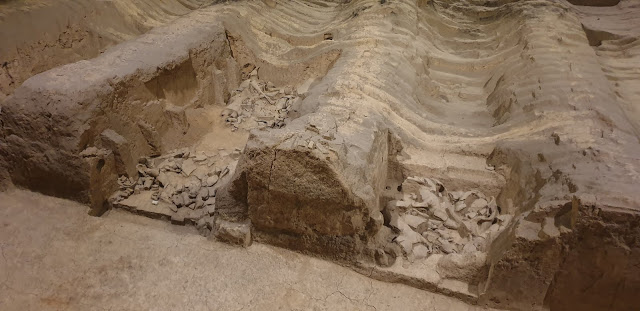
The excavation of this pit has only just begun, so it is possible to see where they have carefully removed the top cover, and you can see the broken parts of the warriors lying in a heap.

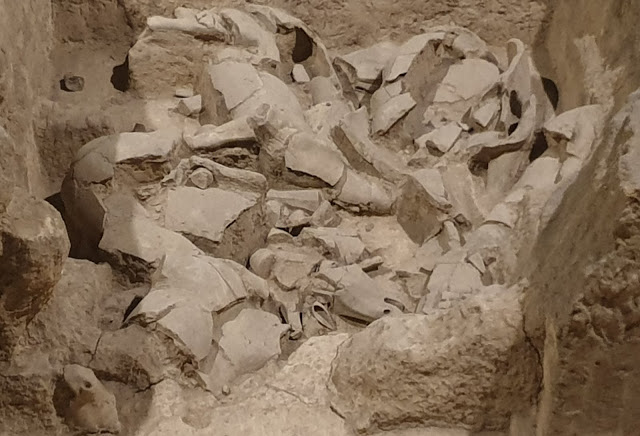
Some parts of the warriors are more discernible closer up

These parts are carefully extracted and taken to the ‘hospital’ where they are digitised and the computer will match each part with the warrior it belongs to.

Pit 1

This has quite a number of standing soldiers that have been glued back together, but not necessarily complete and I notice a number if the statues were incomplete. And if they cannot find the missing pieces, then they are not added to or filled in.

The scale of the pit is enormous, and they have hardly scratched the surface in the restoration process.

What is there is a number of horses as well.

That’s at the front of the pit, a long line of statues, and what is clear is the location of the well where the first fragments were found by a farmer.

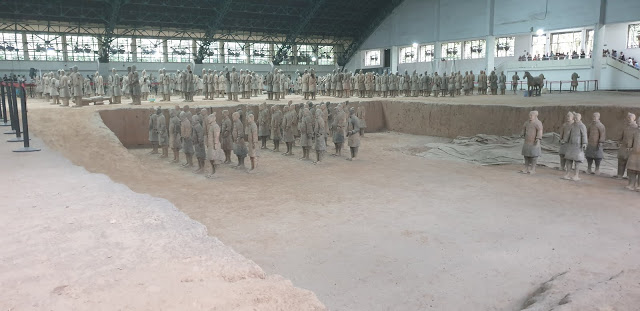
There are about eight lines of soldiers, and some lining the sides.

Midway down there is a large area currently under excavation

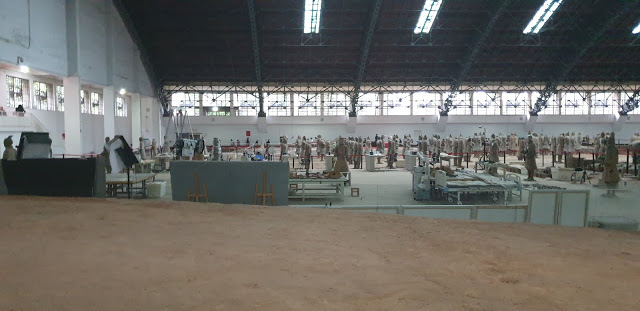
At the back is the hospital where the soldiers are reassembled.  There’s nearly a hundred in the various stages of rebuilding.  These days the soldiers are rebuilt using computer imaging.

The hospital area is where they are put back together

And these are some of the statues in various stages of reconstruction

Another two views of the size and scale of the reconstruction project

The coffee shop is also a sales centre, but there are too many people waiting for coffee and too few places to sit down.

Searching for locations: Terracotta Warriors and Horses Museum, X’ian, China

Terracotta Warriors and Horses Museum

A little history, and anecdotal advice first:

In 1974 a 26-year-old farmer, Yang Jide, was drilling a well and found fragments of the terracotta soldiers and bronze weapons.

What was discovered later was one of the biggest attended burial pits of China’s first feudal Emperor, Qin Shi Huang.  In the following years remains had been found in 3 pits, yielding at least 8,000 soldiers and horses, and over 100 chariots.  The soldiers were infantry, cavalry, and others.

Emperor Qin was born in 259 BC and died in 210 BC.  He began building a mausoleum for himself at the foot of Mount Li when he was 13.  Construction took 38 years, from 247 BC to 208 BC.  It was divided into 3 stages and involved 720,000 conscripts.

The pits of pottery figures are 1.5 km east of Emperor Qin’s mausoleum.  Pit 1 has about 6,000 terracotta armored warriors and horses and 40 wooden chariots.  Pit 2 is estimated to have over 900 terracotta warriors and 350 terracotta horses with about 90 wooden chariots.  Pit 3 had so far yielded only 66 pottery figures and one chariot drawn by four horses.

Official records say it was discovered later that it was likely Xiang Yu, a rebel, intentionally damaged the Mausoleum and the soldiers in the pits, by setting fire to the wooden roof rafters, and these fell on and broke the warriors into pieces.

However, we were told that after the terracotta warriors were completed, the Emperor ordered the builders to be killed so that they would not tell anyone about the warriors, and then of those that remained alive deliberately smashed all of the artifacts.

The thing is, all of the terracotta figures that have been found are in pieces, and they need computers to piece them back together again.

The visit:
The first impression is the size of the car park and the number of buses parked in the lot, and a hell of a lot more outside up the road an off on side streets.  Obviously, it costs money to park in the parking lot.

The other first impressions; the numbers waiting to get in were not as many as yesterday outside the forbidden city, in fact, a lot less.

Be warned there’s a long walk from the entrance gate where your bags are scanned and a body scan as well, before admittance.  This walk is through a landscaped area which it is expect might sometime in the future reveal more soldiers, or other artifacts.

At the end of the walk that takes about ten minutes, you can get a one-way ride to the second checkpoint, but we opted not to as no one else in our group did.

That walk is the warm-up exercise to an organized viewing of the exhibits after going through a second ticket checkpoint.  On the other side, we had to hand our tickets back to the tour guide which was disappointing not to end up with a memento of actually having been there.

So, on the other side in the courtyard, the guide told us the most important parts of the exhibition, that we should spend most of the time looking at pit 1, and then spent a little time in 2 which is only there in the first stages of excavation.  Then move onto the museum if only to see the replica chariots.

We do.

The chariots were small but interesting

The horses were better and intricately detailed

These are soldiers, perhaps complete examples of those types found in the end pit.

This is one of the archers.  You can tell by the way he wears his hair.

Pit 2

The excavation of this pit has only just begun, so it is possible to see where they have carefully removed the top cover, and you can see the broken parts of the warriors lying in a heap.

Some parts of the warriors are more discernible closer up

These parts are carefully extracted and taken to the ‘hospital’ where they are digitised and the computer will match each part with the warrior it belongs to.

Pit 1

This has quite a number of standing soldiers that have been glued back together, but not necessarily complete and I notice a number if the statues were incomplete. And if they cannot find the missing pieces, then they are not added to or filled in.

The scale of the pit is enormous, and they have hardly scratched the surface in the restoration process.

What is there is a number of horses as well.

That’s at the front of the pit, a long line of statues, and what is clear is the location of the well where the first fragments were found by a farmer.

There are about eight lines of soldiers, and some lining the sides.

Midway down there is a large area currently under excavation

At the back is the hospital where the soldiers are reassembled.  There’s nearly a hundred in the various stages of rebuilding.  These days the soldiers are rebuilt using computer imaging.

The hospital area is where they are put back together

And these are some of the statues in various stages of reconstruction

Another two views of the size and scale of the reconstruction project

The coffee shop is also a sales centre, but there are too many people waiting for coffee and too few places to sit down.