These gardens are very tightly put together and are interspersed with buildings that you can go in and look at as distinct from just looking in from the outside.
There are lots of paths that wind around interspersed with rocks which may or may not be sculpted, and equally interspersed with trees, bushes, and small plants. In the middle is a lake which usually has lotus plants in bloom, but they are not in season.
The gardens were built around a small lake that was filled with fish of all sizes and colours
The buildings were also a contrast for those built for the men
and those for the women
In the middle of the garden was a significant rock pillar
surrounded by certain areas of the garden that had smaller rock formations
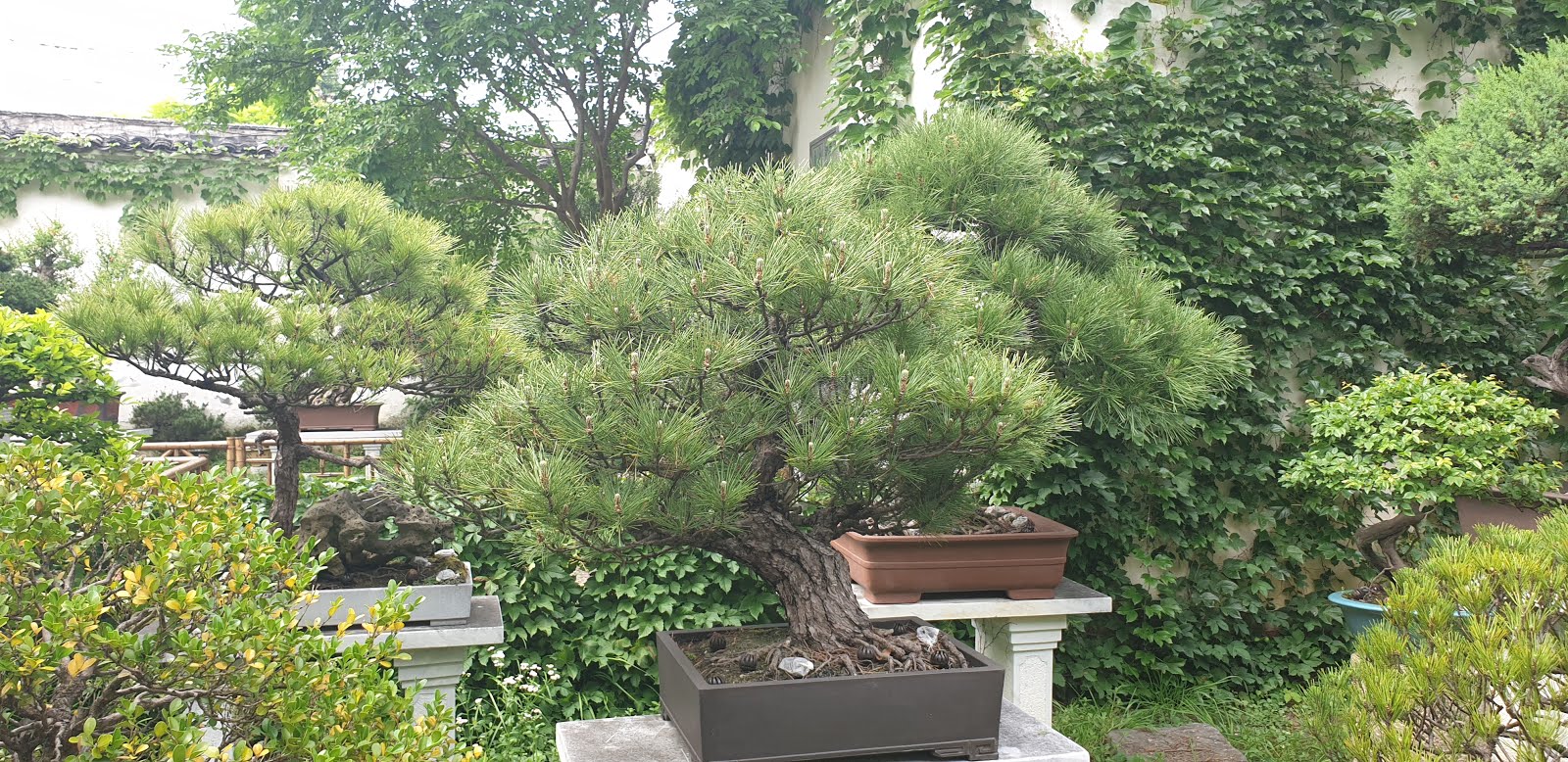
At the end of the garden is a large collection of bonsai trees, some of which are quite exquisite.
Beijing Zoo Founded in 1906 during the late Qing dynasty, it is the oldest Zoo in China. It also has an aquarium and has 450 land-based species, some of which are rare and endemic to China like the Giant Panda, and 500 marine-based species. Other rare animals to be seen are the Red Panda, the Golden Snub-nosed Monkey, the South China Tiger, the White Lipped deer, the Chinese alligator, the Yak,, and the Snow Leopard. Most of the original animals were bought in 1908 from Germany by the viceroy of Liangjiang Duanfang. The Zoo first opened on June 16th, 1908. Currently, the Zoo grounds resemble classical Chinese gardens, and among the attractions are a number of Qing dynasty buildings to view, as well as an Elephant hall, a Lion and tiger hall, a Monkey hall, and a Panda hall. In all, there are 30 halls. The Zoo is located at 137 Xizhimen WaiDajie in Xicheng district, near the 2nd ring road.
We are primarily at the Zoo to see the Pandas, and there is a specific hall devoted to them, and by the way, it costs extra to see them. Everyone in our group is particularly interested in seeing them because it’s rare that any can be found anywhere else in the world. Perhaps if there had been more time, another hour, maybe, it might have made all the difference, but I think that extra time might have clashed with the pearl factory, and that, for obvious reasons, was deemed to be more important.
Our first stop is in the Panda hall.
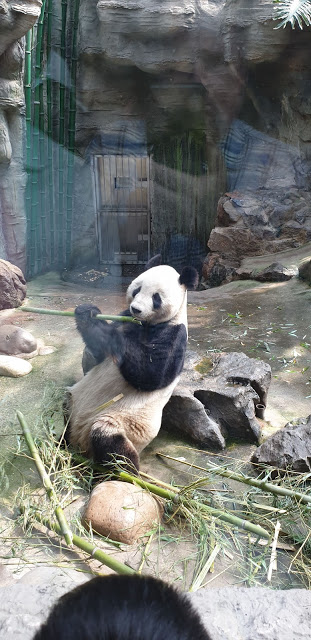
There are two pandas that we can see, one of whom is a little camera shy, and the other, above, who is demonstrating how pandas eat bamboo. They are behind a large glass wall, and you have to wait for the opportunity to get a good photo, and, sometimes only enough to include the top of the head of the person in front of you. Unfortunately, the Chinese visitors don’t understand the polite excuse me in English, and, can at times, be rude enough to shove their way to the front.
What is also a problem is the uncooperativeness of the pandas to pose for photos. I guess there’s no surprise there given the thousands of visitors every day with only one purpose in mind. We counted ourselves lucky to get the photos we did.
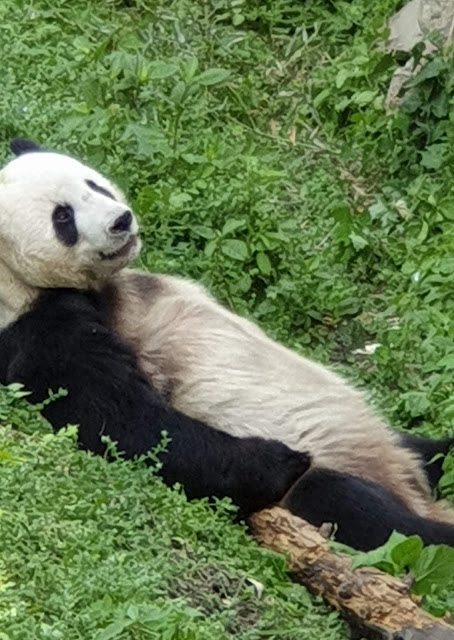
The hall itself is built on to the external enclosure where there are a number of giant pandas some of whom that were on show were relatively lethargic, as though they had a big weekend, and we’re sleeping it off, like this panda below:
Then, remarkably, we came across one that decided to be a little more energetic and did a walk in front of hundreds of Chinese who had undoubtedly come to show their children the animals.
This Panda was also easier to photograph whereas the other panda, one chewing on a morning feast of bamboo, saw a lot of pushing and shoving by the spectators to get the best spot to take his photograph. Having manners just doesn’t cut it here, so do what you have to to get that photograph.
We also saw a couple of monkeys that were also in the panda enclosure, but they were not much of a side benefit. They may have been there to use the Panda’s exercise equipment, though it was not quite like what we use.There was no time really to wander off to see much else, but apparently, there were also red pandas, and surprisingly, a category call Australian animals. But, who goes to another country to view your own animals?The cutest animals were the stuffed pandas, and they were quite reasonably priced.
This morning is a boat ride that will take us along a small portion of the main canal, and we head through a number of back streets, to a landing where there are a number of boats all vying with each other to get us passengers on boats.
But…
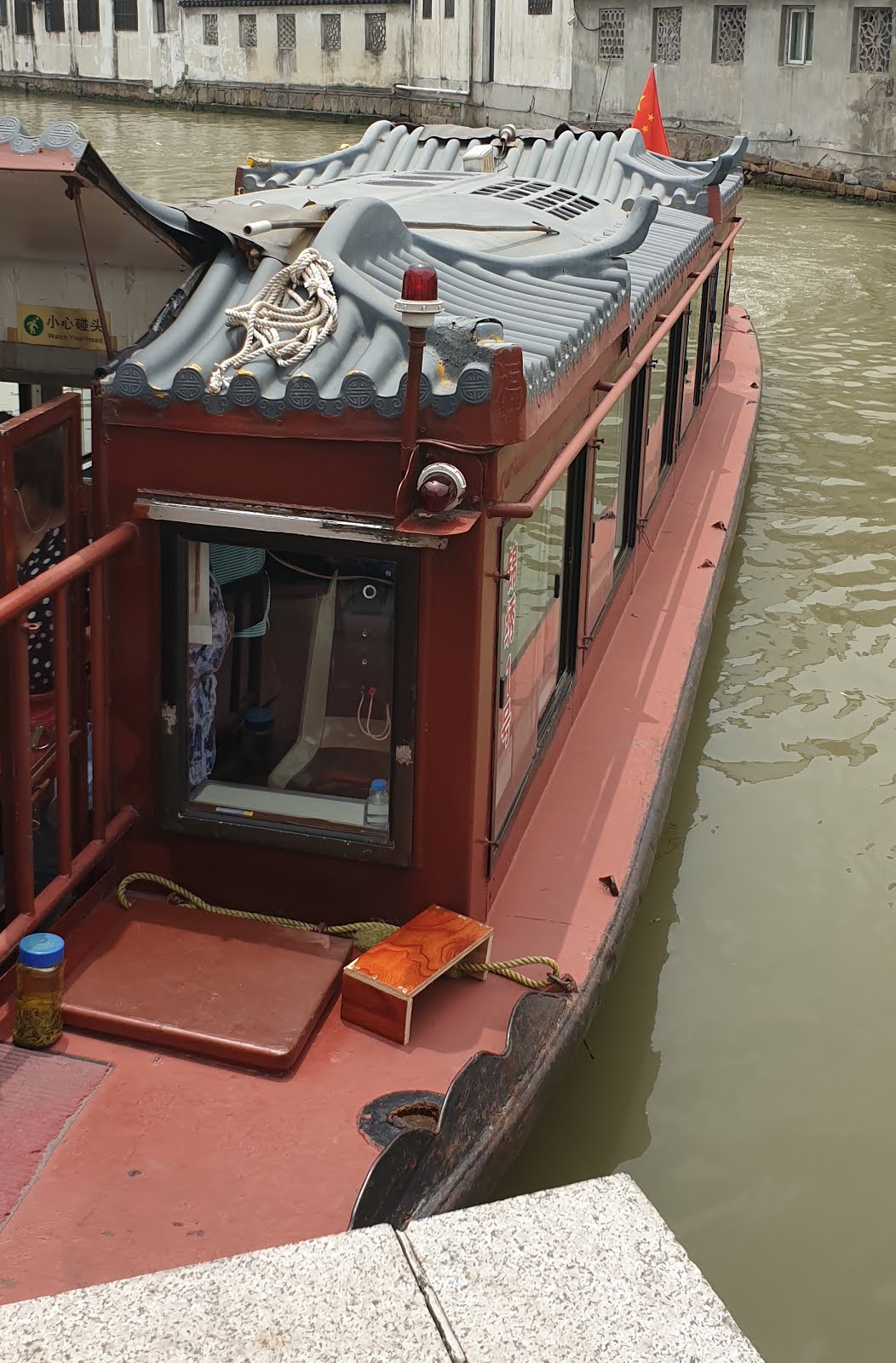
These boats don’t have a wharf to tie up to and then put out a stable gangplank. No. They just more into a concrete step and you take your life in your hands getting on. One wrong step and you’re in the canal. And not a very clean one at that.
That’s if another boat doesn’t come along and bumps you, knocking you off balance. We managed not to lose anyone in boarding the vessel.
This is where we get on the boat
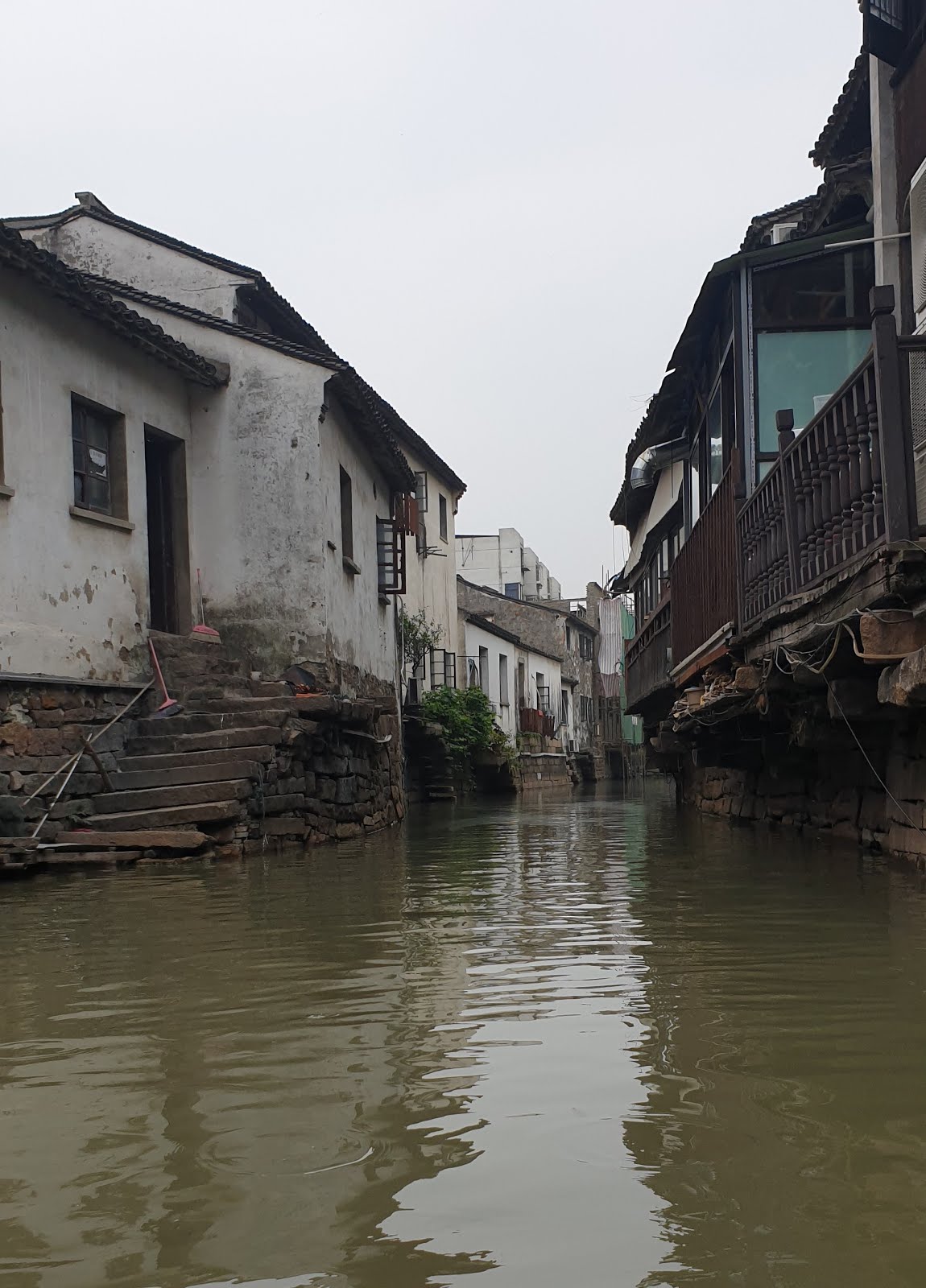
We go along what appears to be downstream towards another larger canal, past tree-lined streets until the canal narrows and we’re looking at the backs of houses, which look very dilapidated.
And the canals? Well, it’s not quite like it is in Venice
Though some parts of the canal look better than others
What doesn’t bear thinking about is the electrical wiring which is a nightmarish spider web of cables going off in all directions. How anyone could troubleshoot problems is beyond me.
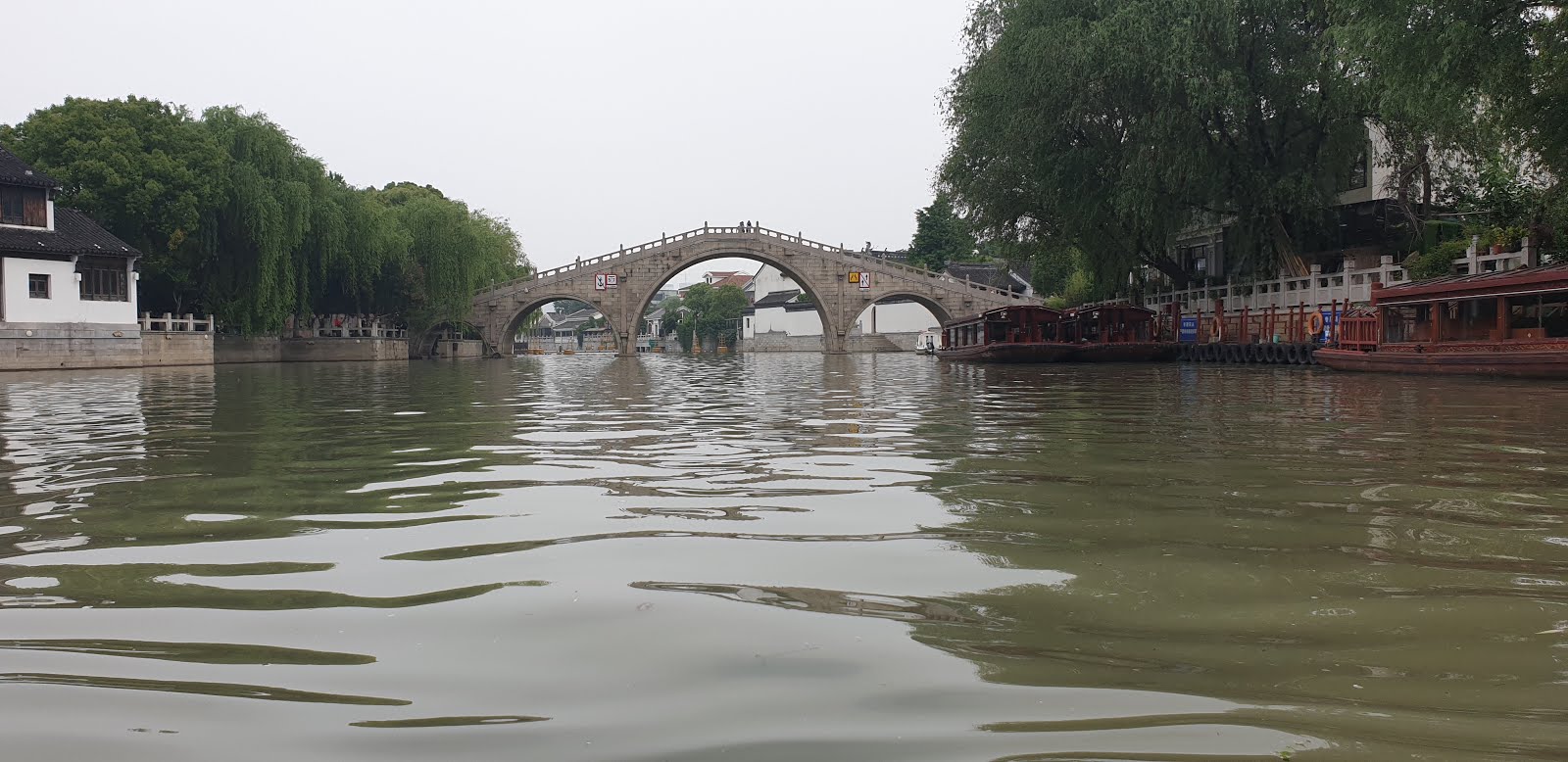
We pass under a number of bridges, and then, about 30 minutes after leaving, we reach a larger canal and do a 180-degree turn, and head back to a drop off point the will enable us to walk through a typical everyday Chinese market for food and the other items.
This drop off point is much the same as the starting point, a concrete step which is as hazardous as the first. At least we don’t have to compete with other boats for the landing spot.
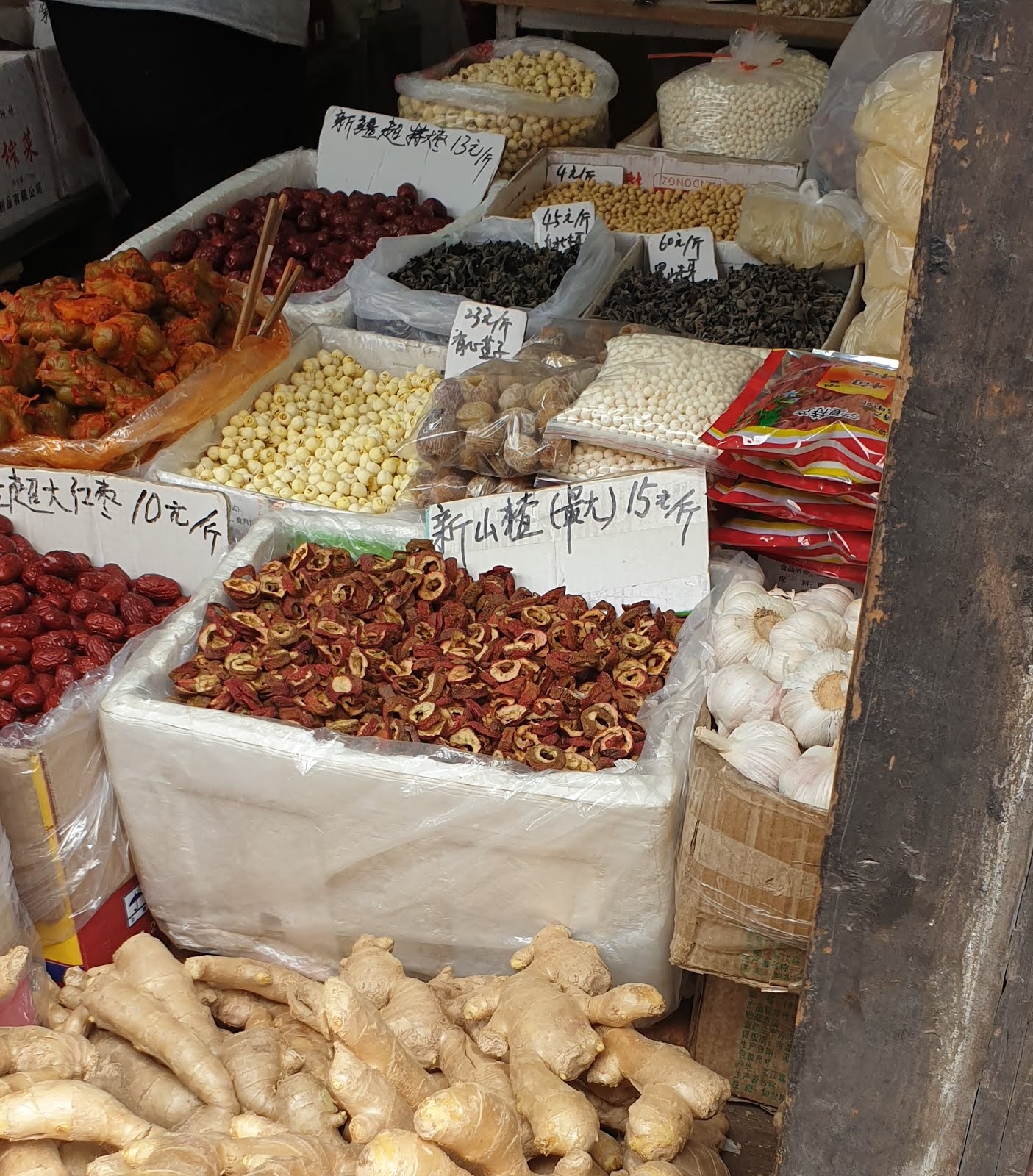
We take a leisurely stroll down a small section of Pingjiang Road with small shops on either side, selling all manner of goods
but my interest is in the food and the prices, which at times seem quite expensive for so-called local people, so maybe because the tourists go down this street every day, the prices have been inflated accordingly.
I find it rather disappointing.
We walk to the bridge, go under to the other side crossing the canal and find the coffee shop which is also the meeting place.
So…
When is a coffee shop not a coffee shop, when it takes an eternity to make a cup of coffee, we waited 25 minutes?
We also ordered beef black pepper rice and it took 20 minutes before it arrived, but it was well worth the wait. Strands of perfectly cooked beef with onion, carrot, and capsicum, with a very peppery and spicy sauce, with a side of boiled rice.
A pizza was ordered too but it did not arrive at all before we left.
In 1974 a 26-year-old farmer, Yang Jide, was drilling a well and found fragments of the terracotta soldiers and bronze weapons.
What was discovered later was one of the biggest attended burial pits of China’s first feudal Emperor, Qin Shi Huang. In the following years remains had been found in 3 pits, yielding at least 8,000 soldiers and horses, and over 100 chariots. The soldiers were infantry, cavalry, and others.
Emperor Qin was born in 259 BC and died in 210 BC. He began building a mausoleum for himself at the foot of Mount Li when he was 13. Construction took 38 years, from 247 BC to 208 BC. It was divided into 3 stages and involved 720,000 conscripts.
The pits of pottery figures are 1.5 km east of Emperor Qin’s mausoleum. Pit 1 has about 6,000 terracotta armored warriors and horses and 40 wooden chariots. Pit 2 is estimated to have over 900 terracotta warriors and 350 terracotta horses with about 90 wooden chariots. Pit 3 had so far yielded only 66 pottery figures and one chariot drawn by four horses.
Official records say it was discovered later that it was likely Xiang Yu, a rebel, intentionally damaged the Mausoleum and the soldiers in the pits, by setting fire to the wooden roof rafters, and these fell on and broke the warriors into pieces.
However, we were told that after the terracotta warriors were completed, the Emperor ordered the builders to be killed so that they would not tell anyone about the warriors, and then of those that remained alive deliberately smashed all of the artifacts.
The thing is, all of the terracotta figures that have been found are in pieces, and they need computers to piece them back together again.
The visit: The first impression is the size of the car park and the number of buses parked in the lot, and a hell of a lot more outside up the road an off on side streets. Obviously, it costs money to park in the parking lot.
The other first impressions; the numbers waiting to get in were not as many as yesterday outside the forbidden city, in fact, a lot less.
Be warned there’s a long walk from the entrance gate where your bags are scanned and a body scan as well, before admittance. This walk is through a landscaped area which it is expect might sometime in the future reveal more soldiers, or other artifacts.
At the end of the walk that takes about ten minutes, you can get a one-way ride to the second checkpoint, but we opted not to as no one else in our group did.
That walk is the warm-up exercise to an organized viewing of the exhibits after going through a second ticket checkpoint. On the other side, we had to hand our tickets back to the tour guide which was disappointing not to end up with a memento of actually having been there.
So, on the other side in the courtyard, the guide told us the most important parts of the exhibition, that we should spend most of the time looking at pit 1, and then spent a little time in 2 which is only there in the first stages of excavation. Then move onto the museum if only to see the replica chariots.
We do.
The chariots were small but interesting
The horses were better and intricately detailed
These are soldiers, perhaps complete examples of those types found in the end pit.
This is one of the archers. You can tell by the way he wears his hair.
Pit 2
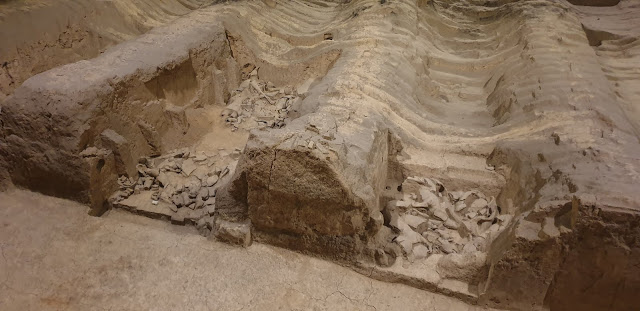
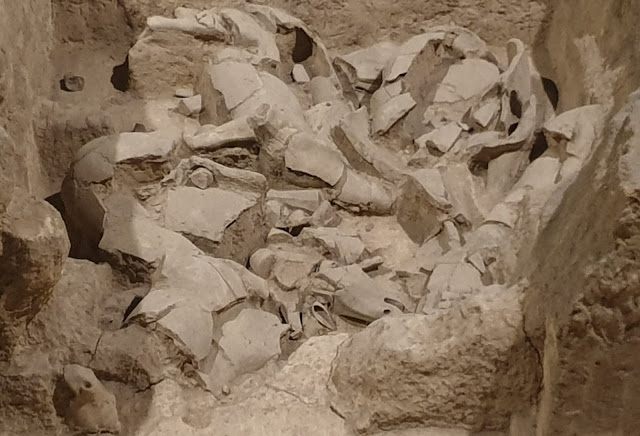
The excavation of this pit has only just begun, so it is possible to see where they have carefully removed the top cover, and you can see the broken parts of the warriors lying in a heap.
Some parts of the warriors are more discernible closer up
These parts are carefully extracted and taken to the ‘hospital’ where they are digitised and the computer will match each part with the warrior it belongs to.
Pit 1
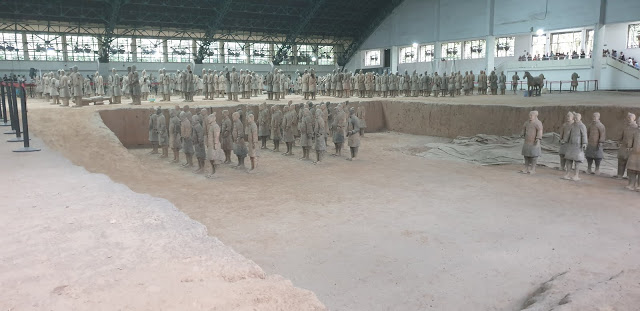
This has quite a number of standing soldiers that have been glued back together, but not necessarily complete and I notice a number if the statues were incomplete. And if they cannot find the missing pieces, then they are not added to or filled in.
The scale of the pit is enormous, and they have hardly scratched the surface in the restoration process.
What is there is a number of horses as well.
That’s at the front of the pit, a long line of statues, and what is clear is the location of the well where the first fragments were found by a farmer.
There are about eight lines of soldiers, and some lining the sides.
Midway down there is a large area currently under excavation
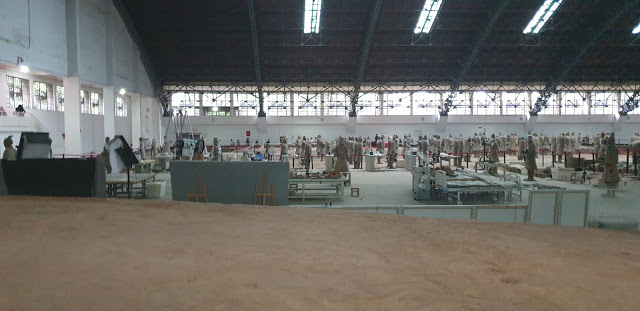
At the back is the hospital where the soldiers are reassembled. There’s nearly a hundred in the various stages of rebuilding. These days the soldiers are rebuilt using computer imaging.
The hospital area is where they are put back together
And these are some of the statues in various stages of reconstruction
Another two views of the size and scale of the reconstruction project
The coffee shop is also a sales centre, but there are too many people waiting for coffee and too few places to sit down.