A photograph from the inspirational bin – 13

I came across this photo:

This is like so many roads off in what is known as the Gold Coast hinterland, that tract of land between the ocean and the mountain range that runs along the eastern side of the country, known as the Great Dividing Range.

This is the road that runs behind where friends of ours live, and runs on down into a valley where a river runs, and when the rains come down, floods.

It’s hard to imagine that a few hundred years ago all of this would have been tropical jungle, and intrepid explorers would be making their way north or west, just to see what was there.

I imagine in another 100 years, all of this will be gone, given over to housing, shopping malls, and factories, and anything that resembles country living will have been moved out to far beyond the mountain range and towards the what is called the ‘red’ centre.

Or over that time there is a reckoning with mother nature, and if there is, I know who I’d put my money on.

But, as for a story…

…

It was quite literally the road to nowhere.

You just had to follow it until it disintegrated into a dirt track, and then for another 20 miles before you finished up at a rusty gate attached to a dilapidated fence that surrounds the a house that was cleverly hidden behind a grove of trees, the only place I knew as home. We had no phones, no television or radio, no real contact with the outside world.

Until, one day, my fairy godmother came and rescued me.

Yes, it felt like that.

Little had I realized that there were any other people in our family, and it took until the death of my parents to find out I had grandparents, and a much larger extended family.

There had been, according to my father, no reason to leave. Or for anyone else to come, and the few that ventured to end of the road, found there was nothing to see, and no reason to stay.

For all intents and purposes we didn’t exist, and, oddly, I was content with that.

Until I decided to venture further afield, run into two people, a man and a woman, both of whom said they were related to my father, and ask me to take them back with them to meet my father,

A bad choice, but I didn’t know it at the time.

Not until my father ran them off at the point of the gun he always had with him.

He knew who they were, and it surprised me to see the change in him, from the strong silent type, to a man greatly afraid, though he would not tell me of what.

He just told me to lock myself in my room, and not to come out for anything.

I heard him leave, but not come back.

It took three days before I left that room, to find I was completely alone in the house. Outside, it was a different story. There, half way between the back door and the barn were the two people I’d brought home, both dead. A little further away were my parents, also dead.

And another man, who was leaning over my father.

I stopped when he looked up in my direction.

“You must be Jake.”

How did he know my name? I nodded, warily watching him in case I had to run.

He went from body to body, checking to see if they were still alive, then stood and turned around to look at me.

“Do you know what happened?”

“No.”

“Do you know who the other two are?”

I assumed he was referring to the visitors.

“No. The man said he was a relative, asked me to bring them here.”

“How did you…”

Escape? “My father told me to hide and not come out.” If this man was associated with the other two…

Perhaps he saw my trepidation.

“I’m a friend of your father’s, a policeman. You were supposed to be safe here.”

We were, until I brought the harbingers of death. “Not any more,” I said.

…

© Charles Heath 2021

Searching for locations: Toronto to New York

After leaving Toronto, we just had enough time to have breakfast and get to the car, another sedan, just managing to fit everything in.

By now we have finally realized the booking agent at Flight Centre had made the wrong type of car bookings for us in Canada, and I will be waiting with interest what cars we get in New York.

We went to a special section of the airport where Air Canada planes depart for the USA, and where the customs and immigration were completed on the Canada side and we just walked out of the terminal into the USA.

The plane trip was undertaken in an Embraer 175, twinjet, a small plane with 27 rows of 2 x 2 in coach, the American equivalent to economy.

Today we are traveling from Toronto Pearson to Newark Airport, somewhere near New York, USA.

The flight, a relatively short one, was supposed to take 56 minutes flying time, but as we all know, that’s not usually where the problems lie.

Here is the flight’s running sheet:

Boarding completed at 12:08

Push back at 12:18

Advised of a 45-minute wait at 12:41, something is holding us up.

Engines are shut down and we are sitting on the tarmac somewhere within the airfield. Snacks are handed out.

Take off is at exactly 1:30 pm

Landed 2:40 pm after taking the long way to Newark. Follow the course tracker as we approached Newark was like watching a drunk wander home from the pub.

Taxied for 8 minutes only to discover our parking bay is still occupied, so waiting to see if it is a long or short wait.

We have been plagued with difficulties.

Engine shutdown, or so I thought, at 2:56 means we are in for a long wait for a gate. Turns out the engines were on slow idle so they could power the lights and air conditioning.

Here we sit on the tarmac at Newark airport and going nowhere. Other planes are seen to come and go.

A 3pm announcement, another 20-minute wait for a gate.

3:40 pm we can now go to our gate.

4:15 we exit the terminal and find the car, and set off for the hotel in New York

Suburban 7 seater, very sedate driver, didn’t go over 45mph. Finally, we get a car that fits us and our luggage.

As for the ride from the airport to the hotel…

We were picked up by a Chevrolet Suburban, driven by the most cautious driver in America. Hoping to get a glimpse of the US countryside on the way from Newark to the hotel, arriving after 4 and getting dark by 4:30, most of the drive was in the dark

As far as I could tell, after taking the Manhattan tunnel, we drove around the outside of the island till we reached the nearest street to our hotel. It took about 45 minutes but at least it was warm, comfortable and better than any limousine we’ve had so far.

And then the Manhattan club…

I can’t help but think on first sight that this was once a night club, you know, the type that existed in the 40s and 50s where it wasn’t a social crime to smoke and drink and then drive home though I suspect most of the customers those days had nearby apartments.

Yes, a different and now lost forever, age.

As for the truth…

A photograph from the inspirational bin – 14

I’m always rummaging through the endless photographs that, if you were to ask me, I would vehemently deny I took.

It’s like the camera on my phone takes them itself, you know, the latest upgrade they didn’t tell you about, the artificial intelligence.

OK, so it’s simply a ferry crossing a wide stretch of water. You ask, why didn’t they build a bridge? A good question, and not one I can answer.

But, what does the thought of a ferry conjure up?

It brought to mind the film Jaws, and the summer visitors to the island, or should I say, shark hunting ground.

Here?

Perhaps a little less sinister…or not.

To me, at this point, it suggests the possibility of a get away, depending on what side you’re on, mainland, or island. I’m going to say, you’re on the island and going back to the mainland.

Running.

The island is like one of those remote places, with one way in and one way out. a place where people go to try and breathe life back into a marriage that’s falling apart under the stresses of city life, but it failed.

The problem wasn’t the fact you didn’t see each other enough, it’s just that you had grown to dislike each other, and going into a small isolated situation only made the problem worse.

It was just easier to blame everything else.

But going home, well that’s a whole different kettle of fish, because bridges were burned before you left, and going back, well, there was going to be grovelling involved.

Or not.

There’s a story here, but not right now. Perhaps in a day or two.

It’s late, very late, and I need some sleep … well, thinking time.

A photograph from the inspirational bin – 13

I came across this photo:

This is like so many roads off in what is known as the Gold Coast hinterland, that tract of land between the ocean and the mountain range that runs along the eastern side of the country, known as the Great Dividing Range.

This is the road that runs behind where friends of ours live, and runs on down into a valley where a river runs, and when the rains come down, floods.

It’s hard to imagine that a few hundred years ago all of this would have been tropical jungle, and intrepid explorers would be making their way north or west, just to see what was there.

I imagine in another 100 years, all of this will be gone, given over to housing, shopping malls, and factories, and anything that resembles country living will have been moved out to far beyond the mountain range and towards the what is called the ‘red’ centre.

Or over that time there is a reckoning with mother nature, and if there is, I know who I’d put my money on.

But, as for a story…

…

It was quite literally the road to nowhere.

You just had to follow it until it disintegrated into a dirt track, and then for another 20 miles before you finished up at a rusty gate attached to a dilapidated fence that surrounds the a house that was cleverly hidden behind a grove of trees, the only place I knew as home. We had no phones, no television or radio, no real contact with the outside world.

Until, one day, my fairy godmother came and rescued me.

Yes, it felt like that.

Little had I realized that there were any other people in our family, and it took until the death of my parents to find out I had grandparents, and a much larger extended family.

There had been, according to my father, no reason to leave. Or for anyone else to come, and the few that ventured to end of the road, found there was nothing to see, and no reason to stay.

For all intents and purposes we didn’t exist, and, oddly, I was content with that.

Until I decided to venture further afield, run into two people, a man and a woman, both of whom said they were related to my father, and ask me to take them back with them to meet my father,

A bad choice, but I didn’t know it at the time.

Not until my father ran them off at the point of the gun he always had with him.

He knew who they were, and it surprised me to see the change in him, from the strong silent type, to a man greatly afraid, though he would not tell me of what.

He just told me to lock myself in my room, and not to come out for anything.

I heard him leave, but not come back.

It took three days before I left that room, to find I was completely alone in the house. Outside, it was a different story. There, half way between the back door and the barn were the two people I’d brought home, both dead. A little further away were my parents, also dead.

And another man, who was leaning over my father.

I stopped when he looked up in my direction.

“You must be Jake.”

How did he know my name? I nodded, warily watching him in case I had to run.

He went from body to body, checking to see if they were still alive, then stood and turned around to look at me.

“Do you know what happened?”

“No.”

“Do you know who the other two are?”

I assumed he was referring to the visitors.

“No. The man said he was a relative, asked me to bring them here.”

“How did you…”

Escape? “My father told me to hide and not come out.” If this man was associated with the other two…

Perhaps he saw my trepidation.

“I’m a friend of your father’s, a policeman. You were supposed to be safe here.”

We were, until I brought the harbingers of death. “Not any more,” I said.

…

© Charles Heath 2021

Searching for locations: The Mary Valley Rattler, Gympie, Queensland, Australia

I have a passion for visiting transport museums, to see old trains, planes, buses, cars, even ships if it’s possible.

This has led to taking a number of voyages on the TSS Earnslaw in Queenstown, New Zealand.

Many, many, many years ago on Puffing Billy, a steam train in the Dandenongs, Victoria, Australia.

The steam train in Kingston, New Zealand, before it was closed down, but hopefully it will reopen sometime in the future.

The London Transport Museum in London England, which had a lot of buses.

The Workshops Railway Museum in Ipswich, Queensland, where once the many steam engines were built and maintained, and now had only a handful of engines remaining.

However, in the quest for finding and experiencing old transportation methods, we came across the Mary Valley Rattler, which runs out of Gympie, Queensland, Australia.

The ride begins in Gympie at the old Gympie Railway station, and as can be seen below, is one of the relics of the past, and, nothing like the new more modern stations.  Thankfully.

If you’re going to have a vintage train, then you have to have a vintage station.

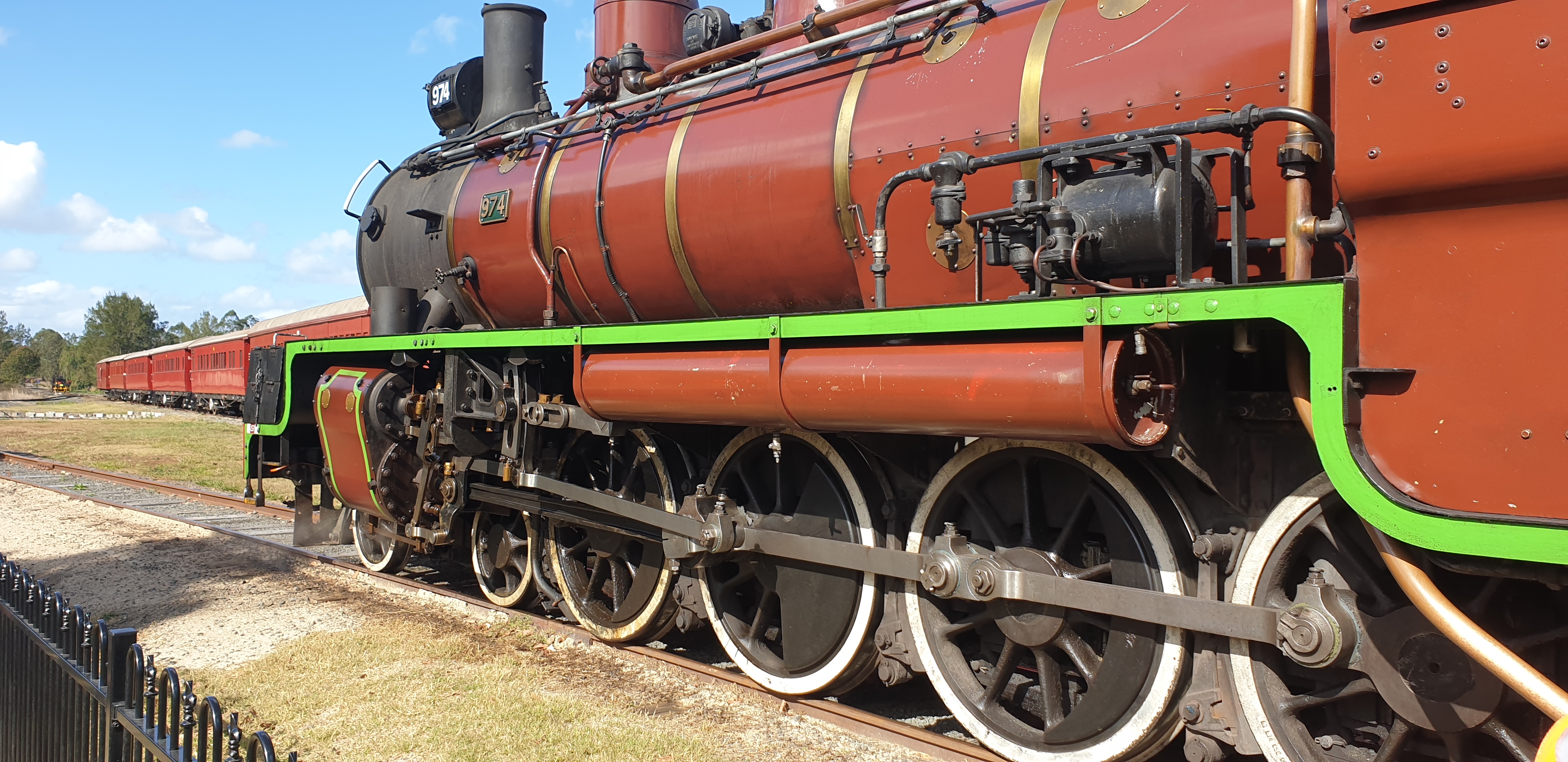
The Class of engine, seen below, is the C17, a superheated upgrade to the C16 it was based on, and first run in 1903.  This particular engine was built in 1951, although the first of its type was seen in  1920 and the last of 227 made in 1953.  It was the most popular of the steam engines used by Queensland Railways.

The C designation meant it had four driving axels and 17 was the diameter of the cylinder, 17 inches.  It is also known as a 4-8-0 steam locomotive
 and nicknamed one of the “Brown Bombers” because of its livery, brown with green and red trimming.

Also, this engine was built in Maryborough, not far from Gympie by Walkers Limited, one of 138.

This photo was taken as the train returned from Amamoor, a trip that takes up to an hour.

The locomotive is detached from the carriages, then driven to the huge turntable to turn around for the return journey to Amamoor.

This is the locomotive heading down to the water station, and then taking on water.  After that, it will switch lines, and reverse back to reconnect the carriages for the trip to Amamoor.

The carriages are completely restored and are extremely comfortable.  It brings back, for me, many memories of riding in older trains in Melbourne when I was a child.

The trains, then, were called Red Rattlers.

This is the locomotive climbing one of the hilly parts of the line before crossing over the Mary River on a trestle bridge.

This is the engine at Amamoor near the picnic area where young children and excited parents and grandparents can get on the locomotive itself and look inside where the driver sits.

And, no, I didn’t volunteer to shovel coal.

This particular locomotive spent most of its working life between Townsville and Mount Isa and was based in Cloncurry, Charters Towers, and Townsville, before being sent, at the end of its useful days in the late 1960s, to the Ipswich Railway Workshops.

I’m trying to write a period piece

Televison is a great recorder of the past, and most channels, and especially cable tv have great libraries of films that go back more than a hundred years.

And, whilst it’s possible that modern day films and television series can try to recapture the past, the English as an exception being very good at it, often it is impossible to capture it correctly.

But, if you have a film shot in the moment, then you have a visual record of what life, and what was once part of our world before you in all it’s dated glory. The pity of it is that, then, we never appreciated it.

After all, in those particular times, who had the time to figuratively stop and smell the roses. Back then as life was going on, we were all tied up with just trying to get through each day.

Years later, often on reflection, we try to remember the old days, and, maybe, remember some of what it was like, but the chances are that change came far too rapidly, and often too radical, that it erases what we thought we knew existed before.

My grandmothers house is a case in point. In it’s place is a multi lane super highway, and there’s nothing left to remind us, or anyone of it, just some old sepia photographs.

I was reminded of how volatile history really is when watching an old documentary, in black and white, and how the city I grew up in used to look.

Then, even though it seemed large to me then, it was a smaller city, with suburbs that stretched about ten or so miles in every direction, and the outer suburbs were where people moved to get a larger block, and countrified atmosphere.

Now, those outer suburbs are no longer spacious properties, the acreage subdivided and the old owners now much richer for a decision made with profit not being the motivator, and the current suburban sprawl is now out to forty or fifty miles.

The reason for the distance is no longer the thought of open spaces and cleaner air, the reason for moving now is that land further out is cheaper, and can make buying that first house more affordable.

This is where I tip my hat to the writers of historical fiction. I myself am writing a story based in the 1970s, and its difficult to find what is and isn’t time specific.

If only I had a dollar for every time I went to write the character pulling out his or her mobile phone.

What I’ve found is the necessity to research, and this has amounted to finding old films, documentaries of the day, and a more fascinating source of information, the newspapers of the day.

The latter especially has provoked a lot of memories and a lot of stuff I thought I’d forgotten, some of it by choice, but others that were poignant.

Yes, and don’t get me started on the distractions.

If only I’d started this project earlier…

Searching for locations: The Mary Valley Rattler, Gympie, Queensland, Australia

I have a passion for visiting transport museums, to see old trains, planes, buses, cars, even ships if it’s possible.

This has led to taking a number of voyages on the TSS Earnslaw in Queenstown, New Zealand.

Many, many, many years ago on Puffing Billy, a steam train in the Dandenongs, Victoria, Australia.

The steam train in Kingston, New Zealand, before it was closed down, but hopefully it will reopen sometime in the future.

The London Transport Museum in London England, which had a lot of buses.

The Workshops Railway Museum in Ipswich, Queensland, where once the many steam engines were built and maintained, and now had only a handful of engines remaining.

However, in the quest for finding and experiencing old transportation methods, we came across the Mary Valley Rattler, which runs out of Gympie, Queensland, Australia.

The ride begins in Gympie at the old Gympie Railway station, and as can be seen below, is one of the relics of the past, and, nothing like the new more modern stations.  Thankfully.

If you’re going to have a vintage train, then you have to have a vintage station.

The Class of engine, seen below, is the C17, a superheated upgrade to the C16 it was based on, and first run in 1903.  This particular engine was built in 1951, although the first of its type was seen in  1920 and the last of 227 made in 1953.  It was the most popular of the steam engines used by Queensland Railways.

The C designation meant it had four driving axels and 17 was the diameter of the cylinder, 17 inches.  It is also known as a 4-8-0 steam locomotive
 and nicknamed one of the “Brown Bombers” because of its livery, brown with green and red trimming.

Also, this engine was built in Maryborough, not far from Gympie by Walkers Limited, one of 138.

This photo was taken as the train returned from Amamoor, a trip that takes up to an hour.

The locomotive is detached from the carriages, then driven to the huge turntable to turn around for the return journey to Amamoor.

This is the locomotive heading down to the water station, and then taking on water.  After that, it will switch lines, and reverse back to reconnect the carriages for the trip to Amamoor.

The carriages are completely restored and are extremely comfortable.  It brings back, for me, many memories of riding in older trains in Melbourne when I was a child.

The trains, then, were called Red Rattlers.

This is the locomotive climbing one of the hilly parts of the line before crossing over the Mary River on a trestle bridge.

This is the engine at Amamoor near the picnic area where young children and excited parents and grandparents can get on the locomotive itself and look inside where the driver sits.

And, no, I didn’t volunteer to shovel coal.

This particular locomotive spent most of its working life between Townsville and Mount Isa and was based in Cloncurry, Charters Towers, and Townsville, before being sent, at the end of its useful days in the late 1960s, to the Ipswich Railway Workshops.

I’m trying to write a period piece

Televison is a great recorder of the past, and most channels, and especially cable tv have great libraries of films that go back more than a hundred years.

And, whilst it’s possible that modern day films and television series can try to recapture the past, the English as an exception being very good at it, often it is impossible to capture it correctly.

But, if you have a film shot in the moment, then you have a visual record of what life, and what was once part of our world before you in all it’s dated glory. The pity of it is that, then, we never appreciated it.

After all, in those particular times, who had the time to figuratively stop and smell the roses. Back then as life was going on, we were all tied up with just trying to get through each day.

Years later, often on reflection, we try to remember the old days, and, maybe, remember some of what it was like, but the chances are that change came far too rapidly, and often too radical, that it erases what we thought we knew existed before.

My grandmothers house is a case in point. In it’s place is a multi lane super highway, and there’s nothing left to remind us, or anyone of it, just some old sepia photographs.

I was reminded of how volatile history really is when watching an old documentary, in black and white, and how the city I grew up in used to look.

Then, even though it seemed large to me then, it was a smaller city, with suburbs that stretched about ten or so miles in every direction, and the outer suburbs were where people moved to get a larger block, and countrified atmosphere.

Now, those outer suburbs are no longer spacious properties, the acreage subdivided and the old owners now much richer for a decision made with profit not being the motivator, and the current suburban sprawl is now out to forty or fifty miles.

The reason for the distance is no longer the thought of open spaces and cleaner air, the reason for moving now is that land further out is cheaper, and can make buying that first house more affordable.

This is where I tip my hat to the writers of historical fiction. I myself am writing a story based in the 1970s, and its difficult to find what is and isn’t time specific.

If only I had a dollar for every time I went to write the character pulling out his or her mobile phone.

What I’ve found is the necessity to research, and this has amounted to finding old films, documentaries of the day, and a more fascinating source of information, the newspapers of the day.

The latter especially has provoked a lot of memories and a lot of stuff I thought I’d forgotten, some of it by choice, but others that were poignant.

Yes, and don’t get me started on the distractions.

If only I’d started this project earlier…

Searching for locations: Hotels can be a mine of information for a story

Hotels can be one of the major letdowns of a holiday.

They can also be extensive fodder for writing material.  For the main stories I write, hotel stays feature prominently, and so each experience, no matter how insignificant, is another paragraph in my book of experiences.

So…

If you are going to use a travel agent to pick a hotel for you, make sure you check as much as you can before you see them, because no matter how it is described, seeing it, in reality, is always completely different than the pictures in a brochure and sometimes on the Internet.  It requires research and a good look at TripAdvisor.

Or word of mouth by someone you know and trust who have stayed there.

Take, for instance, staying in a five-star hotel, the usual stomping ground of the rich and famous.  It is always interesting to see how the less privileged fare.  Where hotel staff is supposed to treat each guest equally, it’s not always the case.  Certainly, if you’re flashing money around, the staff will be happy to take it, though you may not necessarily get what you’re expecting.

We were once lucky enough to be in the highest hotel loyalty level and this gave us a number of privileges; at times working in our favor, but even then not always.

Privilege can sometimes count for nothing.  It often depends on the humor of the front desk clerk, or the guest services manager, and woe betide you if you get the receptionist from hell.

Been there, done that, more than once.

Then there is the room.

There is such a wide variety of rooms available, even if the hotel site or brochure has representative pictures, the odds are you can still get a room that is nothing like you’re expecting or were promised.

Believe me, there are rooms with a view, overlooking pigeon coops or air-conditioning vents.  And if you’re lucky, at Niagara Falls, it might be that six inches of window space that allows a very limited view of the falls.

Still, why should I complain, you can see the Falls … can you not?

A bone of contention often can be the location of the hotel and sometimes parking facilities, not the least of which is the cost of Valet parking; given the extortion some hotels charge, it’s better to just forget a car.

It is nothing like the movies, you just do not drive up to the front entrance, get out, hand the keys to the concierge, and expect everything else to happen by magic.

It doesn’t.

One time we waited for over an hour for our luggage to be delivered, and that was after three phone calls to the concierge desk.

Sometimes you can be reasonably near transport, yes, if you could walk the distance (which feels like the length of a marathon) to the nearest bus or tram stop.

The problem is we both have trouble with knees and ankles and walking distances are difficult at the best of times, and for us, it is a long, long way when you can’t walk and that’s when the hotel starts to feel like a prison.  Taxis may be cheap but when you have to use them three or four times a day it all adds up.

Also, be wary when a hotel says it is close to public transport.  While that may be true in London, anywhere else and especially in Europe, you could find yourself in the middle of nowhere.

It’s when you discover your travel agent didn’t exactly lie but it is why that weekly rate was so cheap.  In the end, the sum of the taxi fares and the accommodation turns out to be dearer than if you stayed at the Savoy.

So, those front line experiences are fodder for the travel blogger, and people who are also known as road warriors, the true frequent flyers.

There is a very large gulf between five stars and three and sometimes three can be very generous.  And of course, l now have a list of hotels l would never stay in again, the names of which might surprise you.


Searching for locations: Hotels can be a mine of information for a story

Hotels can be one of the major letdowns of a holiday.

They can also be extensive fodder for writing material.  For the main stories I write, hotel stays feature prominently, and so each experience, no matter how insignificant, is another paragraph in my book of experiences.

So…

If you are going to use a travel agent to pick a hotel for you, make sure you check as much as you can before you see them, because no matter how it is described, seeing it, in reality, is always completely different than the pictures in a brochure and sometimes on the Internet.  It requires research and a good look at TripAdvisor.

Or word of mouth by someone you know and trust who have stayed there.

Take, for instance, staying in a five-star hotel, the usual stomping ground of the rich and famous.  It is always interesting to see how the less privileged fare.  Where hotel staff is supposed to treat each guest equally, it’s not always the case.  Certainly, if you’re flashing money around, the staff will be happy to take it, though you may not necessarily get what you’re expecting.

We were once lucky enough to be in the highest hotel loyalty level and this gave us a number of privileges; at times working in our favor, but even then not always.

Privilege can sometimes count for nothing.  It often depends on the humor of the front desk clerk, or the guest services manager, and woe betide you if you get the receptionist from hell.

Been there, done that, more than once.

Then there is the room.

There is such a wide variety of rooms available, even if the hotel site or brochure has representative pictures, the odds are you can still get a room that is nothing like you’re expecting or were promised.

Believe me, there are rooms with a view, overlooking pigeon coops or air-conditioning vents.  And if you’re lucky, at Niagara Falls, it might be that six inches of window space that allows a very limited view of the falls.

Still, why should I complain, you can see the Falls … can you not?

A bone of contention often can be the location of the hotel and sometimes parking facilities, not the least of which is the cost of Valet parking; given the extortion some hotels charge, it’s better to just forget a car.

It is nothing like the movies, you just do not drive up to the front entrance, get out, hand the keys to the concierge, and expect everything else to happen by magic.

It doesn’t.

One time we waited for over an hour for our luggage to be delivered, and that was after three phone calls to the concierge desk.

Sometimes you can be reasonably near transport, yes, if you could walk the distance (which feels like the length of a marathon) to the nearest bus or tram stop.

The problem is we both have trouble with knees and ankles and walking distances are difficult at the best of times, and for us, it is a long, long way when you can’t walk and that’s when the hotel starts to feel like a prison.  Taxis may be cheap but when you have to use them three or four times a day it all adds up.

Also, be wary when a hotel says it is close to public transport.  While that may be true in London, anywhere else and especially in Europe, you could find yourself in the middle of nowhere.

It’s when you discover your travel agent didn’t exactly lie but it is why that weekly rate was so cheap.  In the end, the sum of the taxi fares and the accommodation turns out to be dearer than if you stayed at the Savoy.

So, those front line experiences are fodder for the travel blogger, and people who are also known as road warriors, the true frequent flyers.

There is a very large gulf between five stars and three and sometimes three can be very generous.  And of course, l now have a list of hotels l would never stay in again, the names of which might surprise you.