Like leg, arm is a word that is mostly associated with a body part.
Like being legless, another description for being drunk, being rendered ‘armless’ means you are no threat, in a rather awful but funny way by saying it.
I guess we all have a dash of ‘sick’ humour in all of us.
However, arm can also be used to describe a part of a structure too.
It could also describe the arm of an ‘armchair’.
But…
Arm also means to give people weapons like guns, usually from an armoury.
I’m guessing that a whole lot of people with arms is an army!
You can also say that taking those weapons away would be to disarm them.
It might take the long arm of the law to do it, too.
And to disarm someone doesn’t necessarily mean to take away their arms, but to ‘charm’ them with your wit and humour.
An arm can also be a river or streams tributary, so I could say instead of staying on the main river, I’ll take the ‘named’ arm, but just remember, sometimes this can be dangerous, getting off the main route.
On a boat, there is a yardarm, and this was once used to hang seamen who committed serious crimes such as mutiny.
A call to arms was to declare war,
And lastly, an arm of the defence services could be any one of Army, Navy, Marines or Airforce.
Just steer clear of the Navy for the aforementioned reasons.
Like leg, arm is a word that is mostly associated with a body part.
Like being legless, another description for being drunk, being rendered ‘armless’ means you are no threat, in a rather awful but funny way by saying it.
I guess we all have a dash of ‘sick’ humour in all of us.
However, arm can also be used to describe a part of a structure too.
It could also describe the arm of an ‘armchair’.
But…
Arm also means to give people weapons like guns, usually from an armoury.
I’m guessing that a whole lot of people with arms is an army!
You can also say that taking those weapons away would be to disarm them.
It might take the long arm of the law to do it, too.
And to disarm someone doesn’t necessarily mean to take away their arms, but to ‘charm’ them with your wit and humour.
An arm can also be a river or streams tributary, so I could say instead of staying on the main river, I’ll take the ‘named’ arm, but just remember, sometimes this can be dangerous, getting off the main route.
On a boat, there is a yardarm, and this was once used to hang seamen who committed serious crimes such as mutiny.
A call to arms was to declare war,
And lastly, an arm of the defence services could be any one of Army, Navy, Marines or Airforce.
Just steer clear of the Navy for the aforementioned reasons.
On an early morning walk, I discovered the Brooklyn Diner, a small restaurant tucked away in a street not far from Columbus Circle, perhaps a piece of history from the American past.
After all, if you’re going to take in the sights, sounds, and food of a country what better way to do it than visiting what was once a tradition.
This one was called the Brooklyn Diner. It had a combination of booths and counter sit down, though the latter was not a very big space, so we opted for a booth.
The object of going to a Diner is the fact they serve traditional American food, which when you get past the hot dogs and hamburgers and fries, takes the form of turkey and chicken pot pies among a variety of other choices.
Still looking for a perfectly cooked turkey, something I’ve never been able to do myself, I opted for the Teadition Turkey Lunch, which the menu invitingly said was cooked especially at the diner and was succulent. I couldn’t wait.
We also ordered a hamburger, yes, yet another, and a chicken pot pie, on the basis the last one I had in Toronto was absolutely delicious (and cooked the same way since the mid-1930s)
While waiting we got to look at a slice of history belonging to another great American tradition, Baseball, a painting on the wall of the Brooklyn Dodgers at Ebbets field, long since gone from their home.
The Turnkey lunch looked like this
which didn’t seem to be much, and had this odd pasta slice on the plate, but the turkey was amazing and lived up to the menu description.
The Chicken Pot Pie looked like this
And looked a lot larger in reality than the photo shows.
But, sadly while it was not bad, it was a little dry, and could possibly do with using the more succulent thigh part of the chicken.
All of this was washed down by Long Island Ice Teas and Brooklyn Lager.
AS for the Diner experience, it’s definitely a 10 out of 10 for me.
On an early morning walk, I discovered the Brooklyn Diner, a small restaurant tucked away in a street not far from Columbus Circle, perhaps a piece of history from the American past.
After all, if you’re going to take in the sights, sounds, and food of a country what better way to do it than visiting what was once a tradition.
This one was called the Brooklyn Diner. It had a combination of booths and counter sit down, though the latter was not a very big space, so we opted for a booth.
The object of going to a Diner is the fact they serve traditional American food, which when you get past the hot dogs and hamburgers and fries, takes the form of turkey and chicken pot pies among a variety of other choices.
Still looking for a perfectly cooked turkey, something I’ve never been able to do myself, I opted for the Teadition Turkey Lunch, which the menu invitingly said was cooked especially at the diner and was succulent. I couldn’t wait.
We also ordered a hamburger, yes, yet another, and a chicken pot pie, on the basis the last one I had in Toronto was absolutely delicious (and cooked the same way since the mid-1930s)
While waiting we got to look at a slice of history belonging to another great American tradition, Baseball, a painting on the wall of the Brooklyn Dodgers at Ebbets field, long since gone from their home.
The Turnkey lunch looked like this
which didn’t seem to be much, and had this odd pasta slice on the plate, but the turkey was amazing and lived up to the menu description.
The Chicken Pot Pie looked like this
And looked a lot larger in reality than the photo shows.
But, sadly while it was not bad, it was a little dry, and could possibly do with using the more succulent thigh part of the chicken.
All of this was washed down by Long Island Ice Teas and Brooklyn Lager.
AS for the Diner experience, it’s definitely a 10 out of 10 for me.
After leaving Toronto, we just had enough time to have breakfast and get to the car, another sedan, just managing to fit everything in.
By now we have finally realized the booking agent at Flight Centre had made the wrong type of car bookings for us in Canada, and I will be waiting with interest what cars we get in New York.
We went to a special section of the airport where Air Canada planes depart for the USA, and where the customs and immigration were completed on the Canada side and we just walked out of the terminal into the USA.
The plane trip was undertaken in an Embraer 175, twinjet, a small plane with 27 rows of 2 x 2 in coach, the American equivalent to economy.
Today we are traveling from Toronto Pearson to Newark Airport, somewhere near New York, USA.
The flight, a relatively short one, was supposed to take 56 minutes flying time, but as we all know, that’s not usually where the problems lie.
Here is the flight’s running sheet:
Boarding completed at 12:08
Push back at 12:18
Advised of a 45-minute wait at 12:41, something is holding us up.
Engines are shut down and we are sitting on the tarmac somewhere within the airfield. Snacks are handed out.
Take off is at exactly 1:30 pm
Landed 2:40 pm after taking the long way to Newark. Follow the course tracker as we approached Newark was like watching a drunk wander home from the pub.
Taxied for 8 minutes only to discover our parking bay is still occupied, so waiting to see if it is a long or short wait.
We have been plagued with difficulties.
Engine shutdown, or so I thought, at 2:56 means we are in for a long wait for a gate. Turns out the engines were on slow idle so they could power the lights and air conditioning.
Here we sit on the tarmac at Newark airport and going nowhere. Other planes are seen to come and go.
A 3pm announcement, another 20-minute wait for a gate.
3:40 pm we can now go to our gate.
4:15 we exit the terminal and find the car, and set off for the hotel in New York
Suburban 7 seater, very sedate driver, didn’t go over 45mph. Finally, we get a car that fits us and our luggage.
As for the ride from the airport to the hotel…
We were picked up by a Chevrolet Suburban, driven by the most cautious driver in America. Hoping to get a glimpse of the US countryside on the way from Newark to the hotel, arriving after 4 and getting dark by 4:30, most of the drive was in the dark
As far as I could tell, after taking the Manhattan tunnel, we drove around the outside of the island till we reached the nearest street to our hotel. It took about 45 minutes but at least it was warm, comfortable and better than any limousine we’ve had so far.
And then the Manhattan club…
I can’t help but think on first sight that this was once a night club, you know, the type that existed in the 40s and 50s where it wasn’t a social crime to smoke and drink and then drive home though I suspect most of the customers those days had nearby apartments.
After leaving Toronto, we just had enough time to have breakfast and get to the car, another sedan, just managing to fit everything in.
By now we have finally realized the booking agent at Flight Centre had made the wrong type of car bookings for us in Canada, and I will be waiting with interest what cars we get in New York.
We went to a special section of the airport where Air Canada planes depart for the USA, and where the customs and immigration were completed on the Canada side and we just walked out of the terminal into the USA.
The plane trip was undertaken in an Embraer 175, twinjet, a small plane with 27 rows of 2 x 2 in coach, the American equivalent to economy.
Today we are traveling from Toronto Pearson to Newark Airport, somewhere near New York, USA.
The flight, a relatively short one, was supposed to take 56 minutes flying time, but as we all know, that’s not usually where the problems lie.
Here is the flight’s running sheet:
Boarding completed at 12:08
Push back at 12:18
Advised of a 45-minute wait at 12:41, something is holding us up.
Engines are shut down and we are sitting on the tarmac somewhere within the airfield. Snacks are handed out.
Take off is at exactly 1:30 pm
Landed 2:40 pm after taking the long way to Newark. Follow the course tracker as we approached Newark was like watching a drunk wander home from the pub.
Taxied for 8 minutes only to discover our parking bay is still occupied, so waiting to see if it is a long or short wait.
We have been plagued with difficulties.
Engine shutdown, or so I thought, at 2:56 means we are in for a long wait for a gate. Turns out the engines were on slow idle so they could power the lights and air conditioning.
Here we sit on the tarmac at Newark airport and going nowhere. Other planes are seen to come and go.
A 3pm announcement, another 20-minute wait for a gate.
3:40 pm we can now go to our gate.
4:15 we exit the terminal and find the car, and set off for the hotel in New York
Suburban 7 seater, very sedate driver, didn’t go over 45mph. Finally, we get a car that fits us and our luggage.
As for the ride from the airport to the hotel…
We were picked up by a Chevrolet Suburban, driven by the most cautious driver in America. Hoping to get a glimpse of the US countryside on the way from Newark to the hotel, arriving after 4 and getting dark by 4:30, most of the drive was in the dark
As far as I could tell, after taking the Manhattan tunnel, we drove around the outside of the island till we reached the nearest street to our hotel. It took about 45 minutes but at least it was warm, comfortable and better than any limousine we’ve had so far.
And then the Manhattan club…
I can’t help but think on first sight that this was once a night club, you know, the type that existed in the 40s and 50s where it wasn’t a social crime to smoke and drink and then drive home though I suspect most of the customers those days had nearby apartments.
I have a passion for visiting transport museums, to see old trains, planes, buses, cars, even ships if it’s possible.
This has led to taking a number of voyages on the TSS Earnslaw in Queenstown, New Zealand.
Many, many, many years ago on Puffing Billy, a steam train in the Dandenongs, Victoria, Australia.
The steam train in Kingston, New Zealand, before it was closed down, but hopefully it will reopen sometime in the future.
The London Transport Museum in London England, which had a lot of buses.
The Workshops Railway Museum in Ipswich, Queensland, where once the many steam engines were built and maintained, and now had only a handful of engines remaining.
However, in the quest for finding and experiencing old transportation methods, we came across the Mary Valley Rattler, which runs out of Gympie, Queensland, Australia.
The ride begins in Gympie at the old Gympie Railway station, and as can be seen below, is one of the relics of the past, and, nothing like the new more modern stations. Thankfully.
If you’re going to have a vintage train, then you have to have a vintage station.
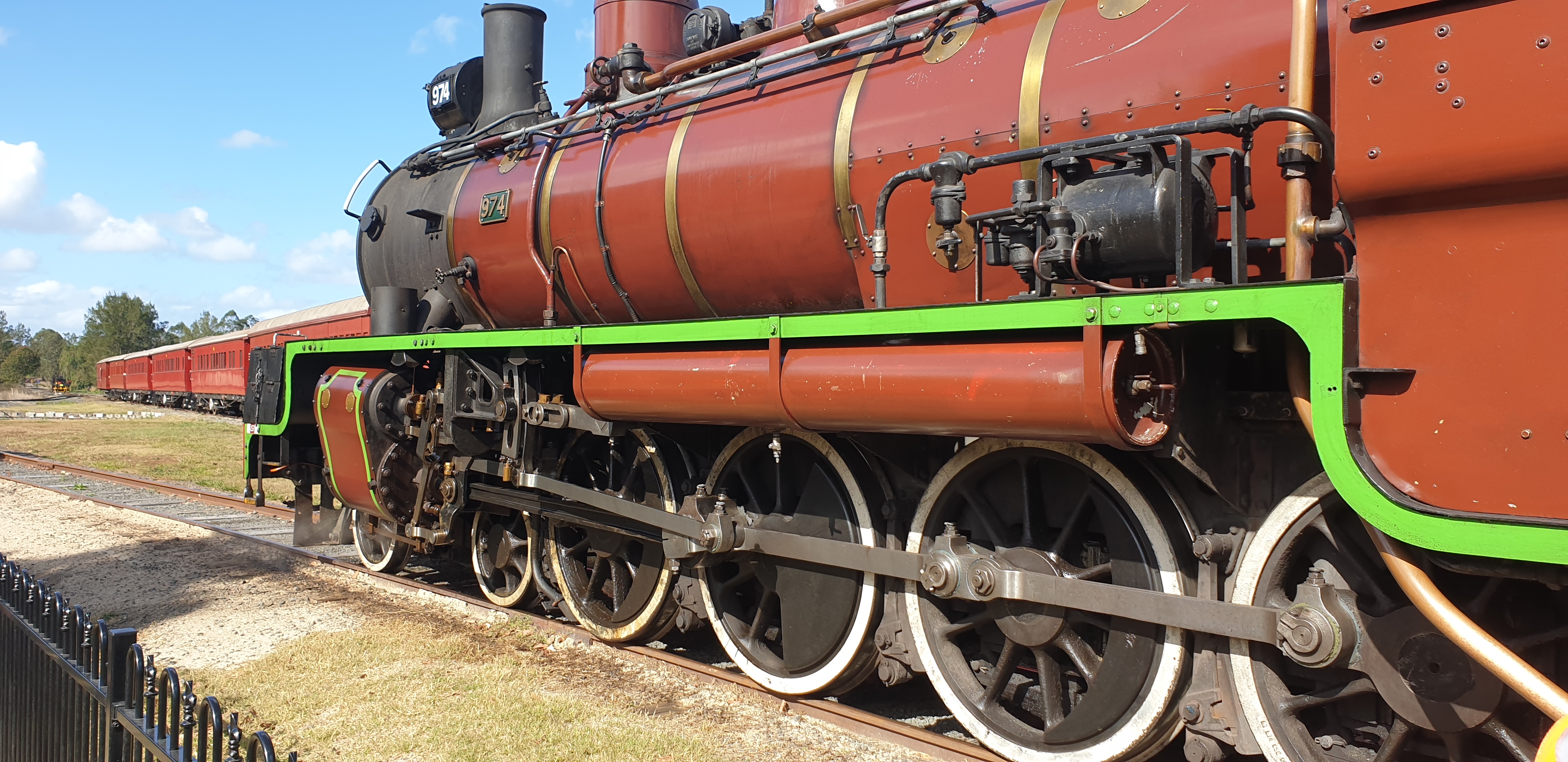
The Class of engine, seen below, is the C17, a superheated upgrade to the C16 it was based on, and first run in 1903. This particular engine was built in 1951, although the first of its type was seen in 1920 and the last of 227 made in 1953. It was the most popular of the steam engines used by Queensland Railways.
The C designation meant it had four driving axels and 17 was the diameter of the cylinder, 17 inches. It is also known as a 4-8-0 steam locomotive and nicknamed one of the “Brown Bombers” because of its livery, brown with green and red trimming.
Also, this engine was built in Maryborough, not far from Gympie by Walkers Limited, one of 138.
This photo was taken as the train returned from Amamoor, a trip that takes up to an hour.
The locomotive is detached from the carriages, then driven to the huge turntable to turn around for the return journey to Amamoor.
This is the locomotive heading down to the water station, and then taking on water. After that, it will switch lines, and reverse back to reconnect the carriages for the trip to Amamoor.
The carriages are completely restored and are extremely comfortable. It brings back, for me, many memories of riding in older trains in Melbourne when I was a child.
The trains, then, were called Red Rattlers.
This is the locomotive climbing one of the hilly parts of the line before crossing over the Mary River on a trestle bridge.
This is the engine at Amamoor near the picnic area where young children and excited parents and grandparents can get on the locomotive itself and look inside where the driver sits.
And, no, I didn’t volunteer to shovel coal.
This particular locomotive spent most of its working life between Townsville and Mount Isa and was based in Cloncurry, Charters Towers, and Townsville, before being sent, at the end of its useful days in the late 1960s, to the Ipswich Railway Workshops.
I have a passion for visiting transport museums, to see old trains, planes, buses, cars, even ships if it’s possible.
This has led to taking a number of voyages on the TSS Earnslaw in Queenstown, New Zealand.
Many, many, many years ago on Puffing Billy, a steam train in the Dandenongs, Victoria, Australia.
The steam train in Kingston, New Zealand, before it was closed down, but hopefully it will reopen sometime in the future.
The London Transport Museum in London England, which had a lot of buses.
The Workshops Railway Museum in Ipswich, Queensland, where once the many steam engines were built and maintained, and now had only a handful of engines remaining.
However, in the quest for finding and experiencing old transportation methods, we came across the Mary Valley Rattler, which runs out of Gympie, Queensland, Australia.
The ride begins in Gympie at the old Gympie Railway station, and as can be seen below, is one of the relics of the past, and, nothing like the new more modern stations. Thankfully.
If you’re going to have a vintage train, then you have to have a vintage station.
The Class of engine, seen below, is the C17, a superheated upgrade to the C16 it was based on, and first run in 1903. This particular engine was built in 1951, although the first of its type was seen in 1920 and the last of 227 made in 1953. It was the most popular of the steam engines used by Queensland Railways.
The C designation meant it had four driving axels and 17 was the diameter of the cylinder, 17 inches. It is also known as a 4-8-0 steam locomotive and nicknamed one of the “Brown Bombers” because of its livery, brown with green and red trimming.
Also, this engine was built in Maryborough, not far from Gympie by Walkers Limited, one of 138.
This photo was taken as the train returned from Amamoor, a trip that takes up to an hour.
The locomotive is detached from the carriages, then driven to the huge turntable to turn around for the return journey to Amamoor.
This is the locomotive heading down to the water station, and then taking on water. After that, it will switch lines, and reverse back to reconnect the carriages for the trip to Amamoor.
The carriages are completely restored and are extremely comfortable. It brings back, for me, many memories of riding in older trains in Melbourne when I was a child.
The trains, then, were called Red Rattlers.
This is the locomotive climbing one of the hilly parts of the line before crossing over the Mary River on a trestle bridge.
This is the engine at Amamoor near the picnic area where young children and excited parents and grandparents can get on the locomotive itself and look inside where the driver sits.
And, no, I didn’t volunteer to shovel coal.
This particular locomotive spent most of its working life between Townsville and Mount Isa and was based in Cloncurry, Charters Towers, and Townsville, before being sent, at the end of its useful days in the late 1960s, to the Ipswich Railway Workshops.
Started to write a post, get so far, and another theme or idea slips in, and demands to be written first?
I’m on this nostalgia kick, simply because when I turned on the TV to catch up with the latest COVID news, it was on a channel that shows old movies.
In case you don’t realize it, I love old movies, not just those from Hollywood, but also from Britain.
What was on?
An American in Paris.
Well, it had to be one of my favorites, even though I’m not a great fan of Gene Kelly, the sheer majesty of the music more than makes up for the story in between.
Could it be said, then, this was from the golden years of Hollywood? Such bright and cheerful movies such as Singing in the Rain, and An American in Paris, perhaps exemplify the Hollywood musical.
Years before, Fred Astaire and Ginger Rogers were the quintessential musical stars, followed by the likes of Judy Garland and Deanna Durbin, and later Bing Crosby and Frank Sinatra. A couple of musicals, in particular, comes to mind, firstly the Wizard of Oz and then High Society.
Moving forward to more modern times, several stand out in the1960s, My Fair Lady and Sound of Music. By this time theatergoers were dining on the superb talents of Rogers and Hammerstein, and Learner and Lowe. Of the former, musicals such as Carousel, South Pacific, and The King and I were on my list of favorites.
Even later still in the 1970s, there is Funny Girl, and Hello Dolly, which has a connection to the past with its director, none other than, yes, Gene Kelly.
But it seems once the 60s had passed the notion of the Hollywood blockbuster musical had gone, and we were left with clip shows like That’s Entertainment, put together while Gene Kelly and Fred Astaire were still alive. WE still had the film versions of the stage plays, but the lustre had, somehow, gone.
Perhaps it will return, who knows, after all, everything old is usually new again, it just takes time to go full circle.
Started to write a post, get so far, and another theme or idea slips in, and demands to be written first?
I’m on this nostalgia kick, simply because when I turned on the TV to catch up with the latest COVID news, it was on a channel that shows old movies.
In case you don’t realize it, I love old movies, not just those from Hollywood, but also from Britain.
What was on?
An American in Paris.
Well, it had to be one of my favorites, even though I’m not a great fan of Gene Kelly, the sheer majesty of the music more than makes up for the story in between.
Could it be said, then, this was from the golden years of Hollywood? Such bright and cheerful movies such as Singing in the Rain, and An American in Paris, perhaps exemplify the Hollywood musical.
Years before, Fred Astaire and Ginger Rogers were the quintessential musical stars, followed by the likes of Judy Garland and Deanna Durbin, and later Bing Crosby and Frank Sinatra. A couple of musicals, in particular, comes to mind, firstly the Wizard of Oz and then High Society.
Moving forward to more modern times, several stand out in the1960s, My Fair Lady and Sound of Music. By this time theatergoers were dining on the superb talents of Rogers and Hammerstein, and Learner and Lowe. Of the former, musicals such as Carousel, South Pacific, and The King and I were on my list of favorites.
Even later still in the 1970s, there is Funny Girl, and Hello Dolly, which has a connection to the past with its director, none other than, yes, Gene Kelly.
But it seems once the 60s had passed the notion of the Hollywood blockbuster musical had gone, and we were left with clip shows like That’s Entertainment, put together while Gene Kelly and Fred Astaire were still alive. WE still had the film versions of the stage plays, but the lustre had, somehow, gone.
Perhaps it will return, who knows, after all, everything old is usually new again, it just takes time to go full circle.