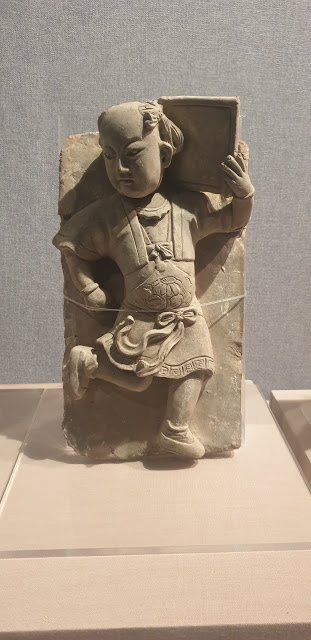
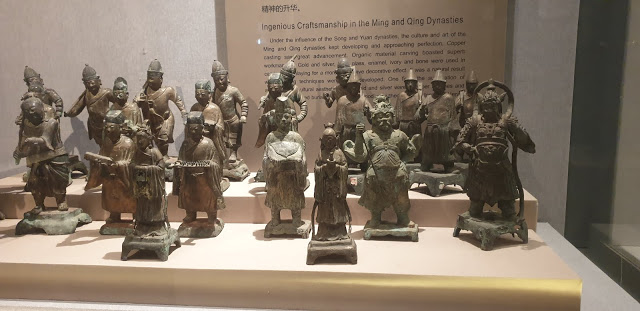
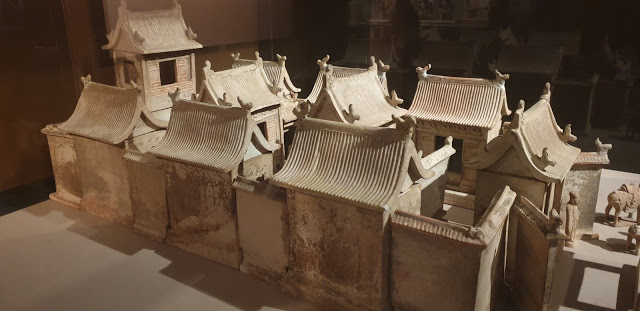
The Henan Museum is one of the oldest museums in China. In June 1927, General Feng Yuxiang proposed that a museum be built, and it was completed the next year. n 1961, along with the move of the provincial capital, Henan Museum moved from Kaifeng to Zhengzhou.
It currently holds about 130,000 individual pieces, more of which are mostly cultural relics, bronze vessels of the Shang and Zhou Dynasties, and pottery and porcelain wares of the various dynasties.
Eventually, we arrive at the museum and get off the bus adjacent to a scooter track and despite the efforts of the guide, there’s no stopping them from nearly running us over.
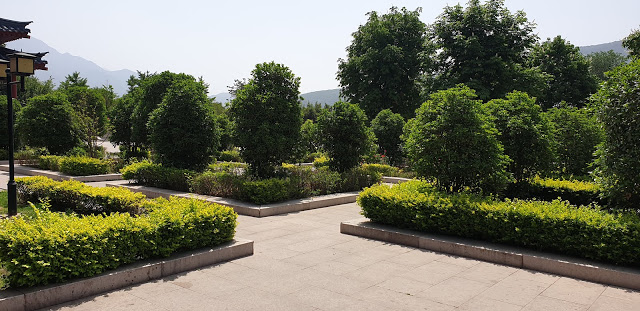
We arrive to find the museum has been moved to a different and somewhat smaller building nearby as the existing, and rather distinctively designed, building is being renovated.
While we are waiting for the tickets to enter, we are given another view of industrial life in that there is nothing that resembles proper health and safety on worksites in this country, and the workers are basically standing on what looks to be a flimsy bamboo ladder with nothing to stop them from falling off.
The museum itself has exhibits dating back a few thousand years and consist of bronze and ceramic items. One of the highlights was a tortoiseshell with reportedly the oldest know writing ever found.
Other than that it was a series of cooking utensils, a table, and ceramic pots, some in very good condition considering their age.
The Henan Museum is one of the oldest museums in China. In June 1927, General Feng Yuxiang proposed that a museum be built, and it was completed the next year. n 1961, along with the move of the provincial capital, Henan Museum moved from Kaifeng to Zhengzhou.
It currently holds about 130,000 individual pieces, more of which are mostly cultural relics, bronze vessels of the Shang and Zhou Dynasties, and pottery and porcelain wares of the various dynasties.
Eventually, we arrive at the museum and get off the bus adjacent to a scooter track and despite the efforts of the guide, there’s no stopping them from nearly running us over.
We arrive to find the museum has been moved to a different and somewhat smaller building nearby as the existing, and rather distinctively designed, building is being renovated.
While we are waiting for the tickets to enter, we are given another view of industrial life in that there is nothing that resembles proper health and safety on worksites in this country, and the workers are basically standing on what looks to be a flimsy bamboo ladder with nothing to stop them from falling off.
The museum itself has exhibits dating back a few thousand years and consist of bronze and ceramic items. One of the highlights was a tortoiseshell with reportedly the oldest know writing ever found.
Other than that it was a series of cooking utensils, a table, and ceramic pots, some in very good condition considering their age.
After leaving the hotel in Zhengzhou, what was once one of the eight ancient capitals of China, we are going to Dengfeng city, and the home of China’s most famous martial art – Shaolin Kung Fu.
The Shaolin Temple nearby is the origin of Chinese Zen Buddhism, and the Songyang Academy, called “the Centre of Heaven and Earth” is located 87 Km from Zhengzhou, or, as we were advised, a 2 hour drive. It will be scenic because we are heading towards the mountains.
As one of the four ancient Song Dynasty Academies, Songyang Academy is one of many schools in the province. It is both on a large-scale, is quite spectacular, and is a comprehensive Wushu training base where students are trained to spread the Shaolin Wushu Kung fu style at home and abroad.
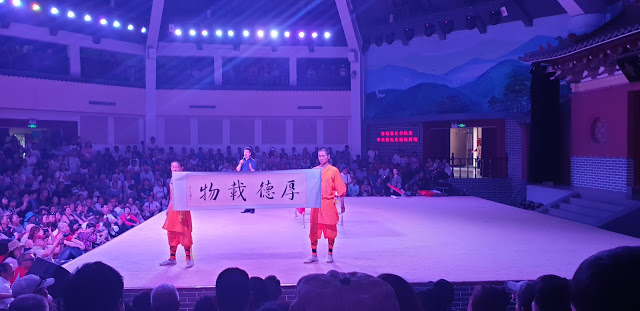
There is a 500 seat demonstration hall where you are able to observe 30 minutes of various martial arts in shows starting on the hour.
Outside there is a specific area that generally has about 600 trainees learning kung fu elements during the day, but can hold 5,000 [ep[;e when outdoor performances are required.
The kung fu school
The thing you notice most about the kung fu school is it’s size and then the number of buses which tells you that it is a popular tourist stop.
And with that size comes long distances between the car park and the venues we need to go to, the first of which is about half a km, and that’s just to get to the ticket plaza.
But, it is pleasantly set out and is quite a large number of shops for both souvenirs and food
We pass by some of the students going through their paces
From there it’s another long, long walk to the show arena, where we’re supposed to see various kung fu elements on display. We watched this for a few minutes, then headed off towards the hall for a more intense demonstration of kung fu, and because there is limited seating we have to start lining at the head of the queue to get a seat.
But…
Everyone else has the same idea and we join the throng which then becomes a ride, and true to the Chinese they start finding ways to push in, even using the imaginary friend somewhere ahead in the queue.
The doors open and then it’s open slather, with the hoards pushing from behind and sliding up the side to get in first. We go with the tide, and manage to get in and find a seat though we were separated from three of our group.
It was an interesting show even though not one word of English was spoken, which from our point of view was a disappointment because we had no idea what was going on.
However…
It wasn’t hard to follow
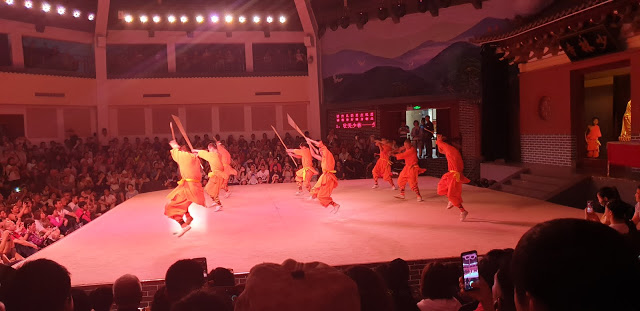
What the performers were doing was relatively self-explanatory, and quite fascinating especially the guy who broke a sword over his head, and the guy who stopped two spears penetrating the neck, both examples of very disciplined men.
Boys gave a demonstration of kung fu moves, and intensity and age increased as this progressed to the end.
Next, we were taken in hand by an instructor in Tai chi or an equivalent, I was not quite sure what it was called, and went through the twelve or maybe more moves that constituted a morning or afternoon exercise session or it could be just for relaxation. I lasted the first session but it was a little difficult to do with my sore limbs and a bad back.
Not that I could remember any of it now other than hands overhead, hands in front, bent knees, and a few gentle kung fu hand moves.
Perhaps when I get home I might seek out someone to show me the moves.
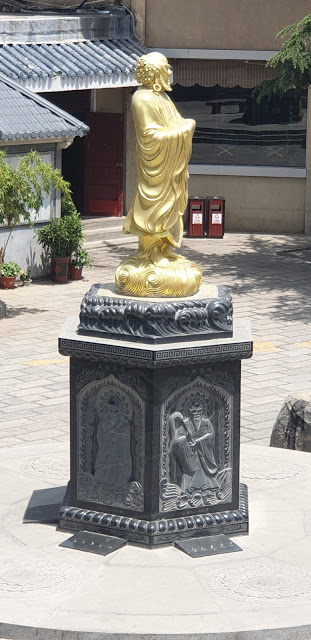
Whilst the others were following their training instructor, I wandered about, finding a large statue
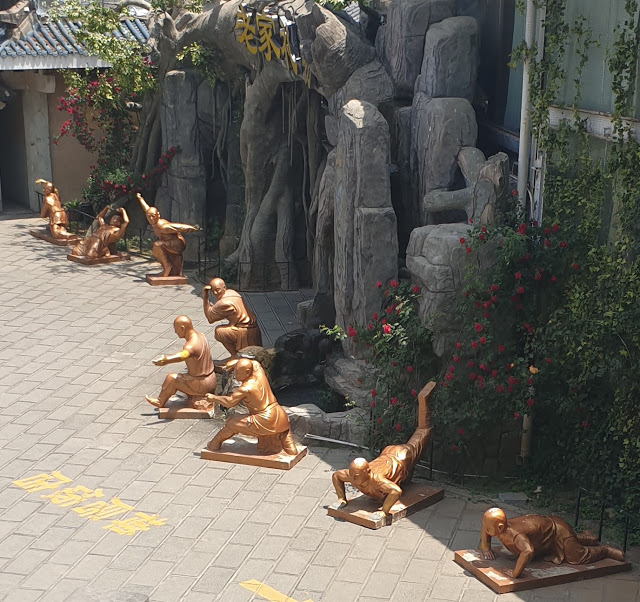
And some smaller statues
Lunch in the Zen Restaurant
After all that exercise it was time to have the lunch purportedly the same food as the king fu masters. It’s in the Zen restaurant, aptly named, and the food when it came, came thick and fast, but some of it wasn’t very nice, meat with bones, tofu, a tasteless soup, but some good dishes like the vegetables and noodles with meat, without bones.
The only problem, nothing to drink except a pot of hot water. No tea, no cold water, and if you wanted a cold drink you had to pay for it. After paying 550 yuan why should we have to pay more for a drink when we have not had to so far.
But no cold water? That was just not on, and when we brought this to that attention of the tour guide she just simply ignored us. We just didn’t get anything.
That basically tainted the whole experience.
After lunch, we had the Shaolin Temple, and the Pogoda Forest to visit.
After leaving the hotel in Zhengzhou, what was once one of the eight ancient capitals of China, we are going to Dengfeng city, and the home of China’s most famous martial art – Shaolin Kung Fu.
The Shaolin Temple nearby is the origin of Chinese Zen Buddhism, and the Songyang Academy, called “the Centre of Heaven and Earth” is located 87 Km from Zhengzhou, or, as we were advised, a 2 hour drive. It will be scenic because we are heading towards the mountains.
As one of the four ancient Song Dynasty Academies, Songyang Academy is one of many schools in the province. It is both on a large-scale, is quite spectacular, and is a comprehensive Wushu training base where students are trained to spread the Shaolin Wushu Kung fu style at home and abroad.
There is a 500 seat demonstration hall where you are able to observe 30 minutes of various martial arts in shows starting on the hour.
Outside there is a specific area that generally has about 600 trainees learning kung fu elements during the day, but can hold 5,000 [ep[;e when outdoor performances are required.
The kung fu school
The thing you notice most about the kung fu school is it’s size and then the number of buses which tells you that it is a popular tourist stop.
And with that size comes long distances between the car park and the venues we need to go to, the first of which is about half a km, and that’s just to get to the ticket plaza.
But, it is pleasantly set out and is quite a large number of shops for both souvenirs and food
We pass by some of the students going through their paces
From there it’s another long, long walk to the show arena, where we’re supposed to see various kung fu elements on display. We watched this for a few minutes, then headed off towards the hall for a more intense demonstration of kung fu, and because there is limited seating we have to start lining at the head of the queue to get a seat.
But…
Everyone else has the same idea and we join the throng which then becomes a ride, and true to the Chinese they start finding ways to push in, even using the imaginary friend somewhere ahead in the queue.
The doors open and then it’s open slather, with the hoards pushing from behind and sliding up the side to get in first. We go with the tide, and manage to get in and find a seat though we were separated from three of our group.
It was an interesting show even though not one word of English was spoken, which from our point of view was a disappointment because we had no idea what was going on.
However…
It wasn’t hard to follow
What the performers were doing was relatively self-explanatory, and quite fascinating especially the guy who broke a sword over his head, and the guy who stopped two spears penetrating the neck, both examples of very disciplined men.
Boys gave a demonstration of kung fu moves, and intensity and age increased as this progressed to the end.
Next, we were taken in hand by an instructor in Tai chi or an equivalent, I was not quite sure what it was called, and went through the twelve or maybe more moves that constituted a morning or afternoon exercise session or it could be just for relaxation. I lasted the first session but it was a little difficult to do with my sore limbs and a bad back.
Not that I could remember any of it now other than hands overhead, hands in front, bent knees, and a few gentle kung fu hand moves.
Perhaps when I get home I might seek out someone to show me the moves.
Whilst the others were following their training instructor, I wandered about, finding a large statue
And some smaller statues
Lunch in the Zen Restaurant
After all that exercise it was time to have the lunch purportedly the same food as the king fu masters. It’s in the Zen restaurant, aptly named, and the food when it came, came thick and fast, but some of it wasn’t very nice, meat with bones, tofu, a tasteless soup, but some good dishes like the vegetables and noodles with meat, without bones.
The only problem, nothing to drink except a pot of hot water. No tea, no cold water, and if you wanted a cold drink you had to pay for it. After paying 550 yuan why should we have to pay more for a drink when we have not had to so far.
But no cold water? That was just not on, and when we brought this to that attention of the tour guide she just simply ignored us. We just didn’t get anything.
That basically tainted the whole experience.
After lunch, we had the Shaolin Temple, and the Pogoda Forest to visit.
The Longjing Pearl Factory is located at: No.2 Zuoan Gate Inner Street, ChongWen District, Beijing 100061 China.
This Pearl Center specializes in both freshwater and seawater pearls, with a reputation backed by the government of China, with a big selection and of the highest quality. There were all kinds of jewelry made of pearls in different colors, shapes, and sizes.
They also had, as an interesting sideline, famous Chinese traditional cosmetics such as pearl cream and pearl powder, reputed to make your skin smoother, tendered and most importantly, younger.
We were advised of all of this well before we arrived at the factory, and of course, one suspected the glowing review, with emphasis on the fact it was a government operation and therefore trustworthy, suggested we should buy, meant the tour guide would receive a commission on each sale.
This is nothing new, it’s the same the world over, so it’s up to the visitor to buy or not to buy.
As soon as you get in the door you are taken to the group’s guide for the tour (and afterward, available for help on making purchases). who gives you a rundown on the different types and colors of pearls. This briefly is,
Pearls come in two main categories: freshwater cultured pearls and saltwater cultured pearls. Various types of pearls are the result of the environment in which they live, and different cultivation techniques used by the pearl farmers.
Freshwater cultured pearls are grown in lakes and rivers, whereas saltwater cultured pearls are grown in bodies of saltwater such as bays. The most commonly used pearls are Freshwater pearls.
Freshwater Pearls come in various pastel shades of white, pink, peach, lavender, plum, purple, and tangerine. South Sea cultured pearls come in shades of lustrous white, often with silver or rose overtones.
Black pearls are known as Tahitian pearls and come most often in shades of black and gray. While a Tahitian pearl has a black body color, it will vary in its overtones, which most often will be green or pink.
Then there’s a demonstration, where one of the tour group is selected to pick an oyster out of the tank, and then there’s the guessing game as to how many pearls are in the shell, with the winner getting a pearl.
Guesses ranged from 1 to 23 and the answer was 26. Nearest wins, and one for the person who picked the oyster out of the tank. After this demonstration, we move on to the ways we can tell the difference between real and fake pearls.
It seems strange that they would, but we were guaranteed by both the tour guide and the lady delivering the lecture that the pearls we were about to buy were real, so how could we suspect there was anything dodgy about them? Besides, now we could tell real from fake!
We then move onto the showroom floor where there are casements of pearl products, in the form of necklaces, earrings, and any number of variations and uses. And, just to let you know, the prices are very, very expensive, even if they say they have a special.
Perhaps the best products, and those that found favor with many of the women on the tour, was the pearl cremes and powders. These were not expensive, and, as we discovered later, actually worked as described.
The Longjing Pearl Factory is located at: No.2 Zuoan Gate Inner Street, ChongWen District, Beijing 100061 China.
This Pearl Center specializes in both freshwater and seawater pearls, with a reputation backed by the government of China, with a big selection and of the highest quality. There were all kinds of jewelry made of pearls in different colors, shapes, and sizes.
They also had, as an interesting sideline, famous Chinese traditional cosmetics such as pearl cream and pearl powder, reputed to make your skin smoother, tendered and most importantly, younger.
We were advised of all of this well before we arrived at the factory, and of course, one suspected the glowing review, with emphasis on the fact it was a government operation and therefore trustworthy, suggested we should buy, meant the tour guide would receive a commission on each sale.
This is nothing new, it’s the same the world over, so it’s up to the visitor to buy or not to buy.
As soon as you get in the door you are taken to the group’s guide for the tour (and afterward, available for help on making purchases). who gives you a rundown on the different types and colors of pearls. This briefly is,
Pearls come in two main categories: freshwater cultured pearls and saltwater cultured pearls. Various types of pearls are the result of the environment in which they live, and different cultivation techniques used by the pearl farmers.
Freshwater cultured pearls are grown in lakes and rivers, whereas saltwater cultured pearls are grown in bodies of saltwater such as bays. The most commonly used pearls are Freshwater pearls.
Freshwater Pearls come in various pastel shades of white, pink, peach, lavender, plum, purple, and tangerine. South Sea cultured pearls come in shades of lustrous white, often with silver or rose overtones.
Black pearls are known as Tahitian pearls and come most often in shades of black and gray. While a Tahitian pearl has a black body color, it will vary in its overtones, which most often will be green or pink.
Then there’s a demonstration, where one of the tour group is selected to pick an oyster out of the tank, and then there’s the guessing game as to how many pearls are in the shell, with the winner getting a pearl.
Guesses ranged from 1 to 23 and the answer was 26. Nearest wins, and one for the person who picked the oyster out of the tank. After this demonstration, we move on to the ways we can tell the difference between real and fake pearls.
It seems strange that they would, but we were guaranteed by both the tour guide and the lady delivering the lecture that the pearls we were about to buy were real, so how could we suspect there was anything dodgy about them? Besides, now we could tell real from fake!
We then move onto the showroom floor where there are casements of pearl products, in the form of necklaces, earrings, and any number of variations and uses. And, just to let you know, the prices are very, very expensive, even if they say they have a special.
Perhaps the best products, and those that found favor with many of the women on the tour, was the pearl cremes and powders. These were not expensive, and, as we discovered later, actually worked as described.
Instead of making a grand entrance, arriving in style and being greeted by important dignitaries, we are slinking in via an airplane, late at night.
It’s hardly the entrance I’d envisaged. At 9:56 the plane touches down on the runway. Outside the plane, it is dark and gloomy and from what I could see, it had been raining. That could, of course, simply be condensation.
Once on the ground, everyone was frantically gathering together everything from seat pockets and sending pillows and blankets to the floor. A few were turning their mobile phones back on, and checking for a signal, and, perhaps, looking for messages sent to them during the last 12 hours. Or perhaps they were just suffering from mobile phone deprivation.
It took 10 minutes for the plane to arrive at the gate.
That’s when everyone moves into overdrive, unbuckling belts, some before the seatbelt sign goes off, and are first out of their seats and into the overhead lockers. Most are not taking care that their luggage may have moved, but fortunately, no bags fall out onto someone’s head.
The flight had been relatively turbulent free.
When as many people and bags have squeezed into that impossibly small aisle space, we wait for the door to open, and then the privileged few business and first-class passengers to depart before we can begin to leave.
As we are somewhere near the middle of the plane, our wait will not be as long as it usually is. This time we avoided being at the back of the plane. Perhaps that privilege awaits us on the return trip.
Once off the plane, it is a matter of following the signs, some of which are not as clear as they could be. It’s why it took another 30 odd minutes to get through immigration, but that was not necessarily without a few hiccups along the way. We got sidetracked at the fingerprint machines, which seemed to have a problem if your fingers were not straight, not in the center of the glass, and then if it was generally cranky, which ours were, continue to tell you to try again, and again, and again, and again…That took 10 to 15 minutes before we joined an incredibly long queue of other arrivals,
A glance at the time, and suddenly it’s nearly an hour from the moment we left the plane.
And…
That’s when we got to the immigration officer, and it became apparent we were going to have to do the fingerprints yet again. Fortunately this time, it didn’t take as long. Once that done, we collected our bags, cleared customs by putting our bags through a huge x-ray machine, and it was off to find our tour guide.
We found several tour guides with their trip-a-deal flags waiting for us to come out of the arrivals hall. It wasn’t a difficult process in the end. We were in the blue group. Other people we had met on the plane were in the red group or the yellow group. The tour guide found, or as it turned out she found us, it was simply a matter of waiting for the rest of the group, of which there were eventually 28.Gathered together we were told we would be taking the bags to one place and then ourselves to the bus in another. A glance in the direction of the bus park, there were a lot of busses.
Here’s a thought, imagine being told your bus is the white one with blue writing on the side.
Yes, yours is, and 25 others because all of the tourist coaches are the same. An early reminder, so that you do not get lost, or, God forbid, get on the wrong bus, for the three days in Beijing, is to get the last five numbers of the bus registration plate and commit them to memory. It’s important. Failing that, the guide’s name is in the front passenger window.
Also, don’t be alarmed if your baggage goes in one direction, and you go in another. In a rather peculiar set up the bags are taken to the hotel by what the guide called the baggage porter. It is an opportunity to see how baggage handlers treat your luggage; much better than the airlines it appears.
That said, if you’re staying at the Beijing Friendship Hotel, be prepared for a long drive from the airport. It took us nearly an hour, and bear in mind that it was very late on a Sunday night. Climbing out of the bus after what seemed a convoluted drive through a park with buildings, we arrive at the building that will be our hotel for the next three days. From the outside, it looks quite good, and once inside the foyer, that first impression is good. Lots of space, marble, and glass. If you are not already exhausted by the time you arrive, the next task is to get your room key, find your bags, get to your room, and try to get to be ready the next morning at a reasonable hour.
Sorry, that boat has sailed. We were lucky, we were told, that our plane arrived on time, and we still arrived at the hotel at 12:52. Imagine if the incoming plane is late.
This was taken the following morning. It didn’t look half as bland late at night.
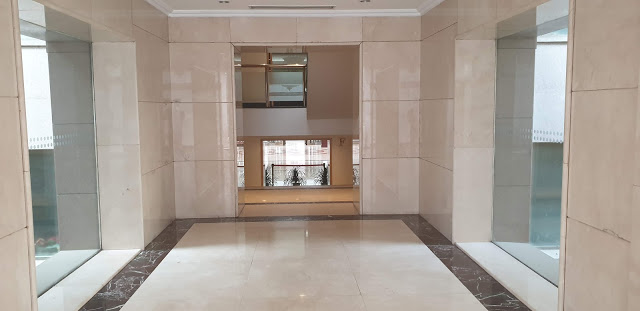
This is the back entrance to Building No 4 but is quite representative of the whole foyer, made completely of marble and glass. It all looked very impressive under the artificial lights, but not so much in the cold hard light of early morning.
This the foyer of the floor our room was on. Marble with interesting carpet designs. Those first impressions of it being a plush hotel were slowly dissipating as we got nearer and nearer to the room. From the elevator, it was a long, long walk.
So…
Did I tell you about the bathroom in our room? The shower and the toilet both share the same space with no divide and the shower curtain doesn’t reach to the floor. Water pressure is phenomenal. Having a shower floods the whole shower plus toilet area so when you go to the toilet you’re basically underwater. Don’t leave your book or magazine on the floor or it will end up a watery mess. And the water pressure is so hard that it could cut you in half. Only a small turn of the tap is required to get that tingling sensation going. It’s after 1:30 before we finally get to sleep.
Instead of making a grand entrance, arriving in style and being greeted by important dignitaries, we are slinking in via an airplane, late at night.
It’s hardly the entrance I’d envisaged. At 9:56 the plane touches down on the runway. Outside the plane, it is dark and gloomy and from what I could see, it had been raining. That could, of course, simply be condensation.
Once on the ground, everyone was frantically gathering together everything from seat pockets and sending pillows and blankets to the floor. A few were turning their mobile phones back on, and checking for a signal, and, perhaps, looking for messages sent to them during the last 12 hours. Or perhaps they were just suffering from mobile phone deprivation.
It took 10 minutes for the plane to arrive at the gate.
That’s when everyone moves into overdrive, unbuckling belts, some before the seatbelt sign goes off, and are first out of their seats and into the overhead lockers. Most are not taking care that their luggage may have moved, but fortunately, no bags fall out onto someone’s head.
The flight had been relatively turbulent free.
When as many people and bags have squeezed into that impossibly small aisle space, we wait for the door to open, and then the privileged few business and first-class passengers to depart before we can begin to leave.
As we are somewhere near the middle of the plane, our wait will not be as long as it usually is. This time we avoided being at the back of the plane. Perhaps that privilege awaits us on the return trip.
Once off the plane, it is a matter of following the signs, some of which are not as clear as they could be. It’s why it took another 30 odd minutes to get through immigration, but that was not necessarily without a few hiccups along the way. We got sidetracked at the fingerprint machines, which seemed to have a problem if your fingers were not straight, not in the center of the glass, and then if it was generally cranky, which ours were, continue to tell you to try again, and again, and again, and again…That took 10 to 15 minutes before we joined an incredibly long queue of other arrivals,
A glance at the time, and suddenly it’s nearly an hour from the moment we left the plane.
And…
That’s when we got to the immigration officer, and it became apparent we were going to have to do the fingerprints yet again. Fortunately this time, it didn’t take as long. Once that done, we collected our bags, cleared customs by putting our bags through a huge x-ray machine, and it was off to find our tour guide.
We found several tour guides with their trip-a-deal flags waiting for us to come out of the arrivals hall. It wasn’t a difficult process in the end. We were in the blue group. Other people we had met on the plane were in the red group or the yellow group. The tour guide found, or as it turned out she found us, it was simply a matter of waiting for the rest of the group, of which there were eventually 28.Gathered together we were told we would be taking the bags to one place and then ourselves to the bus in another. A glance in the direction of the bus park, there were a lot of busses.
Here’s a thought, imagine being told your bus is the white one with blue writing on the side.
Yes, yours is, and 25 others because all of the tourist coaches are the same. An early reminder, so that you do not get lost, or, God forbid, get on the wrong bus, for the three days in Beijing, is to get the last five numbers of the bus registration plate and commit them to memory. It’s important. Failing that, the guide’s name is in the front passenger window.
Also, don’t be alarmed if your baggage goes in one direction, and you go in another. In a rather peculiar set up the bags are taken to the hotel by what the guide called the baggage porter. It is an opportunity to see how baggage handlers treat your luggage; much better than the airlines it appears.
That said, if you’re staying at the Beijing Friendship Hotel, be prepared for a long drive from the airport. It took us nearly an hour, and bear in mind that it was very late on a Sunday night. Climbing out of the bus after what seemed a convoluted drive through a park with buildings, we arrive at the building that will be our hotel for the next three days. From the outside, it looks quite good, and once inside the foyer, that first impression is good. Lots of space, marble, and glass. If you are not already exhausted by the time you arrive, the next task is to get your room key, find your bags, get to your room, and try to get to be ready the next morning at a reasonable hour.
Sorry, that boat has sailed. We were lucky, we were told, that our plane arrived on time, and we still arrived at the hotel at 12:52. Imagine if the incoming plane is late.
This was taken the following morning. It didn’t look half as bland late at night.
This is the back entrance to Building No 4 but is quite representative of the whole foyer, made completely of marble and glass. It all looked very impressive under the artificial lights, but not so much in the cold hard light of early morning.
This the foyer of the floor our room was on. Marble with interesting carpet designs. Those first impressions of it being a plush hotel were slowly dissipating as we got nearer and nearer to the room. From the elevator, it was a long, long walk.
So…
Did I tell you about the bathroom in our room? The shower and the toilet both share the same space with no divide and the shower curtain doesn’t reach to the floor. Water pressure is phenomenal. Having a shower floods the whole shower plus toilet area so when you go to the toilet you’re basically underwater. Don’t leave your book or magazine on the floor or it will end up a watery mess. And the water pressure is so hard that it could cut you in half. Only a small turn of the tap is required to get that tingling sensation going. It’s after 1:30 before we finally get to sleep.
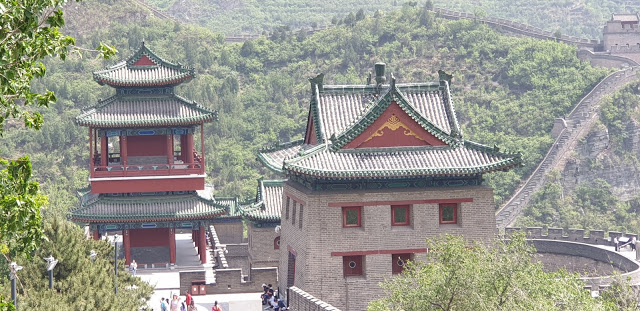
This is in a very scenic area and on the first impression; it is absolutely stunning in concept and in viewing.
As for the idea of walking on it, well, that first view of the mountain climb when getting off the bus, my first question was where the elevator is? Sorry, there is none. It’s walk on up or stay down the bottom.
Walk it is. As far as you feel you are able. There are quite a few who don’t make it to the top. I didn’t. I only made it to the point where the steps narrowed.
But as for the logistics, there’s the gradual incline to the starting point, and what will be the end meeting place. From there, it’s a few steps up to the guard station no 7, and a few more to get up to the start of the main climb. The top of the wall is guard station no 12.
Ok, those first few steps are a good indication of what it’s was going to be like and it’s more the awkwardness of the uneven heights of the steps that’s the killer, some as high as about 15 inches. This photo paints an illusion, that it’s easy. It’s not.
If you make it to the first stage, then it augers well you will get about 100 steps before you both start feeling it in your legs, particularly the knees, and then suffering from the height if you have a problem with heights as the air is thinner. And if you have a thing with heights, never look down.
This was from where we stopped, about a third of the way up. The one below, from almost at the bottom. One we’re looking almost down on the buildings, the other, on the same level.
It requires rest before you come down, and that’s when you start to feel it in the knees, our tour guide called it jelly legs, but it’s more in the knees down. Descending should be slow, and it can be more difficult negotiating the odd height steps, and particularly those high ones. You definitely need to hang onto the rail, even try going backward.
And, no, that rail hasn’t been there as long as the wall.
While you are waiting for the guide to return to the meeting place at the appointed time, there should be time to have some jasmine tea. Highly refreshing after the climb.
This is in a very scenic area and on the first impression; it is absolutely stunning in concept and in viewing.
As for the idea of walking on it, well, that first view of the mountain climb when getting off the bus, my first question was where the elevator is? Sorry, there is none. It’s walk on up or stay down the bottom.
Walk it is. As far as you feel you are able. There are quite a few who don’t make it to the top. I didn’t. I only made it to the point where the steps narrowed.
But as for the logistics, there’s the gradual incline to the starting point, and what will be the end meeting place. From there, it’s a few steps up to the guard station no 7, and a few more to get up to the start of the main climb. The top of the wall is guard station no 12.
Ok, those first few steps are a good indication of what it’s was going to be like and it’s more the awkwardness of the uneven heights of the steps that’s the killer, some as high as about 15 inches. This photo paints an illusion, that it’s easy. It’s not.
If you make it to the first stage, then it augers well you will get about 100 steps before you both start feeling it in your legs, particularly the knees, and then suffering from the height if you have a problem with heights as the air is thinner. And if you have a thing with heights, never look down.
This was from where we stopped, about a third of the way up. The one below, from almost at the bottom. One we’re looking almost down on the buildings, the other, on the same level.
It requires rest before you come down, and that’s when you start to feel it in the knees, our tour guide called it jelly legs, but it’s more in the knees down. Descending should be slow, and it can be more difficult negotiating the odd height steps, and particularly those high ones. You definitely need to hang onto the rail, even try going backward.
And, no, that rail hasn’t been there as long as the wall.
While you are waiting for the guide to return to the meeting place at the appointed time, there should be time to have some jasmine tea. Highly refreshing after the climb.